Usefulness of Serum Biomarkers in Predicting Anastomotic Leakage After Gastrectomy
by
 , ,
, ,
Diego Ramos
1,2,* ,
,
Enrique Gallego-Colón
2,3 ,
,
Javier Mínguez
4,
Ignacio Bodega
1,2,
Pablo Priego
5 and
Francisca García-Moreno
6 1
General and Gastrointestinal Surgery Department, Hospital Central de la Defensa “Gómez Ulla” CSVE, 28047 Madrid, Spain
2
Department of Medicine, Escuela Militar de Sanidad, 28047 Madrid, Spain
3
Hospital Universitario de Getafe, 28905 Getafe, Spain
4
General and Gastrointestinal Surgery Department, Hospital Universitario Príncipe de Asturias, 28805 Alcalá de Henares, Spain
5
General and Gastrointestinal Surgery Department, Hospital Universitario La Paz, 28046 Madrid, Spain
6
Biomedical Research Group on Biomaterials and Wound Healing (Ciber-BBN), Traslational Research and Innovation in General and Digestive Surgery (Idipaz), 28046 Madrid, Spain
*
Author to whom correspondence should be addressed.
Cancers 2025, 17(1), 125; https://doi.org/10.3390/cancers17010125
Submission received: 25 November 2024
/
Revised: 24 December 2024
/
Accepted: 31 December 2024
/
Published: 3 January 2025
(This article belongs to the Special Issue Advances in Abdominal Surgical Oncology and Intraperitoneal Therapies)
Simple Summary
Anastomotic leakage after gastrectomy is a relatively common, but potentially lethal complication, whose morbi-mortality is greatly decreased with a prompt diagnosis and treatment. The aim of this study was to assess the performance of several serum biomarkers in reliably predicting the existence of anastomotic leakage. We confirmed the discrimination capability of C-reactive protein, procalcitonin, the neutrophil-to-lymphocyte ratio, the platelet-to-lymphocyte ratio, and fibrinogen in identifying anastomotic leakage within the first postoperative week. The use of adequate biomarkers has significant implications for optimizing clinical management strategies in these patients and may facilitate the development of future enhanced-recovery programs.
Abstract
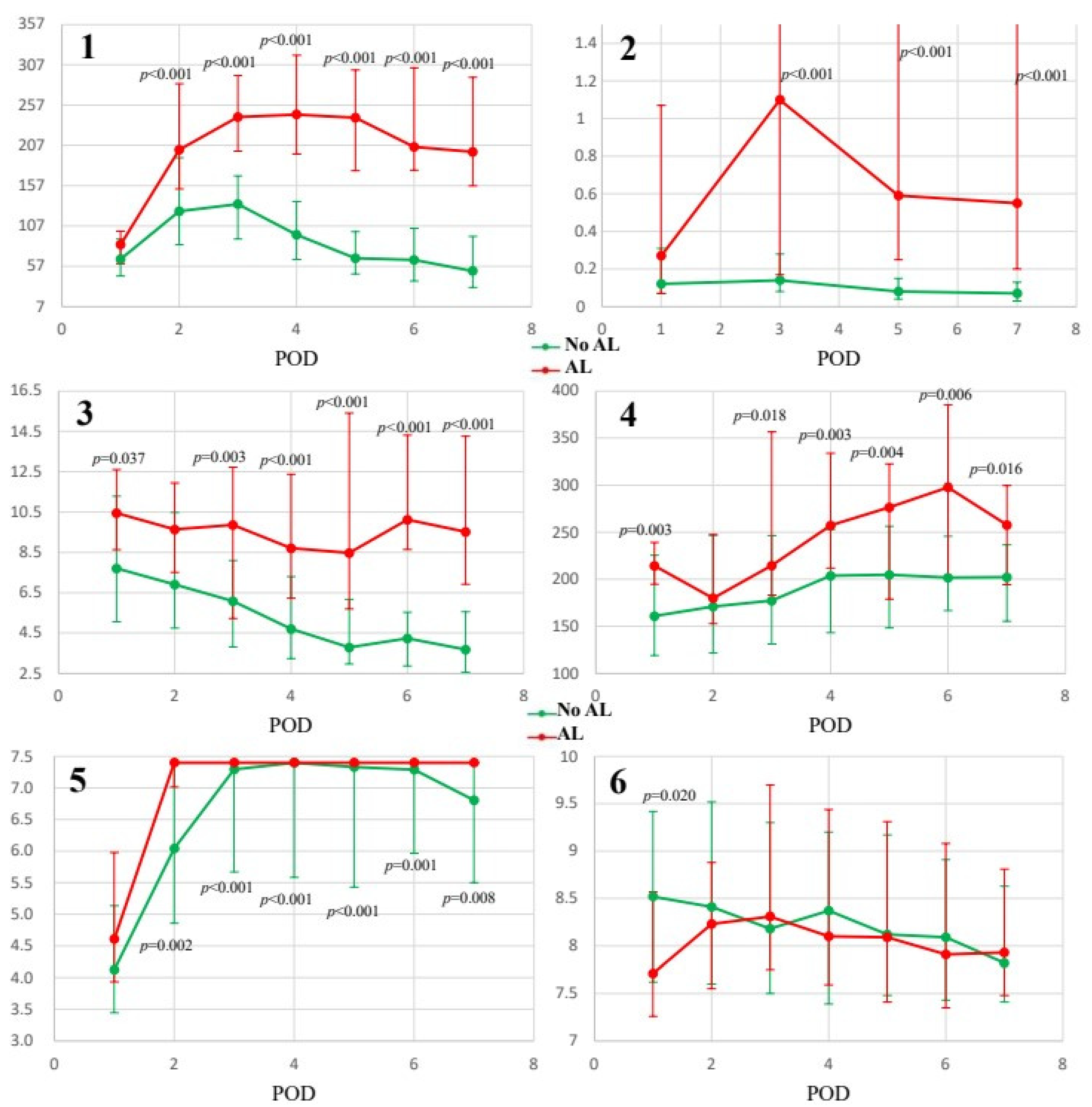
Background/Objectives: Anastomotic leakage (AL) is one of the most concerning complications following gastrectomy. The aim of this study was to assess and compare the predictive accuracy of C-reactive protein (CRP), procalcitonin (PCT), the neutrophil-to-lymphocyte ratio (NLR), the platelet-to-lymphocyte ratio (PLR), fibrinogen, and the mean platelet volume (MPV) in the early diagnosis of post-gastrectomy AL. Methods: A prospective bicentric observational study was conducted including all patients undergoing elective gastrectomy between August 2018 and December 2022. The performance of the selected biomarkers in predicting the existence of AL within the first 7 postoperative days (PODs) was assessed. Results: A total of 107 patients were included for analysis. The incidence of AL was 20.56%, and the median day of diagnosis was on POD5 (interquartile range 4–6). CRP, PCT, the NLR, the PLR, and fibrinogen showed significant associations with the presence of AL (from POD2 for CRP and fibrinogen and from POD3 for PCT, NLR, and PLR). CRP demonstrated a superior predictive accuracy on POD4, with a threshold value of 181.4 mg/L (NPV 99%; AUC 0.87, p < 0.001); PCT demonstrated a superior predictive accuracy on POD7, with a threshold value of 0.13 μg/L (NPV 98%; AUC 0.84, p < 0.001); the NLR showed a superior predictive accuracy on POD6, with a threshold ratio of 6.77 (NPV 95%; AUC 0.86, p < 0.001); the PLR achieved a superior predictive accuracy on POD7, with a ratio of 234 (NPV 98%; AUC 0.71; p = 0.002); and fibrinogen demonstrated a superior predictive accuracy on POD5, with a threshold of 7.344 g/L (NPV 98%; AUC 0.74; p = 0.003). In the comparison of predictive accuracy, CPR, PCT, and the NLR were found to be superior to all other biomarkers. Conclusions: CRP, PCT, and the NLR are biomarkers with a sufficient predictive ability to clinically discard the presence of AL within the first postoperative week.