Lymphocyte Function at Baseline Could Be a New Predictor of Tumor Burden following Six Cycles of Radium-223 Therapy in Patients with Metastasized, Castration-Resistant Prostate Cancer
by
 ,
,
Vahé Barsegian
1, 
Daniel Möckel
1,
Sebastian Buehler
1,
Stefan P. Müller
2,†,
Michael C. Kreissl
3 ,
,
Patrick Ostheim
4,
Peter A. Horn
5 and
Monika Lindemann
5,* 1
Institute of Nuclear Medicine, Helios Kliniken, 19055 Schwerin, Germany
2
Department of Nuclear Medicine, University Hospital, 45147 Essen, Germany
3
Division of Nuclear Medicine, Department of Radiology and Nuclear Medicine, Otto von Guericke University, 39106 Magdeburg, Germany
4
Bundeswehr Institute of Radiobiology, 80937 Munich, Germany
5
Institute for Transfusion Medicine, University Hospital, 19055 Essen, Germany
*
Author to whom correspondence should be addressed.
†
Retired.
Cancers 2024, 16(5), 886; https://doi.org/10.3390/cancers16050886
Submission received: 24 January 2024
/
Revised: 9 February 2024
/
Accepted: 20 February 2024
/
Published: 22 February 2024
(This article belongs to the Special Issue Role of Cytokines in Cancer)
Simple Summary
Patients with metastasized, castration-resistant prostate cancer can be treated locally with radioactive radium-223, which usually comprises six cycles. We wanted to know whether this treatment affects immune function. We performed cell culture experiments with white blood cells from the patients and added components of microorganisms. We tested the ability of the cells to proliferate and produce two cytokines (interferon-gamma and interleukin-10) that are important for the balance of the immune system. Our data in 21 patients indicate that the immune cells show impairment in their defense against microorganisms after treatment. As determined by bone scintigraphy, a reduction in tumor burden was observed in 67% of patients. Interestingly, even before treatment, the number of cells producing interleukin-10, an anti-inflammatory cytokine, was an indicator of tumor burden at the end of treatment. Thus, a blood test can help assess whether the treatment is likely to be successful.
Abstract
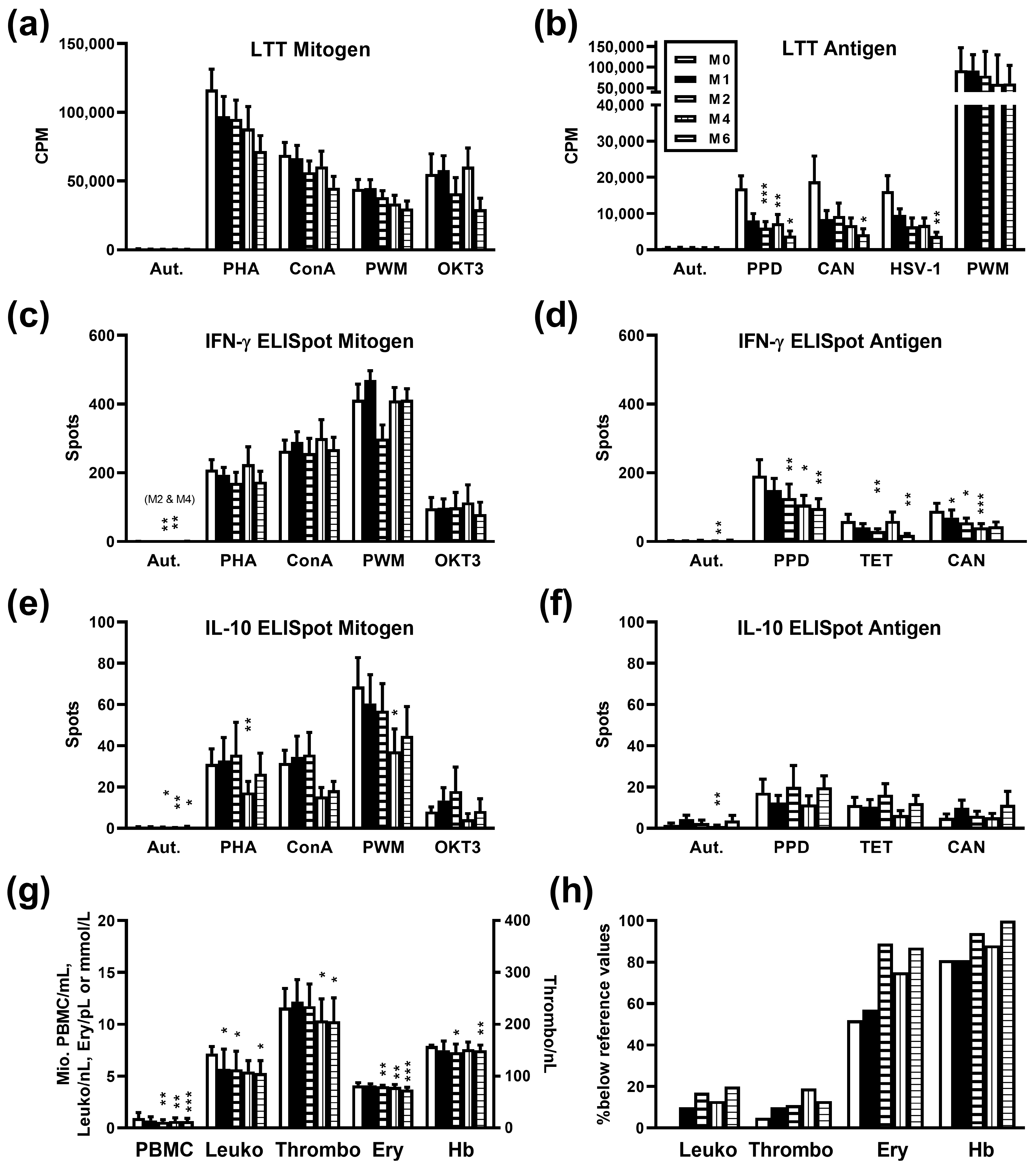
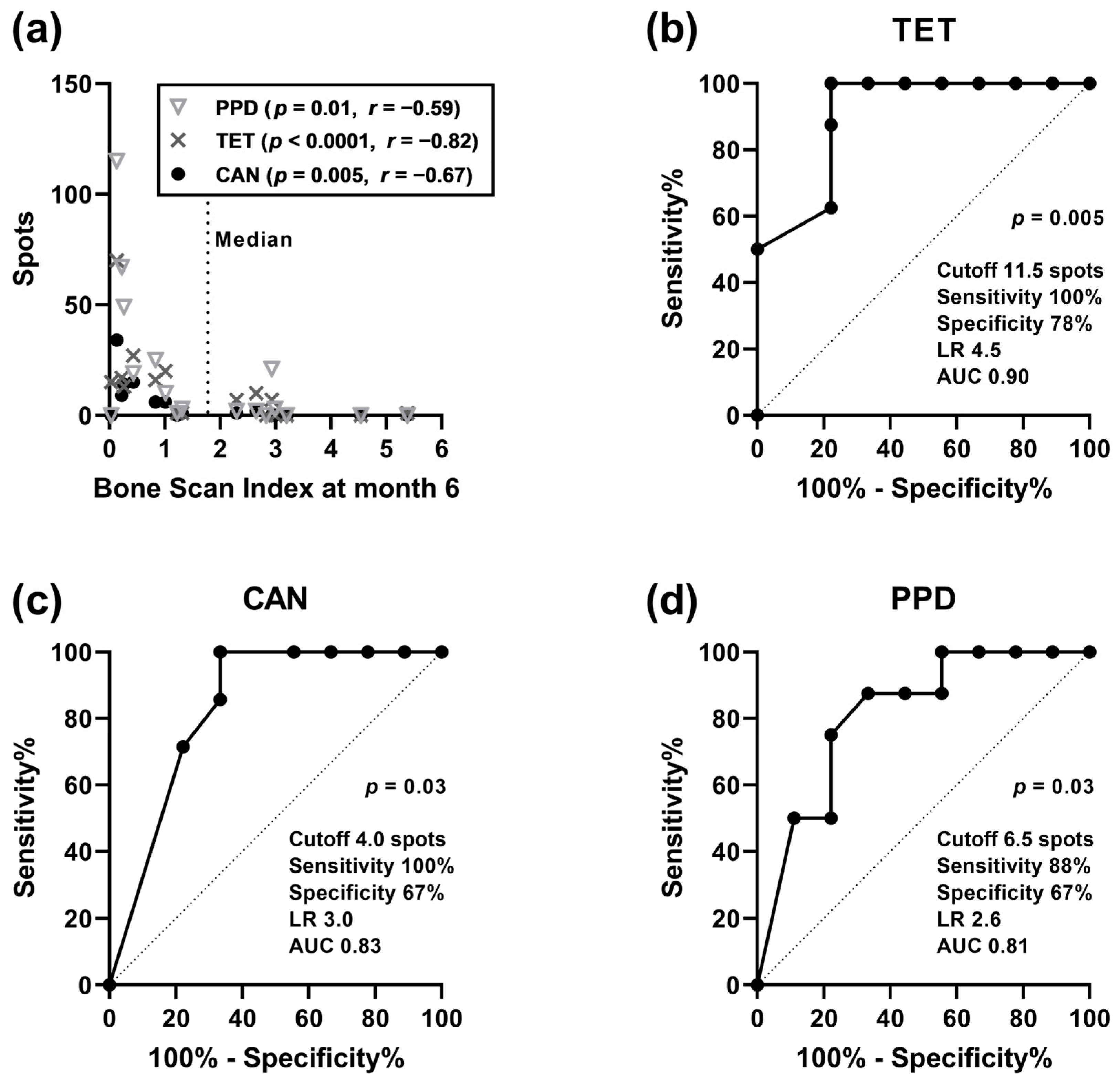
Previous data indicate that one cycle of treatment with radium-223 (223Ra) did not significantly impair lymphocyte function in patients with metastasized, castration-resistant prostate cancer. The aim of the current study was to assess in 21 patients whether six cycles of this therapy had an effect on lymphocyte proliferation and interferon-γ and interleukin (IL)-10 ELISpot results. Lymphocyte proliferation after stimulation with microbial antigens and the production of interferon-γ continuously decreased after six cycles of radionuclide therapy, reaching statistical significance (p < 0.05) at months 1, 2, 4, and/or 6 after therapy. One month after the last cycle of therapy, 67% of patients showed a decrease in tumor burden. The tumor burden correlated negatively with IL-10 secretion at baseline, e.g., after stimulation with tetanus antigen (p < 0.0001, r = −0.82). As determined by receiver operating characteristic (ROC) curve analysis, tetanus-specific IL-10 spots at baseline had the highest predictive value (p = 0.005) for tumor burden at month 6, with an area under the curve (AUC) of 0.90 (sensitivity 100%, specificity 78%). In conclusion, we observed an additive effect of treatment with 223Ra on immune function and found that IL-10 secretion at baseline predicted tumor burden at month 6 after treatment.