Combination, Modulation and Interplay of Modern Radiotherapy with the Tumor Microenvironment and Targeted Therapies in Pancreatic Cancer: Which Candidates to Boost Radiotherapy?
by
 , , ,
, , ,
Sofian Benkhaled
1,2 ,
,
Cedric Peters
3,
Nicolas Jullian
1,
Tatjana Arsenijevic
4,5, 
Julie Navez
6,
Dirk Van Gestel
1,
Luigi Moretti
1,
Jean-Luc Van Laethem
5 and
Christelle Bouchart
1,* 1
Department of Radiation Oncology, Hopital Universitaire de Bruxelles (H.U.B.), Institut Jules Bordet, Université Libre de Bruxelles (ULB), Rue Meylenmeersch 90, 1070 Brussels, Belgium
2
Department of Radiation Oncology, UNIL-CHUV, Rue du Bugnon 46, 1011 Lausanne, Switzerland
3
Department of Radiation Oncology, AZ Turnhout, Rubensstraat 166, 2300 Turnhout, Belgium
4
Laboratory of Experimental Gastroenterology, Université Libre de Bruxelles (ULB), 1070 Brussels, Belgium
5
Department of Gastroenterology, Hepatology and Digestive Oncology, Hopital Universitaire de Bruxelles H.U.B. CUB Hopital Erasme, Université Libre de Bruxelles (ULB), Route de Lennik 808, 1070 Brussels, Belgium
6
Department of Hepato-Biliary-Pancreatic Surgery, Hopital Universitaire de Bruxelles H.U.B. CUB Hopital Erasme, Université Libre de Bruxelles (ULB), 1070 Brussels, Belgium
*
Author to whom correspondence should be addressed.
Cancers 2023, 15(3), 768; https://doi.org/10.3390/cancers15030768
Submission received: 31 December 2022
/
Revised: 20 January 2023
/
Accepted: 22 January 2023
/
Published: 26 January 2023
(This article belongs to the Special Issue Combination Therapies for Pancreatic Cancer: How to Make Comprehensive Progress?)
Simple Summary
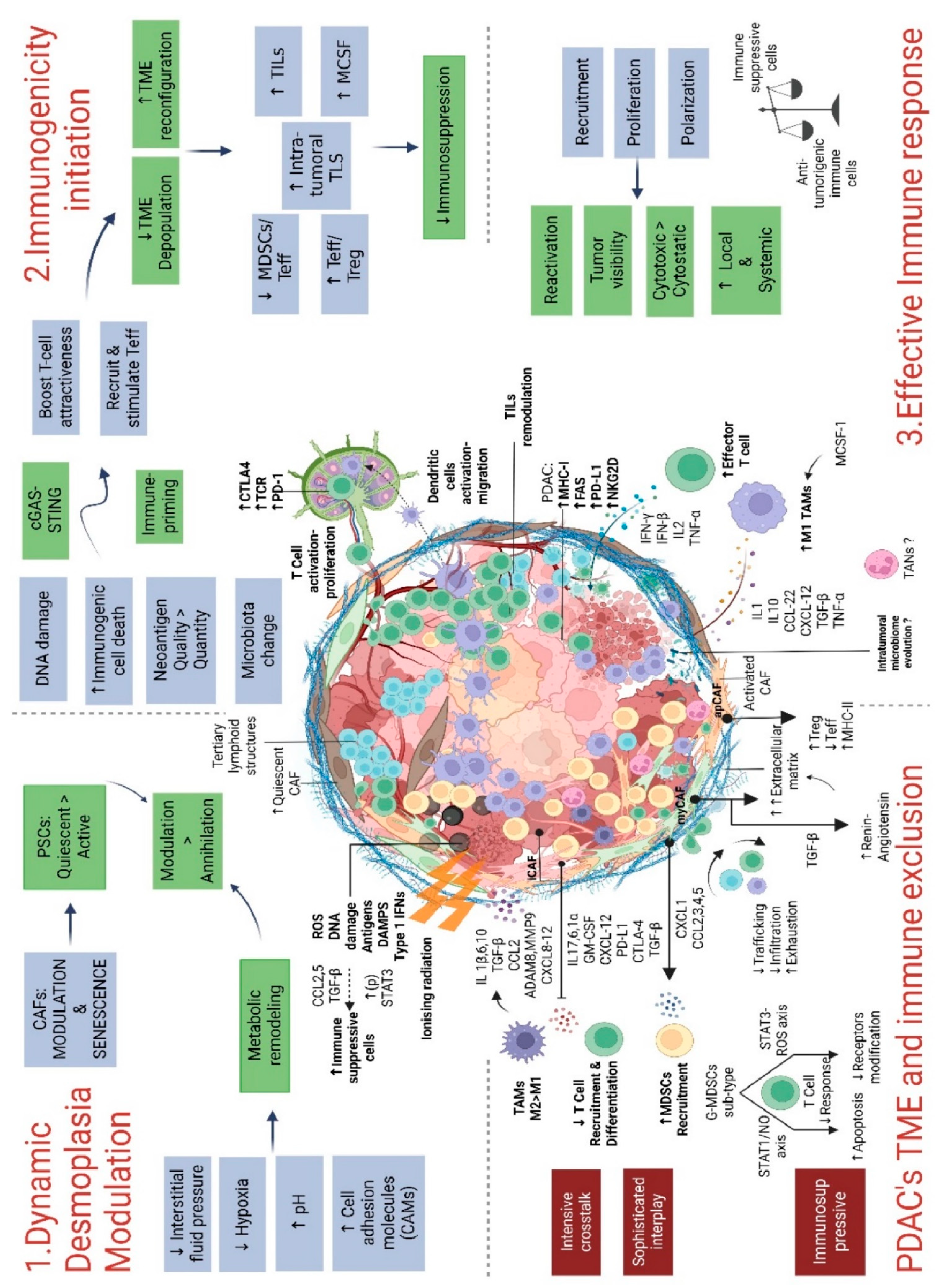
Progress in pancreatic ductal adenocarcinoma cancer (PDAC) has been, and still is, difficult. Compared to other solid tumors, the PDAC’s tumor microenvironment (TME) is unique and complex and prevents systemic agents from effectively penetrating and killing tumor cells. Radiotherapy (RT) has the potential to modulate the TME and therefore enhance the effectiveness of targeted systemic therapies. The success of future clinical trials will depend on our understanding of the complex and dynamic TME and therapy associations, including RT.
Abstract
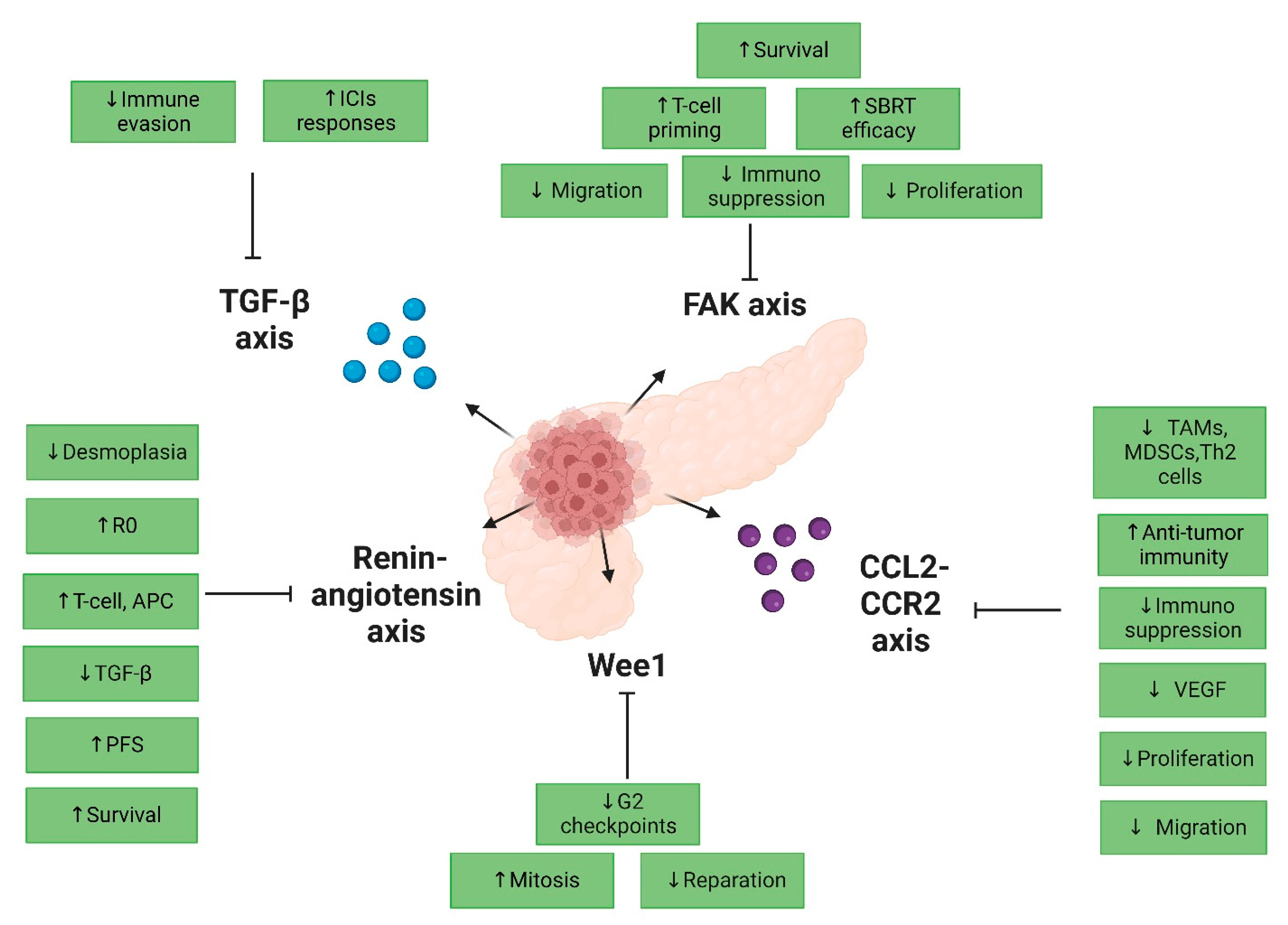
Pancreatic ductal adenocarcinoma cancer (PDAC) is a highly diverse disease with low tumor immunogenicity. PDAC is also one of the deadliest solid tumor and will remain a common cause of cancer death in the future. Treatment options are limited, and tumors frequently develop resistance to current treatment modalities. Since PDAC patients do not respond well to immune checkpoint inhibitors (ICIs), novel methods for overcoming resistance are being explored. Compared to other solid tumors, the PDAC’s tumor microenvironment (TME) is unique and complex and prevents systemic agents from effectively penetrating and killing tumor cells. Radiotherapy (RT) has the potential to modulate the TME (e.g., by exposing tumor-specific antigens, recruiting, and infiltrating immune cells) and, therefore, enhance the effectiveness of targeted systemic therapies. Interestingly, combining ICI with RT and/or chemotherapy has yielded promising preclinical results which were not successful when translated into clinical trials. In this context, current standards of care need to be challenged and transformed with modern treatment techniques and novel therapeutic combinations. One way to reconcile these findings is to abandon the concept that the TME is a well-compartmented population with spatial, temporal, physical, and chemical elements acting independently. This review will focus on the most interesting advancements of RT and describe the main components of the TME and their known modulation after RT in PDAC. Furthermore, we will provide a summary of current clinical data for combinations of RT/targeted therapy (tRT) and give an overview of the most promising future directions.