
Modulation of Epstein-Barr-Virus (EBV)-Associated Cancers by Co-Infections


Viral Immunobiology, Institute of Experimental Immunology, University of Zürich, Winterthurerstrasse 190, 8057 Zürich, Switzerland
Cancers 2023, 15(24), 5739; https://doi.org/10.3390/cancers15245739
Submission received: 16 November 2023
/
Revised: 4 December 2023
/
Accepted: 5 December 2023
/
Published: 7 December 2023
(This article belongs to the Special Issue Epstein–Barr Virus (EBV) Associated Cancers)
Simple Summary
Epstein Barr virus (EBV) is a constant companion of humans with more than 95% of the adult population being persistently infected. Fortunately, this companionship is mostly asymptomatic, but in around 300,000 new patients every year, EBV-associated cancers emerge. These medical cases are mostly caused by environmental or genetic conditions that either increase EBV-associated tumorigenesis or weaken its immune control. In this review, I will discuss co-infections as important environmental risk factors for EBV-associated malignancies and how both EBV infection but also the respective co-infections could be targeted to reduce the associated disease load.
Abstract
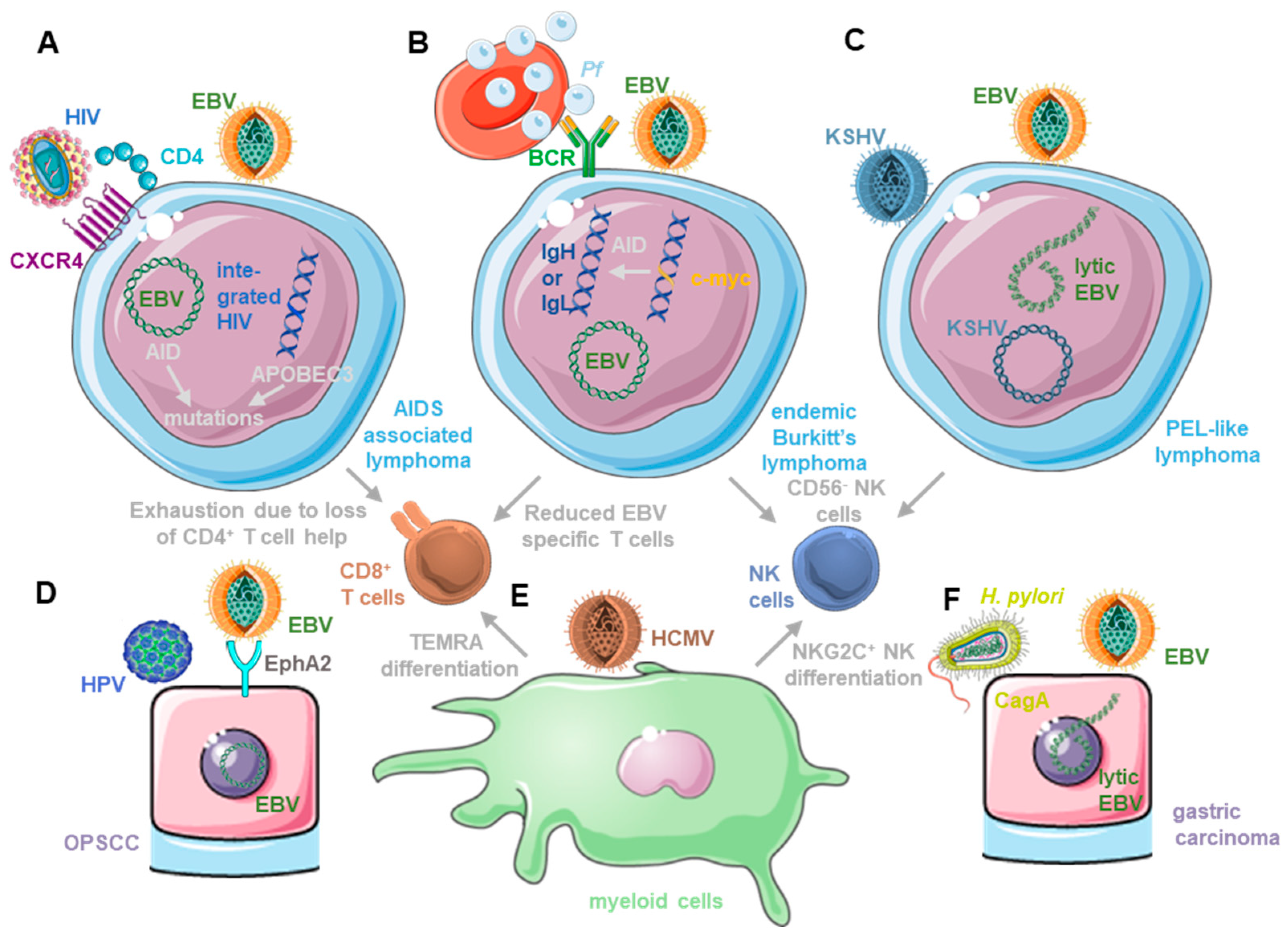
The oncogenic and persistent Epstein Barr virus (EBV) is carried by more than 95% of the human adult population. While asymptomatic in most of these, EBV can cause a wide variety of malignancies of lymphoid or epithelial cell origin. Some of these are also associated with co-infections that either increase EBV-induced tumorigenesis or weaken its immune control. The respective pathogens include Kaposi-sarcoma-associated herpesvirus (KSHV), Plasmodium falciparum and human immunodeficiency virus (HIV). In this review, I will discuss the respective tumor entities and possible mechanisms by which co-infections increase the EBV-associated cancer burden. A better understanding of the underlying mechanisms could allow us to identify crucial features of EBV-associated malignancies and defects in their immune control. These could then be explored to develop therapies against the respective cancers by targeting EBV and/or the respective co-infections with pathogen-specific therapies or vaccinations.