The Current Treatment Trends and Survival Patterns in Melanoma Patients with Positive Sentinel Lymph Node Biopsy (SLNB): A Multicenter Nationwide Study
by
 , , , , , and
Marcin Ziętek
1,2,*,† ,
,
Paweł Teterycz
3,4,†,
Jędrzej Wierzbicki
2,5,
Michał Jankowski
6,
Manuela Las-Jankowska
6,
Wojciech Zegarski
6,
Janusz Piekarski
7,
Dariusz Nejc
7,8,
Kamil Drucis
9,
Bożena Cybulska-Stopa
10,
Wojciech Łobaziewicz
11,
Katarzyna Galwas
12,
Grażyna Kamińska-Winciorek
13,
Marcin Zdzienicki
3,
Tatsiana Sryukina
3,14,
Anna Ziobro
3,14,
Agnieszka Kluz
3,14,
Anna M. Czarnecka
3,15 and
and
Piotr Rutkowski
3
1
Department of Oncology, Wroclaw Medical University, 50-367 Wroclaw, Poland
2
Department of Surgical Oncology, Lower Silesian Oncology, Pulmonology and Hematology Center, 53-413 Wroclaw, Poland
3
Department of Soft Tissue/Bone Sarcoma and Melanoma, Maria Sklodowska-Curie National Research Institute of Oncology, 02-781 Warsaw, Poland
4
Department of Computational Oncology, Maria Sklodowska-Curie National Research Institute of Oncology, 02-781 Warsaw, Poland
5
Laboratory of Immunopathology, Department of Experimental Therapy, Hirszfeld Institute of Immunology & Experimental Therapy, Polish Academy of Sciences, 53-114 Wroclaw, Poland
6
Chair of Surgical Oncology, Collegium Medicum Nicolaus Copernicus University, Oncology Center—Prof Franciszek Łukaszczyk Memorial Hospital, 85-796 Bydgoszcz, Poland
7
Department of Surgical Oncology, Medical University of Lodz, 90-419 Lodz, Poland
8
Nicolaus Copernicus Multidisciplinary Center for Oncology and Traumatology, 93-513 Lodz, Poland
9
Department of Surgical Oncology, Gdansk Medical University, 80-210 Gdansk, Poland
10
Department of Clinical Oncology, Maria Sklodowska-Curie National Research Institute of Oncology, Cracow Branch, 31-115 Cracow, Poland
11
Department of Surgical Oncology, Maria Sklodowska-Curie National Research Institute of Oncology, Cracow Branch, 31-115 Cracow, Poland
12
2nd Department of Radiotherapy and Chemotherapy, Maria Sklodowska-Curie National Research Institute of Oncology, Gliwice Branch, 44-102 Gliwice, Poland
13
Department of Bone Marrow Transplantation and Onco-Hematology, Skin Cancer and Melanoma Team, Maria Sklodowska-Curie National Research Institute of Oncology, Gliwice Branch, 44-102 Gliwice, Poland
14
Faculty of Medicine, Medical University of Warsaw, 02-091 Warsaw, Poland
15
Department of Experimental Pharmacology, Mossakowski Medical Research Centers, Polish Academy of Sciences, 02-106 Warsaw, Poland
*
Author to whom correspondence should be addressed.
†
These authors contributed equally to this work.
Cancers 2023, 15(10), 2667; https://doi.org/10.3390/cancers15102667
Submission received: 10 April 2023
/
Revised: 25 April 2023
/
Accepted: 8 May 2023
/
Published: 9 May 2023
(This article belongs to the Section Cancer Therapy)
Simple Summary
In this study, the treatment trends and survival among 557 patients with sentinel lymph node biopsy (SLNB)-positive melanomas were analyzed. We have demonstrated the increasing role of the adjuvant systemic treatment and the non-proportional character in the RFS improvement during and after the adjuvant. The completion lymph node dissection (CLND) has, for years, been the standard of care for patients with clinically occult node-positive melanoma, although recently published multicenter randomized studies indicate a similar survival benefit for active surveillance in the groups where the multiple adjuvant systemic therapies have been implemented in patients after surgical resection of sentinel node metastases and in patients qualified for systemic adjuvant therapy without CLND. The limitation of our study was non-complete pathological reports outside reference oncological centers, especially in terms of the subtype of primary melanoma and the maximal size of the metastatic focus in the sentinel lymph node. Treatment of SLNB-positive melanoma patients is constantly evolving, and the role of surgery is currently rather limited. Whether CLND has been performed or not, in a group of SLNB-positive patients, adjuvant systemic treatment should be offered to all eligible patients.
Abstract
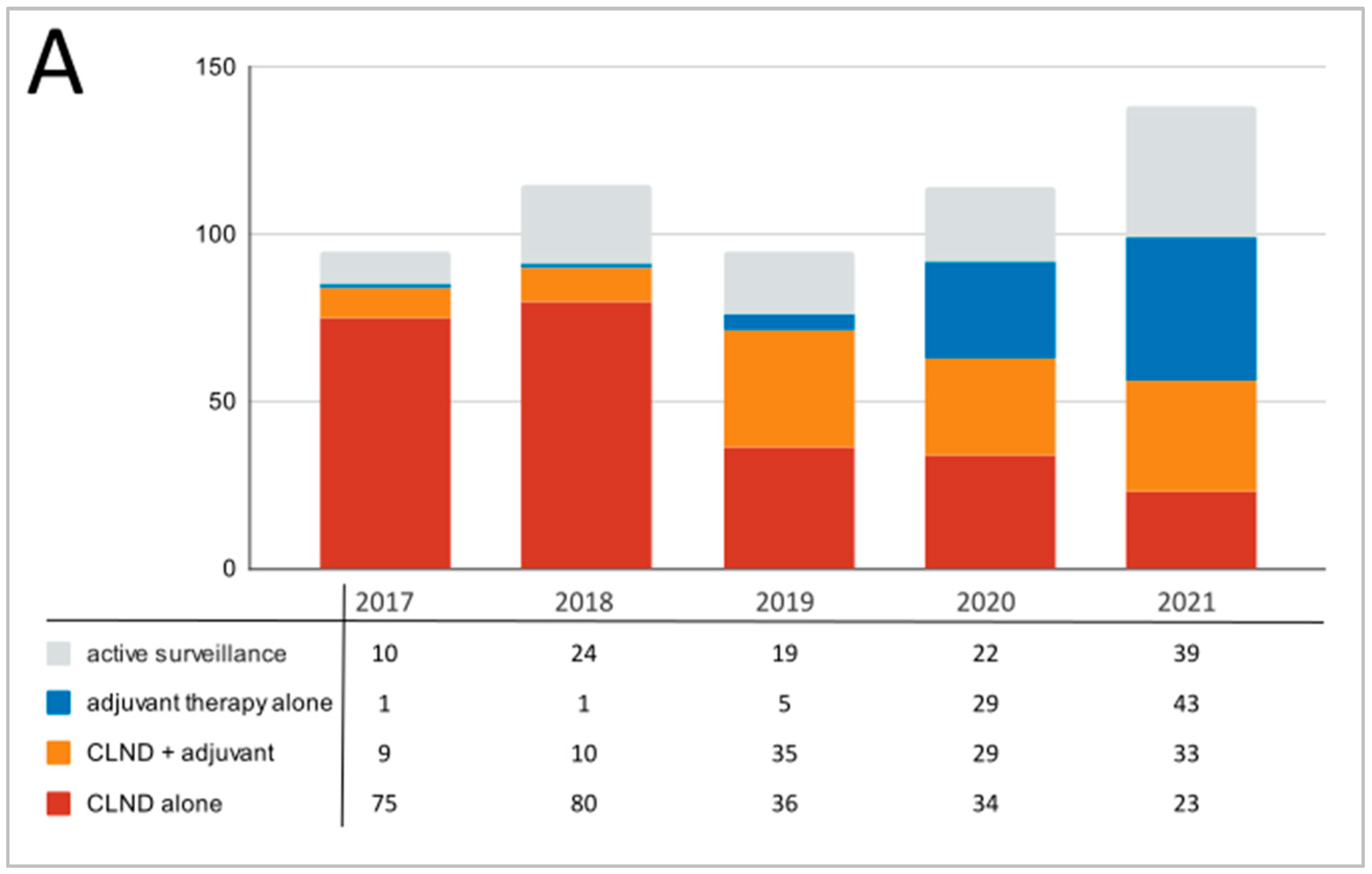
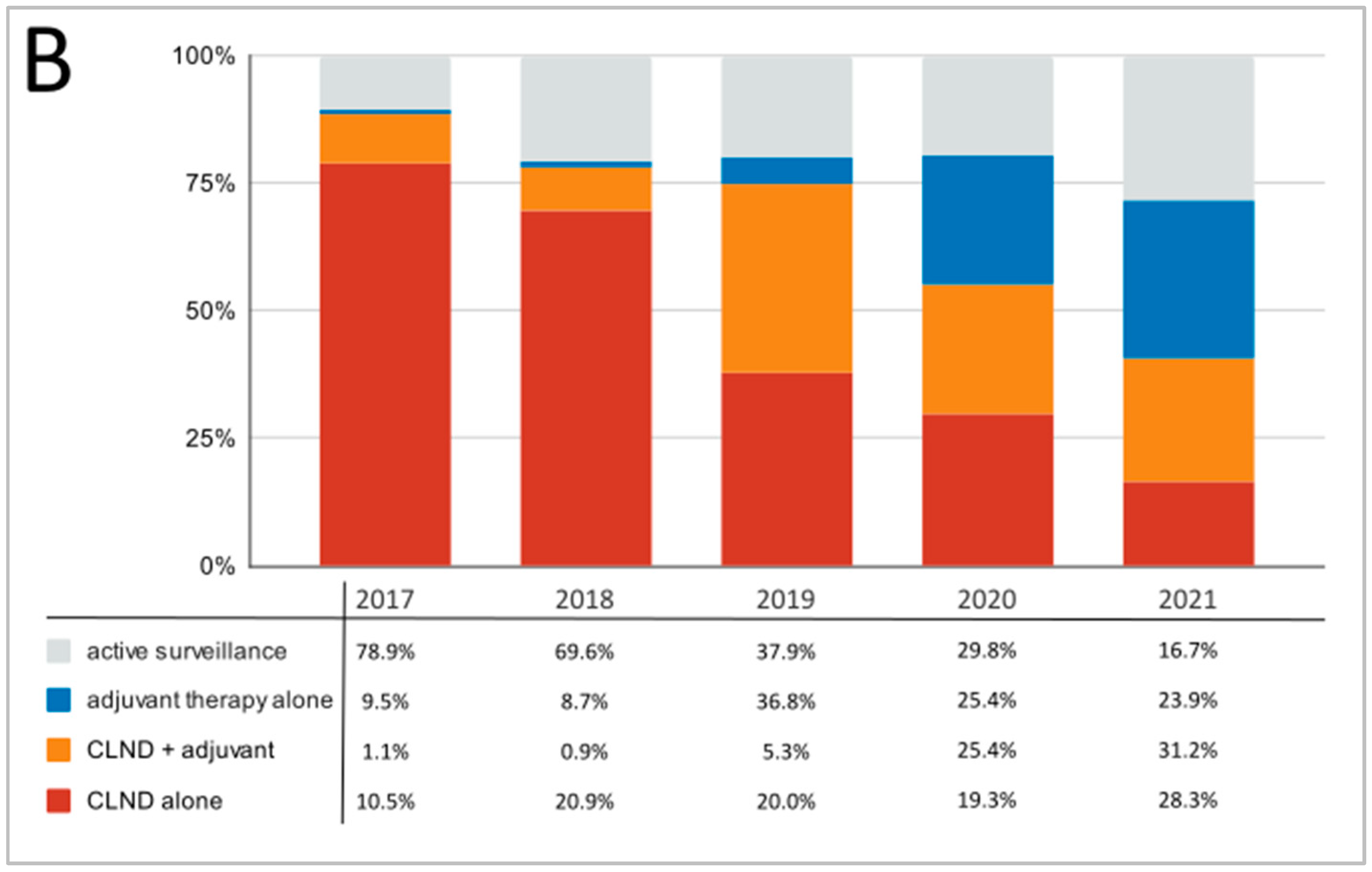
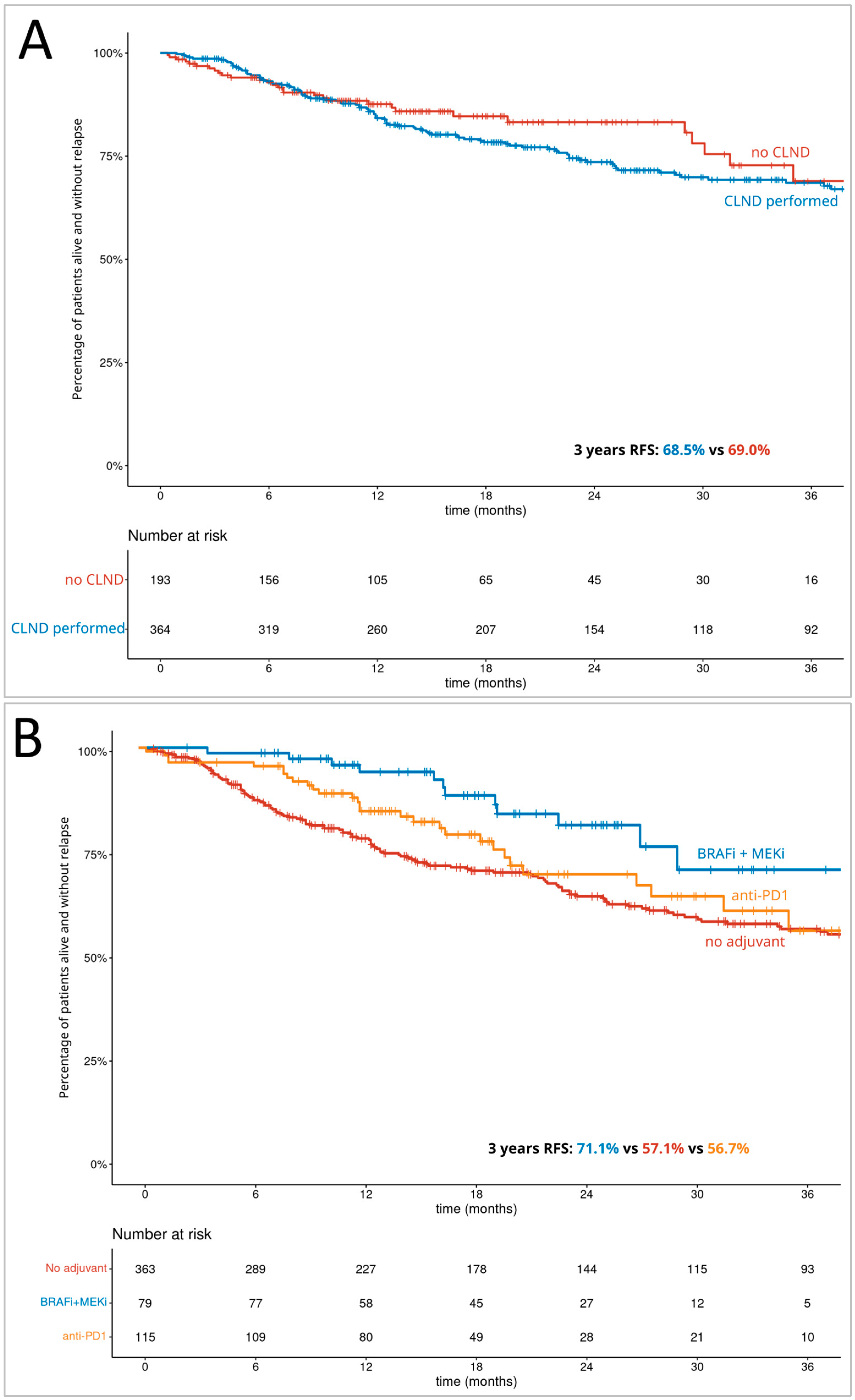
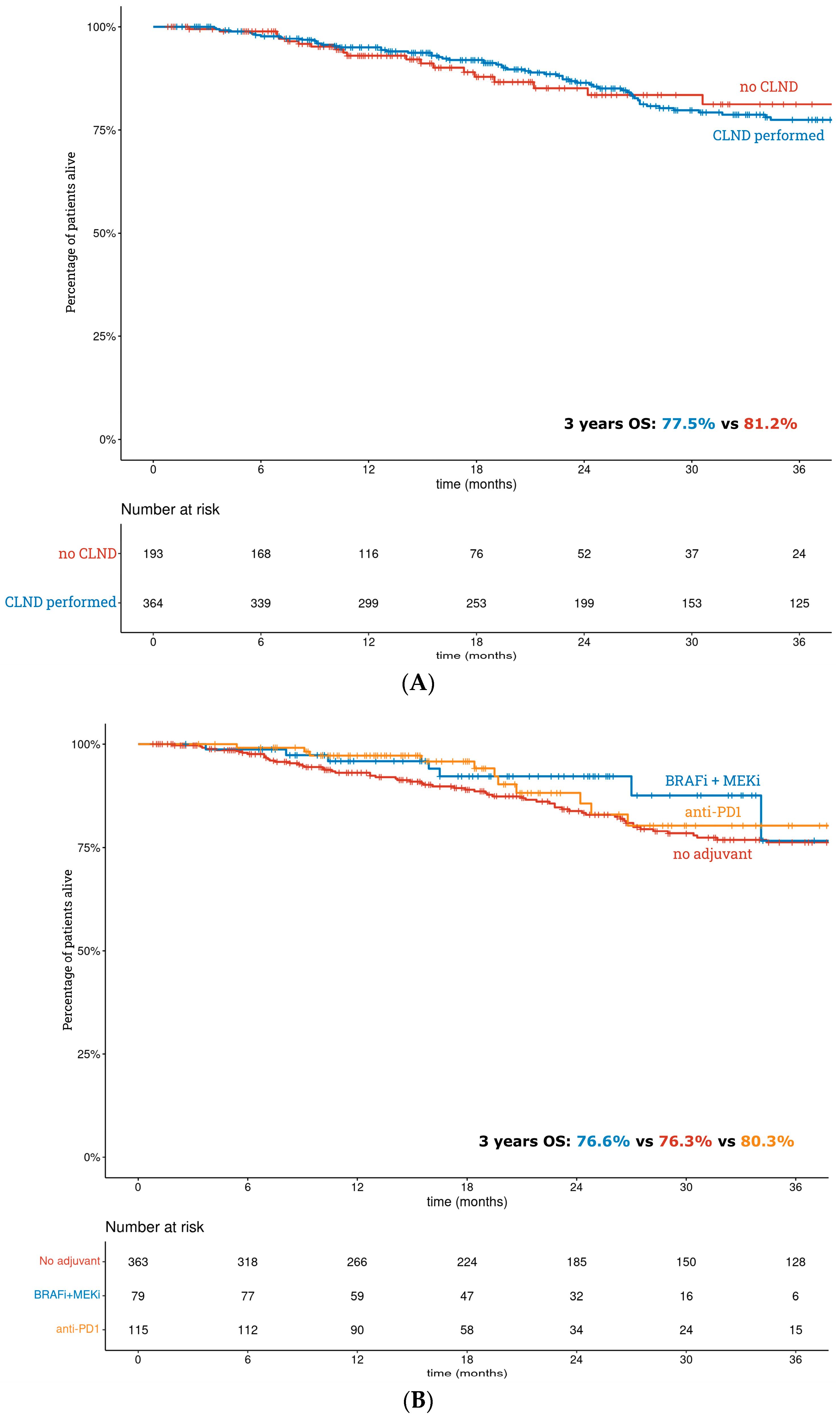
Background: In melanoma treatment, an approach following positive sentinel lymph node biopsy (SLNB) has been recently deescalated from completion lymph node dissection (CLND) to active surveillance based on phase III trials data. In this study, we aim to evaluate treatment strategies in SLNB-positive melanoma patients in real-world practice. Methods: Five-hundred-fifty-seven melanoma SLNB-positive patients from seven comprehensive cancer centers treated between 2017 and 2021 were included. Kaplan–Meier methods and the Cox Proportional-Hazards Model were used for analysis. Results: The median follow-up was 25 months. Between 2017 and 2021, the percentage of patients undergoing CLND decreased (88–41%), while the use of adjuvant treatment increased (11–51%). The 3-year OS and RFS rates were 77.9% and 59.6%, respectively. Adjuvant therapy prolonged RFS (HR:0.69, p = 0.036)), but CLND did not (HR:1.22, p = 0.272). There were no statistically significant differences in OS for either adjuvant systemic treatment or CLND. Lower progression risk was also found, and time-dependent hazard ratios estimation in patients treated with systemic adjuvant therapy was confirmed (HR:0.20, p = 0.002 for BRAF inhibitors and HR:0.50, p = 0.015 for anti-PD-1 inhibitors). Conclusions: Treatment of SLNB-positive melanoma patients is constantly evolving, and the role of surgery is currently rather limited. Whether CLND has been performed or not, in a group of SLNB-positive patients, adjuvant systemic treatment should be offered to all eligible patients.