SNP-Target Genes Interaction Perturbing the Cancer Risk in the Post-GWAS
by
Wenmin Yang
1,2,3,†,
Te Zhang
1,2,3,†,
Xuming Song
1,2,3,
Gaochao Dong
1,2,*,
Lin Xu
1,2,3,4 and
Feng Jiang
1,2,3,* 1
Department of Thoracic Surgery, Nanjing Medical University Affiliated Cancer Hospital and Jiangsu Cancer Hospital and Jiangsu Institute of Cancer Research, Nanjing 210009, China
2
Jiangsu Key Laboratory of Molecular and Translational Cancer Research, Cancer Institute of Jiangsu Province, Nanjing 210009, China
3
The Fourth Clinical College, Nanjing Medical University, Nanjing 210009, China
4
Collaborative Innovation Center for Cancer Personalized Medicine, Nanjing Medical University, Nanjing 211116, China
*
Authors to whom correspondence should be addressed.
†
These authors contributed equally to this work.
Cancers 2022, 14(22), 5636; https://doi.org/10.3390/cancers14225636
Submission received: 11 October 2022
/
Revised: 10 November 2022
/
Accepted: 13 November 2022
/
Published: 17 November 2022
(This article belongs to the Special Issue Genes in Cancer)
Simple Summary
Genome-wide association studies have identified a vast number of cancer risk-associated loci harboring numerous single nucleotide polymorphisms that regulate gene expression and affect individual genetic susceptibility to cancer through different routes. Recently, there has been some progress made regarding the molecular and biological mechanisms underlying the ways that genetic variation affects gene regulation. This review summarizes the molecular and biological mechanisms of genetic variation that affect gene regulation by drawing from the findings provided by past studies.
Abstract
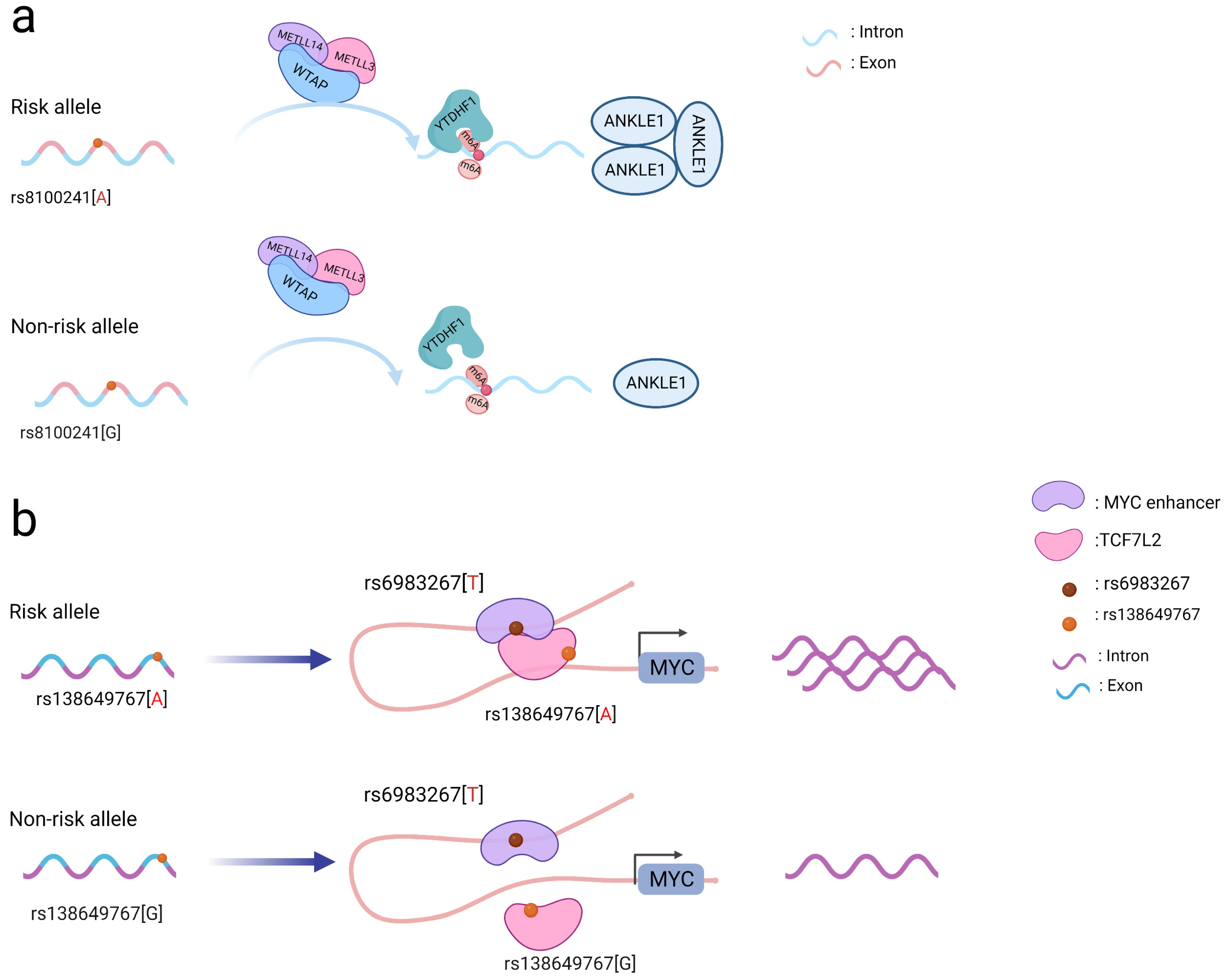
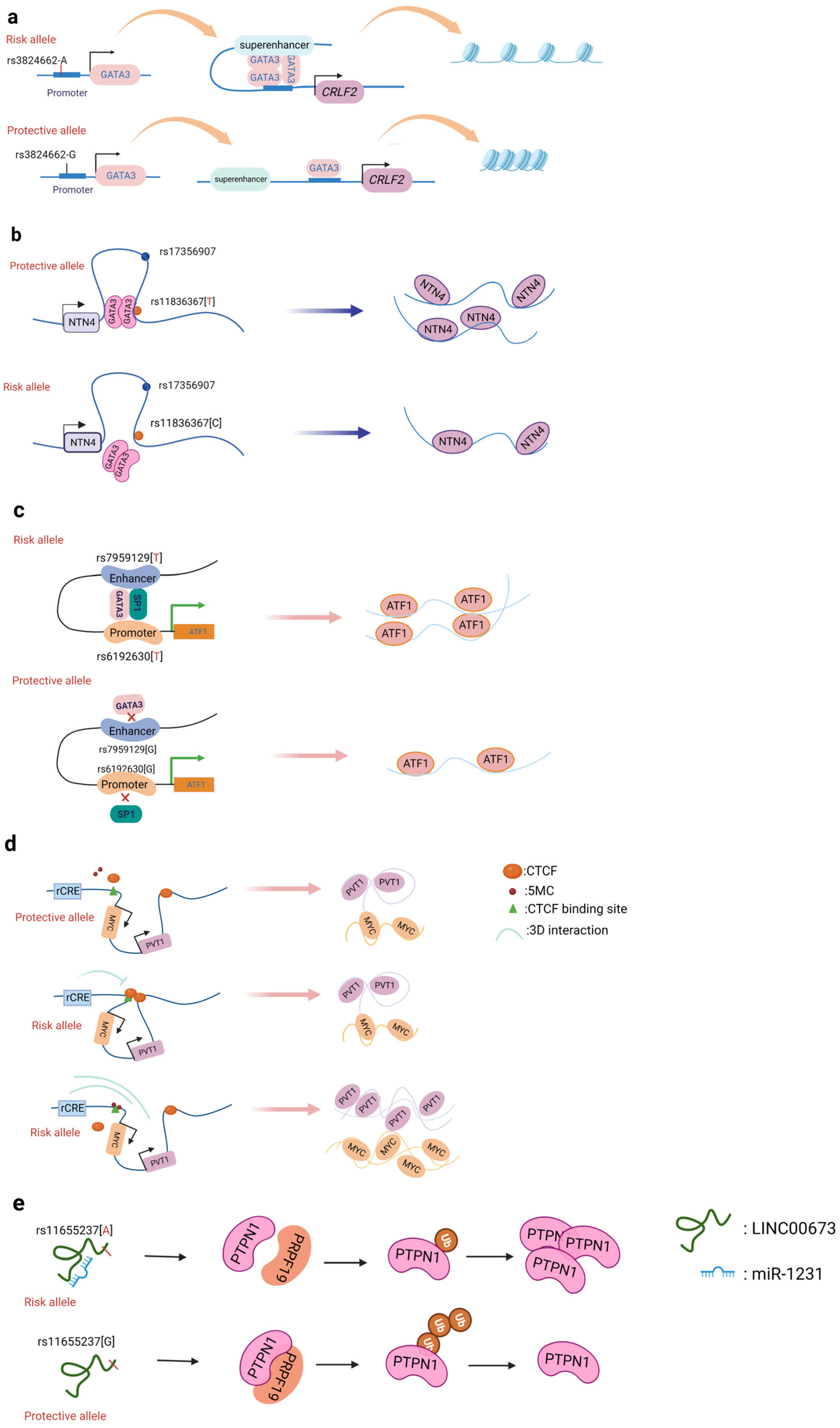
Cancer ranks as the second leading cause of death worldwide, and, being a genetic disease, it is highly heritable. Over the past few decades, genome-wide association studies (GWAS) have identified many risk-associated loci harboring hundreds of single nucleotide polymorphisms (SNPs). Some of these cancer-associated SNPs have been revealed as causal, and the functional characterization of the mechanisms underlying the cancer risk association has been illuminated in some instances. In this review, based on the different positions of SNPs and their modes of action, we discuss the mechanisms underlying how SNPs regulate the expression of target genes to consequently affect tumorigenesis and the development of cancer.