SF3B1 Mutations in Hematological Malignancies



1
Department of Clinical and Biological Sciences, University of Turin, 10043 Turin, Italy
2
Division of Advanced Materials Metrology and Life Sciences, Istituto Nazionale di Ricerca Metrologica (INRiM), 10135 Turin, Italy
*
Author to whom correspondence should be addressed.
Cancers 2022, 14(19), 4927; https://doi.org/10.3390/cancers14194927
Submission received: 30 August 2022
/
Revised: 3 October 2022
/
Accepted: 4 October 2022
/
Published: 8 October 2022
Simple Summary
In recent years, spliceosome mutations have become of diagnostic and prognostic interest in several malignancies, as alternative splice mRNA isoforms are often associated with neoplasia. The role played by SF3B1, one of the splicing factors most frequently mutated in cancer, in different hematological neoplasia has been summarized here. A better knowledge of diagnostic and prognostic factors can allow a more precise stratification of hematological patients and a better prediction of the response to therapy.
Abstract
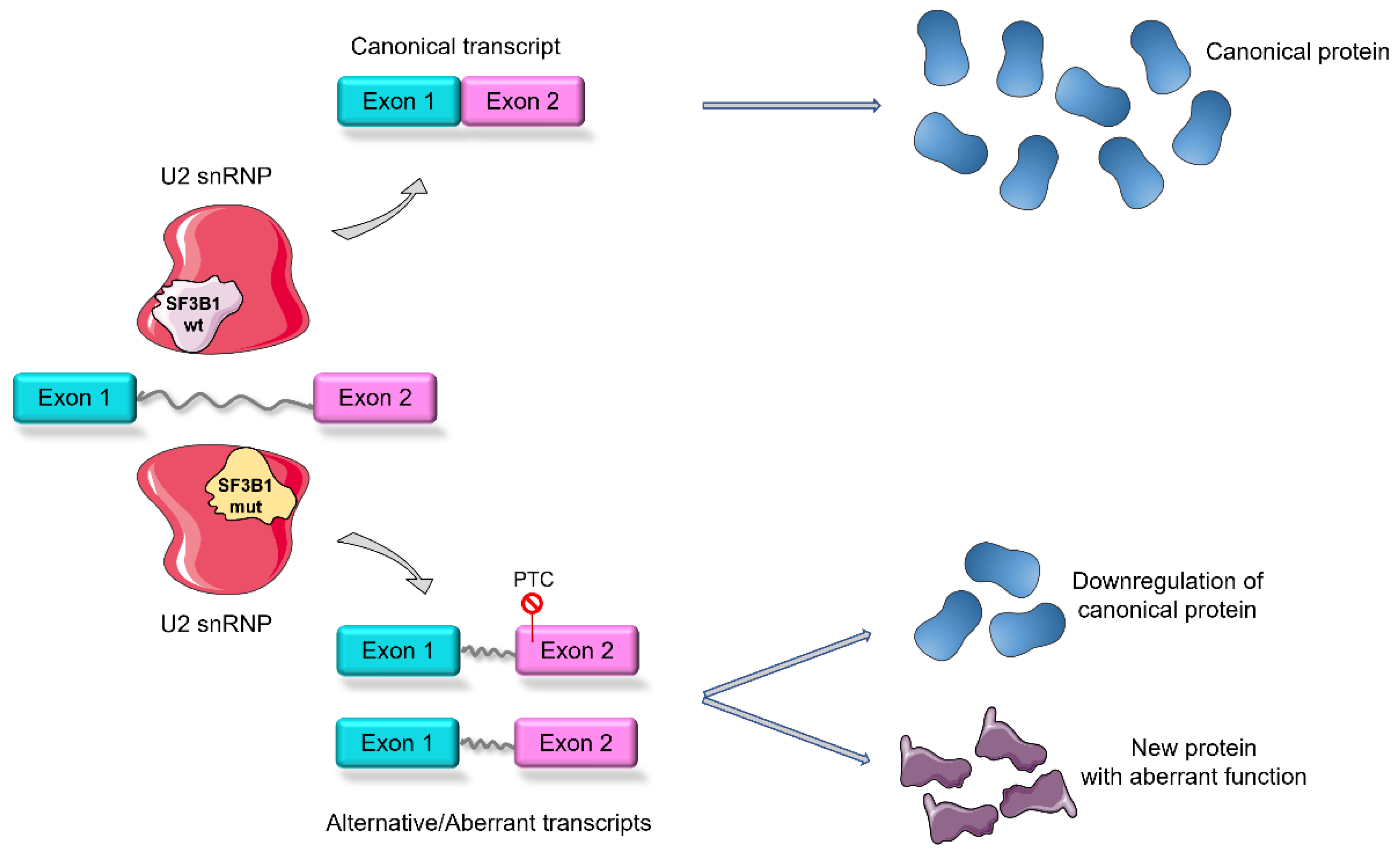
Recently, mutations in the genes involved in the spliceosome have attracted considerable interest in different neoplasms. Among these, SF3B1 mutations have acquired great interest, especially in myelodysplastic syndromes, as they identify a subgroup of patients who can benefit from personalized therapy. The SF3B1 gene encodes the largest subunit of the splicing factor 3b protein complex and is critical for spliceosome assembly and mRNA splicing. The mutated SF3B1 gene encodes for a protein with a different mRNA processing mechanism that results in the aberrant splicing of many mRNAs, which can be downregulated. Although there are many mRNAs affected by a splicing alteration, only a few of these have been directly related to the pathogenesis of several diseases. In this review, we took a snapshot of the current knowledge on the implications of SF3B1 mutations in different hematological malignancies.