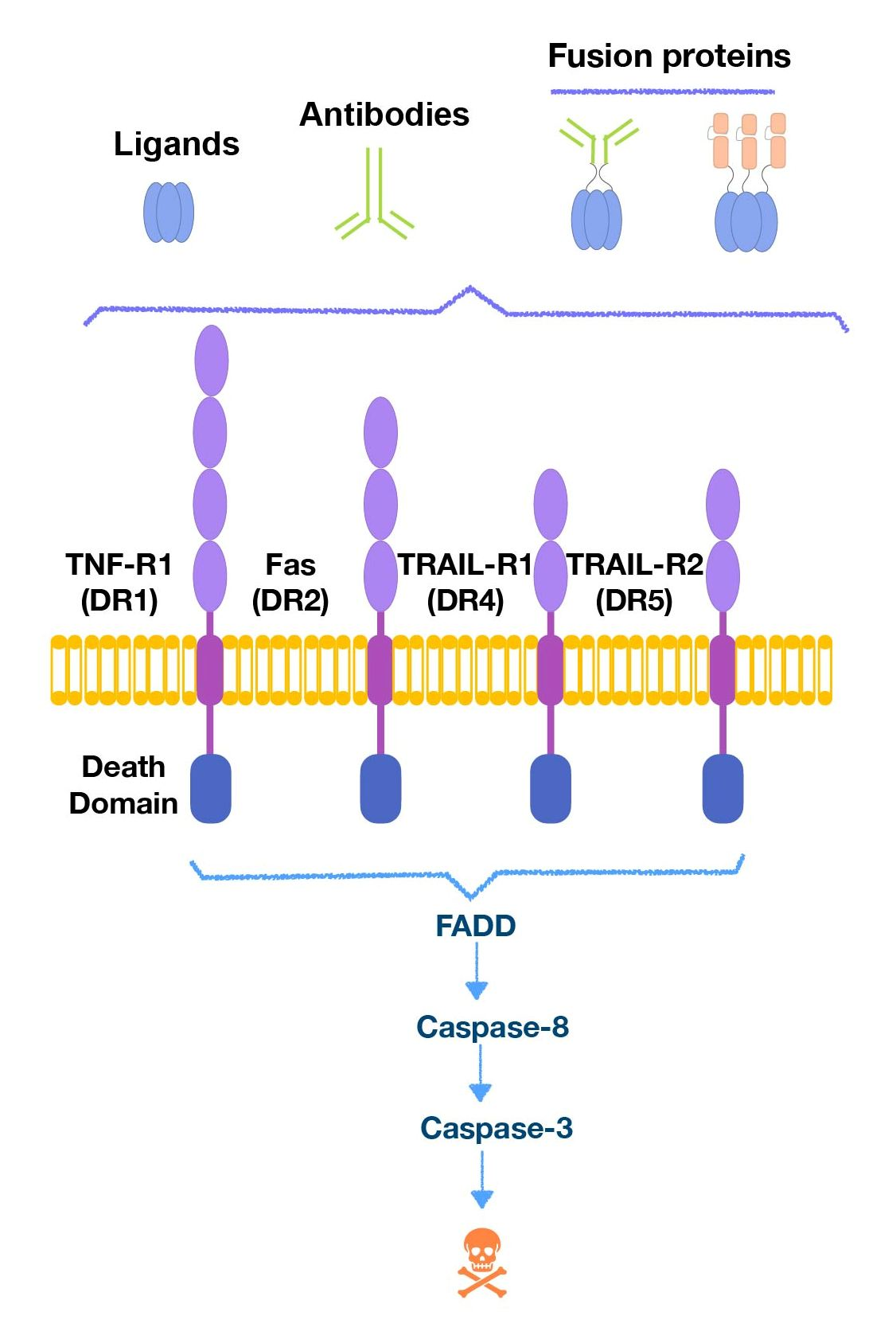
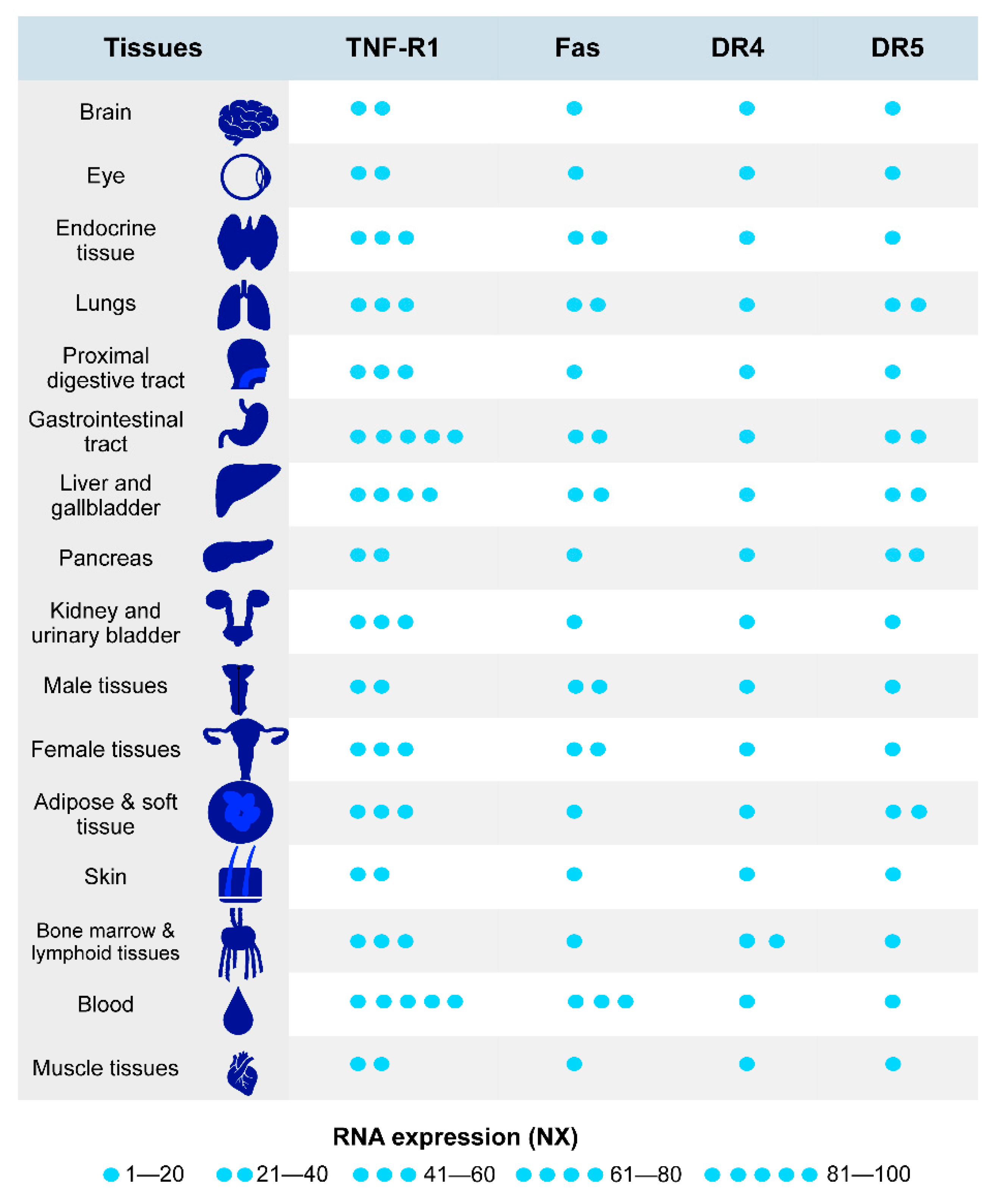
Apoptosis-Inducing TNF Superfamily Ligands for Cancer Therapy



Simple Summary
Abstract

1. Introduction
2. Apoptosis
2.1. Apoptosis-Inducing Ligands and Their Receptors
2.1.1. Tumor Necrosis Factor-α (TNF-α)
2.1.2. Fas Ligand (FasL)
2.1.3. TNF-Related Apoptosis-Inducing Ligand (TRAIL)
3. Improving Receptor Specificity of the Apoptosis-Inducing Ligands
3.1. DR-Targeting Antibodies
3.2. Trimer Conformation Plays a Crucial Role in Receptor Activation
3.3. Fusion Proteins Improve Receptor Activation and Half-Life
3.3.1. TNF-α
3.3.2. FasL
3.3.3. TRAIL
4. Gene Therapy
5. Conclusions
Author Contributions
Funding
Acknowledgments
Conflicts of Interest
References
- Hanahan, D.; Weinberg, R.A. Hallmarks of Cancer: The Next Generation. Cell 2011, 144, 646–674. [Google Scholar] [CrossRef] [Scilit] [PubMed]
- Holohan, C.; Van Schaeybroeck, S.; Longley, D.B.; Johnston, P.G. Cancer drug resistance: An evolving paradigm. Nat. Rev. Cancer 2013, 13, 714–726. [Google Scholar] [CrossRef] [Scilit]
- Kroemer, G.; Pouyssegur, J. Tumor Cell Metabolism: Cancer’s Achilles’ Heel. Cancer Cell 2008, 13, 472–482. [Google Scholar] [CrossRef] [Scilit] [PubMed]
- Jia, L.T.; Chen, S.Y.; Yang, A.G. Cancer gene therapy targeting cellular apoptosis machinery. Cancer Treat. Rev. 2012, 38, 868–876. [Google Scholar] [CrossRef] [Scilit]
- Bremer, E.; de Bruyn, M.; Wajant, H.; Helfrich, W. Targeted Cancer Immunotherapy Using Ligands of the Tumor Necrosis Factor Super-Family. Curr. Drug Targets 2009, 10, 94–103. [Google Scholar] [CrossRef] [Scilit]
- Elmore, S. Apoptosis: A Review of Programmed Cell Death. Toxicol. Pathol. 2007, 35, 495–516. [Google Scholar] [CrossRef] [Scilit]
- Kiraz, Y.; Adan, A.; Kartal Yandim, M.; Baran, Y. Major apoptotic mechanisms and genes involved in apoptosis. Tumor Biol. 2016, 37, 8471–8486. [Google Scholar] [CrossRef] [Scilit] [PubMed]
- Mahmood, Z.; Shukla, Y. Death receptors: Targets for cancer therapy. Exp. Cell Res. 2010, 316, 887–899. [Google Scholar] [CrossRef] [Scilit]
- Tait, S.W.G.; Green, D.R. Mitochondria and cell death: Outer membrane permeabilization and beyond. Nat. Rev. Mol. Cell Biol. 2010, 11, 621–632. [Google Scholar] [CrossRef] [Scilit]
- Ichim, G.; Tait, S.W.G. A fate worse than death: Apoptosis as an oncogenic process. Nat. Rev. Cancer 2016, 16, 539–548. [Google Scholar] [CrossRef] [Scilit]
- Park, H.H. Domain swapping of death domain superfamily: Alternative strategy for dimerization. Int. J. Biol. Macromol. 2019, 138, 565–572. [Google Scholar] [CrossRef] [Scilit]
- MacKenzie, S.H.; Clark, A.C. Targeting cell death in tumors by activating caspases. Curr. Cancer Drug Targets 2008, 8, 98–109. [Google Scholar] [CrossRef]
- D’Arcy, M.S. Cell death: A review of the major forms of apoptosis, necrosis and autophagy. Cell Biol. Int. 2019, 43, 582–592. [Google Scholar] [CrossRef] [Scilit]
- Taylor, R.C.; Cullen, S.P.; Martin, S.J. Apoptosis: Controlled demolition at the cellular level. Nat. Rev. Mol. Cell Biol. 2008, 9, 231–241. [Google Scholar] [CrossRef] [Scilit] [PubMed]
- Walczak, H. Death receptor-ligand systems in cancer, cell death, and inflammation. Cold Spring Harb. Perspect. Biol. 2013, 5, 1–18. [Google Scholar] [CrossRef] [Scilit]
- Nikoletopoulou, V.; Markaki, M.; Palikaras, K.; Tavernarakis, N. Crosstalk between apoptosis, necrosis and autophagy. Biochim. Biophys. Acta Mol. Cell Res. 2013, 1833, 3448–3459. [Google Scholar] [CrossRef] [Scilit] [PubMed]
- Jain, M.V.; Paczulla, A.M.; Klonisch, T.; Dimgba, F.N.; Rao, S.B.; Roberg, K.; Schweizer, F.; Lengerke, C.; Davoodpour, P.; Palicharla, V.R.; et al. Interconnections between apoptotic, autophagic and necrotic pathways: Implications for cancer therapy development. J. Cell. Mol. Med. 2013, 17, 12–29. [Google Scholar] [CrossRef] [Scilit]
- Jouan-Lanhouet, S.; Arshad, M.I.; Piquet-Pellorce, C.; Martin-Chouly, C.; Le Moigne-Muller, G.; Van Herreweghe, F.; Takahashi, N.; Sergent, O.; Lagadic-Gossmann, D.; Vandenabeele, P.; et al. TRAIL induces necroptosis involving RIPK1/RIPK3-dependent PARP-1 activation. Cell Death Differ. 2012, 19, 2003–2014. [Google Scholar] [CrossRef] [Scilit] [PubMed]
- Yi, F.; Frazzette, N.; Cruz, A.C.; Klebanoff, C.A.; Siegel, R.M. Beyond Cell Death: New Functions for TNF Family Cytokines in Autoimmunity and Tumor Immunotherapy. Trends Mol. Med. 2018, 1–12. [Google Scholar] [CrossRef] [Scilit]
- Papenfuss, K.; Cordier, S.M.; Walczak, H. Death receptors as targets for anti-cancer therapy. J. Cell. Mol. Med. 2008, 12, 2566–2585. [Google Scholar] [CrossRef] [Scilit]
- Möller, P.; Koretz, K.; Leithäuser, F.; Brüderlein, S.; Henne, C.; Quentmeier, A.; Krammer, P.H. Expression of APO-1 (CD95), a member of the NGF/TNF receptor superfamily, in normal and neoplastic colon epithelium. Int. J. Cancer 1994, 57, 371–377. [Google Scholar] [CrossRef] [Scilit] [PubMed]
- Viard-Leveugle, I.; Veyrenc, S.; French, L.E.; Brambilla, C.; Brambilla, E. Frequent loss of Fas expression and function in human lung tumours with overexpression of FasL in small cell lung carcinoma. J. Pathol. 2003, 201, 268–277. [Google Scholar] [CrossRef] [Scilit] [PubMed]
- Das, H.; Koizumi, T.; Sugimoto, T.; Chakraborty, S.; Ichimura, T.; Hasegawa, K.; Nishimura, R. Quantitation of Fas and Fas ligand gene expression in human ovarian, cervical and endometrial carcinomas using real time quantitative RT-PCR. Br. J. Cancer 2000, 82, 1682–1688. [Google Scholar] [CrossRef] [Scilit] [PubMed]
- Reesink-Peters, N.; Hougardy, B.M.T.; Van Den Heuvel, F.A.J.; Ten Hoor, K.A.; Hollema, H.; Boezen, H.M.; De Vries, E.G.E.; De Jong, S.; Van Der Zee, A.G.J. Death receptors and ligands in cervical carcinogenesis: An immunohistochemical study. Gynecol. Oncol. 2005, 96, 705–713. [Google Scholar] [CrossRef] [Scilit]
- Ozawa, F.; Friess, H.; Kleeff, J.; Xu, Z.; Zimmermann, A.; Sheikh, M.; Büchler, M. Effects and expression of TRAIL and its apoptosis-promoting receptors in human pancreatic cancer. Cancer Lett. 2001, 163, 71–81. [Google Scholar] [CrossRef] [Scilit]
- Koornstra, J.J.; Kleibeuker, J.H.; van Geelen, C.M.M.; Rijcken, F.E.M.; Hollema, H.; de Vries, E.G.E.; de Jong, S. Expression of TRAIL (TNF-related apoptosis-inducing ligand) and its receptors in normal colonic mucosa, adenomas, and carcinomas. J. Pathol. 2003, 200, 327–335. [Google Scholar] [CrossRef] [Scilit]
- Kawasaki, M.; Kuwano, K.; Nakanishi, Y.; Hagimoto, N.; Takayama, K.; Pei, X.-H.; Maeyama, T.; Yoshimi, M.; Hara, N. Analysis of Fas and Fas ligand expression and function in lung cancer cell lines. Eur. J. Cancer 2000, 36, 656–663. [Google Scholar] [CrossRef] [Scilit]
- Hwang, H.S.; Park, Y.Y.; Shin, S.J.; Go, H.J.; Park, J.M.; Yoon, S.Y.; Lee, J.L.; Cho, Y.M. Involvement of the tnf-á pathway in tki resistance and suggestion of tnfr1 as a predictive biomarker for tki responsiveness in clear cell renal cell carcinoma. J. Korean Med. Sci. 2020, 35, 1–12. [Google Scholar] [CrossRef] [Scilit]
- Yang, J.; LeBlanc, F.R.; Dighe, S.A.; Hamele, C.E.; Olson, T.L.; Feith, D.J.; Loughran, T.P. TRAIL mediates and sustains constitutive NF-κB activation in LGL leukemia. Blood 2018, 131, 2803–2815. [Google Scholar] [CrossRef] [Scilit]
- TODA, M.; KAWAMOTO, T.; UEHA, T.; KISHIMOTO, K.; HARA, H.; FUKASE, N.; ONISHI, Y.; HARADA, R.; MINODA, M.; KUROSAKA, M.; et al. ‘Decoy’ and ‘non-decoy’ functions of DcR3 promote malignant potential in human malignant fibrous histiocytoma cells. Int. J. Oncol. 2013, 43, 703–712. [Google Scholar] [CrossRef] [Scilit] [PubMed]
- Wu, H.; Hymowitz, S.G. Structure and Function of Tumor Necrosis Factor (TNF) at the Cell Surface. In Handbook of Cell Signaling; Bradshaw, R.A., Dennis, E.A., Eds.; Academic Press: San Diego, CA, USA, 2010; ISBN 9780123741455. [Google Scholar]
- Sheikh, M.; Fornace, A. Death and decoy receptors and p53-mediated apoptosis. Leukemia 2000, 14, 1509–1513. [Google Scholar] [CrossRef] [Scilit] [PubMed]
- Aggarwal, B.B. Signalling pathways of the TNF superfamily: A double-edged sword. Nat. Rev. Immunol. 2003, 3, 745–756. [Google Scholar] [CrossRef] [Scilit]
- Locksley, R.M.; Killeen, N.; Lenardo, M.J. The TNF and TNF Receptor Superfamilies. Cell 2001, 104, 487–501. [Google Scholar] [CrossRef] [Scilit]
- Vince, J.E.; Wong, W.W.L.; Khan, N.; Feltham, R.; Chau, D.; Ahmed, A.U.; Benetatos, C.A.; Chunduru, S.K.; Condon, S.M.; McKinlay, M.; et al. IAP Antagonists Target cIAP1 to Induce TNFα-Dependent Apoptosis. Cell 2007, 131, 682–693. [Google Scholar] [CrossRef] [Scilit] [PubMed]
- Varfolomeev, E.; Vucic, D. Intracellular regulation of TNF activity in health and disease. Cytokine 2018, 101, 26–32. [Google Scholar] [CrossRef] [Scilit]
- Medler, J.; Wajant, H. Tumor necrosis factor receptor-2 (TNFR2): An overview of an emerging drug target. Expert Opin. Ther. Targets 2019, 23, 295–307. [Google Scholar] [CrossRef] [Scilit]
- Martínez-Reza, I.; Díaz, L.; García-Becerra, R. Preclinical and clinical aspects of TNF-α and its receptors TNFR1 and TNFR2 in breast cancer. J. Biomed. Sci. 2017, 24, 90. [Google Scholar] [CrossRef] [Scilit] [PubMed]
- Black, R.A.; Rauch, C.T.; Kozlosky, C.J.; Peschon, J.J.; Slack, J.L.; Wolfson, M.F.; Castner, B.J.; Stocking, K.L.; Reddy, P.; Srinivasan, S.; et al. A metalloproteinase disintegrin that releases tumour-necrosis factor-α from cells. Nature 1997, 385, 729–733. [Google Scholar] [CrossRef] [Scilit]
- Josephs, S.F.; Ichim, T.E.; Prince, S.M.; Kesari, S.; Marincola, F.M.; Escobedo, A.R.; Jafri, A. Unleashing endogenous TNF-alpha as a cancer immunotherapeutic. J. Transl. Med. 2018, 16, 242. [Google Scholar] [CrossRef] [Scilit]
- Hikita, A.; Tanaka, N.; Yamane, S.; Ikeda, Y.; Furukawa, H.; Tohma, S.; Suzuki, R.; Tanaka, S.; Mitomi, H.; Fukui, N. Involvement of a disintegrin and metalloproteinase 10 and 17 in shedding of tumor necrosis factor-α. Biochem. Cell Biol. 2009, 87, 581–593. [Google Scholar] [CrossRef] [Scilit]
- Schwarz, J.; Broder, C.; Helmstetter, A.; Schmidt, S.; Yan, I.; Müller, M.; Schmidt-Arras, D.; Becker-Pauly, C.; Koch-Nolte, F.; Mittrücker, H.-W.; et al. Short-term TNFα shedding is independent of cytoplasmic phosphorylation or furin cleavage of ADAM17. Biochim. Biophys. Acta Mol. Cell Res. 2013, 1833, 3355–3367. [Google Scholar] [CrossRef] [Scilit]
- Balkwill, F. Tumour necrosis factor and cancer. Nat. Rev. Cancer 2009, 9, 361–371. [Google Scholar] [CrossRef] [Scilit] [PubMed]
- Ehrenschwender, M.; Wajant, H. The Role of FasL and Fas in Health and Disease. Adv. Exp. Med. Biol. 2009, 647, 64–93. [Google Scholar] [PubMed]
- Vanamee, É.S.; Faustman, D.L. Structural principles of tumor necrosis factor superfamily signaling. Sci. Signal. 2018, 11, eaao4910. [Google Scholar] [CrossRef] [Scilit]
- Pitti, R.M.; Marsters, S.A.; Lawrence, D.A.; Roy, M.; Kischkel, F.C.; Dowd, P.; Huang, A.; Donahue, C.J.; Sherwood, S.W.; Baldwin, D.T.; et al. Genomic amplification of a decoy receptor for Fas ligand in lung and colon cancer. Nature 1998, 396, 699–703. [Google Scholar] [CrossRef] [Scilit]
- Wajant, H. Principles and mechanisms of CD95 activation. Biol. Chem. 2014, 395, 1401–1416. [Google Scholar] [CrossRef] [Scilit]
- Hsieh, S.-L.; Lin, W.-W. Decoy receptor 3: An endogenous immunomodulator in cancer growth and inflammatory reactions. J. Biomed. Sci. 2017, 24, 39. [Google Scholar] [CrossRef] [Scilit]
- Ge, Z.; Sanders, A.J.; Ye, L.; Jiang, W.G. Aberrant expression and function of death receptor-3 and death decoy receptor-3 in human cancer. Exp. Ther. Med. 2011, 2, 167–172. [Google Scholar] [CrossRef] [Scilit] [PubMed]
- Wu, Q.; Zheng, Y.; Chen, D.; Li, X.; Lu, C.; Zhang, Z. Aberrant expression of decoy receptor 3 in human breast cancer: Relevance to lymphangiogenesis. J. Surg. Res. 2014, 188, 459–465. [Google Scholar] [CrossRef] [Scilit] [PubMed]
- Macher-Goeppinger, S.; Aulmann, S.; Wagener, N.; Funke, B.; Tagscherer, K.E.; Haferkamp, A.; Hohenfellner, M.; Kim, S.; Autschbach, F.; Schirmacher, P.; et al. Decoy Receptor 3 Is a Prognostic Factor in Renal Cell Cancer. Neoplasia 2008, 10, 1049–IN2. [Google Scholar] [CrossRef] [Scilit]
- Zhou, J.; Song, S.; Li, D.; He, S.; Zhang, B.; Wang, Z.; Zhu, X. Decoy receptor 3 (DcR3) overexpression predicts the prognosis and pN2 in pancreatic head carcinoma. World J. Surg. Oncol. 2014, 12, 52. [Google Scholar] [CrossRef] [Scilit]
- Malleter, M.; Tauzin, S.; Bessede, A.; Castellano, R.; Goubard, A.; Godey, F.; Levêque, J.; Jézéquel, P.; Campion, L.; Campone, M.; et al. CD95L cell surface cleavage triggers a prometastatic signaling pathway in triple-negative breast cancer. Cancer Res. 2013, 73, 6711–6721. [Google Scholar] [CrossRef] [Scilit]
- ElOjeimy, S.; McKillop, J.C.; El-Zawahry, A.M.; Holman, D.H.; Liu, X.; Schwartz, D.A.; Day, T.A.; Dong, J.Y.; Norris, J.S. FasL gene therapy: A new therapeutic modality for head and neck cancer. Cancer Gene Ther. 2006, 13, 739–745. [Google Scholar] [CrossRef] [Scilit] [PubMed]
- Timmer, T.; de Vries, E.G.E.; de Jong, S. Fas receptor-mediated apoptosis: A clinical application? J. Pathol. 2002, 196, 125–134. [Google Scholar] [CrossRef] [Scilit] [PubMed]
- Trivedi, R.; Mishra, D.P. Trailing TRAIL Resistance: Novel Targets for TRAIL Sensitization in Cancer Cells. Front. Oncol. 2015, 5, 69. [Google Scholar] [CrossRef] [Scilit] [PubMed]
- Degli-Esposti, M.A.; Smolak, P.J.; Walczak, H.; Waugh, J.; Huang, C.-P.; DuBose, R.F.; Goodwin, R.G.; Smith, C.A. Cloning and Characterization of TRAIL-R3, a Novel Member of the Emerging TRAIL Receptor Family. J. Exp. Med. 1997, 186, 1165–1170. [Google Scholar] [CrossRef] [Scilit]
- Falschlehner, C.; Emmerich, C.H.; Gerlach, B.; Walczak, H. TRAIL signalling: Decisions between life and death. Int. J. Biochem. Cell Biol. 2007, 39, 1462–1475. [Google Scholar] [CrossRef] [Scilit] [PubMed]
- Bernardi, S.; Voltan, R.; Rimondi, E.; Melloni, E.; Milani, D.; Cervellati, C.; Gemmati, D.; Celeghini, C.; Secchiero, P.; Zauli, G.; et al. TRAIL, OPG, and TWEAK in kidney disease: Biomarkers or therapeutic targets? Clin. Sci. 2019, 133, 1145–1166. [Google Scholar] [CrossRef] [Scilit] [PubMed]
- Candido, R. The osteoprotegerin/tumor necrosis factor related apoptosis-inducing ligand axis in the kidney. Curr. Opin. Nephrol. Hypertens. 2014, 23, 69–74. [Google Scholar] [CrossRef] [Scilit]
- Deligiorgi, M.V.; Panayiotidis, M.I.; Griniatsos, J.; Trafalis, D.T. Harnessing the versatile role of OPG in bone oncology: Counterbalancing RANKL and TRAIL signaling and beyond. Clin. Exp. Metastasis 2020, 37, 13–30. [Google Scholar] [CrossRef] [Scilit]
- Ramamurthy, V.; Yamniuk, A.P.; Lawrence, E.J.; Yong, W.; Schneeweis, L.A.; Cheng, L.; Murdock, M.; Corbett, M.J.; Doyle, M.L.; Sheriff, S. The structure of the death receptor 4–TNF-related apoptosis-inducing ligand (DR4–TRAIL) complex. Acta Crystallogr. Sect. F Struct. Biol. Commun. 2015, 71, 1273–1281. [Google Scholar] [CrossRef] [Scilit]
- Azijli, K.; Yuvaraj, S.; Peppelenbosch, M.P.; Würdinger, T.; Dekker, H.; Joore, J.; van Dijk, E.; Quax, W.J.; Peters, G.J.; de Jong, S.; et al. Kinome profiling of non-canonical TRAIL signaling reveals RIP1-Src-STAT3-dependent invasion in resistant non-small cell lung cancer cells. J. Cell Sci. 2012, 125, 4651–4661. [Google Scholar] [CrossRef] [Scilit] [PubMed]
- Dufour, F.; Rattier, T.; Constantinescu, A.A.; Zischler, L.; Morlé, A.; Ben Mabrouk, H.; Humblin, E.; Jacquemin, G.; Szegezdi, E.; Delacote, F.; et al. TRAIL receptor gene editing unveils TRAIL-R1 as a master player of apoptosis induced by TRAIL and ER stress. Oncotarget 2017, 8, 9974–9985. [Google Scholar] [CrossRef] [Scilit]
- Bodmer, J.L.; Meier, P.; Tschopp, J.; Schneider, P. Cysteine 230 is essential for the structure and activity of the cytotoxic ligand TRAIL. J. Biol. Chem. 2000, 275, 20632–20637. [Google Scholar] [CrossRef] [Scilit] [PubMed]
- Kim, M.H.; Billiar, T.R.; Seol, D.W. The secretable form of trimeric TRAIL, a potent inducer of apoptosis. Biochem. Biophys. Res. Commun. 2004, 321, 930–935. [Google Scholar] [CrossRef] [Scilit]
- Amarante-Mendes, G.P.; Griffith, T.S. Therapeutic applications of TRAIL receptor agonists in cancer and beyond. Pharmacol. Ther. 2015, 155, 117–131. [Google Scholar] [CrossRef] [Scilit]
- Lemke, J.; von Karstedt, S.; Zinngrebe, J.; Walczak, H. Getting TRAIL back on track for cancer therapy. Cell Death Differ. 2014, 21, 1350–1364. [Google Scholar] [CrossRef] [Scilit]
- Stuckey, D.W.; Shah, K. TRAIL on trial: Preclinical advances in cancer therapy. Trends Mol. Med. 2013, 19, 685–694. [Google Scholar] [CrossRef] [Scilit]
- Herbst, R.S.; Eckhardt, S.G.; Kurzrock, R.; Ebbinghaus, S.; O’Dwyer, P.J.; Gordon, M.S.; Novotny, W.; Goldwasser, M.A.; Tohnya, T.M.; Lum, B.L.; et al. Phase I Dose-Escalation Study of Recombinant Human Apo2L/TRAIL, a Dual Proapoptotic Receptor Agonist, in Patients With Advanced Cancer. J. Clin. Oncol. 2010, 28, 2839–2846. [Google Scholar] [CrossRef] [Scilit]
- Wainberg, Z.A.; Messersmith, W.A.; Peddi, P.F.; Kapp, A.V.; Ashkenazi, A.; Royer-Joo, S.; Portera, C.C.; Kozloff, M.F. A Phase 1B Study of Dulanermin in Combination With Modified FOLFOX6 Plus Bevacizumab in Patients With Metastatic Colorectal Cancer. Clin. Colorectal Cancer 2013, 12, 248–254. [Google Scholar] [CrossRef] [Scilit]
- Soria, J.-C.; Márk, Z.; Zatloukal, P.; Szima, B.; Albert, I.; Juhász, E.; Pujol, J.-L.; Kozielski, J.; Baker, N.; Smethurst, D.; et al. Randomized Phase II Study of Dulanermin in Combination With Paclitaxel, Carboplatin, and Bevacizumab in Advanced Non–Small-Cell Lung Cancer. J. Clin. Oncol. 2011, 29, 4442–4451. [Google Scholar] [CrossRef] [Scilit]
- Ouyang, X.; Shi, M.; Jie, F.; Bai, Y.; Shen, P.; Yu, Z.; Wang, X.; Huang, C.; Tao, M.; Wang, Z.; et al. Phase III study of dulanermin (recombinant human tumor necrosis factor-related apoptosis-inducing ligand/Apo2 ligand) combined with vinorelbine and cisplatin in patients with advanced non-small-cell lung cancer. Invest. New Drugs 2018, 36, 315–322. [Google Scholar] [CrossRef] [Scilit]
- Hou, J.; Qiu, L.; Zhao, Y.; Zhang, X.; Liu, Y.; Wang, Z.; Zhou, F.; Leng, Y.; Yang, S.; Xi, H.; et al. A Phase1b Dose Escalation Study of Recombinant Circularly Permuted TRAIL in Patients With Relapsed or Refractory Multiple Myeloma. Am. J. Clin. Oncol. 2018, 41, 1008–1014. [Google Scholar] [CrossRef] [Scilit]
- Leng, Y.; Qiu, L.; Hou, J.; Zhao, Y.; Zhang, X.; Yang, S.; Xi, H.; Huang, Z.; Pan, L.; Chen, W. Phase II open-label study of recombinant circularly permuted TRAIL as a single-agent treatment for relapsed or refractory multiple myeloma. Chin. J. Cancer 2016, 35, 86. [Google Scholar] [CrossRef] [Scilit]
- Leng, Y.; Hou, J.; Jin, J.; Zhang, M.; Ke, X.; Jiang, B.; Pan, L.; Yang, L.; Zhou, F.; Wang, J.; et al. Circularly permuted TRAIL plus thalidomide and dexamethasone versus thalidomide and dexamethasone for relapsed/refractory multiple myeloma: A phase 2 study. Cancer Chemother. Pharmacol. 2017, 79, 1141–1149. [Google Scholar] [CrossRef] [Scilit] [PubMed]
- WAJANT, H.; GERSPACH, J.; PFIZENMAIER, K. Tumor therapeutics by design: Targeting and activation of death receptors. Cytokine Growth Factor Rev. 2005, 16, 55–76. [Google Scholar] [CrossRef] [Scilit]
- Sheng, Y.; Li, F.; Qin, Z. TNF Receptor 2 Makes Tumor Necrosis Factor a Friend of Tumors. Front. Immunol. 2018, 9, 1–9. [Google Scholar] [CrossRef] [Scilit]
- Holland, P.M. Death receptor agonist therapies for cancer, which is the right TRAIL? Cytokine Growth Factor Rev. 2014, 25, 185–193. [Google Scholar] [CrossRef] [Scilit]
- Wajant, H.; Gerspach, J.; Pfizenmaier, K. Engineering death receptor ligands for cancer therapy. Cancer Lett. 2013, 332, 163–174. [Google Scholar] [CrossRef] [Scilit]
- Nakamura, S.; Kato, A.; Masegi, T.; Fukuoka, M.; Kitai, K.; Ogawa, H.; Ichikawa, Y.; Maeda, M.; Watanabe, N.; Kohgo, Y.; et al. A novel recombinant tumor necrosis factor-alpha mutant with increased anti-tumor activity and lower toxicity. Int. J. Cancer 1991, 48, 744–748. [Google Scholar] [CrossRef] [Scilit]
- Van Ostade, X.; Vandenabeele, P.; Everaerdt, B.; Loetscher, H.; Gentz, R.; Brockhaus, M.; Lesslauer, W.; Tavernier, J.; Brouckaert, P.; Fiers, W. Human TNF mutants with selective activity on the p55 receptor. Nature 1993, 361, 266–269. [Google Scholar] [CrossRef] [Scilit]
- Shin, N.-K.; Lee, I.; Chang, S.-G.; Shin, H.-C. A novel tumor necrosis factor-α mutant with significantly enhanced cytotoxicity and receptor binding affinity. IUBMB Life 1998, 44, 1075–1082. [Google Scholar] [CrossRef] [Scilit]
- Kuroda, K.; Miyata, K.; Fujita, F.; Koike, M.; Fujita, M.; Nomura, M.; Nakagawa, S.; Tsutsumi, Y.; Kawagoe, T.; Mitsuishi, Y.; et al. Human tumor necrosis factor-α mutant RGD-V29 (F4614) shows potent antitumor activity and reduced toxicity against human tumor xenografted nude mice. Cancer Lett. 2000, 159, 33–41. [Google Scholar] [CrossRef] [Scilit]
- Yan, Z.; Zhao, N.; Wang, Z.; Li, B.; Bao, C.; Shi, J.; Han, W.; Zhang, Y. A mutated human tumor necrosis factor-alpha improves the therapeutic index in vitro and in vivo. Cytotherapy 2006, 8, 415–423. [Google Scholar] [CrossRef] [Scilit]
- MacFarlane, M.; Kohlhaas, S.L.; Sutcliffe, M.J.; Dyer, M.J.S.; Cohen, G.M. TRAIL receptor-selective mutants signal to apoptosis via TRAIL-R1 in primary lymphoid malignancies. Cancer Res. 2005, 65, 11265–11270. [Google Scholar] [CrossRef] [Scilit]
- Reis, C.R.; van der Sloot, A.M.; Natoni, A.; Szegezdi, E.; Setroikromo, R.; Meijer, M.; Sjollema, K.; Stricher, F.; Cool, R.H.; Samali, A.; et al. Rapid and efficient cancer cell killing mediated by high-affinity death receptor homotrimerizing TRAIL variants. Cell Death Dis. 2010, 1, e83. [Google Scholar] [CrossRef] [Scilit]
- Yu, R.; Albarenque, S.M.; Cool, R.H.; Quax, W.J.; Mohr, A.; Zwacka, R.M. DR4 specific TRAIL variants are more efficacious than wild-type TRAIL in pancreatic cancer. Cancer Biol. Ther. 2014, 15, 1658–1666. [Google Scholar] [CrossRef] [Scilit]
- Kelley, R.F.; Totpal, K.; Lindstrom, S.H.; Mathieu, M.; Billeci, K.; DeForge, L.; Pai, R.; Hymowitz, S.G.; Ashkenazi, A. Receptor-selective Mutants of Apoptosis-inducing Ligand 2/Tumor Necrosis Factor-related Apoptosis-inducing Ligand Reveal a Greater Contribution of Death Receptor (DR) 5 than DR4 to Apoptosis Signaling. J. Biol. Chem. 2005, 280, 2205–2212. [Google Scholar] [CrossRef] [Scilit] [PubMed]
- Duiker, E.W.; De Vries, E.G.E.; Mahalingam, D.; Meersma, G.J.; Van Ek, W.B.; Hollema, H.; De Hooge, M.N.L.; Van Dam, G.M.; Cool, R.H.; Quax, W.J.; et al. Enhanced antitumor efficacy of a DR5-specific TRAIL variant over recombinant human TRAIL in a bioluminescent ovarian cancer xenograft model. Clin. Cancer Res. 2009, 15, 2048–2057. [Google Scholar] [CrossRef] [Scilit]
- Gasparian, M.E.; Chernyak, B.V.; Dolgikh, D.A.; Yagolovich, A.V.; Popova, E.N.; Sycheva, A.M.; Moshkovskii, S.A.; Kirpichnikov, M.P. Generation of new TRAIL mutants DR5-A and DR5-B with improved selectivity to death receptor 5. Apoptosis 2009, 14, 778–787. [Google Scholar] [CrossRef] [Scilit] [PubMed]
- Huang, M.; Zhu, H.; Yi, C.; Yan, J.; Wei, L.; Yang, X.; Chen, S.; Huang, Y. A novel TRAIL mutant-TRAIL-Mu3 enhances the antitumor effects by the increased affinity and the up-expression of DR5 in pancreatic cancer. Cancer Chemother. Pharmacol. 2018, 82, 829–838. [Google Scholar] [CrossRef] [Scilit]
- Scott, A.M.; Wolchok, J.D.; Old, L.J. Antibody therapy of cancer. Nat. Rev. Cancer 2012, 12, 278–287. [Google Scholar] [CrossRef] [Scilit] [PubMed]
- Lim, B.; Greer, Y.; Lipkowitz, S.; Takebe, N. Novel apoptosis-inducing agents for the treatment of cancer, a new arsenal in the toolbox. Cancers 2019, 11, 1087. [Google Scholar] [CrossRef] [Scilit]
- Castelli, M.S.; McGonigle, P.; Hornby, P.J. The pharmacology and therapeutic applications of monoclonal antibodies. Pharmacol. Res. Perspect. 2019, 7, e00535. [Google Scholar] [CrossRef] [Scilit] [PubMed]
- Fischer, R.; Kontermann, R.E.; Pfizenmaier, K. Selective Targeting of TNF Receptors as a Novel Therapeutic Approach. Front. Cell Dev. Biol. 2020, 8, 1–21. [Google Scholar] [CrossRef] [Scilit]
- Zettlitz, K.A.; Lorenz, V.; Landauer, K.; Münkel, S.; Herrmann, A.; Scheurich, P.; Pfizenmaier, K.; Kontermann, R.E. ATROSAB, a humanized antagonistic anti-tumor necrosis factor receptor one-specific antibody. MAbs 2010, 2, 639–647. [Google Scholar] [CrossRef] [Scilit]
- Williams, S.K.; Fairless, R.; Maier, O.; Liermann, P.C.; Pichi, K.; Fischer, R.; Eisel, U.L.M.; Kontermann, R.; Herrmann, A.; Weksler, B.; et al. Anti-TNFR1 targeting in humanized mice ameliorates disease in a model of multiple sclerosis. Sci. Rep. 2018, 8, 1–14. [Google Scholar] [CrossRef] [Scilit] [PubMed]
- Badran, Y.R.; Cohen, J.V.; Brastianos, P.K.; Parikh, A.R.; Hong, T.S.; Dougan, M. Concurrent therapy with immune checkpoint inhibitors and TNFα blockade in patients with gastrointestinal immune-related adverse events. J. Immunother. Cancer 2019, 7, 226. [Google Scholar] [CrossRef] [Scilit]
- Montfort, A.; Filleron, T.; Virazels, M.; Dufau, C.; Milhès, J.; Pagès, C.; Olivier, P.; Ayyoub, M.; Mounier, M.; Lusque, A.; et al. Combining Nivolumab and Ipilimumab with Infliximab or Certolizumab in Patients with Advanced Melanoma: First Results of a Phase Ib Clinical Trial. Clin. Cancer Res. 2021, 27, 1037–1047. [Google Scholar] [CrossRef] [Scilit] [PubMed]
- Ogasawara, J.; Watanabe-Fukunaga, R.; Adachi, M.; Matsuzawa, A.; Kasugai, T.; Kitamura, Y.; Itoh, N.; Suda, T.; Nagata, S. Lethal effect of the anti-Fas antibody in mice. Nature 1993, 364, 806–809. [Google Scholar] [CrossRef] [Scilit]
- Yonehara, S. Death receptor Fas and autoimmune disease: From the original generation to therapeutic application of agonistic anti-Fas monoclonal antibody. Cytokine Growth Factor Rev. 2002, 13, 393–402. [Google Scholar] [CrossRef] [Scilit]
- Ichikawa, K.; Yoshida-Kato, H.; Ohtsuki, M.; Ohsumi, J.; Yamaguchi, J.; Takahashi, S.; Tani, Y.; Watanabe, M.; Shiraishi, A.; Nishioka, K.; et al. A novel murine anti-human Fas mAb which mitigates lymphadenopathy without hepatotoxicity. Int. Immunol. 2000, 12, 555–562. [Google Scholar] [CrossRef] [Scilit] [PubMed]
- Pukac, L.; Kanakaraj, P.; Humphreys, R.; Alderson, R.; Bloom, M.; Sung, C.; Riccobene, T.; Johnson, R.; Fiscella, M.; Mahoney, A.; et al. HGS-ETR1, a fully human TRAIL-receptor 1 monoclonal antibody, induces cell death in multiple tumour types in vitro and in vivo. Br. J. Cancer 2005, 92, 1430–1441. [Google Scholar] [CrossRef] [Scilit]
- Tolcher, A.W.; Mita, M.; Meropol, N.J.; Von Mehren, M.; Patnaik, A.; Padavic, K.; Hill, M.; Mays, T.; McCoy, T.; Fox, N.L.; et al. Phase I pharmacokinetic and biologic correlative study of mapatumumab, a fully human monoclonal antibody with agonist activity to tumor necrosis factor-related apoptosis-inducing ligand receptor-1. J. Clin. Oncol. 2007, 25, 1390–1395. [Google Scholar] [CrossRef] [Scilit]
- Hotte, S.J.; Hirte, H.W.; Chen, E.X.; Siu, L.L.; Le, L.H.; Corey, A.; Iacobucci, A.; MacLean, M.; Lo, L.; Fox, N.L.; et al. A Phase 1 Study of Mapatumumab (Fully Human Monoclonal Antibody to TRAIL-R1) in Patients with Advanced Solid Malignancies. Clin. Cancer Res. 2008, 14, 3450–3455. [Google Scholar] [CrossRef] [Scilit]
- Von Pawel, J.; Harvey, J.H.; Spigel, D.R.; Dediu, M.; Reck, M.; Cebotaru, C.L.; Humphreys, R.C.; Gribbin, M.J.; Fox, N.L.; Camidge, D.R. Phase II Trial of Mapatumumab, a Fully Human Agonist Monoclonal Antibody to Tumor Necrosis Factor-Related Apoptosis-Inducing Ligand Receptor 1 (TRAIL-R1), in Combination With Paclitaxel and Carboplatin in Patients With Advanced Non–Small-Cell Lung Cancer. Clin. Lung Cancer 2014, 15, 188–196.e2. [Google Scholar] [CrossRef] [Scilit] [PubMed]
- Ciuleanu, T.; Bazin, I.; Lungulescu, D.; Miron, L.; Bondarenko, I.; Deptala, A.; Rodriguez-Torres, M.; Giantonio, B.; Fox, N.L.; Wissel, P.; et al. A randomized, double-blind, placebo-controlled phase II study to assess the efficacy and safety of mapatumumab with sorafenib in patients with advanced hepatocellular carcinoma. Ann. Oncol. 2016, 27, 680–687. [Google Scholar] [CrossRef] [Scilit]
- Herbst, R.S.; Kurzrock, R.; Hong, D.S.; Valdivieso, M.; Hsu, C.-P.; Goyal, L.; Juan, G.; Hwang, Y.C.; Wong, S.; Hill, J.S.; et al. A First-in-Human Study of Conatumumab in Adult Patients with Advanced Solid Tumors. Clin. Cancer Res. 2010, 16, 5883–5891. [Google Scholar] [CrossRef] [Scilit]
- Demetri, G.D.; Le Cesne, A.; Chawla, S.P.; Brodowicz, T.; Maki, R.G.; Bach, B.A.; Smethurst, D.P.; Bray, S.; Hei, Y.; Blay, J.-Y. First-line treatment of metastatic or locally advanced unresectable soft tissue sarcomas with conatumumab in combination with doxorubicin or doxorubicin alone: A Phase I/II open-label and double-blind study. Eur. J. Cancer 2012, 48, 547–563. [Google Scholar] [CrossRef] [Scilit]
- Paz-Ares, L.; Bálint, B.; de Boer, R.H.; van Meerbeeck, J.P.; Wierzbicki, R.; De Souza, P.; Galimi, F.; Haddad, V.; Sabin, T.; Hei, Y.; et al. A Randomized Phase 2 Study of Paclitaxel and Carboplatin with or without Conatumumab for First-Line Treatment of Advanced Non–Small-Cell Lung Cancer. J. Thorac. Oncol. 2013, 8, 329–337. [Google Scholar] [CrossRef] [Scilit]
- Kindler, H.L.; Richards, D.A.; Garbo, L.E.; Garon, E.B.; Stephenson, J.J.; Rocha-Lima, C.M.; Safran, H.; Chan, D.; Kocs, D.M.; Galimi, F.; et al. A randomized, placebo-controlled phase 2 study of ganitumab (AMG 479) or conatumumab (AMG 655) in combination with gemcitabine in patients with metastatic pancreatic cancer. Ann. Oncol. 2012, 23, 2834–2842. [Google Scholar] [CrossRef] [Scilit]
- Fuchs, C.S.; Fakih, M.; Schwartzberg, L.; Cohn, A.L.; Yee, L.; Dreisbach, L.; Kozloff, M.F.; Hei, Y.; Galimi, F.; Pan, Y.; et al. TRAIL receptor agonist conatumumab with modified FOLFOX6 plus bevacizumab for first-line treatment of metastatic colorectal cancer. Cancer 2013, 119, 4290–4298. [Google Scholar] [CrossRef] [Scilit]
- Plummer, R.; Attard, G.; Pacey, S.; Li, L.; Razak, A.; Perrett, R.; Barrett, M.; Judson, I.; Kaye, S.; Fox, N.L.; et al. Phase 1 and pharmacokinetic study of lexatumumab in patients with advanced cancers. Clin. Cancer Res. 2007, 13, 6187–6194. [Google Scholar] [CrossRef] [Scilit]
- Merchant, M.S.; Geller, J.I.; Baird, K.; Chou, A.J.; Galli, S.; Charles, A.; Amaoko, M.; Rhee, E.H.; Price, A.; Wexler, L.H.; et al. Phase I Trial and Pharmacokinetic Study of Lexatumumab in Pediatric Patients With Solid Tumors. J. Clin. Oncol. 2012, 30, 4141–4147. [Google Scholar] [CrossRef] [Scilit]
- Forero-Torres, A.; Shah, J.; Wood, T.; Posey, J.; Carlisle, R.; Copigneaux, C.; Luo, F. (Roger); Wojtowicz-Praga, S.; Percent, I.; Saleh, M. Phase I Trial of Weekly Tigatuzumab, an Agonistic Humanized Monoclonal Antibody Targeting Death Receptor 5 (DR5). Cancer Biother. Radiopharm. 2010, 25, 13–19. [Google Scholar] [CrossRef] [Scilit]
- Cheng, A.L.; Kang, Y.K.; He, A.R.; Lim, H.Y.; Ryoo, B.Y.; Hung, C.H.; Sheen, I.S.; Izumi, N.; Austin, T.; Wang, Q.; et al. Safety and efficacy of tigatuzumab plus sorafenib as first-line therapy in subjects with advanced hepatocellular carcinoma: A phase 2 randomized study. J. Hepatol. 2015, 63, 896–904. [Google Scholar] [CrossRef] [Scilit]
- Forero-Torres, A.; Infante, J.R.; Waterhouse, D.; Wong, L.; Vickers, S.; Arrowsmith, E.; He, A.R.; Hart, L.; Trent, D.; Wade, J.; et al. Phase 2, multicenter, open-label study of tigatuzumab (CS-1008), a humanized monoclonal antibody targeting death receptor 5, in combination with gemcitabine in chemotherapy-naive patients with unresectable or metastatic pancreatic cancer. Cancer Med. 2013, 2, 925–932. [Google Scholar] [CrossRef] [Scilit] [PubMed]
- Camidge, D.R.; Herbst, R.S.; Gordon, M.S.; Eckhardt, S.G.; Kurzrock, R.; Durbin, B.; Ing, J.; Tohnya, T.M.; Sager, J.; Ashkenazi, A.; et al. A Phase I Safety and Pharmacokinetic Study of the Death Receptor 5 Agonistic Antibody PRO95780 in Patients with Advanced Malignancies. Clin. Cancer Res. 2010, 16, 1256–1263. [Google Scholar] [CrossRef] [Scilit] [PubMed]
- Rocha Lima, C.M.; Bayraktar, S.; Flores, A.M.; MacIntyre, J.; Montero, A.; Baranda, J.C.; Wallmark, J.; Portera, C.; Raja, R.; Stern, H.; et al. Phase Ib Study of Drozitumab Combined With First-Line mFOLFOX6 Plus Bevacizumab in Patients with Metastatic Colorectal Cancer. Cancer Invest. 2012, 30, 727–731. [Google Scholar] [CrossRef] [Scilit] [PubMed]
- Sharma, S.; de Vries, E.G.; Infante, J.R.; Oldenhuis, C.N.; Gietema, J.A.; Yang, L.; Bilic, S.; Parker, K.; Goldbrunner, M.; Scott, J.W.; et al. Safety, pharmacokinetics, and pharmacodynamics of the DR5 antibody LBY135 alone and in combination with capecitabine in patients with advanced solid tumors. Invest. New Drugs 2014, 32, 135–144. [Google Scholar] [CrossRef] [Scilit]
- Brünker, P.; Wartha, K.; Friess, T.; Grau-Richards, S.; Waldhauer, I.; Koller, C.F.; Weiser, B.; Majety, M.; Runza, V.; Niu, H.; et al. RG7386, a novel tetravalent FAP-DR5 antibody, effectively triggers FAP-dependent, avidity-driven DR5 hyperclustering and tumor cell apoptosis. Mol. Cancer Ther. 2016, 15, 946–957. [Google Scholar] [CrossRef] [Scilit]
- Rader, C.; Wiestner, A. Six-packed antibodies punch better. Haematologica 2019, 104, 1696–1699. [Google Scholar] [CrossRef] [Scilit]
- Overdijk, M.B.; Strumane, K.; Buijsse, A.O.; Vermot-Desroches, C.; Kroes, T.; de Jong, B.; Hoevenaars, N.; Beurskens, F.J.; de Jong, R.N.; Lingnau, A.; et al. Abstract 2391: DR5 agonist activity of HexaBody ® -DR5/DR5 (GEN1029) is potentiated by C1q and independent of Fc-gamma receptor binding in preclinical tumor models. In Proceedings of the Immunology; American Association for Cancer Research: Atlanta, GA, USA, 2019; Volume 5, p. 2391. [Google Scholar]
- Berg, D.; Lehne, M.; Müller, N.; Siegmund, D.; Münkel, S.; Sebald, W.; Pfizenmaier, K.; Wajant, H. Enforced covalent trimerization increases the activity of the TNF ligand family members TRAIL and CD95L. Cell Death Differ. 2007, 14, 2021–2034. [Google Scholar] [CrossRef] [Scilit] [PubMed]
- Schneider, P.; Holler, N.; Bodmer, J.-L.; Hahne, M.; Frei, K.; Fontana, A.; Tschopp, J. Conversion of Membrane-bound Fas(CD95) Ligand to Its Soluble Form Is Associated with Downregulation of Its Proapoptotic Activity and Loss of Liver Toxicity. J. Exp. Med. 1998, 187, 1205–1213. [Google Scholar] [CrossRef] [Scilit] [PubMed]
- Eisele, G.; Roth, P.; Hasenbach, K.; Aulwurm, S.; Wolpert, F.; Tabatabai, G.; Wick, W.; Weller, M. APO010, a synthetic hexameric CD95 ligand, induces human glioma cell death in vitro and in vivo. Neuro. Oncol. 2011, 13, 155–164. [Google Scholar] [CrossRef] [Scilit]
- Onxeo A Phase I Dose Finding Study of APO010 in Patients With Solid Tumors (AP1001). Available online: https://clinicaltrials.gov/ct2/show/NCT00437736?term=apo010&draw=2&rank=2 (accessed on 2 September 2020).
- Walczak, H.; Miller, R.E.; Ariail, K.; Gliniak, B.; Griffith, T.S.; Kubin, M.; Chin, W.; Jones, J.; Woodward, A.; Le, T.; et al. Tumoricidal activity of tumor necrosis factor–related apoptosis–inducing ligand in vivo. Nat. Med. 1999, 5, 157–163. [Google Scholar] [CrossRef] [Scilit]
- Schneider, P. Production of Recombinant TRAIL and TRAIL Receptor: Fc Chimeric Proteins. In Methods in Enzymology; ACADEMIC PRESS: Cambridge, MA, USA, 2000; Volume 322, pp. 325–345. [Google Scholar]
- Ganten, T.M. Preclinical Differentiation between Apparently Safe and Potentially Hepatotoxic Applications of TRAIL Either Alone or in Combination with Chemotherapeutic Drugs. Clin. Cancer Res. 2006, 12, 2640–2646. [Google Scholar] [CrossRef] [Scilit]
- Koschny, R.; Walczak, H.; Ganten, T.M. The promise of TRAIL—potential and risks of a novel anticancer therapy. J. Mol. Med. 2007, 85, 923–935. [Google Scholar] [CrossRef] [Scilit] [PubMed]
- Hutt, M.; Marquardt, L.; Seifert, O.; Siegemund, M.; Müller, I.; Kulms, D.; Pfizenmaier, K.; Kontermann, R.E. Superior properties of Fc-comprising scTRAIL fusion proteins. Mol. Cancer Ther. 2017, 16, 2792–2802. [Google Scholar] [CrossRef] [Scilit]
- De Bruyn, M.; Bremer, E.; Helfrich, W. Antibody-based fusion proteins to target death receptors in cancer. Cancer Lett. 2013, 332, 175–183. [Google Scholar] [CrossRef] [Scilit] [PubMed]
- Wajant, H.; Moosmayer, D.; Wüest, T.; Bartke, T.; Gerlach, E.; Schönherr, U.; Peters, N.; Scheurich, P.; Pfizenmaier, K. Differential activation of TRAIL-R1 and -2 by soluble and membrane TRAIL allows selective surface antigen-directed activation of TRAIL-R2 by a soluble TRAIL derivative. Oncogene 2001, 20, 4101–4106. [Google Scholar] [CrossRef] [Scilit] [PubMed]
- Chen, X.; Zaro, J.L.; Shen, W.C. Fusion protein linkers: Property, design and functionality. Adv. Drug Deliv. Rev. 2013, 65, 1357–1369. [Google Scholar] [CrossRef] [Scilit] [PubMed]
- Ahmad, Z.A.; Yeap, S.K.; Ali, A.M.; Ho, W.Y.; Alitheen, N.B.M.; Hamid, M. ScFv antibody: Principles and clinical application. Clin. Dev. Immunol. 2012, 2012. [Google Scholar] [CrossRef] [Scilit] [PubMed]
- Monnier, P.; Vigouroux, R.; Tassew, N. In Vivo Applications of Single Chain Fv (Variable Domain) (scFv) Fragments. Antibodies 2013, 2, 193–208. [Google Scholar] [CrossRef] [Scilit]
- Liu, Y.; Zhang, W.; Cheung, L.H.; Niu, T.; Wu, Q.; Li, C.; Van Pelt, C.S.; Rosenblum, M.G. The antimelanoma immunocytokine scFvMEL/TNF shows reduced toxicity and potent antitumor activity against human tumor xenografts. Neoplasia 2006, 8, 384–393. [Google Scholar] [CrossRef] [Scilit]
- Bauer, S.; Adrian, N.; Williamson, B.; Panousis, C.; Fadle, N.; Smerd, J.; Fettah, I.; Scott, A.M.; Pfreundschuh, M.; Renner, C. Targeted Bioactivity of Membrane-Anchored TNF by an Antibody-Derived TNF Fusion Protein. J. Immunol. 2004, 172, 3930–3939. [Google Scholar] [CrossRef] [Scilit]
- Rosenblum, M.G.; Horn, S.A.; Cheung, L.H. A novel recombinant fusion toxin targeting HER-2/NEU-over-expressing cells and containing human tumor necrosis factor. Int. J. Cancer 2000, 88, 267–273. [Google Scholar] [CrossRef] [Scilit]
- Cooke, S.P.; Pedley, R.B.; Boden, R.; Begent, R.H.J.; Chester, K.A. In Vivo Tumor Delivery of a Recombinant Single-Chain Fv::Tumor Necrosis Factor: A Fusion Protein. Bioconjug. Chem. 2002, 13, 7–15. [Google Scholar] [CrossRef] [Scilit]
- Halin, C.; Gafner, V.; Villani, M.E.; Borsi, L.; Berndt, A.; Kosmehl, H.; Zardi, L.; Neri, D. Synergistic therapeutic effects of a tumor targeting antibody fragment, fused to interleukin 12 and to tumor necrosis factor alpha. Cancer Res. 2003, 63, 3202–3210. [Google Scholar]
- Liu, Y.; Cheung, L.H.; Marks, J.W.; Rosenblum, M.G. Recombinant single-chain antibody fusion construct targeting human melanoma cells and containing tumor necrosis factor. Int. J. Cancer 2004, 108, 549–557. [Google Scholar] [CrossRef] [Scilit]
- Spitaleri, G.; Berardi, R.; Pierantoni, C.; De Pas, T.; Noberasco, C.; Libbra, C.; González-Iglesias, R.; Giovannoni, L.; Tasciotti, A.; Neri, D.; et al. Phase I/II study of the tumour-targeting human monoclonal antibody–cytokine fusion protein L19-TNF in patients with advanced solid tumours. J. Cancer Res. Clin. Oncol. 2013, 139, 447–455. [Google Scholar] [CrossRef] [Scilit]
- Papadia, F.; Basso, V.; Patuzzo, R.; Maurichi, A.; Di Florio, A.; Zardi, L.; Ventura, E.; González-Iglesias, R.; Lovato, V.; Giovannoni, L.; et al. Isolated limb perfusion with the tumor-targeting human monoclonal antibody-cytokine fusion protein L19-TNF plus melphalan and mild hyperthermia in patients with locally advanced extremity melanoma. J. Surg. Oncol. 2013, 107, 173–179. [Google Scholar] [CrossRef] [Scilit]
- Danielli, R.; Patuzzo, R.; Ruffini, P.A.; Maurichi, A.; Giovannoni, L.; Elia, G.; Neri, D.; Santinami, M. Armed antibodies for cancer treatment: A promising tool in a changing era. Cancer Immunol. Immunother. 2015, 64, 113–121. [Google Scholar] [CrossRef] [Scilit]
- Samel, D.; Müller, D.; Gerspach, J.; Assohou-Luty, C.; Sass, G.; Tiegs, G.; Pfizenmaier, K.; Wajant, H. Generation of a FasL-based proapoptotic fusion protein devoid of systemic toxicity due to cell-surface antigen-restricted activation. J. Biol. Chem. 2003, 278, 32077–32082. [Google Scholar] [CrossRef] [Scilit]
- Bremer, E.; ten Cate, B.; Samplonius, D.F.; Mueller, N.; Wajant, H.; Stel, A.J.; Chamuleau, M.; van de Loosdrecht, A.A.; Stieglmaier, J.; Fey, G.H.; et al. Superior Activity of Fusion Protein scFvRit:sFasL over Cotreatment with Rituximab and Fas Agonists. Cancer Res. 2008, 68, 597–604. [Google Scholar] [CrossRef] [Scilit]
- Bremer, E.; ten Cate, B.; Samplonius, D.F.; de Leij, L.F.M.H.; Helfrich, W. CD7-restricted activation of Fas-mediated apoptosis: A novel therapeutic approach for acute T-cell leukemia. Blood 2006, 107, 2863–2870. [Google Scholar] [CrossRef] [Scilit]
- Huang, J.-H.; Tykocinski, M.L. CTLA-4–Fas ligand functions as a trans signal converter protein in bridging antigen-presenting cells and T cells. Int. Immunol. 2001, 13, 529–539. [Google Scholar] [CrossRef] [Scilit]
- Chan, D.V.; Sharma, R.; Ju, C.-Y.A.; Roffler, S.R.; Ju, S.-T. A recombinant scFv-FasLext as a targeting cytotoxic agent against human Jurkat-Ras cancer. J. Biomed. Sci. 2013, 20, 16. [Google Scholar] [CrossRef] [Scilit]
- Ahamadi-Fesharaki, R.; Fateh, A.; Vaziri, F.; Solgi, G.; Siadat, S.D.; Mahboudi, F.; Rahimi-Jamnani, F. Single-Chain Variable Fragment-Based Bispecific Antibodies: Hitting Two Targets with One Sophisticated Arrow. Mol. Ther. Oncol. 2019, 14, 38–56. [Google Scholar] [CrossRef] [Scilit]
- Schneider, B.; Münkel, S.; Krippner-Heidenreich, A.; Grunwald, I.; Wels, W.S.; Wajant, H.; Pfizenmaier, K.; Gerspach, J. Potent antitumoral activity of TRAIL through generation of tumor-targeted single-chain fusion proteins. Cell Death Dis. 2010, 1, e68. [Google Scholar] [CrossRef] [Scilit]
- Uckun, F.M.; Myers, D.E.; Qazi, S.; Ozer, Z.; Rose, R.; Cruz, O.J.D.; Ma, H. Recombinant human CD19L-sTRAIL effectively targets B cell precursor acute lymphoblastic leukemia. J. Clin. Invest. 2014, 125, 1–13. [Google Scholar] [CrossRef] [Scilit]
- Bremer, E.; Kuijlen, J.; Samplonius, D.; Walczak, H.; de Leij, L.; Helfrich, W. Target cell-restricted and -enhanced apoptosis induction by a scFv:sTRAIL fusion protein with specificity for the pancarcinoma-associated antigen EGP2. Int. J. Cancer 2004, 109, 281–290. [Google Scholar] [CrossRef] [Scilit]
- Bremer, E.; Samplonius, D.F.; Van Genne, L.; Dijkstra, M.H.; Kroesen, B.J.; De Leij, L.F.M.H.; Helfrich, W. Simultaneous Inhibition of Epidermal Growth Factor Receptor ( EGFR ) Signaling and Enhanced Activation of Tumor Necrosis mediated Apoptosis Induction by an scFv: sTRAIL Fusion Protein with Specificity for Human EGFR *. Biochemistry 2005, 280, 10025–10033. [Google Scholar] [CrossRef] [Scilit]
- Bremer, E.; de Bruyn, M.; Samplonius, D.F.; Bijma, T.; ten Cate, B.; de Leij, L.F.M.H.; Helfrich, W. Targeted delivery of a designed sTRAIL mutant results in superior apoptotic activity towards EGFR-positive tumor cells. J. Mol. Med. 2008, 86, 909–924. [Google Scholar] [CrossRef] [Scilit]
- De Bruyn, M.; Rybczynska, A.A.; Wei, Y.; Schwenkert, M.; Fey, G.H.; Dierckx, R.A.J.O.; van Waarde, A.; Helfrich, W.; Bremer, E.; De Bruyn, M.; et al. Melanoma-associated Chondroitin Sulfate Proteoglycan (MCSP) -targeted delivery of soluble TRAIL potently inhibits melanoma outgrowth in vitro and in vivo. Mol. Cancer 2010, 9, 301. [Google Scholar] [CrossRef] [Scilit]
- El-Mesery, M.; Trebing, J.; Schäfer, V.; Weisenberger, D.; Siegmund, D.; Wajant, H. CD40-directed scFv-TRAIL fusion proteins induce CD40-restricted tumor cell death and activate dendritic cells. Cell Death Dis. 2013, 4, e916. [Google Scholar] [CrossRef] [Scilit]
- Trebing, J.; El-Mesery, M.; Schäfer, V.; Weisenberger, D.; Siegmund, D.; Silence, K.; Wajant, H. CD70-restricted specific activation of TRAILR1 or TRAILR2 using scFv-targeted TRAIL mutants. Cell Death Dis. 2014, 5, e1035. [Google Scholar] [CrossRef] [Scilit]
- Wang, L.-H.; Ni, C.-W.; Lin, Y.-Z.; Yin, L.; Jiang, C.-B.; Lv, C.-T.; Le, Y.; Lang, Y.; Zhao, C.-Y.; Yang, K.; et al. Targeted induction of apoptosis in glioblastoma multiforme cells by an MRP3-specific TRAIL fusion protein in vitro. Tumor Biol. 2014, 35, 1157–1168. [Google Scholar] [CrossRef] [Scilit]
- Uckun, F.M.; Myers, D.E.; Ma, H.; Rose, R.; Qazi, S. Low Dose Total Body Irradiation Combined With Recombinant CD19-Ligand×Soluble TRAIL Fusion Protein is Highly Effective Against Radiation-resistant B-precursor Acute Lymphoblastic Leukemia in Mice. EBioMedicine 2015, 2, 306–316. [Google Scholar] [CrossRef] [Scilit]
- Hartung, F.; Pardo, L.A. Guiding TRAIL to cancer cells through Kv10.1 potassium channel overcomes resistance to doxorubicin. Eur. Biophys. J. 2016, 45, 709–719. [Google Scholar] [CrossRef] [Scilit]
- Tatzel, K.; Kuroki, L.; Dmitriev, I.; Kashentseva, E.; Curiel, D.T.; Goedegebuure, S.P.; Powell, M.A.; Mutch, D.G.; Hawkins, W.G.; Spitzer, D. Membrane-proximal TRAIL species are incapable of inducing short circuit apoptosis signaling: Implications for drug development and basic cytokine biology. Sci. Rep. 2016, 6, 1–13. [Google Scholar] [CrossRef] [Scilit]
- Kretz, A.; Trauzold, A.; Hillenbrand, A.; Knippschild, U.; Henne-Bruns, D.; von Karstedt, S.; Lemke, J. TRAILblazing Strategies for Cancer Treatment. Cancers 2019, 11, 456. [Google Scholar] [CrossRef] [Scilit]
- Haisma, H.J.; Bellu, A.R. Pharmacological interventions for improving adenovirus usage in gene therapy. Mol. Pharm. 2011, 8, 50–55. [Google Scholar] [CrossRef] [Scilit]
- Khalighinejad, N.; Hariri, H.; Behnamfar, O.; Yousefi, A.; Momeni, A. Adenoviral gene therapy in gastric cancer: A review. World J. Gastroenterol. 2008, 14, 180–184. [Google Scholar] [CrossRef] [Scilit]
- Chen, Y.H.; Keiser, M.S.; Davidson, B.L. Viral Vectors for Gene Transfer. Curr. Protoc. Mouse Biol. 2018, 8, e58. [Google Scholar] [CrossRef] [Scilit]
- Lee, C.S.; Bishop, E.S.; Zhang, R.; Yu, X.; Farina, E.M.; Yan, S.; Zhao, C.; Zeng, Z.; Shu, Y.; Wu, X.; et al. Adenovirus-mediated gene delivery: Potential applications for gene and cell-based therapies in the new era of personalized medicine. Genes Dis. 2017, 4, 43–63. [Google Scholar] [CrossRef] [Scilit]
- Chulpanova, D.; Solovyeva, V.; Kitaeva, K.; Dunham, S.; Khaiboullina, S.; Rizvanov, A. Recombinant Viruses for Cancer Therapy. Biomedicines 2018, 6, 94. [Google Scholar] [CrossRef] [Scilit]
- Hardcastle, J.; Kurozumi, K.; Antonio Chiocca, E.; Kaur, B. Oncolytic Viruses Driven by Tumor-Specific Promoters. Curr. Cancer Drug Targets 2007, 7, 181–189. [Google Scholar] [CrossRef] [Scilit]
- Seiwert, T.Y.; Darga, T.; Haraf, D.; Blair, E.A.; Stenson, K.; Cohen, E.E.W.; Salama, J.K.; Villaflor, V.; Witt, M.E.; Lingen, M.W.; et al. A phase I dose escalation study of Ad GV.EGR.TNF.11D (TNFeradeTM Biologic) with concurrent chemoradiotherapy in patients with recurrent head and neck cancer undergoing reirradiation. Ann. Oncol. 2013, 24, 769–776. [Google Scholar] [CrossRef] [Scilit]
- Herman, J.M.; Wild, A.T.; Wang, H.; Tran, P.T.; Chang, K.J.; Taylor, G.E.; Donehower, R.C.; Pawlik, T.M.; Ziegler, M.A.; Cai, H.; et al. Randomized phase iii multi-institutional study of tnferade biologic with fluorouracil and radiotherapy for locally advanced pancreatic cancer: Final results. J. Clin. Oncol. 2013, 31, 886–894. [Google Scholar] [CrossRef] [Scilit]
- Brenner, A.J.; Cohen, Y.C.; Breitbart, E.; Bangio, L.; Sarantopoulos, J.; Giles, F.J.; Borden, E.C.; Harats, D.; Triozzi, P.L. Phase i dose-escalation study of VB-111, an antiangiogenic virotherapy, in patients with advanced solid tumors. Clin. Cancer Res. 2013, 19, 3996–4007. [Google Scholar] [CrossRef] [Scilit]
- Cloughesy, T.F.; Brenner, A.; de Groot, J.F.; Butowski, N.A.; Zach, L.; Campian, J.L.; Ellingson, B.M.; Freedman, L.S.; Cohen, Y.C.; Lowenton-Spier, N.; et al. A randomized controlled phase III study of VB-111 combined with bevacizumab vs bevacizumab monotherapy in patients with recurrent glioblastoma (GLOBE). Neuro. Oncol. 2020, 22, 705–717. [Google Scholar] [CrossRef] [Scilit]
- Senzer, N.; Mani, S.; Rosemurgy, A.; Nemunaitis, J.; Cunningham, C.; Guha, C.; Bayol, N.; Gillen, M.; Chu, K.; Rasmussen, C.; et al. TNFerade biologic, an adenovector with a radiation-inducible promoter, carrying the human tumor necrosis factor alpha gene: A phase I study in patients with solid tumors. J. Clin. Oncol. 2004, 22, 592–601. [Google Scholar] [CrossRef] [Scilit] [PubMed]
- Weichselbaum, R.R.; Kufe, D. Translation of the radio- and chemo-inducible TNFerade vector to the treatment of human cancers. Cancer Gene Ther. 2009, 16, 609–619. [Google Scholar] [CrossRef] [Scilit] [PubMed]
- Moradi Marjaneh, R.; Hassanian, S.M.; Ghobadi, N.; Ferns, G.A.; Karimi, A.; Jazayeri, M.H.; Nasiri, M.; Avan, A.; Khazaei, M. Targeting the death receptor signaling pathway as a potential therapeutic target in the treatment of colorectal cancer. J. Cell. Physiol. 2018, 233, 6538–6549. [Google Scholar] [CrossRef] [Scilit]
- Triozzi, P.L.; Borden, E.C. VB-111 for cancer. Expert Opin. Biol. Ther. 2011, 11, 1669–1676. [Google Scholar] [CrossRef] [Scilit]
- Gruslova, A.; Cavazos, D.A.; Miller, J.R.; Breitbart, E.; Cohen, Y.C.; Bangio, L.; Yakov, N.; Soundararajan, A.; Floyd, J.R.; Brenner, A.J. VB-111: A novel anti-vascular therapeutic for glioblastoma multiforme. J. Neurooncol. 2015, 124, 365–372. [Google Scholar] [CrossRef] [Scilit]
- Brenner, A.J.; Peters, K.B.; Vredenburgh, J.; Bokstein, F.; Blumenthal, D.T.; Yust-Katz, S.; Peretz, I.; Oberman, B.; Freedman, L.S.; Ellingson, B.M.; et al. Safety and efficacy of VB-111, an anti-cancer gene-therapy, in patients with recurrent glioblastoma: Results of a phase I/II study. Neuro. Oncol. 2019, 11, 1669–1676. [Google Scholar] [CrossRef] [Scilit]
- Oh, E.; Hong, J.; Kwon, O.-J.; Yun, C.-O. A hypoxia- and telomerase-responsive oncolytic adenovirus expressing secretable trimeric TRAIL triggers tumour-specific apoptosis and promotes viral dispersion in TRAIL-resistant glioblastoma. Sci. Rep. 2018, 8, 1420. [Google Scholar] [CrossRef] [Scilit]
- Wu, Y.; He, J.; Geng, J.; An, Y.; Ye, X.; Yan, S.; Yu, Q.; Yin, J.; Zhang, Z.; Li, D. Recombinant Newcastle disease virus expressing human TRAIL as a potential candidate for hepatoma therapy. Eur. J. Pharmacol. 2017, 802, 85–92. [Google Scholar] [CrossRef] [Scilit]
- Ganar, K.; Das, M.; Sinha, S.; Kumar, S. Newcastle disease virus: Current status and our understanding. Virus Res. 2014, 184, 71–81. [Google Scholar] [CrossRef] [Scilit]
- Jacob, D.; Davis, J.; Zhu, H.; Zhang, L.; Teraishi, F.; Wu, S.; Marini, F.C.; Fang, B. Suppressing orthotopic pancreatic tumor growth with a fiber-modified adenovector expressing the TRAIL gene from the human telomerase reverse transcriptase promoter. Clin. Cancer Res. 2004, 10, 3535–3541. [Google Scholar] [CrossRef] [Scilit]
- Zhang, X. Radiotherapy Sensitization by Tumor-Specific TRAIL Gene Targeting Improves Survival of Mice Bearing Human Non-Small Cell Lung Cancer. Clin. Cancer Res. 2005, 11, 6657–6668. [Google Scholar] [CrossRef] [Scilit]
- Dong, F. Eliminating Established Tumor in nu/nu Nude Mice by a Tumor Necrosis Factor- -Related Apoptosis-Inducing Ligand-Armed Oncolytic Adenovirus. Clin. Cancer Res. 2006, 12, 5224–5230. [Google Scholar] [CrossRef] [Scilit]
- Zhou, W.; Zhu, H.; Chen, W.; Hu, X.; Pang, X.; Zhang, J.; Huang, X.; Fang, B.; He, C. Treatment of patient tumor-derived colon cancer xenografts by a TRAIL gene-armed oncolytic adenovirus. Cancer Gene Ther. 2011, 18, 336–345. [Google Scholar] [CrossRef] [Scilit]
- Zhou, W.; Dai, S.; Zhu, H.; Song, Z.; Cai, Y.; Lee, J.B.; Li, Z.; Hu, X.; Fang, B.; He, C.; et al. Telomerase-specific oncolytic adenovirus expressing TRAIL suppresses peritoneal dissemination of gastric cancer. Gene Ther. 2017, 24, 199–207. [Google Scholar] [CrossRef] [Scilit]
- Yang, F.; Shi, P.; Xi, X.; Yi, S.; Li, H.; Sun, Q.; Sun, M. Recombinant Adenoviruses Expressing TRAIL Demonstrate Antitumor Effects on Non-Small Cell Lung Cancer (NSCLC). Med. Oncol. 2006, 23, 191–204. [Google Scholar] [CrossRef] [Scilit]
- Chen, J.; Sun, X.; Yang, W.; Jiang, G.; Li, X. Cisplatin-enhanced sensitivity of glioblastoma multiforme U251 cells to adenovirus-delivered TRAIL in vitro. Tumor Biol. 2010, 31, 613–622. [Google Scholar] [CrossRef] [Scilit]
- Kim, D.R.; Park, M.-Y.; Lee, C.-S.; Shim, S.-H.; Yoon, H.-I.; Lee, J.H.; Sung, M.-W.; Kim, Y.-S.; Lee, C.-T. Combination of vorinostat and adenovirus-TRAIL exhibits a synergistic antitumor effect by increasing transduction and transcription of TRAIL in lung cancer cells. Cancer Gene Ther. 2011, 18, 467–477. [Google Scholar] [CrossRef] [Scilit]
- Yang, T.; Lan, J.; Huang, Q.; Chen, X.; Sun, X.; Liu, X.; Yang, P.; Jin, T.; Wang, S.; Mou, X. Embelin Sensitizes Acute Myeloid Leukemia Cells to TRAIL through XIAP Inhibition and NF-κB Inactivation. Cell Biochem. Biophys. 2015, 71, 291–297. [Google Scholar] [CrossRef] [Scilit]
- Kim, C.-Y.; Jeong, M.; Mushiake, H.; Kim, B.-M.; Kim, W.-B.; Ko, J.P.; Kim, M.-H.; Kim, M.; Kim, T.-H.; Robbins, P.D.; et al. Cancer gene therapy using a novel secretable trimeric TRAIL. Gene Ther. 2006, 13, 330–338. [Google Scholar] [CrossRef] [Scilit]
- Bremer, E.; van Dam, G.M.; de Bruyn, M.; van Riezen, M.; Dijkstra, M.; Kamps, G.; Helfrich, W.; Haisma, H. Potent systemic anticancer activity of adenovirally expressed EGFR-selective TRAIL fusion protein. Mol. Ther. 2008, 16, 1919–1926. [Google Scholar] [CrossRef] [Scilit]
- Jiménez, J.A.; Li, X.; Zhang, Y.-P.; Bae, K.H.; Mohammadi, Y.; Pandya, P.; Kao, C.; Gardner, T.A. Antitumor activity of Ad-IU2, a prostate-specific replication-competent adenovirus encoding the apoptosis inducer, TRAIL. Cancer Gene Ther. 2010, 17, 180–191. [Google Scholar] [CrossRef] [Scilit] [PubMed]
- Wang, Y.; Huang, F.; Cai, H.; Wu, Y.; He, G.; Tan, W.-S. The efficacy of combination therapy using adeno-associated virus-TRAIL targeting to telomerase activity and cisplatin in a mice model of hepatocellular carcinoma. J. Cancer Res. Clin. Oncol. 2010, 136, 1827–1837. [Google Scholar] [CrossRef] [Scilit] [PubMed]
- Jiang, M.; Liu, Z.; Xiang, Y.; Ma, H.; Liu, S.; Liu, Y.; Zheng, D. Synergistic antitumor effect of AAV-mediated TRAIL expression combined with cisplatin on head and neck squamous cell carcinoma. BMC Cancer 2011, 11, 54. [Google Scholar] [CrossRef] [Scilit]
- Li, J.T.; Bian, K.; Zhang, A.L.; Kim, D.H.; Ashley, W.W.; Nath, R.; McCutcheon, I.; Fang, B.; Murad, F. Targeting different types of human meningioma and glioma cells using a novel adenoviral vector expressing GFP-TRAIL fusion protein from hTERT promoter. Cancer Cell Int. 2011, 11, 1–14. [Google Scholar] [CrossRef] [Scilit]
- Zheng, L.; Weilun, Z.; Minghong, J.; Yaxi, Z.; Shilian, L.; Yanxin, L.; Dexian, Z. Adeno-associated virus-mediated doxycycline-regulatable TRAIL expression suppresses growth of human breast carcinoma in nude mice. BMC Cancer 2012, 12, 153. [Google Scholar] [CrossRef] [Scilit]
- Wang, S.B.; Tan, Y.; Lei, W.; Wang, Y.G.; Zhou, X.M.; Jia, X.Y.; Zhang, K.J.; Chu, L.; Liu, X.Y.; Qian, W. Bin Complete eradication of xenograft hepatoma by oncolytic adenovirus ZD55 harboring TRAIL-IETD-smac gene with broad antitumor effect. Hum. Gene Ther. 2012, 23, 992–1002. [Google Scholar] [CrossRef] [Scilit]
- Yang, L.; Guo, J.; Wang, J.; Wan, S.; Yang, S.; Wang, R.; Chen, W.; Peng, G.; Fang, D. Ad-KDRscFv:sTRAIL displays a synergistic antitumor effect without obvious cytotoxicity to normal tissues. Int. Immunopharmacol. 2012, 13, 37–45. [Google Scholar] [CrossRef] [Scilit]
- Zhao, Y.; Li, Y.; Wang, L.; Yang, H.; Wang, Q.; Qi, H.; Li, S.; Zhou, P.; Liang, P.; Wang, Q.; et al. microRNA response elements-regulated TRAIL expression shows specific survival-suppressing activity on bladder cancer. J. Exp. Clin. Cancer Res. 2013, 32, 10. [Google Scholar] [CrossRef] [Scilit]
- Liu, J.; Ma, L.; Li, C.; Zhang, Z.; Yang, G.; Zhang, W. Tumor-targeting TRAIL expression mediated by miRNA response elements suppressed growth of uveal melanoma cells. Mol. Oncol. 2013, 7, 1043–1055. [Google Scholar] [CrossRef] [Scilit] [PubMed]
- YAN, Y.; ZHANG, F.; FAN, Q.; LI, X.; ZHOU, K. Breast cancer-specific TRAIL expression mediated by miRNA response elements of let-7 and miR-122. Neoplasma 2014, 61, 672–679. [Google Scholar] [CrossRef] [Scilit]
- Zhou, K.; Yan, Y.; Zhao, S. Esophageal cancer-selective expression of TRAIL mediated by MREs of miR-143 and miR-122. Tumor Biol. 2014, 35, 5787–5795. [Google Scholar] [CrossRef] [Scilit] [PubMed]
- Huo, W.; Jin, N.; Fan, L.; Wang, W. MiRNA regulation of TRAIL expression exerts selective cytotoxicity to prostate carcinoma cells. Mol. Cell. Biochem. 2014, 388, 123–133. [Google Scholar] [CrossRef] [Scilit]
- Wu, G.; Ji, Z.; Li, H.; Lei, Y.; Jin, X.; Yu, Y.; Sun, M. Selective TRAIL-induced cytotoxicity to lung cancer cells mediated by miRNA response elements. Cell Biochem. Funct. 2014, 32, 547–556. [Google Scholar] [CrossRef] [Scilit]
- El-Shemi, A.G.; Ashshi, A.M.; Na, Y.; Li, Y.; Basalamah, M.; Al-Allaf, F.A.; Oh, E.; Jung, B.-K.; YUN, C.-O. Combined therapy with oncolytic adenoviruses encoding TRAIL and IL-12 genes markedly suppressed human hepatocellular carcinoma both in vitro and in an orthotopic transplanted mouse model. J. Exp. Clin. Cancer Res. 2016, 35, 74. [Google Scholar] [CrossRef] [Scilit] [PubMed]
- Galal El-Shemi, A.; Mohammed Ashshi, A.; Oh, E.; Jung, B.-K.; Basalamah, M.; Alsaegh, A.; Yun, C.-O. Efficacy of combining ING4 and TRAIL genes in cancer-targeting gene virotherapy strategy: First evidence in preclinical hepatocellular carcinoma. Gene Ther. 2018, 25, 54–65. [Google Scholar] [CrossRef] [Scilit]
- Crommentuijn, M.H.W.; Kantar, R.; Noske, D.P.; Vandertop, W.P.; Badr, C.E.; Würdinger, T.; Maguire, C.A.; Tannous, B.A. Systemically administered AAV9-sTRAIL combats invasive glioblastoma in a patient-derived orthotopic xenograft model. Mol. Ther. Oncol. 2016, 3, 16017. [Google Scholar] [CrossRef] [Scilit]
- Zhang, R.; Zhang, X.; Ma, B.; Xiao, B.; Huang, F.; Huang, P.; Ying, C.; Liu, T.; Wang, Y. Enhanced antitumor effect of combining TRAIL and MnSOD mediated by CEA-controlled oncolytic adenovirus in lung cancer. Cancer Gene Ther. 2016, 23, 168–177. [Google Scholar] [CrossRef] [Scilit] [PubMed]
- Ru, Q.; Li, W.; Wang, X.; Zhang, S.; Chen, L.; Zhang, Y.; Ge, Y.; Zu, Y.; Liu, Y.; Zheng, D. Preclinical study of rAAV2-sTRAIL: Pharmaceutical efficacy, biodistribution and safety in animals. Cancer Gene Ther. 2017, 24, 251–258. [Google Scholar] [CrossRef] [Scilit]
- Hu, J.; Wang, H.; Gu, J.; Liu, X.; Zhou, X. Trail armed oncolytic poxvirus suppresses lung cancer cell by inducing apoptosis. Acta Biochim. Biophys. Sin. 2018, 50, 1018–1027. [Google Scholar] [CrossRef] [Scilit]
- Micheau, O.; Shirley, S.; Dufour, F. Death receptors as targets in cancer. Br. J. Pharmacol. 2013, 169, 1723–1744. [Google Scholar] [CrossRef] [Scilit]
- Tansey, M.G.; Szymkowski, D.E. The TNF superfamily in 2009: New pathways, new indications, and new drugs. Drug Discov. Today 2009, 14, 1082–1088. [Google Scholar] [CrossRef] [Scilit] [PubMed]
- Zhu, F.C.; Li, Y.H.; Guan, X.H.; Hou, L.H.; Wang, W.J.; Li, J.X.; Wu, S.P.; Sen Wang, B.; Wang, Z.; Wang, L.; et al. Safety, tolerability, and immunogenicity of a recombinant adenovirus type-5 vectored COVID-19 vaccine: A dose-escalation, open-label, non-randomised, first-in-human trial. Lancet 2020, 395, 1845–1854. [Google Scholar] [CrossRef] [Scilit]
- Samaridou, E.; Heyes, J.; Lutwyche, P. Lipid nanoparticles for nucleic acid delivery: Current perspectives. Adv. Drug Deliv. Rev. 2020, 154–155, 37–63. [Google Scholar] [CrossRef] [Scilit]
- Baden, L.R.; El Sahly, H.M.; Essink, B.; Kotloff, K.; Frey, S.; Novak, R.; Diemert, D.; Spector, S.A.; Rouphael, N.; Creech, C.B.; et al. Efficacy and Safety of the mRNA-1273 SARS-CoV-2 Vaccine. N. Engl. J. Med. 2021, 384, 403–416. [Google Scholar] [CrossRef] [Scilit]



| Based on | Protein | Format | Modification | Affinity | Ref. |
|---|---|---|---|---|---|
| TNF-α | Mutant 471 | 1-7del + P8R/S9K/D10R | [81] | ||
| mutant R32w | R32w | TNF-R1 | [82] | ||
| Mutant M3 | 1-7del + S52I, Y56F | TNF-R1 | [83] | ||
| RGD-V29 | includes cell adhesive sequence (R4, G5, D6) + R29V | TNF-R1 | [84] | ||
| rmhTNF | 1-7del + P8R/S9K/D10R/L157F | [85] | |||
| TRAIL | TRAIL.R1-5 | TRAIL (aa 95–281) | Q193S/N199 V/K201R/Y213 W/S215N | DR4 | [86] |
| 4c7 | TRAIL (aa 114–281) | G131R/R149I/S159R/ N199R/K201H/S215D | DR4 | [87] | |
| rTRAIL DR4 | S159R | DR4 | [88] | ||
| FLAG-Apo2L.DR5–8 Trp-213; | TRAIL (aa 96–281) | Y189 N/R191 K/Q193R/H264R/ I266L/D267Q | DR5 | [89] | |
| DHER | TRAIL (aa 114–281) | D269H and E195R | DR5 | [90] | |
| DR5-A | TRAIL (aa 114–281) | Y189 N/R191 K/Q193R/H264R/ I266L/D267Q/D269H | DR5 | [91] | |
| DR5-B | TRAIL (aa 114–281) | Y189 N/R191 K/Q193R/H264R/ I266L/D269H | DR5 | [91] | |
| TRAIL-Mu3 | TRAIL (aa 114–281) | aa 114–121 (VRERGPQR) were replaced by RRRRRRRR | DR4 and DR5 | [92] |
| Name | Fusion Domain | Format | Ref. |
|---|---|---|---|
| anti-FAP-TNF | FAP-positive tumor stroma | humanized anti-FAP Fab + TNF | [140] |
| sFv23/TNF | HER2/neu | scFv23 + TNF | [141] |
| MFE-23:TNF-α | carcinoembryonic antigen (CEA) | scFvMFe-23 + TNF | [142] |
| IL-12-L19-TNF-α | T-cell-stimulating factor and scFv (L19) against the EDB domain of fibronectin | Triple fusion protein: IL-12 + scFvL19 + TNF-α | [143] |
| scFvMEL/TNF | gp240 antigen on human melanoma cells | scFvMEL + TNF-α | [139,144] |
| L19-TNF * | EDB domain of fibronectin | hmAb L19 + TNF-α | [145,146] |
| Name | Fusion Domain | Format | Ref. |
|---|---|---|---|
| sc40-FasL | scFv against fibroblast activation protein (FAP) | CD152 + FasL | [148] |
| scFvCD7:sFasL | scFv against CD7 (T-cell leukemia-associated antigen) | scFv40 + FasL | [150] |
| scFvRit:sFasL | scFv against CD20 (Rituximab) | scFvCD7 + sFasL | [149] |
| CTLA-4-FasL | Extracellular domain of receptor CTLA4 (B/) | [151] | |
| cc49scFv-FasLext | scFv against human tumor-associated glycoprotein (TAG-72) | scFvRituximab + sFasL | [152] |
| Name | Target Antigen | Combination | TRAIL Format | Ref. |
|---|---|---|---|---|
| scFvC54:sTRAIL | EGP2 | - | sTRAIL | [156] |
| scFv425:sTRAIL | EGFR | Iressa | sTRAIL | [157] |
| scFv425:sTRAILmR1-5 | EGFR | Cisplatin, valproic acid | DR4-specific sTRAIL mutant | [158] |
| scFv-scTRAIL | ErbB2 | - | three sTRAIL monomers (aa 95–281) | [154] |
| Anti-MCSP:TRAIL | MCSP | Rimcazole | sTRAIL | [159] |
| scFv:G28-TRAIL | CD40 | - | TNC-TRAIL (95–281); | [160] |
| scFv:CD70-TRAIL variants | CD27 | - | TNC-sTRAIL monomer (aa 99–281). wt, DR4, and DR5-specific | [161] |
| scFvM58-sTRAIL | MRP3 | - | sTRAIL | [162] |
| CD19L-sTRAIL | CD19 | Radiation | sTRAIL (aa 114–281) | [163] |
| scFv62-TRAIL | Kv10.1 | Doxorubicin | Full-length TRAIL | [164] |
| ss-TR3 | Mesothelin | - | Covalent linked-TRAIL trimer (Monomer aa 91–281) | [165] |
| ABBV-621 | Human IgG1-Fc | Venetoclax (DLBCL, AML only), FOLFIRI + bevacizumab (KRAS-mutant CRC) | scTRAIL-RBD | NCT03082209 |
| Vector | Type | TRAIL format | Target/Aim | Ref. |
| Ad/TRAIL-F/RGD | Replication-defective adenovirus | Pancreatic cancer NSCLC | [186] [187] | |
| Ad/TRAIL-E1 | Oncolytic adenovirus | NSCLC Colon cancer Gastric cancer | [188,189,190] | |
| Ad-TRAIL | Replication-defective adenovirus | NSCLC Glioblastoma Lung cancer cells AML | [191,192] [193] [194] | |
| Ad-stTRAIL | Replication-defective adenovirus | SS-ILZ-TRAIL (114–281 aa) | Solid tumors | [195] |
| Ad-scFv425:sTRAIL | Replication-defective adenovirus | scFv against EGFR + sTRAIL | Renal carcinoma | [196] |
| Ad-IU2 | Oncolytic adenovirus | Full-length TRAIL | Prostate cancer | [197] |
| AAV-hTERT-TRAIL | Adeno-associated virus | HCC | [198] | |
| AAV/TRAIL | Adeno-associated virus | HNSCC | [199] | |
| Ad/gTRAIL | Replication-defective adenovirus | GFP-TRAIL | Glioma | [200] |
| AAV-TRE-TRAIL and AAV-Tet-On | Adeno-associated virus | soluble TRAIL | Breast cancer | [201] |
| ZD55-TRAIL-(IETD)-Smac | Oncolytic adenovirus | TRAIL-(IETD)-Smac | Hepatoma | [202] |
| Ad-KDRscFv:sTRAIL | Replication-defective adenovirus | scFv against VEGF + sTRAIL (114–281 aa) | Solid tumors | [203] |
| Ad-TRAIL-MRE | Replication-defective adenovirus | Bladder cancer | [204] | |
| Uveal melanoma | [205] | |||
| Breast cancer | [206] | |||
| Esophageal cancer | [207] | |||
| Prostate cancer | [208] | |||
| Lung cancer | [209] | |||
| Ad-ΔB/TRAIL plus | Oncolytic adenovirus | HCC | [210,211] | |
| AAV9-NSE-sTRAIL | Adeno-associated virus | Glioblastoma | [212] | |
| CD55-TRAIL-(IETD)-MnSOD | Oncolytic adenovirus | TRAIL-(IETD)-MnSOD | Lung cancer | [213] |
| NDV/Anh-TRAIL | Newcastle disease virus/oncolytic virus | Soluble TRAIL | HCC | [184] |
| rAAV2-sTRAIL 95-281 | Adeno-associated virus | Solid tumors | [214] | |
| H5CmTERT-Ad/TRAIL | Oncolytic adenovirus | sTRAIL (114–281 aa) | Glioblastoma | [183] |
| Oncopox-trail | Oncolytic poxvirus | Lung cancer | [215] |
Publisher’s Note: MDPI stays neutral with regard to jurisdictional claims in published maps and institutional affiliations. |
© 2021 by the authors. Licensee MDPI, Basel, Switzerland. This article is an open access article distributed under the terms and conditions of the Creative Commons Attribution (CC BY) license (http://creativecommons.org/licenses/by/4.0/).
Share and Cite
Diaz Arguello, O.A.; Haisma, H.J. Apoptosis-Inducing TNF Superfamily Ligands for Cancer Therapy. Cancers 2021, 13, 1543. https://doi.org/10.3390/cancers13071543
Diaz Arguello OA, Haisma HJ. Apoptosis-Inducing TNF Superfamily Ligands for Cancer Therapy. Cancers. 2021; 13(7):1543. https://doi.org/10.3390/cancers13071543
Chicago/Turabian StyleDiaz Arguello, Olivia A., and Hidde J. Haisma. 2021. "Apoptosis-Inducing TNF Superfamily Ligands for Cancer Therapy" Cancers 13, no. 7: 1543. https://doi.org/10.3390/cancers13071543
APA StyleDiaz Arguello, O. A., & Haisma, H. J. (2021). Apoptosis-Inducing TNF Superfamily Ligands for Cancer Therapy. Cancers, 13(7), 1543. https://doi.org/10.3390/cancers13071543