Development and Validation of Targeted Gene Sequencing Panel Based Companion Diagnostic for Korean Patients with Solid Tumors
by
 , , , ,
Byung-Joo Min
1,†, 
Woo Seung Lee
2,†,
Myung-Eui Seo
2,
Kye-Hwa Lee
3,
Seung-Yong Jeong
4,5,
Ja-Lok Ku
6,
Yeul Hong Kim
7 ,
,
Sang-Won Shin
7 and
Ju Han Kim
2,* 1
DNA Analysis Division, National Forensic Service Seoul Institute, Seoul 08036, Korea
2
Seoul National University Biomedical Informatics (SNUBI), Division of Biomedical Informatics, Seoul National University College of Medicine, Seoul 03080, Korea
3
Asan Medical Center, University of Ulsan College of Medicine, Seoul 05505, Korea
4
Department of Surgery, Seoul National University College of Medicine, Seoul National University Hospital, Seoul 03080, Korea
5
Cancer Research Institute, Seoul National University, Seoul 03080, Korea
6
Korean Cell Line Bank, Laboratory of Cell Biology, Cancer Research Institute, Seoul National University College of Medicine, Seoul 03080, Korea
7
Department of Internal Medicine, Division of Oncology/Hematology, Korea University College of Medicine, Seoul 151-742, Korea
*
Author to whom correspondence should be addressed.
†
The authors contributed equally to this work as first authors.
Cancers 2021, 13(20), 5112; https://doi.org/10.3390/cancers13205112
Submission received: 30 July 2021
/
Revised: 1 September 2021
/
Accepted: 8 October 2021
/
Published: 12 October 2021
(This article belongs to the Special Issue Cancer Targets for Personalized Therapy)
Simple Summary
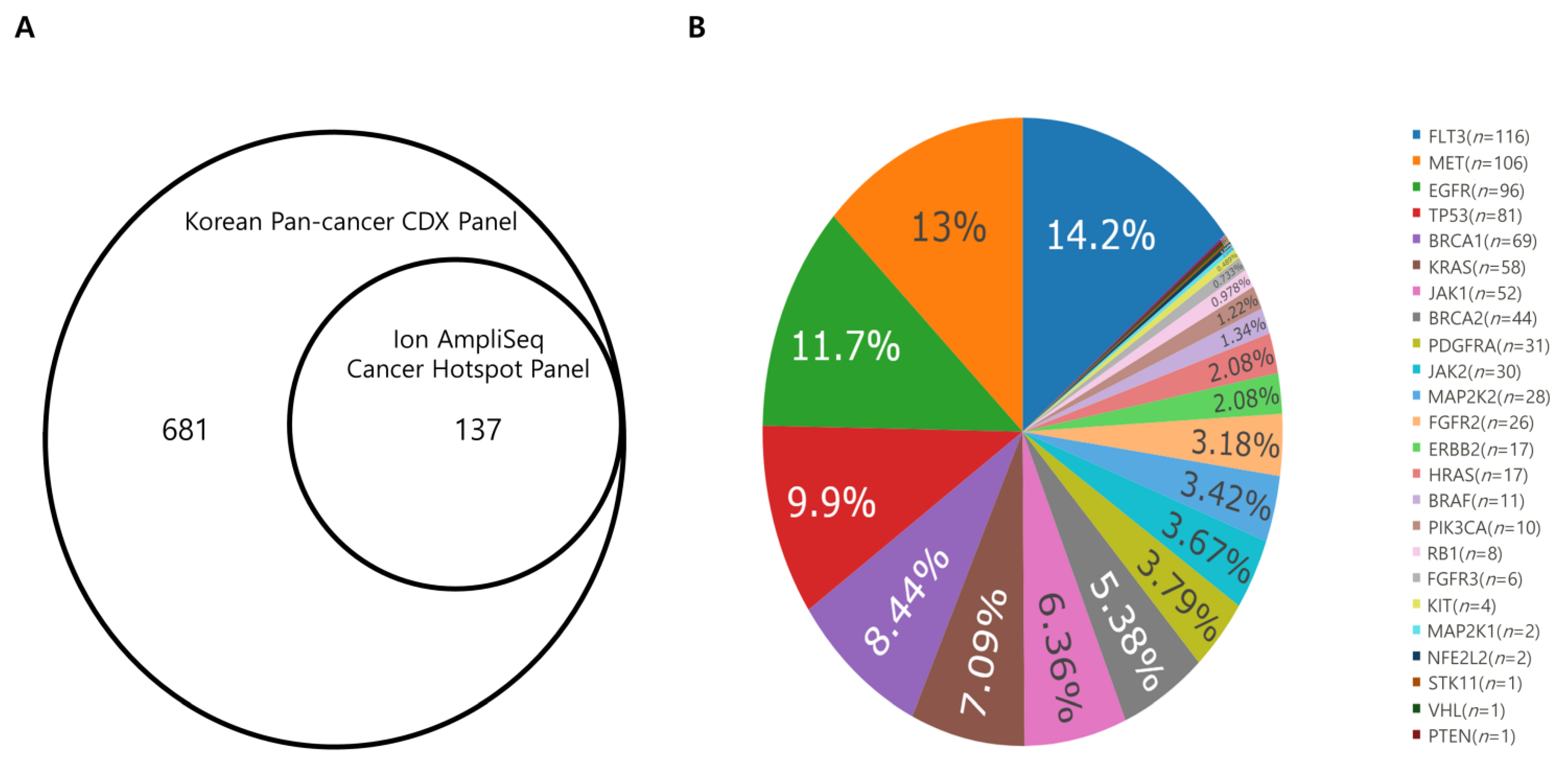
We have developed and analytically validated the Korean Pan-cancer Companion Diagnostic (CDX) Panel to apply targeted anticancer drugs to Korean patients based on the molecular characteristics of tumors using tumor samples without matched patient normal samples. The panel included 31 genes with reported single nucleotide variants, 9 genes with reported copy number variations, and 15 genes with predictive responses to targeted drugs under clinical testing, enabling the panel to be analyzed for the targets of 30 targeted anticancer drugs. It is cost-effective and optimized for cancer type-specific therapy in Korean cancer patients across solid cancer types while minimizing the limitations of existing approaches. This gene screening method is expected to reduce test turnaround time and cost, making it a balanced approach to investigate solid cancer-related gene regions.
Abstract
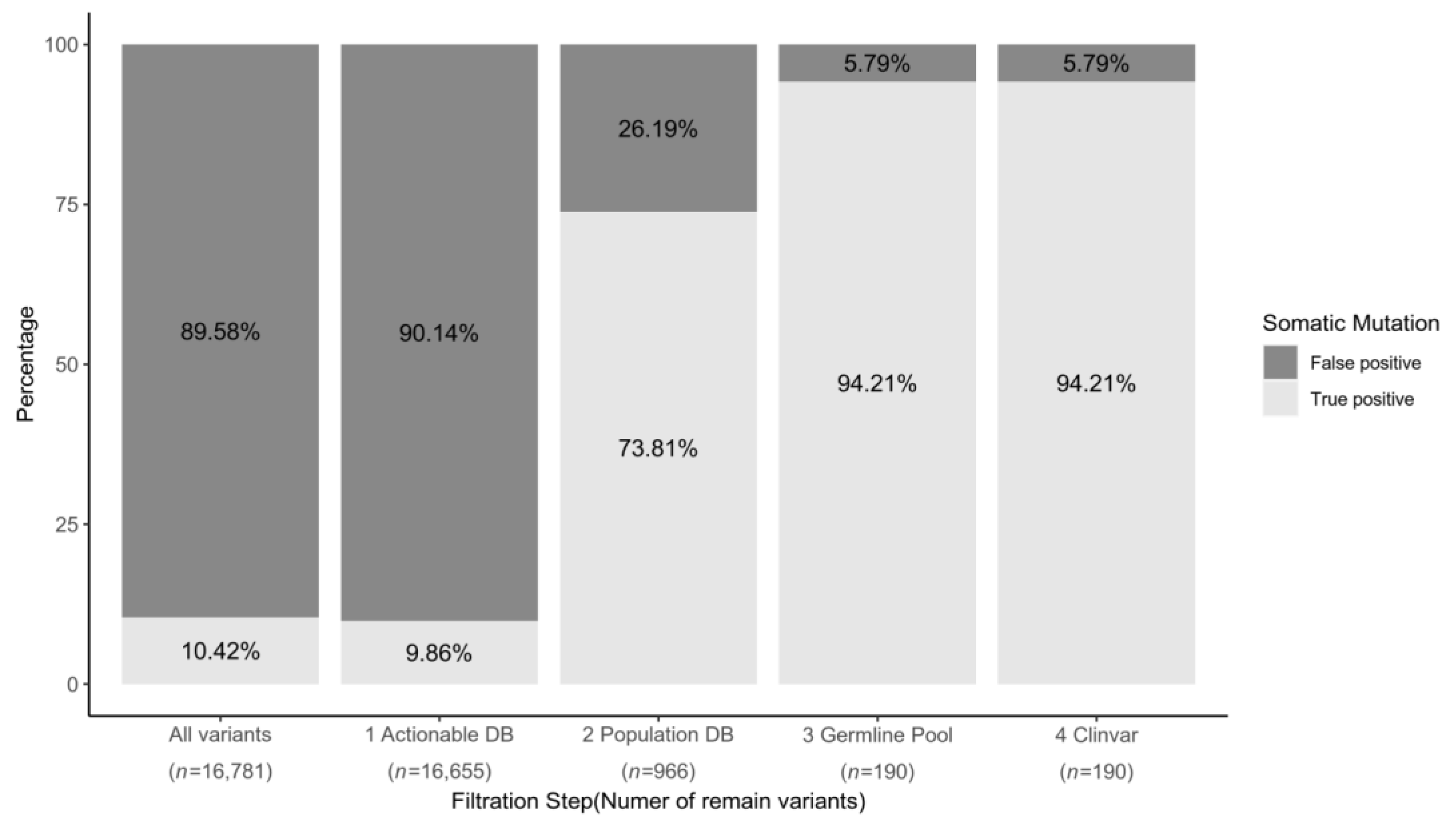
Recently, several panels using two representative targeting methods have been developed but they do not reflect racial specificity, especially for Asians. We have developed and analytically validated the Korean Pan-cancer Companion Diagnostic (CDX) Panel to apply targeted anticancer drugs to Korean patients based on the molecular characteristics of tumors using tumor samples without matched patient normal samples. The panel included 31 genes with reported single nucleotide variants, 9 genes with reported copy number variations, and 15 genes with predictive responses to targeted drugs under clinical testing, enabling the panel to be analyzed for the targets of 30 targeted anticancer drugs. It is cost-effective and optimized for cancer type-specific therapy in Korean cancer patients across solid cancer types while minimizing the limitations of existing approaches. In addition, the optimized filtering protocol for somatic variants from tumor-only samples enables researchers to use this panel without matched normal samples. To verify the panel, 241 frozen tumor tissues and 71 formalin-fixed paraffin-embedded (FFPE) samples from several institutes were registered. This gene screening method is expected to reduce test turnaround time and cost, making it a balanced approach to investigate solid cancer-related gene regions.