TNF-α May Exert Different Antitumor Effects in Response to Radioactive Iodine Therapy in Papillary Thyroid Cancer with/without Autoimmune Thyroiditis

1
ENT Department, University of Medicine and Pharmacy Carol Davila Bucharest, 050474 Bucharest, Romania
2
Electrical Engineering Faculty, University Politehnica of Bucharest, 060042 Bucharest, Romania
3
Department of Radionuclide Therapy, Institute of Oncology Bucharest, 022328 Bucharest, Romania
4
Department of Carcinogenesis and Molecular Biology, Institute of Oncology Bucharest, 022328 Bucharest, Romania
*
Author to whom correspondence should be addressed.
Cancers 2021, 13(14), 3609; https://doi.org/10.3390/cancers13143609
Submission received: 14 June 2021
/
Revised: 13 July 2021
/
Accepted: 14 July 2021
/
Published: 19 July 2021
(This article belongs to the Special Issue Thyroid Cancer: Focus on Invasion and Metastasis Mechanisms, Therapeutic Target and Drug Treatment)
Simple Summary
Recent evidence shows that autoimmune thyroiditis (AIT) may impair the uptake of radioiodine (131I), altering the success of attempted remnant ablation in papillary thyroid cancer (PTC), but the cause is not clear. Finding the mechanisms that govern immune cells during the 131I therapy of PTC with concomitant AIT (PTC + AIT) could provide a rationale for these reports. Our study was conducted on female patients admitted for 131I therapy. In the PTC group, 131I therapy modulates the production of cytokines in situ, increasing the antitumor immune response accordingly. On the contrary, in the presence of chronic inflammation due to AIT, 131I therapy amplifies innate immunity, leading to a weaker development of adaptive, specific immunity.
Abstract
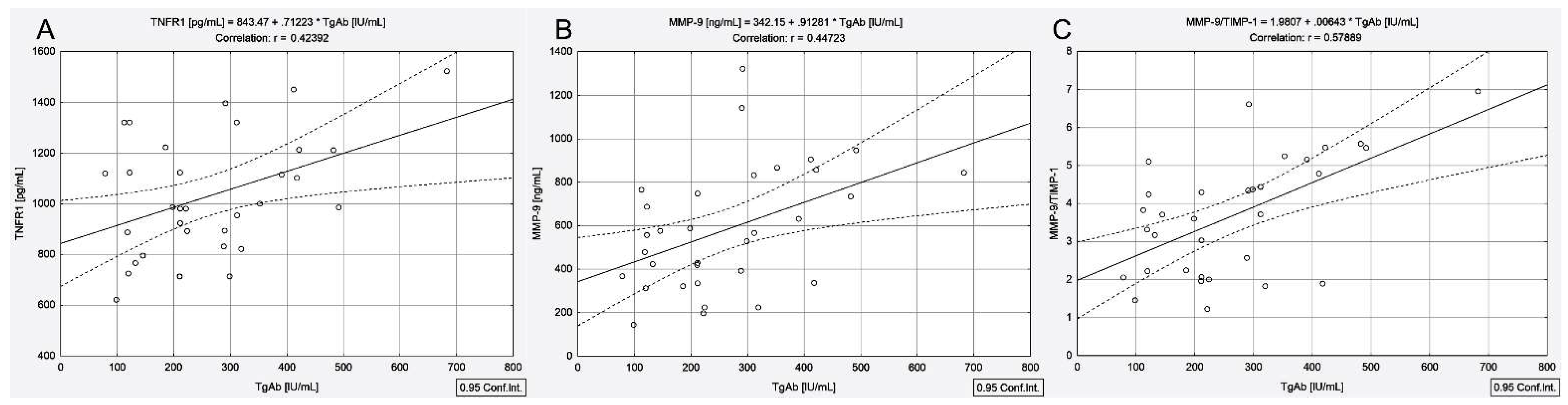
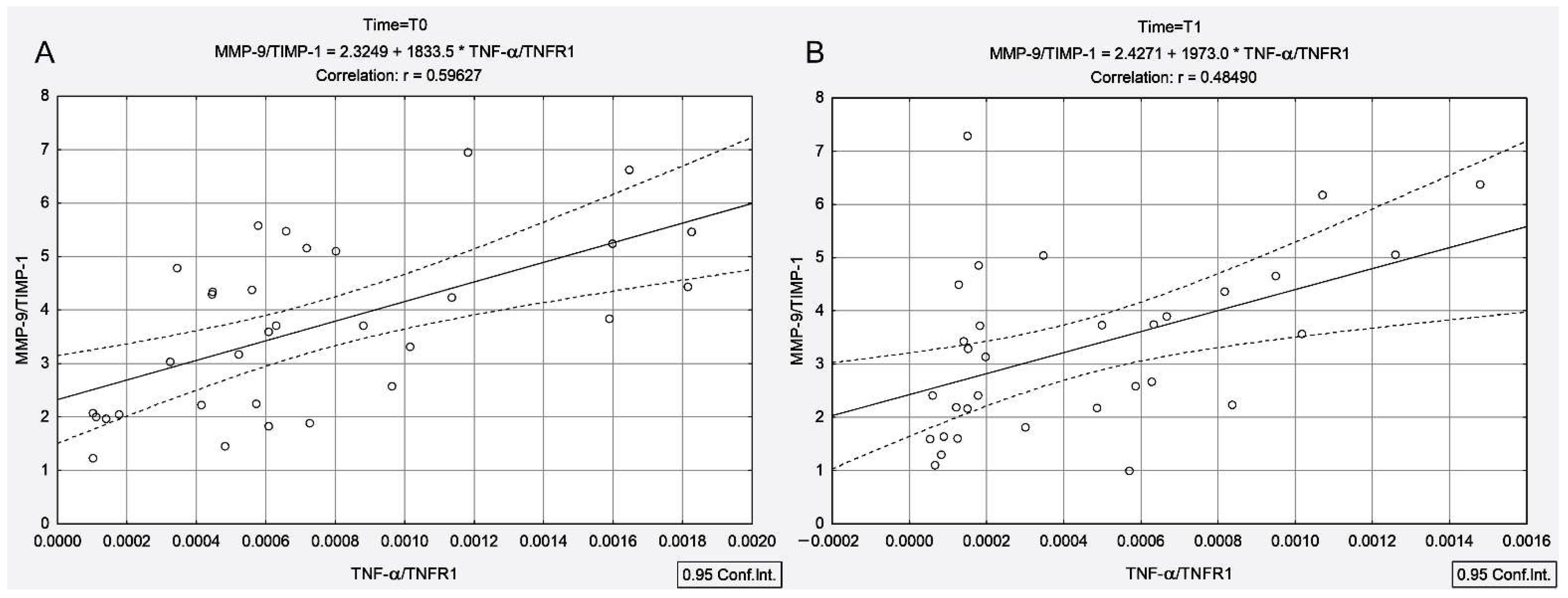
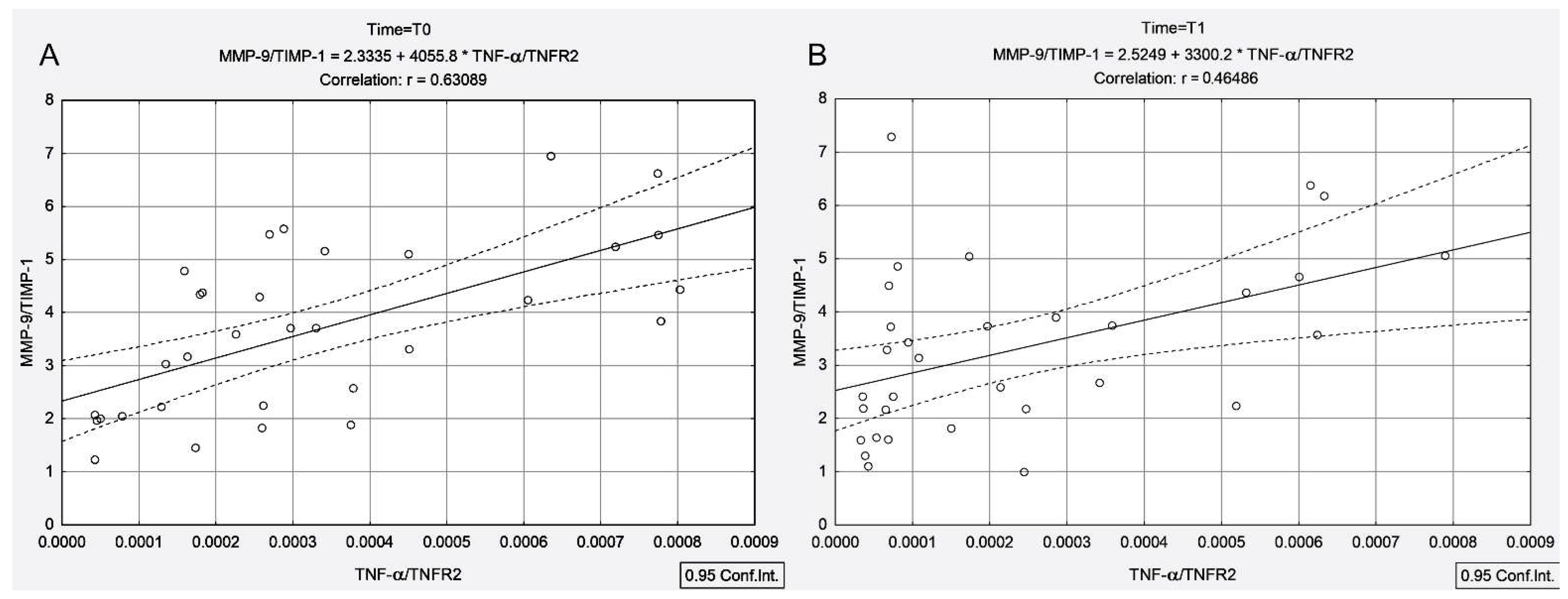
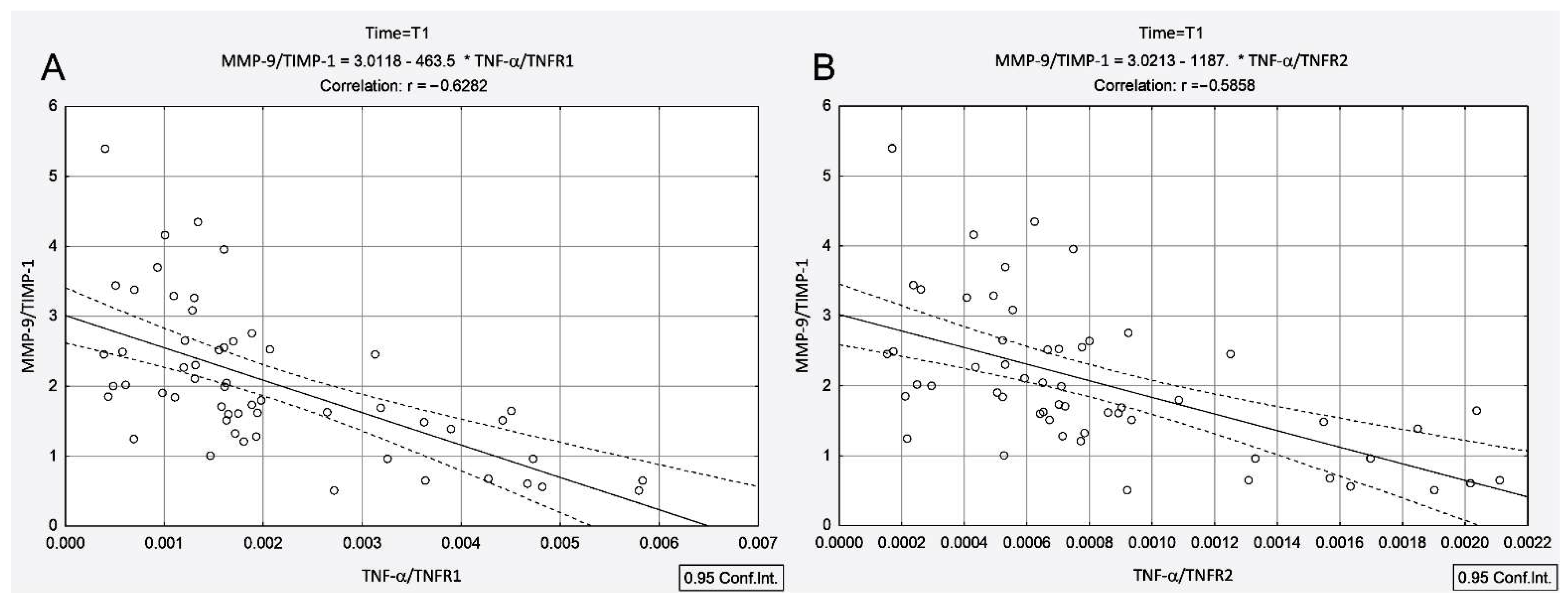
Autoimmune thyroiditis (AIT) may impair radioiodine (131I) uptake in papillary thyroid cancer (PTC). Finding the mechanisms that govern immune cells during 131I therapy of PTC with concomitant AIT (PTC + AIT) could provide a rationale. Our study aimed to evaluate the effects of 131I on anti-thyroglobulin antibodies (TgAb), matrix metalloproteinase-9 (MMP-9) and its tissue inhibitor TIMP-1 and tumor necrosis factor-α (TNF-α) and its receptors TNFR1 and TNFR2, in PTC and PTC + AIT patients. Peripheral blood was collected from 56 female patients with PTC and 32 with PTC + AIT before and 4 days after 131I (3.7 GBq). The serum levels of TgAb, MMP-9, TIMP-1, TNF-α, TNFR1 and TNFR2 were measured by ELISA. The mean radioactivity of blood samples collected after 131I intake was higher in the PTC + AIT group than in PTC (p < 0.001). In the PTC + AIT group, TNF-α/TNFR1 and TNF-α/TNFR2 ratios decreased by 0.38-fold and 0.32-fold after 131I and were positively correlated with the MMP-9/TIMP-1 ratio (r = 0.48, p = 0.005, and r = 0.46, p = 0.007). In the PTC group, TNF-α/TNFR1 and TNF-α/TNFR2 ratios increased by 3.17-fold and 3.33-fold and were negatively correlated with the MMP-9/TIMP-1 ratio (r = −0.62, p < 0.001 and r = −0.58, p < 0.001). Our results demonstrate that TNF-α may exert different antitumor effects in response to 131I therapy depending on the patient’s immune profile.
Keywords:
papillary thyroid cancer; autoimmune thyroiditis; 131I; TgAb; TNF-α; TNFR