Prognostic Impact of let-7e MicroRNA and Its Target Genes in Localized High-Risk Intestinal GIST: A Spanish Group for Research on Sarcoma (GEIS) Study
by
 , , , , , and
Antonio Fernandez-Serra
1, 
David S. Moura
2,
María Dolores Sanchez-Izquierdo
3,
Silvia Calabuig-Fariñas
4,5,6,
Maria Lopez-Alvarez
2,
Andrea Martínez-Martínez
1,
Irene Carrasco-Garcia
2,7,
Marta Ramírez-Calvo
1,
Elena Blanco-Alcaina
2,
Raquel López-Reig
1,
Antonia Obrador-Hevia
8,9,
Regina Alemany
10,
Antonio Gutierrez
11,
Nadia Hindi
2,7 ,
,
Andres Poveda
12,
Jose A. Lopez-Guerrero
1,13,* and
and
Javier Martin-Broto
2,7,*
1
Laboratory of Molecular Biology, Fundación Instituto Valenciano de Oncología, 46009 Valencia, Spain
2
Institute of Biomedicine of Sevilla (IBIS, HUVR, CSIC, Universidad de Sevilla), 41013 Sevilla, Spain
3
Instituto de Investigación Sanitaria La Fe, 46026 Valencia, Spain
4
Molecular Oncology Laboratory, Fundación Investigación, Hospital General Universitario de Valencia, 46014 Valencia, Spain
5
Centro de Investigación Biomédica en Red de Cáncer (CIBEROnc), 28029 Madrid, Spain
6
Department of Pathology, Universitat de València, 46003 Valencia, Spain
7
Medical Oncology Department, University Hospital Virgen del Rocio, 41013 Sevilla, Spain
8
Group of Advanced Therapies and Biomarkers in Clinical Oncology, Institut d’Investigació Sanitària de les Illes Balears (IdISBa-IUNICS), 07120 Palma de Mallorca, Spain
9
Sequencing Unit, University Hospital Son Espases, 07120 Palma de Mallorca, Spain
10
Department of Biology, Balearic Islands University, 07122 Palma de Mallorca, Spain
11
Hematology Department, University Hospital Son Espases, 07120 Mallorca, Spain
12
Medical Oncology Department, Fundación Instituto Valenciano de Oncología, 46009 Valencia, Spain
13
Department of Basic Medical Sciences, School of Medicine, Catholic University of Valencia ‘San Vicente Martir’, 46001 Valencia, Spain
*
Authors to whom correspondence should be addressed.
Cancers 2020, 12(10), 2979; https://doi.org/10.3390/cancers12102979
Submission received: 11 August 2020
/
Revised: 9 September 2020
/
Accepted: 10 October 2020
/
Published: 14 October 2020
(This article belongs to the Special Issue New Therapeutic Advances in Rare Tumors)
Simple Summary
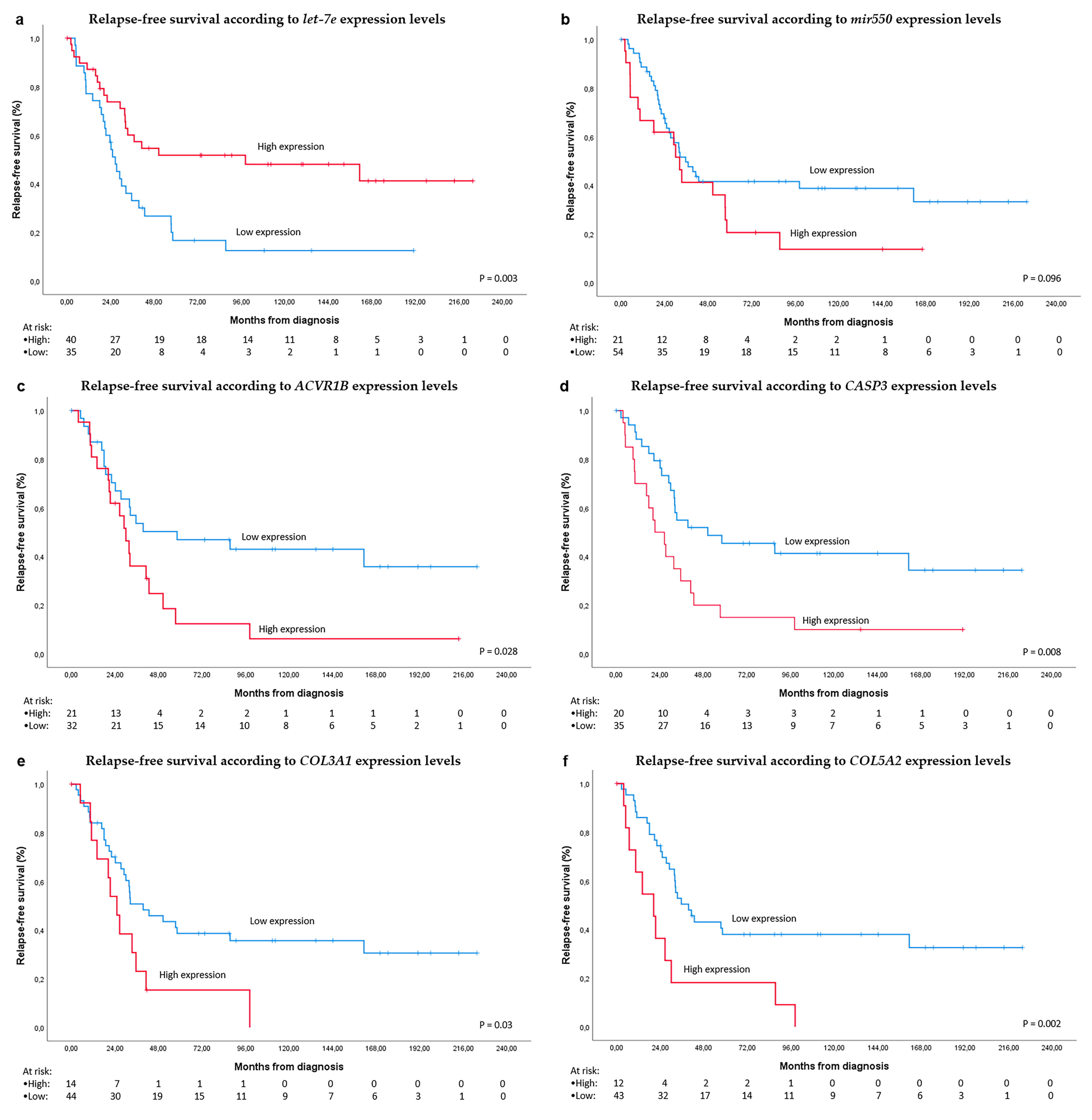
For intestinal localized high-risk gastrointestinal stromal tumors (GIST) patients’ new molecular biomarkers are urgently needed for a more accurate prognosis. In our study, miRNA profiling analyses was planned to explore new molecular biomarkers with potential prognostic role in this clinical context. Our data, revealed that 39 microRNAs (miRNAs) were significantly deregulated when comparing patients with disease relapsed versus non-relapsed cases. The underexpression of a specific miRNA let-7e and the overexpression of 4 of its target genes (ACVR1B, CASP3, COL3A1 and COL5A2) correlated significantly with worse relapse-free survival. Overall, our results suggest that miRNA profiling is a potential molecular tool useful for a more accurate prognosis for intestinal localized high-risk GIST patients.
Abstract
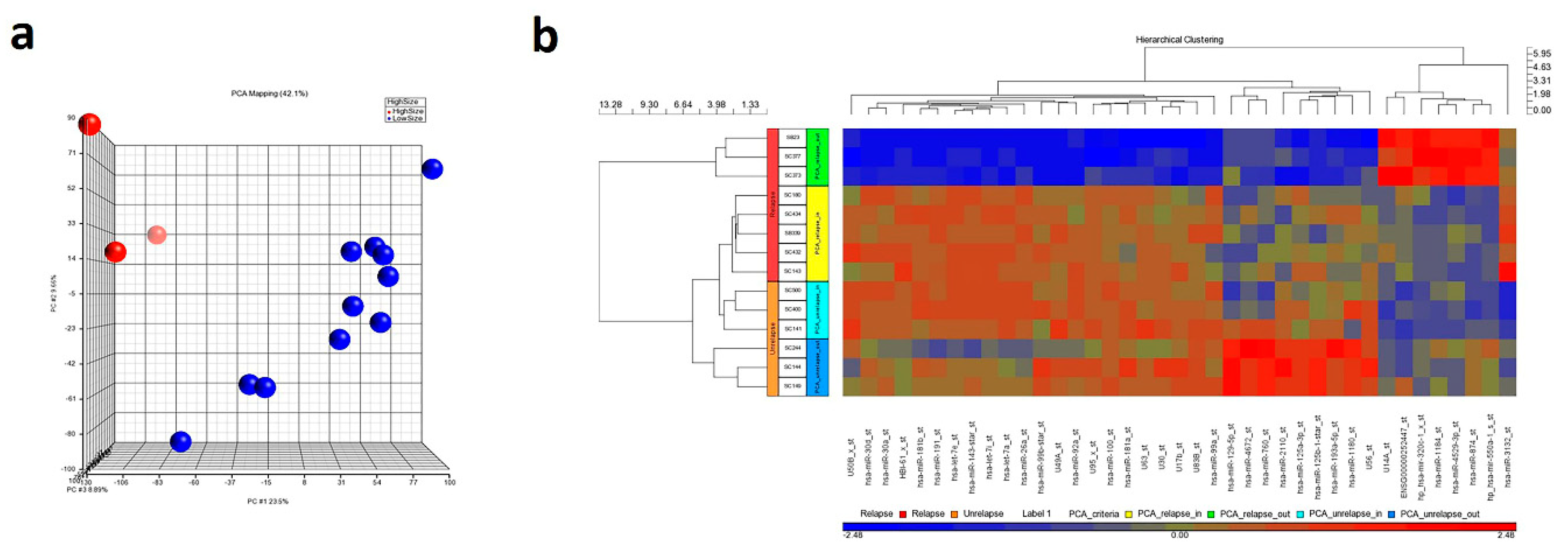
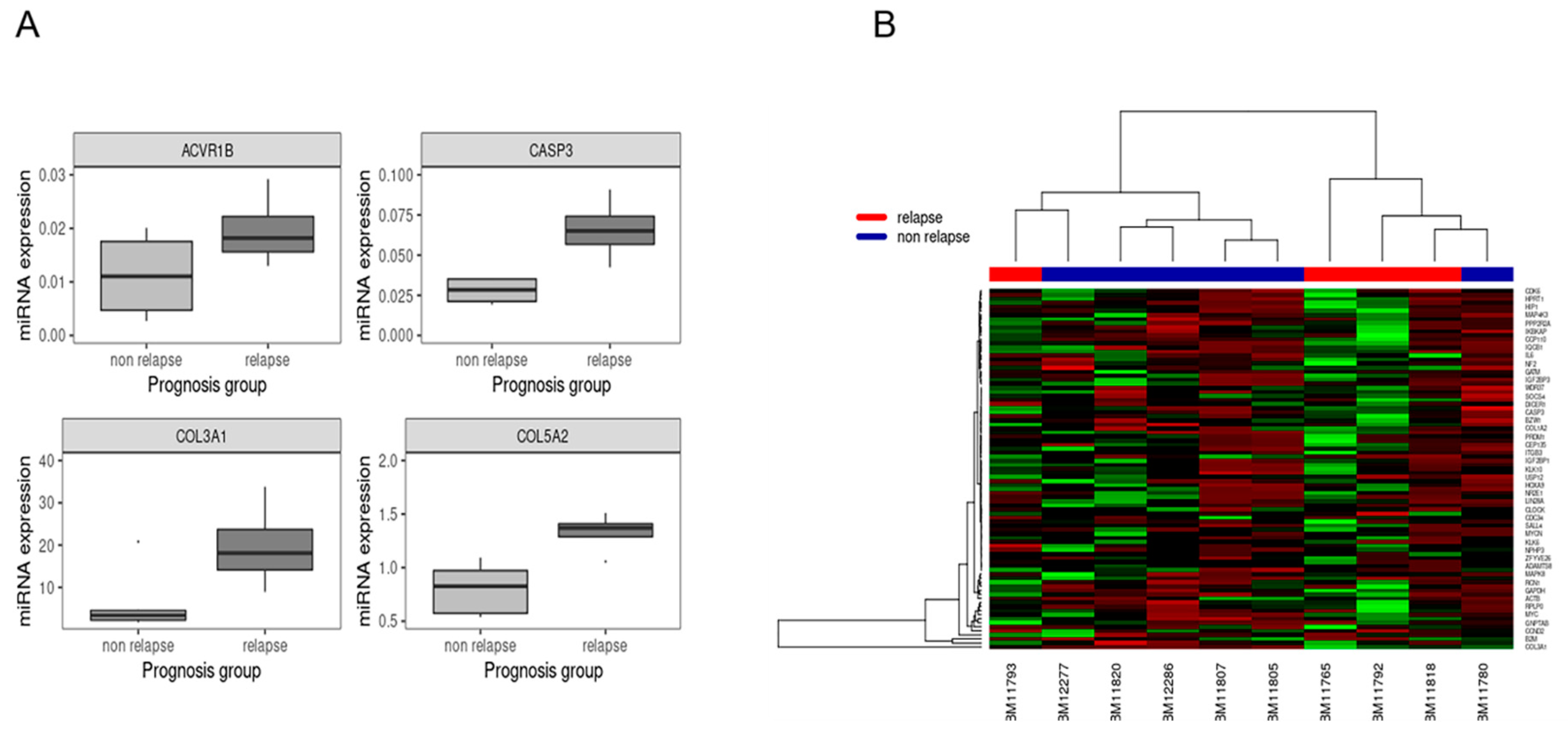
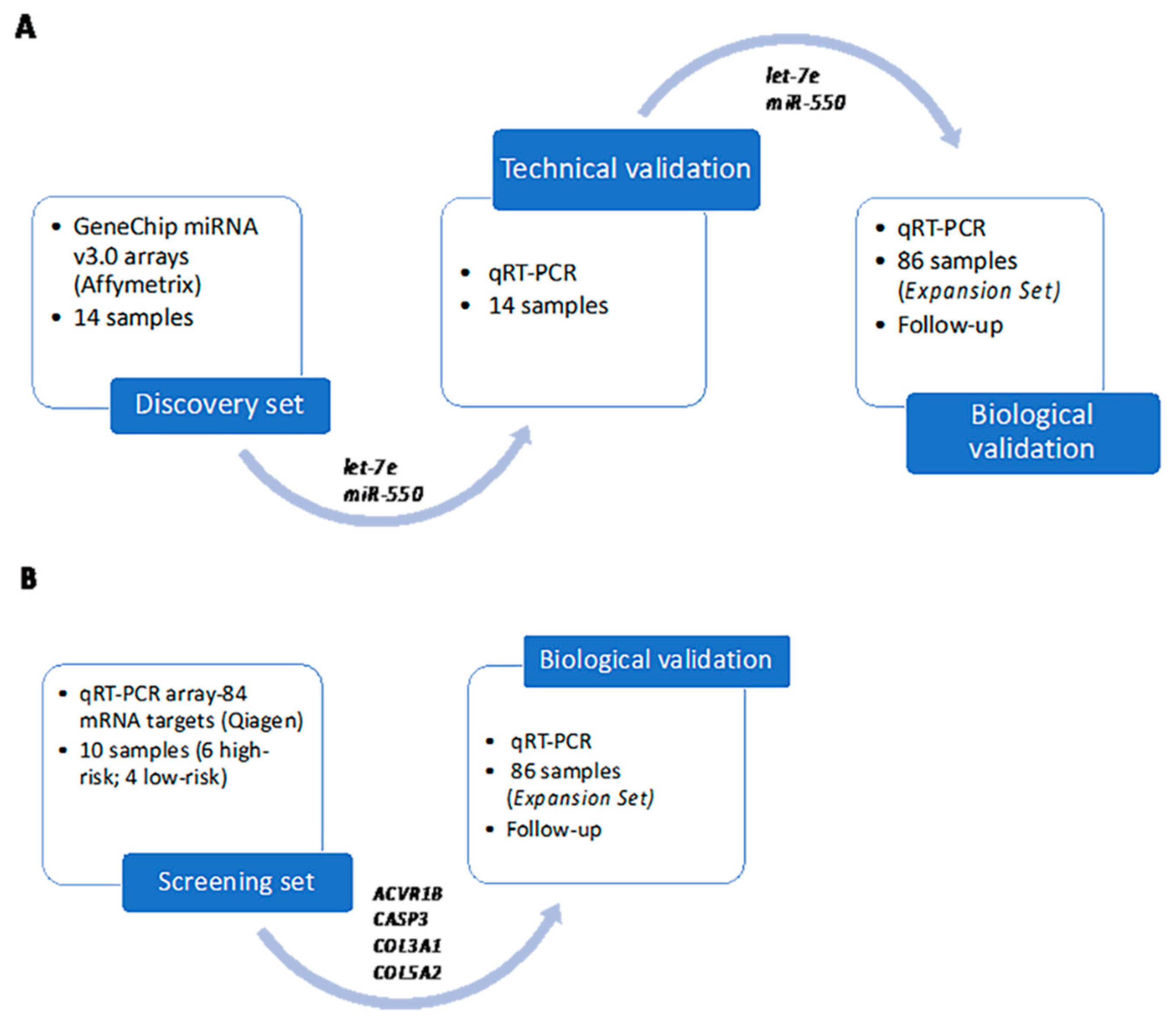
MicroRNAs (miRNAs) are small non-coding RNAs that negatively regulate gene expression at the post-transcriptional level, and they have been described as being associated with tumor prognosis. Here, miRNA profiling was planned to explore new molecular prognostic biomarkers in localized intestinal high-risk GIST. Paraffin tumor blocks of 14 and 86 patients were used in the discovery and expansion sets, respectively. GeneChip miRNA v3.0 was employed to identify the miRNAs differentially expressed between relapsed and non-relapsed patient samples, which were validated in the expansion set, by qRT-PCR. RT2 Profiler PCR Array was used for the screening of let-7e targets. Expression levels were correlated with relapse-free survival and overall survival. In the discovery set, 39 miRNAs were significantly deregulated, let-7e and miR-550 being the most underexpressed and overexpressed miRNAs in the relapsed group, respectively. In the expansion set, the underexpression of let-7e or the overexpression of 4 of its target genes (ACVR1B, CASP3, COL3A1, and COL5A2) were statistically associated with worse relapse-free survival. The expression of let-7e and 4 of its target genes are potential prognostic biomarkers in high-risk localized intestinal GIST. The expression of these genes is a potential molecular tool useful for a more accurate prognosis in this subset of GIST patients.
Keywords:
GIST; let-7e; prognostic biomarkers; caspase-3; miR-550