Article

Hydrothermally Synthesized PPy/VO2 Nanorod Composites for High-Performance Aqueous Zinc-Ion Battery Cathodes

1
School of Information, Hunan University of Humanities, Science and Technology, Loudi 417099, China
2
Key Laboratory of Low-Dimensional Structural Physics and Application, Education Department of Guangxi Zhuang Autonomous Region, College of Physics and Electronic Information Engineering, Guilin University of Technology, Guilin 541004, China
*
Author to whom correspondence should be addressed.
Micromachines 2025, 16(6), 705; https://doi.org/10.3390/mi16060705
Submission received: 11 May 2025 / Revised: 7 June 2025 / Accepted: 11 June 2025 / Published: 13 June 2025
(This article belongs to the Section E: Engineering and Technology)

Abstract

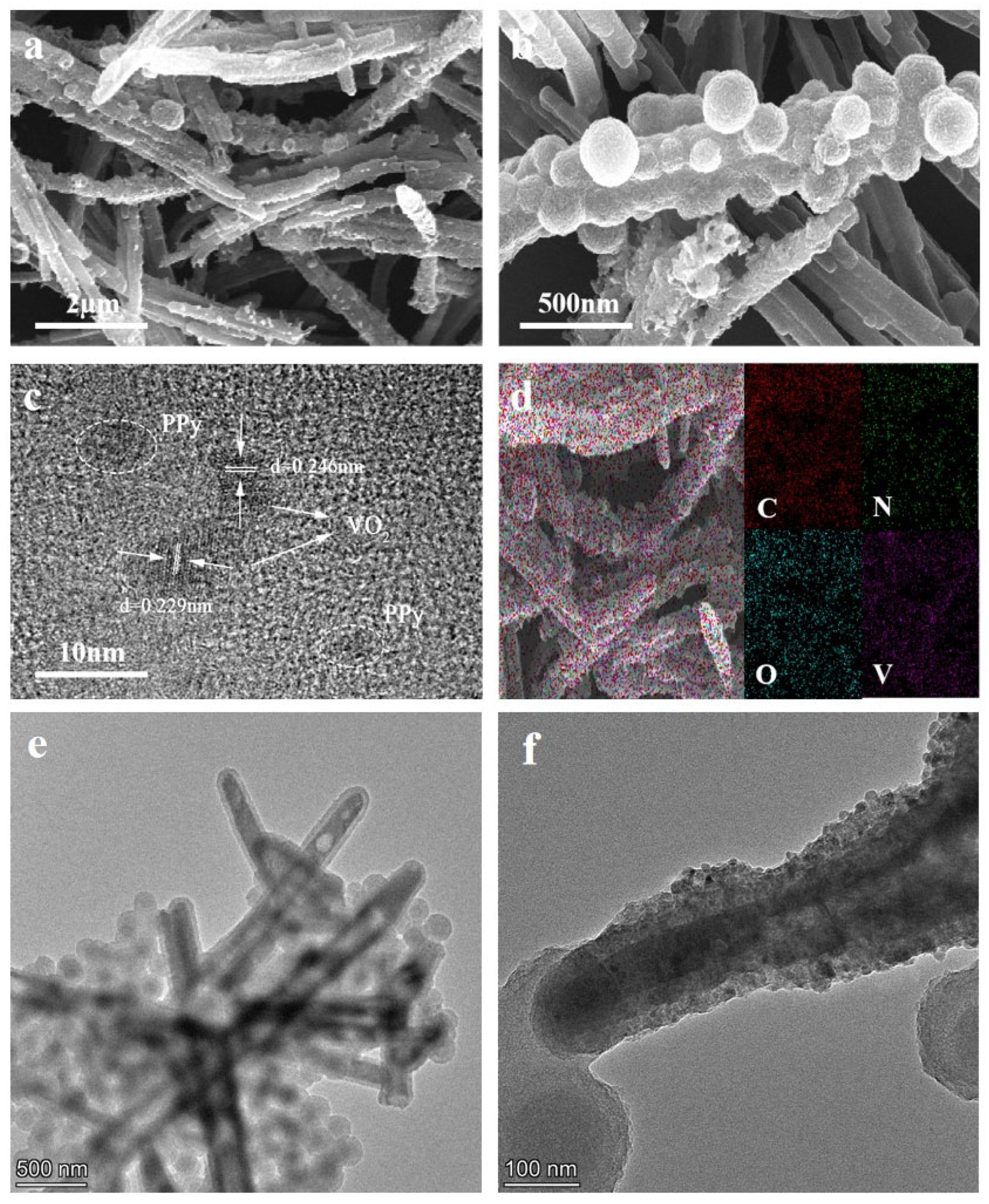
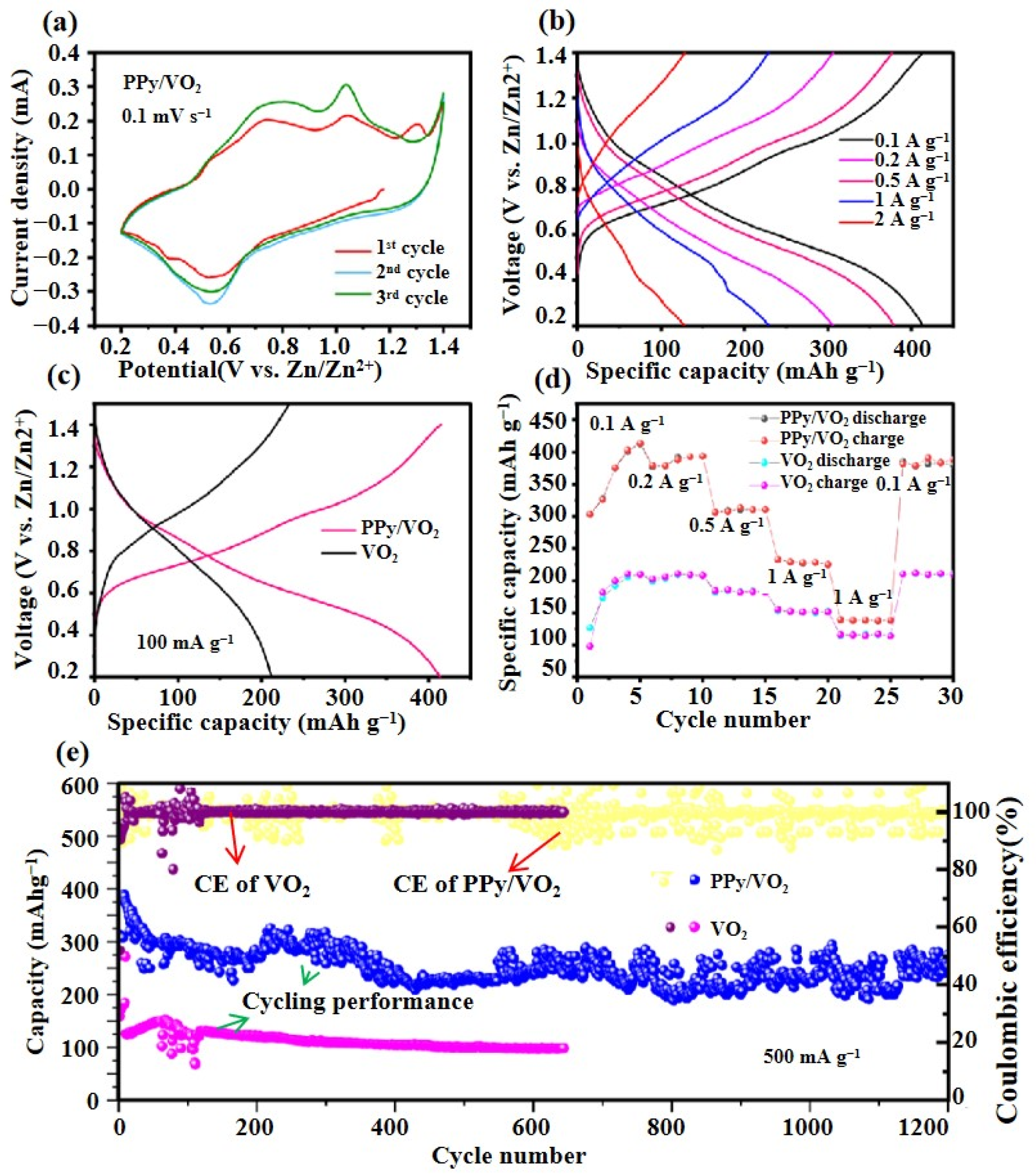
The rapid development of energy storage technologies has led to an increasing demand for high-performance electrode materials that can enhance both the energy density and the cycling stability of batteries. In this study, polypyrrole (PPy) nanorods with partial hollow features are utilized as a conductive and flexible framework for the in situ growth of VO2 nanospheres via a simple hydrothermal method, forming a well-defined core–shell PPy/VO2 nanocomposite. This hierarchical nanostructure combines the excellent electrical conductivity and mechanical flexibility of PPy with the high theoretical capacity of VO2, creating a synergistic effect that significantly enhances the electrochemical performance. The well-integrated interface between PPy and VO2 reduces interfacial resistance, promotes efficient electron and ion transport, and improves the overall energy conversion efficiency. Electrochemical testing reveals that the PPy/VO2 nanocomposite delivers a high specific capacity of 413 mAh g−1 at 100 mA g−1 and retains 87.2% of its initial capacity after 1200 cycles, demonstrating exceptional rate capability and long-term cycling stability. This work provides a versatile strategy for designing high-performance cathode materials and highlights the promising potential of PPy/VO2 nanocomposites for next-generation high-energy-density aqueous zinc-ion batteries.
Keywords: PPy/VO2 hybrid nanocomposite; electrochemical performance; zinc-ion battery; cycling stability; high energy density; hierarchical nanostructure PPy/VO2 hybrid nanocomposite; electrochemical performance; zinc-ion battery; cycling stability; high energy density; hierarchical nanostructure