Optimization and Predictive Modeling of SiC Wafer Dicing Using a Thin Diamond Grinding Wheel via RSM and NSGA-II
 ,
,
Abstract
1. Introduction
2. Experimental Planning
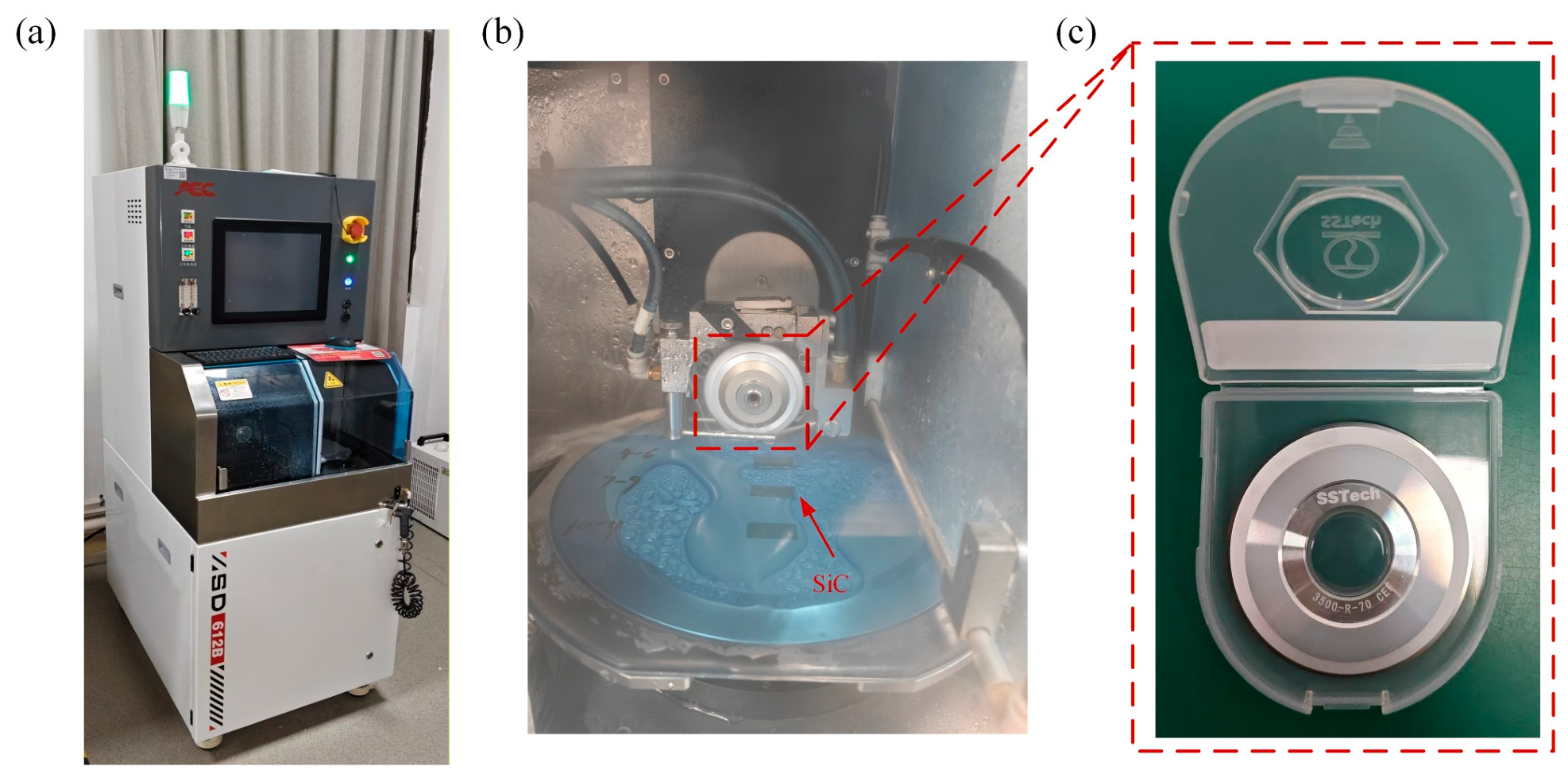
2.1. Experimental Equipment and Materials
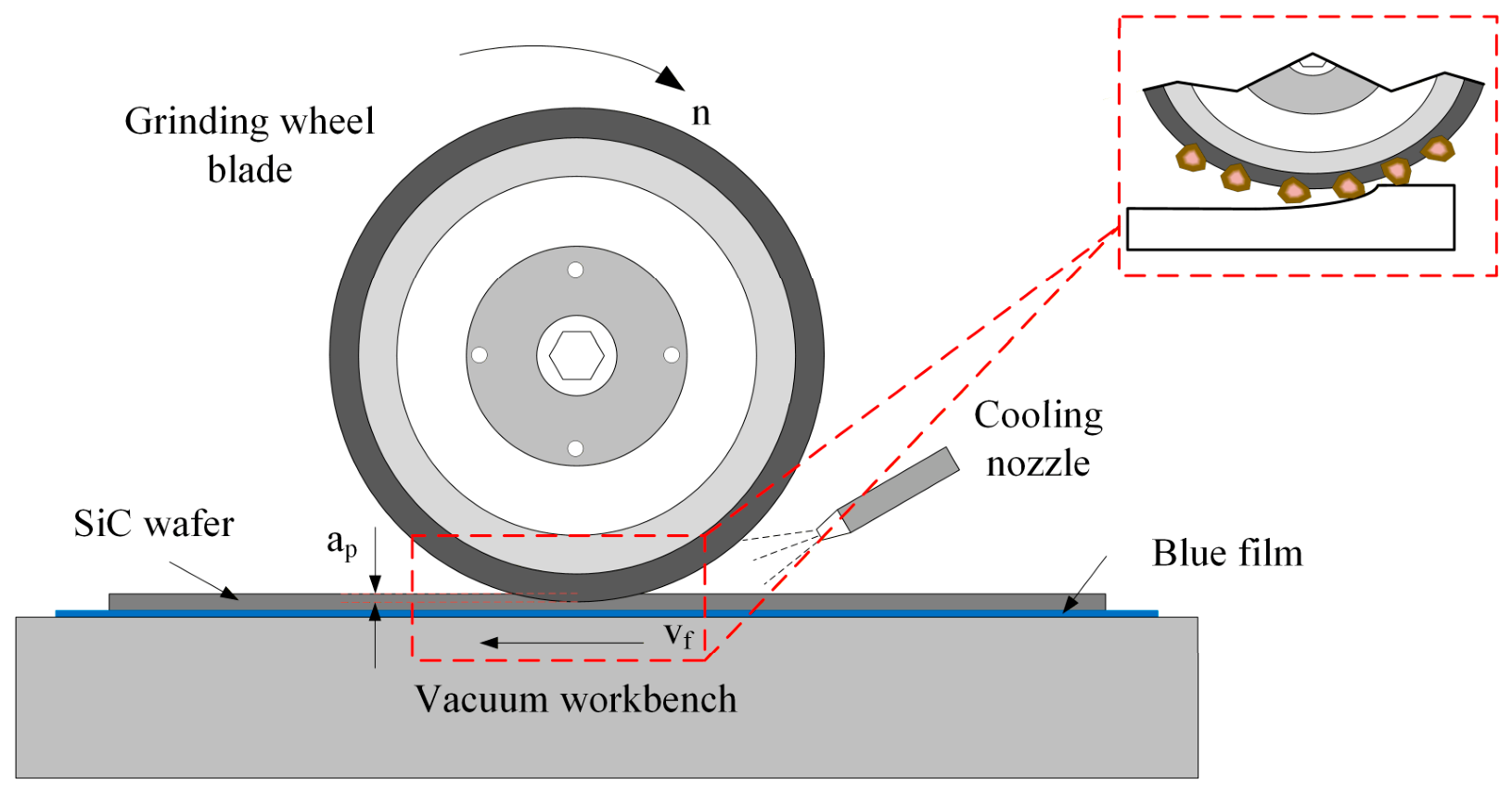
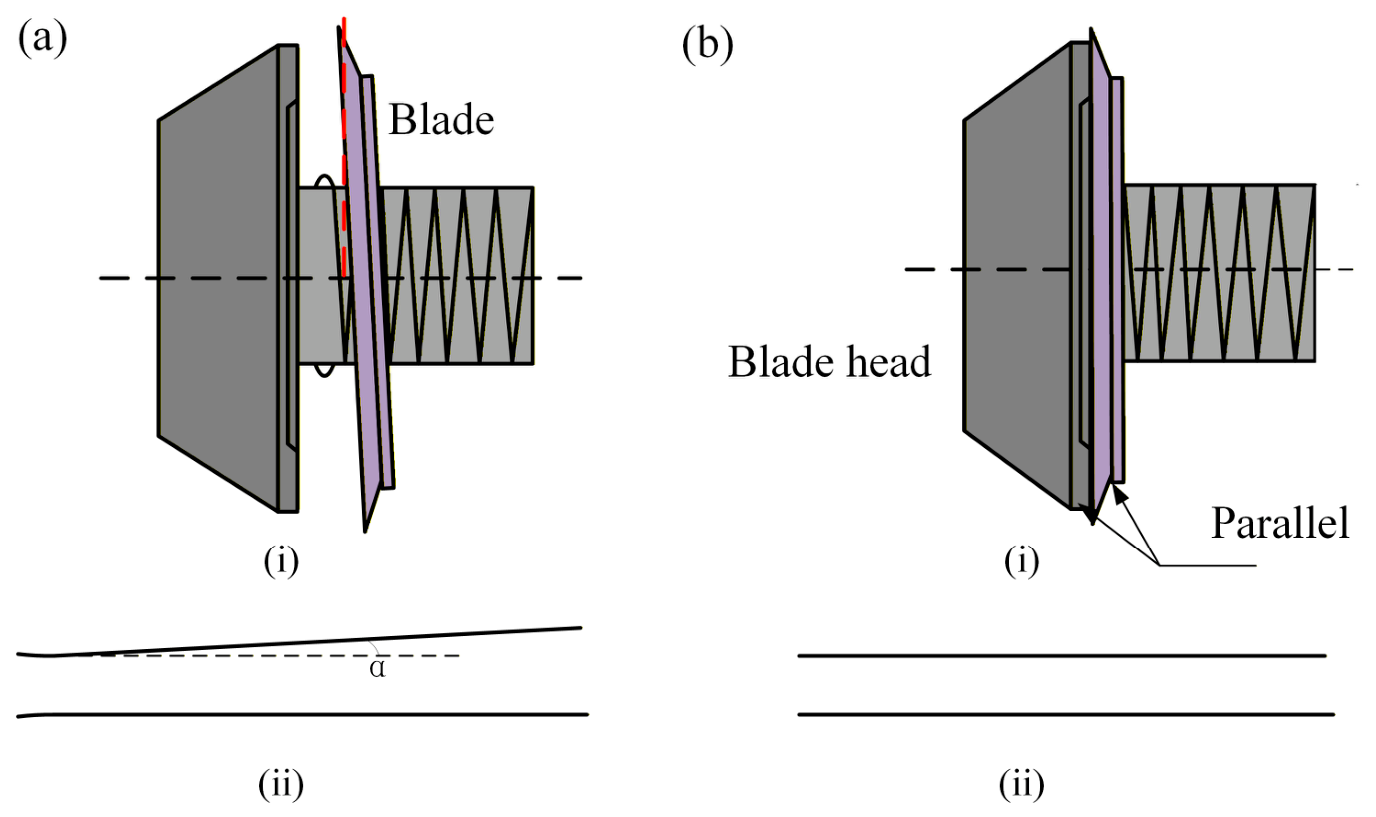
2.2. Experimental Principle
- : The blade exposure measured at the nth time.
- : The blade exposure measured at the (n + 1)th height measurement (n = 1, 2, 3, …).
2.3. Basic Experimental Design and Parameter Screening
2.3.1. Basic Experimental Design
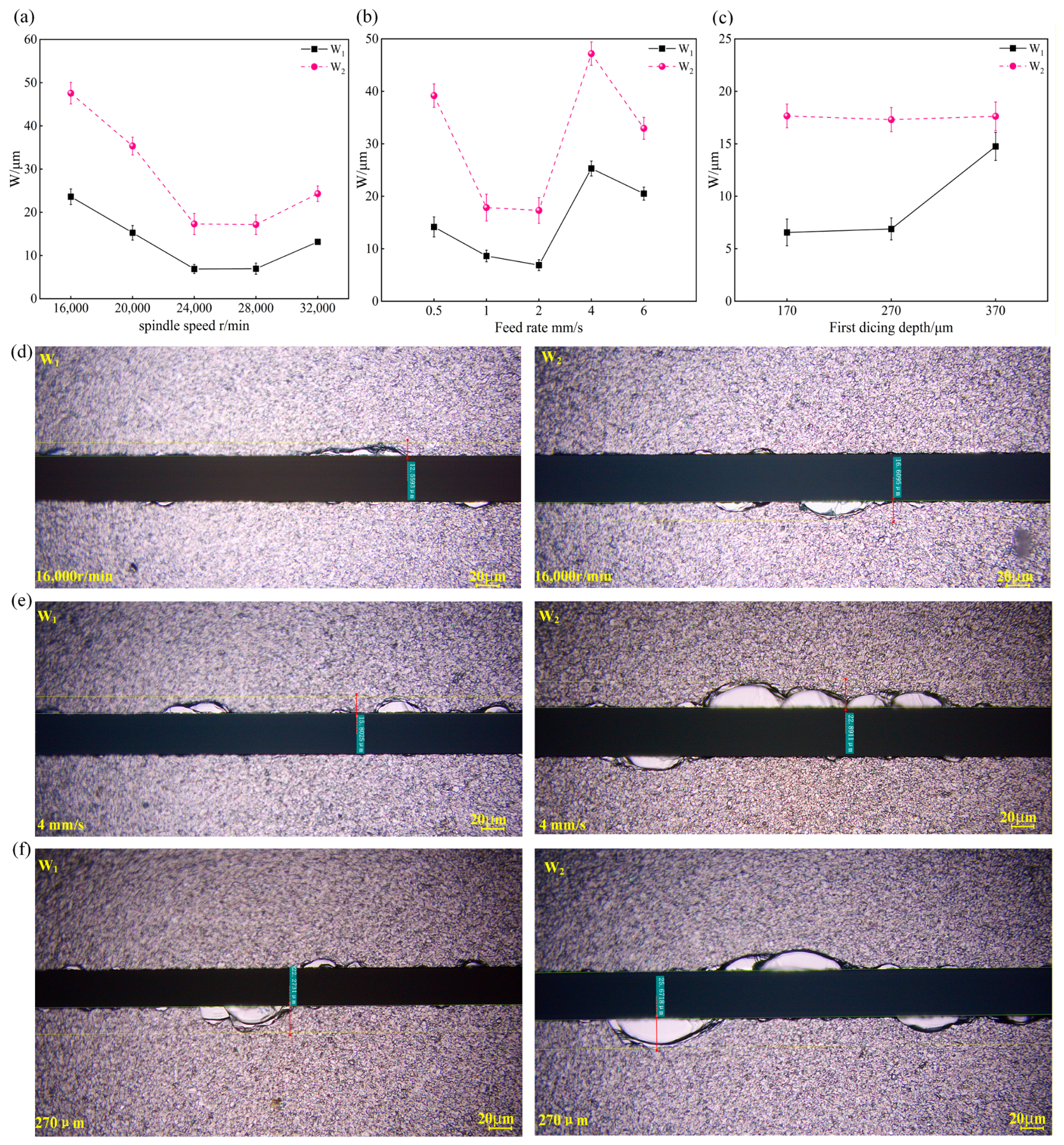
2.3.2. Influence Patterns of Single Factors on W1 and W2 and Parameter Determination
3. Response Surface Experimental Design and Result Analysis
3.1. Experimental Protocol
3.2. Response Surface Analysis
3.2.1. Model Establishment and Variance Analysis
3.2.2. Response Surface Analysis of Various Factors on W1
3.2.3. Response Surface Analysis of Various Factors on W2
3.3. Process Parameter Optimization and Experimental Verification
4. Conclusions
- (1)
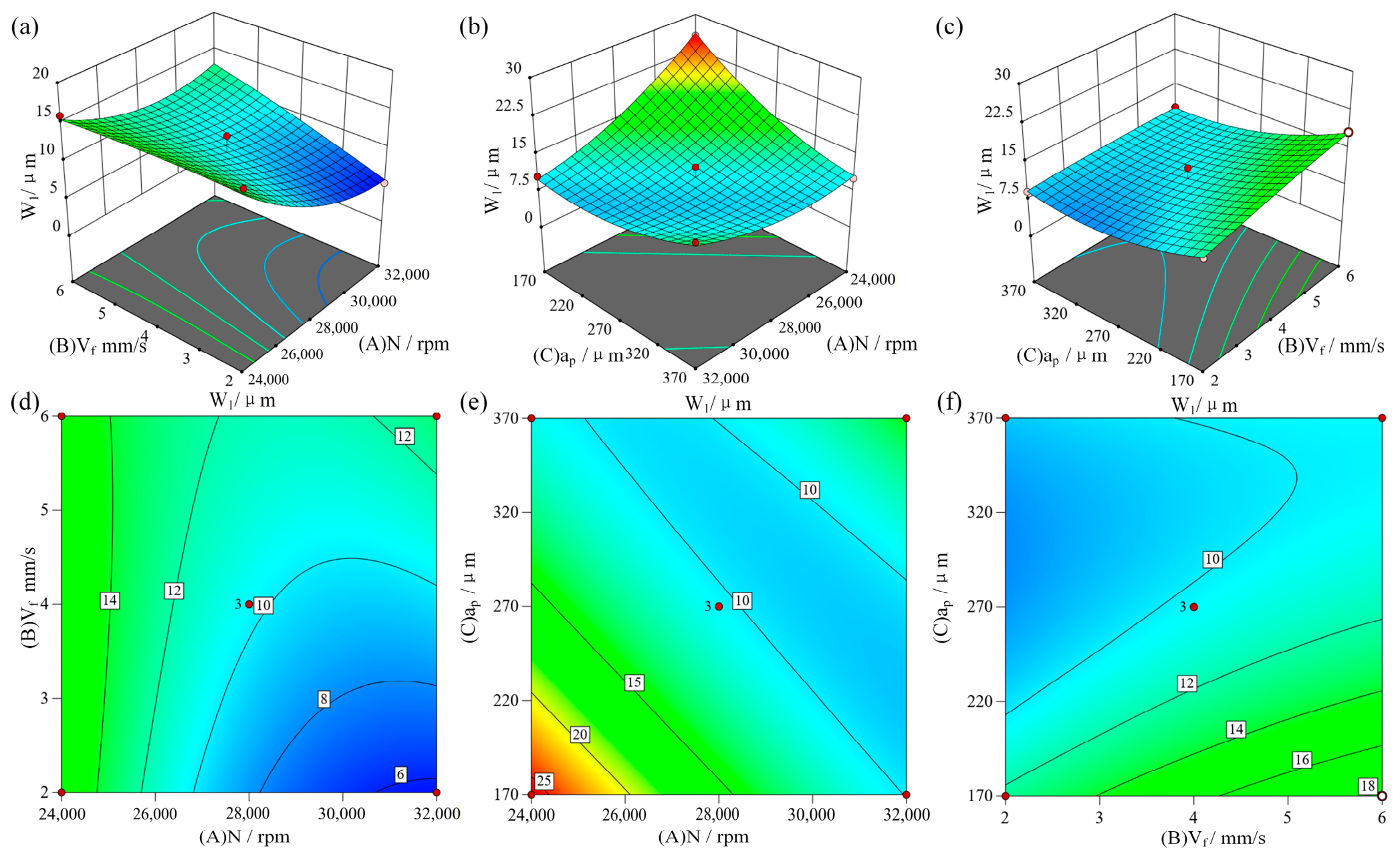
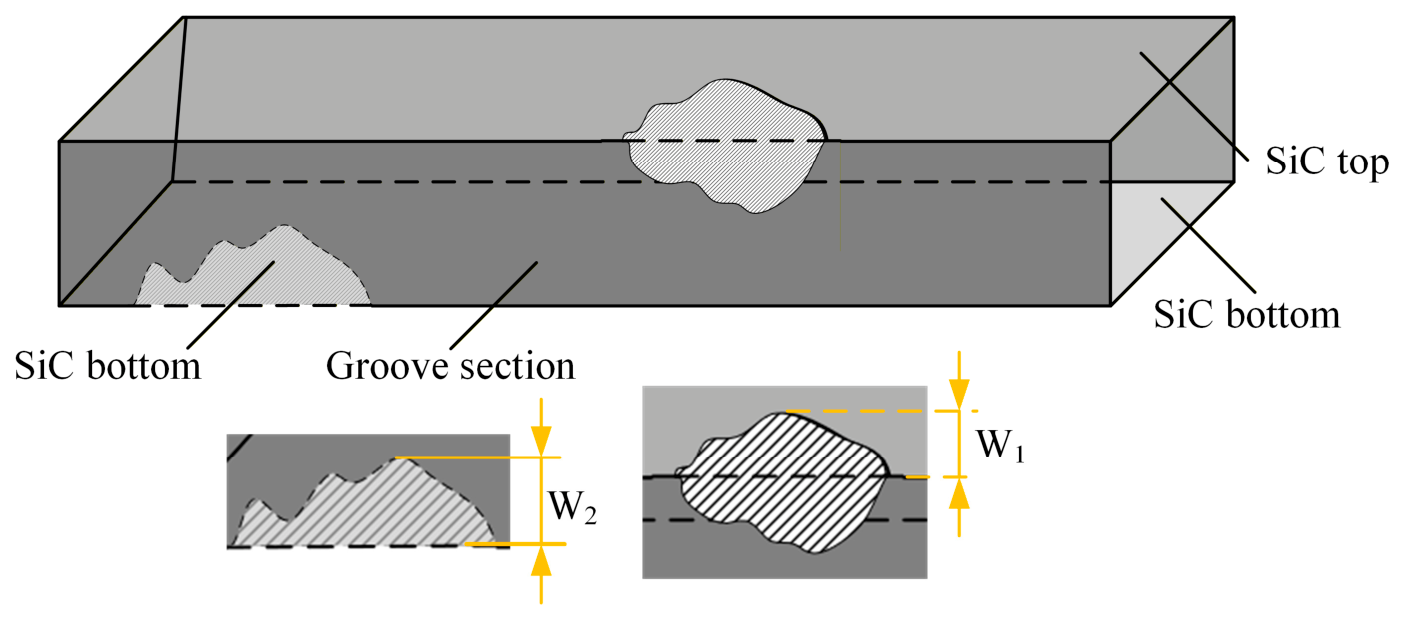
- Spindle speed ranks as the most critical factor affecting maximum chip width W1, followed by the first dicing depth, with feed rate being the least influential. Based on the single-factor experiment, W1 increases with increasing spindle speed and increasing first dicing depth, although the magnitude of change remains relatively small. Within a certain range, the interaction of feed rate with spindle speed and first dicing depth can lead to an overall improvement in W1. When the spindle speed was 28,000 rpm, the feed rate was 2 mm/s, and the first dicing depth was 270 μm, W1 measured less than 9.14 μm.
- (2)
- In the layered dicing process, the difference in the first dicing depth directly affects the extent of variation in W1 and W2. Under a spindle speed of 24,000 r/min and a feed rate of 2 mm/s, the front maximum chipping width W1 initially decreases and then increases with the first dicing depth, while the back maximum chipping width W2 first increases slowly and then rapidly as the first dicing depth increases.
- (3)
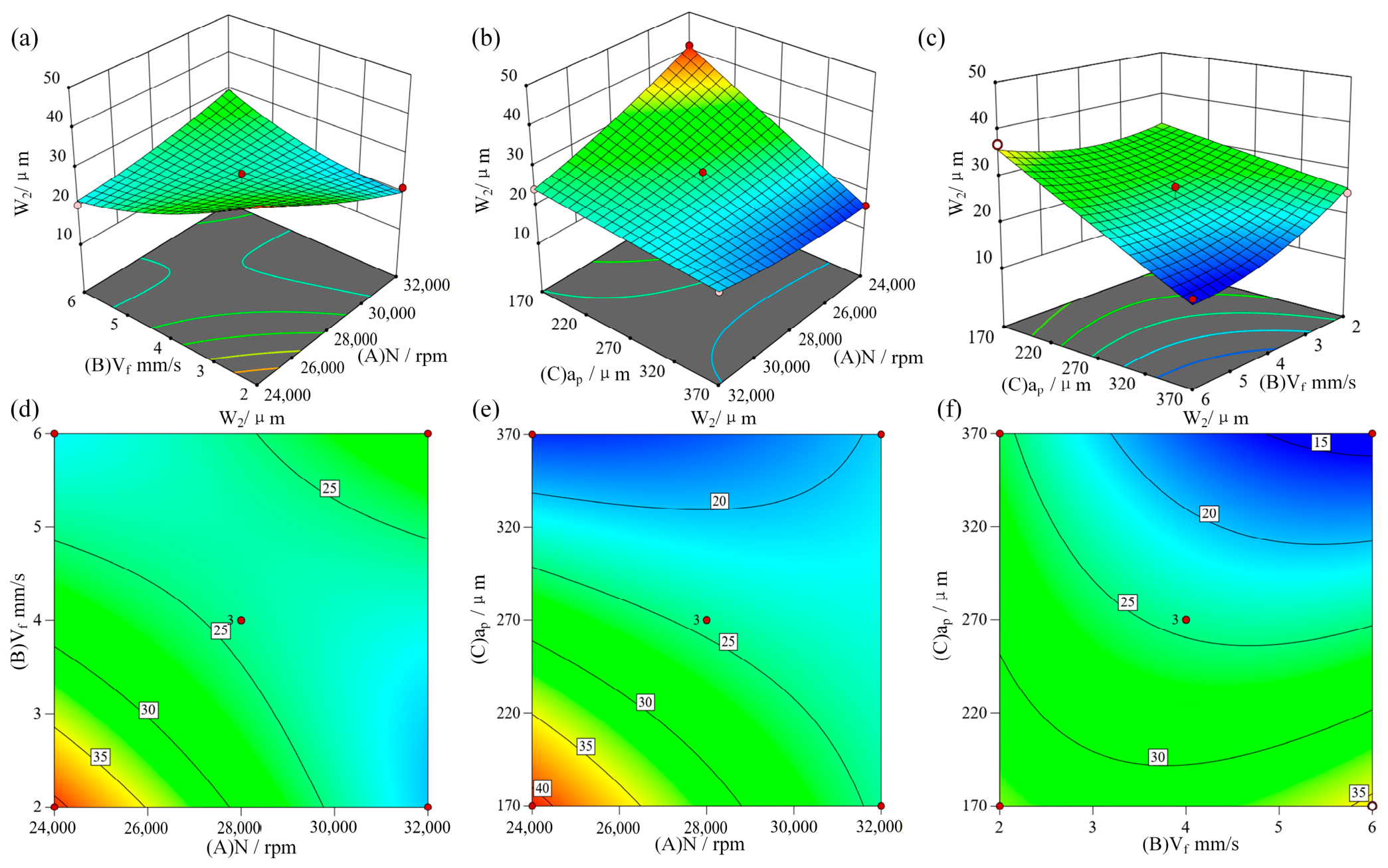
- Preventing the combination of low spindle speed and low feed rate can effectively prevent W2 from becoming excessively large. By strictly controlling the first dicing depth, the accumulation of subsurface damage inside the workpiece can be reduced, thereby suppressing the expansion of the back-side chipping width. In the response surface model, when the spindle speed was held constant, the back maximum chipping width W2 decreased rapidly with simultaneous increases in the first dicing depth and the feed rate, reaching a minimum of 14.83 μm.
- (4)
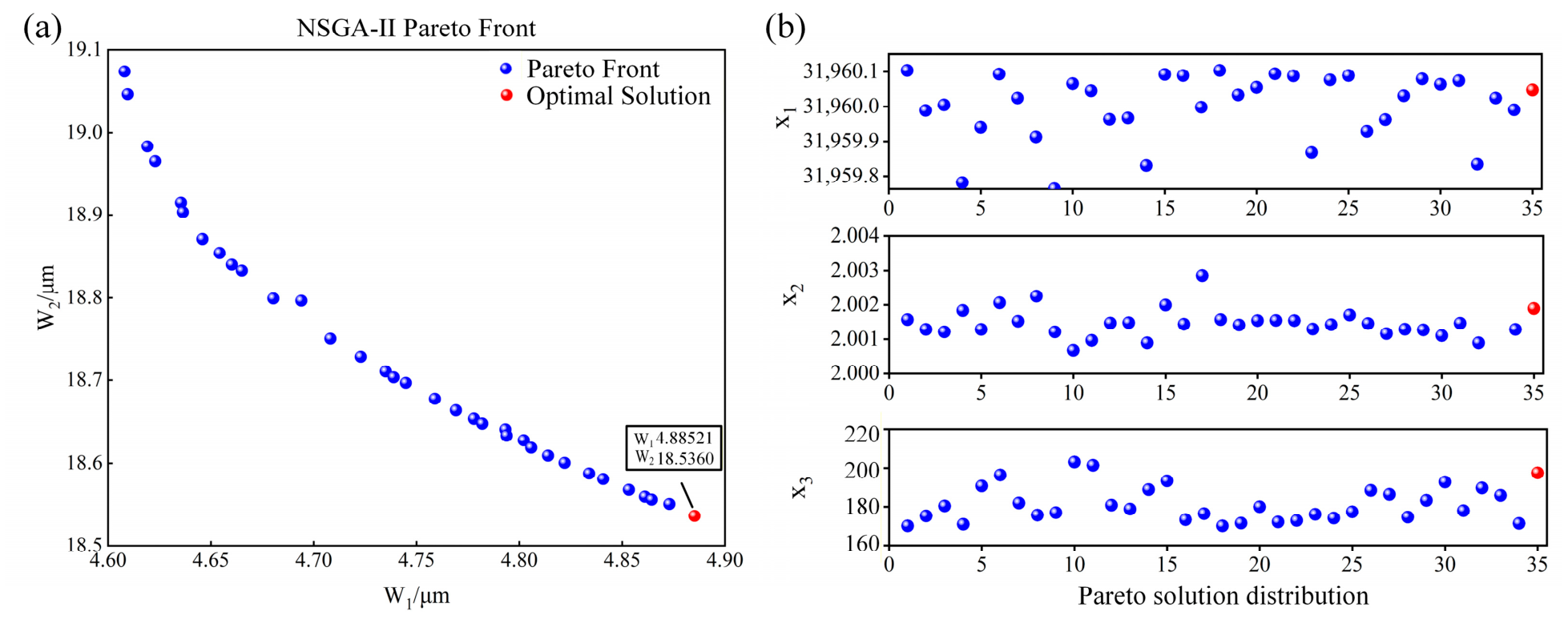
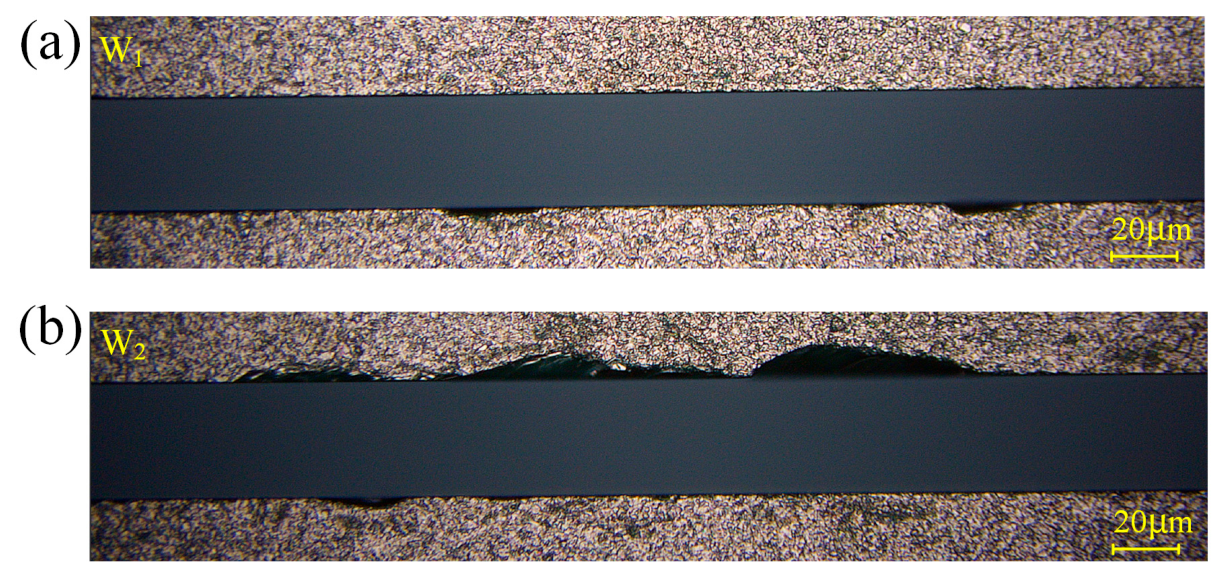
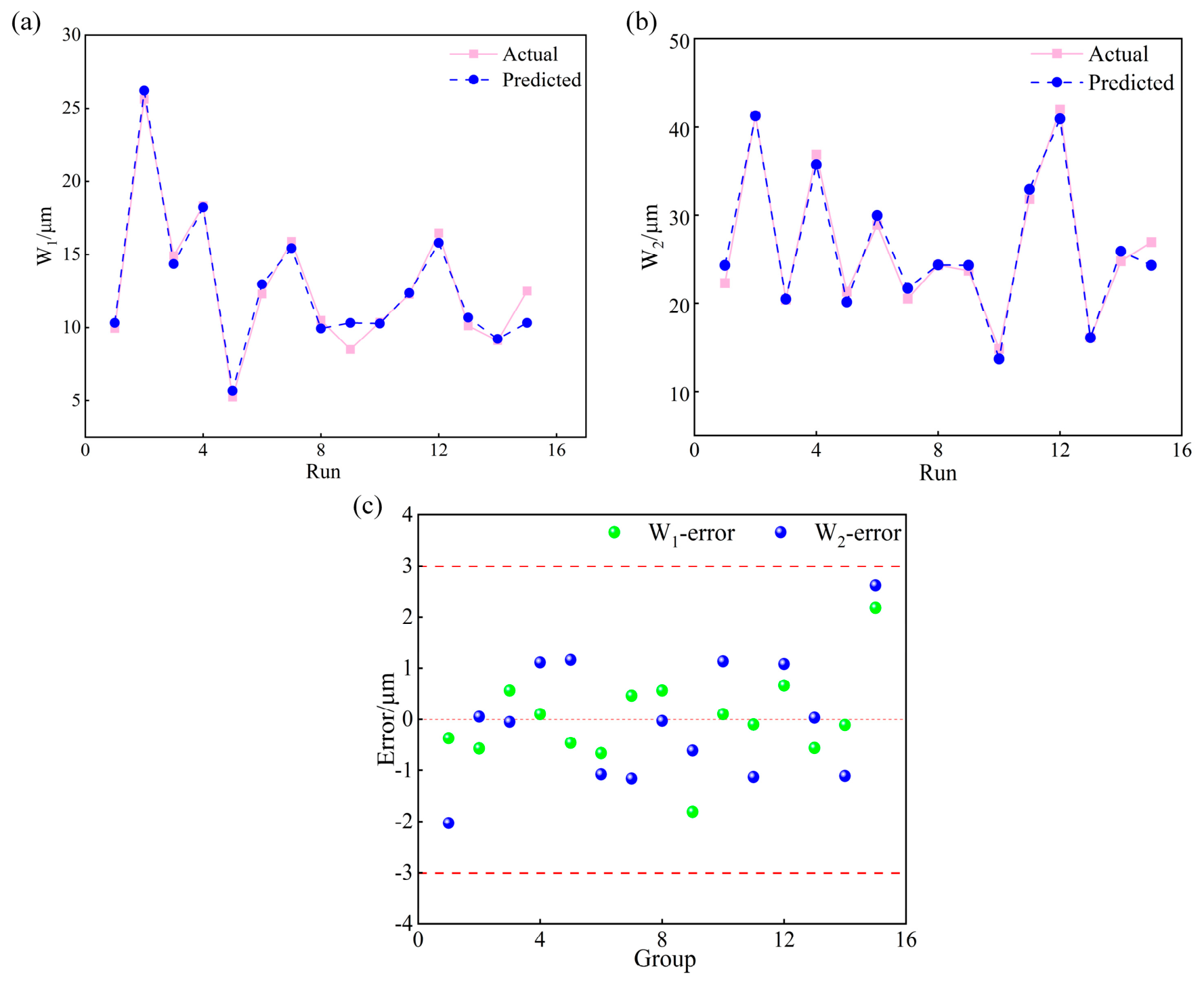
- Based on the response surface analysis, quadratic regression models for W1 and W2 were established. The NSGA-II multi-objective optimization algorithm was employed to determine the optimal parameter combination, which was then validated experimentally. The resulting relative errors for W1 and W2 were 2.83% and 4.43%, respectively, both falling within 5%. These results confirm the validity of the prediction models for W1 and W2 and provide a reliable reference for improving the dicing quality of silicon carbide in the future.
Author Contributions
Funding
Institutional Review Board Statement
Informed Consent Statement
Data Availability Statement
Conflicts of Interest
References
- Musolino, M.; Carria, E.; Crippa, D.; Preti, S.; Azadmand, M.; Mauceri, M.; Isacson, M.; Calabretta, M.; Messina, A. Development of n-type epitaxial growth on 200 mm 4H-SiC wafers forthe next generation of power devices. Microelectron. Eng. 2023, 274, 111976. [Google Scholar] [CrossRef]
- Hu, H.L.; Li, Q.Z.; She, W.J.; Zou, X.; Lu, Z.T.; Chen, G.; Wang, Y.D.; Wan, Y.X. Effect of Laser Slicing on Stress and Wafer Shape of 4H-SiC Substrates. J. Synth. Cryst. 2026, 55, 378–386. [Google Scholar]
- He, J.J.; Guan, J.H.; Wang, M. A Brief Analysis of the Application and Research Progress of Silicon Carbide Ceramics in the Semiconductor Industry. Ceramics 2025, 10, 77–78+89. [Google Scholar]
- Zulkifle, C.N.S.B.C.; Kenshin, H.; Junji, M. High-efficiency wafer-scale finishing of 4H-SiC (0001) surface using chemical-free electrochemical mechanical method with a solid polymer electrolyte. Diam. Relat. Mater. 2021, 120, 108700. [Google Scholar] [CrossRef]
- Chen, F.J.; Du, M.L.; Feng, M.; Bao, R.; Jing, L.; Hong, Q.; Xiao, L.W.; Liu, J. Recent Advances in Precision Diamond Wheel Dicing Technology. Micromachines 2025, 16, 1188. [Google Scholar] [CrossRef]
- Wang, Y.F.; Li, Z.X.; Chen, F.J.; Xu, Z.Q. Processing Characteristics of Ultra-Precision Cutting of 4H-SiC Wafers by Dicing Blade. Micromachines 2026, 17, 187. [Google Scholar] [CrossRef]
- Araujo, L.A.O.; Foschini, C.R.; Jasinevícius, R.G.; Fortulan, C.A. Precision dicing of hard materials with abrasive blade. Int. J. Adv. Manuf. Technol. 2016, 86, 2885–2894. [Google Scholar] [CrossRef]
- Li, D.Y.; Wang, C.J.; He, N.Q. Optimized for Silicon Wafer Dicing Blade Machining and Grinding Parameters of Structure. Manuf. Technol. 2025, 25, 67–75. [Google Scholar] [CrossRef]
- Yin, S.H.; Yang, H.L.; Chen, F.J.; Geng, J.X.; Zhang, J.J. Experimental Research on Step Cut Process of Silicon Wafer. Surf. Technol. 2018, 47, 1–7. [Google Scholar]
- Yan, L.T.; Chen, X.H.; Li, H.Y.; Zhang, Q.J. Investigation on focused ultrasound-assisted diamond wire sawing of silicon carbide. Int. J. Adv. Manuf. Technol. 2023, 128, 3251–3259. [Google Scholar] [CrossRef]
- Su, T.J.; Chen, Y.F.; Cheng, J.C.; Chiu, C.L. Optimizing the dicing saw parameters of 60 μm wafer dicing street. Microsyst. Technol. 2018, 24, 3965–3971. [Google Scholar] [CrossRef]
- Shi, J.; Liu, W.; Chen, Z.; Cao, W.; Zhou, L. Optimization method of cutting parameters of wafer dicing saw based on orthogonal regression design. SN Appl. Sci. 2022, 4, 262. [Google Scholar] [CrossRef]
- Ma, Y.; Jiang, X.Q.; Liu, H.; Zhang, Z.Z.; Cao, Z.D. Simulation analysis of influencing factors of grinding wheel scribing quality. J. Phys. Conf. Ser. 2022, 2301, 012022. [Google Scholar] [CrossRef]
- Sun, H.C.; Wang, H.B.; Xu, Y.; Xie, L.Y. Optimization Method of Cutting Process Parameters for Dicing Saw. J. Northeast. Univ. 2017, 38, 531–535. [Google Scholar]
- Kurniawan, R.; Kiswanto, G.; Ko, T.J.; Chen, S.; Teng, H.; Kwak, Y.; Ali, S.; Han, P.W.; Kim, G.S. Analysis of novel ultrasonic dicing blade design utilizing resonance impedance model. Int. J. Adv. Manuf. Technol. 2025, 141, 5761–5780. [Google Scholar] [CrossRef]
- Chang, B.R.; Tsai, H.F.; Mo, H.Y. Ensemble meta-learning-based robust chipping prediction for wafer dicing. Electronics 2024, 13, 1802. [Google Scholar] [CrossRef]
- Chen, F.; Bao, R.; Du, M.L.; Cheng, M.; Peng, J.H. Multi-Objective Optimization of Material Removal Characteristics for Robot Polishing of Ti-6Al-4V. Micromachines 2026, 17, 146. [Google Scholar] [CrossRef]
- Mukras, S.M.; Omar, H.M.; Al-Mufadi, F.A. Experimental-based multi-objective optimization of injection molding process parameters. Arab. J. Sci. Eng. 2019, 44, 7653–7665. [Google Scholar] [CrossRef]
- Kahhal, P.; Ghasemi, M.; Kashfi, M.; Ghorbani-Menghari, H.; Kim, J.H. A multi-objective optimization using response surface model coupled with particle swarm algorithm on FSW process parameters. Sci. Rep. 2022, 12, 2837. [Google Scholar] [CrossRef] [PubMed]
- Zhang, Z.R.; Wu, F.; Wu, A. Research on multi-objective process parameter optimization method in hard turning based. Processes 2024, 12, 950. [Google Scholar] [CrossRef]
- Patil, S.S.; Gadakh, V.S.; Shinde, V.B.; Khemnar, N.S.; Uyala, S.B. Grinding process parameter optimization to enhance surface finish using NSGA-II algorithm: An integrated experimental and evolutionary approach. J. Eng. Appl. Sci. 2026, 73, 61. [Google Scholar] [CrossRef]
- Wang, X.; Yuan, Z.W.; Zhuang, P.; Wu, T.Z.; Feng, S. Study on precision dicing process of SiC wafer with diamond dicing blades. Nanotechnol. Precis. Eng. 2021, 4, 49–57. [Google Scholar] [CrossRef]
- Li, M.; Mu, D.K.; Wu, Y.Q.; Huang, G.Q.; Meng, H.; Xu, X.P.; Huang, H. Influence of diamond abrasives on material removal of single crystal SiC in mechanical dicing. J. Mater. Process. Technol. 2024, 327, 118390. [Google Scholar] [CrossRef]
- Luo, S.Y.; Fan, Y.T.; Li, J.; Liu, Y.J.; Li, G. Multi-objective optimization on hot rolling process parameters for aerospacenickel-based alloy drum-shaped parts based on RSM and NSGA-II. Forg. Stamp. Technol. 2025, 50, 140–149. [Google Scholar]
- Wang, J.Y.; Shen, G.X.; Zhang, R.X.; Gu, W.T.; Zhao, W.S. Multi-objective Parameter Optimization for Reciprocated TravellingWire EDM by Using RSM-PSO. Electromach. Mould 2018, 5, 24–28+37. [Google Scholar]







| Hard Blade Series | SSTYE | Concentration | 70 |
|---|---|---|---|
| Abrasive type | SD Synthetic Diamond | Blade Length/mm | 0.89~1.02 |
| Abrasive Grain Size | 3500 | Kerf Width/mm | 0.040~0.050 |
| Bond Hardness | R Hard | Blue Film SPV 224SRB | t = 0.08 mm |
| Factor Name | Low Level | Medium Level | High Level |
|---|---|---|---|
| Spindle Speed r/min | 24,000 | 28,000 | 32,000 |
| Feed Rate mm/s | 2 | 4 | 6 |
| Dicing Depth/μm | 170 | 270 | 370 |
| Index | Response Variable | Response Volume | |||
|---|---|---|---|---|---|
| N r/min | Vf mm/s | ap/mm | W1/μm | W2/μm | |
| 1 | 24,000 | 2 | 0.27 | 16.4600 | 41.9884 |
| 2 | 32,000 | 2 | 0.27 | 5.2321 | 21.3061 |
| 3 | 24,000 | 6 | 0.27 | 15.8926 | 20.5339 |
| 4 | 32,000 | 6 | 0.27 | 12.3021 | 28.8760 |
| 5 | 24,000 | 4 | 0.17 | 25.6322 | 41.3085 |
| 6 | 32,000 | 4 | 0.17 | 10.5029 | 24.3427 |
| 7 | 24,000 | 4 | 0.37 | 10.1196 | 16.1161 |
| 8 | 32,000 | 4 | 0.37 | 14.9193 | 20.4212 |
| 9 | 28,000 | 2 | 0.17 | 12.2723 | 31.8096 |
| 10 | 28,000 | 6 | 0.17 | 18.3310 | 36.8518 |
| 11 | 28,000 | 2 | 0.37 | 9.1143 | 24.7939 |
| 12 | 28,000 | 6 | 0.37 | 10.3690 | 14.8284 |
| 13 | 28,000 | 4 | 0.27 | 9.9527 | 22.2849 |
| 14 | 28,000 | 4 | 0.27 | 8.5128 | 23.7037 |
| 15 | 28,000 | 4 | 0.27 | 12.5022 | 26.9297 |
| Source | W1 | W2 | ||
|---|---|---|---|---|
| F | p | F | p | |
| Model | 16.94 | 0.0031 | 24.83 | 0.0012 |
| A (Spindle speed) | 36.72 | 0.0018 | 18.27 | 0.0079 |
| B (Feed rate) | 11.08 | 0.0208 | 10.34 | 0.0236 |
| C (First dicing depth) | 28.66 | 0.0031 | 98.84 | 0.0002 |
| AB | 6.77 | 0.0481 | 49.25 | 0.0009 |
| AC | 46.12 | 0.0011 | 26.45 | 0.0036 |
| BC | 2.68 | 0.1625 | 13.17 | 0.0151 |
| A2 | 10.38 | 0.0234 | 1.19 | 0.3254 |
| B2 | 0.1663 | 0.7003 | 6.28 | 0.0541 |
| C2 | 10.81 | 0.0218 | 0.004 | 0.9521 |
| Lack of Fit | 0.2124 | 0.8812 | 0.5914 | 0.6777 |
| R2 | 0.9683 | / | R2 | 0.9781 |
| Adjusted R2 | 0.9111 | / | Adjusted R2 | 0.9387 |
| Predicted R2 | 0.8231 | / | Predicted R2 | 0.8093 |
| Experimental Group | Group 1 | Group 2 | Group 3 | Average Value | Predicted Value | |Absolute Error| | Relative Error |
|---|---|---|---|---|---|---|---|
| W1/μm | 5.2043 | 5.0142 | 4.8637 | 5.0274 | 4.8852 | 0.1422 | 2.83% |
| W1/μm | 18.5033 | 19.4528 | 20.2268 | 19.3943 | 18.5360 | 0.8583 | 4.43% |
| Process Parameters | Spindle speed: 31,960 r/min; Feed rate: 2.0019 mm/s; First dicing depth: 197.51 μm | ||||||
Disclaimer/Publisher’s Note: The statements, opinions and data contained in all publications are solely those of the individual author(s) and contributor(s) and not of MDPI and/or the editor(s). MDPI and/or the editor(s) disclaim responsibility for any injury to people or property resulting from any ideas, methods, instructions or products referred to in the content. |
© 2026 by the authors. Licensee MDPI, Basel, Switzerland. This article is an open access article distributed under the terms and conditions of the Creative Commons Attribution (CC BY) license.
Share and Cite
Liu, J.; Du, M.; Wu, J.; Gong, S.; Ouyang, P.; Huang, S.; Chen, F. Optimization and Predictive Modeling of SiC Wafer Dicing Using a Thin Diamond Grinding Wheel via RSM and NSGA-II. Micromachines 2026, 17, 686. https://doi.org/10.3390/mi17060686
Liu J, Du M, Wu J, Gong S, Ouyang P, Huang S, Chen F. Optimization and Predictive Modeling of SiC Wafer Dicing Using a Thin Diamond Grinding Wheel via RSM and NSGA-II. Micromachines. 2026; 17(6):686. https://doi.org/10.3390/mi17060686
Chicago/Turabian StyleLiu, Jian, Meiling Du, Jinzhong Wu, Sheng Gong, Penggen Ouyang, Shuai Huang, and Fengjun Chen. 2026. "Optimization and Predictive Modeling of SiC Wafer Dicing Using a Thin Diamond Grinding Wheel via RSM and NSGA-II" Micromachines 17, no. 6: 686. https://doi.org/10.3390/mi17060686
APA StyleLiu, J., Du, M., Wu, J., Gong, S., Ouyang, P., Huang, S., & Chen, F. (2026). Optimization and Predictive Modeling of SiC Wafer Dicing Using a Thin Diamond Grinding Wheel via RSM and NSGA-II. Micromachines, 17(6), 686. https://doi.org/10.3390/mi17060686