Article

Improved Threshold Voltage Stability of p-GaN Gate HEMTs Under Off-State Drain Stress Using p-NiO RESURF Terminal


1
Zhongtian Broadband Technology Co., Ltd., Nantong 226463, China
2
School of Electronic Science and Engineering, Nanjing University, Nanjing 210023, China
3
School of Electrical Engineering, Nanjing Vocational University of Industry Technology, Nanjing 210023, China
*
Author to whom correspondence should be addressed.
Micromachines 2026, 17(4), 482; https://doi.org/10.3390/mi17040482
Submission received: 26 February 2026 / Revised: 1 April 2026 / Accepted: 14 April 2026 / Published: 16 April 2026
(This article belongs to the Section D1: Semiconductor Devices)

Abstract

A comparative study was undertaken to examine the VTH stability of p-GaN gate high electron mobility transistors (HEMTs) without the p-NiO reduced surface field (RESURF) terminal and with the RESURF terminal under off-state drain voltage stress and negative gate stress, involving in-depth analyses of the net negative charge accumulation processes in the gate region and buffer layer, thereby revealing the degradation mechanisms of the devices. The findings indicate that the p-NiO RESURF terminal effectively enhances the stability of VTH under off-state drain voltage stress by injecting holes into the buffer layer and hence initiating a light-pumping effect, and simultaneously also by flattening the electric field peak on the drain side beneath the gate and thus significantly mitigating hole loss in the gate region and electron capture in the buffer layer. This study provides a theoretical basis for the application of the p-NiO RESURF terminal in p-GaN HEMTs.

1. Introduction

GaN high electron mobility transistors (HEMTs) have attracted extensive attention in high-power switching applications due to their advantages such as high breakdown voltage, low on-resistance, and fast switching speed [1,2,3]. To simplify circuit design and enhance safety, normally-off operation has become a key requirement. Among various techniques for achieving enhancement mode, the p-GaN gate structure has become the mainstream choice for commercial devices [4,5]. As power switching devices, p-GaN gate HEMT devices are typically biased with a negative gate voltage in the off-state to prevent accidental turn-on, while the drain-source must withstand extremely high off-state voltages. This off-state condition, characterized by high drain voltage and negative gate voltage, leads to charge accumulation or loss in multiple regions such as the p-GaN layer, the AlGaN/passivation interface, and the buffer layer, causing severe reliability problems such as threshold voltage shift and on-resistance degradation [6,7,8,9]. To address this issue, researchers have proposed some terminal structures to improve the reliability of devices under off-state drain voltage stress. Wu et al., for example, employed a p-GaN active passivation (AP) layer on the drain side of the gate, which can effectively shield the surface traps from capturing electrons and significantly suppress the on-resistance degradation of p-GaN gate HEMT devices under off-state drain voltage stress [10,11]. However, the impact of this AP layer on threshold voltage shift has not been fully discussed. Additionally, the fabrication of the AP terminal structure requires multiple-step etching processes and strict control of etching depth.
NiO material is intrinsically p-type with a large bandgap, which can be fabricated by room-temperature magnetron sputtering without additional multi-step etching [12,13]. Moreover, the interface between the p-NiO and the AlGaN barrier layer shows a type-II band alignment [14,15], and thus holes may be injected into the buffer layer from the p-NiO under off-state drain voltage stress, which is expected to alleviate the electron trapping process in the buffer layer and thereby improve the threshold voltage stability of the device. A similar concept of utilizing favorable band alignment to enhance device performance has been demonstrated in AlGaN/GaN HEMTs by depositing an AlNO film, which offers competitive barrier heights for both electrons and holes and consequently suppresses gate leakage [16,17].
In this work, we introduce the p-NiO reduced surface field (RESURF) terminal structure into p-GaN gate HEMTs and study the impact of this terminal on the threshold voltage stability of the device under off-state drain voltage stress and the related mechanisms. Combining step-stress and gate current tests, we find that the p-NiO RESURF terminal can significantly suppress the hole loss in the gate region and the electron accumulation in the buffer layer, thereby significantly improving the threshold voltage stability of the device under off-state drain voltage stress.

2. Device Fabrication

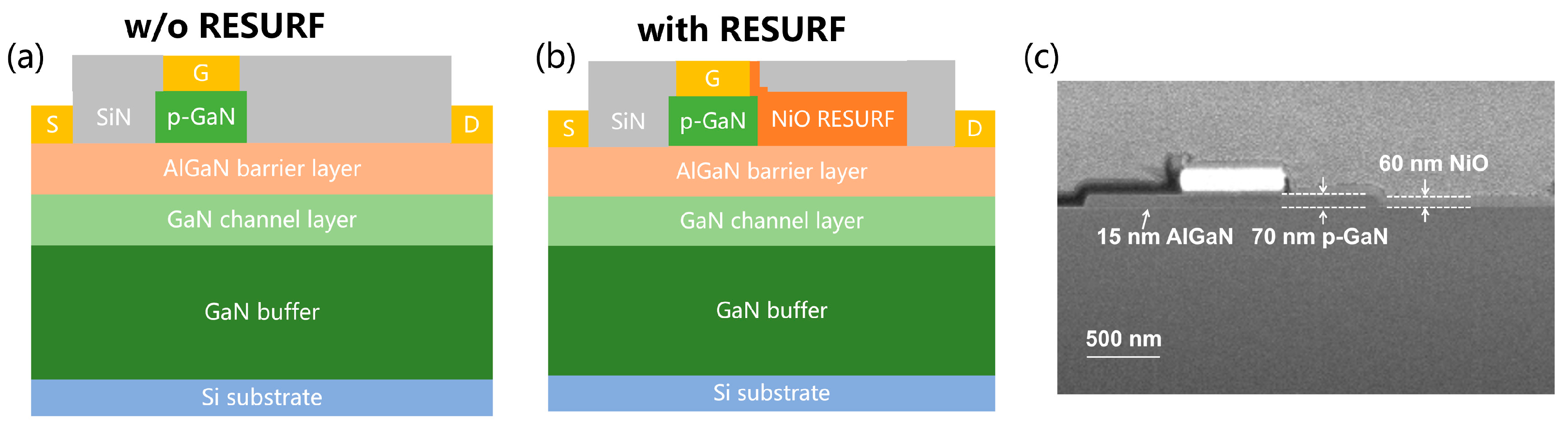
The p-GaN gate AlGaN/GaN HEMT structure used in this work was grown by metal-organic chemical vapor deposition (MOCVD) on a Si (111) substrate, consisting of a 4-μm C-doped GaN buffer layer, a 300 nm undoped GaN channel, a 15 nm Al0.25Ga0.75N barrier, and a 70 nm p-GaN with a Mg concentration of ∼1 × 1019 cm−3. The device fabrication started with removing p-GaN outside the gate region by inductively coupled plasma (ICP) dry etching, and the source/drain ohmic contacts were then formed by electron-beam evaporation (EBE) of a Ti/Al/Ni/Au (30/150/50/100 nm) metal stack, followed by rapid thermal annealing at 850 °C for 30 s in N2 ambient. Subsequently, the Ni/Au (30/200 nm) stack was deposited on p-GaN as the Schottky gate contact by EBE. Then a 60 nm-thick and 2-μm-long p-NiO film with a hole concentration of 1 × 1017 cm−3 was deposited between the gate and drain by RF magnetron sputtering at room temperature, followed by a 100-nm-thick SiNx passivation layer using plasma-enhanced chemical vapor deposition. Finally, a mesa isolation process was carried out by ICP dry etching, and the electrode window was opened by the lithography process. For reference, p-GaN gate HEMTs without the p-NiO RESURF terminal were also fabricated. The schematic cross-sectional structure of the two HEMTs with LG/LGS/LGD/W = 2/3/12/100 μm are displayed in Figure 1a and Figure 1b, respectively. The scanning electron microscope (SEM) image of the GaN HEMT with the RESURF terminal is shown in Figure 1c.

3. Results and Discussion

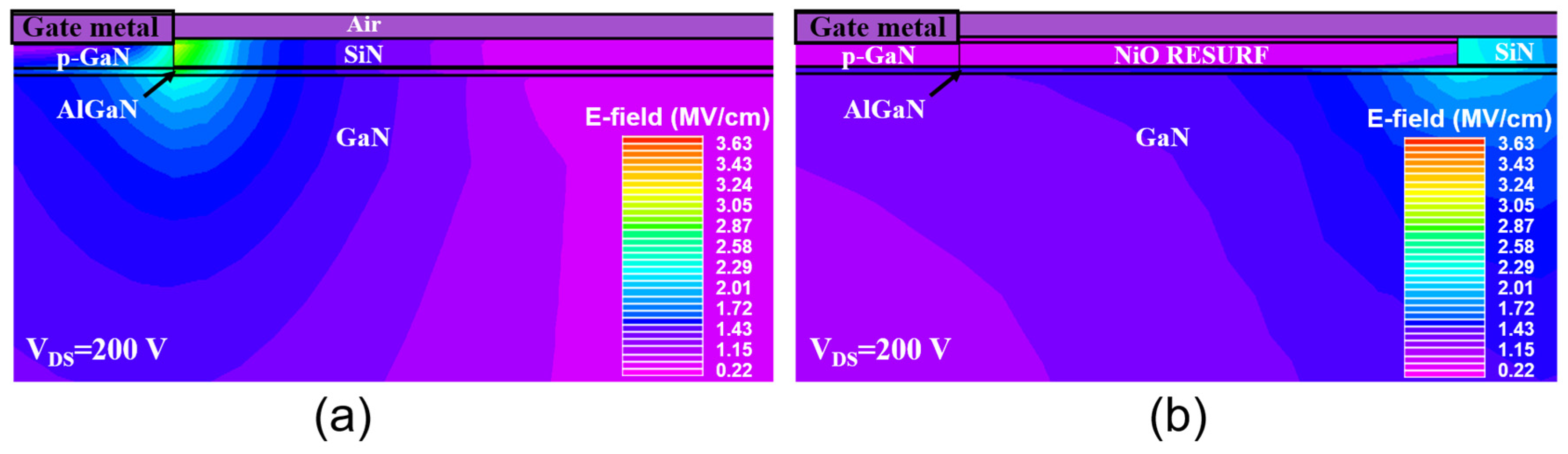
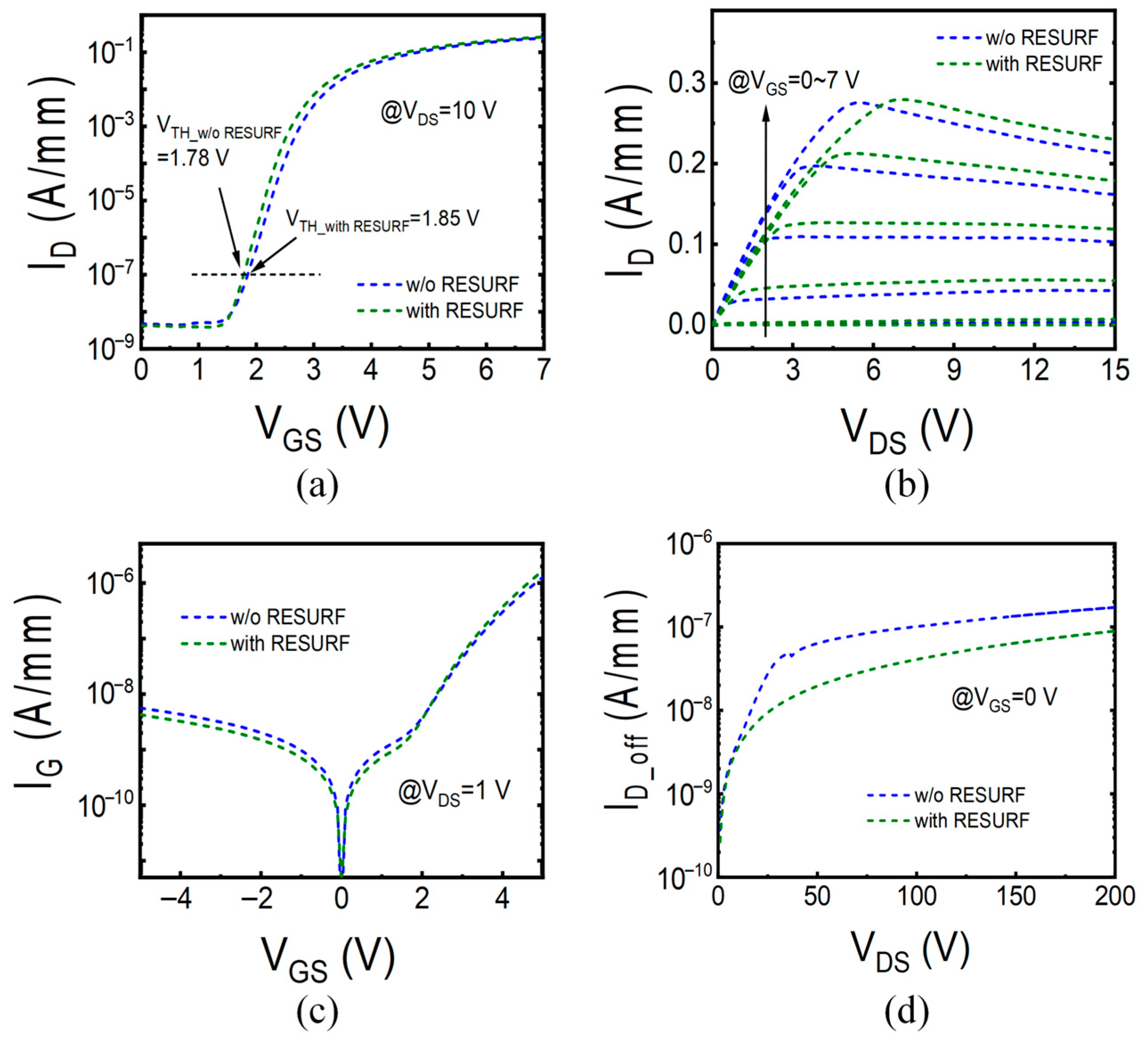
Figure 2a presents the transfer characteristics of two types of devices with and without the p-NiO RESURF terminal, measured under the condition of drain-source voltage VDS = 10 V and gate-source voltage VGS swept from 0 V to 7 V. The VGS corresponding to a drain current ID of 100 nA/mm is defined as the threshold voltage VTH. The VTH for the device without RESURF is 1.78 V, while for the device with RESURF it is 1.85 V. Figure 2b illustrates the output characteristics of both devices with VGS from 0 V to 7 V, and both devices exhibit the same saturation output current of 0.27 A/mm at VGS = 7 V. Figure 2c shows the gate current IG for both devices, measured with VDS set at 1 V. Figure 2d depicts the off-state drain leakage current (ID_off) for both devices, measured with VGS set at 0 V to ensure that the channel is turned off, and VDS is swept from 0 V to 200 V. It can be observed that the ID_off of the device with RESURF is lower than that of the device without RESURF, which can be attributed to the flattening of the electric field peak on the drain side beneath the gate by the p-NiO RESURF terminal, thereby reducing leakage through the buffer layer [18]. The flattening of the electric field peak on the drain side beneath the gate can be confirmed by simulating and comparing the electric field distributions of two HEMT devices under VDS = 200 V, as shown in Figure 3a,b. Overall, the transfer characteristics, output characteristics, and gate currents of both devices are very similar. Therefore, it can be inferred that the p-NiO RESURF terminal has less impact on the on-state performances of the p-GaN gate HEMT devices.
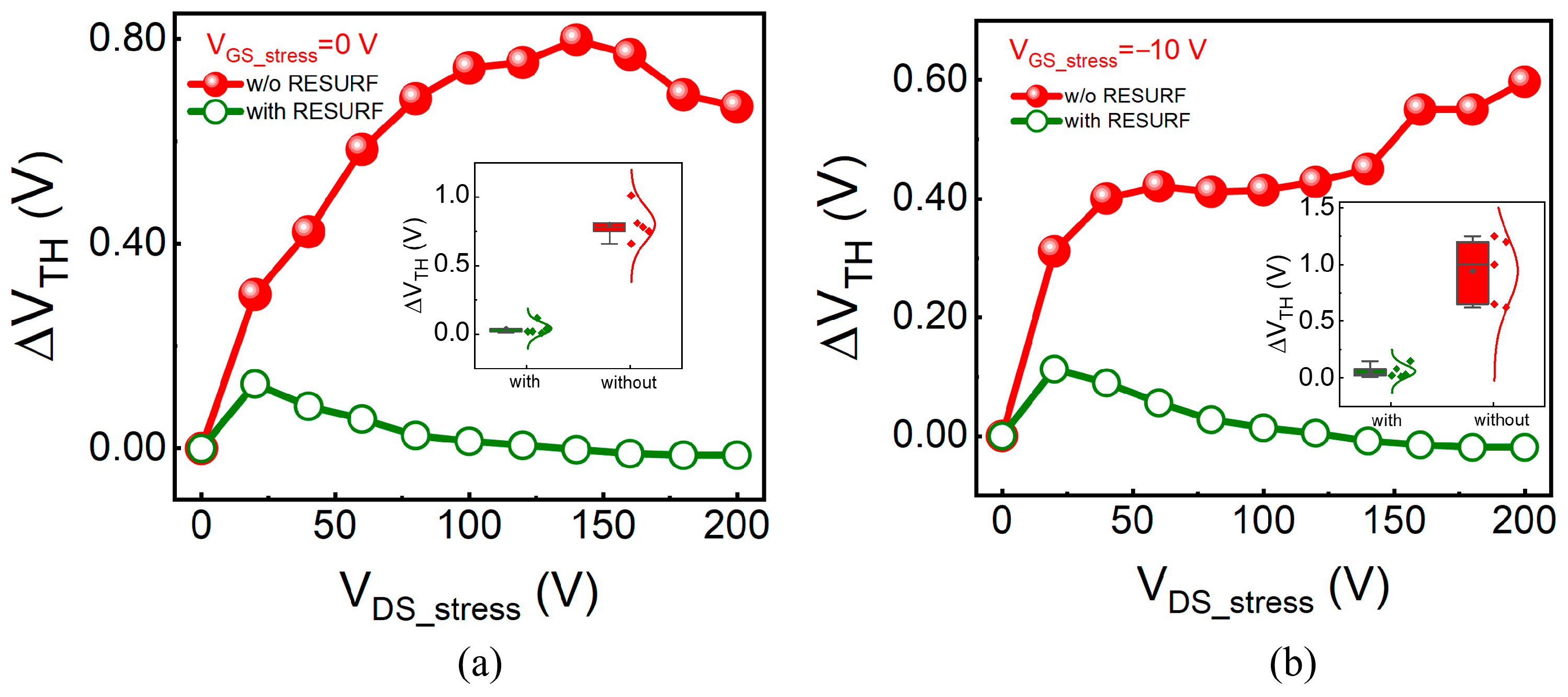
To investigate the trends of VTH variation under drain bias stress, we conducted step drain voltage stress (VDS_stress) tests. During the stress process, the gate voltage stress (VGS_stress) was fixed, while the VDS_stress was gradually increased from 0 V to 200 V in steps of 20 V, with each step maintained for 100 s. Transfer characteristic measurements were performed before and between step-stress voltages to monitor the changes of VTH in response to VDS_stress. The VTH shifts (ΔVTH) at VGS_stress = 0 V and −10 V with the substrate grounded (GND) are extracted and shown in Figure 4a and Figure 4b respectively with the error bars in the insets. Overall, the ΔVTH of the device with RESURF is significantly smaller than that of the device without RESURF, and the trends in ΔVTH are notably different. For the device without RESURF, the ΔVTH continuously increases with the increase in VDS_stress, ultimately reaching saturation, after which it exhibits a slight decrease or increase. This behavior is attributed to the fact that under higher VDS_stress, holes in the p-NiO terminal can inject into the buffer layer more easily, thus resulting in a light-pumping effect, which denotes the process wherein light emitted from the recombination of electrons and holes in the buffer layer excites electrons confined in trap states. This light-pumping effect will significantly suppress the electron capture process and prevent ΔVTH from further increasing or even decreasing. In contrast, for the device with RESURF, the ΔVTH reaches a maximum value at VDS_stress = 20 V and subsequently decreases with increasing VDS_stress. The positive shift in VTH indicates the accumulation of net negative charge in the gate region or buffer layer, and the significant difference in ΔVTH between the two devices suggests that the p-NiO RESURF terminal suppresses the accumulation of net negative charge, thereby significantly enhancing the stability of VTH under off-state leakage voltage stress. In addition, the p-NiO/AlGaN interface may present oxidation or diffusion processes under high off-state stress, which also has an important effect on VTH stability by changing interface fixed charges, as reported by Shen et al. [19]. However, oxidation or O atom diffusion at the p-NiO/AlGaN interface will weaken the effect of hole injection on the VTH shift due to a higher potential barrier of Al2O3 at the oxidized interface of the p-NiO/AlGaN or reduced hole concentration in the p-NiO bulk resulting from O atom diffusion, and this phenomenon did not occur in the ΔVTH variation trend with VDS_stress, as presented in Figure 4.
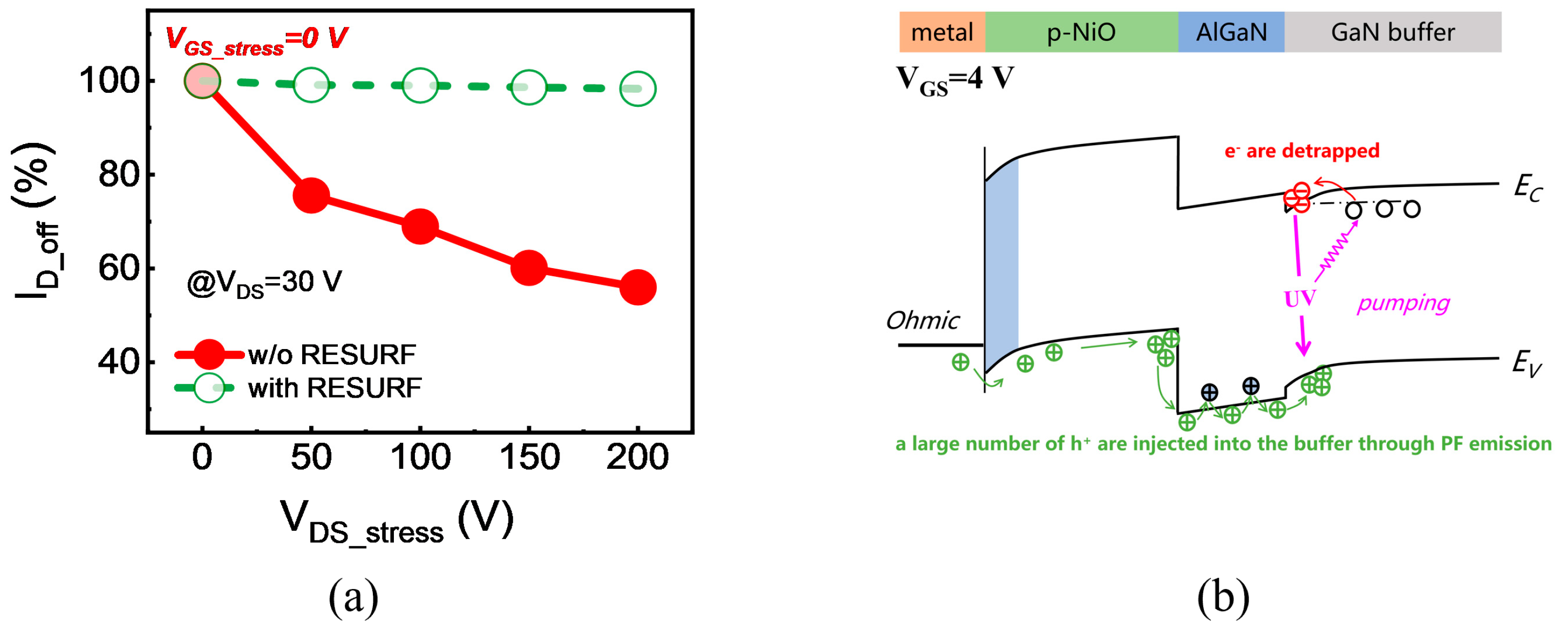
To verify the accumulation of net negative charge in the gate region or buffer layer, we tested the variation of ID_off with respect to VDS_stress for both devices. During the tests, VGS_stress was set to 0 V, and VDS_stress was gradually increased to 200 V. As shown in Figure 5a, after stress, the ID_off of the device without RESURF exhibits a significant decrease, while that of the device with RESURF shows only a slight reduction measured at VDS = 30 V. It is well known that traps within the buffer layer can capture electrons and form a barrier, impeding the flow of electrons from the source to the drain and resulting in a decrease in ID_off [20,21]. Therefore, the decrease in ID_off indicates that the electron capture process has occurred within the buffer layer under stress. As shown in the band diagram of Figure 5b, under the vertically downward electric field produced by high drain stress voltage, holes from the p-NiO terminal will cross the AlGaN barrier layer into the GaN buffer layer, generating a light-pumping effect, thereby achieving the effect of electron de-trapping [22,23]. In addition, the injected holes may directly recombine with trapped charges in defect states. Owing to these mechanisms, the rise in ID_off is suppressed, and the VTH stability is substantially improved.
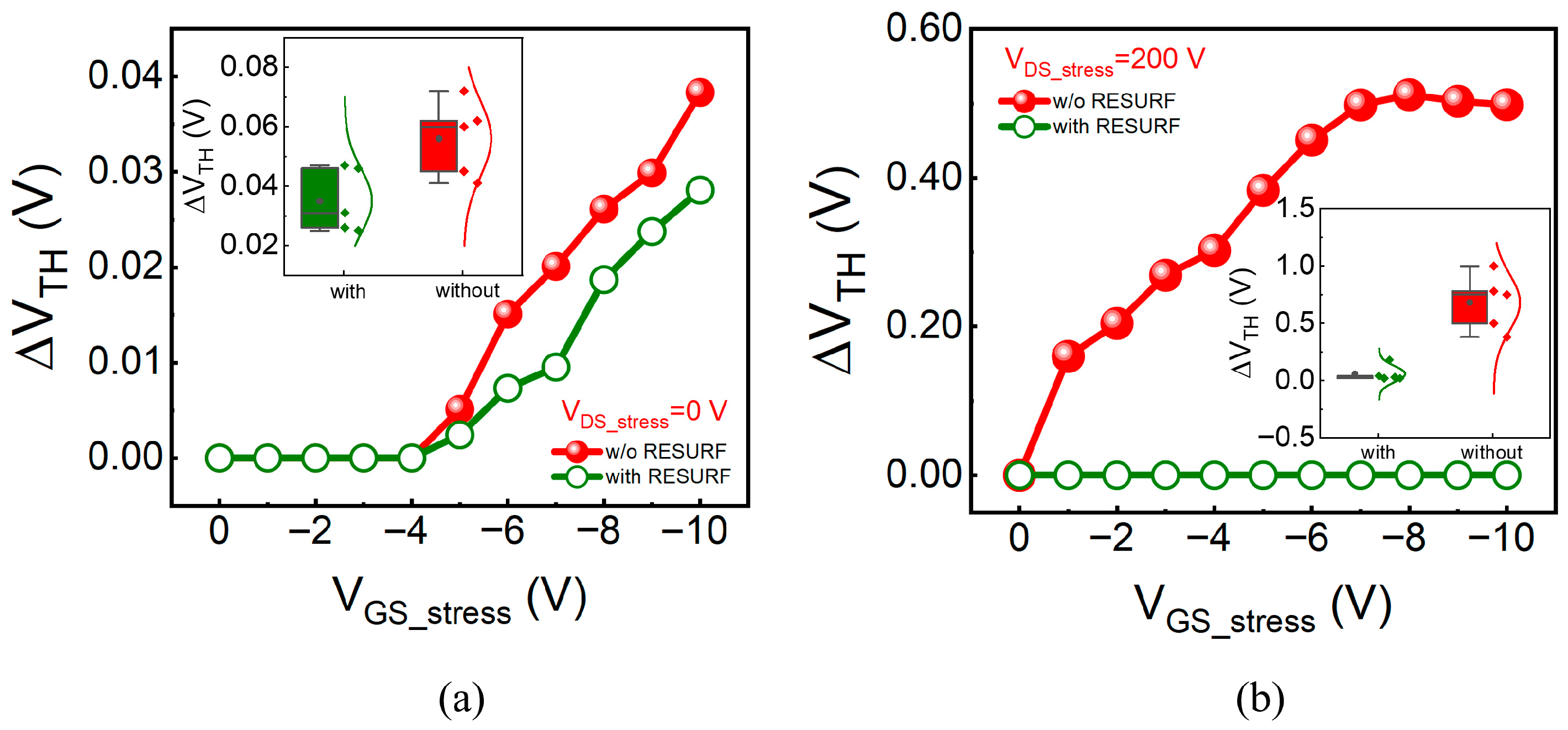
Further analysis of the impact of negative gate voltage on VTH stability was conducted by step-stress measurements. During tests, VDS_stress was fixed while VGS_stress was gradually increased from 0 V to −10 V. Negative gate voltage stress could also induce net charge accumulation and modulate the impact ionization process induced by high drain voltage stress. To clarify the specific effect mechanisms, tests were performed under two conditions: VDS_stress = 0 V and 200 V. At VDS_stress = 0 V, the degradation of the device is solely attributed to negative gate voltage, eliminating the influence of charge accumulation caused by high drain voltage. The shifts in VTH for both devices at VDS_stress = 0 V are illustrated in Figure 6a with the error bars in the inset. Overall, both devices exhibit a slight positive shift in VTH, indicating that negative gate voltage can also lead to minor negative charge accumulation. The ΔVTH of the device with RESURF is slightly less than that of the device without RESURF, suggesting that the p-NiO RESURF terminal also exerts some regulatory effect on the negative charge accumulation caused by negative gate voltage. At VDS_stress = 200 V, the shifts in VTH are depicted in Figure 6b with the error bars in the inset. Overall, the ΔVTH of the device with RESURF is significantly smaller than that of the device without RESURF. As VGS_stress increases, the ΔVTH of the device without RESURF first continuously increases and then gradually saturates, while the ΔVTH of the device with RESURF shows less change. These results confirm that the net negative charge accumulation is primarily induced by the drain voltage. For the device without RESURF, negative gate voltage has a significant regulatory effect on the net negative charge accumulation or impact ionization process. In contrast, for the device with the p-NiO RESURF terminal, negative gate voltage has almost no effect on ΔVTH.
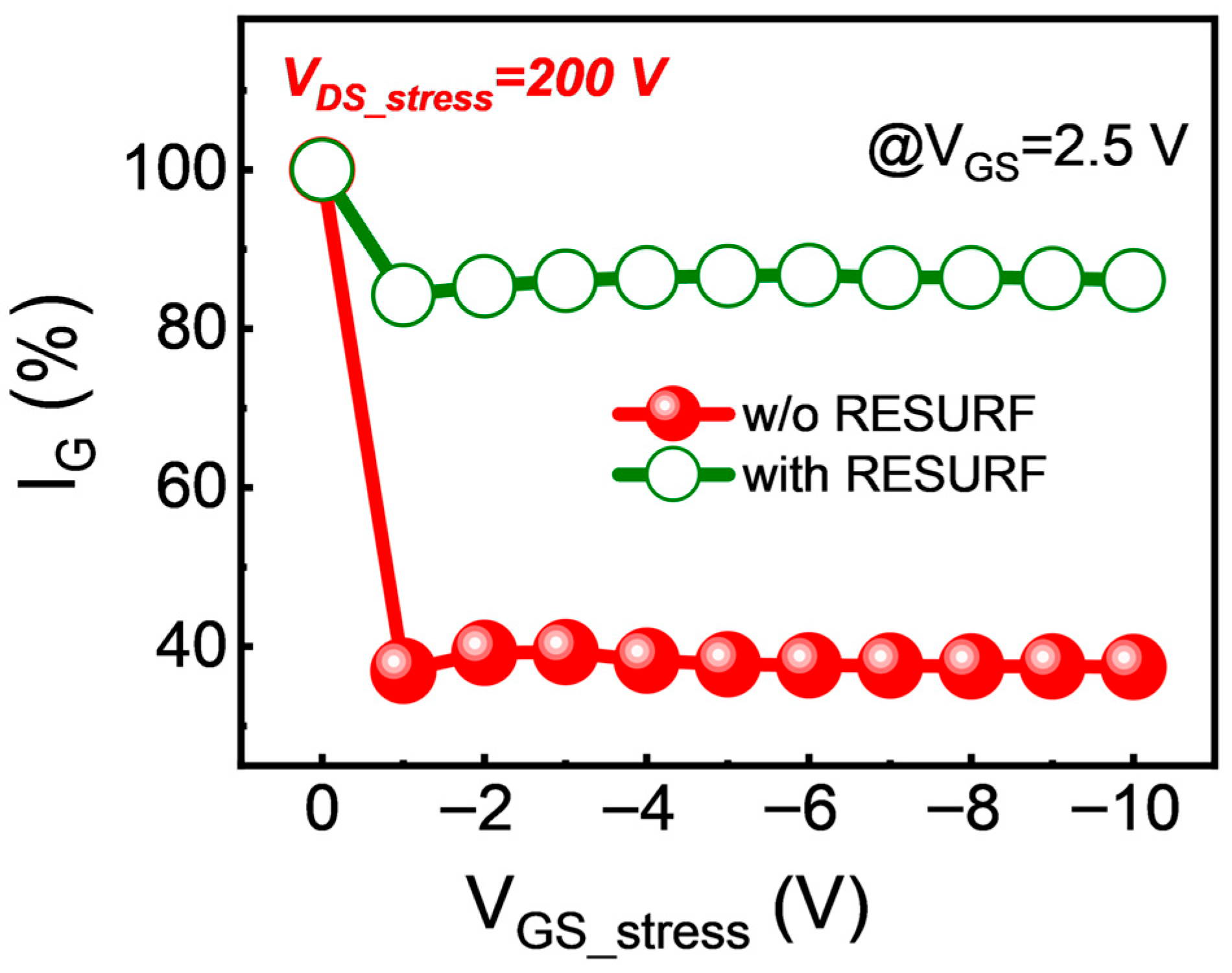
Finally, the effect of the p-NiO RESURF terminal on degradation of IG with VGS_stress under high drain voltage was investigated. The variation of IG with VGS_stress for both devices at VDS_stress = 200 V is presented in Figure 7. Overall, both devices exhibit noticeable degradation in IG at VGS_stress = −1 V, followed by only slight fluctuations with increasing VGS_stress. Moreover, the degradation of IG for the device with RESURF is significantly less than that for the device without RESURF. The increase in VGS_stress not only suppresses the process of hole generation by impact ionization but also attracts more holes to the gate [24]. These two effects reach a balance with the increasing VGS_stress, and so the effect of increased VGS_stress on hole loss in the gate region is almost negligible. Based on this phenomenon, it can be further speculated that the loss of holes in the gate region is primarily induced by high drain voltage. The main reason that the p-NiO RESURF can inhibit hole loss in the gate region is that this terminal can flatten the electric field beneath the gate.
Overall, for the device without RESURF, negative gate voltage under high drain voltage exerts a regulatory effect on the impact ionization at the drain side beneath the gate, consequently affecting the net negative charge accumulation in the buffer layer and gate region. In contrast, for the device with RESURF, the p-NiO terminal can effectively suppress the net negative charge accumulation in the buffer layer and gate region through the light-pumping effect and by flattening the electric field.

4. Summary

A comparative study has been conducted on the VTH shifts of devices without RESURF versus those with RESURF under off-state drain voltage stress. Experimental results indicate that the VTH shift of the device with RESURF is significantly smaller than that of the device without RESURF, which can be primarily attributed to: (1) the light-pumping effect induced by the p-NiO terminal by injecting holes into the buffer layer under the vertical electric field and significantly suppressing electron capture within the buffer layer; and (2) the flattening of the electric field peak on the drain side beneath the gate by using the p-NiO terminal and alleviating hole loss in the gate region. Furthermore, for the device without RESURF, negative gate voltage has a slight effect on the net negative charge accumulation in the buffer layer and gate region, consequently affecting the VTH shift. In contrast, for the device with RESURF, this effect is almost negligible. These disparities further highlight the significant advantage of the p-NiO RESURF terminal in enhancing VTH stability of p-GaN HEMTs.

Author Contributions

Methodology, J.P.; investigation, J.P.; validation, X.Y., R.J., A.M., F.M., Z.M. and J.L.; writing—original draft preparation, J.P.; writing—review and editing, Y.P. and H.G.; supervision, Y.P. and H.G.; funding acquisition, Y.P. and H.G. All authors have read and agreed to the published version of the manuscript.

Funding

This work was supported by the Key R&D Project of Jiangsu Province, China (BK20243037, BE2022070-4), the National Natural Science Foundation of China (62304100, 62534003, 62504104), Fundamental ResearchFunds for the Central Universities (021014380192).

Institutional Review Board Statement

Not applicable.

Informed Consent Statement

Not applicable.

Data Availability Statement

The original contributions presented in this study are included in the article. Further inquiries can be directed to the corresponding author.

Conflicts of Interest

Authors Jun Pan, Xiangru Ye, Ruixi Jiang, Ailin Miao, Fuxiang Miao and Zhiyi Mao were employed by the company Zhongtian Broadband Technology Co., Ltd. The remaining authors declare that the research was conducted in the absence of any commercial or financial relationships that could be construed as a potential conflict of interest.

References

  1. Wang, Z.X.; Nan, J.; Tian, Z.W.; Liu, P.; Wu, Y.H.; Zhang, J.C. Review on Main Gate Characteristics of P-Type GaN Gate High-Electron-Mobility Transistors. Micromachines 2024, 15, 80. [Google Scholar] [CrossRef] [PubMed]
  2. Haziq, M.; Falina, S.; Manaf, A.A.; Kawarada, H.; Syamsul, M. Challenges and Opportunities for High-Power and High-Frequency AlGaN/GaN High-Electron-Mobility Transistor (HEMT) Applications: A Review. Micromachines 2022, 13, 2133. [Google Scholar] [CrossRef]
  3. Dora, Y.; Chakraborty, A.; McCarthy, L.; Keller, S.; DenBaars, S.P.; Mishra, U.K. High Breakdown Voltage Achieved on AlGaN/GaN HEMTs with Integrated Slant Field Plates. IEEE Electron Device Lett. 2006, 27, 713–715. [Google Scholar] [CrossRef]
  4. Greco, G.; Iucolano, F.; Roccaforte, F. Review of Technology for Normally-Off HEMTs with P-GaN Gate. Mater. Sci. Semicond. Process. 2018, 78, 96–106. [Google Scholar] [CrossRef]
  5. Zhu, M.D.; Li, G.X.; Li, H.T.; Guo, Z.H.; Yang, Y.; Shang, J.B.; Feng, Y.K.; Lu, Y.S.; Li, Z.X.; Li, X.H.; et al. Challenges and Advancements in P-GaN Gate Based High Electron Mobility Transistors (HEMTs) on Silicon Substrates. J. Mater. Chem. C 2024, 12, 16272–16293. [Google Scholar] [CrossRef]
  6. Chao, X.; Tang, C.K.; Wang, C.; Tan, J.J.; Ji, L.; Chen, L.; Zhu, H.; Sun, Q.Q.; Zhang, D.W. Observation and Analysis of Anomalous VTH Shift of P-GaN Gate HEMTs Under Off-State Drain Stress. IEEE Trans. Electron Devices 2022, 69, 6587–6593. [Google Scholar] [CrossRef]
  7. Cioni, M.; Zagni, N.; Iucolano, F.; Moschetti, M.; Verzellesi, G.; Chini, A. Partial Recovery of Dynamic RON Versus OFF-State Stress Voltage in P-GaN Gate AlGaN/GaN Power HEMTs. IEEE Trans. Electron Devices 2021, 68, 4862–4868. [Google Scholar] [CrossRef]
  8. Wang, R.; Guo, H.; Hou, Q.Y.; Lei, J.M.; Wang, J.; Xue, J.J.; Liu, B.; Chen, D.J.; Lu, H.; Zhang, R.; et al. Evaluation on Temperature-Dependent Transient VT Instability in P-GaN Gate HEMTs under Negative Gate Stress by Fast Sweeping Characterization. Micromachines 2022, 13, 1096. [Google Scholar] [CrossRef]
  9. Tang, G.F.; Wei, J.; Zhang, Z.F.; Tang, X.; Hua, M.Y.; Wang, H.X.; Chen, K.J. Dynamic RON of GaN-on-Si Lateral Power Devices with a Floating Substrate Termination. IEEE Electron Device Lett. 2017, 38, 937–940. [Google Scholar] [CrossRef]
  10. Wu, Y.L.; Wei, J.; Wang, M.J.; Nuo, M.Q.; Yang, J.J.; Lin, W.; Zheng, Z.Y.; Zhang, L.; Hua, M.Y.; Yang, X.L.; et al. An Actively-Passivated p-GaN Gate HEMT with Screening Effect Against Surface Traps. IEEE Electron Device Lett. 2023, 44, 25–28. [Google Scholar] [CrossRef]
  11. Cui, J.W.; Wang, M.J.; Wu, Y.L.; Yang, J.J.; Yang, H.; Yu, J.J.; Li, T.; Yang, X.L.; Liu, X.S.; Cheng, K.; et al. Demonstration of 1200-V E-Mode GaN-on-Sapphire Power Transistor with Low Dynamic ON-Resistance Based on Active Passivation Technique. IEEE Electron Device Lett. 2024, 45, 220–223. [Google Scholar] [CrossRef]
  12. Guo, H.; Gong, H.H.; Shao, P.F.; Yu, X.X.; Wang, J.; Wang, R.; Yu, L.; Ye, J.D.; Chen, D.J.; Lu, H.; et al. Over 1200 V Normally-OFF p-NiO Gated AlGaN/GaN HEMTs on Si with a Small Threshold Voltage Shift. IEEE Electron Device Lett. 2022, 43, 268–271. [Google Scholar] [CrossRef]
  13. Hao, W.B.; Wu, F.H.; Li, W.S.; Xu, G.W.; Xie, X.; Zhou, K.; Guo, W.; Zhou, X.Z.; He, Q.M.; Zhao, X.L.; et al. Improved Vertical β-Ga2O3 Schottky Barrier Diodes with Conductivity-Modulated P-NiO Junction Termination Extension. IEEE Trans. Electron Devices 2023, 70, 2129–2134. [Google Scholar] [CrossRef]
  14. Guo, H.; Gong, H.H.; Yu, X.X.; Wang, R.; Cai, Q.; Xue, J.J.; Wang, J.; Pan, D.F.; Ye, J.D.; Liu, B.; et al. NiO/AlGaN Interface Reconstruction and Transport Manipulation of P-NiO Gated AlGaN/GaN HEMTs. Appl. Phys. Rev. 2021, 8, 041405. [Google Scholar] [CrossRef]
  15. Peng, Y.H.; Guo, H.; Gong, R.L.; Liu, H.Z.; Shao, P.F.; Sun, N.; Ren, F.F.; Ye, J.D.; Zheng, Y.D.; Lu, H.; et al. Investigation of Carrier Transport and Recombination at Type-II Band Aligned P-NiO/AlGaN Interface in P-NiO Gate AlGaN/GaN HEMTs under Forward Bias. Appl. Phys. Lett. 2024, 124, 173504. [Google Scholar] [CrossRef]
  16. Wang, Q.; Cheng, X.H.; Zheng, L.; Ye, P.Y.; Li, M.L.; Shen, L.Y.; Li, J.J.; Zhang, D.L.; Gu, Z.Y.; Yu, Y.H. Band Alignment Between PEALD-AlNO and AlGaN/GaN Determined by Angle-resolved X-ray Photoelectron Spectroscopy. Appl. Surf. Sci. 2017, 423: 675. [Google Scholar] [CrossRef]
  17. Wang, Q.; Cheng, X.H.; Zheng, L.; Shen, L.Y.; Li, J.J.; Zhang, D.L.; Ru, Q.; Yu, Y.H. Interface Engineering of An AlNO/AlGaN/GaN MIS Diode Induced by PEALD Alternate Insertion of AlN in Al2O3. RSC Adv. 2017, 7, 11745. [Google Scholar] [CrossRef]
  18. Gong, R.L.; Guo, H.; An, J.Y.; Peng, Y.H.; Qiao, G.; Sun, N.; Shao, P.F.; Ye, J.D.; Zhou, Y.G.; Lu, H.; et al. Electric Field Modulation and Hot-Electron Suppression in AlGaN/GaN HEMTs on Si Using a Hybrid p-NiO RESURF-FP Termination. J. Phys. D-Appl. Phys. 2025, 58, 355104. [Google Scholar] [CrossRef]
  19. Shen, L.Y.; Zhang, D.L.; Cheng, X.H.; Zheng, L.; Xu, D.W.; Wang, Q.; Li, J.J.; Cao, D.; Yu, Y.H. Performance Improvement and Current Collapse Suppression of Al2O3/AlGaN/GaN HEMTs Achieved by Fluorinated Graphene Passivation. IEEE Electron Device Lett. 2017, 38, 596. [Google Scholar] [CrossRef]
  20. Wang, Y.R.; Hua, M.Y.; Tang, G.F.; Lei, J.C.; Zheng, Z.Y.; Wei, J.; Chen, K.J. Dynamic OFF-State Current (Dynamic IOFF) in P-GaN Gate HEMTs with an Ohmic Gate Contact. IEEE Electron Device Lett. 2018, 39, 1366–1369. [Google Scholar] [CrossRef]
  21. Wang, Y.R.; Wei, J.; Yang, S.; Lei, J.C.; Hua, M.Y.; Chen, K.J. Investigation of Dynamic IOFF Under Switching Operation in Schottky-Type P-GaN Gate HEMTs. IEEE Trans. Electron Devices 2019, 66, 3789–3794. [Google Scholar] [CrossRef]
  22. Liu, H.Z.; Peng, Y.H.; Guo, H.; Sun, N.; Gong, R.L.; Qiao, G.; Shao, P.F.; Ye, J.D.; Zhang, R.; Chen, D.J. Investigation of Gate Conduction Mechanisms in P-NiO Gate HEMTs with a Type-II Band Aligned NiO/AlGaN Heterojunction. Appl. Phys. Lett. 2025, 126, 162102. [Google Scholar] [CrossRef]
  23. Wu, Y.L.; Nuo, M.Q.; Yang, J.J.; Zheng, Z.Y.; Zhang, L.; Chen, K.J.; Hua, M.Y.; Hao, Y.L.; Yang, X.L.; Shen, B.; et al. High Dynamic Stability in Enhancement-Mode Active-Passivation P-GaN Gate HEMT. In Proceedings of the 35th IEEE International Symposium on Power Semiconductor Devices and ICs (ISPSD), Hong Kong, China, 28 May–1 June 2023; IEEE: New York, NY, USA, 2023; pp. 378–381. [Google Scholar]
  24. Zheng, Z.Y.; Hua, M.Y.; Wei, J.; Zhang, Z.F.; Chen, K.J. Identifying the Location of Hole-Induced Gate Degradation in LPCVD-SiNx/GaN MIS-FETs under High Reverse-Bias Stress. In Proceedings of the 31st IEEE International Symposium on Power Semiconductor Devices and ICs (ISPSD), Shanghai, China, 19–23 May 2019; IEEE: New York, NY, USA, 2019; pp. 435–438. [Google Scholar]
Figure 1. Schematics of GaN HEMT devices (a) w/o RESURF and (b) with RESURF terminal, and (c) SEM image of GaN HEMT with RESURF terminal.
Micromachines 17 00482 g001
Figure 2. (a) Transfer and (b) output characteristics, and (c) gate current and (d) off-state drain leakage of HEMT devices with and without the p-NiO RESURF.
Micromachines 17 00482 g002
Figure 3. Electric field distributions of the HEMT devices (a) without and (b) with the RESURF terminal under VDS = 200 V.
Micromachines 17 00482 g003
Figure 4. The trends of VTH variation of HEMT devices with and without the p-NiO RESURF under drain bias stress at VGS_stress of (a) 0 V and (b) −10 V, respectively. Inset: Statistical VTH shift data.
Micromachines 17 00482 g004
Figure 5. (a) Variations of ID_off with VDS_stress for HEMT devices with and without the p-NiO RESURF at VGS_stress = 0 V and VDS = 30 V, and (b) band diagram of the p-NiO/AlGaN/GaN buffer.
Micromachines 17 00482 g005
Figure 6. VTH variations of HEMT devices with and without the p-NiO RESURF under negative gate voltage at VDS_stress of (a) 0 V and (b) 200 V, respectively. Inset: Statistical VTH shift data.
Micromachines 17 00482 g006
Figure 7. The variation of IG with VGS_stress for HEMT devices with and without the p-NiO RESURF at VDS_stress = 200 V.
Micromachines 17 00482 g007
Disclaimer/Publisher’s Note: The statements, opinions and data contained in all publications are solely those of the individual author(s) and contributor(s) and not of MDPI and/or the editor(s). MDPI and/or the editor(s) disclaim responsibility for any injury to people or property resulting from any ideas, methods, instructions or products referred to in the content.