Design and Implementation of a Low-Noise Analog Front-End Circuit for MEMS Capacitive Accelerometers




Abstract
1. Introduction
2. System Overview and Design Objectives
2.1. OIS System
2.2. Design Objectives
3. The AFE Circuit Design for the MEMS Accelerometer
3.1. The MEMS Accelerometer
3.2. AFE Circuit Design for the SOG Accelerometer
3.2.1. Overall Architecture
- (a)
- Continuous-time architecture: this study employs a continuous-time circuit architecture, which prevents noise folding and provides essential advantages over discrete-time designs. In discrete-time circuits, broadband noise and interference sources are integrated into the signal bandwidth during periodic sampling, resulting in heightened in-band noise [10]. The continuous-time architecture eliminates the noise folding issue by removing the sampling process.
- (b)
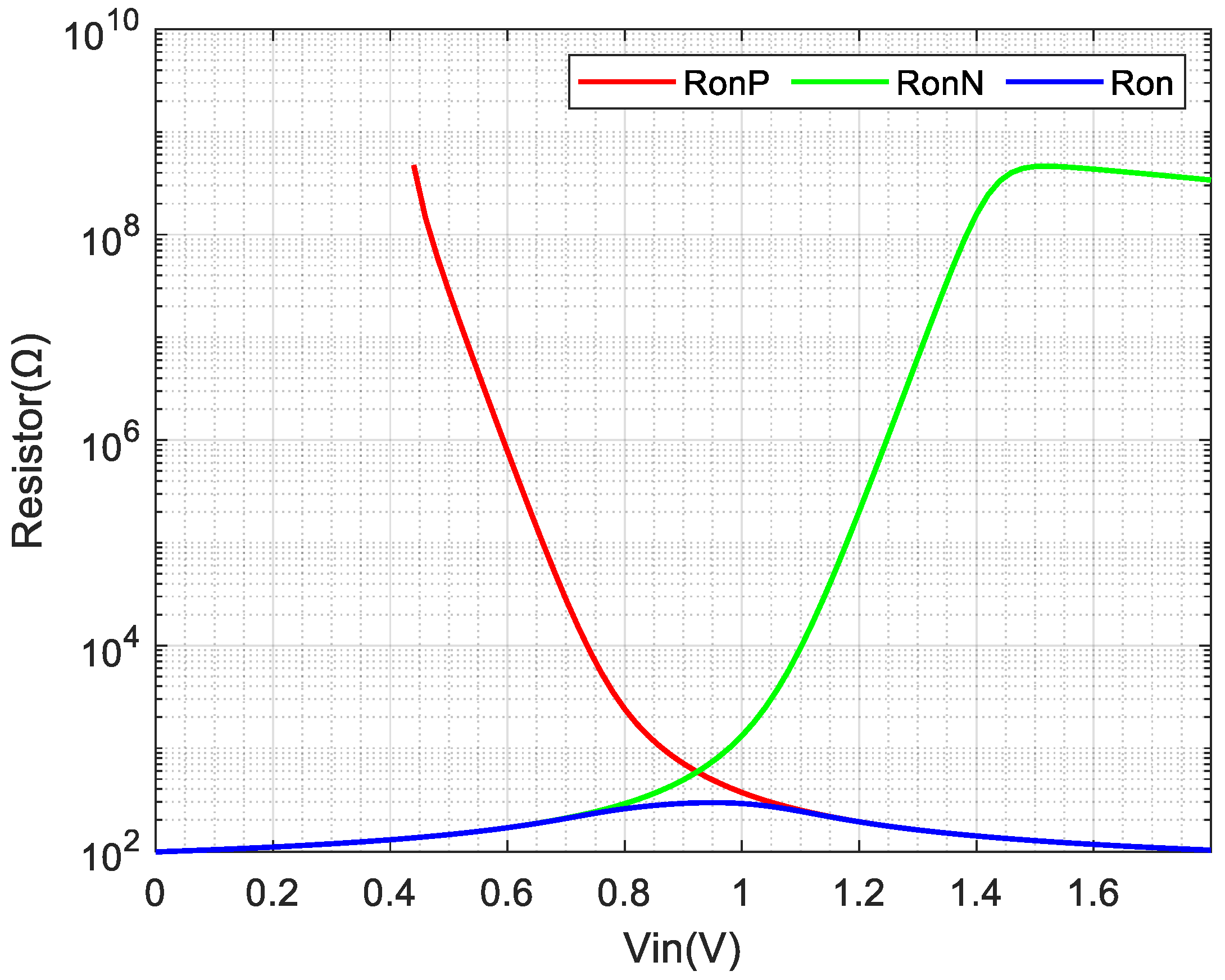
- High-impedance DC biasing scheme: to establish a stable DC operating point without area-consuming passive resistors, an MOS-bipolar pseudo-resistor scheme is implemented. Utilizing sub-threshold leakage, this structure provides ultra-high resistance, significantly reducing the chip area compared to conventional solutions.
- (c)
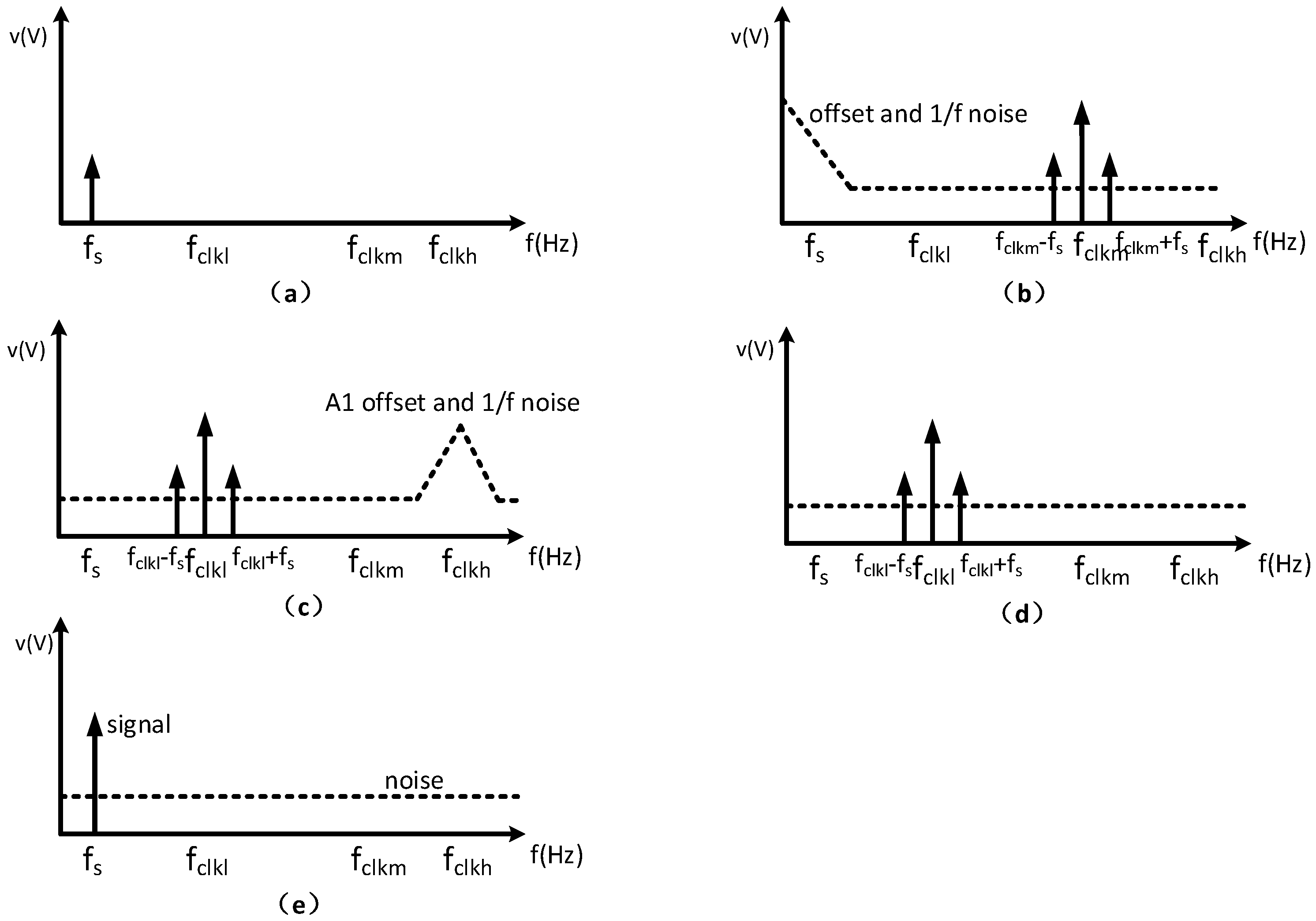
- Chopper stabilization technology: this circuit employs chopper stabilization technology to significantly suppress low-frequency noise and offset. By modulating the input signal to a chopper frequency to amplification, then demodulating it back to baseband, inherent 1/f noise and DC offset are upconverted and filtered out [25]. Figure 5 illustrates the spectral shift process of chopper modulation. Through chopper stabilization technology, the circuit meets the ultra-low noise requirements for OIS applications.
- (d)
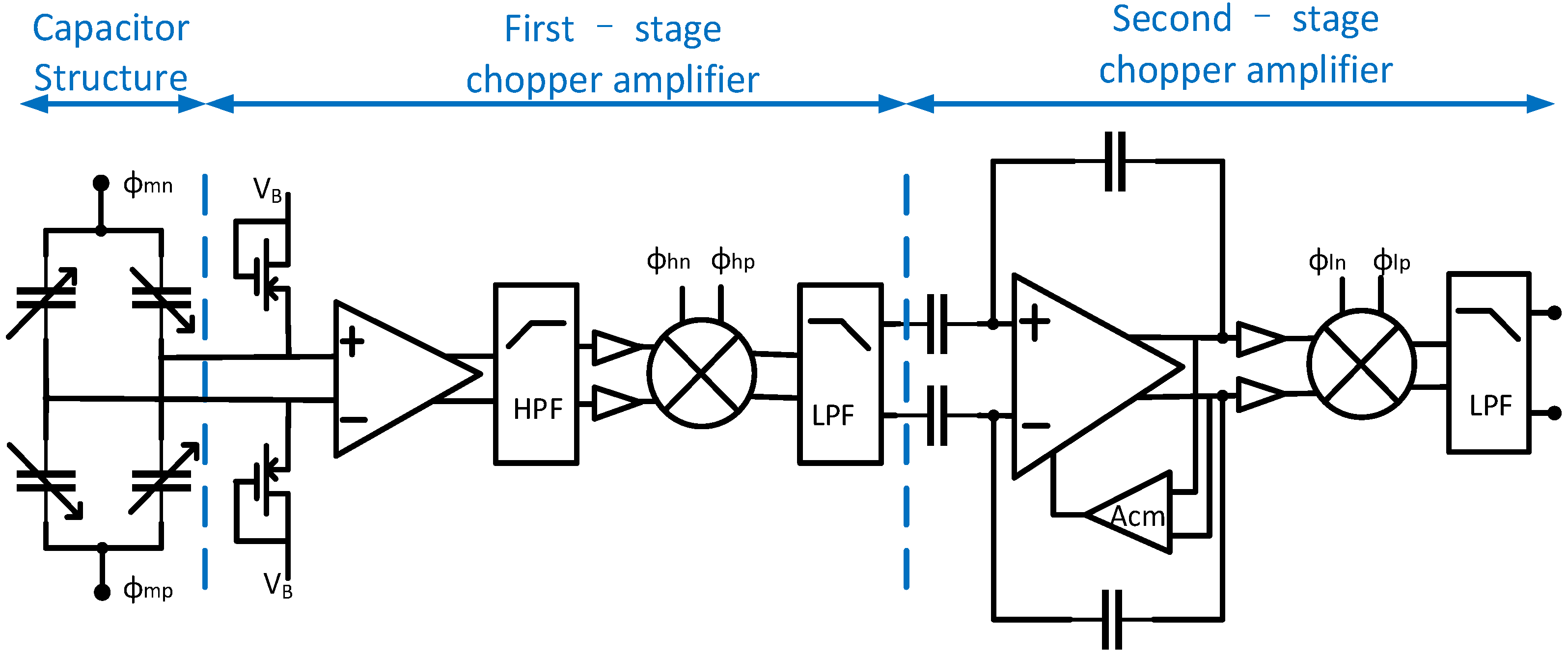
- Dual-chopper amplifier: The dual-chopper architecture shown in Figure 4 is used to balance impedance matching, noise reduction, and power consumption. Since the capacitive MEMS accelerometer has frequency-dependent impedance characteristics, a relatively high modulation frequency of 500 kHz is adopted in the first chopper stage to improve the interface between the sensor and the front-end amplifier. This high chopping frequency also shifts the signal away from the low-frequency region and reduces the influence of 1/f noise. However, operating the entire amplifier chain at such a high frequency would require a larger bandwidth and lead to higher power consumption. Therefore, a second chopper stage operating at 20 kHz is introduced so that, after the initial high-frequency modulation and amplification, the signal can be translated to a lower frequency for the following low-bandwidth and low-power amplification stages. In this way, the proposed dual-chopper topology provides a practical trade-off among sensor interfacing, noise performance, and power efficiency.
3.2.2. Module Design
3.2.3. Simulation Results
4. Experiments and Results
4.1. Noise Testing
4.2. The Quasi-Static Response Testing
4.3. The Dynamic Performance Testing
5. Discussion and Conclusions
Author Contributions
Funding
Institutional Review Board Statement
Informed Consent Statement
Data Availability Statement
Conflicts of Interest
References
- Rawat, P.; Singhai, J. Review of motion estimation and video stabilization techniques for hand held mobile video. Signal Image Process. Int. J. 2011, 2, 159–168. [Google Scholar]
- Kim, W.-Y.; Seo, H.-T.; Kim, S.; Kim, K.-S. Practical approach for controlling optical image stabilization system. Int. J. Control. Autom. Syst. 2020, 18, 824–833. [Google Scholar] [CrossRef]
- Zhang, Y.-x.; Zhang, W.-g.; Zhao, X.-x.; Yuan, H.-m. Study on Electronic Image Stabilization System Based on MEMS Gyro. In Proceedings of the 2009 International Conference on Electronic Computer Technology, Macau, China, 20–22 February 2009; pp. 641–643. [Google Scholar]
- Liu, S.; Li, H.; Wang, Z.; Wang, J.; Zhu, S.; Zeng, B. DeepOIS: Gyroscope-Guided Deep Optical Image Stabilizer Compensation. IEEE Trans. Circuits Syst. Video Technol. 2022, 32, 2856–2867. [Google Scholar] [CrossRef]
- La Rosa, F.; Virzì, M.C.; Bonaccorso, F.; Branciforte, M. Optical Image Stabilization (OIS). STMicroelectronics. 2015. Available online: http://www.st.com/resource/en/white_paper/ois_white_paper.pdf (accessed on 12 October 2017).
- Liu, C.; Yin, C.; Han, Y.; Wang, G.; Mao, Z.; Chen, Y.; Tu, Z.; Sun, H. HyperOIS: A Comprehensive Optical Image Stabilization Solution for Modern Smartphones. IEEE Trans. Consum. Electron. 2024, 70, 696–703. [Google Scholar] [CrossRef]
- Nasiri, S.; Sachs, D.; Maia, M. Selection and integration of MEMS-based motion processing in consumer devices. DSP Des. Line 2009, 8. Available online: https://www.eetimes.com/selection-and-integration-of-mems-based-motion-processing-devices/ (accessed on 16 December 2025).
- Ferlito, U.; Grasso, A.D.; Pennisi, S.; Vaiana, M.; Bruno, G. Sub-Femto-Farad Resolution Electronic Interfaces for Integrated Capacitive Sensors: A Review. IEEE Access 2020, 8, 153969–153980. [Google Scholar] [CrossRef]
- Mohammed, Z.; Elfadel, I.M.; Rasras, M. Monolithic multi degree of freedom (MDoF) capacitive MEMS accelerometers. Micromachines 2018, 9, 602. [Google Scholar] [CrossRef]
- Jiangfeng, W.; Fedder, G.K.; Carley, L.R. A low-noise low-offset capacitive sensing amplifier for a 50-μg/√ Hz monolithic CMOS MEMS accelerometer. IEEE J. Solid-State Circuits 2004, 39, 722–730. [Google Scholar] [CrossRef]
- Hongwei, Q.; Deyou, F.; Huikai, X. A Monolithic CMOS-MEMS 3-Axis Accelerometer with a Low-Noise, Low-Power Dual-Chopper Amplifier. IEEE Sens. J. 2008, 8, 1511–1518. [Google Scholar] [CrossRef]
- Liu, Y.-S.; Wen, K.-A. Monolithic low noise and low zero-g offset CMOS/MEMS accelerometer readout scheme. Micromachines 2018, 9, 637. [Google Scholar] [CrossRef]
- Tirupathi, R.; Kar, S.K. A 200 μg/√Hz, 2.7 milli-g offset differential interface for capacitive micro accelerometer. IEEE Trans. Circuits Syst. II Express Briefs 2020, 68, 1753–1757. [Google Scholar] [CrossRef]
- Liu, Y.-C.; Tsai, M.-H.; Li, S.-S.; Fang, W. A fully-differential, multiplex-sensing interface circuit monolithically integrated with tri-axis pure oxide capacitive CMOS-MEMS accelerometers. In Proceedings of the 2013 Transducers & Eurosensors XXVII: The 17th International Conference on Solid-State Sensors, Actuators and Microsystems (TRANSDUCERS & EUROSENSORS XXVII), Barcelona, Spain, 16–20 June 2013; pp. 610–613. [Google Scholar]
- Lajevardi, P.; Petkov, V.P.; Murmann, B. A ΔΣ interface for MEMS accelerometers using electrostatic spring constant modulation for cancellation of bondwire capacitance drift. IEEE J. Solid-State Circuits 2012, 48, 265–275. [Google Scholar] [CrossRef]
- Amini, B.V.; Ayazi, F. A 2.5-V 14-bit/spl Sigma//spl Delta/CMOS SOI capacitive accelerometer. IEEE J. Solid-State Circuits 2004, 39, 2467–2476. [Google Scholar] [CrossRef]
- Chen, D.; Liu, X.; Yin, L.; Wang, Y.; Shi, Z.; Zhang, G. A ΣΔ closed-loop interface for a MEMS accelerometer with digital built-in self-test function. Micromachines 2018, 9, 444. [Google Scholar] [CrossRef]
- Luo, H.; Zhang, G.; Carley, L.R.; Fedder, G.K. A post-CMOS micromachined lateral accelerometer. J. Microelectromech. Syst. 2002, 11, 188–195. [Google Scholar] [CrossRef]
- Li, X.; Chung, V.P.; Guney, M.G.; Mukherjee, T.; Fedder, G.K.; Paramesh, J. A high dynamic range CMOS-MEMS accelerometer array with drift compensation and fine-grain offset compensation. In Proceedings of the 2019 IEEE custom integrated circuits conference (CICC), Austin, TX, USA, 14–17 April 2019; pp. 1–4. [Google Scholar]
- Lee, S.K.; Kong, J.H. An implementation of closed-loop optical image stabilization system for mobile camera. In Proceedings of the 2014 IEEE International Conference on Consumer Electronics (ICCE), Las Vegas, NV, USA, 10–13 January 2014; pp. 45–46. [Google Scholar]
- Carignan, B.; Daneault, J.-F.; Duval, C. Quantifying the importance of high frequency components on the amplitude of physiological tremor. Exp. Brain Res. 2010, 202, 299–306. [Google Scholar] [CrossRef]
- Gavant, F.; Alacoque, L.; Dupret, A.; David, D. A physiological camera shake model for image stabilization systems. In Proceedings of the SENSORS, 2011 IEEE, Limerick, Ireland, 28–31 October 2011; pp. 1461–1464. [Google Scholar]
- Kuehnel, W. Modelling of the mechanical behaviour of a differential capacitor acceleration sensor. Sens. Actuators A Phys. 1995, 48, 101–108. [Google Scholar] [CrossRef]
- Li, J.; Feng, R.; Wang, X.; Cao, H.; Gong, K.; Xie, H. A Micromachined Silicon-on-Glass Accelerometer with an Optimized Comb Finger Gap Arrangement. Micromachines 2024, 15, 1173. [Google Scholar] [CrossRef]
- Sun, H.; Fang, D.; Jia, K.; Maarouf, F.; Qu, H.; Xie, H. A Low-Power Low-Noise Dual-Chopper Amplifier for Capacitive CMOS-MEMS Accelerometers. IEEE Sens. J. 2011, 11, 925–933. [Google Scholar] [CrossRef]
- Tsai, M.-H.; Liu, Y.-C.; Fang, W. A three-axis CMOS-MEMS accelerometer structure with vertically integrated fully differential sensing electrodes. J. Microelectromech. Syst. 2012, 21, 1329–1337. [Google Scholar] [CrossRef]
- Chiu, Y.; Lin, C.-Y.; Hong, H.-C. A monolithic CMOS-MEMS reconfigurable/tunable capacitive accelerometer with integrated sensing circuits. Front. Mech. Eng. 2022, 8, 876714. [Google Scholar] [CrossRef]
- Dei, M.; Gagliardi, F.; Bruschi, P. Slew-rate enhancement techniques for switched-capacitors fast-settling amplifiers: A review. Chips 2024, 3, 98–128. [Google Scholar] [CrossRef]
- Xin, Y.; Zhao, X.; Wen, B.; Dong, L.; Lv, X. A high current efficiency two-stage amplifier with inner feedforward path compensation technique. IEEE Access 2020, 8, 22664–22671. [Google Scholar] [CrossRef]
- Lin, C.-H.; Song, C.-H.; Wen, K.-A. Multi-function microelectromechanical systems implementation with an ASIC compatible CMOS 0.18 μm process. Micromachines 2021, 12, 314. [Google Scholar] [CrossRef] [PubMed]
- Tsai, M.-H.; Liu, Y.-C.; Liang, K.-C.; Fang, W. Monolithic CMOS—MEMS pure oxide tri-axis accelerometers for temperature stabilization and performance enhancement. J. Microelectromech. Syst. 2015, 24, 1916–1927. [Google Scholar] [CrossRef]
- Tan, S.-S.; Liu, C.-Y.; Yeh, L.-K.; Chiu, Y.-H.; Lu, M.S.-C.; Hsu, K.Y. An integrated low-noise sensing circuit with efficient bias stabilization for CMOS MEMS capacitive accelerometers. IEEE Trans. Circuits Syst. I Regul. Pap. 2011, 58, 2661–2672. [Google Scholar] [CrossRef]
- Fang, D.; Qu, H.; Xie, H. A 1mW Dual-Chopper Amplifier for a 50-/spl mu/g/spl radic/Hz Monolithic CMOS-MEMS Capacitive Accelerometer. In Proceedings of the 2006 Symposium on VLSI Circuits, Honolulu, HI, USA, 15-17 June 2006; Digest of Technical Papers; IEEE: Piscataway, NJ, USA, 2006; pp. 59–60. [Google Scholar]
- Baschirotto, A.; Gola, A.; Chiesa, E.; Lasalandra, E.; Pasolini, F.; Tronconi, M.; Ungaretti, T. A ±1-g dual-axis linear accelerometer in a standard 0.5-μm CMOS technology for high-sensitivity applications. IEEE J. Solid-State Circuits 2003, 38, 1292–1297. [Google Scholar] [CrossRef]
- Xie, H.; Erdmann, L.; Zhu, X.; Gabriel, K.J.; Fedder, G.K. Post-CMOS processing for high-aspect-ratio integrated silicon microstructures. J. Microelectromech. Syst. 2002, 11, 93–101. [Google Scholar]







| Performance Parameters | Design Specification |
|---|---|
| Noise level | |
| Bandwidth | 0–200 Hz |
| Acceleration range | −1 g–1 g |
| Die footprint | <1 |
| Parameters | Values |
|---|---|
| Technology | Silicon on glass (SOG) |
| Overall size | |
| Structure thickness | |
| Comb fingers | |
| Resonant frequency | 2050 Hz |
| Sensing capacitance | 480 fF |
| Sensing range | −1 g–1 g |
| Mechanical sensitivity | 59 nm/g |
| Brownian noise |
| Block | Power (mW) | Percentage (%) |
|---|---|---|
| First-stage amplifier | 1.045 | 29.3 |
| Second-stage amplifier | 0.475 | 13.3 |
| Chopper switches and buffer | 4 | 4 |
| Bias and cmfb circuits | 0.136 | 3.8 |
| Filters | 0.636 | 17.8 |
| Total | 3.572 | 100 |
| References | Technology | Sensing Range (g) | Power Dissipation (mW) | Noise Floor ) | Nonlinearity (%) | Chip Area |
|---|---|---|---|---|---|---|
| This work | SOG + CMOS | 1 | 3.6 | 14 | 1.1 | 1000 950 (SOG) 945 600 (CMOS) |
| Wu [10] | CMOS-MEMS | 6 | 30 | 50 | N/A | 600 450 (MEMS) 3.5 mm 2.5 mm (total) |
| Tan [32] | CMOS-MEMS | 2 | 2.57 | 54 | 1.28 | 400 400 (MEMS) 2.38 mm 2.38 mm (total) |
| Fang [33] | CMOS-MEMS | 8 | 1 | 50 | 0.1 | N/A |
| Qu [11] | CMOS-MEMS | 1 | 1 | X,Y axis:12 Z axis:110 | N/A | 1.23 mm 1.23 mm (MEMS) 3 mm 3 mm (total) |
| Sun [25] | CMOS-MEMS | 1 | 1 | 50 | N/A | 3 mm 3 mm (total) |
| Baschirotto [34] | MEMS + CMOS | 1 | 45 | 13.5 | N/A | 2.60 mm 2.38 mm (total) |
Disclaimer/Publisher’s Note: The statements, opinions and data contained in all publications are solely those of the individual author(s) and contributor(s) and not of MDPI and/or the editor(s). MDPI and/or the editor(s) disclaim responsibility for any injury to people or property resulting from any ideas, methods, instructions or products referred to in the content. |
© 2026 by the authors. Licensee MDPI, Basel, Switzerland. This article is an open access article distributed under the terms and conditions of the Creative Commons Attribution (CC BY) license.
Share and Cite
Gong, K.; Li, J.; Wang, X.; Cao, H.; Xie, H. Design and Implementation of a Low-Noise Analog Front-End Circuit for MEMS Capacitive Accelerometers. Micromachines 2026, 17, 378. https://doi.org/10.3390/mi17030378
Gong K, Li J, Wang X, Cao H, Xie H. Design and Implementation of a Low-Noise Analog Front-End Circuit for MEMS Capacitive Accelerometers. Micromachines. 2026; 17(3):378. https://doi.org/10.3390/mi17030378
Chicago/Turabian StyleGong, Keru, Jiacheng Li, Xiaoyi Wang, Huiliang Cao, and Huikai Xie. 2026. "Design and Implementation of a Low-Noise Analog Front-End Circuit for MEMS Capacitive Accelerometers" Micromachines 17, no. 3: 378. https://doi.org/10.3390/mi17030378
APA StyleGong, K., Li, J., Wang, X., Cao, H., & Xie, H. (2026). Design and Implementation of a Low-Noise Analog Front-End Circuit for MEMS Capacitive Accelerometers. Micromachines, 17(3), 378. https://doi.org/10.3390/mi17030378