Article

MM-WAE: Multimodal Wasserstein Autoencoders for Semi-Supervised Wafer Map Defect Recognition

by
Yifeng Zhang
1,2,
Qingqing Sun
1,
Ziyu Liu
1,* and
David Wei Zhang
1
1
School of Microelectronics, Fudan University, Shanghai 200433, China
2
Guangdong Leadyo IC Testing Co., Ltd., Dongguan 523000, China
*
Author to whom correspondence should be addressed.
Micromachines 2026, 17(3), 367; https://doi.org/10.3390/mi17030367

Submission received: 2 February 2026 / Revised: 9 March 2026 / Accepted: 12 March 2026 / Published: 18 March 2026
(This article belongs to the Section E: Engineering and Technology)

Abstract

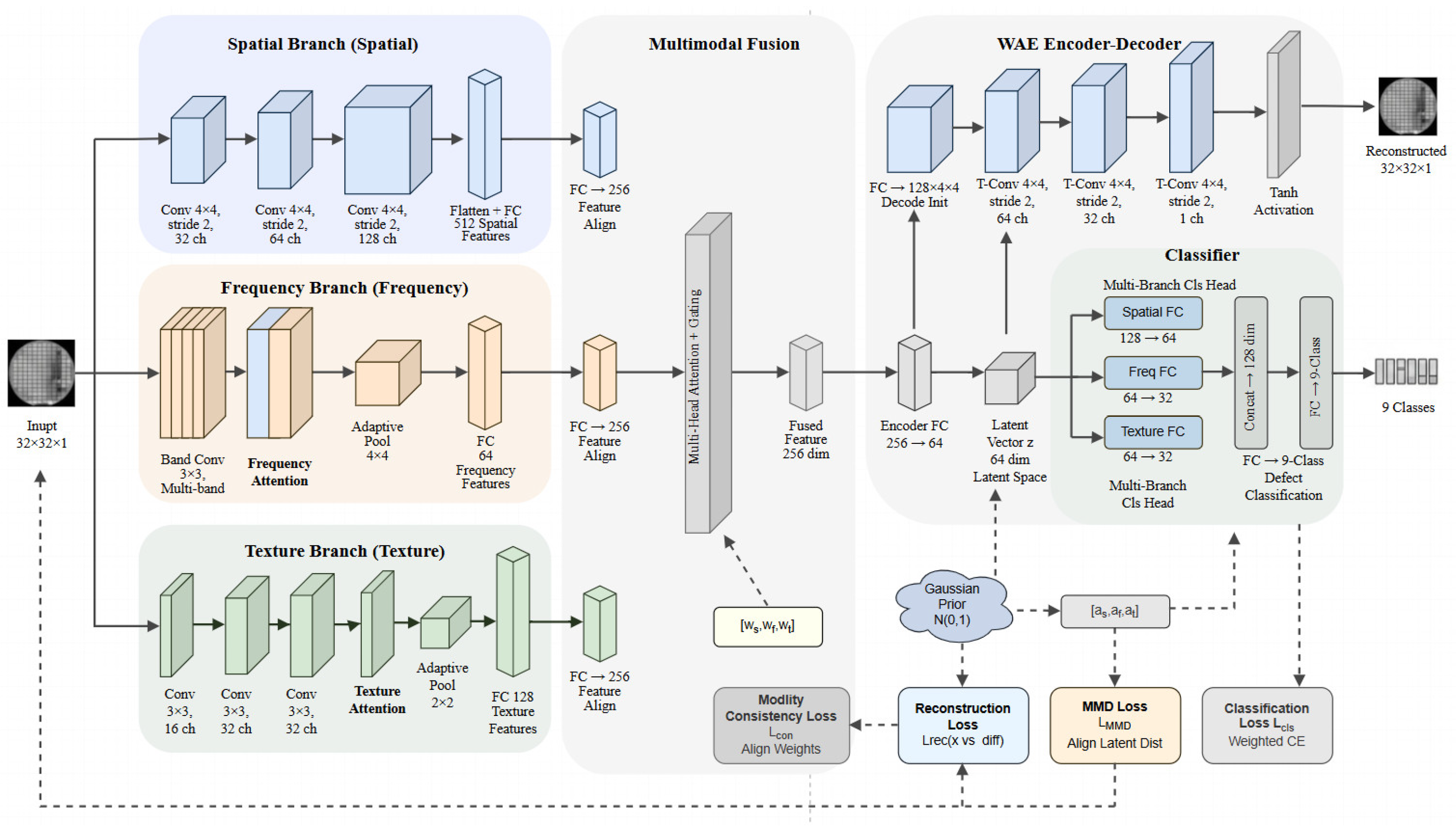
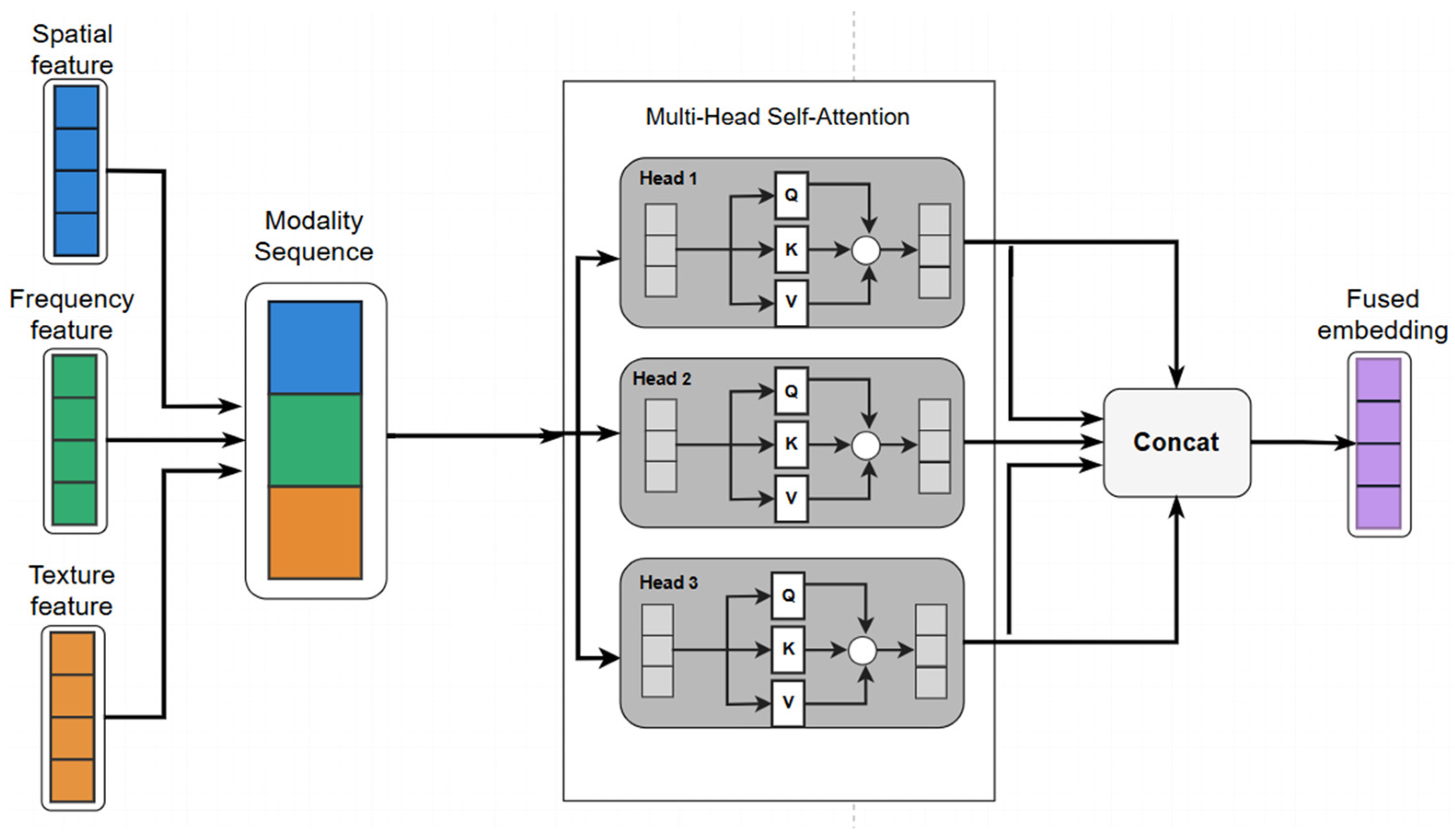
Wafer map defect pattern recognition is a key task for ensuring yield in integrated circuit manufacturing. However, in real production lines it commonly suffers from scarce labeled data, long-tailed class distributions, and limited feature representations, which cause existing deep learning models to degrade in performance, particularly for minority defect classes and complex defect morphologies. To address these challenges, we propose a semi-supervised classification method for wafer maps based on a multimodal Wasserstein autoencoder (MM-WAE). The framework constructs three parallel feature branches in the spatial, frequency, and texture domains, using a multi-head attention mechanism and gating mechanism for adaptive multimodal fusion. This allows defect patterns to be comprehensively characterized by macroscopic geometric distributions, spectral periodic structures, and microscopic texture details. The Wasserstein autoencoder is introduced, with the latent space distribution regularized by a maximum mean discrepancy (MMD) loss using an inverse multiquadratic kernel. Additionally, an inverse class-frequency weighted cross-entropy loss and a modality consistency loss between the encoder and classifier jointly optimize the reconstruction and classification paths while leveraging large amounts of unlabeled wafer maps for semi-supervised learning. Experimental results show that MM-WAE mitigates performance limitations caused by insufficient labels and class imbalance, significantly improving the accuracy and robustness of wafer defect classification, with promising potential for industrial application and further development.
Keywords: wafer map defect recognition; multimodal Wasserstein autoencoder; semi-supervised learning; class imbalance wafer map defect recognition; multimodal Wasserstein autoencoder; semi-supervised learning; class imbalance