Structure Design Optimization of a Differential Capacitive MEMS Accelerometer Based on a Multi-Objective Elitist Genetic Algorithm

 ,
,
Abstract
1. Introduction
2. Optimization Methodology Based on a Genetic Algorithm
2.1. Parameterized Modeling of MEMS Accelerometer
2.2. Optimization Objectives
2.3. Optimization Algorithm
3. Optimization Process and Results
3.1. Optimization Process
3.2. Optimization Results
4. Experiments and Results
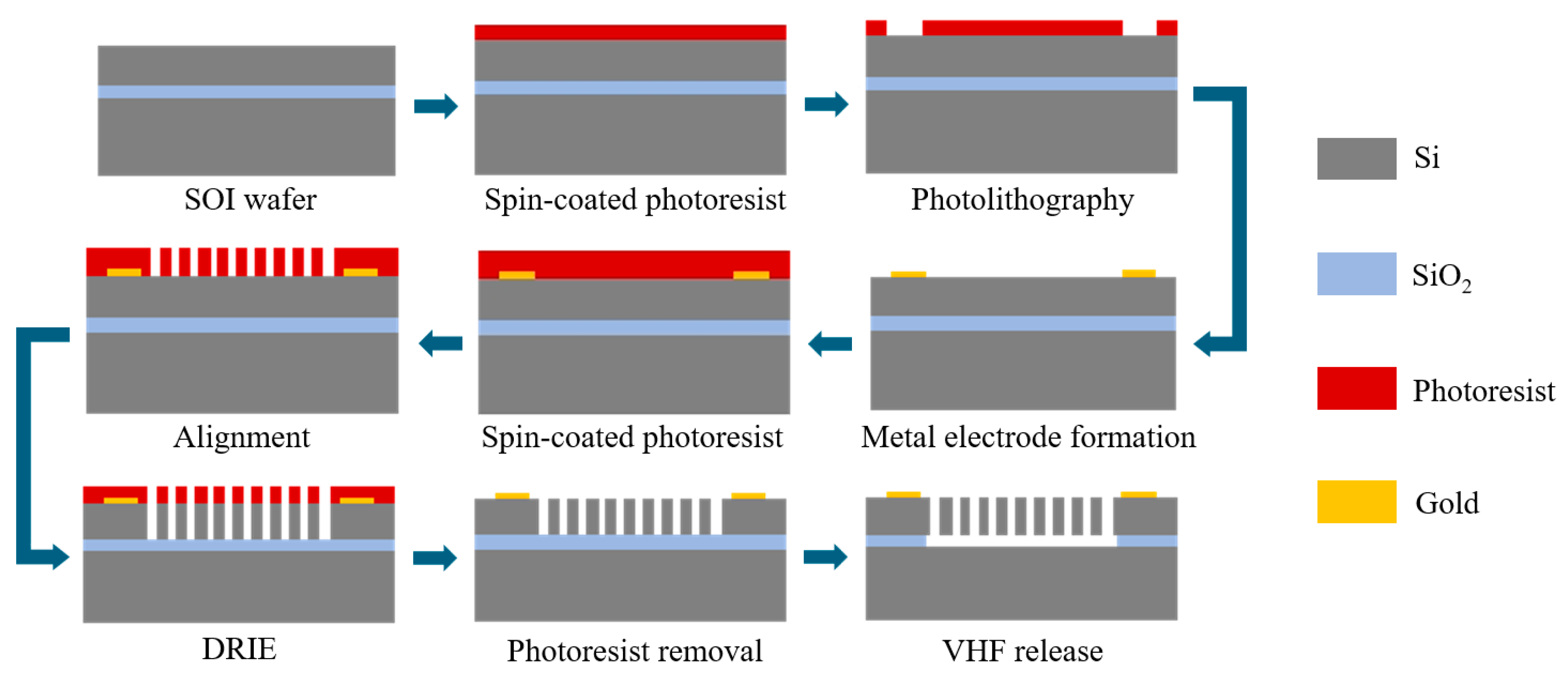
4.1. Device Fabrication
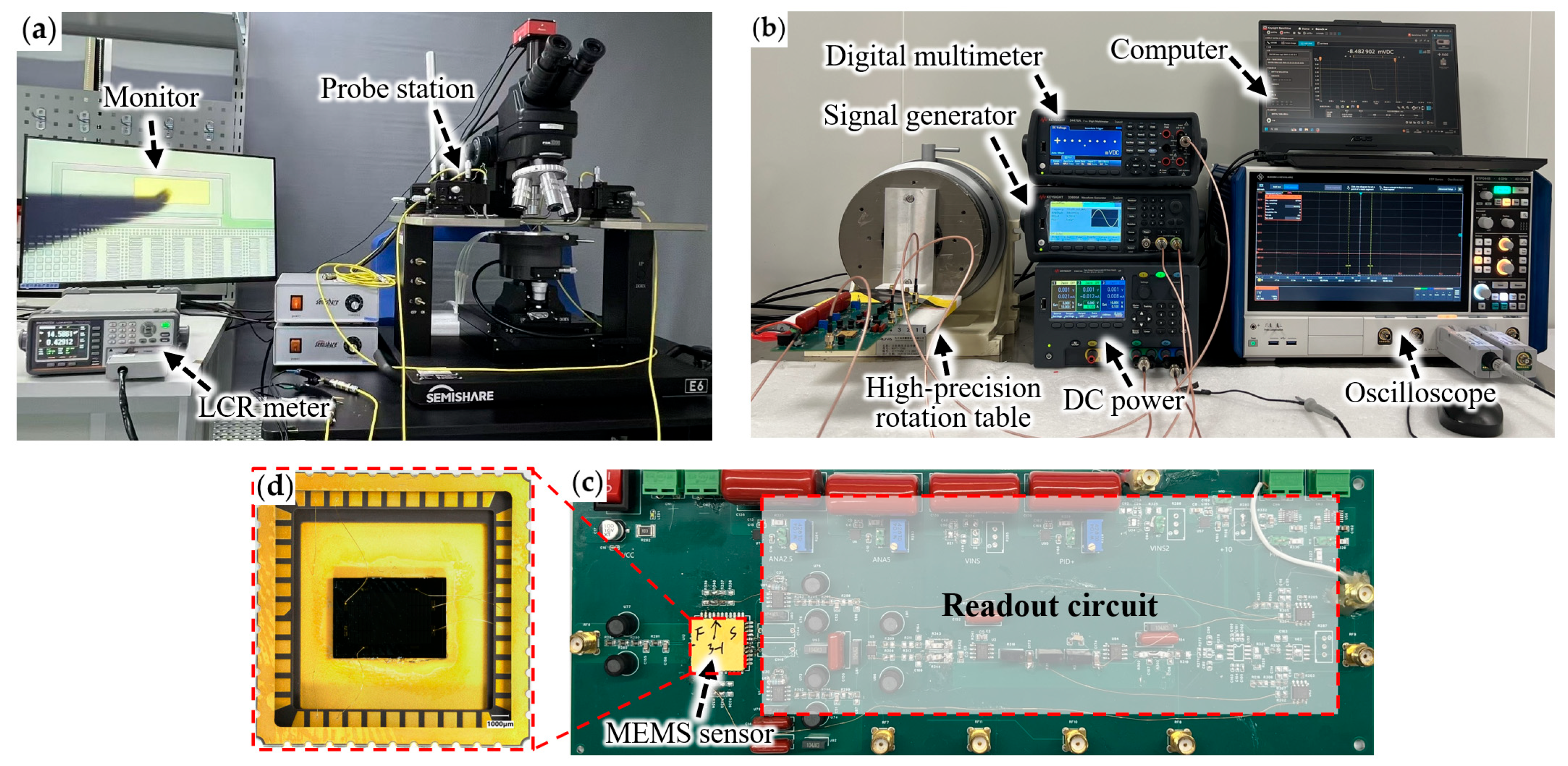
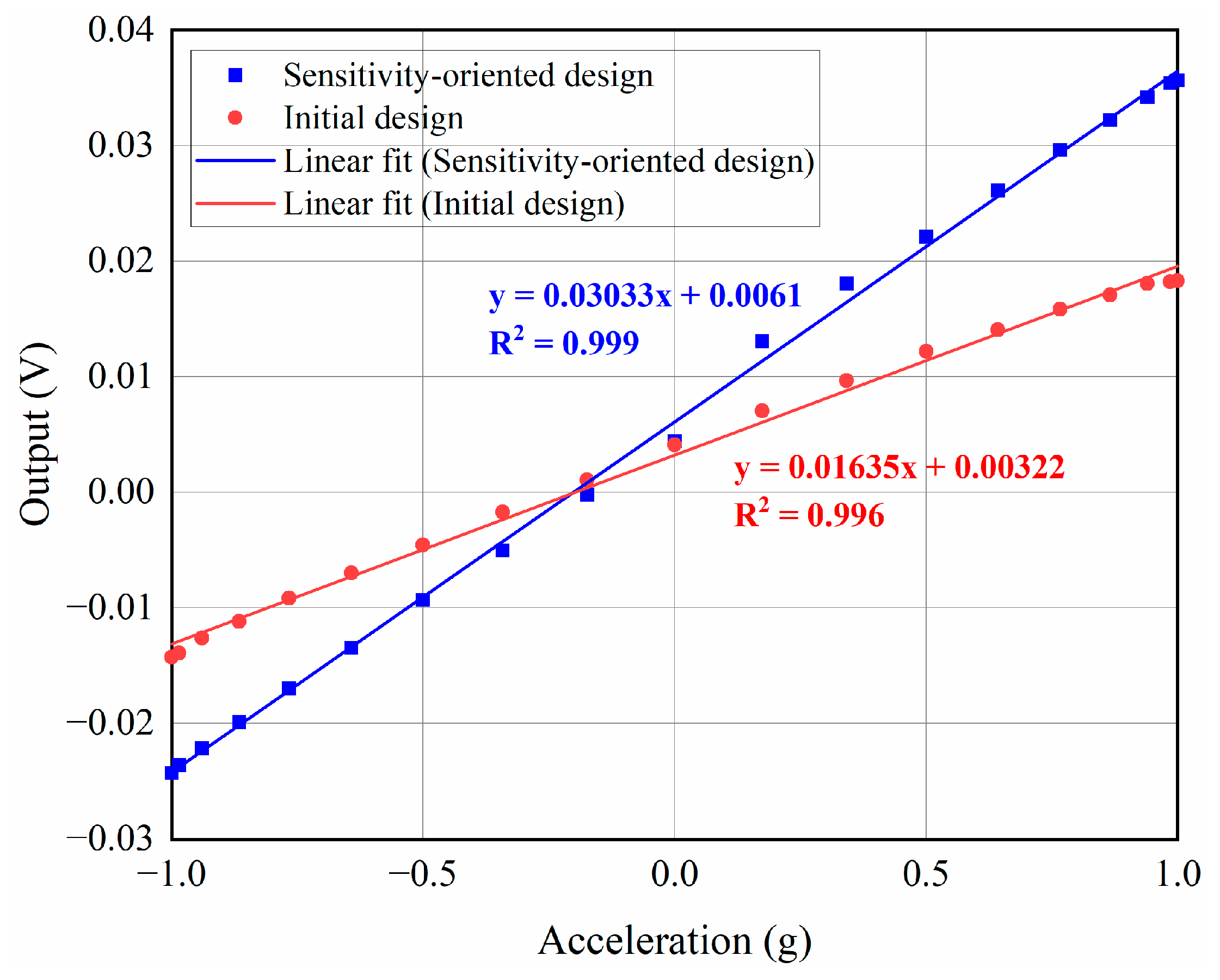
4.2. Experimental Step and Results
5. Discussion
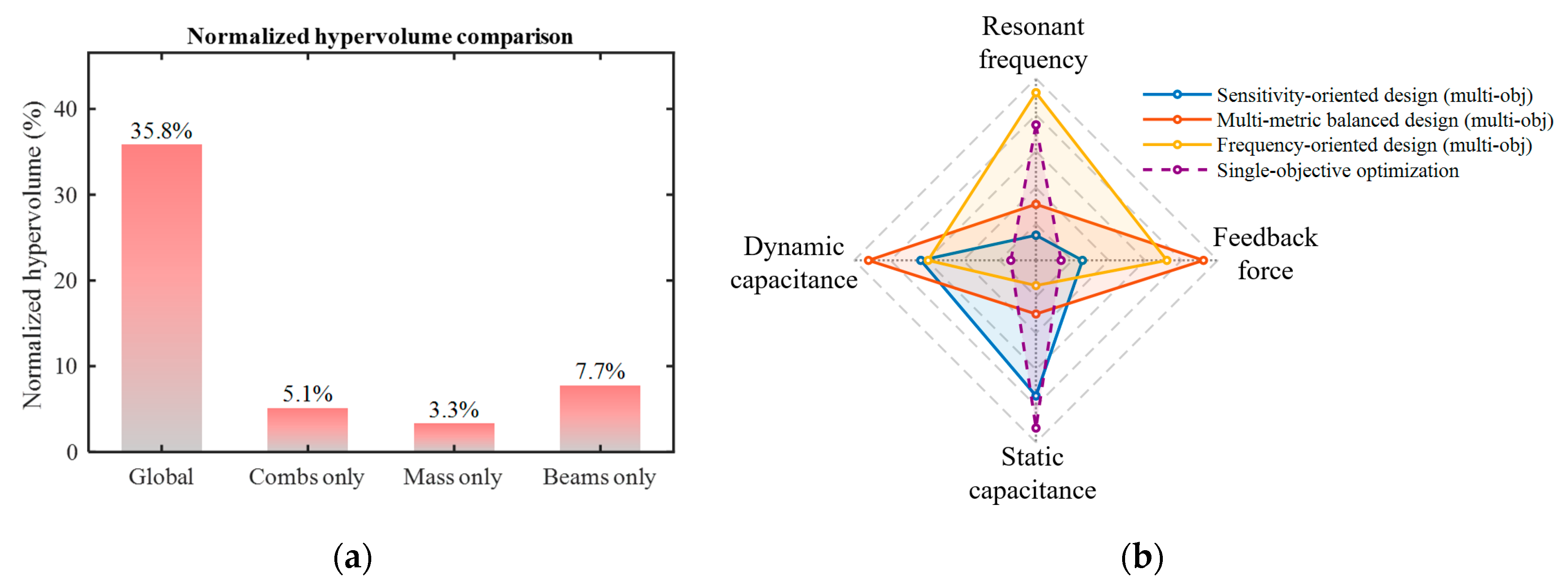
5.1. Comparison of Different Optimization Methodologies
5.1.1. Multi-Objective Local Optimization
5.1.2. Single-Objective Global Optimization
5.2. Results Analysis
6. Conclusions
Author Contributions
Funding
Institutional Review Board Statement
Informed Consent Statement
Data Availability Statement
Acknowledgments
Conflicts of Interest
References
- El-Sheimy, N.; Youssef, A. Inertial Sensors Technologies for Navigation Applications: State of the Art and Future Trends. Satell. Navig. 2020, 1, 2. [Google Scholar] [CrossRef]
- Shi, S.; Ma, L.; Kang, K.; Zhu, J.; Hu, J.; Ma, H.; Pang, Y.; Wang, Z. High-Sensitivity Piezoelectric MEMS Accelerometer for Vector Hydrophones. Micromachines 2023, 14, 1598. [Google Scholar] [CrossRef]
- Aydemir, A.; Terzioglu, Y.; Akin, T. A New Design and a Fabrication Approach to Realize a High Performance Three Axes Capacitive MEMS Accelerometer. Sens. Actuators A Phys. 2016, 244, 324–333. [Google Scholar] [CrossRef]
- Sheng, B.; Chen, F.; Qian, C.; Xu, D.; Guo, S.; Li, X. Design of a Dual Quantization Electromechanical Sigma–Delta Modulator MEMS Vibratory Wheel Gyroscope. J. Microelectromech. Syst. 2018, 27, 218–230. [Google Scholar] [CrossRef]
- Bian, W.; Zhao, X.; Lu, W.; Yang, Y.; Zhang, J.; You, R.; Xing, F. Design Method for Out-of-Plane Motion Rejecting Structure in 2-DoF Large Stroke Actuators. Microsyst. Nanoeng. 2025, 11, 144. [Google Scholar] [CrossRef]
- Wang, C.; Wang, Y.; Fang, W.; Song, X.; Quan, A.; Gidts, M.; Zhang, H.; Liu, H.; Bai, J.; Sadeghpour, S.; et al. Design of a Large-Range Rotary Microgripper with Freeform Geometries Using a Genetic Algorithm. Microsyst. Nanoeng. 2022, 8, 3. [Google Scholar] [CrossRef]
- Zhang, H.; Wei, X.; Ding, Y.; Jiang, Z.; Ren, J. A Low Noise Capacitive MEMS Accelerometer with Anti-Spring Structure. Sens. Actuators A Phys. 2019, 296, 79–86. [Google Scholar] [CrossRef]
- Ouyang, C.; He, W.; Jia, L.; Wang, P.; Zhao, K.; Xing, F.; You, Z. Full-System Simulation and Analysis of a Four-Mass Vibratory MEMS Gyroscope. Micromachines 2025, 16, 414. [Google Scholar] [CrossRef]
- Zhao, K.; Chen, T.; Yang, L.; Wu, W.; Hu, C.; Liu, H.; Fan, J. Research on Parasitic Capacitance Reduction in All-Silicon High-Precision MEMS Accelerometers. J. Microelectromech. Syst. 2025, 34, 422–431. [Google Scholar] [CrossRef]
- Chen, F.; Yuan, W.; Chang, H.; Yuan, G.; Xie, J.; Kraft, M. Design and Implementation of an Optimized Double Closed-Loop Control System for MEMS Vibratory Gyroscope. IEEE Sens. J. 2014, 14, 184–196. [Google Scholar] [CrossRef]
- Wang, J.; Yuan, S.; Xu, H.; Ruitao, L.; Huang, Q.-A.; Zhou, Z.-F. Macro-Modeling Technique of Capacitive MEMS Based on the Implicit Condensation Method and Lagrange Principle. IEEE Sens. J. 2025, 25, 17264–17274. [Google Scholar] [CrossRef]
- Ren, Y.; Duan, G.; Jiao, J. Experimental Study on Temperature Compensation for Dual-Axis MEMS Accelerometers Using Adaptive Mode Decomposition and Hybrid Convolutional–Recurrent Temporal Network Modeling. Micromachines 2025, 16, 1284. [Google Scholar] [CrossRef]
- Wang, C.; Wu, X.; Sadeghpour, S.; Shojaeian, M.; Wang, L.; Madeira, B.P.; Guan, Y.; Liu, H.; Wang, Y.; Zhang, P.; et al. A MEMS Electro-Mechanical Co-Optimization Platform Featuring Freeform Geometry Optimization Based on a Genetic Algorithm. Microsyst. Nanoeng. 2025, 11, 64. [Google Scholar] [CrossRef] [PubMed]
- Haji, S.H.; Abdulazeez, A.M. Comparison of Optimization Techniques Based on Gradient Descent Algorithm: A Review. PalArch’s J. Archaeol. Egypt Egyptol. 2021, 18, 2715–2743. [Google Scholar]
- Li, R.; Mohammed, Z.; Rasras, M.; Elfadel, I.A.M.; Choi, D. Design, Modelling and Characterization of Comb Drive MEMS Gap-Changeable Differential Capacitive Accelerometer. Measurement 2021, 169, 108377. [Google Scholar] [CrossRef]
- Wang, T. Summary of MEMS Capacitive Accelerometer. Adv. Eng. Technol. Res. 2024, 11, 672. [Google Scholar] [CrossRef]
- Sari, I.; Zeimpekis, I.; Kraft, M. A Dicing Free SOI Process for MEMS Devices. Microelectron. Eng. 2012, 95, 121–129. [Google Scholar] [CrossRef]
- Ren, G.; Yuan, S.; Peng, J.; Liu, R.; Feng, Y.; Liu, H.; Lu, W.; Xing, F.; Sun, T.; Yu, S. Attofarad-Class Ultra-High-Capacitance Resolution Capacitive Readout Circuits. Sensors 2025, 25, 2461. [Google Scholar] [CrossRef]
- Michal, V. Front-end ΔC/C0 Capacitive Interface Based on Negative Impedance Converter. Electron. Lett. 2014, 50, 1726–1728. [Google Scholar] [CrossRef]
- Wang, B.; Qi, Z.; Wang, K.; Zhai, Z.; Wang, Z.; Zou, X. A Mode-Localized Micro-Electromechanical System Accelerometer with Force Rebalance Closed-Loop Control. Micromachines 2025, 16, 248. [Google Scholar] [CrossRef]
- Akbaba, C.E.; Tanrıkulu, Y. MEMS Capacitive Accelerometer: A Review. Artıbilim Adana Alparslan Türkeş Bilim Teknol. Üniv. Fen Bilim. Derg. 2023, 6, 41–58. [Google Scholar] [CrossRef]
- Deng, W.; Zhang, X.; Zhou, Y.; Liu, Y.; Zhou, X.; Chen, H.; Zhao, H. An Enhanced Fast Non-Dominated Solution Sorting Genetic Algorithm for Multi-Objective Problems. Inf. Sci. 2022, 585, 441–453. [Google Scholar] [CrossRef]
- Ma, H.; Zhang, Y.; Sun, S.; Liu, T.; Shan, Y. A Comprehensive Survey on NSGA-II for Multi-Objective Optimization and Applications. Artif. Intell. Rev. 2023, 56, 15217–15270. [Google Scholar] [CrossRef]
- Liu, H.; Pike, W.T.; Charalambous, C.; Stott, A.E. Passive Method for Reducing Temperature Sensitivity of a Microelectromechanical Seismic Accelerometer for Marsquake Monitoring below 1 Nano-g. Phys. Rev. Appl. 2019, 12, 064057. [Google Scholar] [CrossRef]
- Jiao, S.; Qu, Z.; Ma, X.; Ouyang, H.; Xiong, W.; Zhang, S.; Wang, Q.; Liu, H. An Optomechanical MEMS Geophone with a 2.5 Ng/Hz1/2 Noise Floor for Oil/Gas Exploration. Microsyst. Nanoeng. 2024, 10, 176. [Google Scholar] [CrossRef]
- Varanis, M.; Silva, A.; Mereles, A.; Pederiva, R. MEMS Accelerometers for Mechanical Vibrations Analysis: A Comprehensive Review with Applications. J. Braz. Soc. Mech. Sci. Eng. 2018, 40, 527. [Google Scholar] [CrossRef]
- Chircov, C.; Grumezescu, A.M. Microelectromechanical Systems (MEMS) for Biomedical Applications. Micromachines 2022, 13, 164. [Google Scholar] [CrossRef]
- Ko, W.H.; Zhang, R.; Huang, P.; Guo, J.; Ye, X.; Young, D.J.; Megerian, C.A. Studies of MEMS Acoustic Sensors as Implantable Microphones for Totally Implantable Hearing-Aid Systems. IEEE Trans. Biomed. Circuits Syst. 2009, 3, 277–285. [Google Scholar] [CrossRef]
- Ba, Y.; Li, Y.; Zhou, Y. Design, Fabrication, and Characterization of a Piezoelectric Micromachined Ultrasonic Transducer with a Suspended Cantilever Beam-like Structure with Enhanced SPL for Air Detection Applications. Micromachines 2025, 16, 1280. [Google Scholar] [CrossRef]
- Hadibafekr, S.; Mirzaee, I.; Khalilian, M.; Shirvani, H. Thermo-Entropic Analysis and Multi-Objective Optimization of Wavy Lobed Heat Exchanger Tube Using DOE, RSM, and NSGA II Algorithm. Int. J. Therm. Sci. 2023, 184, 107921. [Google Scholar] [CrossRef]
- Urdampilleta, I.; Bengoechea, M.; de Meatza, I.; Boyano, I.; Alberto Blázquez, J.; Lizaso, L.; Mainar, A.R.; Miguel, O.; Grande, H.-J.; Landa-Medrano, I.; et al. Holistic Optimization of Lithium-Ion Battery Negative Electrode Formulation Using a Combination of Theory of Mixtures, Box-Behnken Matrix, Multi-Variant Analysis and Desirability Functions of Derringer-Suich. Chem. Eng. J. 2023, 474, 145271. [Google Scholar] [CrossRef]
- Chen, C.; Zhou, J.; Wang, H.; Fan, Y.; Song, X.; Xie, J.; Bäck, T.; Wang, H. Machine Learning-Driven Discovery of High-Performance MEMS Disk Resonator Gyroscope Structural Topologies. Microsyst. Nanoeng. 2024, 10, 161. [Google Scholar] [CrossRef] [PubMed]

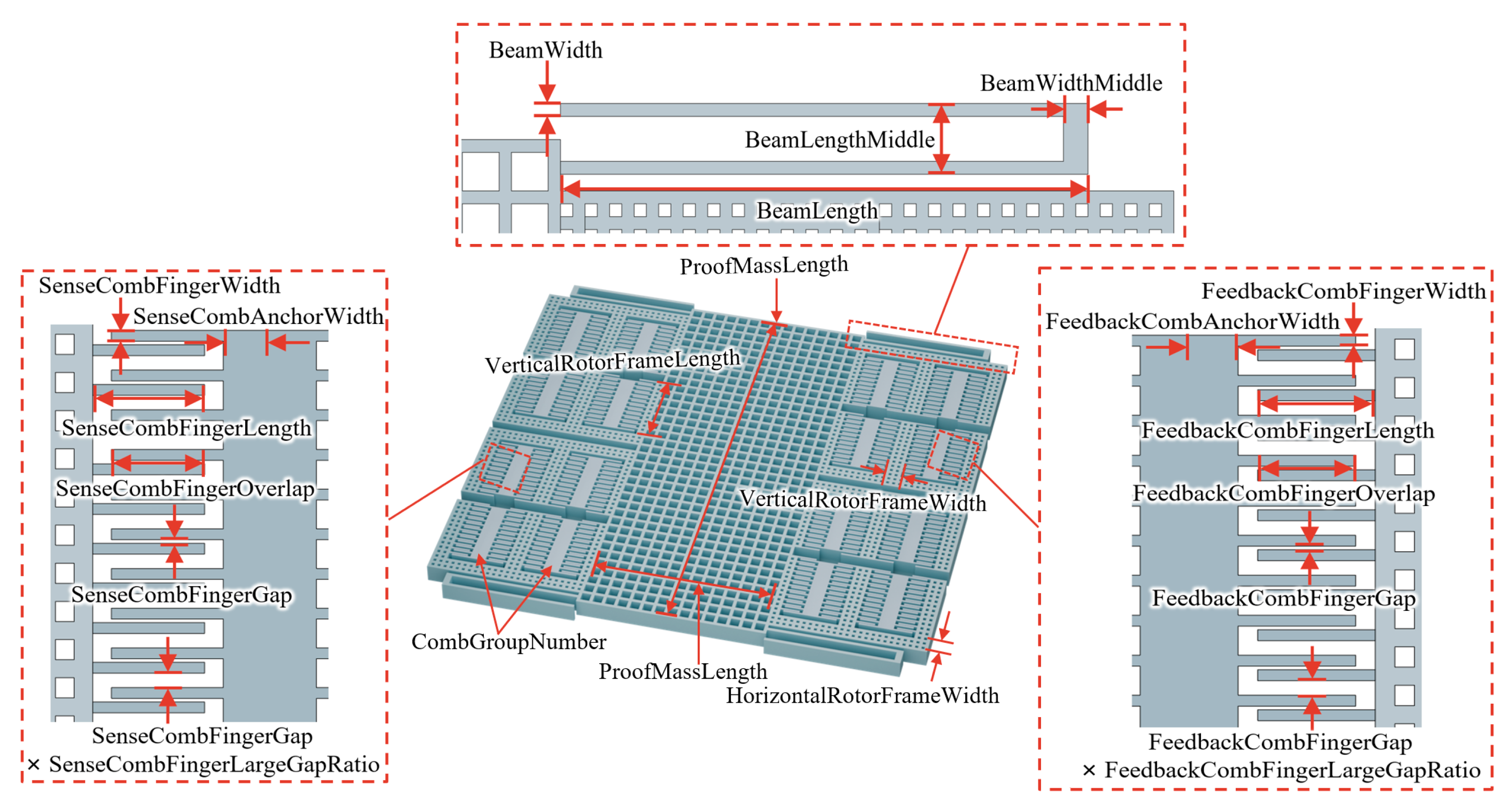






| Parameter | Symbol | LB | UB |
|---|---|---|---|
| ProofMassWidth | WM | 1000 μm | 3000 μm |
| ProofMassLength | LM | 3000 μm | 3200 μm |
| VerticalRotorFrameLength | LVF | 600 μm | 700 μm |
| SenseCombFingerWidth | WSC | 5 μm | 10 μm |
| SenseCombFingerLength | LSC | 50 μm | 150 μm |
| SenseCombFingerLargeGapRatio | RSC | 3 | 20 |
| SenseCombFingerOverlap | OSC | 30 μm | 140 μm |
| SenseCombFingerGap | GSC | 2 μm | 6 μm |
| FeedbackCombFingerWidth | WFC | 5 μm | 10 μm |
| FeedbackCombFingerLength | LFC | 50 μm | 150 μm |
| FeedbackCombFingerLargeGapRatio | RFC | 2 | 8 |
| FeebackCombFingerOverlap | OFC | 40 μm | 140 μm |
| FeebackCombFingerGap | GFC | 2 μm | 6 μm |
| BeamWidth | WB | 8 μm | 15 μm |
| BeamLength | LB | 600 μm | 1050 μm |
| BeamLengthMiddle | LMB | 45 μm | 65 μm |
| BeamWidthMiddle | WLB | 15 μm | 25 μm |
| CombFingerGroupNumber | NC | 3 | 6 |
| HorizontalRotorFrameWidth | WHF | 50 μm | 90 μm |
| VerticalRotorFrameWidth | WVF | 50 μm | 50 μm |
| SenseCombAnchorWidth | WSA | 25 μm | 25 μm |
| FeedbackCombAnchorWidth | WFA | 25 μm | 25 μm |
| Number | Constraint |
|---|---|
| 1 | LM − 4 × LVF = 450 μm |
| 2 | −WM – 24 × LSC + 12 × OSC – 24 × LFC + 12 × OFC <= −2760 μm |
| 3 | WM + 24 × LSC – 12 × OSC + 24 × LFC – 12 × OFC <= 3760 μm |
| 4 | −LM – 2 × LMB <= −3154 μm |
| 5 | LM + 2 × LMB <= 3354 μm |
| 6 | OSC/OFC >= 0.5 |
| 7 | OSC/OFC <= 1.5 |
| 8 | LSC − OSC >= 10 μm |
| 9 | LSC − OSC <= 20 μm |
| 10 | −LFC + OFC <= −6 μm |
| 11 | LFC − OFC <= 10 μm |
| 12 | LMB − WLB >= 37 μm |
| 13 | LMB – 2 × WLB <= 37 μm |
| Parameter | Symbol | Sensitivity-Oriented Design | Frequency-Oriented Design | Multi-Metric Balanced Design |
|---|---|---|---|---|
| ProofMassWidth | WM | 2810 μm | 1610 μm | 1490 μm |
| ProofMassLength | LM | 3090 μm | 3170 μm | 3170 μm |
| VerticalRotorFrameLength | LVF | 660 μm | 660 μm | 640 μm |
| SenseCombFingerWidth | WSC | 6 μm | 6 μm | 6 μm |
| SenseCombFingerLength | LSC | 93 μm | 98 μm | 116 μm |
| SenseCombFingerLargeGapRatio | RSC | 14 | 12 | 13 |
| SenseCombFingerOverlap | OSC | 78 μm | 83 μm | 101 μm |
| SenseCombFingerGap | GSC | 2 μm | 2 μm | 2 μm |
| FeedbackCombFingerWidth | WFC | 6 μm | 6 μm | 6 μm |
| FeedbackCombFingerLength | LFC | 150 μm | 100 μm | 134 μm |
| FeedbackCombFingerLargeGapRatio | RFC | 4 | 4 | 4 |
| FeebackCombFingerOverlap | OFC | 101 μm | 92 μm | 128 μm |
| FeebackCombFingerGap | GFC | 2 μm | 2 μm | 2 μm |
| BeamWidth | WB | 10 μm | 12 μm | 10 μm |
| BeamLength | LB | 897 μm | 857 μm | 875 μm |
| BeamLengthMiddle | LMB | 56 μm | 49 μm | 52 μm |
| BeamWidthMiddle | WLB | 18 μm | 25 μm | 20 μm |
| CombFingerGroupNumber | NC | 3 | 5 | 4 |
| HorizontalRotorFrameWidth | WHF | 50 μm | 70 μm | 90 μm |
| VerticalRotorFrameWidth | WVF | 50 μm | 50 μm | 50 μm |
| SenseCombAnchorWidth | WSA | 25 μm | 25 μm | 25 μm |
| FeedbackCombAnchorWidth | WFA | 25 μm | 25 μm | 25 μm |
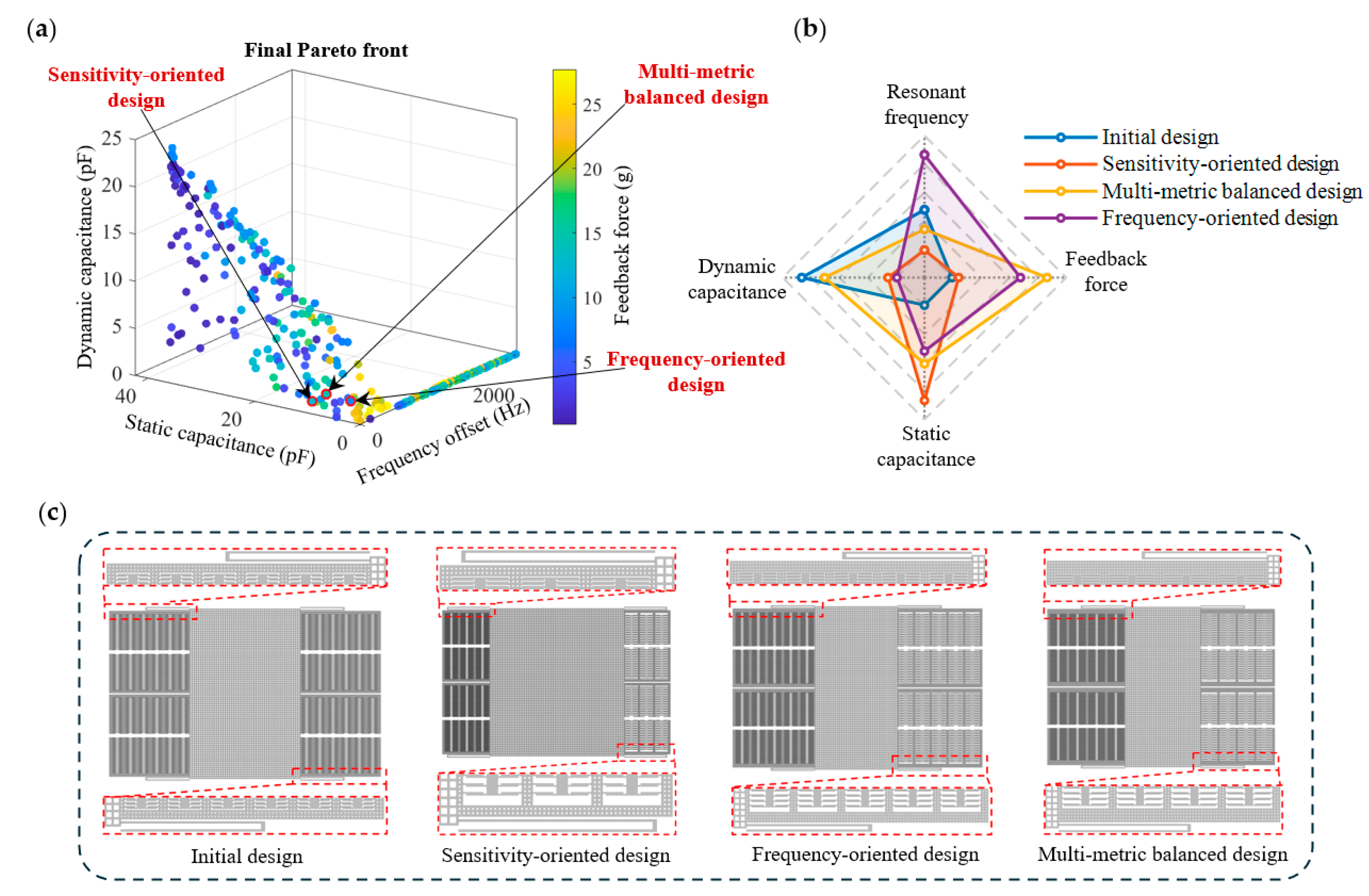
| Objective | Initial Design | Sensitivity-Oriented Design | Frequency-Oriented Design | Multi-Metric Balanced Design | |||
|---|---|---|---|---|---|---|---|
| fy (Hz) | 1146.06 | 961.50 | −16.1% | 1398.80 | 22.1% | 1056.37 | −8.1% |
| C0 (pF) | 14.59 | 4.93 | −66.2% | 9.93 | −31.9% | 8.64 | −40.8% |
| ΔC (pF) | 1.77 | 1.09 | −66.2% | 1.02 | −42.4% | 1.59 | −10.2% |
| Fb (g) | 7.40 | 7.88 | 6.5% | 12.31 | 66.35% | 14.23 | 92.3% |
| ΔC/C0 | 0.1213 | 0.2210 | 82.1% | 0.1027 | −15.3% | 0.1840 | 51.6% |
| Objective | Initial Design | Sensitivity-Oriented Design | ||
|---|---|---|---|---|
| Simulation | Static capacitance | 14.59 pF | 4.93 pF | −66.2% |
| ΔC/C0 (reflect sensitivity) | 0.1213 | 0.2210 | 82.1% | |
| Experiment | Static capacitance | 18.78 pF | 8.24 pF | −56.1% |
| Sensitivity | 16.35 mV/g | 30.33 mV/g | 85.5% | |
| Number | FOM | |fy − 1300| (Hz) | C0 (pF) | ΔC (pF) | Fb (g) |
|---|---|---|---|---|---|
| 1 | 0 | 0 | 3.47 | 0.23 | 6.76 |
| 2 | 0.0037 | 0.0021 | 3.26 | 0.23 | 7.77 |
| 3 | 0.0049 | 0.0026 | 2.65 | 0.19 | 7.30 |
| 4 | 0.0059 | 0.0030 | 2.66 | 0.19 | 6.97 |
| 5 | 0.0106 | 0.0059 | 3.27 | 0.24 | 7.56 |
| 6 | 0.0109 | 0.0094 | 5.60 | 0.66 | 7.38 |
| 7 | 0.0144 | 0.0059 | 2.08 | 0.15 | 5.83 |
| 8 | 0.0146 | 0.0075 | 4.07 | 0.29 | 7.26 |
| 9 | 0.0155 | 0.0110 | 3.75 | 0.44 | 6.09 |
| 10 | 0.0163 | 0.0076 | 1.98 | 0.14 | 6.46 |
Disclaimer/Publisher’s Note: The statements, opinions and data contained in all publications are solely those of the individual author(s) and contributor(s) and not of MDPI and/or the editor(s). MDPI and/or the editor(s) disclaim responsibility for any injury to people or property resulting from any ideas, methods, instructions or products referred to in the content. |
© 2026 by the authors. Licensee MDPI, Basel, Switzerland. This article is an open access article distributed under the terms and conditions of the Creative Commons Attribution (CC BY) license.
Share and Cite
Yang, D.; Chu, Y.; Liu, R.; Zhang, X.; Yuan, S.; Zhang, F.; Xuan, S.; Chi, Y.; Liu, J.; Lei, Z.; et al. Structure Design Optimization of a Differential Capacitive MEMS Accelerometer Based on a Multi-Objective Elitist Genetic Algorithm. Micromachines 2026, 17, 129. https://doi.org/10.3390/mi17010129
Yang D, Chu Y, Liu R, Zhang X, Yuan S, Zhang F, Xuan S, Chi Y, Liu J, Lei Z, et al. Structure Design Optimization of a Differential Capacitive MEMS Accelerometer Based on a Multi-Objective Elitist Genetic Algorithm. Micromachines. 2026; 17(1):129. https://doi.org/10.3390/mi17010129
Chicago/Turabian StyleYang, Dongda, Yao Chu, Ruitao Liu, Xiwen Zhang, Saifei Yuan, Fan Zhang, Shengjie Xuan, Yunzhang Chi, Jiahui Liu, Zetong Lei, and et al. 2026. "Structure Design Optimization of a Differential Capacitive MEMS Accelerometer Based on a Multi-Objective Elitist Genetic Algorithm" Micromachines 17, no. 1: 129. https://doi.org/10.3390/mi17010129
APA StyleYang, D., Chu, Y., Liu, R., Zhang, X., Yuan, S., Zhang, F., Xuan, S., Chi, Y., Liu, J., Lei, Z., & You, R. (2026). Structure Design Optimization of a Differential Capacitive MEMS Accelerometer Based on a Multi-Objective Elitist Genetic Algorithm. Micromachines, 17(1), 129. https://doi.org/10.3390/mi17010129