Article

Metal-Induced Trap States: The Roles of Interface and Border Traps in HfO2/InGaAs

1
Faculty of Applied Science, Ho Chi Minh City University of Technology and Education, 01 Vo Van Ngan Street, Ho Chi Minh City 700000, Vietnam
2
Department of Materials Science and Engineering, National Yang Ming Chiao Tung University, 1001, Daxue Road, East District, Hsinchu 300093, Taiwan
3
Department of Physics, National Sun Yat-sen University, Kaohsiung 80424, Taiwan
4
Faculty of Fundamental Sciences, University of Architecture Ho Chi Minh City, 196 Pasteur St., Dist. 3, Ho Chi Minh City 700000, Vietnam
5
Faculty of electrical and electronics engineering, Ho Chi Minh City University of Technology and Education, 01 Vo Van Ngan Street, Ho Chi Minh City 700000, Vietnam
6
EEE Department, University of Sheffield, Sheffield S10 2TN, UK
*
Author to whom correspondence should be addressed.
Micromachines 2023, 14(8), 1606; https://doi.org/10.3390/mi14081606
Submission received: 16 May 2023 / Revised: 1 August 2023 / Accepted: 11 August 2023 / Published: 15 August 2023
(This article belongs to the Special Issue Optoelectronic Devices: From Fundamental Research to Applications)

Abstract

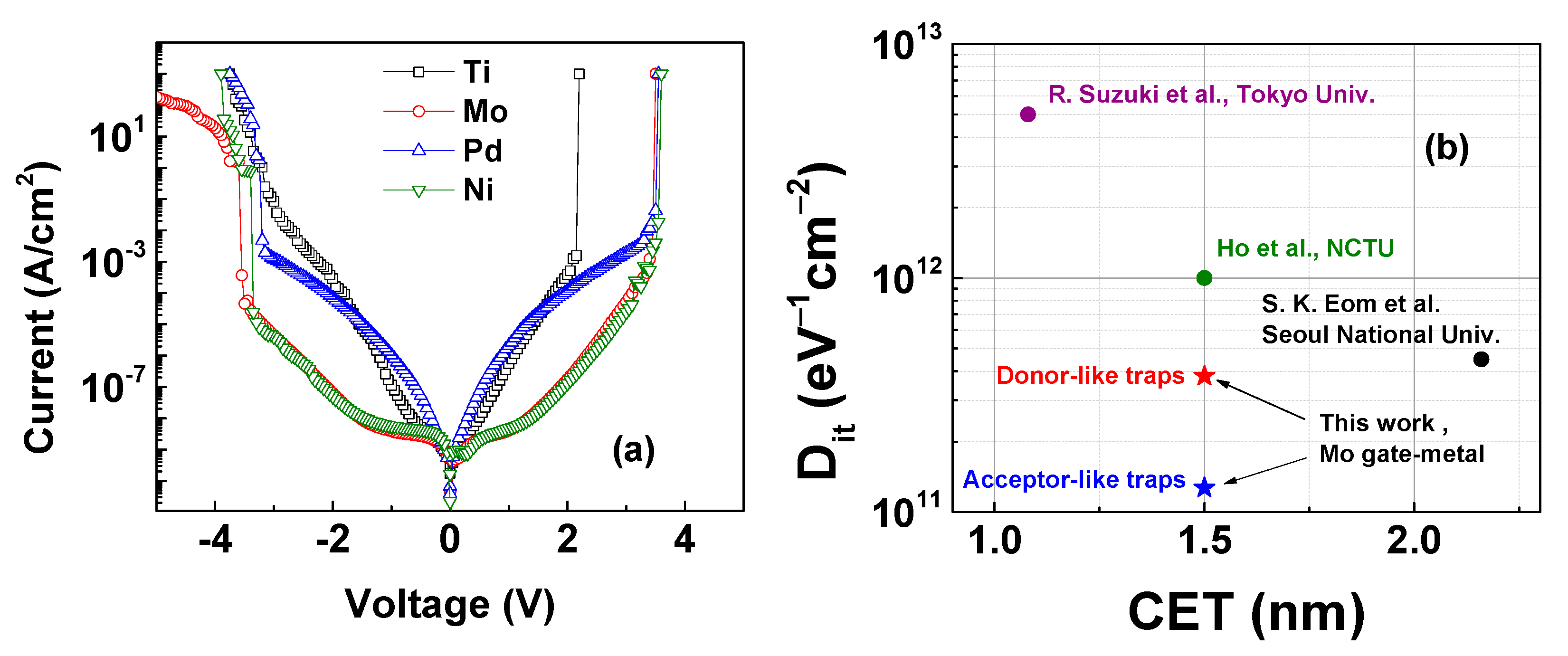
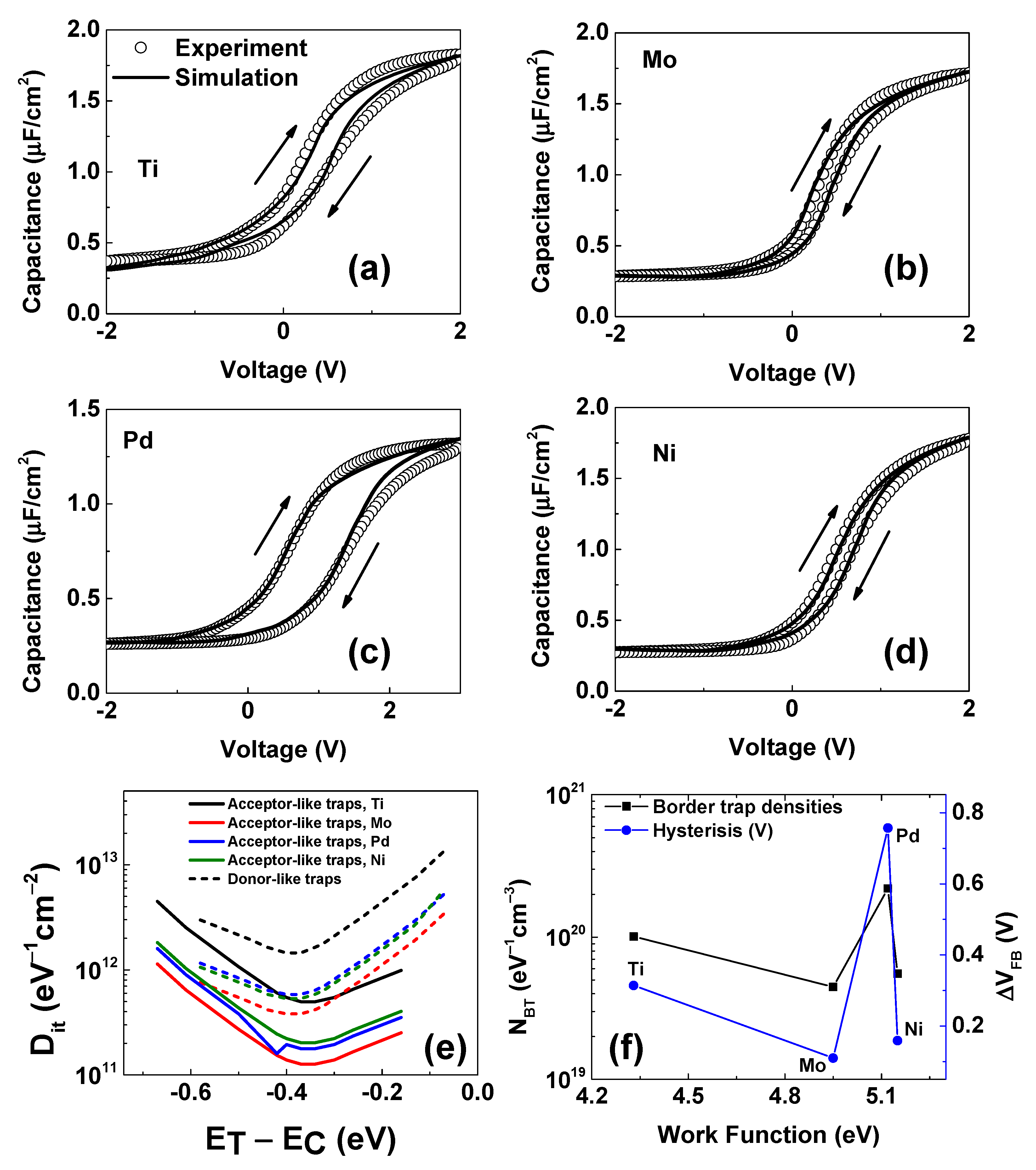
By combining capacitance–voltage measurements, TCAD simulations, and X-ray photoelectron spectroscopy, the impact of the work function of the gate metals Ti, Mo, Pd, and Ni on the defects in bulk HfO2 and at the HfO2/InGaAs interfaces are studied. The oxidation at Ti/HfO2 is found to create the highest density of interface and border traps, while a stable interface at the Mo/HfO2 interface leads to the smallest density of traps in our sample. The extracted values of Dit of 1.27 × 10¹¹ eV−1cm−2 for acceptor-like traps and 3.81 × 10¹¹ eV−1cm−2 for donor-like traps are the lowest reported to date. The density and lifetimes of border traps in HfO2 are examined using the Heiman function and strongly affect the hysteresis of capacitance–voltage curves. The results help systematically guide the choice of gate metal for InGaAs.
Keywords: defects in HfO2; interface traps; border traps; acceptor-like and donor-like traps; Hf 4f peaks; valence band maximum; electronic band structure defects in HfO2; interface traps; border traps; acceptor-like and donor-like traps; Hf 4f peaks; valence band maximum; electronic band structure