Review

Sulforaphane in Cutaneous Disorders and Skin Injury: Mechanisms, Evidence, and Clinical Perspectives

1
Stanley Division of Developmental Neurovirology, Department of Pediatrics, The Johns Hopkins University School of Medicine, Baltimore, MD 21287, USA
2
Department of Medicine, The Johns Hopkins University School of Medicine, Baltimore, MD 21205, USA
3
Department of Psychiatry & Behavioral Sciences, The Johns Hopkins University School of Medicine, Baltimore, MD 21205, USA
4
Department of Physiology, Pharmacology & Therapeutics, The Johns Hopkins University School of Medicine, Baltimore, MD 21205, USA
5
iMIND Institute, The Johns Hopkins University School of Medicine, Baltimore, MD 21205, USA
6
Institute of Medicine, University of Maine, Orono, ME 04469, USA
*
Author to whom correspondence should be addressed.
Nutrients 2026, 18(9), 1444; https://doi.org/10.3390/nu18091444
Submission received: 30 March 2026 / Revised: 27 April 2026 / Accepted: 28 April 2026 / Published: 30 April 2026

Abstract

Cutaneous disorders such as atopic dermatitis, psoriasis, acne vulgaris, and rosacea, together with UV-induced skin injury and photoaging, are highly prevalent conditions that involve varying contributions from dysregulated immune responses, cutaneous inflammation, oxidative stress, barrier dysfunction, microbiome alteration, and exogenous injury. However, these conditions are biologically heterogeneous and should not be regarded as a single mechanistic class. Sulforaphane, a naturally occurring isothiocyanate found primarily in broccoli and other cruciferous vegetables, has attracted interest in dermatology because of its antioxidant, cytoprotective, and context-dependent anti-inflammatory properties. Sulforaphane exerts its biological effects by modulating key signaling pathways, particularly the Keap1/Nrf2 pathway and, in some settings, NF-κB-related signaling, thereby reducing oxidative stress and inflammation, regulating immune responses, enhancing skin barrier function, and potentially influencing the cutaneous microbiome. Preclinical studies and limited human data suggest that sulforaphane may reduce erythema, edema, and other markers of cutaneous damage in selected settings. This comprehensive review explores the role of sulforaphane across heterogeneous cutaneous conditions, with emphasis on molecular mechanisms, disease-specific differences, current evidence, and discusses key translational constraints including formulation, delivery, lack of standardized dosing, and the limitations of cell culture and animal models for predicting human efficacy. Overall, sulforaphane should presently be regarded as a promising but still early-stage translational candidate in dermatology. Robust human efficacy data remain lacking for chronic inflammatory dermatoses such as psoriasis, atopic dermatitis, acne, and rosacea, whereas the strongest current human evidence relates to UV-associated skin outcomes and photoprotection.

1. Introduction

Cutaneous disorders and skin injury are among the most common chronic conditions, imposing significant physical, psychological, and socioeconomic burdens, warranting a multidimensional management approach. Notable disorders in this category include psoriasis, atopic dermatitis (AD, eczema), rosacea, and acne vulgaris (acne), as well as UV-induced skin injury such as sunburn. The prevalence of these conditions varies, with psoriasis affecting approximately 2–3% of the population, while AD impacts 15–20% of children globally and can persist into adulthood in many cases [1,2,3]. Rosacea affects around 5% of adults [4]. Acne, as one of the most common skin conditions, is prevalent among 85–90% of adolescents and young adults, and sunburn is almost universally experienced, with acute and long-term consequences including an increased risk of cutaneous malignancy [5,6,7,8,9,10].
While the mechanisms underlying these conditions are intricate, involving a combination of genetic predisposition, environmental factors, and immune system dysregulation [11,12], inflammation is a key feature in the pathogenesis of most of them [1,2,4,5,13], but these disorders should not be regarded as a single mechanistic class. Inflammatory responses are initiated through activation of the innate immune system in response to environmental insults, microbial infection, or genetic predisposition. Then, released inflammatory cytokines activate adaptive immunity, followed by keratinocyte dysfunction, oxidative stress, and compromised skin barrier integrity, leading to symptoms such as redness (erythema), swelling (edema), itching (pruritus), and sometimes pain [14,15,16]. However, the relative contribution of these processes differs substantially among diseases.
Specific mechanisms vary by disease. In conditions like psoriasis, an overreactive immune system triggers the production of pro-inflammatory cytokines such as TNF-α and IL-17, and results in the abnormal proliferation of skin cells, leading to the formation of thick, scaly plaques [17]. In AD, skin barrier dysfunction allows allergens and irritants to penetrate more easily, triggering immune activation, chronic inflammation and itching [18]. In acne, current evidence supports a more complex pathogenesis involving sebaceous gland biology, follicular hyperkeratinization, host–microbiome interactions, and dysbiosis, rather than simple bacterial overgrowth alone [5]. By contrast, sunburn is better understood as an acute UV-induced skin injury caused by exogenous damage and stress-response signaling, although inflammation remains an important downstream feature.
None of the current treatment options, including topical agents, systemic therapies, and biologics, have fully met the needs of affected patients, although effective for many of them [11,19,20,21,22,23,24,25,26,27]. Adverse effects, the need for consistent laboratory monitoring, and loss or lack of efficacy are common reasons for the decreased use of conventional therapies [28,29]. Consequently, many patients continue to face significant management challenges and persistent symptoms [30]. Treatment dissatisfaction presents a major barrier to achieving optimal care, and the most effective treatments are those that patients are willing to use consistently. Many affected individuals therefore seek additional therapeutic options. Thus, there is a need for more mechanism- and evidence-based, scientifically validated, and well-tolerated complementary or adjunctive medicine approaches for these conditions [31,32,33,34].
Much like other chronic diseases, these cutaneous disorders and injury states arise from perturbations in multiple signaling pathways, suggesting that targeting a single pathway is unlikely to yield effective prevention or treatment [35]. Therefore, there is a growing interest in exploring multi-targeted, cost-effective, readily available and non-toxic agents, that can complement conventional treatments [36]. Phytochemicals, small molecule analogs, and well-characterized simple plant extracts, have long been recognized for their diverse biological effects [37], making strategies that utilize multi-functional phytochemicals, or even the edible plants from which those compounds are isolated, particularly appealing.
Sulforaphane [1-isothiocyanato-4-(methylsulfinyl)-butane; SF] is a naturally occurring isothiocyanate (ITC) derived from its biological precursor glucoraphanin (GR), a glucosinolate abundant in the cruciferous vegetable broccoli, and especially in broccoli sprouts and seeds [38,39,40,41]. Depending on its intended use, GR/SF can be classified as a food, dietary supplement, or drug [37,42,43]. SF is formed through the enzymatic hydrolysis of GR by the enzyme myrosinase during tissue disruption, processes like chopping or chewing activate this enzymatic conversion [38,41], and by the action of gastrointestinal microbiota [44,45]. Following absorption, SF rapidly forms glutathione conjugates, which facilitates its metabolism through the mercapturic acid pathway prior to excretion in the urine (Figure 1) [38]. This metabolic transformation is crucial as it influences the effective concentration of SF available for biological activity [46,47].
SF is a multi-functional phytochemical, with demonstrated antioxidant, anti-inflammatory, and anti-proliferative properties [48], along with anti-angiogenic effects [49,50,51]. Over the past three decades, a growing body of evidence, from in vitro studies to animal models and various clinical investigations, has highlighted SF’s remarkable ability to activate endogenous cytoprotective mechanisms, regulate redox balance, and inhibit pathogenic inflammatory signaling [48,52,53,54,55,56,57,58]. The pharmacologic versatility and favorable safety profile of SF position it as a viable candidate for safe, sustainable adjunctive therapy in managing these chronic skin conditions. However, the current evidence base remains weighted toward preclinical studies, and several translational issues, including model relevance, tissue exposure, formulation stability, and dose optimization, remain to be resolved. Even so, the available data support SF as a biologically active and translationally relevant candidate in dermatology, although its use should be evaluated based upon the evidence for each condition.
This review delves into the molecular mechanisms through which SF exerts its effects on heterogeneous cutaneous conditions and skin injury states and discusses the clinical evidence supporting its dermatologic applications. We also explore the challenges and future prospects for developing SF-based therapies for these conditions. The aim of this review is to provide a comprehensive overview of SF’s potential as a therapeutic agent in managing these dermatologic contexts, including its mechanisms of action, relevant preclinical and clinical studies, and the implications of its use in therapeutic regimens, while emphasizing disease-specific differences and the necessity for further research to clarify its benefits and applications in dermatology.

2. SF and Skin Health: Mechanisms of Action

The biologic effects of SF are rooted in its direct and indirect interactions with redox-sensitive pathways and inflammatory signaling systems that play critical roles in several cutaneous disorders and skin injury states. SF has been shown to modulate key stress-response and inflammatory pathways, inhibit the release of pro-inflammatory cytokines in selected experimental systems, and enhance the skin’s natural defense mechanisms [16,59]. Furthermore, its ability to activate the nuclear factor erythroid 2–related factor 2 (Nrf2) pathway, a critical regulator of cellular stress responses, underscores its potential relevance in mitigating oxidative stress and inflammatory amplification in the skin [60,61,62].
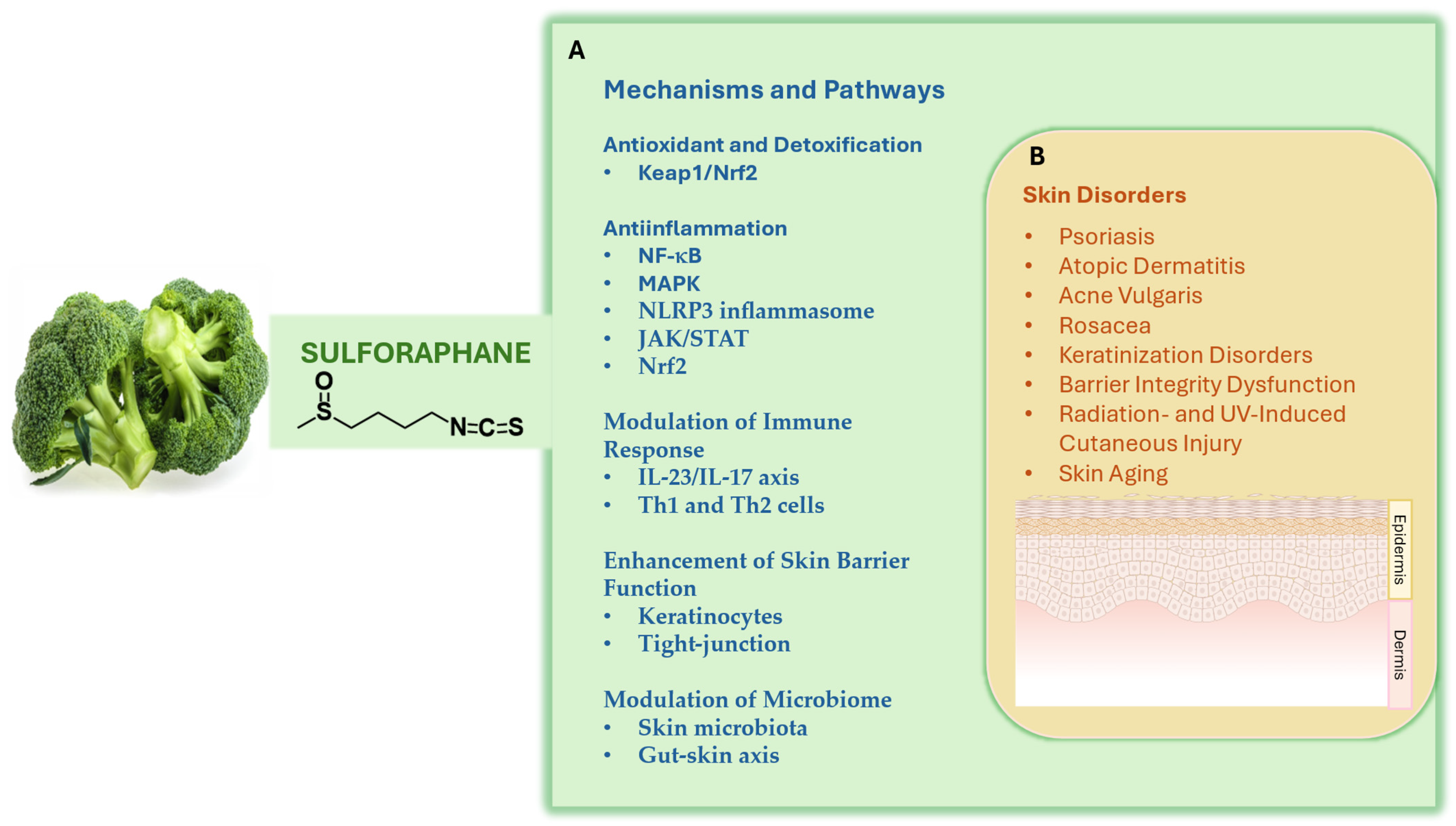
SF mediates its biologic effects through various interconnected mechanisms primarily involving the modulation of antioxidant pathways, anti-inflammatory responses, and skin cell functions [63,64,65]. However, the relative importance of these mechanisms likely depends on disease context, route of delivery, tissue exposure, and duration of treatment. The key pathways and cellular interactions through which SF may exert these effects are outlined in Figure 2.

2.1. Antioxidant and Detoxification Pathways

Oxidative stress significantly contributes to the pathogenesis of various cutaneous disorders and skin injury states by driving an excess of reactive oxygen species (ROS) relative to antioxidant defenses in the skin. As the body’s largest organ, the skin serves as a protective barrier and is frequently exposed to environmental insults such as ultraviolet radiation (UVR), pollution, and pathogens, all of which can elevate oxidative stress [66,67,68]. Increased ROS levels can cause cellular damage, exacerbate inflammation, and alter immune responses, leading to conditions like psoriasis and AD. In other settings, such as UV-induced skin injury, oxidative stress may arise more directly from exogenous damage. In these diseases, oxidative stress not only aggravates inflammation but also contributes to the persistence of chronic lesions by promoting the secretion of pro-inflammatory cytokines and activating immune cells. Moreover, it can impair skin barrier function, further perpetuating inflammation and creating a cycle of tissue damage and immune activation. Thus, targeting oxidative stress pathways represents an important mechanistic strategy in several dermatologic contexts, although its relevance is likely to differ by disease.
One of the primary responses for cellular defense against oxidative and electrophilic stress is via the Nrf2 redox-sensitive transcription factor [69]. Under normal conditions, Nrf2 is sequestered in the cytoplasm by Kelch-like ECH associating protein 1 (Keap1), which facilitates its ubiquitination and proteasomal degradation. Upon exposure to oxidative stress or electrophilic compounds like SF, modifications of critical cysteine residues on Keap1 result in the release and nuclear translocation of Nrf2. Nrf2 then binds to antioxidant response elements (AREs) in promoters of target genes, enhancing the transcription of detoxifying and antioxidant enzymes such as heme oxygenase-1 (HO-1) and NAD(P)H quinone oxidoreductase 1 (NQO1), as well as enzymes involved in glutathione biosynthesis [70]. This transcriptional response enhances cellular antioxidant capacity, thereby reducing oxidative damage, which may be particularly relevant in cutaneous settings where redox imbalance contributes materially to tissue injury or inflammatory amplification.
SF is among the most potent naturally occurring inducers of mammalian cytoprotective enzymes through the Keap1/Nrf2/ARE signaling pathway [38]. Activation of Nrf2 has direct relevance to skin disease because it plays a significant role in counteracting oxidative stress, a major contributor to various inflammatory disorders [71,72,73,74,75]. As a master regulator of cellular redox homeostasis, Nrf2 is especially important for the skin, which is continuously exposed to environmental challenges [68,76,77]. Nrf2 also exhibits robust anti-inflammatory activity through several mechanisms, including modulation of redox metabolism, crosstalk with NF-κB, and direct inhibition of pro-inflammatory gene expression [78]. Additionally, Nrf2 may promote keratinocyte differentiation and regulate skin homeostasis [79,80]. Therefore, Nrf2 represents a biologically important and potentially targetable pathway in dermatologic disease [81,82]. At the same time, the consequences of Nrf2 activation are context dependent, and its role should not be assumed to be uniformly beneficial across all skin conditions. Notably, dimethyl fumarate (DMF), the only direct Nrf2 activator approved by both the European Medicines Agency and the US Food and Drug Administration, is used clinically to treat psoriasis and relapsing-remitting multiple sclerosis [83,84,85].

2.2. Anti-Inflammatory Mechanisms

Several cutaneous inflammatory disorders, including psoriasis and AD, are characterized by excessive production of pro-inflammatory cytokines and chemokines that contribute to disease pathophysiology, although the dominant inflammatory programs differ across diseases. SF exhibits potent anti-inflammatory properties by modulating various inflammatory pathways [86].
The nuclear factor kappa-light-chain-enhancer of activated B cells (NF-κB) is central to the inflammatory process, regulating the transcription of genes encoding cytokines (e.g., TNF-α, IL-1β, IL-6), adhesion molecules, inducible nitric oxide synthase (iNOS), and cyclooxygenase-2 (COX-2). In the context of inflammatory skin disorders, persistent NF-κB activation leads to production of these inflammatory mediators that contribute to keratinocyte hyperproliferation, immune cell recruitment, and cytokine-driven exacerbation of disease symptoms [87,88,89].
SF directly suppresses NF-κB signaling by preventing degradation of its inhibitor IκB-α, thereby blocking NF-κB nuclear translocation and limiting its transcriptional activity [86,90,91]. Furthermore, SF can indirectly inhibit NF-κB activation through crosstalk between Nrf2 and NF-κB [86,92]. In activated keratinocytes and dermal fibroblasts, SF inhibits the phosphorylation and nuclear translocation of NF-κB, leading to reduced transcription of inflammatory mediators like TNF-α, IL-6, IL-8, IL-1β, IL-17, and COX-2 [93,94,95]. These effects correspond with reduced skin inflammation and improved barrier function in experimental systems.
In imiquimod (IMQ)-induced psoriasis-like models, treatment with SF reduced nuclear translocation of NF-κB p65 and significantly decreased the expression of downstream inflammatory mediators [95]. This suppression of NF-κB correlated with an improvement in skin pathology and a decrease in keratinocyte proliferation, although such findings should be interpreted cautiously because IMQ-induced inflammation does not fully recapitulate human psoriasis.
Mitogen-activated protein kinases (MAPKs) are a family of protein kinases that also regulate the production of cytokines and mediators of inflammation, which involves regulating skin cell responses to stress and inflammatory stimuli. This family comprises three main groups: extracellular signal-regulated kinases (ERK), p38 MAPK, and c-Jun NH2-terminal kinases (JNK). Activation of these pathways leads to the release of proinflammatory cytokines such as IL-6, IL-8, and TNF-α, which can initiate inflammatory responses [96]. SF can inhibit the phosphorylation of key MAPK proteins, such as ERK, JNK, and p38 MAPK, thereby reducing inflammatory cytokine production and attenuating inflammatory responses [93,97,98,99,100].
Inflammatory activation can also occur through the nucleotide-binding domain leucine-rich repeat-containing family, pyrin domain-containing 3 (NLRP3) inflammasome, a protein complex involved in the production of pro-inflammatory cytokines such as IL-1b and IL-18, which contribute to disease progression and symptom severity. In vitro and in vivo studies have demonstrated that NLRP3 directly promotes keratinocyte proliferation and inflammatory cytokine expression [101], and circulating levels of these cytokines are significantly elevated in untreated psoriasis patients, further supporting their role in disease severity and systemic manifestations [102]. Studies have also confirmed a key role of NLRP3 in the inflammatory pathogenesis of acne, both in vitro and in vivo [103,104,105]. Recent research has also highlighted the significant role of the NLRP3 inflammasome in the development of AD [106,107]. SF has been shown to protect against pancreatic acinar cell injury by modulating Nrf2-mediated oxidative stress markers and suppressing activation of the NLRP3 inflammatory pathway [108]. Additionally, SF has been shown to suppress NLRP3 inflammasome activation through inhibition of NF-κB nuclear translocation and modulation of Nrf2-mediated miRNAs expression in murine microglia [109]. Notably, in a mouse model, SF suppresses the oxidative stress by upregulation of Nrf2, which subsequently inhibits activation of the NLRP3 inflammasome and DNA damage, thereby preventing and alleviating radiation-induced skin injury [110].
SF also modulates Janus kinase/signal transducer and activator of transcription (JAK/STAT) signaling, further attenuating the inflammatory cascade [95,97,99,100,111,112]. The convergence of these signaling networks contributes to the inflammatory activation in several acute and chronic cutaneous conditions, but the extent to which SF can meaningfully modulate these pathways in human disease remains uncertain and is likely to vary across dermatologic contexts.

2.3. Modulation of Immune and Cellular Responses

Immune responses and several inflammatory skin disorders are closely linked, with conditions like psoriasis and AD arising from dysregulated immunity where genetic and epigenetic alterations, metabolic changes, environmental factors, and microbiome dysbiosis trigger abnormal activation of immune cells (e.g., T-cells, macrophages) and excessive production of cytokines, leading to chronic inflammation, itching, and skin barrier disruption [113]. In these disorders, the immune responses may be excessive, prolonged, or inappropriate, contributing to the development and persistence of disease symptoms, although the dominant immune programs differ substantially across diseases.
Specific immune pathways play crucial roles in the pathogenesis of common inflammatory dermatoses. For instance, psoriasis is characterized by Th17 cell involvement [114,115,116], which is a major driver of inflammation, and AD is primarily linked to an imbalance between Th2 cells and Th1 cells [2,117,118,119].
SF has been reported to exert immunomodulatory effects through interacting with various immune cell types, including T cells and macrophages, thereby modulating their activity [120,121,122,123]. For example, in psoriasis experimental studies SF may inhibit Th17 cell activation. By influencing immune-cell activation and the secretion of inflammatory mediators, SF can help reduce the inflammatory environment that exacerbates skin diseases [122]. These findings provide clear mechanistic support for immunomodulatory activity of SF, although their translation into clinically meaningful benefit in human dermatologic disease remains to be demonstrated.

2.4. Effects on Skin Barrier Function

Compromised skin barrier function plays a pivotal role in the pathophysiology of several cutaneous disorders, particularly AD, and may also contribute to psoriasis, acne, and rosacea. Inflammatory cytokines can disrupt the integrity of the skin’s protective barrier, and a weakened physical and chemical barrier permits allergens and pathogens to infiltrate the skin, triggering immune responses and contributing to chronic inflammation [124,125,126,127,128,129,130,131,132].
Keratinocytes, the predominant cell type in the epidermis, are essential for maintaining skin homeostasis and orchestrating the inflammatory response. SF has been shown to enhance the viability of keratinocytes under oxidative stress conditions [93,133]. By inducing the Nrf2-mediated production of antioxidant enzymes, SF helps to sustain keratinocyte integrity, thereby potentially supporting skin barrier function.
By way of Nrf2 activation, SF may enhance the expression and stability of key barrier proteins, such as filaggrin, loricrin, and involucrin, within keratinocytes [134]. Additionally, Nrf2-mediated improvement of antioxidant status reduces peroxidation of membrane lipids, preserving the architecture of the skin barrier [95,112,135]. These findings suggest that SF may, in some settings, contribute to the restoration of epidermal integrity.
SF also influences keratinocyte differentiation, promoting a more balanced state that supports normal skin structure [95]. This modulation may aid in restoring proper barrier function and strengthening the skin’s protective layer.
Although direct evidence remains limited in this organ (the skin), tight-junction preservation may represent an additional mechanism by which SF supports epidermal barrier function in inflammatory dermatoses. Evidence from other (non-cutaneous) barrier tissues indicates that SF can oppose junction disruption during inflammatory and oxidative stress, including Nrf2-dependent maintenance of blood–brain barrier tight-junction proteins and function [136], protection against NSAID-related intestinal barrier injury [137], reduction in lipopolysaccharide-induced epithelial permeability [138], and increased intestinal tight-junction protein expression in vivo [139]. Although these data do not yet establish a direct cutaneous tight-junction effect, they provide a compelling rationale for considering tight-junction preservation as one possible component of the barrier-related activity of SF in selected dermatologic contexts.

2.5. Potential Effects on the Microbiome

Recent research highlights the crucial role of human microbiota, encompassing gut and skin communities, in both physiological and pathological processes. These microbial populations are essential for maintaining homeostasis, modulating immune response, and defending against pathogens. Dysbiosis, characterized by imbalances in these communities, can impair barrier functions, disrupt inflammatory and immune responses, and potentially initiate disease development [140,141].
Skin microbiota, a complex ecosystem of microorganisms, is vital for skin integrity. Dysbiosis impairs the skin barrier, increasing water loss and allowing harmful microbes and toxins to enter, triggering inflammation. Specific microbial shifts have been documented in various skin conditions. For example, AD is associated with decreased microbial diversity and an overgrowth of pathogenic Staphylococcus aureus [142,143]. In psoriasis, although there is no convincing conclusion regarding whether the diversity of the microbial community on psoriatic lesional skin is lower than that on healthy skin, increased S. aureus abundance and decreased S. epidermis abundance have been observed in psoriatic lesions [144,145].
Meanwhile, an increasing body of evidence links disrupted gut flora to immunological and metabolic disorders manifesting in the skin, contributing to the onset of conditions such as AD, psoriasis, and rosacea [146,147,148,149,150]. Although the precise mechanisms connecting the gut and skin microbiomes remain inadequately understood [146,149,151], several microbial alterations have been reported. For instance, levels of Clostridium difficile, Escherichia coli, and S. aureus were higher in individuals with AD compared to the healthy controls [152,153]. Patients with psoriasis exhibit altered gut microbiomes with increased Prevotella spp. and decreased Lachnospira spp. and Akkermansia muciniphila, along with reduced microbial diversity compared to healthy individuals [154,155,156]. Rosacea has also been linked to significant microbial alterations [157], including an increased prevalence of Helicobacter pylori in moderate-to-severe cases [158,159]. This underscores the significance of the gut-skin axis as a potentially important pathway in the pathophysiology of these conditions [140]. Further investigation of this axis could illuminate how alterations in gut microbiota composition and diversity influence epidermal differentiation and metabolism, since dysbiosis can trigger immune responses, promote inflammation, and compromise skin barrier integrity [141,144,160,161,162].
Given the association between dysbiosis and several dermatologic conditions, addressing microbial imbalances presents a potential therapeutic strategy [140]. SF has emerged as a potent modulator of the gut microbiome, increasing beneficial bacteria such as Bacteroidetes spp., enhancing the production of anti-inflammatory metabolites like short-chain fatty acids (SCFAs), and improving gut barrier function [163,164,165,166,167,168,169,170,171,172]. Studies involving inflammatory bowel disease (IBD) demonstrate that SF supplementation restores microbial balance and reduces inflammation. In mouse models of colitis, SF improved gut barrier integrity and modulated the microbial composition, resulting in diminished inflammation [173,174,175]. In an autism spectrum disorders (ASD)-like rat model and ASD patients, SF treatment alleviated social deficits linked to the modulation of gut microbiota [176]. Additionally, oral SF administration ameliorated the progression of hyperuricemia by reprogramming the gut microbiome and metabolome in a rat model [177]. Therefore, by reducing pathogenic microbes and promoting a more diverse microbiome, SF can mitigate inflammation, metabolic disorders, and dysbiosis, ultimately improving systemic health and potentially impacting skin conditions.
While most microbiome research has concentrated on the gut, studies that directly examine SF’s effects on skin microbiota remain limited. Existing work has mainly explored how SF modulates skin inflammation, immune responses, and cellular health mechanisms that could indirectly alter microbial communities and which indicate potential dermatologic effect. The gut lining (alimentary canal) and the skin are the two principal sites where epithelial cells and their tight junction’s interface directly with extensive microbial ecosystems. Both allochthonous and autochthonous microbial communities occupy distinct niches across the skin’s surface, and, as with the gut, their composition is plausibly influenced by phytochemicals such as SF [178,179].
Overall, SF’s influence on both the gut and skin microbiomes supports interest in the possibility that microbiome-related effects may contribute to some of its biologic actions. However, direct evidence that SF improves dermatologic disease through microbiome modulation remains limited. Further exploration of the intricate connections between diet, microbiome modulation, and skin health is necessary to clarify the clinical relevance of SF in dermatologic disease.
In summary, through activation of Nrf2 signaling, inhibition of pro-inflammatory pathways such as NF-κB and MAPK, modulation of immune responses and keratinocyte function, and possible effects on the gut–skin axis, SF may influence several biologic processes relevant to dermatology. Understanding these mechanisms not only helps clarify where SF has mechanistic plausibility but also sets the stage for future studies exploring its clinical applications in dermatology.

3. Evidence from Specific Cutaneous Disorders and Skin Injury

Although substantial preclinical evidence supports biologic activity of SF in several dermatologic contexts, well-designed clinical trials demonstrating therapeutic efficacy remain lacking for many of the chronic conditions discussed below. Herein, we critically review the preclinical and emerging clinical evidence for SF in conditions such as psoriasis, AD, and other dermatologic disorders (Figure 2).
The cutaneous conditions discussed in this review should not be regarded as a single mechanistic class. Psoriasis and atopic dermatitis are immune-mediated inflammatory dermatoses, although they differ markedly in immune architecture [180,181], whereas UV-induced skin injury (sunburn), radiation dermatitis, and skin aging are driven more directly by exogenous damage, oxidative stress, and tissue remodeling. Acne and rosacea represent additional mechanistically distinct contexts involving pilosebaceous, innate immune, neurovascular, microbial, and barrier-related mechanisms, while keratinization disorders are centered more directly on structural and differentiation abnormalities of the epidermis. Accordingly, the most plausible point of convergence for SF is not one shared inflammatory mechanism, but partial overlap in oxidative stress handling, barrier stress, and Keap1/Nrf2-linked cytoprotective pathways.

3.1. In Vitro and Mechanistic Studies

Cultured human keratinocytes and dermal fibroblasts have been extensively employed in cell, co-culture, human skin equivalent, and ex vivo studies. In these studies, pretreatment with SF confers protection against oxidative damage from hydrogen peroxide, UVR, particulate matter (PM) exposure, and inflammatory cytokines [65,93,95,133,182,183,184]. These protective effects are abrogated when Nrf2 is silenced or knocked out, confirming the critical role of this pathway [76,133]. Furthermore, SF is shown to reduce the secretion of inflammatory chemokines (such as CCL17, CCL20, CCL22 and CXCL8) [184,185] and matrix metalloproteinases (MMPs) [65,186], while also normalizing abnormal keratinocyte proliferation observed in models of psoriasis and acne [60,187,188]. However, these experimental systems do not fully capture the complexity of human skin disease, and the concentrations used in vitro may not reflect achievable tissue exposure in vivo. Of note, Yehuda and colleagues demonstrated that SF reduced expression and secretion of key psoriasis-related pro-inflammatory cytokines in human monocytes, macrophage-like cells [94]. Taken together, these studies demonstrate that SF can modulate stress-response and inflammatory pathways in relevant cell systems and provide an important mechanistic basis for further translational investigation, although they are not in themselves evidence of clinical efficacy.

3.2. Psoriasis

Psoriasis is a common, chronic, proliferative, and immune-mediated dermatosis characterized by epidermal hyperplasia, scaling, erythema, and infiltration of activated immune cells [1,116,189,190,191]. It is no longer thought of as a disorder that affects only the skin, but is instead seen as a systemic inflammatory disorder associated with an increased prevalence of comorbid conditions, including psoriatic arthritis, cancer, depression, metabolic syndrome, type 2 diabetes, and cardiovascular disorders [17,192,193,194,195]. These complications contribute to compromised quality of life, reduced work productivity, increased physical disability, and can even lead to impaired social functioning [196].
Preclinical Studies: The pathophysiology of psoriasis is complex and dynamic. Dysregulation of the IL-23/IL-17 axis, oxidative stress, and NF-κB activation are key features driving disease pathogenesis. The IMQ-induced murine model is widely used as a psoriasis-like inflammatory model, but it does not fully recapitulate the clinical and immunologic complexity of human [197,198]. Two studies have evaluated SF in this model, in which the efficacy of SF was not attributable to a single molecular target, but rather to modulation of multiple pathways relevant to psoriasis-like inflammation in this experimental setting [95,199].
In one of these studies, Du et al. (2022) observed that intraperitoneal (i.p.) administration of SF ameliorated IMQ-induced skin lesions [199]. Mechanistically, SF upregulated antioxidant genes including peroxiredoxin 1 (Prdx1; an antioxidant enzyme that catalyzes the reduction of hydrogen peroxide), NQO1, HO-1, and glutathione synthetase (Gss), while reducing lipid peroxidation (TBARS/MDA) in IMQ-stimulated mouse skin [199]. Meanwhile, flow cytometry revealed fewer Th1 and Th17 cells in draining lymph nodes and spleen, consistent with attenuation of IL-23/IL-17 axis signaling. Additionally, docking studies suggested a potential interaction between SF and RORγt (the master transcription factor for cytokine IL-17), although this finding remains inferential.
Using the same model, Ma et al. (2023) reported that systemic i.p. SF significantly reduced skin thickness, scaling, and erythema [95]. These clinical improvements were accompanied by decreased epidermal hyperplasia and dermal inflammatory cell infiltration, as well as reduced expression of psoriasis-associated stress keratins (K16 and K17) and the proliferation marker Ki67, indicating normalization of keratinocyte hyperproliferation [95]. Furthermore, SF restored diminished Nrf2 expression in psoriatic lesions, increased expression of canonical antioxidant genes, and reduced STAT3 and NF-κB activation in skin tissue. These changes correlated with lower levels of IL-1β, IL-6, and CCL2 in both lesional skin and in IL-22/TNF-α-stimulated HaCaT keratinocytes treated with SF.
Taken together, these preclinical results suggest that SF can attenuate psoriasis-like pathology in experimental systems through restoration of Nrf2-mediated antioxidant defenses, suppression of NF-κB and STAT3 signaling, as well as reduction in pro-inflammatory mediators and Th1/Th17-associated responses. Although these findings should be interpreted as mechanistic and preclinical evidence rather than as proof of clinical efficacy in psoriasis, they support further investigation of SF as a potential therapeutic strategy in psoriasis.
Clinical evidence: Human data supporting SF in psoriasis remain limited. Earlier work by Yehuda et al. (2012) reported that ITCs modulate psoriasis-relevant inflammatory mediators in human monocytes and macrophage-like cells, and additionally demonstrated suppression of psoriasis-associated cytokine expression and secretion in ex vivo cultures of inflamed human skin using 4-methylthiobutyl isothiocyanate (the reduced form of SF) rather than SF [94]. While these findings provide preliminary human-cell support for SF activity and human-tissue support for closely related ITC-mediated modulation of psoriasis-relevant pathways, they do not include clinical outcome measures. Well-designed clinical trials demonstrating therapeutic efficacy of SF in psoriasis are still lacking, and further translational research is needed.

3.3. Atopic Dermatitis (AD, Eczema)

AD is a chronic relapsing inflammatory dermatosis characterized by severe skin lesions such as pruritus, erythema, rash, edema, dryness, and skin hypersensitivity [3]. Because of these features, AD patients often suffer from sleep deprivation, anxiety, and stress, which can lower their quality of life. Individuals with AD are also at increased risk of developing other chronic inflammatory conditions, including asthma and allergic reactions [13,200].
AD has a complex etiology involving genetic, immunologic, and environmental factors. A central feature of AD pathogenesis is skin barrier dysfunction, which promotes enhanced penetration of allergens, irritants, and microbes and thereby facilitates ongoing immune activation [201,202]. AD is often accompanied by elevated serum immunoglobulin E (IgE) levels [27]. Skin microbiome abnormalities and oxidative stress are also key components of pathogenesis in AD [13,25,142]. Genetic and acquired barrier abnormalities, including filaggrin loss-of-function mutations, defects within the epidermal differentiation complex, altered stratum corneum lipid composition with shortened ceramide and fatty acid chains, and tight junction disruption, compromise epidermal integrity. These changes lead to increased transepidermal water loss, elevated skin pH, and enhanced penetration of allergens and microbes [200,201,202]. In contrast to psoriasis, which is driven predominantly by IL-23 and Th17-centered immunity, AD is characterized mainly by type 2 immune polarization. Key roles are played by cytokines such as IL-4 and IL-13, which further impair barrier function and amplify inflammation. Chronic lesions acquire additional Th22, Th17, and Th1 components (e.g., IL-22, IL-17A, IFN-γ), while pruritogenic cytokines such as IL-31, IL-4, IL-13, and TSLP act directly on sensory neurons to promote itch, scratching, and mechanical barrier damage. This establishes a self-reinforcing cycle linking barrier disruption, type 2-skewed inflammation, and pruritus [13,203].
Although current therapies have improved outcomes for many patients, interest remains in adjunctive or complementary approaches that might modulate oxidative stress, inflammatory amplification, or barrier-related dysfunction without displacing established disease-targeted treatments [27].
Preclinical Studies: Two studies have examined SF in 2,4-dinitrochlorobenzene (DNCB)-induced AD-like dermatitis models in mice using i.p. or subcutaneous (s.c.) administration. SF pre- or post-treatment attenuated scratching behavior, suppressed skin thickening and spongiosis, and reduced serum IgE levels, consistent with anti-inflammatory and barrier-restorative actions [112,204].
Wu et al. (2019) reported that SF administered i.p. three times weekly reduced ear thickness, dermatitis scores, and scratching behavior in the AD mouse model [112]. Histologically, SF decreased eosinophil and mast cell infiltration, while significantly lowering serum IgE levels [112]. The study also demonstrated increased Nrf2 and HO-1 expression in lesional skin following SF treatment, along with reduced phosphorylation of JAK2 and STAT3, and decreased IL-6, IL-1β, and TNF-α levels [112].
Using s.c. SF administration after AD establishment in the DNCB-induced AD-like mouse model, Alyoussef observed attenuated clinical lesions and reduced expression of NF-κB, TNF-α, IL-1β, IL-4, IgE, and caspase-3 in skin tissue. These changes were accompanied by increased Nrf2 and IL-10 expression and reduced oxidative DNA damage [204].
Taken together, these independent preclinical studies suggest that systemic SF treatment can ameliorate AD-like features (redness, itching, swelling) in experimental models by inhibiting inflammation (NF-κB, Th2-relevant chemokines, and pro-inflammatory cytokines), enhancing antioxidant defenses via Nrf2 activation, and lowering immune-associated markers such as eosinophils, mast cells, and IgE. Although these findings derive from chemically induced murine dermatitis models and do not establish clinical efficacy in human AD, they provide meaningful preclinical support for the biologic potential of SF in this setting. However, well-designed human clinical trials evaluating SF specifically in AD remain lacking. Further translational studies are needed to confirm efficacy, establish dosing parameters, and determine its clinical relevance as a possible adjunctive strategy.

3.4. Acne Vulgaris and Rosacea

At present, evidence for SF in acne and rosacea remains limited or indirect, and no well-designed clinical trials establish therapeutic efficacy in either condition. Acne vulgaris is a multifactorial disorder of the pilosebaceous unit and should not be treated as a straightforward counterpart to immune-mediated inflammatory dermatoses such as psoriasis or AD. Contemporary models emphasize the interplay among sebaceous gland activity, altered sebocyte differentiation, follicular hyperkeratinization, host–microbiome interactions, and dysbiosis within the pilosebaceous niche [205,206]. Rosacea is also mechanistically distinct from psoriasis and AD, involving dysregulated innate immunity, neurovascular signaling, barrier dysfunction, and microbial and environmental triggers [207]. However, the mechanistic rationale, including the roles of oxidative stress, NF-κB signaling, and dysregulated innate immunity in these conditions, suggests that SF may represent a candidate for future investigation, although this rationale is more indirect than in psoriasis, AD, or UV-related skin injury.
Most notably, sulforaphene, the structurally related ITC derived from radish seeds, has been shown to inhibit Cutibacterium acnes growth and reduce C. acnes-induced pro-inflammatory cytokine production in HaCaT keratinocytes and THP-1 monocytes through suppression of NF-κB signaling, including modulation of IL-1α [187]. Additionally, a small clinical study of a 6% broccoli stem extract cream demonstrated improvements in post-acne macular erythema and hyperpigmentation, attributed to combined antioxidant, anti-inflammatory, and anti-melanogenic effects of broccoli-derived phytochemicals, including SF [208]. However, this study focused on post-inflammatory sequelae rather than active inflammatory lesions, and the multicomponent formulation limits attribution specifically to SF.
Commercial nutraceutical formulations for rosacea have incorporated SF-containing extracts as one component among multiple antioxidants and bioflavonoids, often citing SF’s Nrf2 activation and NF-κB inhibition as putative mechanisms [209]. However, these claims are not supported by controlled, peer-reviewed clinical trials and the specific contribution of SF cannot be known.
Although the findings cited here are preliminary and involve either a different but functionally related ITC, sulforaphene [210], or multicomponent botanical formulations, they suggest that SF-related compounds may warrant further study in acne and rosacea. At the same time, acne and rosacea are mechanistically distinct from psoriasis and AD, and current evidence is insufficient to support clinical inferences for SF in either condition. Dedicated preclinical and early-phase clinical studies will be required to determine whether SF has any meaningful disease-specific role in these common disorders.

3.5. Keratinization Disorders and Barrier Integrity Dysfunction

A distinctive aspect of SF’s dermatologic profile is its capacity to reprogram keratin biosynthesis and compensate for structural defects in the keratin network, thereby potentially improving barrier integrity.
In an epidermolysis bullosa simplex (EBS) mouse model, we demonstrated that in utero treatment with SF (i.p. injections of SF to the pregnant mother) dramatically reduced blistering and improved skin integrity in newborn keratin-14-deficient mice by inducing expression of more resilient keratins, notably K16 and K17, thereby reinforcing the keratin cytoskeleton [16]. This study provided early proof-of-concept for SF as a potential disease-modifying agent in genetic skin fragility disorders. In mechanistic follow-up studies, our colleagues showed that SF induces K16 and K17 expression in mouse epidermis through both Nrf2-dependent and -independent pathways [211]. Nrf2 knockout and Keap1-hypomorphic mice established a requirement for Nrf2 in part of the keratin response and in phase 2 gene induction, while pharmacologic inhibition and genetic perturbation of MEK–ERK and AP-1 pathways revealed an Nrf2-independent contribution to K16 induction [211]. This work underscores that SF’s effects on keratin expression are not solely attributable to Nrf2 and may involve classical stress-responsive MAPK/AP-1 signaling. We ultimately conducted a clinical study in which we applied ca. 71 nmol/cm2 of SF in a SF-rich broccoli sprout extract (BSE), to the inner arm of human subjects daily for 7 days. This treatment activated Nrf2, up-regulated K17, had variable effects on K16 and K6 expression, and did not alter K14 or K5 expression in the treated skin [212].
In Keratin (Krt)16-null mice, which develop palmoplantar keratoderma (PPK)-like paw lesions, the same research group found that early defects in keratinocyte differentiation and downregulation of Krt9 precede lesion onset [213]. Topical SF prevented development of PPK-like lesions and restored Krt9 expression and terminal differentiation, suggesting that SF can normalize volar epidermal differentiation programs.
Schäfer et al. investigated the consequences of sustained Nrf2 activation in keratinocytes using keratinocyte-specific constitutively active Nrf2 transgenic mice and topical Nrf2 activators, including SF and tBHQ [67]. Chronic high-level Nrf2 activity produced epidermal thickening, hyperkeratosis, impaired desquamation, altered lipid metabolism, and a secondary inflammatory infiltrate resembling lamellar ichthyosis. Transcriptomic analysis identified multiple Nrf2-regulated barrier components, including cornified envelope proteins (Sprr2d/2h) and the serine protease inhibitor Slpi, implicating Nrf2 in the regulation of desquamation and lipid handling [67].
Taken together, these findings suggest that moderate, targeted Nrf2 activation by SF may be beneficial in keratin fragility disorders and PPK-like states. However, chronic or excessive Nrf2 activation can itself provoke barrier dysfunction and inflammation [82,214]. If SF or related approaches are to be used in keratinization disorders, the magnitude and duration of Nrf2 activation must therefore be finely tuned.

3.6. Radiation- and UV-Induced Cutaneous Injury

In addition to direct DNA damage, radiation and UV promote the generation of reactive oxygen intermediates that can cause oxidative damage, tissue remodeling, and inflammatory responses, ultimately leading to skin aging and tumor formation [215]. In the skin, Nrf2 activation in keratinocytes and fibroblasts leads to increased resilience against UV-induced oxidative damage, chemical insults, and biologically generated free radicals [68,76,82,216,217]. Animal studies have shown that Nrf2 deficiency increases susceptibility to cutaneous oxidative injury, while pharmacologic activation by SF can restore adaptive capacity and reduce lesion severity in selected experimental settings [95,112,133,199,204,214,218,219]. Protection against UVR-induced skin damage using SF or BSE has therefore been extensively investigated by us and others.
Preclinical studies: In a murine thigh X-ray irradiation model, Wei et al. showed that SF reduced dermal and hypodermal fibrous hyperplasia and histologic damage [110]. SF increased Nrf2 and downstream antioxidant gene expression, decreased ROS and markers of oxidative damage (4-HNE, 3-nitrotyrosine), and suppressed components of the NLRP3 inflammasome, including NLRP3, caspase-1, and IL-1β [110]. An earlier related report from the same group corroborated these protective effects [220]. These data position SF as a modulator of radiation-induced oxidative stress and inflammasome-driven inflammation in skin, suggesting possible utility in radiation dermatitis or as a protective adjunct to radiotherapy.
Chaiprasongsuk et al. examined SF in UVA-irradiated HaCaT keratinocytes and BALB/c mouse dorsal skin [186]. Repetitive UVA exposure increased MMP-1 expression and collagen degradation via activation of MAPK pathways (ERK, JNK, p38) and AP-1 signaling. Pretreatment with SF, via Nrf2 activation, reduced UVA-induced MMP-1 expression, preserved collagen integrity, and diminished MAPK and AP-1 phosphorylation [186]. Nrf2 knockdown abrogated these protective effects, confirming Nrf2 dependence.
Additionally, topical application of SF-containing BSE induced the phase 2 response in the epidermis of SKH-1 hairless mice, increasing the protein levels of NQO1, glutathione S-transferase A1, and HO-1, three representative phase 2 enzymes [221,222]. In an HR-1 hairless mouse model, SF oral administration significantly reduced UVB-induced skin thickness, COX-2 protein expression, and epidermal hyperplasia [93].
Clinical studies: In two randomized, double-blind, placebo-controlled independent clinical trials in healthy human subjects, our group observed protection against erythema induced by UVR exposure of human skin following topical application of SF from broccoli sprouts [62,135]. Furthermore, topical application of SF-containing BSE increased the enzyme activity of NQO1 in a dose-dependent manner in human skin punch biopsies, thus providing direct evidence for induction of the phase 2 response in humans [221].
In another study, Kleszczyński et al. investigated SF in ex vivo human full-thickness skin exposed to UVR, demonstrating protection against UVR-induced damage by reducing the number of sunburn cells, preventing the depletion of the antioxidant enzyme catalase, and protecting against apoptosis as shown by reduced caspase-3 activation via Nrf2-dependent induction of HO-1 and other antioxidant enzymes [182]. This work provides direct evidence that SF pre-treatment can activate Nrf2 in human skin and attenuate UVR-induced damage.
Most recently, we reported that in healthy human skin exposed to UVB, short-term oral GR administration significantly upregulated the cytoprotective/antioxidant enzyme NQO1 and reduced local pro-inflammatory mediators IL-1β, TNF-α, IL-6, IL-17, STING, and CYR61 in the skin, with confirmed delivery of SF to dermal tissue [223]. Although this small, short-duration study did not demonstrate a clear clinical photoprotective endpoint (e.g., reduced erythema), it confirmed measurable biological activity in human skin following oral, rather than topical administration.
Taken together, this is one of the strongest translational areas for SF in dermatology. Current human data support photoprotective effects and measurable biologic activity in skin, whereas its role in routine clinical management of radiation dermatitis remains undefined.

3.7. Skin Aging

While skin aging is not classified as an inflammatory skin disorder, it shares several pathophysiological mechanisms in which SF has demonstrated biologic activity. Therefore, SF has been investigated in the context of skin aging, particularly as a prototypical small-molecule activator of the Keap1/Nrf2 cytoprotective pathway with relevance to both intrinsic skin aging and photoaging [81,82]. Preclinical work consistently shows that SF attenuates oxidative stress, matrix degradation, and dermal structural decline, while early human studies demonstrate pharmacologic delivery to skin and modulation of UV-responsive pathways, albeit without yet proving macroscopic “anti-aging” efficacy.
Preclinical studies: In murine models of spontaneous aging, chronic dietary SF or GR supplementation improves multiple histological and molecular hallmarks of aged skin. Petković et al. observed robust up-regulation of Nrf2 and its downstream targets NQO1 and HO-1 in skin following a three-month SF-supplemented diet, accompanied by reduced ROS levels and lower MMP-9 protein abundance in aged animals [60]. Histologically, SF treatment improved collagen organization and dermal structure in both young and old mice, suggesting that long-term Nrf2 activation may help prevent and possibly partially reverse age-associated dermal extracellular matrix (ECM) deterioration.
Similar findings were reported in a senescence-accelerated mouse prone 1 (SAMP1) model. Chawalitpong et al. administered GR-enriched kale (metabolized in vivo to SF) to SAMP1 mice for 39 weeks and documented suppression of dorsal skin thinning, an overall reduction in composite senescence scores, and increased collagen production in skin [224]. Mechanistically, GR/SF intake enhanced nuclear translocation of Nrf2 and HO-1 expression, and activated TβRII/Smad3 signaling, implicating combined antioxidant and pro-collagenogenic actions. Together, these studies support the concept that chronic, low-dose SF exposure can mitigate intrinsic skin aging by decreasing oxidative stress and preserving dermal ECM.
A substantial body of preclinical literature also links SF-mediated Nrf2 activation to protection from UV-driven skin damage, an important contributor to clinical photoaging [77]. As described in Section 3.6, in a mouse model of UVA exposure, Chaiprasongsuk et al. demonstrated that Nrf2 knock-down or genetic deficiency augments UVA-induced MMP-1 expression and collagen loss via MAPK/AP-1 pathways, whereas topical SF activates Nrf2, suppresses MMP-1 up-regulation, restores type I collagen, and reduces UVA-induced epidermal thickening [186]. These data directly link SF-induced Nrf2 signaling to inhibition of the canonical collagen-degrading axis that underlies wrinkle formation.
UVB models reinforce this protective role. Saw and colleagues showed that Nrf2-null mice develop more sustained UVB-induced inflammation, more sunburn cells, higher IL-1β and IL-6 expression, and greater keratinocyte apoptosis than wild-type controls; topical SF markedly reduced sunburn cell formation and inflammatory markers in Nrf2-competent but not Nrf2-deficient mice, demonstrating Nrf2 dependence [225]. A subsequent study from the same group reported increased UVB-induced ECM degradation and pro-MMP-9 expression in Nrf2-knockout mice, further implicating Nrf2 in preservation of dermal connective tissue [226]. These findings strongly suggest that SF, through Nrf2 activation, can attenuate both inflammatory and structural components of UVB-driven photoaging.
Work from our group provided foundational evidence that SF-rich BSE induces phase 2 cytoprotective enzymes in murine skin and reduces UV-induced inflammation and edema [135]. More recently, Li and co-workers used integrated metabolomic, methylomic, and transcriptomic profiling in UVB-irradiated HaCaT keratinocytes to show that UVB drives extensive metabolic rewiring and epigenetic reprogramming in pathways related to oxidative stress, TGF-β signaling, and matrix regulation. Co-treatment with SF attenuated many of these UVB-induced changes, supporting a role for SF in limiting early molecular events that can contribute to photoaging and photo-carcinogenesis [64].
In the context of air pollution-related skin aging, SF has been shown to counteract fine particulate matter (PM2.5)-induced oxidative and paracrine damage in cutaneous cells. Using keratinocyte-melanocyte and keratinocyte-fibroblast co-culture systems exposed to diesel PM2.5, Ko et al. reported that SF markedly reduced intracellular ROS in keratinocytes and suppressed NF-κB-dependent expression of pro-inflammatory cytokines (TNF-α, IL-1β, IL-6, COX-2), melanogenic mediators (endothelin-1, PGE2), and ECM-degrading or pro-senescent factors (CCN1, MMP-1), while preserving type I procollagen in fibroblasts and attenuating melanogenesis in melanocytes [65]. These data support a model in which SF, via Nrf2 activation and NF-κB inhibition, dampens PM2.5-triggered oxidative stress in keratinocytes and normalizes their paracrine signaling to neighboring pigment cells and fibroblasts, thereby mitigating pollution-induced dyspigmentation and collagen breakdown. A recent review highlights this work as a key example of how broccoli-derived ITCs can modulate PM2.5-induced skin inflammation, barrier dysfunction, and premature aging phenotypes, positioning SF as a promising anti-pollution agent for skin-care and dermatologic applications [227].
Clinical studies: Human data on SF and skin aging remain limited and largely mechanistic. In a seminal proof-of-concept study by our group, SF-rich BSE was topically applied to small skin areas in six healthy volunteers for three days prior to monochromatic UV irradiation [135]. Across UV doses (100–800 mJ/cm2 at 311 nm), BSE-treated sites exhibited a mean ~38% reduction in erythema compared with vehicle sites, with inter-individual protection ranging from approximately 8% to 78%. Although erythema is an acute endpoint, it is a validated surrogate marker for UV-induced epidermal and dermal damage that contributes to long-term photoaging.
More recently, we conducted a randomized trial in 18 healthy adults who received 7 days of oral GR, curcumin, or both, following a low-phytochemical diet [223]. Buttock skin was exposed to 2× the minimal erythema dose of UVB before and after supplementation; biopsies were obtained from irradiated and non-irradiated sites. Across all treatment arms, supplementation induced approximately three-fold increases in NQO1 mRNA in skin and reduced transcripts of several pro-inflammatory mediators (IL-1β, TNF-α, IL-6, IL-17, STING, CYR61) in UVB-exposed skin. However, the study did not detect statistically significant changes in clinical erythema or dyskeratotic keratinocyte counts at this sample size and duration, nor did it assess longer-term aging endpoints such as wrinkle depth or elasticity.
Early-phase clinical efforts are also beginning to evaluate SF more directly in skin aging and photodamage settings, although evidence remains limited and definitive results are still lacking. An ongoing early-phase clinical trial from Johns Hopkins (NCT03730649) is evaluating a topical SF formulation applied to both photo-exposed and photo-protected skin sites for up to six months. Planned endpoints include keratin-16/17 expression, UV and visible-light responses, non-invasive elasticity measurements, and clinical aging scores. Results have not yet been reported, but this trial represents one of the first efforts to evaluate SF specifically for skin aging rather than acute photodamage.
Most recently, an open-label single-arm clinical study investigated an oral GR-rich Brassica oleracea seed extract in 50 women with mild-to-moderate photoaging. After 56 days, participants demonstrated significant improvements in several objective skin parameters, including reductions in transepidermal water loss and tape-stripping protein loss, increased dermis density, decreased wrinkle depth, and enhanced firmness and elasticity [228]. These findings provide preliminary human evidence that oral delivery of an SF precursor may beneficially modulate barrier function and dermal structure in aging skin. However, the absence of a control group, the short intervention period, and the lack of direct pharmacokinetic or Nrf2-related readouts limit interpretation and underscore the need for controlled trials.
Taken together, the current literature supports SF as a biologically relevant candidate in skin aging and photoaging, with effects on Nrf2 signaling, oxidative stress, inflammatory pathways, and matrix regulation that are consistent with preservation of skin structure and function. Human evidence is promising, though stronger conclusions about anti-aging efficacy of SF will require larger, and perhaps longer, controlled studies.

4. Routes of Administration, Safety, and Pharmacokinetic Considerations

The pharmacokinetics of SF have been investigated through both topical and systemic routes of administration, including oral delivery. While systemic administration may provide broader biological effects, topical delivery offers the advantage of concentrating SF directly within the skin, allowing for more targeted therapeutic interventions in dermatologic conditions. Continued research into optimized delivery methods and application strategies will be paramount to fully realizing the translational potential of this promising compound.
A major translational limitation is that achievable and therapeutically relevant tissue concentrations in human skin remain incompletely defined, particularly for oral administration. At the same time, topical development must reconcile chemical stability with sufficient penetration beyond the stratum corneum to achieve biologically meaningful exposure in viable skin layers. Standardized dose, route, and exposure–response relationships also remain unresolved, making comparisons across studies difficult and continuing to constrain clinical translation.

4.1. Topical Delivery

The bioavailability and efficacy of SF for skin conditions can be influenced by its formulation and delivery method. Topical application of SF is a promising approach to enhance local concentration in the epidermis while minimizing systemic exposure. However, the efficiency of its penetration into the stratum corneum and viable epidermal layers is influenced by several factors, including the formulation used for delivery and the integrity of the skin barrier. Theoretically, SF can be incorporated into creams, gels, and ointments designed for direct application to the skin. Notably, vehicles and excipients themselves can influence barrier function and inflammation, which underscores the need for appropriate vehicle controls in study design. Our studies examining topical agents for SF delivery at the Cullman Chemoprotection Center at Johns Hopkins utilized jojoba oil as a vehicle, which along with moringa seed oil, we judged through many unpublished experiments to be the best of the many oils, emollients, creams, and gels examined. Jojoba oil was ultimately chosen as the topical vehicle for delivery of SF used in the clinical trials cited [212,229,230]. In general, formulations containing more organic components, particularly macromolecules, promote rapid reaction and binding of SF, reducing its availability. Thus, while these vehicles may be appropriate for short-term, controlled dosing of highly purified SF in clinical trials, their suitability for topical commercial products remains unclear.
Topical SF has been successfully applied in several mouse models and in human skin, as described in Section 3. Additionally, our group has reported that UVR-induced skin carcinogenesis was substantially inhibited by topical administration of a BSE containing 1 mmol SF in SKH-1 hairless mice; however, the vehicle (80% acetone in water) was completely impractical for human dosing [222]. In a pachyonychia congenita-associated palmoplantar keratoderma mouse model, topical application of SF restored Nrf2 activity, enhanced expression of glutathione reductase and regeneration of GSH, and ultimately reduced the formation of typical skin lesions associated with this condition [231]. Topical SF offers direct epidermal targeting and avoids extensive first-pass metabolism. At the same time, both trial execution and interpretation are complicated by the need to formulate SF in a way that is not only chemically stable but also capable of delivering biologically relevant amounts beyond the stratum corneum into viable epidermal layers. As a result, local tolerability, apparent efficacy, and effective dose delivery may depend substantially on the formulation and vehicle used rather than on SF alone. Because SF is chemically labile, and most studies provide limited formulation detail, it remains difficult to compare dosing approaches, assess reproducibility across studies, or disentangle formulation effects from the intrinsic activity of SF.
Emerging technologies, such as nanoencapsulation, are being investigated to improve the stability and skin penetration of SF when applied topically [232,233]. These nanoformulation strategies demonstrate that ethosomal/ultra-deformable vesicles, nanogels, and liposomal hydrogels can stabilize SF and deliver it effectively into or across the skin. However, these approaches have primarily been evaluated in cancer [234,235,236] and wound-healing models [237], rather than in classical inflammatory dermatoses such as psoriasis or AD, and their clinical relevance for routine dermatologic use remains to be established.

4.2. Systemic/Oral Delivery

Systemic delivery of SF (i.p. or s.c.) has also been used in a few studies described in Section 3. These routes allow interrogation of systemic immune compartments (e.g., spleen and lymph nodes) and their contribution to cutaneous disease. Doses are often in the mg/kg or tens of μmol/kg range, likely exceeding typical human dietary exposure. However, tissue-level SF or conjugate concentrations in skin are not systematically reported, which limits quantitative pharmacokinetic and pharmacodynamic interpretation.
Oral formulations, such as capsules containing extracts from cruciferous vegetables rich in GR/SF, have been widely used in non-skin contexts and are discussed in broader reviews [42,43,57,238,239,240]. Both pharmacokinetic and pharmacodynamic responses have been documented in human clinical studies across a dose range of approximately 1–10 µmol/kg/day for SF and GR. At least one study reported a positive pharmacodynamic effect at a dose near 0.1 µmol/kg/day of SF, while multiple studies found no effect in the 0.1–1 µmol/kg/day range [43]. Early work from our group characterized the pharmacokinetics of a single 200 µmol bolus (~2.9 µmol/kg) of SF in human subjects [241], and similar results have since been reported by other investigators. Bioavailability of both SF and GR when delivered orally has been the subject of much work from our group [40,44,242,243,244,245]. In particular, oral exposure can vary substantially depending on formulation and on the efficiency of conversion of GR to SF. In the context of skin disease, we have shown that UVR-induced skin carcinogenesis was reduced by feeding BSE providing daily doses of 10 μmol of GR in SKH-1 hairless mice [246].
To our knowledge, there are only two studies in which oral SF has been evaluated for its effect on dermal conditions in human volunteers. In one study, in which we collaborated, positive effects on melanoma-associated atypical nevi were observed following 28 days of oral SF treatment, and it was well tolerated at 50, 100, and 200 μmol/day, attaining dose-dependent concentrations in plasma and skin [247]. In a recent clinical study, we reported that seven days of oral delivery of an SF-producing dietary supplement induced expression of the cytoprotective gene NQO1 and decreased expression of pro-inflammatory mediators in skin biopsies. Importantly, SF and its metabolites were measurable in skin biopsies after oral GR, providing the first direct evidence that oral SF precursors can reach human skin at pharmacologically active levels [223]. Nevertheless, the short duration of the study limited its ability to demonstrate a clear clinical endpoint. Although a newly published clinical study using oral GR-rich Brassica oleracea seed extract supplementation reported positive effects on skin aging, the uncontrolled study design and lack of mechanistic biomarkers prevent definitive confirmation of SF’s efficacy [228].

4.3. Safety Profile

SF is a dietary phytochemical and has demonstrated a favorable safety profile [78,239], including in human studies conducted by our group and others, in which SF or BSE has been administered daily for up to six months without evidence of systemic, clinically significant adverse effects [172,223,242,248,249,250,251,252,253,254,255,256,257,258,259,260,261,262,263,264,265]. Safety data of key human SF/BSE studies with skin relevance are summarized in Table S1, with dose, duration, preparation, and reported adverse events (AEs).
Topically applied SF and BSE products have demonstrated good tolerability in both healthy volunteers and patients (Table S1). Mild, transient erythema or stinging has occasionally been reported, likely associated with the vehicle, but no cases of irritant contact dermatitis or photoallergic reactions have been documented. There has been no evidence of systemic toxicity, even with repetitive applications. Across multiple trials conducted in chemoprevention, metabolic disease, and at-risk melanoma survivor populations, oral SF or BSE administered for up to 12 weeks has generally been well tolerated, with mild gastrointestinal upset as the primary AE and no consistent reports of skin toxicity (Table S1). At the same time, safety should not be framed as fully settled for all dermatologic applications. Dose, route, duration of exposure, and disease context remain important variables, particularly because prolonged or excessive Nrf2 activation has shown context-dependent adverse effects in experimental skin systems [82,214]. Thus, the available safety data are reassuring but do not eliminate the need for careful formulation-specific and indication-specific evaluation in future clinical studies.

5. Translational Outlook and Challenges

Preclinical studies provide several important insights: (1) Mechanistic depth, with multiple converging lines of evidence implicating Nrf2, HO-1, NF-κB, JAK/STAT, MAPK, inflammasome pathways, and keratin/barrier programming in SF’s cutaneous actions; (2) Disease-specific activity, as SF ameliorates clinical, histologic, and molecular readouts in AD-like, psoriasiform, radiation-induced skin injury, and aging models, and prevents lesion formation in keratin-based genodermatoses; (3) Multicompartment immune modulation, whereby systemic SF modulates T-cell and B-cell subsets (e.g., Th1 and Th17 cells) in psoriasis models, supporting a possible effect on systemic immune processes with cutaneous relevance.
Despite SF’s promising profile, the translation of preclinical success to clinical efficacy faces challenges, notably due to the complexity, chronicity, and immune-driven nature of many dermatologic conditions under discussion. Most clinical investigations to date have been limited by small sample sizes, short follow-up periods, donor-derived extracts with batch variability, and the absence of standardized clinical endpoints. In addition, the evidence base is uneven across diseases, with the strongest human data currently relating to UV-induced skin injury and photoprotection, whereas evidence in psoriasis, AD, acne, and other chronic dermatoses remains largely preclinical. Key translational challenges include: (1) Standardization of Formulations: Variability in SF content among different preparations can significantly affect clinical outcomes. Establishing standardized formulations with reliable dosing and bioavailability will be essential for therapeutic consistency; (2) Individual Differences: Genetic variability in metabolic pathways and microbiota related to SF may lead to differences in individuals’ responses to treatment. Pharmacogenomic research may therefore help personalize SF-based therapies in selected dermatologic contexts; (3) Long-Term Safety: Although current studies demonstrate a generally favorable safety profile for SF, more extensive long-term investigations are required, particularly for chronic dermatologic use; (4) Pharmacokinetics and Tissue Exposure: Achievable and effective tissue concentrations in human skin remain insufficiently defined, especially for oral administration, and formulation instability further emphasizes the need for continued development of optimized topical delivery strategies. Importantly, excessive or prolonged Nrf2 activation may carry risks. Genetic or sustained pharmacologic Nrf2 activation can elicit hyperkeratosis and ichthyosis-like inflammation [214], emphasizing that Nrf2 signaling is not universally beneficial and highlighting the importance of dose optimization and exposure–response characterization [82].
Taken together, SF has a credible translational rationale in dermatology, although its place in clinical practice remains to be defined. Future progress will depend on stronger controlled human studies, improved formulation and delivery strategies, and clearer identification of the disease contexts in which Nrf2-centered pathway modulation is beneficial and clinically relevant.

6. Future Directions

While SF exhibits biologic and translational potential in dermatology, supported by evidence from preclinical studies and innovative formulations, continued research is vital to further elucidate its possible clinical applications. This section outlines key research directions and potential barriers to successful implementation.

6.1. Optimization of SF Delivery

One of the key challenges in maximizing the translational utility of SF lies in its delivery and bioavailability [266]. Current formulations may not adequately deliver therapeutic concentrations of SF to affected tissues [267]. Research into novel delivery systems, such as unique solvent combinations, liposomes, nanoemulsions, microneedling patch-associated delivery, myrosinase-associated delivery of GR, and microencapsulation techniques, could enhance the skin penetration and stability of SF. However, these approaches will need to be evaluated not only for improved delivery but also for reproducibility and disease-specific relevance. In addition, exploring the manifold synergistic effects of SF [268] with other topical or systemic therapies could improve therapeutic outcomes. For example, combining SF with established anti-inflammatory agents might enhance efficacy while minimizing side effects, although such strategies remain hypothetical until tested in controlled studies.

6.2. Personalized Medicine Approaches

Individual variability in response to SF emphasizes the need for tailored therapeutic strategies. Future research should focus on the genetic and phenotypic characteristics that influence how patients metabolize and respond to SF. Pharmacogenomic studies could help identify responders and non-responders, enabling personalized treatment plans. Additionally, since the gut microbiome can influence drug metabolism and efficacy, understanding the interplay between dietary SF intake, skin and gut microbiota, and inflammatory skin conditions can inform the development of effective therapeutic strategies aimed at restoring microbial balance and may offer insights for personalized interventions. As understanding of the skin microbiome evolves, it will also be important to determine whether SF, especially when topically applied, has meaningful effects on skin microbial composition and whether such effects are beneficial, neutral, or context dependent.

6.3. Addressing Regulatory and Commercial Challenges

The development of SF-based therapeutics will also require careful navigation of regulatory and commercialization challenges. Standardization of extracts to ensure consistent SF content and quality will be essential for regulatory approval. Setting stringent quality control measures will be necessary for products intended for medical use. Clinical adoption will depend less on general awareness than on the availability of standardized products, robust efficacy data, indication-specific safety information, and reproducible manufacturing. At the same time, SF-containing products may continue to appear in dietary supplement and skin-care markets before stronger dermatologic evidence is available, which makes rigorous clinical evaluation and careful communication especially important.
Overall, future work should focus on optimized delivery systems, disease-specific efficacy testing, personalized response factors, long-term safety, and stronger regulatory and manufacturing frameworks. By addressing these issues, the field will be better positioned to determine where SF has meaningful clinical value and where its role may remain limited or adjunctive.

7. Conclusions

SF represents a mechanistically rich small molecule with substantial preclinical activity in models of several cutaneous disorders and skin injury states. By activating Nrf2 and modulating NF-κB, JAK/STAT, MAPK/AP-1, inflammasome signaling, microbiota, and keratin differentiation pathways, SF exerts multi-level effects on oxidative stress, inflammatory cytokine networks, immune and cellular responses, and epidermal structure in AD-like, psoriasiform, and genetic keratinization models, as well as in radiation- and UV-induced skin injury and aging-related contexts.
From a translational standpoint, the strongest human support is presently in UV-related skin outcomes. Topical broccoli sprout or SF-rich preparations have induced protective responses in human skin and reduced UV erythema, with emerging signals in pigmentation and photodamage. By contrast, evidence in chronic inflammatory dermatoses such as psoriasis and AD remains largely preclinical, and acne- or rosacea- related evidence is limited and indirect. Well-designed clinical trials demonstrating therapeutic efficacy are still lacking for several of these chronic dermatologic conditions. Successful translation of SF from bench to bedside will therefore require careful optimization of dose, route of administration, treatment duration, tissue exposure, and formulation, accompanied by rigorous monitoring of clinical efficacy, barrier effects, and safety. Particular caution is warranted because Nrf2 activation is not uniformly beneficial in skin, and excessive or prolonged pathway activation may have adverse effects in some contexts.
Although the evidence base remains predominantly preclinical and important translational questions are still unresolved, the available data support SF as a biologically relevant candidate in dermatology. Its clearest current promise lies in settings where oxidative stress and cytoprotective signaling are especially important, particularly UV-related skin outcomes and photoprotection, where human biologic activity and proof-of-concept signals have already been demonstrated. Broader clinical application, particularly in chronic inflammatory dermatoses, will depend on stronger controlled human studies, improved formulation and delivery strategies, and clearer definition of pharmacokinetic and exposure–response relationships in human skin.

Supplementary Materials

The following supporting information can be downloaded at: https://www.mdpi.com/article/10.3390/nu18091444/s1, Table S1: Clinical (A) and preclinical (B) studies of sulforaphane (SF)/broccoli sprouts extract (BSE) with skin endpoints or clear relevance to skin conditions.

Author Contributions

Conceptualization, H.L. and J.W.F.; Methodology, H.L. and J.W.F.; Validation, H.L., C.Y.S. and J.W.F.; Resources, H.L., C.Y.S. and J.W.F.; Data Curation, H.L., C.Y.S. and J.W.F.; Writing—Original Draft Preparation, H.L.; Writing—Review and Editing, H.L., C.Y.S. and J.W.F. All authors have read and agreed to the published version of the manuscript.

Funding

This research received no external funding.

Institutional Review Board Statement

Not applicable.

Informed Consent Statement

Not applicable.

Data Availability Statement

No new data were created or analyzed in this review.

Acknowledgments

During the preparation of this manuscript, the authors used ChatGPT 5 to improve English-language clarity and readability. After using this tool, the authors have reviewed and edited the content as needed and take full responsibility for the content of this publication. The authors also used icons and templates from BioRender.com to create the Graphical Abstract. The content and design of the graph remain entirely the authors’ own work.

Conflicts of Interest

J.W.F. advises several food and ingredient companies; H.L. and C.Y.S. declare that they have no conflicts. All authors advocate a healthy diet rich in plants, particularly cruciferous vegetables.

Abbreviations

The following abbreviations are used in this manuscript:
ADatopic dermatitis
AP-1activating protein-1
AREantioxidant response element
ASDautism spectrum disorders
BSEbroccoli sprout extract
CCL(2,17, 20, 22)C-C chemokine ligands (2, 17, 20, 22)
CCN1cellular Communication Network Factor 1
CXCL8C-X-C Motif Chemokine Ligand 8
COX-2cyclooxygenase-2
CYR61cysteine rich 61
DNCB2,4-dinitrochlorobenzene
EBSepidermolysis bullosa simplex
ECMextracellular matrix
ERKextracellular signal-regulated kinases
GRglucoraphanin
Gssglutathione synthetase
HO-1heme oxygenase 1
IBDinflammatory bowel disease
IFN-γinterferon gamma
IgEimmunoglobulin E
IL (-1β, -6, -8, -17, -22, -23)interleukin (-1 beta, -6, -8, -17, -22, -23)
IMQimiquimod
iNOSinducible nitric oxide synthase
i.p.intraperitoneal
ITCisothiocyanate
JAKJanus kinase
JNKc-Jun NH2-terminal kinases
K(16, 17)keratin (16, 17)
Keap1Kelch-like ECH-associated protein 1
Ki67marker of proliferation Kiel 67
MAPKmitogen-activated protein kinase
MMPmatrix metalloproteinases
NF-κBnuclear factor kappa-light-chain-enhancer of activated B cells
NLRP3nucleotide-binding domain, leucine-rich-containing family, pyrin domain-containing-3
NQO1NAD(P)H quinone oxidoreductase 1
Nrf2nuclear factor erythroid 2–related factor 2
NSAIDnon-steroidal anti-inflammatory drugs
PGE2Prostaglandin E2
PM(2.5)particulate matter (2.5)
PPKpalmoplantar keratoderma
Prdx1peroxiredoxin 1
RORgtretinoid orphan receptor gamma t
ROSreactive oxygen species
SAMP1senescence-accelerated mouse prone 1
s.c.subcutaneous
SCFAshort-chain fatty acids
SFsulforaphane
STATsignal transducer and activator of transcription
STINGstimulator of interferon gene
TGF-βtransforming growth factor beta
Th(1, 2, 17, 22)T helper (1, 2, 17, 22) cells
TNF-αtumor necrosis factor-alfa
TSLPthymic stromal lymphopoietin
UV(R, A, B)ultraviolet (radiation, A, B)

References

  1. Boehncke, W.H.; Schön, M.P. Psoriasis. Lancet 2015, 386, 983–994. [Google Scholar] [CrossRef]
  2. Bieber, T. Atopic dermatitis. N. Engl. J. Med. 2008, 358, 1483–1494. [Google Scholar] [CrossRef] [PubMed]
  3. Bai, R.; Zheng, Y.; Dai, X. Atopic dermatitis: Diagnosis, molecular pathogenesis, and therapeutics. Mol. Biomed. 2025, 6, 71. [Google Scholar] [CrossRef] [PubMed]
  4. Wang, H.; Zhou, C. Advances in the pathogenesis of rosacea. Front. Immunol. 2025, 16, 1705588. [Google Scholar] [CrossRef]
  5. Williams, H.C.; Dellavalle, R.P.; Garner, S. Acne vulgaris. Lancet 2012, 379, 361–372. [Google Scholar] [CrossRef]
  6. Lopes, D.M.; McMahon, S.B. Ultraviolet Radiation on the Skin: A Painful Experience? CNS Neurosci. Ther. 2016, 22, 118–126. [Google Scholar] [CrossRef]
  7. Svobodova, A.; Walterova, D.; Vostalova, J. Ultraviolet light induced alteration to the skin. Biomed. Pap. Med. Fac. Univ. Palacky Olomouc 2006, 150, 25–38. [Google Scholar] [CrossRef] [PubMed]
  8. Merin, K.A.; Shaji, M.; Kameswaran, R. A Review on Sun Exposure and Skin Diseases. Indian. J. Dermatol. 2022, 67, 625. [Google Scholar] [CrossRef]
  9. Tang, X.; Yang, T.; Yu, D.; Xiong, H.; Zhang, S. Current insights and future perspectives of ultraviolet radiation (UV) exposure: Friends and foes to the skin and beyond the skin. Environ. Int. 2024, 185, 108535. [Google Scholar] [CrossRef]
  10. Vasam, M.; Korutla, S.; Bohara, R.A. Acne vulgaris: A review of the pathophysiology, treatment, and recent nanotechnology based advances. Biochem. Biophys. Rep. 2023, 36, 101578. [Google Scholar] [CrossRef]
  11. Ujiie, H.; Rosmarin, D.; Schön, M.P.; Ständer, S.; Boch, K.; Metz, M.; Maurer, M.; Thaci, D.; Schmidt, E.; Cole, C.; et al. Unmet Medical Needs in Chronic, Non-communicable Inflammatory Skin Diseases. Front. Med. 2022, 9, 875492. [Google Scholar] [CrossRef]
  12. Bieber, T. Disease modification in inflammatory skin disorders: Opportunities and challenges. Nat. Rev. Drug Discov. 2023, 22, 662–680. [Google Scholar] [CrossRef] [PubMed]
  13. Langan, S.M.; Irvine, A.D.; Weidinger, S. Atopic dermatitis. Lancet 2020, 396, 345–360. [Google Scholar] [CrossRef]
  14. Diotallevi, F.; Campanati, A.; Martina, E.; Radi, G.; Paolinelli, M.; Marani, A.; Molinelli, E.; Candelora, M.; Taus, M.; Galeazzi, T.; et al. The Role of Nutrition in Immune-Mediated, Inflammatory Skin Disease: A Narrative Review. Nutrients 2022, 14, 591. [Google Scholar] [CrossRef]
  15. Schwingen, J.; Kaplan, M.; Kurschus, F.C. Review—Current Concepts in Inflammatory Skin Diseases Evolved by Transcriptome Analysis: In-Depth Analysis of Atopic Dermatitis and Psoriasis. Int. J. Mol. Sci. 2020, 21, 699. [Google Scholar] [CrossRef] [PubMed]
  16. Kerns, M.L.; DePianto, D.; Dinkova-Kostova, A.T.; Talalay, P.; Coulombe, P.A. Reprogramming of keratin biosynthesis by sulforaphane restores skin integrity in epidermolysis bullosa simplex. Proc. Natl. Acad. Sci. USA 2007, 104, 14460–14465. [Google Scholar] [CrossRef] [PubMed]
  17. Armstrong, A.W.; Read, C. Pathophysiology, Clinical Presentation, and Treatment of Psoriasis: A Review. JAMA 2020, 323, 1945–1960. [Google Scholar] [CrossRef]
  18. Boothe, W.D.; Tarbox, J.A.; Tarbox, M.B. Atopic Dermatitis: Pathophysiology. Adv. Exp. Med. Biol. 2024, 1447, 21–35. [Google Scholar] [CrossRef]
  19. Menter, A.; Griffiths, C.E. Current and future management of psoriasis. Lancet 2007, 370, 272–284. [Google Scholar] [CrossRef]
  20. Ferrara, F.; Verduci, C.; Laconi, E.; Mangione, A.; Dondi, C.; Del Vecchio, M.; Carlevatti, V.; Zovi, A.; Capuozzo, M.; Langella, R. Current therapeutic overview and future perspectives regarding the treatment of psoriasis. Int. Immunopharmacol. 2024, 143, 113388. [Google Scholar] [CrossRef]
  21. Lee, H.-J.; Kim, M. Challenges and Future Trends in the Treatment of Psoriasis. Int. J. Mol. Sci. 2023, 24, 13313. [Google Scholar] [CrossRef] [PubMed]
  22. Cather, J.C.; Crowley, J.J. Use of biologic agents in combination with other therapies for the treatment of psoriasis. Am. J. Clin. Dermatol. 2014, 15, 467–478. [Google Scholar] [CrossRef]
  23. Raut, A.S.; Prabhu, R.H.; Patravale, V.B. Psoriasis clinical implications and treatment: A review. Crit. Rev. Ther. Drug Carr. Syst. 2013, 30, 183–216. [Google Scholar] [CrossRef]
  24. Wozel, G. Psoriasis treatment in difficult locations: Scalp, nails, and intertriginous areas. Clin. Dermatol. 2008, 26, 448–459. [Google Scholar] [CrossRef]
  25. Alessandrello, C.; Sanfilippo, S.; Minciullo, P.L.; Gangemi, S. An Overview on Atopic Dermatitis, Oxidative Stress, and Psychological Stress: Possible Role of Nutraceuticals as an Additional Therapeutic Strategy. Int. J. Mol. Sci. 2024, 25, 5020. [Google Scholar] [CrossRef]
  26. Radhakrishnan, J.; Kennedy, B.E.; Noftall, E.B.; Giacomantonio, C.A.; Rupasinghe, H.P.V. Recent Advances in Phytochemical-Based Topical Applications for the Management of Eczema: A Review. Int. J. Mol. Sci. 2024, 25, 5375. [Google Scholar] [CrossRef]
  27. Fan, X.; Liu, Z.; Yang, W.; Zhang, H.; Zhong, H.; Pang, Y.; Ye, X.; Wu, C.; Li, L. Advances in Atopic Dermatitis Treatment: From Pathogenesis to Natural Product-Based Therapies. Phytother. Res. 2025, 39, 4444–4473. [Google Scholar] [CrossRef] [PubMed]
  28. Das, A.; Panda, S. Use of Topical Corticosteroids in Dermatology: An Evidence-based Approach. Indian. J. Dermatol. 2017, 62, 237–250. [Google Scholar] [CrossRef] [PubMed]
  29. Alenazi, S.D. Atopic dermatitis: A brief review of recent advances in its management. Dermatol. Rep. 2023, 15, 9678. [Google Scholar] [CrossRef]
  30. Tong, L.Z.; Desai, R.M.; Olsen, R.; Davis, M. The Pathophysiology, Diagnosis and Management of Chronic Inflammatory Skin Diseases. Discov. Med. 2024, 36, 1933–1954. [Google Scholar] [CrossRef]
  31. Gamret, A.C.; Price, A.; Fertig, R.M.; Lev-Tov, H.; Nichols, A.J. Complementary and Alternative Medicine Therapies for Psoriasis: A Systematic Review. JAMA Dermatol. 2018, 154, 1330–1337. [Google Scholar] [CrossRef]
  32. Nwabudike, L.C.; Tatu, A.L. Using Complementary and Alternative Medicine for the Treatment of Psoriasis: A Step in the Right Direction. JAMA Dermatol. 2019, 155, 636. [Google Scholar] [CrossRef]
  33. Chalupczak, N.V.; Lio, P.A. Complementary and Alternative Therapies for Psoriasis. Arch. Dermatol. Res. 2024, 316, 531. [Google Scholar] [CrossRef]
  34. Anheyer, M.; Cramer, H.; Ostermann, T.; Längler, A.; Anheyer, D. Herbal medicine for treating psoriasis: A systematic review. Complement. Ther. Med. 2025, 90, 103173. [Google Scholar] [CrossRef]
  35. Bordoloi, D.; Roy, N.K.; Monisha, J.; Padmavathi, G.; Kunnumakkara, A.B. Multi-Targeted Agents in Cancer Cell Chemosensitization: What We Learnt from Curcumin Thus Far. Recent. Pat. Anticancer. Drug Discov. 2016, 11, 67–97. [Google Scholar] [CrossRef]
  36. Kunnumakkara, A.B.; Bordoloi, D.; Padmavathi, G.; Monisha, J.; Roy, N.K.; Prasad, S.; Aggarwal, B.B. Curcumin, the golden nutraceutical: Multitargeting for multiple chronic diseases. Br. J. Pharmacol. 2017, 174, 1325–1348. [Google Scholar] [CrossRef]
  37. Fahey, J.W.; Talalay, P.; Kensler, T.W. Notes from the Field: “Green” Chemoprevention as Frugal Medicine. Cancer Prev. Res. 2012, 5, 179–188. [Google Scholar] [CrossRef]
  38. Zhang, Y.; Talalay, P.; Cho, C.G.; Posner, G.H. A major inducer of anticarcinogenic protective enzymes from broccoli: Isolation and elucidation of structure. Proc. Natl. Acad. Sci. USA 1992, 89, 2399–2403. [Google Scholar] [CrossRef]
  39. Clarke, J.D.; Dashwood, R.H.; Ho, E. Multi-targeted prevention of cancer by sulforaphane. Cancer Lett. 2008, 269, 291–304. [Google Scholar] [CrossRef]
  40. Fahey, J.W.; Zhang, Y.; Talalay, P. Broccoli sprouts: An exceptionally rich source of inducers of enzymes that protect against chemical carcinogens. Proc. Natl. Acad. Sci. USA 1997, 94, 10367–10372. [Google Scholar] [CrossRef]
  41. Fahey, J.W.; Talalay, P. Antioxidant Functions of Sulforaphane: A Potent Inducer of Phase II Detoxication Enzymes. Food Chem. Toxicol. 1999, 37, 973–979. [Google Scholar] [CrossRef]
  42. Fahey, J.W.; Kensler, T.W. Role of dietary supplements/nutraceuticals in chemoprevention through induction of cytoprotective enzymes. Chem. Res. Toxicol. 2007, 20, 572–576. [Google Scholar] [CrossRef]
  43. Fahey, J.W.; Kensler, T.W. The Challenges of Designing and Implementing Clinical Trials With Broccoli Sprouts… and Turning Evidence Into Public Health Action. Front. Nutr. 2021, 8, 648788. [Google Scholar] [CrossRef]
  44. Fahey, J.W.; Wehage, S.L.; Holtzclaw, W.D.; Kensler, T.W.; Egner, P.A.; Shapiro, T.A.; Talalay, P. Protection of humans by plant glucosinolates: Efficiency of conversion of glucosinolates to isothiocyanates by the gastrointestinal microflora. Cancer Prev. Res. 2012, 5, 603–611. [Google Scholar] [CrossRef]
  45. Fahey, J.W.; Zalcmann, A.T.; Talalay, P. The chemical diversity and distribution of glucosinolates and isothiocyanates among plants. Phytochemistry 2001, 56, 5–51. [Google Scholar] [CrossRef]
  46. Zhang, Y. Role of glutathione in the accumulation of anticarcinogenic isothiocyanates and their glutathione conjugates by murine hepatoma cells. Carcinogenesis 2000, 21, 1175–1182. [Google Scholar] [CrossRef]
  47. Ye, L.; Zhang, Y. Total intracellular accumulation levels of dietary isothiocyanates determine their activity in elevation of cellular glutathione and induction of Phase 2 detoxification enzymes. Carcinogenesis 2001, 22, 1987–1992. [Google Scholar] [CrossRef]
  48. Dinkova-Kostova, A.T.; Fahey, J.W.; Kostov, R.V.; Kensler, T.W. KEAP1 and Done? Targeting the NRF2 Pathway with Sulforaphane. Trends Food Sci. Technol. 2017, 69, 257–269. [Google Scholar] [CrossRef] [PubMed]
  49. Cheung, K.L.; Kong, A.N. Molecular targets of dietary phenethyl isothiocyanate and sulforaphane for cancer chemoprevention. AAPS J. 2010, 12, 87–97. [Google Scholar] [CrossRef] [PubMed]
  50. Myzak, M.C.; Dashwood, R.H. Chemoprotection by sulforaphane: Keep one eye beyond Keap1. Cancer Lett. 2006, 233, 208–218. [Google Scholar] [CrossRef] [PubMed]
  51. Juge, N.; Mithen, R.F.; Traka, M. Molecular basis for chemoprevention by sulforaphane: A comprehensive review. Cell. Mol. Life Sci. 2007, 64, 1105–1127. [Google Scholar] [CrossRef]
  52. Zhang, Y.; Tang, L. Discovery and development of sulforaphane as a cancer chemopreventive phytochemical. Acta Pharmacol. Sin. 2007, 28, 1343–1354. [Google Scholar] [CrossRef]
  53. Liu, H.; Talalay, P.; Fahey, J.W. Biomarker-Guided Strategy for Treatment of Autism Spectrum Disorder (ASD). CNS Neurol. Disord. Drug Targets 2016, 15, 602–613. [Google Scholar] [CrossRef]
  54. Juurlink, B. Human clinical studies involving sulforaphane/glucoraphanin. In Broccoli: Cultivation, Nutritional Properties and Effects on Health; Juurlink, B., Ed.; Nova Publishers: Hauppauge, NY, USA, 2016; pp. 239–249. [Google Scholar]
  55. Panjwani, A.A.; Liu, H.; Fahey, J.W. Crucifers and related vegetables and supplements for neurologic disorders: What is the evidence? Curr. Opin. Clin. Nutr. Metab. Care 2018, 21, 451–457. [Google Scholar] [CrossRef]
  56. Wu, N.; Luo, Z.; Deng, R.; Zhang, Z.; Zhang, J.; Liu, S.; Luo, Z.; Qi, Q. Sulforaphane: An emerging star in neuroprotection and neurological disease prevention. Biochem. Pharmacol. 2025, 233, 116797. [Google Scholar] [CrossRef]
  57. Fahey, J.W.; Liu, H.; Batt, H.; Panjwani, A.A.; Tsuji, P. Sulforaphane and Brain Health: From Pathways of Action to Effects on Specific Disorders. Nutrients 2025, 17, 1353. [Google Scholar] [CrossRef]
  58. Dinkova-Kostova, A.T.; Talalay, P. Direct and indirect antioxidant properties of inducers of cytoprotective proteins. Mol. Nutr. Food Res. 2008, 52, S128–S138. [Google Scholar] [CrossRef]
  59. Dinkova-Kostova, A.T.; Kostov, R.V. Glucosinolates and isothiocyanates in health and disease. Trends Mol. Med. 2012, 18, 337–347. [Google Scholar] [CrossRef] [PubMed]
  60. Petkovic, M.; Leal, E.C.; Alves, I.; Bose, C.; Palade, P.T.; Singh, P.; Awasthi, S.; Børsheim, E.; Dalgaard, L.T.; Singh, S.P.; et al. Dietary supplementation with sulforaphane ameliorates skin aging through activation of the Keap1-Nrf2 pathway. J. Nutr. Biochem. 2021, 98, 108817. [Google Scholar] [CrossRef] [PubMed]
  61. Knatko, E.V.; Higgins, M.; Fahey, J.W.; Dinkova-Kostova, A.T. Loss of Nrf2 abrogates the protective effect of Keap1 downregulation in a preclinical model of cutaneous squamous cell carcinoma. Sci. Rep. 2016, 6, 25804. [Google Scholar] [CrossRef] [PubMed]
  62. Knatko, E.V.; Ibbotson, S.H.; Zhang, Y.; Higgins, M.; Fahey, J.W.; Talalay, P.; Dawe, R.S.; Ferguson, J.; Huang, J.T.; Clarke, R.; et al. Nrf2 Activation Protects against Solar-Simulated Ultraviolet Radiation in Mice and Humans. Cancer Prev. Res. 2015, 8, 475–486. [Google Scholar] [CrossRef]
  63. Mangla, B.; Javed, S.; Sultan, M.H.; Kumar, P.; Kohli, K.; Najmi, A.; Alhazmi, H.A.; Al Bratty, M.; Ahsan, W. Sulforaphane: A review of its therapeutic potentials, advances in its nanodelivery, recent patents, and clinical trials. Phytother. Res. 2021, 35, 5440–5458. [Google Scholar] [CrossRef] [PubMed]
  64. Li, S.; Dina Kuo, H.-C.; Wang, L.; Wu, R.; Sargsyan, D.; Kong, A.-N. UVB Drives Metabolic Rewiring and Epigenetic Reprograming and Protection by Sulforaphane in Human Skin Keratinocytes. Chem. Res. Toxicol. 2022, 35, 1220–1233. [Google Scholar] [CrossRef] [PubMed]
  65. Ko, H.J.; Kim, J.H.; Lee, G.S.; Shin, T. Sulforaphane controls the release of paracrine factors by keratinocytes and thus mitigates particulate matter-induced premature skin aging by suppressing melanogenesis and maintaining collagen homeostasis. Phytomedicine 2020, 77, 153276. [Google Scholar] [CrossRef]
  66. Chaiprasongsuk, A.; Panich, U. Role of Phytochemicals in Skin Photoprotection via Regulation of Nrf2. Front. Pharmacol. 2022, 13, 823881. [Google Scholar] [CrossRef]
  67. Schäfer, M.; Farwanah, H.; Willrodt, A.H.; Huebner, A.J.; Sandhoff, K.; Roop, D.; Hohl, D.; Bloch, W.; Werner, S. Nrf2 links epidermal barrier function with antioxidant defense. EMBO Mol. Med. 2012, 4, 364–379. [Google Scholar] [CrossRef]
  68. Schäfer, M.; Werner, S. Nrf2—A regulator of keratinocyte redox signaling. Free Radic. Biol. Med. 2015, 88, 243–252. [Google Scholar] [CrossRef] [PubMed]
  69. Hayes, J.D.; Dinkova-Kostova, A.T. The Nrf2 regulatory network provides an interface between redox and intermediary metabolism. Trends Biochem. Sci. 2014, 39, 199–218. [Google Scholar] [CrossRef]
  70. Baird, L.; Dinkova-Kostova, A.T. The cytoprotective role of the Keap1-Nrf2 pathway. Arch. Toxicol. 2011, 85, 241–272. [Google Scholar] [CrossRef]
  71. Zhou, Q.; Mrowietz, U.; Rostami-Yazdi, M. Oxidative stress in the pathogenesis of psoriasis. Free Radic. Biol. Med. 2009, 47, 891–905. [Google Scholar] [CrossRef]
  72. Okayama, Y. Oxidative stress in allergic and inflammatory skin diseases. Curr. Drug Targets Inflamm. Allergy 2005, 4, 517–519. [Google Scholar] [CrossRef]
  73. Wagener, F.A.; Carels, C.E.; Lundvig, D.M. Targeting the redox balance in inflammatory skin conditions. Int. J. Mol. Sci. 2013, 14, 9126–9167. [Google Scholar] [CrossRef]
  74. Khan, A.Q.; Agha, M.V.; Sheikhan, K.; Younis, S.M.; Tamimi, M.A.; Alam, M.; Ahmad, A.; Uddin, S.; Buddenkotte, J.; Steinhoff, M. Targeting deregulated oxidative stress in skin inflammatory diseases: An update on clinical importance. Biomed. Pharmacother. 2022, 154, 113601. [Google Scholar] [CrossRef]
  75. Bertino, L.; Guarneri, F.; Cannavò, S.P.; Casciaro, M.; Pioggia, G.; Gangemi, S. Oxidative Stress and Atopic Dermatitis. Antioxidants 2020, 9, 196. [Google Scholar] [CrossRef]
  76. Salman, S.; Paulet, V.; Hardonnière, K.; Kerdine-Römer, S. The role of NRF2 transcription factor in inflammatory skin diseases. BioFactors 2025, 51, e70013. [Google Scholar] [CrossRef] [PubMed]
  77. Kahremany, S.; Hofmann, L.; Gruzman, A.; Dinkova-Kostova, A.T.; Cohen, G. NRF2 in dermatological disorders: Pharmacological activation for protection against cutaneous photodamage and photodermatosis. Free Radic. Biol. Med. 2022, 188, 262–276. [Google Scholar] [CrossRef]
  78. Cuadrado, A.; Rojo, A.I.; Wells, G.; Hayes, J.D.; Cousin, S.P.; Rumsey, W.L.; Attucks, O.C.; Franklin, S.; Levonen, A.L.; Kensler, T.W.; et al. Therapeutic targeting of the NRF2 and KEAP1 partnership in chronic diseases. Nat. Rev. Drug Discov. 2019, 18, 295–317. [Google Scholar] [CrossRef] [PubMed]
  79. Beyer, T.A.; Auf dem Keller, U.; Braun, S.; Schäfer, M.; Werner, S. Roles and mechanisms of action of the Nrf2 transcription factor in skin morphogenesis, wound repair and skin cancer. Cell Death Differ. 2007, 14, 1250–1254. [Google Scholar] [CrossRef]
  80. Lee, Y.; Shin, J.M.; Jang, S.; Choi, D.K.; Seo, M.S.; Kim, H.R.; Sohn, K.C.; Im, M.; Seo, Y.J.; Lee, J.H.; et al. Role of nuclear factor E2-related factor 2 (Nrf2) in epidermal differentiation. Arch. Dermatol. Res. 2014, 306, 677–682. [Google Scholar] [CrossRef] [PubMed]
  81. Kim, H.J.; Hong, J.H. Emerging Therapeutic Strategies for Nrf2-Associated Skin Disorders: From Photoaging to Autoimmunity. Antioxidants 2026, 15, 69. [Google Scholar] [CrossRef]
  82. Khiar-Fernández, I.; Khiar-Fernández, N.; Pereyra-Rodríguez, J.-J.; Fernández, I. NRF2 as a Therapeutic Target in Dermatological Disorders: Mechanisms and Molecules. Pharmaceuticals 2026, 19, 497. [Google Scholar] [CrossRef] [PubMed]
  83. Fox, R.J.; Kita, M.; Cohan, S.L.; Henson, L.J.; Zambrano, J.; Scannevin, R.H.; O’Gorman, J.; Novas, M.; Dawson, K.T.; Phillips, J.T. BG-12 (dimethyl fumarate): A review of mechanism of action, efficacy, and safety. Curr. Med. Res. Opin. 2014, 30, 251–262. [Google Scholar] [CrossRef]
  84. Helwa, I.; Choudhary, V.; Chen, X.; Kaddour-Djebbar, I.; Bollag, W.B. Anti-Psoriatic Drug Monomethylfumarate Increases Nuclear Factor Erythroid 2-Related Factor 2 Levels and Induces Aquaporin-3 mRNA and Protein Expression. J. Pharmacol. Exp. Ther. 2017, 362, 243–253. [Google Scholar] [CrossRef] [PubMed]
  85. Sheremata, W.; Brown, A.D.; Rammohan, K.W. Dimethyl fumarate for treating relapsing multiple sclerosis. Expert. Opin. Drug Saf. 2015, 14, 161–170. [Google Scholar] [CrossRef]
  86. Treasure, K.; Harris, J.; Williamson, G. Exploring the anti-inflammatory activity of sulforaphane. Immunol. Cell Biol. 2023, 101, 805–828. [Google Scholar] [CrossRef] [PubMed]
  87. Goldminz, A.M.; Au, S.C.; Kim, N.; Gottlieb, A.B.; Lizzul, P.F. NF-κB: An essential transcription factor in psoriasis. J. Dermatol. Sci. 2013, 69, 89–94. [Google Scholar] [CrossRef]
  88. Ko, K.I.; Merlet, J.J.; DerGarabedian, B.P.; Zhen, H.; Suzuki-Horiuchi, Y.; Hedberg, M.L.; Hu, E.; Nguyen, A.T.; Prouty, S.; Alawi, F.; et al. NF-κB perturbation reveals unique immunomodulatory functions in Prx1+ fibroblasts that promote development of atopic dermatitis. Sci. Transl. Med. 2022, 14, eabj0324. [Google Scholar] [CrossRef]
  89. Zhou, X.; Chen, Y.; Cui, L.; Shi, Y.; Guo, C. Advances in the pathogenesis of psoriasis: From keratinocyte perspective. Cell Death Dis. 2022, 13, 81. [Google Scholar] [CrossRef]
  90. Heiss, E.; Herhaus, C.; Klimo, K.; Bartsch, H.; Gerhäuser, C. Nuclear factor κB is a molecular target for sulforaphane-mediated anti-inflammatory mechanisms. J. Biol. Chem. 2001, 276, 32008–32015. [Google Scholar] [CrossRef]
  91. Hung, C.N.; Huang, H.P.; Wang, C.J.; Liu, K.L.; Lii, C.K. Sulforaphane inhibits TNF-α-induced adhesion molecule expression through the Rho A/ROCK/NF-κB signaling pathway. J. Med. Food 2014, 17, 1095–1102. [Google Scholar] [CrossRef]
  92. Ahmed, S.M.; Luo, L.; Namani, A.; Wang, X.J.; Tang, X. Nrf2 signaling pathway: Pivotal roles in inflammation. Biochim. Biophys. Acta Mol. Basis Dis. 2017, 1863, 585–597. [Google Scholar] [CrossRef] [PubMed]
  93. Shibata, A.; Nakagawa, K.; Yamanoi, H.; Tsuduki, T.; Sookwong, P.; Higuchi, O.; Kimura, F.; Miyazawa, T. Sulforaphane suppresses ultraviolet B-induced inflammation in HaCaT keratinocytes and HR-1 hairless mice. J. Nutr. Biochem. 2010, 21, 702–709. [Google Scholar] [CrossRef] [PubMed]
  94. Yehuda, H.; Soroka, Y.; Zlotkin-Frušić, M.; Gilhar, A.; Milner, Y.; Tamir, S. Isothiocyanates inhibit psoriasis-related proinflammatory factors in human skin. Inflamm. Res. 2012, 61, 735–742. [Google Scholar] [CrossRef] [PubMed]
  95. Ma, C.; Gu, C.; Lian, P.; Wazir, J.; Lu, R.; Ruan, B.; Wei, L.; Li, L.; Pu, W.; Peng, Z.; et al. Sulforaphane alleviates psoriasis by enhancing antioxidant defense through KEAP1-NRF2 Pathway activation and attenuating inflammatory signaling. Cell Death Dis. 2023, 14, 768. [Google Scholar] [CrossRef]
  96. Kim, E.K.; Choi, E.J. Pathological roles of MAPK signaling pathways in human diseases. Biochim. Biophys. Acta—Mol. Basis Dis. 2010, 1802, 396–405. [Google Scholar] [CrossRef]
  97. Múnera-Rodríguez, A.M.; Leiva-Castro, C.; Sobrino, F.; López-Enríquez, S.; Palomares, F. Sulforaphane-mediated immune regulation through inhibition of NF-κB and MAPK signaling pathways in human dendritic cells. Biomed. Pharmacother. 2024, 177, 117056. [Google Scholar] [CrossRef]
  98. Subedi, L.; Lee, J.H.; Yumnam, S.; Ji, E.; Kim, S.Y. Anti-Inflammatory Effect of Sulforaphane on LPS-Activated Microglia Potentially through JNK/AP-1/NF-κB Inhibition and Nrf2/HO-1 Activation. Cells 2019, 8, 194. [Google Scholar] [CrossRef]
  99. Keum, Y.-S.; Yu, S.; Chang, P.P.-J.; Yuan, X.; Kim, J.-H.; Xu, C.; Han, J.; Agarwal, A.; Kong, A.-N.T. Mechanism of Action of Sulforaphane: Inhibition of p38 Mitogen-Activated Protein Kinase Isoforms Contributing to the Induction of Antioxidant Response Element–Mediated Heme Oxygenase-1 in Human Hepatoma HepG2 Cells. Cancer Res. 2006, 66, 8804–8813. [Google Scholar] [CrossRef]
  100. Alcarranza, M.; Villegas, I.; Muñoz-García, R.; Recio, R.; Fernández, I.; Alarcón-de-la-Lastra, C. Immunomodulatory Effects of (R)-Sulforaphane on LPS-Activated Murine Immune Cells: Molecular Signaling Pathways and Epigenetic Changes in Histone Markers. Pharmaceuticals 2022, 15, 966. [Google Scholar] [CrossRef]
  101. Zhang, C.; Tang, B.; Zheng, X.; Luo, Q.; Bi, Y.; Deng, H.; Yu, J.; Lu, Y.; Han, L.; Chen, H.; et al. Analysis of the potential pyroptosis mechanism in psoriasis and experimental validation of NLRP3 in vitro and in vivo. Int. Immunopharmacol. 2023, 124, 110811. [Google Scholar] [CrossRef]
  102. Verma, D.; Fekri, S.Z.; Sigurdardottir, G.; Bivik Eding, C.; Sandin, C.; Enerbäck, C. Enhanced Inflammasome Activity in Patients with Psoriasis Promotes Systemic Inflammation. J. Investig. Dermatol. 2021, 141, 586–595.e585. [Google Scholar] [CrossRef]
  103. Li, Z.J.; Choi, D.K.; Sohn, K.C.; Seo, M.S.; Lee, H.E.; Lee, Y.; Seo, Y.J.; Lee, Y.H.; Shi, G.; Zouboulis, C.C.; et al. Propionibacterium acnes activates the NLRP3 inflammasome in human sebocytes. J. Investig. Dermatol. 2014, 134, 2747–2756. [Google Scholar] [CrossRef]
  104. Qin, M.; Pirouz, A.; Kim, M.H.; Krutzik, S.R.; Garbán, H.J.; Kim, J. Propionibacterium acnes Induces IL-1β secretion via the NLRP3 inflammasome in human monocytes. J. Investig. Dermatol. 2014, 134, 381–388. [Google Scholar] [CrossRef] [PubMed]
  105. Kistowska, M.; Gehrke, S.; Jankovic, D.; Kerl, K.; Fettelschoss, A.; Feldmeyer, L.; Fenini, G.; Kolios, A.; Navarini, A.; Ganceviciene, R.; et al. IL-1β drives inflammatory responses to propionibacterium acnes in vitro and in vivo. J. Investig. Dermatol. 2014, 134, 677–685. [Google Scholar] [CrossRef]
  106. Sun, Y.; Zhou, Y.; Peng, T.; Huang, Y.; Lu, H.; Ying, X.; Kang, M.; Jiang, H.; Wang, J.; Zheng, J.; et al. Preventing NLRP3 inflammasome activation: Therapeutic atrategy and challenges in atopic dermatitis. Int. Immunopharmacol. 2025, 144, 113696. [Google Scholar] [CrossRef]
  107. Li, L.; Mu, Z.; Liu, P.; Wang, Y.; Yang, F.; Han, X. Mdivi-1 alleviates atopic dermatitis through the inhibition of NLRP3 inflammasome. Exp. Dermatol. 2021, 30, 1734–1744. [Google Scholar] [CrossRef]
  108. Dong, Z.; Shang, H.; Chen, Y.Q.; Pan, L.L.; Bhatia, M.; Sun, J. Sulforaphane Protects Pancreatic Acinar Cell Injury by Modulating Nrf2-Mediated Oxidative Stress and NLRP3 Inflammatory Pathway. Oxid. Med. Cell Longev. 2016, 2016, 7864150. [Google Scholar] [CrossRef]
  109. Tufekci, K.U.; Ercan, I.; Isci, K.B.; Olcum, M.; Tastan, B.; Gonul, C.P.; Genc, K.; Genc, S. Sulforaphane inhibits NLRP3 inflammasome activation in microglia through Nrf2-mediated miRNA alteration. Immunol. Lett. 2021, 233, 20–30. [Google Scholar] [CrossRef] [PubMed]
  110. Wei, J.; Zhao, Q.; Zhang, Y.; Shi, W.; Wang, H.; Zheng, Z.; Meng, L.; Xin, Y.; Jiang, X. Sulforaphane-Mediated Nrf2 Activation Prevents Radiation-Induced Skin Injury through Inhibiting the Oxidative-Stress-Activated DNA Damage and NLRP3 Inflammasome. Antioxidants 2021, 10, 1850. [Google Scholar] [CrossRef]
  111. Shi, Q.; Liu, Y.; Yang, W.; Li, Y.; Wang, C.; Gao, K. The covalent modification of STAT1 cysteines by sulforaphane promotes antitumor immunity via blocking IFN-γ-induced PD-L1 expression. Redox Biol. 2025, 81, 103543. [Google Scholar] [CrossRef] [PubMed]
  112. Wu, W.; Peng, G.; Yang, F.; Zhang, Y.; Mu, Z.; Han, X. Sulforaphane has a therapeutic effect in an atopic dermatitis murine model and activates the Nrf2/HO-1 axis. Mol. Med. Rep. 2019, 20, 1761–1771. [Google Scholar] [CrossRef]
  113. Zhang, B.; Mei, X.; Zhao, M.; Lu, Q. The new era of immune skin diseases: Exploring advances in basic research and clinical translations. J. Transl. Autoimmun. 2024, 8, 100232. [Google Scholar] [CrossRef]
  114. Griffiths, C.E.M.; Armstrong, A.W.; Gudjonsson, J.E.; Barker, J. Psoriasis. Lancet 2021, 397, 1301–1315. [Google Scholar] [CrossRef]
  115. Lowes, M.A.; Suárez-Fariñas, M.; Krueger, J.G. Immunology of psoriasis. Annu. Rev. Immunol. 2014, 32, 227–255. [Google Scholar] [CrossRef]
  116. Nestle, F.O.; Kaplan, D.H.; Barker, J. Psoriasis. N. Engl. J. Med. 2009, 361, 496–509. [Google Scholar] [CrossRef]
  117. Brunner, P.M.; Guttman-Yassky, E.; Leung, D.Y. The immunology of atopic dermatitis and its reversibility with broad-spectrum and targeted therapies. J. Allergy Clin. Immunol. 2017, 139, S65–S76. [Google Scholar] [CrossRef]
  118. Weidinger, S.; Beck, L.A.; Bieber, T.; Kabashima, K.; Irvine, A.D. Atopic dermatitis. Nat. Rev. Dis. Primers 2018, 4, 1. [Google Scholar] [CrossRef]
  119. Seremet, T.; Di Domizio, J.; Girardin, A.; Yatim, A.; Jenelten, R.; Messina, F.; Saidoune, F.; Schlapbach, C.; Bogiatzi, S.; Minisini, F.; et al. Immune modules to guide diagnosis and personalized treatment of inflammatory skin diseases. Nat. Commun. 2024, 15, 10688. [Google Scholar] [CrossRef]
  120. Fernandez-Prades, L.; Brasal-Prieto, M.; Alba, G.; Martin, V.; Montserrat-de la Paz, S.; Cejudo-Guillen, M.; Santa-Maria, C.; Dakhaoui, H.; Granados, B.; Sobrino, F.; et al. Sulforaphane Reduces the Chronic Inflammatory Immune Response of Human Dendritic Cells. Nutrients 2023, 15, 3405. [Google Scholar] [CrossRef]
  121. Mazarakis, N.; Anderson, J.; Toh, Z.Q.; Higgins, R.A.; Do, L.A.H.; Luwor, R.B.; Snibson, K.J.; Karagiannis, T.C.; Licciardi, P.V. Examination of Novel Immunomodulatory Effects of L-Sulforaphane. Nutrients 2021, 13, 602. [Google Scholar] [CrossRef]
  122. Mahn, A.; Castillo, A. Potential of Sulforaphane as a Natural Immune System Enhancer: A Review. Molecules 2021, 26, 752. [Google Scholar] [CrossRef]
  123. Liang, J.; Jahraus, B.; Balta, E.; Ziegler, J.D.; Hübner, K.; Blank, N.; Niesler, B.; Wabnitz, G.H.; Samstag, Y. Sulforaphane Inhibits Inflammatory Responses of Primary Human T-Cells by Increasing ROS and Depleting Glutathione. Front. Immunol. 2018, 9, 2584. [Google Scholar] [CrossRef]
  124. Chen, L.X.; Hao, P.S. The role of skin barrier and immune abnormalities in the pathogenesis of Rosacea. Clin. Exp. Med. 2025, 25, 324. [Google Scholar] [CrossRef] [PubMed]
  125. Strugar, T.L.; Kuo, A.; Seité, S.; Lin, M.; Lio, P. Connecting the Dots: From Skin Barrier Dysfunction to Allergic Sensitization, and the Role of Moisturizers in Repairing the Skin Barrier. J. Drugs Dermatol. 2019, 18, 581. [Google Scholar]
  126. Dong, S.; Li, D.; Shi, D. Skin barrier-inflammatory pathway is a driver of the psoriasis-atopic dermatitis transition. Front. Med. 2024, 11, 1335551. [Google Scholar] [CrossRef]
  127. van den Bogaard, E.H.; Elias, P.M.; Goleva, E.; Berdyshev, E.; Smits, J.P.H.; Danby, S.G.; Cork, M.J.; Leung, D.Y.M. Targeting Skin Barrier Function in Atopic Dermatitis. J. Allergy Clin. Immunol. Pract. 2023, 11, 1335–1346. [Google Scholar] [CrossRef]
  128. Beck, L.A.; Cork, M.J.; Amagai, M.; De Benedetto, A.; Kabashima, K.; Hamilton, J.D.; Rossi, A.B. Type 2 Inflammation Contributes to Skin Barrier Dysfunction in Atopic Dermatitis. JID Innov. 2022, 2, 100131. [Google Scholar] [CrossRef] [PubMed]
  129. Kim, B.E.; Leung, D.Y.M. Significance of Skin Barrier Dysfunction in Atopic Dermatitis. Allergy Asthma Immunol. Res. 2018, 10, 207–215. [Google Scholar] [CrossRef]
  130. Baker, P.; Huang, C.; Radi, R.; Moll, S.B.; Jules, E.; Arbiser, J.L. Skin Barrier Function: The Interplay of Physical, Chemical, and Immunologic Properties. Cells 2023, 12, 2745. [Google Scholar] [CrossRef]
  131. Deng, Y.; Wang, F.; He, L. Skin Barrier Dysfunction in Acne Vulgaris: Pathogenesis and Therapeutic Approaches. Med. Sci. Monit. 2024, 30, e945336. [Google Scholar] [CrossRef] [PubMed]
  132. Schachner, L.A.; Alexis, A.F.; Andriessen, A.; Berson, D.; Gold, M.; Goldberg, D.J.; Hu, S.; Keri, J.; Kircik, L.; Woolery-Lloyd, H. Insights into acne and the skin barrier: Optimizing treatment regimens with ceramide-containing skincare. J. Cosmet. Dermatol. 2023, 22, 2902–2909. [Google Scholar] [CrossRef]
  133. Benedict, A.L.; Knatko, E.V.; Dinkova-Kostova, A.T. The indirect antioxidant sulforaphane protects against thiopurine-mediated photooxidative stress. Carcinogenesis 2012, 33, 2457–2466. [Google Scholar] [CrossRef]
  134. Furue, M. Regulation of Filaggrin, Loricrin, and Involucrin by IL-4, IL-13, IL-17A, IL-22, AHR, and NRF2: Pathogenic Implications in Atopic Dermatitis. Int. J. Mol. Sci. 2020, 21, 5382. [Google Scholar] [CrossRef] [PubMed]
  135. Talalay, P.; Fahey, J.W.; Healy, Z.R.; Wehage, S.L.; Benedict, A.L.; Min, C.; Dinkova-Kostova, A.T. Sulforaphane mobilizes cellular defenses that protect skin against damage by UV radiation. Proc. Natl. Acad. Sci. USA 2007, 104, 17500–17505. [Google Scholar] [CrossRef] [PubMed]
  136. Zhao, J.; Moore, A.N.; Redell, J.B.; Dash, P.K. Enhancing Expression of Nrf2-Driven Genes Protects the Blood-Brain Barrier after Brain Injury. J. Neurosci. 2007, 27, 10240–10248. [Google Scholar] [CrossRef] [PubMed]
  137. Yanaka, A.; Sato, J.; Ohmori, S. Sulforaphane protects small intestinal mucosa from aspirin/NSAID-induced injury by enhancing host defense systems against oxidative stress and by inhibiting mucosal invasion of anaerobic enterobacteria. Curr. Pharm. Des. 2013, 19, 157–162. [Google Scholar] [CrossRef]
  138. Zhang, Y.-J.; Wu, Q. Sulforaphane protects intestinal epithelial cells against lipopolysaccharide-induced injury by activating the AMPK/SIRT1/PGC-1α pathway. Bioengineered 2021, 12, 4349–4360. [Google Scholar] [CrossRef]
  139. He, C.; Huang, L.; Lei, P.; Liu, X.; Li, B.; Shan, Y. Sulforaphane Normalizes Intestinal Flora and Enhances Gut Barrier in Mice with BBN-Induced Bladder Cancer. Mol. Nutr. Food Res. 2018, 62, e1800427. [Google Scholar] [CrossRef]
  140. Sanchez-Lopez, M.F.; Barrero-Caicedo, P.A.; Olmos-Carval, H.M.; Torres-Medina, A.F.; Alzate-Granados, J.P. Relationship between skin and gut microbiota dysbiosis and inflammatory skin diseases in adult patients: A systematic review. Microbe 2025, 7, 100342. [Google Scholar] [CrossRef]
  141. Zhang, X.E.; Zheng, P.; Ye, S.Z.; Ma, X.; Liu, E.; Pang, Y.B.; He, Q.Y.; Zhang, Y.X.; Li, W.Q.; Zeng, J.H.; et al. Microbiome: Role in Inflammatory Skin Diseases. J. Inflamm. Res. 2024, 17, 1057–1082. [Google Scholar] [CrossRef]
  142. Koh, L.F.; Ong, R.Y.; Common, J.E. Skin microbiome of atopic dermatitis. Allergol. Int. 2022, 71, 31–39. [Google Scholar] [CrossRef]
  143. Huang, C.; Zhuo, F.; Guo, Y.; Wang, S.; Zhang, K.; Li, X.; Dai, W.; Dou, X.; Yu, B. Skin microbiota: Pathogenic roles and implications in atopic dermatitis. Front. Cell. Infect. Microbiol. 2025, 14, 1518811. [Google Scholar] [CrossRef] [PubMed]
  144. Chen, P.; He, G.; Qian, J.; Zhan, Y.; Xiao, R. Potential role of the skin microbiota in Inflammatory skin diseases. J. Cosmet. Dermatol. 2021, 20, 400–409. [Google Scholar] [CrossRef] [PubMed]
  145. Radaschin, D.S.; Iancu, A.V.; Ionescu, A.M.; Gurau, G.; Niculet, E.; Bujoreanu, F.C.; Beiu, C.; Tatu, A.L.; Popa, L.G. Comparative Analysis of the Cutaneous Microbiome in Psoriasis Patients and Healthy Individuals-Insights into Microbial Dysbiosis: Final Results. Int. J. Mol. Sci. 2024, 25, 10583. [Google Scholar] [CrossRef]
  146. Zhong, Y.; Wang, F.; Meng, X.; Zhou, L. The associations between gut microbiota and inflammatory skin diseases: A bi-directional two-sample Mendelian randomization study. Front. Immunol. 2024, 15, 1297240. [Google Scholar] [CrossRef] [PubMed]
  147. Wang, Y.; Hou, J.; Tsui, J.C.; Wang, L.; Zhou, J.; Chan, U.K.; Lo, C.J.Y.; Siu, P.L.K.; Loo, S.K.F.; Tsui, S.K.W. Unique Gut Microbiome Signatures among Adult Patients with Moderate to Severe Atopic Dermatitis in Southern Chinese. Int. J. Mol. Sci. 2023, 24, 12856. [Google Scholar] [CrossRef]
  148. Mann, E.A.; Bae, E.; Kostyuchek, D.; Chung, H.J.; McGee, J.S. The Gut Microbiome: Human Health and Inflammatory Skin Diseases. Ann. Dermatol. 2020, 32, 265–272. [Google Scholar] [CrossRef]
  149. Mahmud, M.R.; Akter, S.; Tamanna, S.K.; Mazumder, L.; Esti, I.Z.; Banerjee, S.; Akter, S.; Hasan, M.R.; Acharjee, M.; Hossain, M.S.; et al. Impact of gut microbiome on skin health: Gut-skin axis observed through the lenses of therapeutics and skin diseases. Gut Microbes 2022, 14, 2096995. [Google Scholar] [CrossRef]
  150. Flores-Balderas, X.; Peña-Peña, M.; Rada, K.M.; Alvarez-Alvarez, Y.Q.; Guzmán-Martín, C.A.; Sánchez-Gloria, J.L.; Huang, F.; Ruiz-Ojeda, D.; Morán-Ramos, S.; Springall, R.; et al. Beneficial Effects of Plant-Based Diets on Skin Health and Inflammatory Skin Diseases. Nutrients 2023, 15, 2842. [Google Scholar] [CrossRef]
  151. Rušanac, A.; Škibola, Z.; Matijašić, M.; Čipčić Paljetak, H.; Perić, M. Microbiome-Based Products: Therapeutic Potential for Inflammatory Skin Diseases. Int. J. Mol. Sci. 2025, 26, 6745. [Google Scholar] [CrossRef]
  152. Orivuori, L.; Mustonen, K.; de Goffau, M.C.; Hakala, S.; Paasela, M.; Roduit, C.; Dalphin, J.C.; Genuneit, J.; Lauener, R.; Riedler, J.; et al. High level of fecal calprotectin at age 2 months as a marker of intestinal inflammation predicts atopic dermatitis and asthma by age 6. Clin. Exp. Allergy 2015, 45, 928–939. [Google Scholar] [CrossRef] [PubMed]
  153. Penders, J.; Gerhold, K.; Stobberingh, E.E.; Thijs, C.; Zimmermann, K.; Lau, S.; Hamelmann, E. Establishment of the intestinal microbiota and its role for atopic dermatitis in early childhood. J. Allergy Clin. Immunol. 2013, 132, 601–607.e608. [Google Scholar] [CrossRef] [PubMed]
  154. Zou, X.; Zou, X.; Gao, L.; Zhao, H. Gut microbiota and psoriasis: Pathogenesis, targeted therapy, and future directions. Front. Cell Infect. Microbiol. 2024, 14, 1430586. [Google Scholar] [CrossRef]
  155. Sonomoto, K.; Song, R.; Eriksson, D.; Hahn, A.M.; Meng, X.; Lyu, P.; Cao, S.; Liu, N.; Taudte, R.V.; Wirtz, S.; et al. High-fat-diet-associated intestinal microbiota exacerbates psoriasis-like inflammation by enhancing systemic γδ T cell IL-17 production. Cell Rep. 2023, 42, 112713. [Google Scholar] [CrossRef]
  156. Zhao, Q.; Yu, J.; Zhou, H.; Wang, X.; Zhang, C.; Hu, J.; Hu, Y.; Zheng, H.; Zeng, F.; Yue, C.; et al. Intestinal dysbiosis exacerbates the pathogenesis of psoriasis-like phenotype through changes in fatty acid metabolism. Signal Transduct. Target. Ther. 2023, 8, 40. [Google Scholar] [CrossRef] [PubMed]
  157. Moreno-Arrones, O.M.; Ortega-Quijano, D.; Perez-Brocal, V.; Fernandez-Nieto, D.; Jimenez, N.; de Las Heras, E.; Moya, A.; Perez-Garcia, B. Dysbiotic gut microbiota in patients with inflammatory rosacea: Another clue towards the existence of a brain-gut-skin axis. Br. J. Dermatol. 2021, 185, 655–657. [Google Scholar] [CrossRef]
  158. Gao, Y.; Yang, X.J.; Zhu, Y.; Yang, M.; Gu, F. Association between rosacea and helicobacter pylori infection: A meta-analysis. PLoS ONE 2024, 19, e0301703. [Google Scholar] [CrossRef]
  159. Jørgensen, A.R.; Egeberg, A.; Gideonsson, R.; Weinstock, L.B.; Thyssen, E.P.; Thyssen, J.P. Rosacea is associated with Helicobacter pylori: A systematic review and meta-analysis. J. Eur. Acad. Dermatol. Venereol. 2017, 31, 2010–2015. [Google Scholar] [CrossRef]
  160. Nørreslet, L.B.; Agner, T.; Clausen, M.-L. The Skin Microbiome in Inflammatory Skin Diseases. Curr. Dermatol. Rep. 2020, 9, 141–151. [Google Scholar] [CrossRef]
  161. Scharschmidt, T.C.; Segre, J.A. Skin microbiome and dermatologic disorders. J. Clin. Investig. 2025, 135, e184315. [Google Scholar] [CrossRef]
  162. Wilkhoo, H.S.; Islam, A.W.; Hussain, S.; Kadam, S.R.; Rao, Z.K.; Singh, B. Skin microbiome and inflammatory dermatoses: A focused review. Cosmoderma 2025, 5, 107. [Google Scholar] [CrossRef]
  163. Marshall, S.A.; Young, R.B.; Lewis, J.M.; Rutten, E.L.; Gould, J.; Barlow, C.K.; Giogha, C.; Marcelino, V.R.; Fields, N.; Schittenhelm, R.B.; et al. The broccoli-derived antioxidant sulforaphane changes the growth of gastrointestinal microbiota, allowing for the production of anti-inflammatory metabolites. J. Funct. Foods 2023, 107, 105645. [Google Scholar] [CrossRef]
  164. Jun, S.R.; Cheema, A.; Bose, C.; Boerma, M.; Palade, P.T.; Carvalho, E.; Awasthi, S.; Singh, S.P. Multi-Omic Analysis Reveals Different Effects of Sulforaphane on the Microbiome and Metabolome in Old Compared to Young Mice. Microorganisms 2020, 8, 1500. [Google Scholar] [CrossRef] [PubMed]
  165. Houghton, C.A. The Rationale for Sulforaphane Favourably Influencing Gut Homeostasis and Gut-Organ Dysfunction: A Clinician’s Hypothesis. Int. J. Mol. Sci. 2023, 24, 13448. [Google Scholar] [CrossRef]
  166. He, C.; Chen, M.; Jiang, X.; Ren, J.; Ganapathiraju, S.V.; Lei, P.; Yang, H.; Pannu, P.R.; Zhao, Y.; Zhang, X. Sulforaphane Improves Liver Metabolism and Gut Microbiota in Circadian Rhythm Disorder Mice Models Fed With High-Fat Diets. Mol. Nutr. Food Res. 2024, 68, 2400535. [Google Scholar] [CrossRef] [PubMed]
  167. Sharma, S.; Sharma, R.; Verma, A.K. Sulforaphane and Gut-Brain Axis: An Overview of Its Impact on Intestinal Inflammation, Microbiota Composition, and Neurodegeneration. ACS Food Sci. Technol. 2025, 5, 3645–3661. [Google Scholar] [CrossRef]
  168. Holman, J.; Hurd, M.; Moses, P.L.; Mawe, G.M.; Zhang, T.; Ishaq, S.L.; Li, Y. Interplay of broccoli/broccoli sprout bioactives with gut microbiota in reducing inflammation in inflammatory bowel diseases. J. Nutr. Biochem. 2023, 113, 109238. [Google Scholar] [CrossRef]
  169. Holman, J.M.; Colucci, L.; Baudewyns, D.; Balkan, J.; Hunt, T.; Hunt, B.; Kinney, M.; Holcomb, L.; Stratigakis, A.; Chen, G.; et al. Steamed broccoli sprouts alleviate DSS-induced inflammation and retain gut microbial biogeography in mice. mSystems 2023, 8, e0053223. [Google Scholar] [CrossRef]
  170. Holcomb, L.; Holman, J.M.; Hurd, M.; Lavoie, B.; Colucci, L.; Hunt, B.; Hunt, T.; Kinney, M.; Pathak, J.; Mawe, G.M.; et al. Early life exposure to broccoli sprouts confers stronger protection against enterocolitis development in an immunological mouse model of inflammatory bowel disease. mSystems 2023, 8, e0068823. [Google Scholar] [CrossRef]
  171. Zhang, T.; Holman, J.; McKinstry, D.; Trindade, B.C.; Eaton, K.A.; Mendoza-Castrejon, J.; Ho, S.; Wells, E.; Yuan, H.; Wen, B.; et al. A steamed broccoli sprout diet preparation that reduces colitis via the gut microbiota: Broccoli sprouts reduce colitis via gut microbiota. J. Nutr. Biochem. 2023, 112, 109215. [Google Scholar] [CrossRef]
  172. Mastaloudis, A.; Holcomb, L.; Fahey, J.W.; Olson, C.; Nieman, D.C.; Kay, C.; O’Donnell, R.; Pecorelli, A.; Kinney, M.; Li, Y.; et al. Exogenous myrosinase from mustard seed increases bioavailability of sulforaphane from a glucoraphanin-rich broccoli seed extract in a randomized clinical study. Sci. Rep. 2026, 16, 9162. [Google Scholar] [CrossRef] [PubMed]
  173. Zhang, Y.; Tan, L.; Li, C.; Wu, H.; Ran, D.; Zhang, Z. Sulforaphane alter the microbiota and mitigate colitis severity on mice ulcerative colitis induced by DSS. AMB Express 2020, 10, 119. [Google Scholar] [CrossRef] [PubMed]
  174. He, C.; Gao, M.; Zhang, X.; Lei, P.; Yang, H.; Qing, Y.; Zhang, L. The Protective Effect of Sulforaphane on Dextran Sulfate Sodium-Induced Colitis Depends on Gut Microbial and Nrf2-Related Mechanism. Front. Nutr. 2022, 9, 893344. [Google Scholar] [CrossRef]
  175. Lv, Y.; He, J.; Peng, J.; Li, H.; Yang, Y.; Liang, Z.; Shen, W.; Salekdeh, G.H.; Ding, X. Gut microbiota-related glutathione metabolism is key mechanism for sulforaphane ameliorating ulcerative colitis. J. Nutr. Biochem. 2025, 146, 110042. [Google Scholar] [CrossRef]
  176. Yang, J.; He, L.; Dai, S.; Zheng, H.; Cui, X.; Ou, J.; Zhang, X. Therapeutic efficacy of sulforaphane in autism spectrum disorders and its association with gut microbiota: Animal model and human longitudinal studies. Front. Nutr. 2024, 10, 1294057. [Google Scholar] [CrossRef] [PubMed]
  177. Wang, R.; Halimulati, M.; Huang, X.; Ma, Y.; Li, L.; Zhang, Z. Sulforaphane-driven reprogramming of gut microbiome and metabolome ameliorates the progression of hyperuricemia. J. Adv. Res. 2023, 52, 19–28. [Google Scholar] [CrossRef]
  178. Santiago-Rodriguez, T.M.; Le François, B.; Macklaim, J.M.; Doukhanine, E.; Hollister, E.B. The Skin Microbiome: Current Techniques, Challenges, and Future Directions. Microorganisms 2023, 11, 1222. [Google Scholar] [CrossRef]
  179. Suri, H.; Suri, H.; Nagda, N.; Misra, T.; Vuppu, S. Current perspectives on the human skin microbiome: Functional insights and strategies for therapeutic modulation. Biomed. Pharmacother. 2025, 193, 118655. [Google Scholar] [CrossRef]
  180. Guttman-Yassky, E.; Lowes, M.A.; Fuentes-Duculan, J.; Zaba, L.C.; Cardinale, I.; Nograles, K.E.; Khatcherian, A.; Novitskaya, I.; Carucci, J.A.; Bergman, R.; et al. Low Expression of the IL-23/Th17 Pathway in Atopic Dermatitis Compared to Psoriasis. J. Immunol. 2008, 181, 7420–7427. [Google Scholar] [CrossRef]
  181. Schäbitz, A.; Eyerich, K.; Garzorz-Stark, N. So close, and yet so far away: The dichotomy of the specific immune response and inflammation in psoriasis and atopic dermatitis. J. Intern. Med. 2021, 290, 27–39. [Google Scholar] [CrossRef]
  182. Kleszczyński, K.; Ernst, I.M.; Wagner, A.E.; Kruse, N.; Zillikens, D.; Rimbach, G.; Fischer, T.W. Sulforaphane and phenylethyl isothiocyanate protect human skin against UVR-induced oxidative stress and apoptosis: Role of Nrf2-dependent gene expression and antioxidant enzymes. Pharmacol. Res. 2013, 78, 28–40. [Google Scholar] [CrossRef]
  183. Zhang, B.; Liu, P.; Sheng, H.; Guo, Y.; Han, Y.; Suo, L.; Yuan, Q. New Insight into the Potential Protective Function of Sulforaphene against ROS−Mediated Oxidative Stress Damage In Vitro and In Vivo. Int. J. Mol. Sci. 2023, 24, 13129. [Google Scholar] [CrossRef]
  184. Jeong, S.I.; Choi, B.M.; Jang, S.I. Sulforaphane suppresses TARC/CCL17 and MDC/CCL22 expression through heme oxygenase-1 and NF-κB in human keratinocytes. Arch. Pharm. Res. 2010, 33, 1867–1876. [Google Scholar] [CrossRef]
  185. Park, S.E.; Kim, M.J.; Kwon, H.J.; Hwang, H.S. Therapeutic potential of sulforaphane throughout suppression of antimicrobial peptides in psoriatic HaCaT keratinocyte cells. J. Appl. Biol. Chem. 2024, 67, 380–388. [Google Scholar] [CrossRef]
  186. Chaiprasongsuk, A.; Lohakul, J.; Soontrapa, K.; Sampattavanich, S.; Akarasereenont, P.; Panich, U. Activation of Nrf2 Reduces UVA-Mediated MMP-1 Upregulation via MAPK/AP-1 Signaling Cascades: The Photoprotective Effects of Sulforaphane and Hispidulin. J. Pharmacol. Exp. Ther. 2017, 360, 388–398. [Google Scholar] [CrossRef]
  187. Hwang, H.J.; Kim, J.E.; Lee, K.W. Sulforaphene Attenuates Cutibacterium acnes-Induced Inflammation. J. Microbiol. Biotechnol. 2022, 32, 1390–1395. [Google Scholar] [CrossRef]
  188. Serini, S.; Guarino, R.; Ottes Vasconcelos, R.; Celleno, L.; Calviello, G. The Combination of Sulforaphane and Fernblock® XP Improves Individual Beneficial Effects in Normal and Neoplastic Human Skin Cell Lines. Nutrients 2020, 12, 1608. [Google Scholar] [CrossRef]
  189. Barrea, L.; Nappi, F.; Di Somma, C.; Savanelli, M.C.; Falco, A.; Balato, A.; Balato, N.; Savastano, S. Environmental Risk Factors in Psoriasis: The Point of View of the Nutritionist. Int. J. Environ. Res. Public Health 2016, 13, 743. [Google Scholar] [CrossRef]
  190. Armstrong, A.W.; Mehta, M.D.; Schupp, C.W.; Gondo, G.C.; Bell, S.J.; Griffiths, C.E.M. Psoriasis Prevalence in Adults in the United States. JAMA Dermatol. 2021, 157, 940–946. [Google Scholar] [CrossRef] [PubMed]
  191. Gao, Y.; Xu, T.; Wang, Y.; Hu, Y.; Yin, S.; Qin, Z.; Yu, H. Pathophysiology and Treatment of Psoriasis: From Clinical Practice to Basic Research. Pharmaceutics 2025, 17, 56. [Google Scholar] [CrossRef]
  192. Shlyankevich, J.; Mehta, N.N.; Krueger, J.G.; Strober, B.; Gudjonsson, J.E.; Qureshi, A.A.; Tebbey, P.W.; Kimball, A.B. Accumulating evidence for the association and shared pathogenic mechanisms between psoriasis and cardiovascular-related comorbidities. Am. J. Med. 2014, 127, 1148–1153. [Google Scholar] [CrossRef][Green Version]
  193. Krueger, J.G.; Brunner, P.M. Interleukin-17 alters the biology of many cell types involved in the genesis of psoriasis, systemic inflammation and associated comorbidities. Exp. Dermatol. 2018, 27, 115–123. [Google Scholar] [CrossRef]
  194. Wolk, K.; Sabat, R. Adipokines in psoriasis: An important link between skin inflammation and metabolic alterations. Rev. Endocr. Metab. Disord. 2016, 17, 305–317. [Google Scholar] [CrossRef]
  195. Armstrong, A.W.; Voyles, S.V.; Armstrong, E.J.; Fuller, E.N.; Rutledge, J.C. A tale of two plaques: Convergent mechanisms of T-cell-mediated inflammation in psoriasis and atherosclerosis. Exp. Dermatol. 2011, 20, 544–549. [Google Scholar] [CrossRef]
  196. Korman, N.J.; Zhao, Y.; Pike, J.; Roberts, J. Relationship between psoriasis severity, clinical symptoms, quality of life and work productivity among patients in the USA. Clin. Exp. Dermatol. 2016, 41, 514–521. [Google Scholar] [CrossRef]
  197. Fraillon, E.; Jégou, J.-F.; Rabeony, H.; Lecron, J.-C.; Lebonvallet, N.; Marie-Joseph, E.; Josset-Lamaugarny, A.; Aimond, G.; Misery, L.; Morel, F.; et al. Comparative analysis of cutaneous features of psoriasis in acute and chronic imiquimod-induced mouse models. Sci. Rep. 2025, 15, 26834. [Google Scholar] [CrossRef] [PubMed]
  198. Jabeen, M.; Boisgard, A.S.; Danoy, A.; El Kholti, N.; Salvi, J.P.; Boulieu, R.; Fromy, B.; Verrier, B.; Lamrayah, M. Advanced Characterization of Imiquimod-Induced Psoriasis-Like Mouse Model. Pharmaceutics 2020, 12, 789. [Google Scholar] [CrossRef] [PubMed]
  199. Du, P.; Zhang, W.; Cui, H.; He, W.; Lu, S.; Jia, S.; Zhao, M. Sulforaphane Ameliorates the Severity of Psoriasis and SLE by Modulating Effector Cells and Reducing Oxidative Stress. Front. Pharmacol. 2022, 13, 805508. [Google Scholar] [CrossRef] [PubMed]
  200. Ständer, S. Atopic Dermatitis. New Engl. J. Med. 2021, 384, 1136–1143. [Google Scholar] [CrossRef]
  201. Yang, G.; Seok, J.K.; Kang, H.C.; Cho, Y.-Y.; Lee, H.S.; Lee, J.Y. Skin Barrier Abnormalities and Immune Dysfunction in Atopic Dermatitis. Int. J. Mol. Sci. 2020, 21, 2867. [Google Scholar] [CrossRef]
  202. Pavel, P.; Blunder, S.; Moosbrugger-Martinz, V.; Elias, P.M.; Dubrac, S. Atopic Dermatitis: The Fate of the Fat. Int. J. Mol. Sci. 2022, 23, 2121. [Google Scholar] [CrossRef]
  203. Nakahara, T.; Kido-Nakahara, M.; Tsuji, G.; Furue, M. Basics and recent advances in the pathophysiology of atopic dermatitis. J. Dermatol. 2021, 48, 130–139. [Google Scholar] [CrossRef]
  204. Alyoussef, A. Attenuation of experimentally induced atopic dermatitis in mice by sulforaphane: Effect on inflammation and apoptosis. Toxicol. Mech. Methods 2022, 32, 224–232. [Google Scholar] [CrossRef]
  205. O’Neill, A.M.; Gallo, R.L. Host-microbiome interactions and recent progress into understanding the biology of acne vulgaris. Microbiome 2018, 6, 177. [Google Scholar] [CrossRef]
  206. Kim, J. Review of the Innate Immune Response in Acne vulgaris: Activation of Toll-Like Receptor 2 in Acne Triggers Inflammatory Cytokine Responses. Dermatology 2005, 211, 193–198. [Google Scholar] [CrossRef]
  207. Fisher, G.W.; Travers, J.B.; Rohan, C.A. Rosacea pathogenesis and therapeutics: Current treatments and a look at future targets. Front. Med. 2023, 10, 1292722. [Google Scholar] [CrossRef] [PubMed]
  208. Syahputri, F.; Putra, I.B.; Jusuf, N.K. The effect of broccoli stem extract cream (Brassica oleracea L.) on macular scars post-acne. Front. Med. 2025, 12, 1680933. [Google Scholar] [CrossRef] [PubMed]
  209. Rosadyn+ Natural Rosacea Treatment. Available online: https://rosadyn.com/rosacea-products-skincare/how-rosadyn-ingredients-work-to-target-rosacea/ (accessed on 18 March 2026).
  210. Gao, L.; Du, F.; Wang, J.; Zhao, Y.; Liu, J.; Cai, D.; Zhang, X.; Wang, Y.; Zhang, S. Examination of the differences between sulforaphane and sulforaphene in colon cancer: A study based on next-generation sequencing. Oncol. Lett. 2021, 22, 690. [Google Scholar] [CrossRef]
  211. Kerns, M.; DePianto, D.; Masayuki, Y.; Coulombe, P. Differential Modulation of Keratin Expression by Sulforaphane Occurs via Nrf2-dependent and -independent Pathways in Skin Epithelia. Mol. Biol. Cell 2010, 21, 4068–4075. [Google Scholar] [CrossRef]
  212. Kerns, M.L.; Guss, L.; Fahey, J.; Cohen, B.; Hakim, J.M.; Sung, S.; Lu, R.G.; Coulombe, P.A. Randomized, split-body, single-blinded clinical trial of topical broccoli sprout extract: Assessing the feasibility of its use in keratin-based disorders. J. Am. Acad. Dermatol. 2017, 76, 449–453.e441. [Google Scholar] [CrossRef] [PubMed]
  213. Zieman, A.G.; Poll, B.G.; Ma, J.; Coulombe, P.A. Altered keratinocyte differentiation is an early driver of keratin mutation-based palmoplantar keratoderma. Hum. Mol. Genet. 2019, 28, 2255–2270. [Google Scholar] [CrossRef]
  214. Koch, M.; Ferrarese, L.; Ben-Yehuda Greenwald, M.; Werner, S. Dose-dependent effects of Nrf2 on the epidermis in chronic skin inflammation. Dis. Models Mech. 2025, 18, dmm052126. [Google Scholar] [CrossRef] [PubMed]
  215. Benedict, A.L.; Knatko, E.V.; Kostov, R.V.; Zhang, Y.; Higgins, M.; Kalra, S.; Fahey, J.W.; Ibbotson, S.H.; Proby, C.M.; Talalay, P.; et al. The multifaceted role of sulforaphane in protection against uv radiation-mediated skin damage. In Broccoli: Cultivation, Nutritional Properties and Effects on Health; Nova Publishers: Hauppauge, NY, USA, 2016; pp. 185–208. [Google Scholar]
  216. Wu, R.; Zhang, H.; Zhao, M.; Li, J.; Hu, Y.; Fu, J.; Pi, J.; Wang, H.; Xu, Y. Nrf2 in keratinocytes protects against skin fibrosis via regulating epidermal lesion and inflammatory response. Biochem. Pharmacol. 2020, 174, 113846. [Google Scholar] [CrossRef] [PubMed]
  217. Gęgotek, A.; Skrzydlewska, E. The role of transcription factor Nrf2 in skin cells metabolism. Arch. Dermatol. Res. 2015, 307, 385–396. [Google Scholar] [CrossRef]
  218. Mathew, S.T.; Bergström, P.; Hammarsten, O. Repeated Nrf2 stimulation using sulforaphane protects fibroblasts from ionizing radiation. Toxicol. Appl. Pharmacol. 2014, 276, 188–194. [Google Scholar] [CrossRef]
  219. Boo, Y.C. Natural Nrf2 Modulators for Skin Protection. Antioxidants 2020, 9, 812. [Google Scholar] [CrossRef] [PubMed]
  220. Jiang, X.; Wei, J.; Zhao, Q.; Wang, B.; Hao, W.; Lihua, D. Sulforaphane Attenuates Radiation-Induced Skin Damage By Regulating the Effects of Anti-Inflammation and Anti-Oxidation. Int. J. Radiat. Oncol. Biol. Phys. 2019, 105, E659–E660. [Google Scholar] [CrossRef]
  221. Dinkova-Kostova, A.T.; Fahey, J.W.; Wade, K.L.; Jenkins, S.N.; Shapiro, T.A.; Fuchs, E.J.; Kerns, M.L.; Talalay, P. Induction of the phase 2 response in mouse and human skin by sulforaphane-containing broccoli sprout extracts. Cancer Epidemiol. Biomark. Prev. 2007, 16, 847–851. [Google Scholar] [CrossRef]
  222. Dinkova-Kostova, A.T.; Jenkins, S.N.; Fahey, J.W.; Ye, L.; Wehage, S.L.; Liby, K.T.; Stephenson, K.K.; Wade, K.L.; Talalay, P. Protection against UV-light-induced skin carcinogenesis in SKH-1 high-risk mice by sulforaphane-containing broccoli sprout extracts. Cancer Lett. 2006, 240, 243–252. [Google Scholar] [CrossRef]
  223. Chien, A.L.; Liu, H.; Rachidi, S.; Feig, J.L.; Wang, R.; Wade, K.L.; Stephenson, K.K.; Kecici, A.S.; Fahey, J.W.; Kang, S. Oral Glucoraphanin and Curcumin Supplements Modulate Key Cytoprotective Enzymes in the Skin of Healthy Human Subjects: A Randomized Trial. Metabolites 2025, 15, 360. [Google Scholar] [CrossRef]
  224. Chawalitpong, S.; Ichikawa, S.; Uchibori, Y.; Nakamura, S.; Katayama, S. Long-Term Intake of Glucoraphanin-Enriched Kale Suppresses Skin Aging via Activating Nrf2 and the TβRII/Smad Pathway in SAMP1 Mice. J. Agric. Food Chem. 2019, 67, 9782–9788. [Google Scholar] [CrossRef]
  225. Saw, C.L.; Huang, M.T.; Liu, Y.; Khor, T.O.; Conney, A.H.; Kong, A.N. Impact of Nrf2 on UVB-induced skin inflammation/photoprotection and photoprotective effect of sulforaphane. Mol. Carcinog. 2011, 50, 479–486. [Google Scholar] [CrossRef] [PubMed]
  226. Saw, C.L.; Yang, A.; Mou-tuan, H.; Yue, L.; Jong Hun, L.; Khor, T.; Su, Z.; Limin, S.; Yaoping, L.; Conney, A.; et al. Nrf2 null enhances UVB-induced skin inflammation and extracellular matrix damages. Cell Biosci. 2014, 4, 39. [Google Scholar] [CrossRef]
  227. Jeayeng, S.; Kwanthongdee, J.; Jittreeprasert, R.; Runganantchai, K.; Naksavasdi, K.; Rirkkrai, R.; Wongcharoenthavorn, V.; Mahikul, W.; Chatsirisupachai, A. Natural products as promising therapeutics for fine particulate matter-induced skin damage: A review of pre-clinical studies on skin inflammation and barrier dysfunction. PeerJ 2025, 13, e19316. [Google Scholar] [CrossRef] [PubMed]
  228. Jahangiri Manesh, M.R.; Cestone, E.; Pelizzola, A.; Vellaccio, A.; Ronchi, M.; Nobile, V. Oral Supplementation with Brassica oleracea Dry Aqueous Extract (Purebkale™) Improves Skin Barrier Function, Dermis Density, and Wrinkle Appearance: A 56-Day Open-Label Clinical Study. Cosmetics 2026, 13, 47. [Google Scholar] [CrossRef]
  229. Kerns, M.L.; Chien, A.L.; Kang, S. A role for NRF2-signaling in the treatment and prevention of solar lentigines. Plast. Reconstr. Surg. 2021, 148, 27S–31S. [Google Scholar] [CrossRef]
  230. Kerns, M.L.; Miller, R.J.; Mazhar, M.; Byrd, A.S.; Archer, N.K.; Pinkser, B.L.; Lew, L.; Dillen, C.A.; Wang, R.; Miller, L.S.; et al. Pathogenic and therapeutic role for NRF2 signaling in ultraviolet light–induced skin pigmentation. JCI Insight 2020, 5, e139342. [Google Scholar] [CrossRef] [PubMed]
  231. Kerns, M.L.; Hakim, J.M.; Lu, R.G.; Guo, Y.; Berroth, A.; Kaspar, R.L.; Coulombe, P.A. Oxidative stress and dysfunctional NRF2 underlie pachyonychia congenita phenotypes. J. Clin. Investig. 2016, 126, 2356–2366. [Google Scholar] [CrossRef]
  232. Raszewska-Famielec, M.; Flieger, J. Nanoparticles for Topical Application in the Treatment of Skin Dysfunctions—An Overview of Dermo-Cosmetic and Dermatological Products. Int. J. Mol. Sci. 2022, 23, 15980. [Google Scholar] [CrossRef]
  233. Benavides, J.; Moreira-Rodríguez, M.; Jacobo-Velázquez, D.A. Chapter 9—Nanoformulations applied to the delivery of sulforaphane. In Phytochemical Nanodelivery Systems as Potential Biopharmaceuticals; Heredia, J.B., Gutiérrez-Grijalva, E.P., Licea-Claverie, A., Gutierrez-Uribe, J.A., Patra, J.K., Eds.; Elsevier: Amsterdam, The Netherlands, 2023; pp. 327–341. [Google Scholar]
  234. Soni, K.; Mujtaba, A.; Akhter, M.H.; Zafar, A.; Kohli, K. Optimisation of ethosomal nanogel for topical nano-CUR and sulphoraphane delivery in effective skin cancer therapy. J. Microencapsul. 2020, 37, 91–108. [Google Scholar] [CrossRef]
  235. Ludwig, J.D.C.; Grigoletto, D.F.; Renzi, D.F.; Abraham, W.R.; de Paula, D.; Khalil, N.M. Hydrogels and nanogels: Effectiveness in dermal applications. Beilstein J. Nanotechnol. 2025, 16, 1216–1233. [Google Scholar] [CrossRef]
  236. Cristiano, M.C.; Froiio, F.; Spaccapelo, R.; Mancuso, A.; Nisticò, S.P.; Udongo, B.P.; Fresta, M.; Paolino, D. Sulforaphane-Loaded Ultradeformable Vesicles as A Potential Natural Nanomedicine for the Treatment of Skin Cancer Diseases. Pharmaceutics 2019, 12, 6. [Google Scholar] [CrossRef]
  237. Hemati, H.; Haghiralsadat, F.; Hemati, M.; Sargazi, G.; Razi, N. Design and Evaluation of Liposomal Sulforaphane-Loaded Polyvinyl Alcohol/Polyethylene Glycol (PVA/PEG) Hydrogels as a Novel Drug Delivery System for Wound Healing. Gels 2023, 9, 748. [Google Scholar] [CrossRef]
  238. Fahey, J.W.; Raphaely, M. The Impact of Sulforaphane on Sex-Specific Conditions and Hormone Balance: A Comprehensive Review. Appl. Sci. 2025, 15, 522. [Google Scholar] [CrossRef]
  239. Yagishita, Y.; Fahey, J.W.; Dinkova-Kostova, A.T.; Kensler, T.W. Broccoli or Sulforaphane: Is It the Source or Dose That Matters? Molecules 2019, 24, 3593. [Google Scholar] [CrossRef] [PubMed]
  240. Houghton, C.A. Sulforaphane: Its “Coming of Age” as a Clinically Relevant Nutraceutical in the Prevention and Treatment of Chronic Disease. Oxid. Med. Cell Longev. 2019, 2019, 2716870. [Google Scholar] [CrossRef]
  241. Ye, L.; Dinkova-Kostova, A.T.; Wade, K.L.; Zhang, Y.; Shapiro, T.A.; Talalay, P. Quantitative determination of dithiocarbamates in human plasma, serum, erythrocytes and urine: Pharmacokinetics of broccoli sprout isothiocyanates in humans. Clin. Chim. Acta 2002, 316, 43–53. [Google Scholar] [CrossRef]
  242. Shapiro, T.A.; Fahey, J.W.; Dinkova-Kostova, A.T.; Holtzclaw, W.D.; Stephenson, K.K.; Wade, K.L.; Ye, L.; Talalay, P. Safety, tolerance, and metabolism of broccoli sprout glucosinolates and isothiocyanates: A clinical phase I study. Nutr. Cancer 2006, 55, 53–62. [Google Scholar] [CrossRef] [PubMed]
  243. Shapiro, T.A.; Fahey, J.W.; Wade, K.L.; Stephenson, K.K.; Talalay, P. Chemoprotective glucosinolates and isothiocyanates of broccoli sprouts: Metabolism and excretion in humans. Cancer Epidemiol. Biomark. Prev. 2001, 10, 501–508. [Google Scholar]
  244. Fahey, J.W.; Wade, K.L.; Wehage, S.L.; Holtzclaw, W.D.; Liu, H.; Talalay, P.; Fuchs, E.; Stephenson, K.K. Stabilized sulforaphane for clinical use: Phytochemical delivery efficiency. Mol. Nutr. Food Res. 2017, 61, 1600766. [Google Scholar] [CrossRef]
  245. Fahey, J.W.; Wade, K.L.; Stephenson, K.K.; Panjwani, A.A.; Liu, H.; Cornblatt, G.; Cornblatt, B.S.; Ownby, S.L.; Fuchs, E.; Holtzclaw, W.D.; et al. Bioavailability of Sulforaphane Following Ingestion of Glucoraphanin-Rich Broccoli Sprout and Seed Extracts with Active Myrosinase: A Pilot Study of the Effects of Proton Pump Inhibitor Administration. Nutrients 2019, 11, 1489. [Google Scholar] [CrossRef] [PubMed]
  246. Dinkova-Kostova, A.T.; Fahey, J.W.; Benedict, A.L.; Jenkins, S.N.; Ye, L.; Wehage, S.L.; Talalay, P. Dietary glucoraphanin-rich broccoli sprout extracts protect against UV radiation-induced skin carcinogenesis in SKH-1 hairless mice. Photochem. Photobiol. Sci. 2010, 9, 597–600. [Google Scholar] [CrossRef]
  247. Tahata, S.; Singh, S.V.; Lin, Y.; Hahm, E.R.; Beumer, J.H.; Christner, S.M.; Rao, U.N.; Sander, C.; Tarhini, A.A.; Tawbi, H.; et al. Evaluation of Biodistribution of Sulforaphane after Administration of Oral Broccoli Sprout Extract in Melanoma Patients with Multiple Atypical Nevi. Cancer Prev. Res. 2018, 11, 429–438. [Google Scholar] [CrossRef]
  248. Egner, P.A.; Chen, J.G.; Zarth, A.T.; Ng, D.K.; Wang, J.B.; Kensler, K.H.; Jacobson, L.P.; Muñoz, A.; Johnson, J.L.; Groopman, J.D.; et al. Rapid and sustainable detoxication of airborne pollutants by broccoli sprout beverage: Results of a randomized clinical trial in China. Cancer Prev. Res. 2014, 7, 813–823. [Google Scholar] [CrossRef]
  249. Singh, K.; Connors, S.L.; Macklin, E.A.; Smith, K.D.; Fahey, J.W.; Talalay, P.; Zimmerman, A.W. Sulforaphane treatment of autism spectrum disorder (ASD). Proc. Natl. Acad. Sci. USA 2014, 111, 15550–15555. [Google Scholar] [CrossRef] [PubMed]
  250. Zimmerman, A.W.; Singh, K.; Connors, S.L.; Liu, H.; Panjwani, A.A.; Lee, L.C.; Diggins, E.; Foley, A.; Melnyk, S.; Singh, I.N.; et al. Randomized controlled trial of sulforaphane and metabolite discovery in children with Autism Spectrum Disorder. Mol. Autism 2021, 12, 38. [Google Scholar] [CrossRef]
  251. Alumkal, J.J.; Slottke, R.; Schwartzman, J.; Cherala, G.; Munar, M.; Graff, J.N.; Beer, T.M.; Ryan, C.W.; Koop, D.R.; Gibbs, A.; et al. A phase II study of sulforaphane-rich broccoli sprout extracts in men with recurrent prostate cancer. Investig. New Drugs 2015, 33, 480–489. [Google Scholar] [CrossRef] [PubMed]
  252. Cipolla, B.G.; Mandron, E.; Lefort, J.M.; Coadou, Y.; Della Negra, E.; Corbel, L.; Le Scodan, R.; Azzouzi, A.R.; Mottet, N. Effect of Sulforaphane in Men with Biochemical Recurrence after Radical Prostatectomy. Cancer Prev. Res. 2015, 8, 712–719. [Google Scholar] [CrossRef]
  253. Dwibedi, C.; Axelsson, A.S.; Abrahamsson, B.; Fahey, J.W.; Asplund, O.; Hansson, O.; Ahlqvist, E.; Tremaroli, V.; Bäckhed, F.; Rosengren, A.H. Effect of broccoli sprout extract and baseline gut microbiota on fasting blood glucose in prediabetes: A randomized, placebo-controlled trial. Nat. Microbiol. 2025, 10, 681–693. [Google Scholar] [CrossRef]
  254. Axelsson, A.S.; Tubbs, E.; Mecham, B.; Chacko, S.; Nenonen, H.A.; Tang, Y.; Fahey, J.W.; Derry, J.M.J.; Wollheim, C.B.; Wierup, N.; et al. Sulforaphane reduces hepatic glucose production and improves glucose control in patients with type 2 diabetes. Sci. Transl. Med. 2017, 9, eaah4477. [Google Scholar] [CrossRef]
  255. Wang, Z.; Tu, C.; Pratt, R.; Khoury, T.; Qu, J.; Fahey, J.W.; McCann, S.E.; Zhang, Y.; Wu, Y.; Hutson, A.D.; et al. A Presurgical-Window Intervention Trial of Isothiocyanate-Rich Broccoli Sprout Extract in Patients with Breast Cancer. Mol. Nutr. Food Res. 2022, 66, e2101094. [Google Scholar] [CrossRef] [PubMed]
  256. Ou, J.; Smith, R.C.; Tobe, R.H.; Lin, J.; Arriaza, J.; Fahey, J.W.; Liu, R.; Zeng, Y.; Liu, Y.; Huang, L.; et al. Efficacy of Sulforaphane in Treatment of Children with Autism Spectrum Disorder: A Randomized Double-Blind Placebo-Controlled Multi-center Trial. J. Autism Dev. Disord. 2024, 54, 628–641. [Google Scholar] [CrossRef] [PubMed]
  257. Hei, G.; Smith, R.C.; Li, R.; Ou, J.; Song, X.; Zheng, Y.; He, Y.; Arriaza, J.; Fahey, J.W.; Cornblatt, B.; et al. Sulforaphane Effects on Cognition and Symptoms in First and Early Episode Schizophrenia: A Randomized Double-Blind Trial. Schizophr. Bull. Open 2022, 3, sgac024. [Google Scholar] [CrossRef]
  258. Dickerson, F.; Origoni, A.; Katsafanas, E.; Squire, A.; Newman, T.; Fahey, J.; Xiao, J.C.; Stallings, C.; Goga, J.; Khushalani, S.; et al. Randomized controlled trial of an adjunctive sulforaphane nutraceutical in schizophrenia. Schizophr. Res. 2021, 231, 142–144. [Google Scholar] [CrossRef]
  259. Lynch, R.; Diggins, E.L.; Connors, S.L.; Zimmerman, A.W.; Singh, K.; Liu, H.; Talalay, P.; Fahey, J.W. Sulforaphane from Broccoli Reduces Symptoms of Autism: A Follow-up Case Series from a Randomized Double-blind Study. Glob. Adv. Health Med. 2017, 6, 2164957X17735826. [Google Scholar] [CrossRef]
  260. Chen, J.G.; Johnson, J.; Egner, P.; Ng, D.; Zhu, J.; Wang, J.B.; Xue, X.F.; Sun, Y.; Zhang, Y.H.; Lu, L.L.; et al. Dose-dependent detoxication of the airborne pollutant benzene in a randomized trial of broccoli sprout beverage in Qidong, China. Am. J. Clin. Nutr. 2019, 110, 675–684. [Google Scholar] [CrossRef]
  261. Bent, S.; Lawton, B.; Warren, T.; Widjaja, F.; Dang, K.; Fahey, J.W.; Cornblatt, B.; Kinchen, J.M.; Delucchi, K.; Hendren, R.L. Identification of urinary metabolites that correlate with clinical improvements in children with autism treated with sulforaphane from broccoli. Mol. Autism 2018, 9, 35. [Google Scholar] [CrossRef]
  262. Sidhaye, V.K.; Holbrook, J.T.; Burke, A.; Sudini, K.R.; Sethi, S.; Criner, G.J.; Fahey, J.W.; Berenson, C.S.; Jacobs, M.R.; Thimmulappa, R.; et al. Compartmentalization of anti-oxidant and anti-inflammatory gene expression in current and former smokers with COPD. Respir. Res. 2019, 20, 190. [Google Scholar] [CrossRef]
  263. Oudmaijer, C.A.J.; de Bruin, R.W.F.; Ooms, L.S.S.; Selten, J.W.; van Straalen, E.; Ambagtsheer, G.; Terkivatan, T.; Ijzermans, J.N.M. Preoperative dietary intake of low-dose sulforaphane induces no clinically significant effect in living donor kidney transplantation. J. Funct. Foods 2024, 116, 106161. [Google Scholar] [CrossRef]
  264. Kensler, T.W.; Ng, D.; Carmella, S.G.; Chen, M.; Jacobson, L.P.; Muñoz, A.; Egner, P.A.; Chen, J.G.; Qian, G.S.; Chen, T.Y.; et al. Modulation of the metabolism of airborne pollutants by glucoraphanin-rich and sulforaphane-rich broccoli sprout beverages in Qidong, China. Carcinogenesis 2012, 33, 101–107. [Google Scholar] [CrossRef] [PubMed]
  265. Bauman, J.E.; Hsu, C.H.; Centuori, S.; Guillen-Rodriguez, J.; Garland, L.L.; Ho, E.; Padi, M.; Bageerathan, V.; Bengtson, L.; Wojtowicz, M.; et al. Randomized Crossover Trial Evaluating Detoxification of Tobacco Carcinogens by Broccoli Seed and Sprout Extract in Current Smokers. Cancers 2022, 14, 2129. [Google Scholar] [CrossRef] [PubMed]
  266. Chatzidaki, M.D.; Mitsou, E. Advancements in Nanoemulsion-Based Drug Delivery Across Different Administration Routes. Pharmaceutics 2025, 17, 337. [Google Scholar] [CrossRef] [PubMed]
  267. Lee, T.K.; Hur, G.; Choi, J.; Ban, C.; Kim, J.Y.; Yang, H.; Park, J.H.Y.; Lee, K.W.; Kim, J.H. Enhancing stability and bioavailability of sulforaphene in radish seed extracts using nanoemulsion made with high oleic sunflower oil. Food Sci. Biotechnol. 2023, 32, 1269–1279. [Google Scholar] [CrossRef] [PubMed]
  268. Fahey, J.W.; Liu, H. Sulforaphane Synergies with Phytochemicals and Pharmaceuticals: Implications for Healthspan. Medicines, 2026; in press.
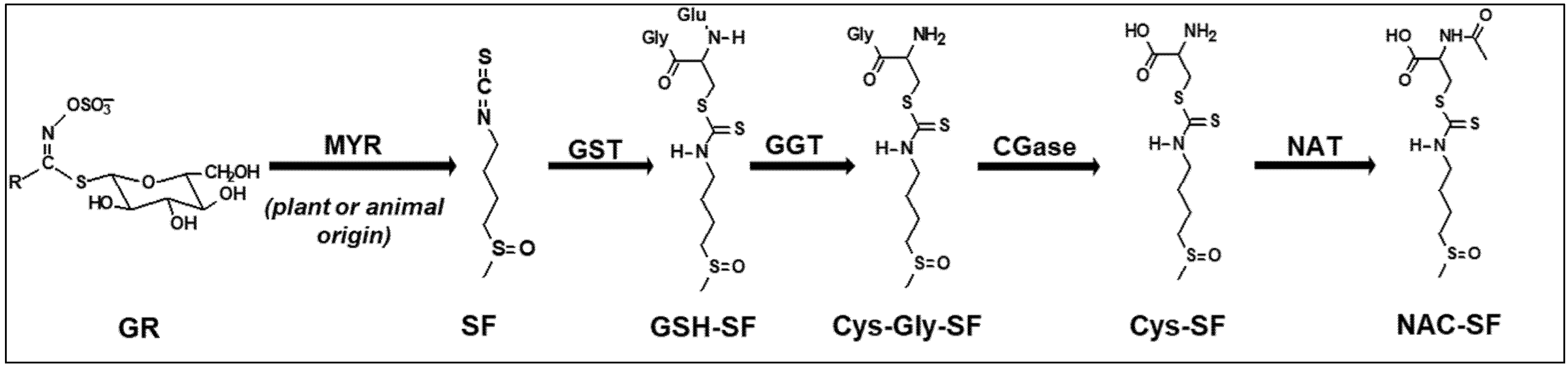
Figure 1. Conversion of glucoraphanin (GR) to sulforaphane (SF) and its metabolites glutathione-SF (GSH-SF), cysteinyl-glycine-SF (Cys-Gly-SF), cysteinyl-SF (Cys-SF), and N-acetyl-cysteinyl-SF (NAC-SF). The enzymes involved are, respectively, myrosinase (MYR), glutathione S-transferase(s) (GST), γ-glutamyl-transpeptidase (GGT), cysteinyl-glycinease (CGase), and N-acetyltransferase (NAT).
Nutrients 18 01444 g001
Figure 2. Sulforaphane and skin health. Sulforaphane has been shown in in vitro, preclinical, and clinical studies to engage multiple molecular and cellular pathways relevant to skin health (panel (A)), including activation of the Nrf2 antioxidant and phase 2 detoxification response; suppression of pro-inflammatory signaling (e.g., NF-κB, MAPK, and the NLRP3 inflammasome); modulation of immune function; preservation of barrier integrity via effects on tight-junction and keratinocyte homeostasis; and modification of the skin microbiome either directly or through the gut–skin axis. These mechanisms of action in panel (A) of the diagram are linked to beneficial effects on a range of skin disorders and conditions shown in panel (B), including inflammatory diseases (psoriasis, atopic dermatitis, acne vulgaris, and rosacea), disorders of keratinization and barrier dysfunction, UV-induced skin damage and photoaging, with specific pathways in panel A connecting to improvements in the listed conditions (panel (B)) through mechanistic studies, biomarker changes, and preclinical or clinical outcome measures.
Nutrients 18 01444 g002
Disclaimer/Publisher’s Note: The statements, opinions and data contained in all publications are solely those of the individual author(s) and contributor(s) and not of MDPI and/or the editor(s). MDPI and/or the editor(s) disclaim responsibility for any injury to people or property resulting from any ideas, methods, instructions or products referred to in the content.