


A Critical Appraisal of the Links Between Video Gaming, Lifestyle Factors, Diet and Eating Behaviour: A Narrative Review



 , , , , , and
Abstract
1. Introduction
2. Materials and Methods
3. Results
3.1. Video Gaming and Psychosocial Stress
3.2. Video Gaming and Physical Activity
3.3. Video Gaming and Sleep Quality
3.4. Video Gaming, Diet and Eating Behaviour
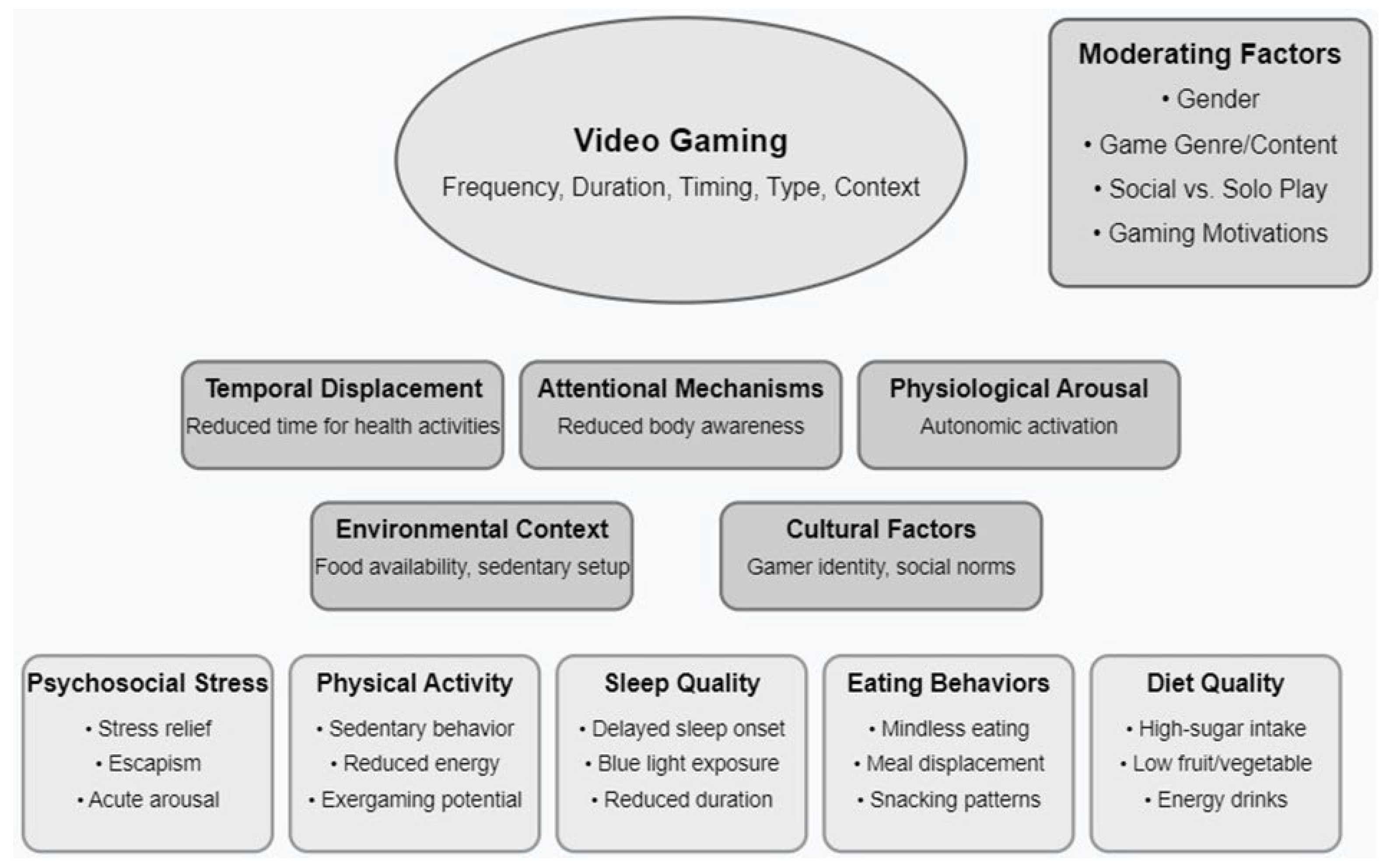
3.5. Integrated Conceptual Framework and Mechanisms
3.6. Implications and Future Directions
3.7. Strengths and Limitations
3.8. What Is Already Known on This Subject?
3.9. What This Study Adds?
4. Conclusions
Author Contributions
Funding
Institutional Review Board Statement
Informed Consent Statement
Data Availability Statement
Acknowledgments
Conflicts of Interest
References
- Pelletier, M.; Krallman, A.; Adams, F.; Hancock, T. One size doesn’t fit all: A uses and gratifications analysis of social media platforms. J. Res. Interact. Mark. 2020, 14, 269–284. [Google Scholar] [CrossRef] [Scilit]
- Clement, J. Number of Gamers Worldwide from 2017 to 2024; Statista: Hamburg, Germany, 2022. [Google Scholar]
- Lager, K.S.; Corso, G. Game Faces: How Digital Play Affects the Psychological Landscape of Youth. Cureus 2025, 17, e77497. [Google Scholar] [CrossRef] [Scilit]
- Gopali, L.; Dhital, R.; Koirala, R.; Shrestha, T.; Bhusal, S.; Rimal, R.; Shrestha, C.; Shah, R. Effect of COVID-19 pandemic on internet gaming disorder among general population: A systematic review and meta-analysis. PLoS Glob. Public Health 2023, 3, e0001783. [Google Scholar] [CrossRef] [Scilit]
- Brand, J.E.; Jervis, J. Digital Australia 2022; IGEA: Eveleigh, Australia, 2021. [Google Scholar]
- Kim, D.; Nam, J.K.; Keum, C. Adolescent Internet gaming addiction and personality characteristics by game genre. PLoS ONE 2022, 17, e0263645. [Google Scholar] [CrossRef] [Scilit]
- Chesham, A.; Wyss, P.; Müri, R.M.; Mosimann, U.P.; Nef, T. What Older People Like to Play: Genre Preferences and Acceptance of Casual Games. JMIR Serious Games 2017, 5, e8. [Google Scholar] [CrossRef] [Scilit]
- Leis, O.; Lautenbach, F. Psychological and physiological stress in non-competitive and competitive esports settings: A systematic review. Psychol. Sport Exerc. 2020, 51, 101738. [Google Scholar] [CrossRef] [Scilit]
- Wang, G.; Zhao, M.; Yang, F.; Cheng, L.J.; Lau, Y. Game-based brain training for improving cognitive function in community-dwelling older adults: A systematic review and meta-regression. Arch. Gerontol. Geriatr. 2021, 92, 104260. [Google Scholar] [CrossRef] [Scilit]
- Neuman, S.B. The displacement effect: Assessing the relation between television viewing and reading performance. Read. Res. Q. 1988, 23, 414–441. [Google Scholar] [CrossRef] [Scilit]
- Hartanto, A.; Lua, V.Y.Q.; Quek, F.Y.X.; Yong, J.C.; Ng, M.H.S. A critical review on the moderating role of contextual factors in the associations between video gaming and well-being. Comput. Hum. Behav. Rep. 2021, 4, 100135. [Google Scholar] [CrossRef] [Scilit]
- Klesges, R.C.; Coates, T.J.; Brown, G.; Sturgeon-Tillisch, J.; Moldenhauer-Klesges, L.M.; Holzer, B.; Woolfrey, J.; Vollmer, J. Parental influences on children’s eating behavior and relative weight. J. Appl. Behav. Anal. 1983, 16, 371–378. [Google Scholar] [CrossRef] [Scilit] [PubMed]
- Deng, N.; Soh, K.G.; Abdullah, B.B.; Tan, H.; Huang, D. Active video games for improving health-related physical fitness in older adults: A systematic review and meta-analysis. Front. Public Health 2024, 12, 1345244. [Google Scholar] [CrossRef] [Scilit] [PubMed]
- Giller, M.; Kowal, T.; Likus, W.; Brzęk, A. Pokémon GO, Went, Gone…-Physical Activity Level, Health Behaviours, and Mental Well-Being of Game Users: A Cross-Sectional Study. Healthcare 2025, 13, 2334. [Google Scholar] [CrossRef] [Scilit] [PubMed]
- Ni, M.Y.; Hui, R.W.H.; Li, T.K.; Tam, A.H.M.; Choy, L.L.Y.; Ma, K.K.W.; Cheung, F.; Leung, G.M. Augmented Reality Games as a New Class of Physical Activity Interventions? The Impact of Pokémon Go Use and Gaming Intensity on Physical Activity. Games Health J. 2019, 8, 1–6. [Google Scholar] [CrossRef] [Scilit]
- Ruggiero, T.E. Uses and Gratifications Theory in the 21st Century. Mass Commun. Soc. 2000, 3, 3–37. [Google Scholar] [CrossRef] [Scilit]
- De Schutter, B. Never too old to play: The appeal of digital games to an older audience. Games Cult. A J. Interact. Media 2011, 6, 155–170. [Google Scholar] [CrossRef] [Scilit]
- Dell’Osso, L.; Nardi, B.; Massoni, L.; Battaglini, S.; De Felice, C.; Bonelli, C.; Pini, S.; Cremone, I.M.; Carpita, B. Video Gaming in Older People: What Are the Implications for Cognitive Functions? Brain Sci. 2024, 14, 731. [Google Scholar] [CrossRef] [Scilit]
- Dong, G.; Potenza, M.N. A cognitive-behavioral model of Internet gaming disorder: Theoretical underpinnings and clinical implications. J. Psychiatr. Res. 2014, 58, 7–11. [Google Scholar] [CrossRef] [Scilit]
- Satapathy, P.; Khatib, M.N.; Balaraman, A.K.; R, R.; Kaur, M.; Srivastava, M.; Barwal, A.; Prasad, G.V.S.; Rajput, P.; Syed, R.; et al. Burden of gaming disorder among adolescents: A systemic review and meta-analysis. Public Health Pract. 2025, 9, 100565. [Google Scholar] [CrossRef] [Scilit]
- Montag, C.; Lachmann, B.; Herrlich, M.; Zweig, K. Addictive Features of Social Media/Messenger Platforms and Freemium Games against the Background of Psychological and Economic Theories. Int. J. Environ. Res. Public Health 2019, 16, 2612. [Google Scholar] [CrossRef] [Scilit] [PubMed]
- Mario, S.; Hannah, C.; Jonathan, W.C.; Jose, L. Frequent video-game playing in young males is associated with central adiposity and high-sugar, low-fibre dietary consumption. Eat. Weight Disord. 2014, 19, 515–520. [Google Scholar] [CrossRef] [Scilit]
- Ali, A.M.; Al-Amer, R.; Atout, M.; Ali, T.S.; Mansour, A.M.H.; Khatatbeh, H.; Alkhamees, A.A.; Hendawy, A.O. The Nine-Item Internet Gaming Disorder Scale (IGDS9-SF): Its Psychometric Properties among Sri Lankan Students and Measurement Invariance across Sri Lanka, Turkey, Australia, and the USA. Healthcare 2022, 10, 490. [Google Scholar] [CrossRef] [Scilit] [PubMed]
- Reinecke, L. Games and Recovery. J. Media Psychol. 2009, 21, 126–142. [Google Scholar] [CrossRef] [Scilit]
- Ballard, M.; Gray, M.; Reilly, J.; Noggle, M. Correlates of video game screen time among males: Body mass, physical activity, and other media use. Eat. Behav. 2009, 10, 161–167. [Google Scholar] [CrossRef] [Scilit] [PubMed]
- Weaver, J.B., 3rd; Mays, D.; Sargent Weaver, S.; Kannenberg, W.; Hopkins, G.L.; Eroğlu, D.; Bernhardt, J.M. Health-risk correlates of video-game playing among adults. Am. J. Prev. Med. 2009, 37, 299–305. [Google Scholar] [CrossRef] [Scilit] [PubMed]
- Weaver, E.; Gradisar, M.; Dohnt, H.; Lovato, N.; Douglas, P. The effect of presleep video-game playing on adolescent sleep. J. Clin. Sleep Med. 2010, 6, 184–189. [Google Scholar] [CrossRef] [Scilit]
- Oldham-Cooper, R.E.; Hardman, C.A.; Nicoll, C.E.; Rogers, P.J.; Brunstrom, J.M. Playing a computer game during lunch affects fullness, memory for lunch, and later snack intake. Am. J. Clin. Nutr. 2011, 93, 308–313. [Google Scholar] [CrossRef] [Scilit]
- Snodgrass, J.G.; Lacy, M.G.; Francois Dengah, H.J., 2nd; Fagan, J.; Most, D.E. Magical flight and monstrous stress: Technologies of absorption and mental wellness in Azeroth. Cult. Med. Psychiatry 2011, 35, 26–62. [Google Scholar] [CrossRef] [Scilit]
- Chaput, J.P.; Visby, T.; Nyby, S.; Klingenberg, L.; Gregersen, N.T.; Tremblay, A.; Astrup, A.; Sjodin, A. Video game playing increases food intake in adolescents: A randomized crossover study. Am. J. Clin. Nutr. 2011, 93, 1196–1203. [Google Scholar] [CrossRef] [Scilit]
- Cronin, J.; McCarthy, M. Fast food and fast games: An ethnographic exploration of food consumption complexity among the videogames subculture. Br. Food J. 2011, 113, 720–743. [Google Scholar] [CrossRef] [Scilit]
- Siervo, M.; Sabatini, S.; Fewtrell, M.S.; Wells, J.C. Acute effects of violent video-game playing on blood pressure and appetite perception in normal-weight young men: A randomized controlled trial. Eur. J. Clin. Nutr. 2013, 67, 1322–1324. [Google Scholar] [CrossRef] [Scilit] [PubMed]
- Nishiwaki, M.; Kuriyama, A.; Ikegami, Y.; Nakashima, N.; Matsumoto, N. A pilot crossover study: Effects of an intervention using an activity monitor with computerized game functions on physical activity and body composition. J. Physiol. Anthropol. 2014, 33, 35. [Google Scholar] [CrossRef] [Scilit] [PubMed]
- Exelmans, L.; Van den Bulck, J. Sleep quality is negatively related to video gaming volume in adults. J. Sleep Res. 2015, 24, 189–196. [Google Scholar] [CrossRef] [Scilit]
- Simons, M.; Chinapaw, M.J.; Brug, J.; Seidell, J.; de Vet, E. Associations between active video gaming and other energy-balance related behaviours in adolescents: A 24-hour recall diary study. Int. J. Behav. Nutr. Phys. Act. 2015, 12, 32. [Google Scholar] [CrossRef] [Scilit]
- Harbard, E.; Allen, N.B.; Trinder, J.; Bei, B. What’s Keeping Teenagers Up? Prebedtime Behaviors and Actigraphy-Assessed Sleep Over School and Vacation. J. Adolesc. Health 2016, 58, 426–432. [Google Scholar] [CrossRef] [Scilit] [PubMed]
- Howe, K.B.; Suharlim, C.; Ueda, P.; Howe, D.; Kawachi, I.; Rimm, E.B. Gotta catch’em all! Pokémon GO and physical activity among young adults: Difference in differences study. BMJ 2016, 355, i6270. [Google Scholar] [CrossRef] [Scilit] [PubMed]
- Smith, L.J.; King, D.L.; Richardson, C.; Roane, B.M.; Gradisar, M. Mechanisms influencing older adolescents’ bedtimes during videogaming: The roles of game difficulty and flow. Sleep Med. 2017, 39, 70–76. [Google Scholar] [CrossRef] [Scilit]
- Turel, O.; Romashkin, A.; Morrison, K.M. A model linking video gaming, sleep quality, sweet drinks consumption and obesity among children and youth. Clin. Obes. 2017, 7, 191–198. [Google Scholar] [CrossRef] [Scilit] [PubMed]
- Cha, E.M.; Hoelscher, D.M.; Ranjit, N.; Chen, B.; Gabriel, K.P.; Kelder, S.; Saxton, D.L. Effect of Media Use on Adolescent Body Weight. Prev. Chronic Dis. 2018, 15, E141. [Google Scholar] [CrossRef] [Scilit]
- Zurita-Ortega, F.; Chacon-Cuberos, R.; Castro-Sanchez, M.; Gutierrez-Vela, F.L.; Gonzalez-Valero, G. Effect of an Intervention Program Based on Active Video Games and Motor Games on Health Indicators in University Students: A Pilot Study. Int. J. Environ. Res. Public Health 2018, 15, 1329. [Google Scholar] [CrossRef] [Scilit]
- Siervo, M.; Gan, J.; Fewtrell, M.S.; Cortina-Borja, M.; Wells, J.C.K. Acute effects of video-game playing versus television viewing on stress markers and food intake in overweight and obese young men: A randomised controlled trial. Appetite 2018, 120, 100–108. [Google Scholar] [CrossRef] [Scilit]
- Altintas, E.; Karaca, Y.; Hullaert, T.; Tassi, P. Sleep quality and video game playing: Effect of intensity of video game playing and mental health. Psychiatry Res. 2019, 273, 487–492. [Google Scholar] [CrossRef] [Scilit] [PubMed]
- Puolitaival, T.; Sieppi, M.; Pyky, R.; Enwald, H.; Korpelainen, R.; Nurkkala, M. Health behaviours associated with video gaming in adolescent men: A cross-sectional population-based MOPO study. BMC Public Health 2020, 20, 415. [Google Scholar] [CrossRef] [Scilit]
- Potvin Kent, M.; Pauze, E.; Roy, E.A.; de Billy, N.; Czoli, C. Children and adolescents’ exposure to food and beverage marketing in social media apps. Pediatr. Obes. 2019, 14, e12508. [Google Scholar] [CrossRef] [Scilit]
- Koban, K.; Jonathan, B.; Julian, B.; Ohler, P. Compensatory video gaming. Gaming behaviours and adverse outcomes and the moderating role of stress, social interaction anxiety, and loneliness. Behav. Inf. Technol. 2022, 41, 2727–2744. [Google Scholar] [CrossRef] [Scilit]
- Akcay, D.; Akcay, B.D. The effect of computer game playing habits of university students on their sleep states. Perspect. Psychiatr. Care 2020, 56, 820–826. [Google Scholar] [CrossRef] [Scilit] [PubMed]
- Rudolf, K.; Bickmann, P.; Frobose, I.; Tholl, C.; Wechsler, K.; Grieben, C. Demographics and Health Behavior of Video Game and eSports Players in Germany: The eSports Study 2019. Int. J. Environ. Res. Public Health 2020, 17, 1870. [Google Scholar] [CrossRef] [Scilit] [PubMed]
- Kwok, C.; Leung, P.; Poon, K.; Fung, X. The Effects of Internet Gaming and Social Media Use On Physical Activity, Sleep, Quality of Life, and Academic Performance among University Students in Hong Kong: A Preliminary Study. Soc. Health Behav. 2021, 4, 36. [Google Scholar] [CrossRef] [Scilit]
- Vaarala, S.; Ruotsalainen, H.; Hylkilä, K.; Kääriäinen, M.; Konttila, J.; Männistö, M.; Männikkö, N. The association of problematic gaming characteristics with dietary habits among Finnish vocational school students. Sci. Rep. 2022, 12, 21381. [Google Scholar] [CrossRef] [Scilit]
- Moore, D.; Morrell, J. Do dietary patterns differ with video game usage in college men? J. Am. Coll. Health 2024, 72, 2362–2370. [Google Scholar] [CrossRef] [Scilit] [PubMed]
- Matias, C.; Cardoso, J.; Cavaca, M.; Cardoso, S.; Giro, R.; Vaz, J.; Couto, P.; Dores, A.; Ferreira, T.; Tinsley, G.; et al. Game on: A cross-sectional study on gamers’ mental health, Game patterns, physical activity, eating and sleeping habits. Comput. Hum. Behav. 2023, 148, 107901. [Google Scholar] [CrossRef] [Scilit]
- Soffner, M.; Bickmann, P.; Tholl, C.; Froböse, I. Dietary behavior of video game players and esports players in Germany: A cross-sectional study. J. Health Popul. Nutr. 2023, 42, 29. [Google Scholar] [CrossRef] [Scilit] [PubMed]
- Kaewpradup, T.; Deric, S.; Uren, H.V.; Nguyen, V.H.; Pereira, L.R.; Coorey, R.; Wells, J.C.K.; Adisakwattana, S.; Stephan, B.C.M.; Siervo, M. Video gaming linked to unhealthy diet, poor sleep quality and lower physical activity levels in Australian University students. Nutrition 2025, 144, 113051. [Google Scholar] [CrossRef] [Scilit]
- Caycho, J.M.; Lozada-Urbano, M.; Aguirre-Ipenza, R.; Contreras, P.J. Factors Influencing Eating Habits of Video Gamers and Professional eSports Gamers in Peru. Foods 2025, 14, 3597. [Google Scholar] [CrossRef] [Scilit]
- Danielsson, M.; Heimerson, I.; Lundberg, U.; Perski, A.; Stefansson, C.-G.; Åkerstedt, T. Psychosocial stress and health problems:Health in Sweden: The National Public Health Report 2012. Chapter 6. Scand. J. Public Health 2012, 40, 121–134. [Google Scholar] [CrossRef] [Scilit] [PubMed]
- Jones, C.M.; Scholes, L.; Johnson, D.; Katsikitis, M.; Carras, M.C. Gaming well: Links between videogames and flourishing mental health. Front. Psychol. 2014, 5, 260. [Google Scholar] [CrossRef] [Scilit] [PubMed]
- Wagener, G.L.; Schulz, A.; Melzer, A. A Plague(d) Tale: Are violent video games effective in reducing stress levels? Int. J. Psychophysiol. 2025, 209, 112518. [Google Scholar] [CrossRef] [Scilit]
- Dowsett, A.; Jackson, M. The effect of violence and competition within video games on aggression. Comput. Hum. Behav. 2019, 99, 22–27. [Google Scholar] [CrossRef] [Scilit]
- Kardefelt-Winther, D. The Moderating Role of Psychosocial Well-Being on the Relationship between Escapism and Excessive Online Gaming. Comput. Hum. Behav. 2014, 38, 68–74. [Google Scholar] [CrossRef] [Scilit]
- Canale, N.; Marino, C.; Griffiths, M.D.; Scacchi, L.; Monaci, M.G.; Vieno, A. The association between problematic online gaming and perceived stress: The moderating effect of psychological resilience. J. Behav. Addict. 2019, 8, 174–180. [Google Scholar] [CrossRef] [Scilit]
- Blasi, M.D.; Giardina, A.; Giordano, C.; Coco, G.L.; Tosto, C.; Billieux, J.; Schimmenti, A. Problematic video game use as an emotional coping strategy: Evidence from a sample of MMORPG gamers. J. Behav. Addict. 2019, 8, 25–34. [Google Scholar] [CrossRef] [Scilit]
- Neophytou, K.; Theodorou, M.; Artemi, T.-F.; Theodorou, C.; Panayiotou, G. Gambling to escape: A systematic review of the relationship between avoidant emotion regulation/coping strategies and gambling severity. J. Contextual Behav. Sci. 2023, 27, 126–142. [Google Scholar] [CrossRef] [Scilit]
- Paulus, F.W.; Ohmann, S.; Möhler, E.; Plener, P.; Popow, C. Emotional Dysregulation in Children and Adolescents With Psychiatric Disorders. A Narrative Review. Front. Psychiatry 2021, 12, 628252. [Google Scholar] [CrossRef] [Scilit]
- Schmidt, M.E.; Vandewater, E.A. Media and attention, cognition, and school achievement. Future Child. 2008, 18, 63–85. [Google Scholar] [CrossRef] [Scilit]
- Kowert, R.; Domahidi, E.; Quandt, T. The relationship between online video game involvement and gaming-related friendships among emotionally sensitive individuals. Cyberpsychol Behav. Soc. Netw. 2014, 17, 447–453. [Google Scholar] [CrossRef] [Scilit] [PubMed]
- Huard Pelletier, V.; Lessard, A.; Piché, F.; Tétreau, C.; Descarreaux, M. Video games and their associations with physical health: A scoping review. BMJ Open Sport Exerc. Med. 2020, 6, e000832. [Google Scholar] [CrossRef] [Scilit] [PubMed]
- Cureau, F.V.; Ekelund, U.; Bloch, K.V.; Schaan, B.D. Does body mass index modify the association between physical activity and screen time with cardiometabolic risk factors in adolescents? Findings from a country-wide survey. Int. J. Obes. 2017, 41, 551–559. [Google Scholar] [CrossRef] [Scilit]
- Cemelli, C.; Burris, J.; Woolf, K. Video Games Impact Lifestyle Behaviors in Adults. Top. Clin. Nutr. 2016, 31, 96–110. [Google Scholar] [CrossRef] [Scilit]
- Bull, F.C.; Al-Ansari, S.S.; Biddle, S.; Borodulin, K.; Buman, M.P.; Cardon, G.; Carty, C.; Chaput, J.P.; Chastin, S.; Chou, R.; et al. World Health Organization 2020 guidelines on physical activity and sedentary behaviour. Br. J. Sports Med. 2020, 54, 1451–1462. [Google Scholar] [CrossRef] [Scilit]
- Taylor, L.M.; Kerse, N.; Frakking, T.; Maddison, R. Active Video Games for Improving Physical Performance Measures in Older People: A Meta-analysis. J. Geriatr. Phys. Ther. 2018, 41, 108–123. [Google Scholar] [CrossRef] [Scilit]
- Barkley, J.; Penko, A. Physiologic responses, perceived exertion, and hedonics of playing a physical interactive video game relative to a sedentary alternative and treadmill walking in adults. J. Exerc. Physiol. Online 2009, 12, 12–23. [Google Scholar]
- Hernandez-Martinez, J.; Ramos-Espinoza, F.; Muñoz-Vásquez, C.; Guzman-Muñoz, E.; Herrera-Valenzuela, T.; Branco, B.H.M.; Castillo-Cerda, M.; Valdés-Badilla, P. Effects of active exergames on physical performance in older people: An overview of systematic reviews and meta-analysis. Front. Public Health 2024, 12, 1250299. [Google Scholar] [CrossRef] [Scilit] [PubMed]
- Joronen, K.; Aikasalo, A.; Suvitie, A. Nonphysical effects of exergames on child and adolescent well-being: A comprehensive systematic review. Scand. J. Caring Sci. 2017, 31, 449–461. [Google Scholar] [CrossRef] [Scilit]
- Adam, C.; Senner, V. Which Motives are Predictors for Long-term Use of Exergames? Procedia Eng. 2016, 147, 806–811. [Google Scholar] [CrossRef] [Scilit]
- Baranowski, T.; Abdelsamad, D.; Baranowski, J.; O’Connor, T.M.; Thompson, D.; Barnett, A.; Cerin, E.; Chen, T.A. Impact of an active video game on healthy children’s physical activity. Pediatrics 2012, 129, e636-642. [Google Scholar] [CrossRef] [Scilit]
- Kenney, E.L.; Gortmaker, S.L. United States Adolescents’ Television, Computer, Videogame, Smartphone, and Tablet Use: Associations with Sugary Drinks, Sleep, Physical Activity, and Obesity. J. Pediatr. 2017, 182, 144–149. [Google Scholar] [CrossRef] [Scilit]
- Wang, H.Y.; Cheng, C. The Associations Between Gaming Motivation and Internet Gaming Disorder: Systematic Review and Meta-analysis. JMIR Ment. Health 2022, 9, e23700. [Google Scholar] [CrossRef] [Scilit]
- Peng, W.; Crouse, J.C.; Lin, J.H. Using active video games for physical activity promotion: A systematic review of the current state of research. Health Educ. Behav. 2013, 40, 171–192. [Google Scholar] [CrossRef] [Scilit]
- Piqueras-Sola, B.; Cortés-Martín, J.; Rodríguez-Blanque, R.; Menor-Rodríguez, M.J.; Mellado-García, E.; Merino Lobato, C.; Sánchez-García, J.C. Systematic Review on the Impact of Mobile Applications with Augmented Reality to Improve Health. Bioengineering 2024, 11, 622. [Google Scholar] [CrossRef] [Scilit] [PubMed]
- Lee, J.E.; Zeng, N.; Oh, Y.; Lee, D.; Gao, Z. Effects of Pokémon GO on Physical Activity and Psychological and Social Outcomes: A Systematic Review. J. Clin. Med. 2021, 10, 1860. [Google Scholar] [CrossRef] [Scilit]
- Hamari, J.; Malik, A.; Koski, J.; Johri, A. Uses and Gratifications of Pokémon Go: Why do People Play Mobile Location-Based Augmented Reality Games? Int. J. Hum.–Comput. Interact. 2019, 35, 804–819. [Google Scholar] [CrossRef] [Scilit]
- Nelson, K.L.; Davis, J.E.; Corbett, C.F. Sleep quality: An evolutionary concept analysis. Nurs. Forum 2022, 57, 144–151. [Google Scholar] [CrossRef] [Scilit]
- LeBourgeois, M.K.; Hale, L.; Chang, A.M.; Akacem, L.D.; Montgomery-Downs, H.E.; Buxton, O.M. Digital Media and Sleep in Childhood and Adolescence. Pediatrics 2017, 140, S92–S96. [Google Scholar] [CrossRef] [Scilit] [PubMed]
- Brautsch, L.A.; Lund, L.; Andersen, M.M.; Jennum, P.J.; Folker, A.P.; Andersen, S. Digital media use and sleep in late adolescence and young adulthood: A systematic review. Sleep Med. Rev. 2023, 68, 101742. [Google Scholar] [CrossRef] [Scilit] [PubMed]
- De Rosa, O.; Baker, F.C.; Barresi, G.; Conte, F.; Ficca, G.; de Zambotti, M. Video gaming and sleep in adults: A systematic review. Sleep Med. 2024, 124, 91–105. [Google Scholar] [CrossRef] [Scilit]
- Hale, L.; Guan, S. Screen time and sleep among school-aged children and adolescents: A systematic literature review. Sleep Med. Rev. 2015, 21, 50–58. [Google Scholar] [CrossRef] [Scilit] [PubMed]
- Peracchia, S.; Curcio, G. Exposure to video games: Effects on sleep and on post-sleep cognitive abilities. A sistematic review of experimental evidences. Sleep Sci. 2018, 11, 302–314. [Google Scholar] [CrossRef] [Scilit]
- Tähkämö, L.; Partonen, T.; Pesonen, A.K. Systematic review of light exposure impact on human circadian rhythm. Chronobiol. Int. 2019, 36, 151–170. [Google Scholar] [CrossRef] [Scilit]
- Tu, Z.; He, J.; Li, Y.; Wang, Z.; Wang, C.; Tian, J.; Tang, Y. Can restricting while-in-bed smartphone use improve sleep quality via decreasing pre-sleep cognitive arousal among Chinese undergraduates with problematic smartphone use? Longitudinal mediation analysis using parallel process latent growth curve modeling. Addict. Behav. 2023, 147, 107825. [Google Scholar] [CrossRef] [Scilit]
- Siebers, T.; Beyens, I.; Baumgartner, S.E.; Valkenburg, P.M. Adolescents’ Digital Nightlife: The Comparative Effects of Day- and Nighttime Smartphone Use on Sleep Quality. Commun. Res. 2024, 00936502241276793. [Google Scholar] [CrossRef] [Scilit]
- Oh, J.H.; Yoo, H.; Park, H.K.; Do, Y.R. Analysis of circadian properties and healthy levels of blue light from smartphones at night. Sci. Rep. 2015, 5, 11325. [Google Scholar] [CrossRef] [Scilit]
- Aslam, M.S. Exploring the impact of mobile device use on mealtime distractions and its consequences for metabolic health: A narrative minireview. World J. Clin. Cases 2025, 13, 99924. [Google Scholar] [CrossRef] [Scilit]
- LaCaille, R.A.; Hooker, S.A.; LaCaille, L.J. Using self-determination theory to understand eating behaviors and weight change in emerging adults. Eat. Behav. 2020, 39, 101433. [Google Scholar] [CrossRef] [Scilit]
- Liguori, C.A.; Nikolaus, C.J.; Nickols-Richardson, S.M. Cognitive Distraction at Mealtime Decreases Amount Consumed in Healthy Young Adults: A Randomized Crossover Exploratory Study. J. Nutr. 2020, 150, 1324–1329. [Google Scholar] [CrossRef] [Scilit]
- Lyons, E.J.; Tate, D.F.; Ward, D.S.; Wang, X. Energy intake and expenditure during sedentary screen time and motion-controlled video gaming. Am. J. Clin. Nutr. 2012, 96, 234–239. [Google Scholar] [CrossRef] [Scilit]
- Arslan, S.; Atan, R.M.; Sahin, N.; Ergul, Y. Evaluation of night eating syndrome and food addiction in esports players. Eur. J. Nutr. 2024, 63, 1695–1704. [Google Scholar] [CrossRef] [Scilit]
- Van den Bulck, J.; Eggermont, S. Media use as a reason for meal skipping and fast eating in secondary school children. J. Hum. Nutr. Diet. 2006, 19, 91–100. [Google Scholar] [CrossRef] [Scilit]
- Sa’ari, A.S.; Hamid, M.R.A.; Ain Azizan, N.; Ismail, N.H. Examining the evidence between screen time and night eating behaviour with dietary intake related to metabolic syndrome: A narrative review. Physiol. Behav. 2024, 280, 114562. [Google Scholar] [CrossRef] [Scilit] [PubMed]
- Siervo, M.; Montagnese, C.; Mathers, J.C.; Soroka, K.R.; Stephan, B.C.; Wells, J.C. Sugar consumption and global prevalence of obesity and hypertension: An ecological analysis. Public Health Nutr. 2014, 17, 587–596. [Google Scholar] [CrossRef] [Scilit]
- Kerr, G.; Pu, H.; Dalton, J.; Daprano, C. Gaming for fuel: A content analysis of energy drink advertising in esports. Perform. Enhanc. Health 2025, 13, 100351. [Google Scholar] [CrossRef] [Scilit]
- Medrano-Sanchez, E.J.; Gutierrez-Berrocal, C.A.; Gonzales-Aguilar, L.C.; Huaman, M.A.; Monteza, K.C.; Ayllon, M.L. Energy Drinks and Cardiovascular Health: A Critical Review of Recent Evidence. Beverages 2026, 12, 4. [Google Scholar] [CrossRef] [Scilit]
- Alosaimi, N.; Sherar, L.B.; Griffiths, P.; Pearson, N. Clustering of diet, physical activity and sedentary behaviour and related physical and mental health outcomes: A systematic review. BMC Public Health 2023, 23, 1572. [Google Scholar] [CrossRef] [Scilit]
- Swinkels, L.M.J.; Veling, H.; van Schie, H.T. Playing videogames is associated with reduced awareness of bodily sensations. Comput. Hum. Behav. 2021, 125, 106953. [Google Scholar] [CrossRef] [Scilit]
- Wang, G.Y.; Simkute, D.; Griskova-Bulanova, I. Neurobiological Link between Stress and Gaming: A Scoping Review. J. Clin. Med. 2023, 12, 3113. [Google Scholar] [CrossRef] [Scilit] [PubMed]
- King, D.L.; Delfabbro, P.H. The cognitive psychology of Internet gaming disorder. Clin. Psychol. Rev. 2014, 34, 298–308. [Google Scholar] [CrossRef] [Scilit] [PubMed]
- Nakagomi, A.; Ide, K.; Kondo, K.; Shiba, K. Digital Gaming and Subsequent Health and Well-Being Among Older Adults: Longitudinal Outcome-Wide Analysis. J. Med. Internet Res. 2025, 27, e69080. [Google Scholar] [CrossRef] [Scilit] [PubMed]
- Jung, E.; Yu, J. The Role of Digital Gaming in Addressing Loneliness Among Older Adults: A Scoping Review. Healthcare 2025, 13, 2140. [Google Scholar] [CrossRef] [Scilit]

| Study | Age Group/ Population | Design | Gaming Measure | Health Domain | Key Findings | Mechanisms Identified |
|---|---|---|---|---|---|---|
| Reinecke et al. (2009) [24] | Adults (Mean age = 24.1 years) | Cross-sectional survey | Gaming frequency and recovery experiences | Psychosocial stress | Higher life stress predicted greater gaming for recovery; Gaming provided psychological detachment from stressors | Recovery experiences; Psychological detachment; Relaxation |
| Ballard et al. (2009) [25] | Young adult males | Cross-sectional survey | Video game screen time | Physical activity; BMI; Other media use | Frequent gamers reported significantly less physical activity; Gaming time predicted BMI independent of other media use | Time displacement; Sedentary behaviour |
| Weaver et al. (2009) [26] | Adults; n = 562 | Cross-sectional survey | Gaming status (player vs. non-player) | BMI; Mental health; Physical health | Female gamers reported greater depression and poorer health; Male gamers had higher BMI; Both sexes showed greater reliance on internet-based social support | Sedentary behaviour; Sex-specific health risk profiles |
| Weaver et al. (2010) [27] | Adolescent males (mean age = 16.6 years); n = 13 | Randomised crossover experimental study | 1 h pre-sleep gaming vs. DVD watching | Sleep onset latency; Sleepiness; Sleep architecture | Pre-sleep gaming increased sleep onset latency and reduced subjective sleepiness; Sleep architecture was unaffected | Cognitive arousal; Evening alertness |
| Oldham-Cooper et al. (2011) [28] | Young adults | Controlled experimental study | Computer game playing during lunch vs. focused eating | Satiety; Meal memory; Later snacking | Gaming during meals led to reduced fullness ratings, poorer meal recall, and increased later snacking | Attentional allocation; Mindless eating; Memory encoding disruption |
| Snodgrass et al. (2011) [29] | Adults (18–30 years) | Mixed methods: Interviews + web survey | Immersive online gaming (World of Warcraft) | Psychosocial stress | Over 50% reported gaming improved mood and reduced stress; Deep immersion facilitated “dissociation” from stressors | Escapism; Attentional redirection; Psychological absorption |
| Chaput et al. (2011) [30] | Adolescent males (15–19 years) | Randomised crossover design | 1 h video game session vs. rest period | Ad libitum food intake; Physiological measures | Significantly higher caloric intake after gaming despite similar hunger ratings; Positive energy balance | Stress-induced eating; Cognitive stimulation; Reward processing |
| Cronin & McCarthy (2011) [31] | Young adults (18–30 years) | Ethnographic exploration | Gaming identity and behaviour | Food culture; Eating practices | Identified a distinct “gaming food culture” valuing convenience, minimal preparation, and energy-dense options | Subcultural identity; Value system around food; Social norms |
| Siervo et al. (2013) [32] | Young men (Mean age = 23.1 years) | Randomised controlled trial (three-arm) | 1 h of violent video game vs. non-violent video game vs. TV watching | Blood pressure; Appetite perception; Food preferences | Violent videogame playing significantly increased diastolic BP (+7.5 ± 5.8 mm Hg); Players of violent games felt less full and reported a preference for sweet foods | Physiological stress response; Arousal-induced appetite changes; Game content-specific effects |
| Nishiwaki et al. (2014) [33] | Young adults (mean age = 31 years); n = 20 | 12-week randomised crossover intervention | Gamified activity monitor vs. standard monitor | Daily steps; Physical activity; Body composition | Gamified intervention produced significantly more daily steps, greater physical activity intensity, and greater body fat reduction compared to standard monitoring | Gamification of physical activity; Motivational engagement |
| Mario et al. (2014) [22] | Young men (18–24 years) | Cross-sectional comparison | Frequent vs. non-frequent gaming | Central adiposity; Dietary intake | Frequent gamers showed significantly higher sugar consumption, lower fibre intake, and greater central adiposity | Dietary displacement; Food environment; Energy-dense snacking |
| Exelmans & Van den Bulck (2015) [34] | Population-based sample (18–94 years) | Cross-sectional survey | Gaming volume, timing, and content | Sleep quality; Chronotype | Gaming volume is significantly associated with later bedtimes, longer sleep onset latency, and greater daytime fatigue | Evening arousal; Delayed sleep phase; Blue light exposure |
| Simons et al. (2015) [35] | Adolescents (aged 12–16 years) | 24 h recall diary study | Active vs. non-active gaming time | Physical activity; Snack consumption | Active gaming did not displace sedentary gaming or other physical activities; active gaming time was weakly associated with increased snack consumption | Limited net energy balance benefit; Snack association |
| Harbard et al. (2016) [36] | Young adults (18–35 years) | 14-day daily diary study | Evening gaming (type, duration, timing) | Sleep parameters (diary and actigraphy) | Each hour of gaming after 8 pm is associated with 28 min delay in sleep onset; Stronger effect than evening studying | Circadian phase delay; Evening arousal; Blue light exposure |
| Howe et al. (2016) [37] | Young adults (aged 18–35 years); n = 1182 | Cohort study | Pokémon GO installation and playing status | Physical activity (daily step count) | Pokémon GO was associated with a short-term increase in daily steps; however, the effect attenuated progressively and returned to pre-installation levels by six weeks | Augmented reality gaming; Incidental physical activity; Novelty-driven motivation; Transient behaviour change |
| Smith et al. (2017) [38] | Young adults (18–25 years) | Cross-sectional survey | Multiplayer vs. single-player gaming preferences | Sleep timing; Duration | Multiplayer online games associated with later bedtimes compared to single-player games | Social obligation; Reduced autonomy over session duration; Gaming communities |
| Turel et al. (2017) [39] | Children/adolescents (mean age = 13.1 years); n = 125 | Cross-sectional time-lagged cohort | Pre-bedtime gaming duration; Session duration | Abdominal adiposity; Sleep quality; Sweet drink consumption | Pre-bedtime gaming was associated with greater abdominal adiposity, mediated through poor sleep quality and higher sweet drink consumption | Sleep disruption; Sugar-sweetened beverage consumption; Mediated pathways to obesity |
| Cha et al. (2018) [40] | Adolescents (13–19 years) | Cross-sectional survey | Gaming sessions > 6 h | Eating behaviours; BMI | Long gaming sessions are associated with meal skipping, late-night eating, and increased BMI | Temporal displacement; Irregular eating patterns |
| Zurita-Ortega et al. (2018) [41] | Young adults | 8-week intervention | Active video games intervention | Physical fitness; Body composition | Significant improvements in physical fitness measures following active gaming intervention compared to controls | Physical exertion; Motivational engagement; Gamification of exercise |
| Siervo et al. (2018) [42] | Young men (18–30 years) | Randomised controlled crossover trial | 1 h standardised gaming session vs. television viewing | Stress biomarkers; Eating behaviour | Gaming produced higher cortisol and blood pressure responses than TV; Higher energy intake following gaming sessions | Physiological arousal; Stress-induced eating; Attentional mechanisms |
| Altintas et al. (2019) [43] | Young adults (mean age = 24.4 years); n = 217 | Cross-sectional survey | Weekly gaming duration; Gaming intensity | Sleep quality (PSQI) | Nearly 40% of gamers had poor sleep quality; gaming intensity was a stronger predictor of poor sleep than duration | Physiological arousal; Cognitive alertness |
| Puolitaival et al. (2020) [44] | Adolescent males (mean age = 17.8 years); n = 796 | Cross-sectional population-based survey | Gaming >3 h/day vs. ≤3 h/day | Physical activity; Dietary habits; BMI | Heavy gamers had lower physical activity, lower fruit/vegetable intake, higher sweetened drink consumption, and greater sitting time | Temporal displacement; Sedentary behaviour; Dietary displacement |
| Potvin Kent et al. (2019) [45] | Content analysis of 100 popular video games | Content analysis | N/A—examined games, not players | Food marketing | 84% of advertised food products failed nutritional quality standards; Energy drinks most common product category | Marketing exposure; Brand association; Cultural influence |
| Koban et al. (2022) [46] | Young adults | Longitudinal (semester-long) | Gaming frequency, compensatory gaming motivation | Psychosocial stress; Academic performance | Gaming for escape during exam periods predicted poorer stress management and academic outcomes | Maladaptive coping; behavioural avoidance; Reduced problem-solving |
| Akcay & Akcay (2020) [47] | Young adults | Cross-sectional survey | Computer game playing habits (frequency, duration, timing) | Sleep quality (Pittsburgh Sleep Quality Index) | Heavy gamers (>3 h/day) scored significantly worse on sleep quality compared to moderate/non-gamers | Sleep latency; Sleep efficiency; Bedtime displacement |
| Rudolf et al. (2020) [48] | Adults (18+ years) | Online survey (eSports study) | Competitive vs. recreational gaming | Dietary intake; Physical activity | 84% failed to meet “five a day” fruit/vegetable recommendations; Competitive gamers showed higher energy drink consumption | Performance enhancement seeking; Gaming culture norms |
| Kwok et al. (2021) [49] | Young adults | Cross-sectional survey | Gaming frequency and duration | Physical activity; Sleep quality; Academic performance | Excessive gaming (>2 h/day) is negatively associated with exercise levels and sleep quality | Temporal displacement; Sleep disruption; Sedentary behaviour |
| Vaarala et al. (2022) [50] | Adolescents/young adults (15–21 years) | Cross-sectional survey | Problematic Gaming Inventory | Eating behaviours; Food attitudes | Problematic gamers reported higher rates of distracted eating, convenience food preferences, and barriers to healthy eating | Attentional mechanisms; Food environment; Cooking skill barriers |
| Moore & Morrell (2024) [51] | College men (aged 18–24 years); n = 1259 | Cross-sectional study | Non-, moderate, and high gaming groups | Dietary patterns (3-day food records) | High gamers had greater saturated fat and discretionary calorie intake and lower fruit and vegetable consumption compared to non-gamers | Food accessibility; Gaming subculture; Dietary displacement |
| Matias et al. (2023) [52] | Adults (18–35 years) | Cross-sectional study | Gaming patterns (frequency, duration, genre) | Mental health; Physical activity; Eating habits; Sleep patterns | High gameplay time (>20 h/week) associated with lower sleep quality and physical activity; Gaming genre influenced sleep timing | Digital immersion; Variable reinforcement scheduling; Temporal displacement |
| Soffner et al. (2023) [53] | Adults (mean age = 24.2 years); n = 817 | Cross-sectional survey | Weekly gaming duration | Dietary intake; Fluid intake | Gaming time positively correlated with energy drink, soft drink, and fast food consumption; Fruit and vegetable intake was low | Gaming culture norms; Convenience prioritisation |
| Kaewpradup et al. (2025) [54] | Young adults | Cross-sectional survey | Gaming patterns (frequency, duration, genre) | Dietary intake; Physical activity; Sleep quality; Psychosocial Stress | High gameplay time (>10 h/week) is associated with lower sleep quality, greater BMI, and lower dietary quality | Convenience prioritisation; Temporal displacement; Sleep disruption |
| Caycho et al., (2025) [55] | Young adults | Cross-sectional survey | Gaming patterns (frequency, duration) | Dietary intake; Physical activity; | Peer interaction within the gaming environment and the perceived influence of video games were significantly associated with poorer eating habits. | Digital immersion; Temporal displacement |
| Giller et al. (2025) [14] | Adults (mean age = 27 years); n = 243 | Cross-sectional survey | Pokémon GO playing habits | Physical activity; Mental well-being; Sleep; Social interaction | Pokémon GO was associated with higher physical activity and improved mood; however, a notable proportion of players reported sleep sacrifice, addictive use, and exceeding WHO screen time guidelines | Augmented reality gaming; Incidental physical activity; Addictive potential; sleep displacement |
Disclaimer/Publisher’s Note: The statements, opinions and data contained in all publications are solely those of the individual author(s) and contributor(s) and not of MDPI and/or the editor(s). MDPI and/or the editor(s) disclaim responsibility for any injury to people or property resulting from any ideas, methods, instructions or products referred to in the content. |
© 2026 by the authors. Licensee MDPI, Basel, Switzerland. This article is an open access article distributed under the terms and conditions of the Creative Commons Attribution (CC BY) license.
Share and Cite
Deric, S.; Kaewpradup, T.; Adisakwattana, S.; Stirling, E.; Stephan, B.; Nguyen, V.; Radin Pereira, L.; Uren, H.V.; Siervo, M. A Critical Appraisal of the Links Between Video Gaming, Lifestyle Factors, Diet and Eating Behaviour: A Narrative Review. Nutrients 2026, 18, 967. https://doi.org/10.3390/nu18060967
Deric S, Kaewpradup T, Adisakwattana S, Stirling E, Stephan B, Nguyen V, Radin Pereira L, Uren HV, Siervo M. A Critical Appraisal of the Links Between Video Gaming, Lifestyle Factors, Diet and Eating Behaviour: A Narrative Review. Nutrients. 2026; 18(6):967. https://doi.org/10.3390/nu18060967
Chicago/Turabian StyleDeric, Svetlana, Thanaporn Kaewpradup, Sirichai Adisakwattana, Ellise Stirling, Blossom Stephan, Van Nguyen, Leticia Radin Pereira, Hannah Velure Uren, and Mario Siervo. 2026. "A Critical Appraisal of the Links Between Video Gaming, Lifestyle Factors, Diet and Eating Behaviour: A Narrative Review" Nutrients 18, no. 6: 967. https://doi.org/10.3390/nu18060967
APA StyleDeric, S., Kaewpradup, T., Adisakwattana, S., Stirling, E., Stephan, B., Nguyen, V., Radin Pereira, L., Uren, H. V., & Siervo, M. (2026). A Critical Appraisal of the Links Between Video Gaming, Lifestyle Factors, Diet and Eating Behaviour: A Narrative Review. Nutrients, 18(6), 967. https://doi.org/10.3390/nu18060967

