The Association Between Vitamin D and Polycystic Ovary Syndrome (PCOS) in Women: A Systematic Review

 ,
,  ,
,
Abstract
1. Introduction
2. Materials and Methods
2.1. Eligibility Criteria
2.2. Information Sources and Search Strategy
2.3. Data Extraction
2.4. Quality Assessment
2.5. Data Synthesis
2.6. Outcomes
3. Results
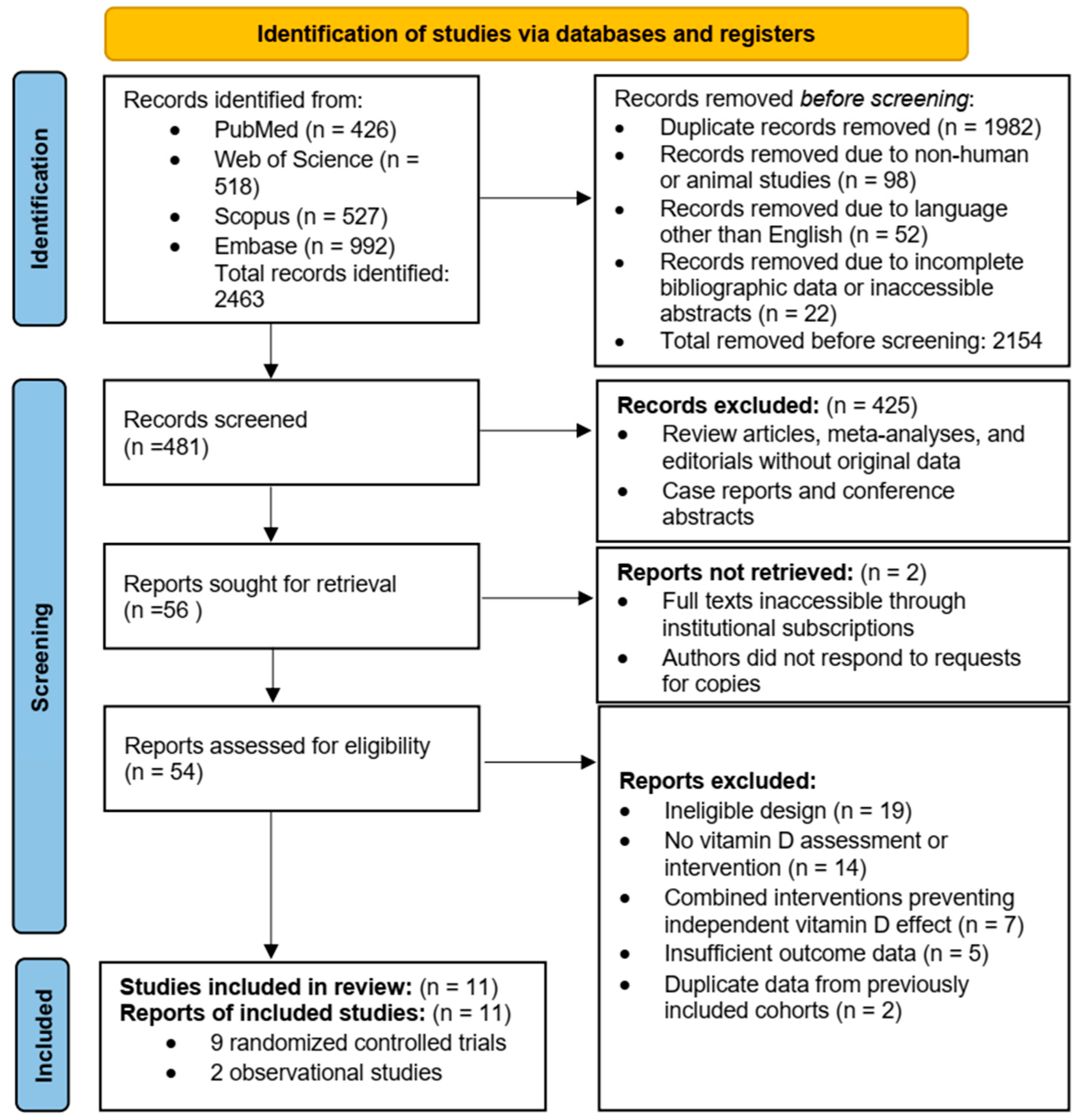
Study Selection and Characteristics
- A.
- Cross-sectional Studies: Vitamin D Status and Metabolic Outcomes
- B.
- Randomized Controlled Trials: Effects of Vitamin D Supplementation on Metabolic and Reproductive outcomes in PCOS
4. Discussion
5. Limitations
6. Recommendations
6.1. Research Recommendations
6.2. Clinical Practice Recommendations
7. Conclusions
Supplementary Materials
Author Contributions
Funding
Institutional Review Board Statement
Informed Consent Statement
Data Availability Statement
Conflicts of Interest
Abbreviations
| 25(OH)D | 25-hydroxyvitamin D |
| ALT | alanine aminotransferase |
| AMH | anti-Müllerian hormone |
| AUC | area under the curve |
| BP | blood pressure |
| FG | Ferriman–Gallwey |
| HOMA-B | homeostatic model assessment of β-cell function |
| HOMA-IR | homeostatic model assessment–insulin resistance |
| IVF | in vitro fertilization |
| IU | international units |
| LDL | low-density lipoprotein |
| LH | luteinizing hormone |
| FSH | follicle-stimulating hormone |
| OGTT | oral glucose tolerance test |
| PCOS | polycystic ovary syndrome |
| QUICKI | quantitative insulin-sensitivity check index |
| RCT | randomized controlled trial |
| sENG | soluble endoglin |
| TGF-β1 | transforming growth factor-β1 |
| vitamin D3 | cholecalciferol |
| E2 | estradiol |
References
- Escobar-Morreale, H.F. Polycystic ovary syndrome: Definition, aetiology, diagnosis and treatment. Nat. Rev. Endocrinol. 2018, 14, 270–284. [Google Scholar] [CrossRef]
- Dong, J.; Rees, D.A. Polycystic ovary syndrome: Pathophysiology and therapeutic opportunities. BMJ Med. 2023, 2, e000548. [Google Scholar] [CrossRef] [PubMed]
- Ali, A.T.; Al-Ani, O.; Al-Ani, F.; Guidozzi, F. Polycystic ovary syndrome and metabolic disorders: A review of the literature. Afr. J. Reprod. Health 2022, 26, 89–99. [Google Scholar] [CrossRef]
- Rotterdam ESHRE/ASRM-Sponsored PCOS Consensus Workshop Group. Revised 2003 consensus on diagnostic criteria and long-term health risks related to polycystic ovary syndrome (PCOS). Hum. Reprod. 2004, 19, 41–47. [Google Scholar] [CrossRef] [PubMed]
- Holick, M.F.; Binkley, N.C.; Bischoff-Ferrari, H.A.; Gordon, C.M.; Hanley, D.A.; Heaney, R.P.; Murad, M.H.; Weaver, C.M. Evaluation, treatment, and prevention of vitamin D deficiency: An Endocrine Society clinical practice guideline. J. Clin. Endocrinol. Metab. 2011, 96, 1911–1930. [Google Scholar] [CrossRef]
- Dewailly, D.; Lujan, M.E.; Carmina, E.; Cedars, M.I.; Laven, J.; Norman, R.J.; Escobar-Morreale, H.F. Definition and significance of polycystic ovarian morphology: A task force report from the Androgen Excess and Polycystic Ovary Syndrome Society. Hum. Reprod Update 2014, 20, 334–352. [Google Scholar] [CrossRef]
- Singh, S.; Pal, N.; Shubham, S.; Sarma, D.K.; Verma, V.; Marotta, F.; Kumar, M. Polycystic Ovary Syndrome: Etiology, Current Management, and Future Therapeutics. J. Clin. Med. 2023, 12, 1454. [Google Scholar] [CrossRef]
- Kumar, R. Metabolism of 1,25-dihydroxyvitamin D3. Physiol. Rev. 1984, 64, 478–504. [Google Scholar] [CrossRef]
- Christakos, S.; Dhawan, P.; Verstuyf, A.; Verlinden, L.; Carmeliet, G. Vitamin D: Metabolism, Molecular Mechanism of Action, and Pleiotropic Effects. Physiol. Rev. 2016, 96, 365–408. [Google Scholar] [CrossRef]
- Farhangnia, P.; Noormohammadi, M.; Delbandi, A.A. Vitamin D and reproductive disorders: A comprehensive review with a focus on endometriosis. Reprod Health 2024, 21, 61. [Google Scholar] [CrossRef] [PubMed]
- Li, M.; Hu, S.; Sun, J.; Zhang, Y. The role of vitamin D3 in follicle development. J. Ovarian. Res. 2024, 17, 148. [Google Scholar] [CrossRef] [PubMed]
- Pittas, A.G.; Lau, J.; Hu, F.B.; Dawson-Hughes, B. The role of vitamin D and calcium in type 2 diabetes. A systematic review and meta-analysis. J. Clin. Endocrinol. Metab. 2007, 92, 2017–2029. [Google Scholar] [CrossRef] [PubMed]
- Muscogiuri, G.; Mitri, J.; Mathieu, C.; Badenhoop, K.; Tamer, G.; Orio, F.; Mezza, T.; Vieth, R.; Colao, A.; Pittas, A. Mechanisms in endocrinology: Vitamin D as a potential contributor in endocrine health and disease. Eur. J. Endocrinol. 2014, 171, R101–R110. [Google Scholar] [CrossRef]
- Chiu, K.C.; Chu, A.; Go, V.L.; Saad, M.F. Hypovitaminosis D is associated with insulin resistance and beta cell dysfunction. Am. J. Clin. Nutr. 2004, 79, 820–825. [Google Scholar] [CrossRef]
- van Tienhoven, X.A.; Gascón, J.R.d.C.; Cano-Herrera, G.; Nehme, J.A.S.; Torun, A.A.S.; Gonzalez, M.F.B.; Salazar, F.E.; Brozon, A.S.; Rosas, E.G.R.; Ocampo, D.C.; et al. Vitamin D in Reproductive Health Disorders: A Narrative Review Focusing on Infertility, Endometriosis, and Polycystic Ovarian Syndrome. Int. J. Mol. Sci. 2025, 26, 2256. [Google Scholar] [CrossRef]
- Yari, F.; Janani, F.; Baharvand, P.; Momeni, A. The Association Between Polycystic Ovary Syndrome and Vitamin D Deficiency in Infertile Women: A Case-Control Study. Health Sci. Rep. 2025, 8, e71553. [Google Scholar] [CrossRef]
- Zadeh-Vakili, A.; Ramezani Tehrani, F.; Daneshpour, M.S.; Zarkesh, M.; Saadat, N.; Azizi, F. Genetic polymorphism of vitamin D receptor gene affects the phenotype of PCOS. Gene 2013, 515, 193–196. [Google Scholar] [CrossRef]
- Miao, C.Y.; Fang, X.J.; Chen, Y.; Zhang, Q. Effect of vitamin D supplementation on polycystic ovary syndrome: A meta-analysis. Exp. Ther. Med. 2020, 19, 2641–2649. [Google Scholar] [CrossRef] [PubMed]
- Page, M.J.; McKenzie, J.E.; Bossuyt, P.M.; Boutron, I.; Hoffmann, T.C.; Mulrow, C.D.; Shamseer, L.; Tetzlaff, J.M.; Akl, E.A.; Brennan, S.E.; et al. The PRISMA 2020 statement: An updated guideline for reporting systematic reviews. BMJ. 2021, 372, n71. [Google Scholar] [CrossRef] [PubMed]
- Hahn, S.; Haselhorst, U.; Tan, S.; Quadbeck, B.; Schmidt, M.; Roesler, S.; Kimmig, R.; Mann, K.; Janssen, O. Low serum 25-hydroxyvitamin D concentrations are associated with insulin resistance and obesity in women with polycystic ovary syndrome. Exp. Clin. Endocrinol. Diabetes 2006, 114, 577–583. [Google Scholar] [CrossRef]
- Wehr, E.; Pilz, S.; Schweighofer, N.; Giuliani, A.; Kopera, D.; Pieber, T.R.; Obermayer-Pietsch, B. Association of hypovitaminosis D with metabolic disturbances in polycystic ovary syndrome. Eur. J. Endocrinol. 2009, 161, 575–582. [Google Scholar] [CrossRef] [PubMed]
- Raja-Khan, N.; Shah, J.; Stetter, C.M.; Lott, M.E.; Kunselman, A.R.; Dodson, W.C.; Legro, R.S. High-dose vitamin D supplementation and measures of insulin sensitivity in polycystic ovary syndrome: A randomized, controlled pilot trial. Fertil. Steril. 2014, 101, 1740–1746. [Google Scholar] [CrossRef]
- Irani, M.; Seifer, D.B.; Grazi, R.V.; Julka, N.; Bhatt, D.; Kalgi, B.; Irani, S.; Tal, O.; Lambert-Messerlian, G.; Tal, R. Vitamin D Supplementation Decreases TGF-β1 Bioavailability in PCOS: A Randomized Placebo-Controlled Trial. J. Clin. Endocrinol. Metab. 2015, 100, 4307–4314. [Google Scholar] [CrossRef]
- Gupta, T.; Rawat, M.; Gupta, N.; Arora, S. Study of Effect of Vitamin D Supplementation on the Clinical, Hormonal and Metabolic Profile of the PCOS Women. J. Obstet. Gynaecol. India 2017, 67, 349–355. [Google Scholar] [CrossRef]
- Maktabi, M.; Chamani, M.; Asemi, Z. The Effects of Vitamin D Supplementation on Metabolic Status of Patients with Polycystic Ovary Syndrome: A Randomized, Double-Blind, Placebo-Controlled Trial. Horm. Metab. Res. 2017, 49, 493–498. [Google Scholar] [CrossRef]
- Dastorani, M.; Aghadavod, E.; Mirhosseini, N.; Foroozanfard, F.; Modarres, S.Z.; Siavashani, M.A.; Asemi, Z. The effects of vitamin D supplementation on metabolic profiles and gene expression of insulin and lipid metabolism in infertile polycystic ovary syndrome candidates for in vitro fertilization. Reprod Biol. Endocrinol. 2018, 16, 94. [Google Scholar] [CrossRef] [PubMed]
- Abootorabi, M.S.; Ayremlou, P.; Behroozi-Lak, T.; Nourisaeidlou, S. The effect of vitamin D supplementation on insulin resistance, visceral fat and adiponectin in vitamin D-deficient women with PCOS: A randomized placebo-controlled trial. Gynecol. Endocrinol. 2018, 34, 489–494. [Google Scholar] [CrossRef] [PubMed]
- Javed, Z.; Papageorgiou, M.; Deshmukh, H.; Kilpatrick, E.S.; Mann, V.; Corless, L.; Abouda, G.; Rigby, A.S.; Atkin, S.L.; Sathyapalan, T. A Randomized, Controlled Trial of Vitamin D Supplementation on Cardiovascular Risk Factors, Hormones, and Liver Markers in Women with Polycystic Ovary Syndrome. Nutrients 2019, 11, 188. [Google Scholar] [CrossRef]
- Trummer, C.; Schwetz, V.; Kollmann, M.; Wölfler, M.; Münzker, J.; Pieber, T.R.; Pilz, S.; Heijboer, A.C.; Obermayer-Pietsch, B.; Lerchbaum, E. Effects of vitamin D supplementation on metabolic and endocrine parameters in PCOS: A randomized-controlled trial. Eur. J. Nutr. 2019, 58, 2019–2028. [Google Scholar] [CrossRef]
- Tóth, B.E.; Takács, I.; Valkusz, Z.; Jakab, A.; Fülöp, Z.; Kádár, K.; Putz, Z.; Kósa, J.P.; Lakatos, P. Effects of Vitamin D3 Treatment on Polycystic Ovary Symptoms: A Prospective Double-Blind Two-Phase Randomized Controlled Clinical Trial. Nutrients 2025, 17, 1246. [Google Scholar] [CrossRef]
- Teede, H.J.; Tay, C.T.; Laven, J.; Dokras, A.; Moran, L.J.; Piltonen, T.T.; Costello, M.F.; Boivin, J.; Redman, L.M.; Boyle, J.A.; et al. Recommendations from the 2023 International Evidence-based Guideline for the Assessment and Management of Polycystic Ovary Syndrome. Fertil. Steril. 2023, 120, 767–793. [Google Scholar] [CrossRef] [PubMed]
- Giustina, A.; Bilezikian, J.P.; Adler, R.A.; Banfi, G.; Bikle, D.D.; Binkley, N.C.; Bollerslev, J.; Bouillon, R.; Brandi, M.L.; Casanueva, F.F.; et al. Consensus Statement on Vitamin D Status Assessment and Supplementation: Whys, Whens, and Hows. Endocr. Rev. 2024, 45, 625–654. [Google Scholar] [CrossRef] [PubMed]


| Study | Country; N | Outcomes | Baseline 25(OH)D, Mean ± SD (ng/mL) | Key Findings | 25(OH)D Assay (Method) |
|---|---|---|---|---|---|
| Hahn et al. (2006) [20] | Germany; N = 120 | Primary: Insulin resistance indices (HOMA-IR, fasting insulin, glucose tolerance) Secondary: BMI, body fat %, leptin, lipid profile, SHBG, FAI | 11.0 ± 7.0 | Lower 25(OH)D was associated with higher BMI, HOMA-IR, fasting insulin, leptin, and triglycerides, and with lower HDL. 25(OH)D correlated positively with SHBG and inversely with FAI. | Radioimmunoassay |
| Wehr et al. (2009) [21] | Austria; N = 206 | Primary: Insulin resistance (HOMA-IR) and metabolic syndrome components Secondary: BMI, blood pressure, glucose, insulin, triglycerides, HDL | NR | Vitamin D deficiency was positively correlated with metabolic syndrome and insulin resistance after adjusting for age, BMI, and season. | ELISA |
| Study | Country; Sample Size (N) * (Intervention/Control) | Intervention | Outcomes (Primary/Secondary) | Mean Baseline Level 25(OH)D (ng/mL) | Mean Post-Intervention 25(OH)D Level (ng/mL) | Key Findings | 25(OH)D Assay (Method) |
|---|---|---|---|---|---|---|---|
| Raja-Khan et al. (2014) [22] | USA, Intervention arm N = 13, Control = 15 | vitamin D3 12,000 IU/day × 12 weeks vs. placebo | Primary: Insulin sensitivity (HOMA-IR, QUICKI) Secondary: 2 h glucose & insulin, BP | Vit D: 19.95 ± 9.47; Placebo: 22.20 ± 6.86 | Vit D: 67.36 ± 28.62; Placebo: 22.45 ± 7.02 | No significant change in all outcomes. | Radioimmunoassay (IDS) |
| Irani et al. (2015) [23] | USA, Intervention arm N = 34 Control N = 34 | vitamin D3 50,000 IU/week × 8 weeks vs. placebo | Primary: Menstrual cycle length Secondary: Hirsutism (FG score), TGF-β1 bioavailability (TGF-β1/sENG ratio) | Intervention: 16.3 ± 0.9/Control: comparable (no reported) | Intervention = 43.2 ± 2.4 (SEM); Control: not reported | Significant improvement in cycle length. Significant reduction in FG score and TGF-β1/sENG ratio. No change in total TGF-β1. | NR |
| Gupta et al. (2017) [24] | India, Intervention N = 25 Control N = 25 | vitamin D3 60,000 IU/week × 12 weeks vs. placebo | Primary: HOMA-IR OR QUICKI Secondary: Menstrual cyclicity, ovulation | Deficient/insufficient (exact mean not reported) | NR | Significant improvement in fasting insulin and glucose homeostasis markers. | NR |
| Maktabi et al. (2017) [25] | Iran, Intervention= 35 Control = 35 70 | vitamin D3 50,000 IU every 2 weeks × 12 weeks vs. placebo | Primary: Fasting glucose, HOMA-IR Secondary: Lipids, testosterone | <20 (mean ± SD not reported) | NR | Significant reductions in fasting glucose and HOMA-IR. | NR |
| Dastorani et al. (2018) [26] | Iran, Intervention = 20/Control = 20 | vitamin D3 50,000 IU every 2 weeks × 8 weeks vs. placebo | Primary: HOMA-IR Secondary: LDL, AMH, metabolic gene expression | <20 (mean ± SD not reported) | NR | Significant reduction in HOMA-IR, LDL, and AMH; improvements in gene expression markers. | NR |
| Abootorabi et al. (2018) [27] | Iran, Intervention = 22/Control = 22 | vitamin D3 50,000 IU/week × 8 weeks vs. placebo | Primary: HOMA-IR Secondary: Visceral fat, adiponectin | <20 (mean ± SD not reported) | NR | significant increase in adiponectin and HOMA-B; borderline improvement in insulin. | NR |
| Javed et al. (2019) [28] | UK and Qatar, intervention = 20/control= 20 | vitamin D3 3200 IU/day × 12 weeks vs. placebo | Primary: HOMA-IR Secondary: ALT, lipids, androgens | Vit D: 21.23 ± 11.94; Placebo: 21.39 ± 12.02 (converted from nmol/L) | Vit D: 36.78 ± 9.33; Placebo: 22.44 ± 10.90 (converted from nmol/L) | Significant reduction in ALT; borderline improvement in HOMA-IR; no change in lipids. | Isotope-dilution LC–MS/MS |
| Trummer et al. (2019) [29] | Austria, Intervention = 90/Control = 90 | vitamin D3 20,000 IU/week × 24 weeks vs. placebo | Primary: OGTT glucose AUC Secondary: Glucose, insulin, endocrine parameters | Vit D: 19.55 ± 6.73; Placebo: 19.55 ± 6.77 (converted from nmol/L) | Vit D: 36.14 ± 8.05; Placebo: 22.76 ± 11.82 (converted from nmol/L) | No significant change in OGTT glucose AUC; no significant improvement in insulin sensitivity markers. | Isotope-dilution LC–MS/MS |
| Tóth et al. (2025) [30] | Hungary, (ITT n = 84), Intervention = 42/Control = 42 | vitamin D3 30,000 IU/week × 24 weeks vs. placebo | Primary: Cycle length, ovulation, ovarian morphology Secondary: androgens, AMH | ~20 (mean ± SD not reported) | NR | Significant reduction in cycle length; significant ovulation rates; improved ovarian morphology markers in subgroup. | NR |
Disclaimer/Publisher’s Note: The statements, opinions and data contained in all publications are solely those of the individual author(s) and contributor(s) and not of MDPI and/or the editor(s). MDPI and/or the editor(s) disclaim responsibility for any injury to people or property resulting from any ideas, methods, instructions or products referred to in the content. |
© 2026 by the authors. Licensee MDPI, Basel, Switzerland. This article is an open access article distributed under the terms and conditions of the Creative Commons Attribution (CC BY) license.
Share and Cite
Jaafar, B.; Chami, N.; Tlais, M.; Matar, M.; Obeid, N.; Taha, N.; El Haddad, K.; Abou Chaaya, J.; Azar, S. The Association Between Vitamin D and Polycystic Ovary Syndrome (PCOS) in Women: A Systematic Review. Nutrients 2026, 18, 968. https://doi.org/10.3390/nu18060968
Jaafar B, Chami N, Tlais M, Matar M, Obeid N, Taha N, El Haddad K, Abou Chaaya J, Azar S. The Association Between Vitamin D and Polycystic Ovary Syndrome (PCOS) in Women: A Systematic Review. Nutrients. 2026; 18(6):968. https://doi.org/10.3390/nu18060968
Chicago/Turabian StyleJaafar, Batoul, Nour Chami, Mohamad Tlais, Maria Matar, Nazih Obeid, Nadia Taha, Karim El Haddad, Jessica Abou Chaaya, and Sami Azar. 2026. "The Association Between Vitamin D and Polycystic Ovary Syndrome (PCOS) in Women: A Systematic Review" Nutrients 18, no. 6: 968. https://doi.org/10.3390/nu18060968
APA StyleJaafar, B., Chami, N., Tlais, M., Matar, M., Obeid, N., Taha, N., El Haddad, K., Abou Chaaya, J., & Azar, S. (2026). The Association Between Vitamin D and Polycystic Ovary Syndrome (PCOS) in Women: A Systematic Review. Nutrients, 18(6), 968. https://doi.org/10.3390/nu18060968