Effects of Caffeine Ingestion on Morning Cognitive and Muscle Strength Measures in Males: A Standardized Approach

 ,
,  , , , , , , and
Abstract
1. Introduction
2. Materials and Methods
2.1. Participants
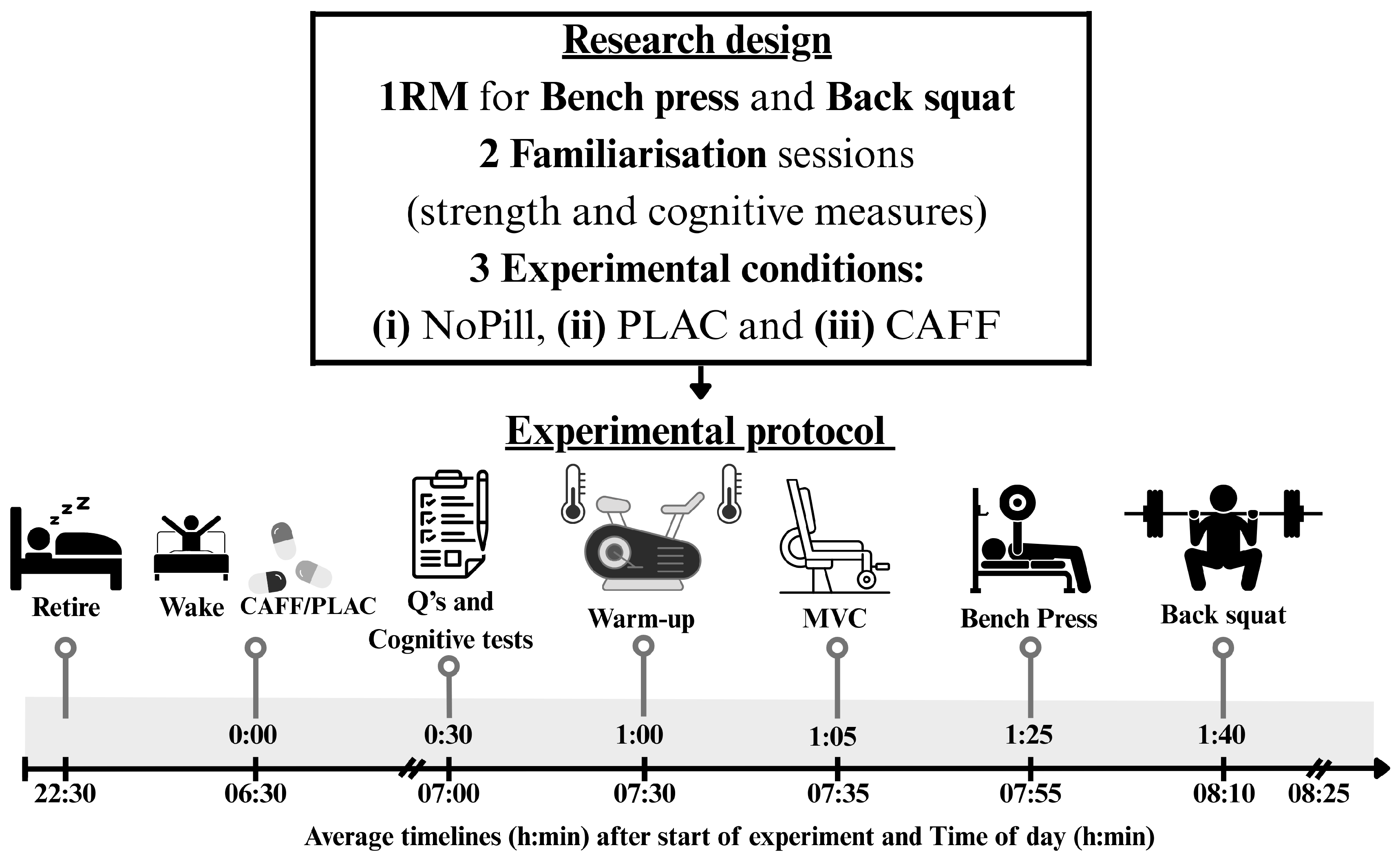
2.2. Research Design
2.3. Protocol and Measurements: Familiarization Session
- (i)
- Cognitive battery of tests
- (ii)
- Isometric maximal voluntary contraction
Twitch Interpolation
- (iii)
- Back squat and bench press
2.4. Experimental Protocol and Measurements
2.5. Statistical Analysis
3. Results
3.1. Rest and Post-Warm-Up Temperatures
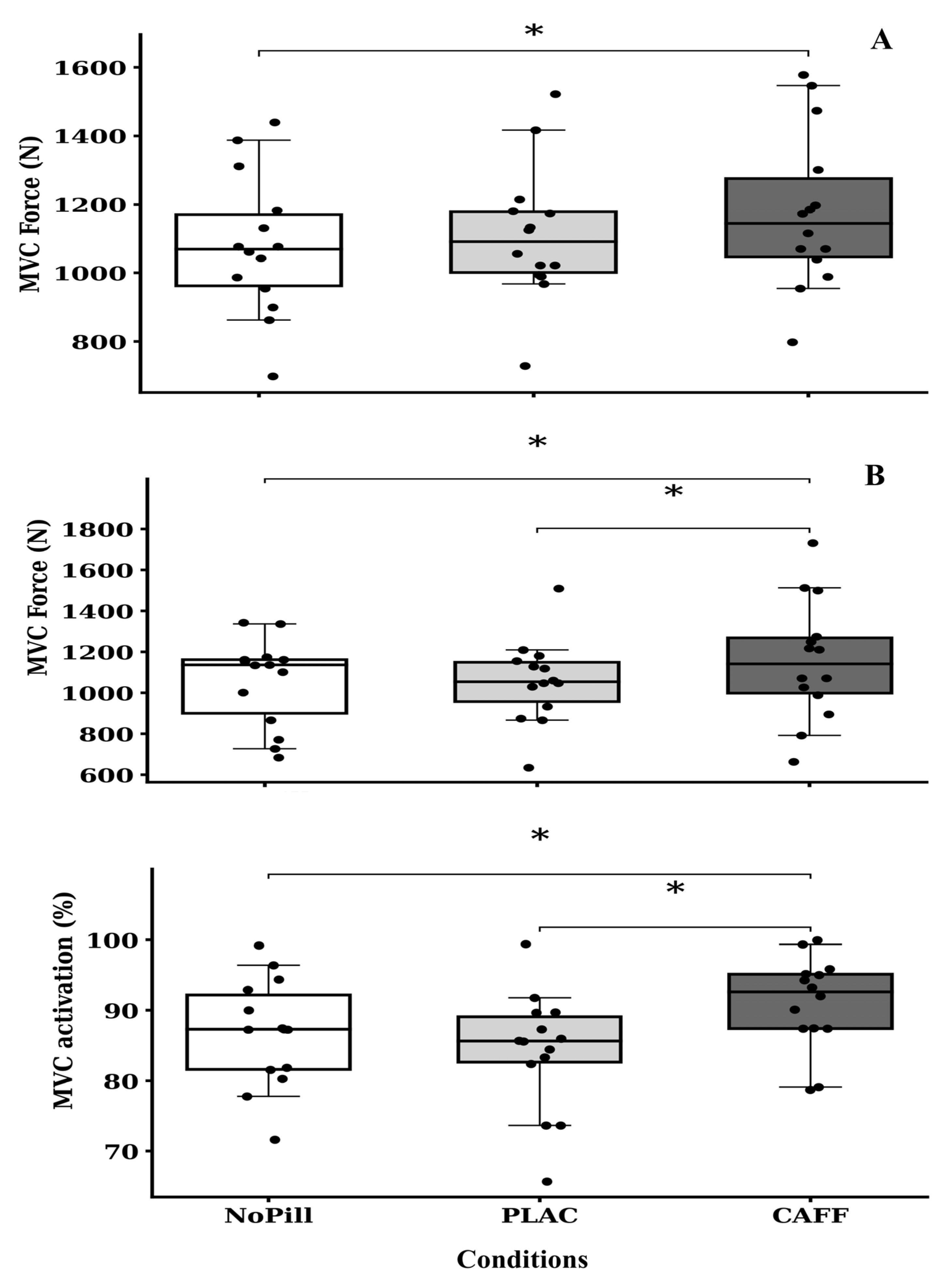
3.2. MVC Force and % Activation
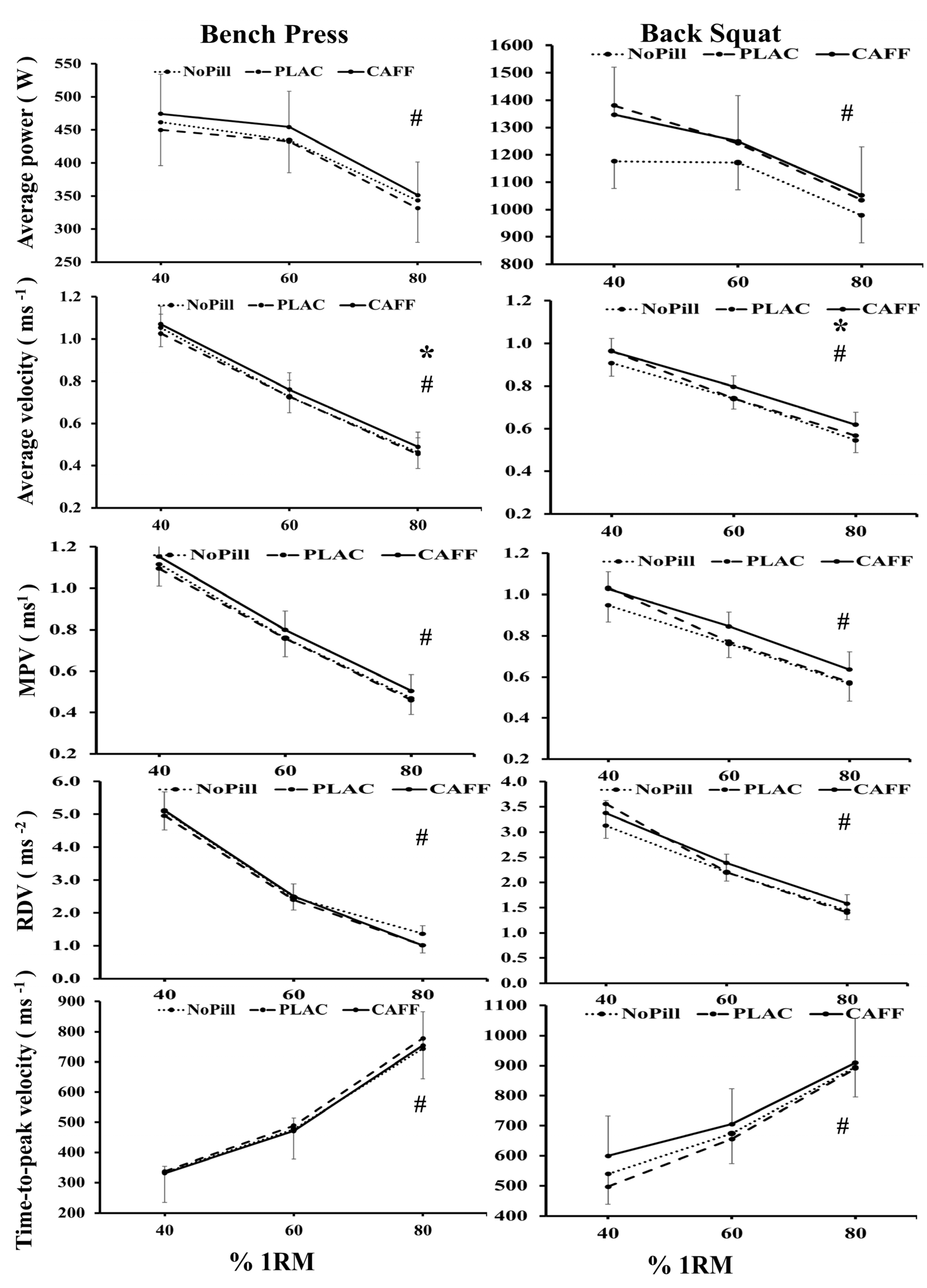
3.3. Bench Press
3.4. Back Squat
3.5. Cognitive Function Tests
3.6. Resting Profile of Mood States, Caffeine Withdrawal and Sleep Questionnaires
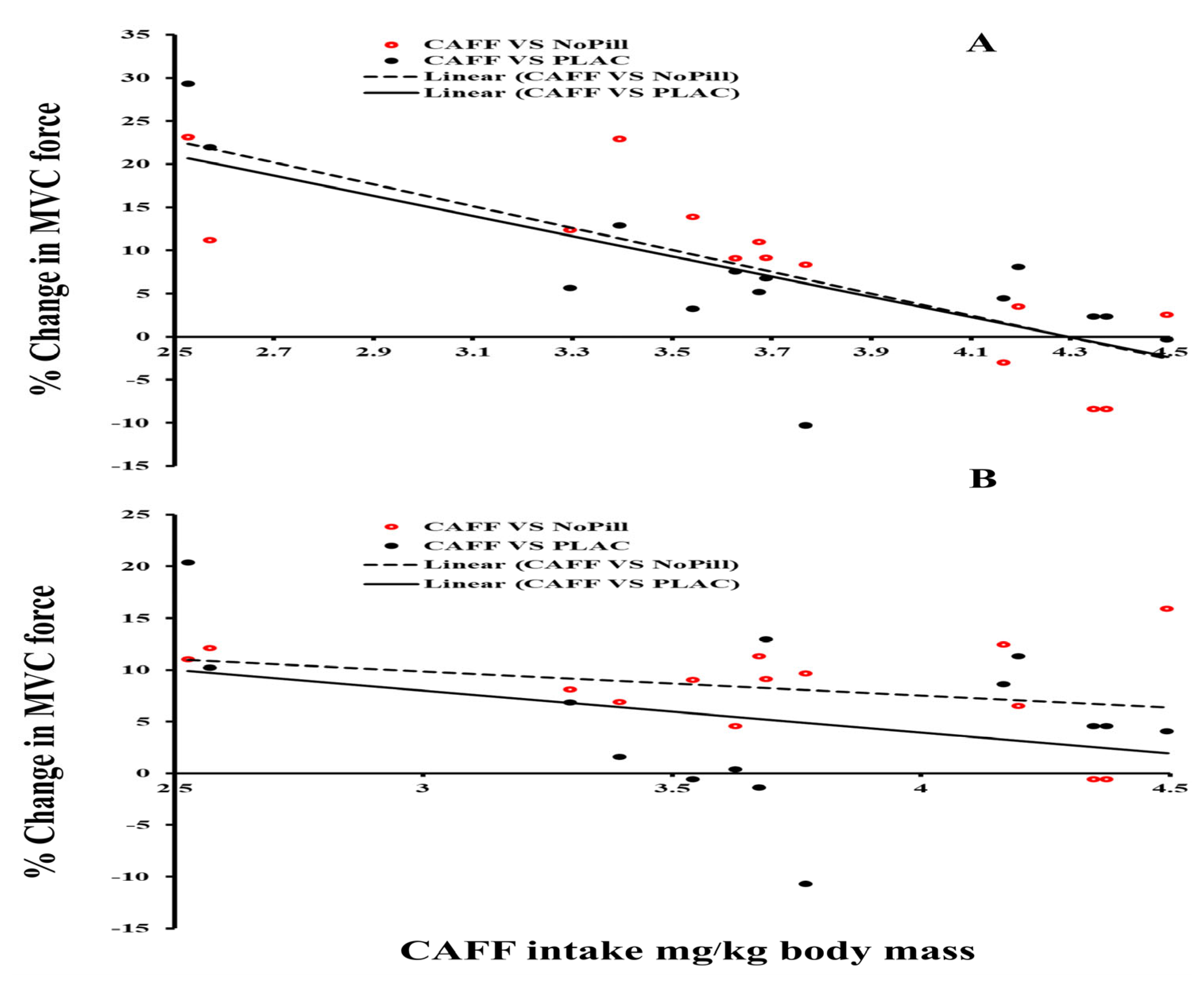
3.7. Correlations Between Dose of Caffeine Ingested and Changes in Peak Force from Placebo and No Pill
4. Discussion

| Participant Considerations | Methodological and Equipment Considerations | Environmental Considerations | Outcome | |||||||
|---|---|---|---|---|---|---|---|---|---|---|
| Author/Variable | Sample size/Sex/Age/A Priori Sample Test | Training Status/1RM/Performance Information | Habitual Sleep Times/Daily Preferences for Exercise/Chronotype | Strength or Cognitive Assessment/Time Between Sessions/TOD of Sessions | Familiarization with Strength or Cognitive Tests/Experimental Conditions/Allocation of IDs to Sessions/Blinded or Double-Blinded | Diet (Timing/Content) on Day of Testing/Caffeine Consumption from Food Intake and Consumption Questionnaire/Caffeine Dose and Timing | Core Temperature Site (CT)/Kit Isometric Dynamometer and Linear Encoder Chosen for the Strength Tests/Cognitive Tests Chosen | Time of Year/Sunrise and Sunset from Start to Study End | Laboratory Dry Temperature/Humidity/BP | ME Caffeine for MVC/ME for Caffeine for BP/ME for Caffeine for BS/ME Caffeine for CT/ME Caffeine for Cognitive Tests |
| Current study | 14/male/18–28 years/a priori = 16 or 10 for one-tailed t-test | Resistance trained > 2 years of strength training 2–4 times per week/1RM BP = 92.5 kg, BS = 122.0 kg | 23:30–07:30 h/did not have one/chronotype score = 33 ± 6, all intermediate types | MVC with or without stimulation and BP and BS with LE/battery of cognitive tests/72 h/07:00 h | Three sessions/NoPill vs. PLAC vs. CAFF/allocated to groups due to 1RM BP and BS then counterbalanced/condition double-blinded | Fasting before AM/34 and 100 mg.day−1/300 mg (~3.6 mg·kg−1 body mass), 60 min before cognitive tests and 9 min before strength tests | Rectal/Squirrel 1000 Series, Grant/Biodex/MuscleLab linear encoder/trail maker, Rays auditory recall (AR), Stroop | October to December (UK autumn to winter)/sunrise–set range from start to end of experiment = 07:29 to 08:01 h and 18:01 to 19:50 h | 19 °C/35–45%/750–760 mmHg | SIM MVC: CAFF vs. PLAC Δ11.7%; CAFF vs. NoPill Δ9.2% p < 0.05 BP: CAFF vs. PLAC Δ4.7%; CAFF vs. NoPill Δ3.3% p < 0.05 BS: CAFF vs. NoPill Δ3.4%; CAFF vs. NoPill Δ4.6% p < 0.05 CT: NA AR: CAFF vs. PLAC Δ11.7% p < 0.05 |
| Montalvo-Alonso et al. [10] | 13/male/24 ± 5 years/not given | Resistance-trained; training experience 5 ± 3 years/BP 1RM.kg−1 = 1.29 ± 0.16; BS 1RM.kg−1 = 1.88 ± 0.34 | Not given/not given/not given | BP and BS/3–7 days/09:00 h | One session/CAFF vs. PLA/randomized allocation, counterbalanced/triple-blind (participants, researchers, and analysts) with external researcher holding codes | Not given/8.6 ± 6.7 mg·kg.day−1/CAFF 3 mg·kg−1 in 150 mL of water, ingested 60 min pre-trial | Not given/equipment: Smith machine (Multipower, Technogym) with Chronojump Boscosystem/cognitive tests not applicable | Not given/not given | Not given/not given/not given | BP25 Vmean: CAFF vs. PLAC Δ11% p = 0.001 BP25 Wmean: CAFF vs. PLAC Δ10% p = 0.001 BP65 endurance Vmean: CAFF vs. PLAC Δ11% p = 0.005 BP65 endurance Wmean CAFF vs. PLAC Δ12% p = 0.003 BP65 endurance Wpeak: CAFF vs. PLAC Δ11% p = 0.027 BS25 Vmean: CAFF vs. PLAC Δ8% p = 0.010 BS25 Wmean: CAFF vs. PLAC Δ11% p = 0.003 BS75 Vmean: CAFF vs. PLAC p = 0.001, (Δ% not reported) BS75 Wmean: CAFF vs. PLAC p = 0.004, (Δ% not reported) BS90 Vmean: CAFF vs. PLAC p = 0.010, (Δ% not reported) BS90 Wmean: CAFF vs. PLAC p = 0.043, (Δ% not reported) BS65 endurance Vmean: CAFF vs. PLAC Δ8.6% p = 0.001 BS65 endurance Wmean: CAFF vs. PLAC Δ9% p = 0.001 CT: NA; cognitive tests: NA |
| Köse et al. [57] | 17 (8 morning and 9 evening type)/male/22.75 ± 1.98 y and 22.22 ± 1.30 y/a priori = 16 | Strength training ≥ 3 days/week (past year)/not given | Not given/not given/morning type and evening type | Handgrip, back strength, cognitive test (modified Flanker Task)/48 h/08:00–10:00 h | Familiarization trials of all physical tests completed on trial day/CAFF (coffee) vs. PLAC (decaf coffee)/crossover, counterbalanced, randomized/double-blind | “Full stomach”/144.00 ± 113.36 mg and 207.78 ± 130.14 mg/3 mg·kg−1, 60–75 min prior | Not given/Takei digital handgrip dynamometer, Takei digital back strength dynamometer/modified Flanker (reaction time) | Not given/not given | Not given/not given/not given | Handgrip: CAFF vs. PLAC p < 0.001 (Δ% not reported) Back strength: CAFF vs. PLAC p = 0.007 (Δ% not reported) |
| Souissi et al. [11] | 15/male/20 ± 1 y/a priori = 14 | Physically active/NA/NA | 22:00 h to 06:00 h/not given/intermediate type | Attention (number of correct responses) and reactions time (RT)/≥3 days between test sessions/07:00, 09:00 h | Two sessions/PLAC vs. CAF (07:00 and 09:00)/randomized, balanced crossover; double-blinded | Standardized meal/no caffeine during testing weeks/6 mg·kg−1 60 min prior | NA/NA/software “React” for simple reaction time; attention assessed with numbers cancellation test | Not given/not given | 28.2–29.3 °C/45.1–46.7%/not given | Reaction time 07:00 h: CAF vs. PLAC Δ6.4% p < 0.05 Reaction time 09:00 h: CAF vs. PLAC Δ4.1% p < 0.05 Attention (correct responses) 07:00 h: CAF vs. PLAC Δ2.9% p < 0.05 Attention (correct responses) 09:00 h: CAF vs. PLAC Δ1.5% p < 0.05 |
| Wilk et al. [58] | 15/male/26.8 ± 6.2 years/not given | Minimum 3 years of strength training experience/1RM BP = 122.3 ± 24.5 kg | Not given/not given/not given | BP with LE/7 days/09:00–11:00 h | One session/PLAC vs. CAFF (3 mg) vs. CAFF (6 mg) vs. CAFF (9 mg)/randomized, crossover/double-blinded | Not given/426 ± 102 mg/caffeine: 3, 6, 9 mg·kg−1 60 min prior | Not given/Tendo Power Analyzer)/not applicable | Not given/not given | Not given/not given/not given | No significance |
| Mora-Rodriguez et al. [13] | 13/male/21.9 ± 2.9 years/not given | Resistance trained (7.1 ± 3.5 years)/1RM BS = 112.5 ± 12.6 kg, BP = 121.0 ± 22.7 kg | Not given/not given/not given | Smith machine BP and BS with LE/36–48 h/08:00 h | Seven session s/CAFF vs. PLAC/double-blinded, cross-over, randomized, placebo-controlled | Standardized diet (breakfast 60 min prior)/light caffeine consumers (≤70 mg.day−1)/6 mg·kg−1 60-min prior | Tympanic temperature/Smith machines (Multipower Fitness Line, Peroga, Spain), T-Force System linear velocity transducers (Ergotech)/not applicable | Not given/not given | Not given/not given/not given | BS (MPV): CAFF vs. PLAC Δ5.4–8.1%; p <0.05 (for 25%, 50%, 75% 1RM) |
| Pallarés et al. [59] | 13/male/21.9 ± 2.9 years/not given | Resistance-trained (7.1 ± 3.5 years)/1RM BS = 112.5 ± 12.6 kg; BP = 121.0 ± 22.7 kg | Not given/not given/not given | Smith machine BP and BS with LE/48 h/08:00 h | Seven sessions/PLAC vs. CAFF 3 mg vs. CAFF 6 mg vs. CAFF 9 mg/randomized, double-blind, crossover, placebo-controlled | Standardized diet (breakfast 60 min prior)/light caffeine consumers (≤ 70 mg day−1)/6 mg·kg−1 60-min prior | Tympanic temperature/Smith machines (Multipower Fitness Line, Peroga, Spain), T-Force System linear velocity transducers (Ergotech)/not applicable | Not given/not given | Not given/not given/not given | BP and BS (MPV): 25–50% 1RM: CAFF 3/6/9 vs. PLAC Δ5.4–8.5% p = 0.039–0.000 75% 1RM: CAFF 6/9 vs. PLAC Δ6.3–8.9% p = 0.046–0.014 BP (MPV): 90% 1RM: CAFF 9 vs. PLAC Δ13.1% p = 0.031 BS (MPV): 90% 1RM: CAFF 9 vs. PLAC Δ10.4% p = 0.046; CAFF 6 vs. PLAC Δ8.3% p = 0.029 BP and BS (MPP): 25–50% 1RM: CAFF 3/6/9 vs. PLAC Δ8.1–12.0% p = 0.022–0.000 (except CAFF 3 in BS) 75% 1RM: CAFF 6/9 vs. PLAC Δ8.3–10.2% p = 0.037–0.010 90% 1RM: CAFF 9 vs. PLAC Δ11.7–15.0% p = 0.031–0.014; CAFF 6 in BP Δ11.4% p = 0.021 |
| Soussi et al. [11] | 12/not given/21.08 ± 1.16 years/not given | Elite Judoists (judokas)/not applicable/not applicable | 23:00 ± 00:30 h to 06:30 ± 00:30 h/not given/no “extreme type” | Simple reaction time/48 h/06:00–07:00 h | “Several” sessions/CAFF vs. PLAC/not given | Not given/reported non-consumers of caffeine/5 mg·kg−1 caffeine (coffee) ingested 60 min prior | NA/NA/software “React” for simple reaction time | Not given/not given | Not given/not given/not given | Simple reaction time: CAFF vs. PLAC Δ11.8 p < 0.001 |
| Mora-Rodriguez et al. [9] | 12/male/19.7 ± 2.8 years/not given | Resistance-trained (7.2 ± 2.4 years); BP and BS 1RM reported relative to body mass (BP = 1.15 ± 0.08; BS = 1.46 ± 0.15); light caffeine users (≤60 mg.day−1) | Not given/not given/not given | BS and BP bar-velocity testing (1 ms−1 load and 75% 1RM), MVCLEG, EVOKLEG, handgrip/trials separated by 24–36 h/10:00 h | Three sessions/CAFF vs. PLAC/randomized double-blind crossover placebo-controlled design | Standardized in-residence diet; abstained alcohol/tobacco/caffeine 4 days pre-testing/caffeine 3 mg·kg−1 in capsules with standardized meal 60 min pre-testing | Tympanic temperature (Braun Thermoscan); T-Force linear encoder; Tedea Huntleigh 1263 and electrical stimulator; cognitive tests not applicable | Not given/not given | Thermoneutral; 19 °C dry bulb/not given/not given | EVOKEDLEG: Peak evoked twitch CAFF vs. PLAC Δ16% p = 0.05 (n = 7) BS velocity (75% 1RM): CAFF vs. PLAC Δ5.3% p = 0.003–0.023. BP velocity (75% 1RM): CAFF vs. PLAC Δ4.6% p = 0.003–0.023. BS velocity (~1.00 m/s load): CAFF vs. PLAC Δ2.5–7.5% p = 0.000–0.002 |
| Maridakis et al. [52] | 18/male/22.7 ± 4.0/a priori = 18 | NA | Not given/not given/not given | Battery of cognitive tests/≥24 h/within 90 min of usual wake time | Four conditions, PLAC, 100 mg or 200 mg doses, 440 kcal breakfast/counterbalanced | 8 h fasted (not including breakfast condition)/61.2 ± 44.4 mg.day−1/100 mg, 200 mg or PLAC ~135 min prior | NA/sustained attention (vigilance), motor (finger) response, Bakan Test. | Not given/not given | Not given/not given/not given | 100 mg and 200 mg of caffeine vs. placebo produced small–moderate improvements in vigilance performance: reduced reaction times, improved target identification and fewer false alarms on Bakan primary and secondary tasks (no Δ% reported; effects described via Hedges’ d; all p < 0.05 for main cognitive effects). |
| Smith et al. [60] | 48/24 males, 24 females/not given/not given | NA | Not given/not given/Morningness–Eveningness Questionnaire completed but chronotype categories not reported | Battery of cognitive tests/NA/07:45 baseline, 11:30 h pre-lunch | Not given/breakfast + CAF, breakfast + DECAF + no breakfast + CAF, no breakfast + DECAF/between-subject design, group allocation method not specified/double-blinded | Fasting before AM/typically 2 cups of coffee per day/4 mg·kg−1 at 08:45 and 11:15 h | NA/cognitive tests: free recall (20-word list), delayed recognition memory (40 words), semantic processing (true/false sentences), logical reasoning (Baddeley letter-order task), repeated digits vigilance (3-digit numbers at 100/min; hits, reaction time, false alarms) | Not given/not given | Not given/not given/not given | Logical reasoning: CAF vs. DECAF % correct Δ9.0% p < 0.005; RT per sentence Δ15.2% p < 0.05 Semantic processing: CAF vs. DECAF Δ7.6% p < 0.05 Repeated digits vigilance: CAF vs. DECAF hits Δ50.5% p < 0.0001; RT Δ13.3% p < 0.0001 |
| Mitchell and Redman [8] | 19/13 female and 6 male/19–39 years/not given | NA | Not given/not given/not given | Five cognitive “Academic type tasks”/7 days/07:00 h | One session/CAFF vs. PLAC/counterbalanced/not given | No CAFF/psychoactive 24 h prior, no food and smoking 1 h prior/n = 6 <120 mg, n = 8 >120 mg <300 mg and n = 8 > 300 mg.day−1/4 mg·kg−1 body mass 60 min before session | NA/NA/20-item short-term memory (STM) task, mental arithmetic (MA), reading comprehension, serial search (SS) and verbal reasoning (VR) tasks | Not given/not given | Not given/not given/not given | Serial search time: CAFF vs. PLAC Δ2.5%; (p < 0.01). Number correct: PLAC vs. CAFF (p < 0.002) VR time taken: CAFF vs. PLAC Δ6.3% p < 0.01 |
5. Limitations
6. Conclusions
7. Practical Implications and Future Research
Author Contributions
Funding
Institutional Review Board Statement
Informed Consent Statement
Data Availability Statement
Acknowledgments
Conflicts of Interest
References
- Walsh, N.P.; Halson, S.L.; Sargent, C.; Roach, G.D.; Nédélec, M.; Gupta, L.; Leeder, J.; Fullagar, H.H.; Coutts, A.J.; Edwards, B.J.; et al. Sleep and the Athlete: Narrative Review and 2021 Expert Consensus Recommendations. Br. J. Sports Med. 2021, 55, 356–368. [Google Scholar] [CrossRef] [PubMed]
- Drust, B.; Waterhouse, J.; Atkinson, G.; Edwards, B.; Reilly, T. Circadian rhythms in sports performance: An update. Chronobiol. Int. 2005, 22, 21–44. [Google Scholar] [CrossRef] [PubMed]
- Robertson, C.M.; Pullinger, S.A.; Robinson, W.R.; Smith, M.E.; Burniston, J.G.; Edwards, B.J. Circadian variation in muscle force output in males using isokinetic, isometric dynamometry: Can we observe this in multi-joint movements using the muscleLab force-velocity encoder and are they similar in peak and magnitude? Chronobiol. Int. 2024, 41, 709–724. [Google Scholar] [CrossRef]
- Munnilari, M.; Bommasamudram, T.; Easow, J.; Tod, D.; Varamenti, E.; Edwards, B.J.; Ravindrakumar, A.; Gallagher, C.; Pullinger, S.A. Diurnal variation in variables related to cognitive performance: A systematic review. Sleep Breath. 2023, 28, 495–510. [Google Scholar] [CrossRef]
- Martins, G.L.; Guilherme, J.; Ferreira, L.H.B.; de Souza-Junior, T.; Lancha, A.H., Jr. Caffeine and Exercise Performance: Possible Directions for Definitive Findings. Front. Sports Act. Living 2020, 2, 574854. [Google Scholar] [CrossRef]
- Guest, N.S.; VanDusseldorp, T.A.; Nelson, M.T.; Grgic, J.; Schoenfeld, B.J.; Jenkins, N.D.M.; Arent, S.M.; Antonio, J.; Stout, J.R.; Trexler, E.T.; et al. International society of sports nutrition position stand: Caffeine and exercise performance. J. Int. Soc. Sports Nutr. 2021, 18, 1. [Google Scholar] [CrossRef]
- Mitchell, J.; Redman, J.R. Effects of caffeine, time of day and user history on study-related performance. Psychopharmacology 1992, 109, 121–126. [Google Scholar] [CrossRef]
- Zhang, Y.; Yang, W.; Xue, Y.; Hou, D.; Chen, S.; Xu, Z.; Peng, S.; Zhao, H.; Wang, C.; Liu, C. Timing Matters: Time of Day Impacts the Ergogenic Effects of Caffeine—A Narrative Review. Nutrients 2024, 16, 1421. [Google Scholar] [CrossRef]
- Mora-Rodríguez, R.; Pallarés, J.G.; López-Samanes, Á.; Ortega, J.F.; Fernández-Elías, V.E. Caffeine Ingestion Reverses the Circadian Rhythm Effects on Neuromuscular Performance in Highly Resistance-Trained Men. PLoS ONE 2012, 7, e33807. [Google Scholar] [CrossRef]
- Montalvo-Alonso, J.J.; Del Val-Manzano, M.; Cerezo-Telléz, E.; Ferragut, C.; Valadés, D.; Rodríguez-Falces, J.; Pérez-López, A. Acute caffeine intake improves muscular strength, power, and endurance performance, reversing the time-of-day effect regardless of muscle activation level in resistance-trained males: A randomized controlled trial. Eur. J. Appl. Physiol. 2025, 125, 3259–3272. [Google Scholar] [CrossRef] [PubMed]
- Souissi, M.; Abedelmalek, S.; Chtourou, H.; Atheymen, R.; Hakim, A.; Sahnoun, Z. Effects of morning caffeine ingestion on mood states, simple reaction time, and short-term maximal performance on elite judoists. Asian J. Sports Med. 2012, 3, 161–168. [Google Scholar] [CrossRef]
- Ma, Y.; Chen, Y.; Ding, L.; Xiao, Y.; Lei, T.; Barnes, M.; Guo, L.; Cao, Y.; Girard, O. How does acute caffeine ingestion affect maximal strength and muscular power in bench press and back squat in resistance trained men? J. Int. Soc. Sports Nutr. 2025, 22, 2587791. [Google Scholar] [CrossRef]
- Mora-Rodríguez, R.; Pallarés, J.G.; López-Gullón, J.M.; López-Samanes, Á.; Fernández-Elías, V.E.; Ortega, J.F. Improvements on neuromuscular performance with caffeine ingestion depend on the time-of-day. J. Sci. Med. Sport 2015, 18, 338–342. [Google Scholar] [CrossRef]
- Edwards, B.J.; Harris, C.; Jackman, Z.; Linares-Alcolea, R.; Matta, R.; Giacomoni, M.; Mahon, E.; Pullinger, S.A.; Burniston, J.G.; Doran, D.A. Is there a diurnal variation in 4-km cycling time-trial performance, conducted in an environmental chamber where a standardised approach has been employed? Biol. Rhythm Res. 2024, 55, 184–209. [Google Scholar] [CrossRef]
- Bambaeichi, E.; Reilly, T.; Cable, N.; Giacomoni, M. The influence of time of day and partial sleep loss on muscle strength in eumenorrheic females. Ergonomics 2005, 48, 1499–1511. [Google Scholar] [CrossRef] [PubMed]
- Giacomoni, M.; Edwards, B.; Bambaeichi, E.; Waterhouse, J.; Reilly, T. Gender differences in the circadian variations in muscle strength assessed with and without superimposed electrical twitches. Ergonomics 2005, 48, 1473–1487. [Google Scholar] [CrossRef]
- Bruggisser, F.; Knaier, R.; Roth, R.; Wang, W.; Qian, J.; Scheer, F.A.J.L. Best Time of Day for Strength and Endurance Training to Improve Health and Performance? A Systematic Review with Meta-analysis. Sports Med. Open 2023, 19, 34. [Google Scholar] [CrossRef]
- Bommasamudram, T.; Ravindrakumar, A.; Varamenti, E.; Tod, D.; Edwards, B.J.; Irene, G.; Peter, I.G.; Pullinger, S.A. Daily variation on performance measures related to time-trials: A systematic review. Chronobiol. Int. 2022, 39, 1167–1182. [Google Scholar] [CrossRef] [PubMed]
- Ravindrakumar, A.; Bommasamudram, T.; Tod, D.; Edwards, B.J.; Chtourou, H.; Pullinger, S.A. Daily variation on performance measures related to anaerobic power and capacity: A systematic review. Chronobiol. Int. 2022, 39, 421–455. [Google Scholar] [CrossRef]
- McKay, A.K.A.; Stellingwerff, T.; Smith, E.S.; Martin, D.T.; Mujika, I.; Goosey-Tolfrey, V.L.; Sheppard, J.; Burke, L.M. Defining Training and Performance Caliber: A Participant Classification Framework. Int. J. Sports Physiol. Perform. 2022, 17, 317–331. [Google Scholar] [CrossRef] [PubMed]
- Nutrition Science Team. Government Dietary Recommendations: Government Recommendations for Energy and Nutrients for Males and Females Aged 1–18 Years and 19+ Years; Public Health England: London, UK, 2016. [Google Scholar]
- Landrum, R.E. College students’ use of caffeine and its relationship to personality. Coll. Stud. J. 1992, 26, 151–155. [Google Scholar]
- Häkkinen, K. Neuromuscular and hormonal adaptations during strength and power training. A Review. J. Sports Med. Phys. Fit. 1989, 29, 9–26. [Google Scholar]
- Buysse, D.J.; Reynolds, C.F., III; Monk, T.H.; Berman, S.R.; Kupfer, D.J. The Pittsburgh Sleep Quality Index: A new instrument for psychiatric practice and research. Psychiatry Res. 1989, 28, 193–213. [Google Scholar] [CrossRef]
- Smith, C.; Reilly, C.; Midkiff, K. Evaluation of three circadian rhythm questionnaires with suggestions for an improved measure of morningness. J. Appl. Psych. 1989, 74, 728–738. [Google Scholar] [CrossRef]
- Atkinson, G.; Nevill, A.M. Statistical methods for assessing measurement error (reliability) in variables relevant to sports medicine. Sports Med. 1998, 26, 217–238. [Google Scholar] [CrossRef] [PubMed]
- Tombaugh, T.N. Trail Making Test A and B: Normative data stratified by age and education. Arch. Clin. Neuropsychol. 2004, 19, 203–214. [Google Scholar] [CrossRef] [PubMed]
- Peaker, A.; Stewart, L.E. Rey’s Auditory Verbal Learning Test: A Review. In Developments in Clinical and Experimental Neuropsychology; Crawford, J.R., Parker, D.M., Eds.; Springer: Boston, MA, USA, 1989; pp. 219–236. [Google Scholar] [CrossRef]
- Stroop, J.R. Studies of interference in serial verbal reactions. J. Exp. Psychol. 1935, 18, 643–662. [Google Scholar] [CrossRef]
- Scarpina, F.; Tagini, S. The Stroop Colour and Word Test. Front. Psychol. 2017, 8, 557. [Google Scholar] [CrossRef]
- Valgimigli, S.; Padovani, R.; Budriesi, C.; Leone, M.E.; Lugli, D.; Nichelli, P. The Stroop test: A normative Italian study on a paper version for clinical use. G. Ital. Psicol. 2010, 37, 945–956. [Google Scholar] [CrossRef]
- Newman, S.A.; Jones, G.; Newham, D.J. Quadriceps voluntary activation at different joint angles measured by two stimulation techniques. Eur. J. Appl. Physiol. 2003, 89, 469–499. [Google Scholar] [CrossRef] [PubMed]
- Morton, J.P.; Atkinson, G.; MacLaren, D.P.M.; Cable, N.T.; Gilbert, G.; Broome, C.; McArdle, A.; Drust, B. Reliability of maximal muscle force and voluntary activation as markers of exercise-induced muscle damage. Eur. J. Appl. Physiol. 2005, 94, 541–548. [Google Scholar] [CrossRef]
- Keogh, J.W.L.; Wilson, G.J.; Weatherby, R.P. A cross-sectional comparison of different resistance training techniques in the bench press. J. Strength Cond. Res. 1999, 13, 247–258. [Google Scholar] [CrossRef]
- Oskouei, M.A.E.; van Mazijk, B.C.F.; Schuiling, M.H.C.; Hezrog, W. Variability in the interpolated twitch torque for maximal and sub-maximal voluntary contractions. J. Appl. Physiol. 2003, 95, 1648–1655. [Google Scholar] [CrossRef] [PubMed]
- Todd, G.; Gorman, R.B.; Gandevia, S.C. Measurement and reproducibility of strength and voluntary activation of lower limb muscles. Muscle Nerve 2004, 29, 834–842. [Google Scholar] [CrossRef]
- Merton, A. Voluntary strength and fatigue. J. Physiol. 1954, 123, 553–564. [Google Scholar] [CrossRef]
- Ramanathan, N.L. A new weighting system for mean surface temperature of the human body. J. Appl. Physiol. 1964, 19, 531–533. [Google Scholar] [CrossRef]
- Burton, A.C. Human calorimetry II. The average temperature of the tissues of the body. J. Nutr. 1935, 9, 261–280. [Google Scholar] [CrossRef]
- Terry, C.; Lane, A.M.; Fogarty, G.J. Construct validity of the profile of Mood States-adolescents for use with adults. Psychol. Sport Exerc. 2003, 4, 125–139. [Google Scholar] [CrossRef]
- Waterhouse, J.; Reilly, T.; Edwards, B. The stress of travel. J. Sports Sci. 2004, 22, 946–966. [Google Scholar] [CrossRef]
- Borg, G.A. Perceived exertion: A note on “history” and methods. Med. Sci. Sports 1973, 5, 90–93. [Google Scholar] [CrossRef]
- Winter, E.M.; Abt, G.; Brookes, F.B.C.; Challis, J.H.; Fowler, N.E.; Knudson, D.V.; Knuttgen, H.G.; Kraemer, W.J.; Lane, A.M.; van Mechelen, W.; et al. Misuse of “Power” and Other Mechanical Terms in Sport and Exercise Science Research. J. Strength Cond. Res. 2016, 30, 292–300. [Google Scholar] [CrossRef] [PubMed]
- Faul, F.; Erdfelder, E.; Buchner, A.; Lang, A.-G. Statistical power analyses using G*Power 3.1: Tests for correlation and regression analyses. Behav. Res. Methods 2009, 41, 1149–1160. [Google Scholar] [CrossRef] [PubMed]
- Ganesh, S.; Cave, V. P values, p values everywhere! N. Z. Vet. J. 2018, 66, 55–56. [Google Scholar] [CrossRef] [PubMed]
- Cohen, J. Statistical Power Analysis for the Behavioral Sciences, 2nd ed.; Lawrence Erlbaum Associates: Hillsdale, NJ, USA, 1988. [Google Scholar]
- Warren, G.L.; Park, N.D.; Maresca, R.D.; McKibans, K.I.; Millard-Stafford, M.L. Effect of caffeine ingestion on muscular strength and endurance: A meta-analysis. Med. Sci. Sports Exerc. 2010, 42, 1375–1387. [Google Scholar] [CrossRef]
- Grgic, J.; Trexler, E.T.; Lazinica, B.; Pedisic, Z. Effects of caffeine intake on muscle strength and power: A systematic review and meta-analysis. J. Int. Soc. Sports Nutr. 2018, 15, 11. [Google Scholar] [CrossRef]
- Doherty, M.; Smith, M. Effects of caffeine ingestion on rating of perceived exertion during and after exercise: A meta-analysis. Scand. J. Med. Sci. Sports 2005, 15, 69–78. [Google Scholar] [CrossRef]
- Ammar, A.; Riemann, B.L.; Masmoudi, L.; Blaumann, M.; Abdelkarim, O.; Hökelmann, A. Kinetic and kinematic patterns during high intensity clean movement: Searching for optimal load. J. Sport Sci. 2018, 36, 1319–1330. [Google Scholar] [CrossRef]
- Reilly, T.; Edwards, B. Altered sleep-wake cycles and physical performance in athletes. Physiol. Behav. 2007, 90, 274–284. [Google Scholar] [CrossRef]
- Prapavessis, H. The POMS and sports performance: A review. J. Appl. Sport Psychol. 2000, 12, 34–48. [Google Scholar] [CrossRef]
- Maridakis, V.; Herring, M.; O’Connor, J. Sensitivity to Change in Cognitive Performance and Mood Measures of Energy and Fatigue in Response to Differing Doses of Caffeine or Breakfast. Int. J. Neurosci. 2009, 119, 975–994. [Google Scholar] [CrossRef]
- Kapellou, A.P.L.; Mavrommatis, Y. Habitual caffeine intake, genetics and cognitive performance. J. Psychopharmacol. 2024, 39, 233–243. [Google Scholar] [CrossRef]
- Ricupero, S.; Ritter, F.E. Caffeine and cognition: A cognitive architecture-based review. Theor. Issues Ergon. Sci. 2024, 25, 655–679. [Google Scholar] [CrossRef]
- Jodra, P.; Lago-Rodríguez, A.; Sánchez-Oliver, A.J.; López-Samanes, A.; Pérez-López, A.; Veiga-Herreros, P.; San Juan, A.F.; Domínguez, R. Effects of caffeinesupplementation on physical performance and mood dimensions in elite and trained recreational athletes. J. Int. Soc. Sports Nutr. 2020, 17, 2. [Google Scholar] [CrossRef]
- McLellan, T.M.; Caldwell, J.A.; Lieberman, H.R. A review of caffeine’s effects on cognitive, physical and occupational performance. Neurosci. Biobehav. Rev. 2016, 71, 294–312. [Google Scholar] [CrossRef]
- Köse, Y.; Karayigit, R.; Sertkaya, M.U. Effects of caffeinated coffee on physical and cognitive performance: Chronotype and time of day study. Chronobiol. Int. 2025, 42, 282–296. [Google Scholar] [CrossRef]
- Wilk, M.; Filip, A.; Krzysztofik, M.; Maszczyk, A.; Zajac, A. The Acute Effect of Various Doses of Caffeine on Power Output and Velocity during the Bench Press Exercise among Athletes Habitually Using Caffeine. Nutrients 2019, 11, 1465. [Google Scholar] [CrossRef]
- Pallarés, J.G.; Fernández-Elías, V.E.; Ortega, J.F.; Muñoz, G.; Muñoz-Guerra, J.; Mora-Rodríguez, R. Neuromuscular responses to incremental caffeine doses: Performance and side effects. Med. Sci. Sports Exerc. 2013, 45, 2184–2192. [Google Scholar] [CrossRef] [PubMed]
- Smith, A.P.; Kendrick, A.M.; Maben, A.L. Effects of breakfast and caffeine on performance and mood in the late morning and after lunch. Neuropsychobiology 1992, 26, 198–204. [Google Scholar] [CrossRef] [PubMed]
- Yousefzadehfard, Y.; Wechsler, B.; DeLorenzo, C. Human circadian rhythm studies: Practical guidelines for inclusion/exclusion criteria and protocol. Neurobiol. Sleep Circadian Rhythm. 2022, 13, 100080. [Google Scholar] [CrossRef]
- Knaier, R.; Qian, J.; Roth, R.; Infanger, D.; Notter, T.; Wang, W.; Cajochen, C.; Scheer, F.A.J.L. Diurnal Variation in Maximum Endurance and Maximum Strength Performance: A Systematic Review and Meta-analysis. Med. Sci. Sports Exerc. 2022, 54, 169–180. [Google Scholar] [CrossRef] [PubMed]
- De Pauw, K.; Roelands, B.; Knaepen, K.; Polfliet, M.; Stiens, J.; Meeusen, R. Effects of caffeine and maltodextrin mouth rinsing on P300, brain imaging, and cognitive performance. J. Appl. Physiol. (1985) 2015, 118, 776–782. [Google Scholar] [CrossRef]
- Bougard, C.; Bessot, N.; Moussay, S.; Sesboue, B.; Gauthier, A. Effects of waking time and breakfast intake prior to evaluation of physical performance in the early morning. Chronobiol. Int. 2009, 26, 307–323. [Google Scholar] [CrossRef]
- Spitschan, M.; Stefani, O.; Blattner, P.; Gronfier, C.; Lockley, S.W.; Lucas, R.J.; Münch, M. How to report light exposure in human chronobiology and sleep research experiments. Clocks Sleep 2019, 1, 280–289. [Google Scholar] [CrossRef]
- Edwards, B.J.; Gibbins, K.; Morgan, C.J.; Giacomoni, M.; Robertson, C.M.; Low, D.A.; Pullinger, S.A. Investigating effects of moderate hyperthermia at two phases of the circadian cycle for core temperature (heat gain and peak), on quadriceps maximal voluntary contraction force. Chronobiol. Int. 2025, 42, 622–639. [Google Scholar] [CrossRef]
- Gallagher, C.; Austin, V.; Dunlop, K.; Dally, J.; Taylor, K.; Pullinger, S.; Edwards, B.J. Effects of supplementing zinc magnesium aspartate on sleep quality and submaximal weightlifting performance, following two consecutive nights of partial sleep deprivation. Nutrients 2024, 16, 251. [Google Scholar] [CrossRef]
- Bougrine, H.; Ammar, A.; Salem, A.; Trabelsi, K.; Żmijewski, P.; Jahrami, H.; Chtourou, H.; Souissi, N. Effects of Different Caffeine Dosages on Maximal Physical Performance and Potential Side Effects in Low-Consumer Female Athletes: Morning vs. Evening Administration. Nutrients 2024, 16, 2223. [Google Scholar] [CrossRef] [PubMed]
- Teimouri-Korani, H.; Hemmatinafar, M.; Willems, M.E.T.; Rezaei, R.; Imanian, B. Individual responses to encapsulated caffeine and caffeine chewing gum on strength and power in strength-trained males. J. Int. Soc. Sports Nutr. 2025, 22, 2495228. [Google Scholar] [CrossRef]
- Granados, J.C.; Falah, K.; Koo, I.; Morgan, E.W.; Perdew, G.H.; Patterson, A.D.; Jamshidi, N.; Nigam, S.K. AHR is a master regulator of diverse pathways in endogenous metabolism. Sci. Rep. 2022, 12, 16625. [Google Scholar] [CrossRef] [PubMed]
- Yang, A.; Palmer, A.A.; de Wit, H. Genetics of caffeine consumption and responses to caffeine. Psychopharmacology 2010, 211, 245–257. [Google Scholar] [CrossRef]
- Caldas, L.C.; Salgueiro, R.B.; Clarke, N.D.; Tallis, J.; Barauna, V.G.; Guimaraes-Ferreira, L. Effect of Caffeine Ingestion on Indirect Markers of Exercise-Induced Muscle Damage: A Systematic Review of Human Trials. Nutrients 2022, 14, 1769. [Google Scholar] [CrossRef]
- Muljadi, J.A.; Kaewphongsri, P.; Chaijenkij, K.; Chaijenkij, K.; Kongtharvonskul, J. Effect of caffeine on delayed-onset muscle soreness: A meta-analysis of RCT. Bull. Natl. Res. Cent. 2021, 45, 197. [Google Scholar] [CrossRef]
- Martin-Rivera, F.; Rodrigo-Mallorca, D.; Franco-Grau, L.M.; Vidal-Vidal, J.; Saez-Berlanga, A.; Chulvi-Medrano, I. Evaluating a New Optical Device for Velocity-Based Training: Validity and Reliability of the PowerTrackTM Sensor. Metrology 2025, 5, 49. [Google Scholar] [CrossRef]
- Nieto-Acevedo, R.; Romero-Moraleda, B.; Díaz-Lara, F.J.; Rubia, A.d.; González-García, J.; Mon-López, D. A Systematic Review and Meta-Analysis of the Differences in Mean Propulsive Velocity between Men and Women in Different Exercises. Sports 2023, 11, 118. [Google Scholar] [CrossRef] [PubMed]
- Kilgallon, J.; Cushion, E.; Joffe, S.; Tallent, J. Reliability and validity of velocity measures and regression methods to predict maximal strength ability in the back-squat using a novel linear position transducer. Proc. Inst. Mech. Eng. Part P J. Sports Eng. Technol. 2022, 239, 335–348. [Google Scholar] [CrossRef]
- Weakley, J.J.; Mann, B.; Banyard, H.G.; McLaren, S.J.; Scott, T.J.; García-Ramos, A. Velocity-Based Training: From Theory to Application. Strength Cond. J. 2020, 43, 31–49. [Google Scholar] [CrossRef]
- Rodríguez-Zamora, L.; Padial, P.; Schoenfeld, B.J.; Feriche, B. Mean Propulsive Velocity Is a Viable Method for Adjusting the Resistance-Training Load at Moderate Altitude. Front. Sports Act. Living 2019, 1, 52. [Google Scholar] [CrossRef]


| Physical Characteristics | Participant Variables | |
|---|---|---|
| Age (year) | 22.4 ± 3.8 | |
| Height (cm) | 176.2 ± 6.7 | |
| Mass (kg) | 83.9 ± 15.7 | |
| Chronotype | 33.0 ± 5.9 | |
| Languid/vigorous | 43.5 ± 6.0 | |
| Flex/rigidity | 45.3 ± 8.6 | |
| Athletic level (1–5) | 1.7 ± 0.9 | |
| Habitual sleep (decimal h) | 9.3 4.1 | |
| 1RM bench press (kg) | 92.5 ± 18.8 | |
| 1RM back squat (kg) | 122.0 ± 23.0 | |
| Daily caffeine intake from questionnaire (mg) | 110.0 ± 45.1 | |
| Habitual Daily Intake | Participants’ Intake | RDI * |
| Calories (kcal) | 2121 ± 518 | 2500 (p = 0.101) |
| Fats (g) | 88 ± 36 | 97 (p = 0.519) |
| Protein (g) | 154 ± 44 | 55.5 (p < 0.001) |
| Carbohydrates (g) | 179 ± 55 | 333 (p < 0.001) |
| Zinc (mg) | 11.4 ± 3.4 | 9.5 (p = 0.456) |
| Magnesium (mg) | 275 ± 103 | 300 (p = 0.672) |
| Vitamin B6 (mg) | 2.5 ± 0.9 | 1.6 (p = 0.222) |
| Caffeine (mg) | 37.3 ± 37.6 | NA |
| Water intake (mL) | 3001 ± 1197 | 2000 (p = 0.069) |
| Variable | NoPill | PLAC | CAFF | Significance Condition (p, η2p, OP) | Significance of Load/Pre-Post (p, η2p, OP) | Interactions (p, η2p, OP) |
|---|---|---|---|---|---|---|
| Temperature | ||||||
| Rectal temperature (°C) | 37.04 ± 9.39 | 37.01 ± 0.64 | 36.98 ± 9.39 | p = 0.883, 0.006, 59.0 | p = 0.012, 0.40, 77.4 | p = 0.873, 0.008, 6.4 |
| Mean skin temperature (°C) | 30.12 ± 7.80 | 29.30 ± 7.91 | 30.61 ± 7.91 | p = 0.078, 0.18, 50.4 | p < 0.001, 0.86, 100 | p = 0.280, 0.093, 26.0 |
| Mean body temperature (°C) | 34.55 ± 0.67 | 34.24 ± 0.58 | 34.24 ± 0.40 | p = 0.109, 0.16, 44.3 | p < 0.001, 0.78, 100 | p = 0.447, 0.060, 17.7 |
| Isokinetic (MVC) | ||||||
| MVC peak force stimulation (N) | 1054 ± 213 | 1057 ± 201 | 1158 ± 292 *# | p = 0.008, 0.31, 83.5 | ||
| % Activation | 86.8 ± 7.6 | 84.2 ± 8.5 | 91.1 ± 6.5 *# | p = 0.016, 0.33, 74.0 | ||
| RPE (6–20) | 18.4 ± 1.8 | 18.8 ± 1.6 | 18.0 ± 2.3 | p = 0.178, 0.13, 32.1 | ||
| RPE (0–10) | 8.9 ± 1.1 | 9.3 ± 0.9 | 9.0 ± 1.0 | p = 0.282, 0.09, 26.1 | ||
| Exertion (1–10) | 9.1 ± 1.1 | 9.2 ± 0.8 | 8.9 ± 1.1 | p = 0.423, 0.06, 16.6 | ||
| MVC peak force no-stim (N) | 1080 ± 204 | 1111 ± 195 | 1178 ± 228 # | p = 0.001, 0.42, 94.9 | ||
| RPE general (6–20) | 17.8 ± 2.4 | 17.7 ± 2.1 | 16.9 ± 3.0 *# | p = 0.040, 0.25, 58.8 | ||
| RPE effort (0–10) | 8.4 ± 2.0 | 8.5 ± 1.7 | 8.2 ± 1.9 | p = 0.500, 0.05, 14.9 | ||
| Exertion in task (1–10) | 8.9 ± 1.4 | 8.4 ± 1.2 | 8.5 ± 1.5 | p = 0.218, 0.11, 31.1 | ||
| Bench Press | ||||||
| Average power (W) | 413 ± 113 | 405 ± 109 | 427 ± 116 | p = 0.062, 0.20, 54.2 | p < 0.001, 0.75, 100 | p = 0.905, 0.02, 10.1 |
| Displacement (cm) | 45.9 ± 5.9 | 45.6 ± 5.7 | 45.9 ± 3.1 | p = 0.672, 0.28, 10.1 | p < 0.001, 0.74. 100 | p = 0.909, 0.02, 100 |
| Average velocity (ms−1) | 0.75 ± 0.28 | 0.74 ± 0.28 | 0.77 ± 0.28 *# | p = 0.031, 0.24, 66.2 | p < 0.001, 0.98, 100 | p = 0.751, 0.04, 14.8 |
| Peak velocity (ms−1) | 1.15 ± 0.43 | 1.14 ± 0.44 | 1.15 ± 0.45 | p = 0.772, 0.01, 6.5 | p < 0.001, 0.98, 100 | p = 0.676, 0.04, 13.1 |
| Time to peak velocity (s) | 0.52 ± 0.26 | 0.53 ± 0.26 | 0.52 ± 0.22 | p = 0.709, 0.02, 8.2 | p < 0.001, 0.79, 100 | p = 0.865, 0.01, 6.2 |
| Mean propulsive velocity (ms−1) | 0.78 ± 0.31 | 0.77 ± 0.31 | 0.82 ± 0.32 *# | p = 0.037, 0.24, 61.7 | p < 0.001, 0.97, 100 | p = 0.906, 0.01, 8.4 |
| RDV (ms−2) | 2.98 ± 1.96 | 2.79 ± 1.86 | 2.88 ± 1.90 | p = 0.272, 0.10, 22.1 | p < 0.001, 0.96, 100 | p = 0.590, 0.04, 14.4 |
| RPE general (6–20) | 12.6 ± 3.1 | 11.9 ± 4.2 | 12.5 ± 3.1 | p = 0.583, 0.04, 11.9 | p < 0.001, 0.93, 100 | p = 0.918, 0.02, 9.7 |
| RPE effort (0–10) | 7.7 ± 2.1 | 7.9 ± 2.4 | 7.9 ± 2.5 | p = 0.503, 0.05, 12.9 | p < 0.001, 0.95, 100 | p = 0.075, 0.15, 62.0 |
| Exertion in task (1–10) | 9.0 ± 2.0 | 9.2 ± 2.2 | 9.2 ± 2.1 | p = 0.452, 0.56, 15.6 | p < 0.001, 0.89, 100 | p = 0.240, 0.10, 31.0 |
| Back Squat | ||||||
| Average power (W) | 1109 ± 380 | 1261 ± 345 | 1219 ± 410 | p = 0.104, 0.18, 40.3 | p < 0.001, 0.74, 100 | p = 0.249, 0.10, 25.0 |
| Displacement (cm) | 61.7 ± 7.3 | 61.7 ± 7.4 | 64.3 ± 7.0 *# | p = 0.015, 0.28, 75.8 | p < 0.001, 0.56, 98.2 | p = 0.239, 0.10, 41.2 |
| Average velocity (ms−1) | 0.73 ± 0.19 | 0.76 ± 0.18 | 0.79 ± 0.18 * | p = 0.031, 0.23, 66.2 | p < 0.001, 0.98, 100 | p = 0.751, 0.04, 14.8 |
| Peak velocity (ms−1) | 1.15 ± 0.43 | 1.14 ± 0.44 | 1.15 ± 0.45 | p = 0.772, 0.01, 6.5 | p < 0.001, 0.98, 100 | p = 0.676, 0.04, 13.1 |
| Time to peak velocity (s) | 0.70 ± 0.26 | 0.68 ± 0.25 | 0.74 ± 0.28 | p = 0.311, 0.08, 17.9 | p < 0.001, 0.74, 100 | p = 0.299, 0.89, 25.7 |
| Mean propulsive velocity (ms−1) | 0.76 ± 0.21 | 0.79 ± 0.22 | 0.84 ± 0.22 * | p = 0.015, 0.32, 74.6 | p < 0.001, 0.96, 100 | p = 0.037, 0.21, 66.0 |
| RDV (ms−2) | 2.26 ± 0.99 | 2.39 ± 1.11 | 2.45 ± 1.05 | p = 0.116, 0.16, 40.9 | p < 0.001, 0.94, 100 | p = 0.013, 0.24, 80.5 |
| RPE general (6–20) | 13.3 ± 3.0 | 13.3 ± 3.4 | 13.3 ± 3.2 | p = 0.779, 0.01, 6.3 | p < 0.001, 0.91, 100 | p = 0.295, 0.01, 26.3 |
| RPE effort (0–10) | 4.6 ± 2.1 | 5.0 ± 2.2 | 4.4 ± 2.3 | p = 0.224, 0.11, 29.6 | p < 0.001, 0.93, 100 | p = 0.200, 0.11, 36.3 |
| Exertion in task (1–10) | 6.0 ± 2.0 | 6.5 ± 2.0 | 6.1 ± 1.9 | p = 0.185, 0.12, 32.8 | p < 0.001, 0.81, 100 | p = 0.601, 0.04, 14.4 |
| Variable | NoPill | PLAC | CAFF | Significance Condition (p, η2p, OP) |
|---|---|---|---|---|
| Cognitive tests | ||||
| Trail-making test A (s) | 13.4 ± 3.0 | 13.5 ± 2.9 | 13.7 ± 2.9 | p = 0.954, 0.004, 5.6 |
| Trail-making test B (s) | 28.7 ± 6.6 | 25.7 ± 5.8 | 29.0 ± 13.4 | p = 0.436, 0.052, 12.9 |
| Rey’s auditory—total number | 51.9 ± 13.1 | 56.3 ± 10.3 | 56.8 ± 11.6 * | p = 0.040, 0.22, 61.3 |
| Rey’s auditory—distractions | 7.2 ± 2.8 | 6.4 ± 2.1 | 6.9 ± 2.5 | p = 0.599, 0.04, 12.7 |
| Rey’s auditory—retention | 10.1 ± 3.4 | 10.9 ± 2.8 | 10.9 ± 3.5 | p = 0.472, 0.06, 16.7 |
| Stroop | ||||
| Colours—number | 64.5 ± 12.1 | 66.6 ± 12.4 | 62.3 ± 10.9 | p = 0.141, 0.142, 38.2 |
| Colours—error | 1.5 ± 1.3 | 1.4 ± 1.2 | 1.1 ± 1.2 | p = 0.716, 0.025, 9.8 |
| Colours interference—number | 15.6 ± 7.3 | 20.3 ± 6.8 | 16.3 ± 5.6 | p = 0.084, 0.162, 49.3 |
| Word—number | 114.1 ± 21.8 | 118.6 ± 23.8 | 113.8 ± 25.5 | p = 0.404, 0.063, 19.5 |
| Word—error | 1.1 ± 1.1 | 0.8 ± 1.0 | 1.0 ± 1.2 | p = 0.634, 0.027, 9.6 |
| Colours interference—error | 9.2 ± 6.7 | 6.5 ± 4.3 | 8.6 ± 4.8 | p = 0.368, 0.069, 21.2 |
| Variables | NoPill | PLAC | CAFF | Significance Condition |
|---|---|---|---|---|
| Sleep questions | ||||
| Get to sleep | 0.00 ± 1.75 | −0.07 ± 2.13 | 0.07 ± 1.86 | p = 0.981, 0.001, 5.3 |
| Well Slept | 1.64 ± 1.91 | 0.64 ± 1.60 | 1.29 ± 2.20 | p = 0.371, 0.072, 19.4 |
| Waking time | −1.50 ± 1.99 | −2.07 ± 1.73 | −1.57 ± 165 | p = 0.708, 0.024, 9.4 |
| Alertness after waking | 0.64 ± 1.34 | −0.07 ± 1.77 | 0.64 ± 1.65 | p = 0.354, 0.077, 21.9 |
| Tiredness (0–10 VAS) | 4.1 ± 2.7 | 3.7 ± 2.4 | 4.0 ± 2.5 | p = 0.807, 0.015, 7.5 |
| Alertness (0–10 VAS) | 6.1 ± 1.8 | 6.1 ± 2.1 | 5.8 ± 2.3 | p = 0.636, 0.034, 11.7 |
| POMS | ||||
| Mood State—Vigour | 7.6 ± 3.6 | 7.4 ± 3.7 | 7.6 ± 4.4 | p = 0.979, 0.002, 5.3 |
| Mood State—Anger | 1.0 ± 1.8 | 1.0 ± 2.3 | 0.6 ± 0.9 | p = 0.655, 0.030, 10.5 |
| Mood State—Tension | 0.8 ± 1.3 | 0.6 ± 1.2 | 0.4 ± 0.8 | p = 0.533, 0.038, 10.9 |
| Mood State—Calm | 8.4 ± 3.2 | 8.6 ± 2.4 | 7.9 ± 3.5 | p = 0.678, 0.027, 9.9 |
| Mood State—Happiness | 7.4 ± 2.9 | 7.6 ± 2.7 | 7.5 ± 3.2 | p = 0.986, 0.001, 5.2 |
| Mood State—Confusion | 0.7 ± 1.3 | 0.6 ± 1.2 | 0.5 ± 0.9 | p = 0.841, 0.012, 7.1 |
| Mood State—Depression | 0.7 ± 1.5 | 0.7 ± 1.5 | 0.1 ± 0.5 | p = 0.244, 0.104, 23.8 |
| Mood State—Fatigue | 8.8 ± 3.8 | 8.7 ± 3.8 | 8.3 ± 5.3 | p = 0.261, 0.098, 26.6 |
| Caffeine Withdrawal symptom scores | 25.6 ± 8.5 | 24.3 ± 6.7 | 24.8 ± 12.7 | p = 0.845, 0.010, 6.7 |
Disclaimer/Publisher’s Note: The statements, opinions and data contained in all publications are solely those of the individual author(s) and contributor(s) and not of MDPI and/or the editor(s). MDPI and/or the editor(s) disclaim responsibility for any injury to people or property resulting from any ideas, methods, instructions or products referred to in the content. |
© 2026 by the authors. Licensee MDPI, Basel, Switzerland. This article is an open access article distributed under the terms and conditions of the Creative Commons Attribution (CC BY) license.
Share and Cite
Agulhari, J.P.S.; Chester, N.; Giacomoni, M.; Gibbons, K.C.; Hajdukiewicz, D.; O’Brien, H.L.; O’Brien, T.D.; Jensen, J.; Lucas, B.; Moss, S.L.; et al. Effects of Caffeine Ingestion on Morning Cognitive and Muscle Strength Measures in Males: A Standardized Approach. Nutrients 2026, 18, 954. https://doi.org/10.3390/nu18060954
Agulhari JPS, Chester N, Giacomoni M, Gibbons KC, Hajdukiewicz D, O’Brien HL, O’Brien TD, Jensen J, Lucas B, Moss SL, et al. Effects of Caffeine Ingestion on Morning Cognitive and Muscle Strength Measures in Males: A Standardized Approach. Nutrients. 2026; 18(6):954. https://doi.org/10.3390/nu18060954
Chicago/Turabian StyleAgulhari, João P. S., Neil Chester, Magali Giacomoni, Karl C. Gibbons, Dani Hajdukiewicz, Haydyn L. O’Brien, Thomas D. O’Brien, Jack Jensen, Briony Lucas, Samantha L. Moss, and et al. 2026. "Effects of Caffeine Ingestion on Morning Cognitive and Muscle Strength Measures in Males: A Standardized Approach" Nutrients 18, no. 6: 954. https://doi.org/10.3390/nu18060954
APA StyleAgulhari, J. P. S., Chester, N., Giacomoni, M., Gibbons, K. C., Hajdukiewicz, D., O’Brien, H. L., O’Brien, T. D., Jensen, J., Lucas, B., Moss, S. L., Pullinger, S. A., & Edwards, B. J. (2026). Effects of Caffeine Ingestion on Morning Cognitive and Muscle Strength Measures in Males: A Standardized Approach. Nutrients, 18(6), 954. https://doi.org/10.3390/nu18060954