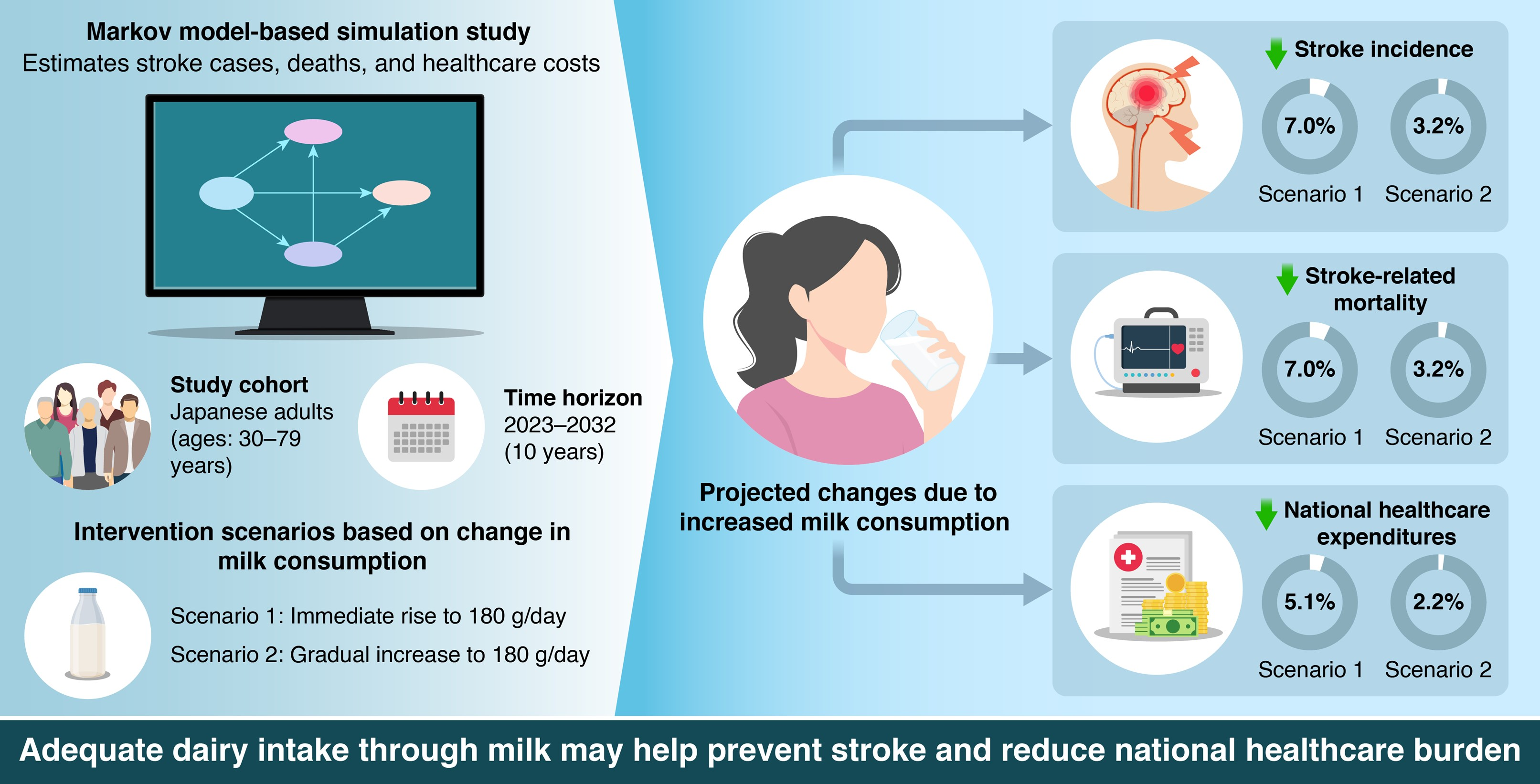
Projected Health and Economic Impacts of Achieving the Recommended Dairy Intake in Japan: A Simulation Study of Increased Milk Consumption for Stroke Prevention


Abstract
1. Introduction
2. Materials and Methods
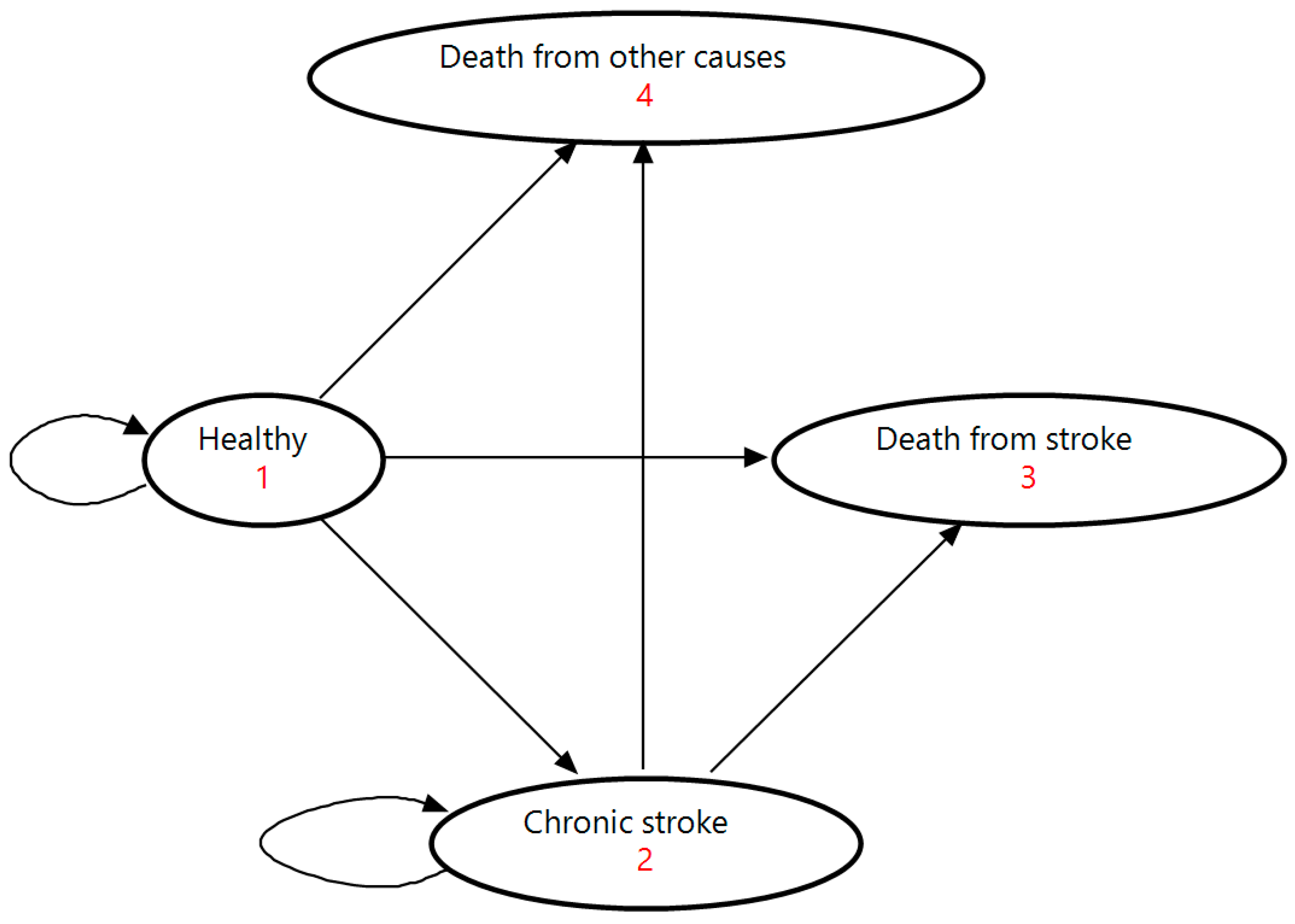
2.1. Modeling Framework
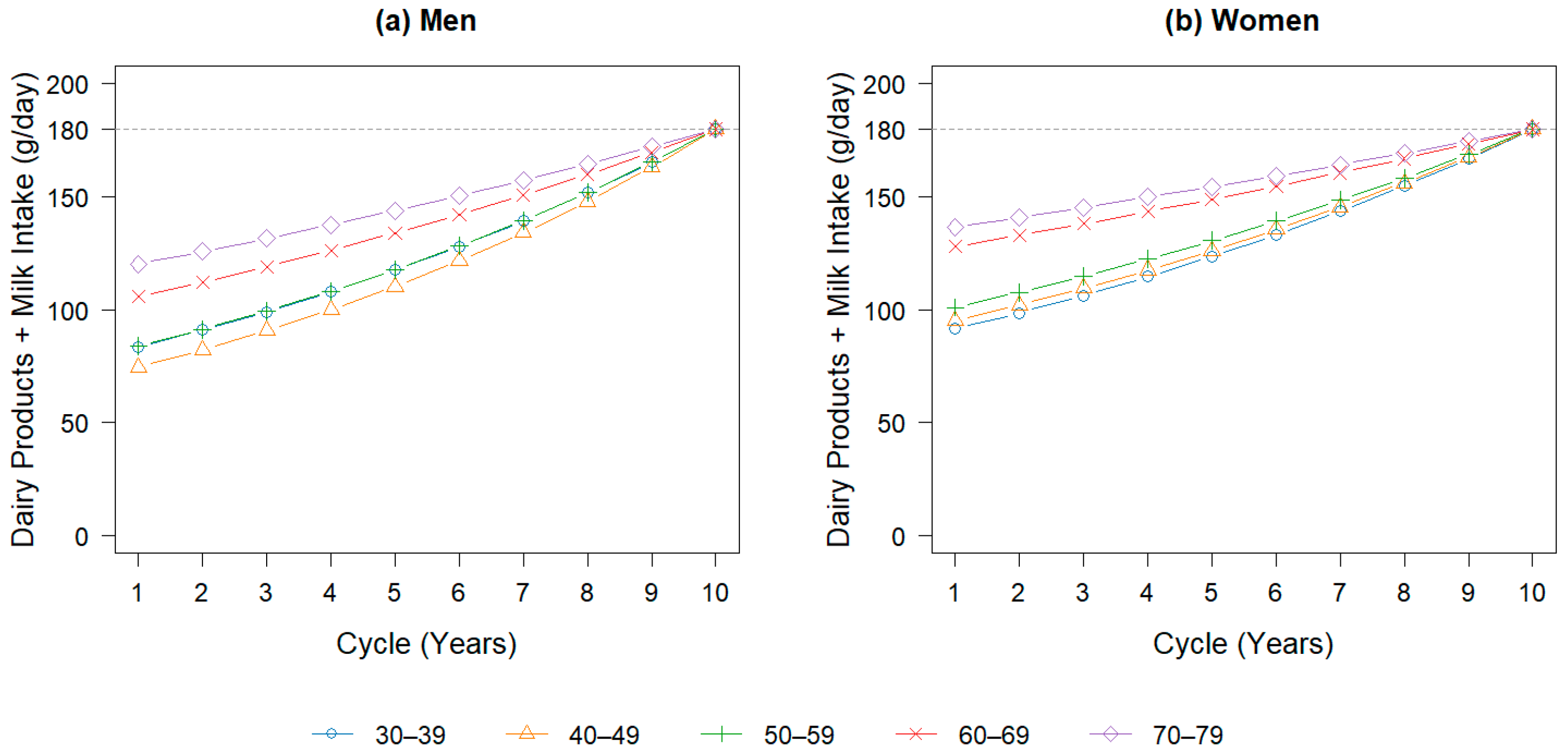
2.2. Scenarios
2.3. Input Parameters
2.4. Sensitivity Analysis
3. Results
3.1. Projected Stroke Incidence, Mortality, and NHE Under the Base-Case Scenario
3.2. Projected Stroke Cases and Mortality Under Scenarios of Increased Milk Intake to Achieve the Recommended Dairy Intake
3.3. Projected NHE Under Scenarios of Increased Milk Intake to Achieve the Recommended Dairy Intake
3.4. Sensitivity Analyses
4. Discussion
5. Conclusions
Author Contributions
Funding
Institutional Review Board Statement
Informed Consent Statement
Data Availability Statement
Acknowledgments
Conflicts of Interest
References
- Ministry of Health, Labour and Welfare. Vital Statistics. 2024. Available online: https://www.mhlw.go.jp/toukei/list/81-1.html (accessed on 30 September 2025).
- Ministry of Health, Labour and Welfare. Estimates of National Medical Care Expenditure. 2023. Available online: https://www.mhlw.go.jp/toukei/saikin/hw/k-iryohi/23/dl/R05data.pdf (accessed on 24 December 2025).
- Ministry of Health, Labour and Welfare, Japan. The Dietary Reference Intakes for Japanese. 2025. Available online: https://www.mhlw.go.jp/stf/newpage_44138.html (accessed on 24 September 2025).
- Xie, L.; Wu, W.; Chen, J.; Tu, J.; Zhou, J.; Qi, X.; Yin, X. Cholesterol levels and hemorrhagic stroke risk in East Asian versus non-East Asian populations: A systematic review and meta-analysis. Neurologist 2017, 22, 107–115. [Google Scholar] [CrossRef] [PubMed]
- Gong, X.; Chen, L.; Song, B.; Han, X.; Xu, W.; Wu, B.; Sheng, F.; Lou, M. Associations of lipid profiles with the risk of ischemic and hemorrhagic stroke: A systematic review and meta-analysis of pro-spective cohort studies. Front. Cardiovasc. Med. 2022, 9, 893248. [Google Scholar] [CrossRef]
- World Health Organization. Healthy Diet. Available online: https://www.who.int/news-room/fact-sheets/detail/healthy-diet (accessed on 30 September 2025).
- Cámara, M.; Giner, R.M.; González-Fandos, E.; López-García, E.; Mañes, J.; Portillo, M.P.; Rafecas, M.; Domínguez, L.; Martínez, J.A. Food-based dietary guidelines around the world: A comparative analysis to update AESAN Scientific Committee dietary recommendations. Nutrients 2021, 13, 3131. [Google Scholar] [CrossRef]
- Ministry of Health, Labour and Welfare. Japanese Food Guide Spinning Top. Available online: https://www.mhlw.go.jp/bunya/kenkou/eiyou-syokuji.html (accessed on 17 September 2025).
- Gijsbers, L.; Ding, E.L.; Malik, V.S.; de Goede, J.; Geleijnse, J.M.; Soedamah-Muthu, S.S. Consumption of dairy foods and diabetes incidence: A dose-response meta-analysis of observational studies. Am. J. Clin. Nutr. 2016, 103, 1111–1124. [Google Scholar] [CrossRef]
- Kim, D.; Kim, J. Dairy consumption is associated with a lower incidence of the metabolic syndrome in middle-aged and older Korean adults: The Korean Genome and Epidemiology Study (KoGES). Br. J. Nutr. 2017, 117, 148–160. [Google Scholar] [CrossRef]
- Wang, H.; Fox, C.S.; Troy, L.M.; McKeown, N.M.; Jacques, P.F. Longitudinal association of dairy consumption with the changes in blood pressure and the risk of incident hypertension: The Framingham Heart Study. Br. J. Nutr. 2015, 114, 1887–1899. [Google Scholar] [CrossRef]
- Elwood, P.C.; Givens, D.I.; Beswick, A.D.; Fehily, A.M.; Pickering, J.E.; Gallacher, J. The survival advantage of milk and dairy consumption: An overview of evidence from cohort studies of vascular diseases, diabetes and cancer. J. Am. Coll. Nutr. 2008, 27, 723s–734s. [Google Scholar] [CrossRef] [PubMed]
- de Goede, J.; Soedamah-Muthu, S.S.; Pan, A.; Gijsbers, L.; Geleijnse, J.M. Dairy consumption and risk of stroke: A systematic review and updated dose-response meta-analysis of prospective cohort studies. J. Am. Heart Assoc. 2016, 5, e002787. [Google Scholar] [CrossRef]
- Alexander, D.D.; Bylsma, L.C.; Vargas, A.J.; Cohen, S.S.; Doucette, A.; Mohamed, M.; Irvin, S.R.; Miller, P.E.; Watson, H.; Fryzek, J.P. Dairy consumption and CVD: A systematic review and meta-analysis. Br. J. Nutr. 2016, 115, 737–750. [Google Scholar] [CrossRef] [PubMed]
- Soedamah-Muthu, S.S.; de Goede, J. Dairy consumption and cardiometabolic diseases: Systematic review and updated meta-analyses of prospective cohort studies. Curr. Nutr. Rep. 2018, 7, 171–182. [Google Scholar] [CrossRef] [PubMed]
- Wang, C.; Yatsuya, H.; Lin, Y.; Sasakabe, T.; Kawai, S.; Kikuchi, S.; Iso, H.; Tamakoshi, A. A Milk intake and stroke mortality in the Japan collaborative cohort study-a Bayesian survival analysis. Nutrients 2020, 12, 2743. [Google Scholar] [CrossRef] [PubMed]
- Lu, Y.; Sugawara, Y.; Hozawa, A.; Iwasaki, M.; Sawada, N.; Kanehara, R.; Oze, I.; Ito, H.; Miyagawa, N.; Koyanagi, Y.N.; et al. Association between dairy intake and all-cause and cause-specific mortality: A pooled analysis of 0.4 million Japanese adults from 10 population-based cohort studies. Int. J. Epidemiol. 2025, 54, dyaf180. [Google Scholar] [CrossRef] [PubMed]
- Ministry of Education, Culture, Sports, Science and Technology. Standard Tables of Food Composition in Japan -2020- (Eighth Revised Edition). Available online: https://www.mext.go.jp/content/20201225-mxt_kagsei-mext_01110_011.pdf (accessed on 8 December 2025).
- Ministry of Health, Labour and Welfare. The National Health and Nutrition Survey, 2023. Available online: https://www.mhlw.go.jp/stf/seisakunitsuite/bunya/kenkou_iryou/kenkou/eiyou/r5-houkoku_00001.html (accessed on 18 September 2025).
- Jayedi, A.; Zargar, M.S. Dietary calcium intake and hypertension risk: A dose-response meta-analysis of prospective cohort studies. Eur. J. Clin. Nutr. 2019, 73, 969–978. [Google Scholar] [CrossRef]
- Larsson, S.C.; Orsini, N.; Wolk, A. Dietary calcium intake and risk of stroke: A dose-response meta-analysis. Am. J. Clin. Nutr. 2013, 97, 951–957. [Google Scholar] [CrossRef]
- Adebamowo, S.N.; Spiegelman, D.; Willett, W.C.; Rexrode, K.M. Association between intakes of magnesium, potassium, and calcium and risk of stroke: 2 cohorts of US women and updated meta-analyses. Am. J. Clin. Nutr. 2015, 101, 1269–1277. [Google Scholar] [CrossRef]
- Wang, Z.M.; Bu, X.X.; Zhou, B.; Li, Y.F.; Nie, Z.L. Dietary calcium intake and the risk of stroke: Meta-analysis of cohort studies. Nutr. Metab. Cardiovasc. Dis. 2023, 33, 934–946. [Google Scholar] [CrossRef]
- TreeAge Software, Inc. TreeAge Pro Healthcare; TreeAge Software, Inc.: Williamstown, MA, USA, 2024. [Google Scholar]
- Ministry of Health, Labour and Welfare. The National Health and Nutrition Survey, 2010. Available online: https://www.mhlw.go.jp/bunya/kenkou/eiyou/h22-houkoku.html (accessed on 18 September 2025).
- The Japan Stroke Data Bank. Assessment of Stroke Treatment in Our Country Using a Stroke Registry 2024 Report; The Japan Stroke Data Bank: Suita, Japan, 2024.
- Rumana, N.; Kita, Y.; Turin, T.C.; Nakamura, Y.; Takashima, N.; Ichikawa, M.; Sugihara, H.; Morita, Y.; Hirose, K.; Kawakami, K.; et al. Acute case-fatality rates of stroke and acute myocardial infarction in a Japanese population: Takashima stroke and AMI registry, 1989–2005. Int. J. Stroke 2014, 9, 69–75. [Google Scholar] [CrossRef]
- Takashima, N.; Arima, H.; Kita, Y.; Fujii, T.; Miyamatsu, N.; Komori, M.; Sugimoto, Y.; Nagata, S.; Miura, K.; Nozaki, K. Incidence, management and short-term outcome of stroke in a general population of 1.4 million Japanese—Shiga Stroke Registry. Circ. J. 2017, 81, 1636–1646. [Google Scholar] [CrossRef]
- Statistics Bureau of Japan. Result of the Population Estimates. Available online: https://www.stat.go.jp/english/data/jinsui/2.html (accessed on 18 September 2025).
- Institute for Health Metrics and Evaluation. Global Burden of Disease Study 2021 (GBD 2021) Results. Available online: https://vizhub.healthdata.org/gbd-results/ (accessed on 18 September 2025).
- Ministry of Health, Labour and Welfare. Survey on Medical Insurance Benefits. 2022. Available online: https://www.e-stat.go.jp/stat-search/files?page=1&layout=datalist&toukei=00450389&tstat=000001044924&cycle=0&tclass1=000001044945&tclass2=000001220980&tclass3val=0 (accessed on 24 September 2025).
- Ministry of Health, Labour and Welfare. Survey on the Trend of Medical Care Expenditures. Available online: https://www.mhlw.go.jp/topics/medias/year/23/gaiyou.html (accessed on 24 September 2025).
- International Monetary Fund. IMF Data Access to Macroeconomic & Financial Data. Available online: https://data.imf.org/?sk=388dfa60-1d26-4ade-b505-a05a558d9a42 (accessed on 18 September 2025).
- Fukuda, T.; Shiroiwa, T.; Ikeda, S.; Igarashi, A.; Akazawa, M.; Ishida, H.; Noto, S.; Saito, S.; Sakamaki, H.; Shimozuma, K.; et al. Guideline for economic evaluation of healthcare technologies in Japan. J. Natl. Inst. Public Health 2013, 62, 625–640. [Google Scholar]
- Thomopoulos, C.; Parati, G.; Zanchetti, A. Effects of blood pressure lowering on outcome incidence in hypertension: 7. Effects of more vs. less intensive blood pressure lowering and different achieved blood pressure levels—Updated overview and meta-analyses of randomized trials. J. Hypertens. 2016, 34, 613–622. [Google Scholar] [CrossRef] [PubMed]
- Ding, M.; Huang, T.; Bergholdt, H.K.; Nordestgaard, B.G.; Ellervik, C.; Qi, L.; CHARGE Consortium. Dairy consumption, systolic blood pressure, and risk of hypertension: Mendelian randomization study. BMJ 2017, 356, j1000. [Google Scholar] [CrossRef]
- Soedamah-Muthu, S.S.; Verberne, L.D.; Ding, E.L.; Engberink, M.F.; Geleijnse, J.M. Dairy consumption and incidence of hypertension: A dose-response meta-analysis of prospective cohort studies. Hypertension 2012, 60, 1131–1137. [Google Scholar] [CrossRef]
- Kawata, D.; Ueno, H.M.; Nakano, A.; Tatara, Y.; Tamada, Y.; Mikami, T.; Murashita, K.; Nakaji, S.; Itoh, K. Dairy consumption has a partial inverse association with systolic blood pressure and hypertension in populations with high salt and low dairy diets: Cross-sectional data analysis from the Iwaki Health Promotion Project. Hypertens. Res. 2025, 48, 1409–1421. [Google Scholar] [CrossRef] [PubMed]
- Cormick, G.; Ciapponi, A.; Cafferata, M.L.; Cormick, M.S.; Belizán, J.M. Calcium supplementation for prevention of primary hypertension. Cochrane Database Syst. Rev. 2022, 1, CD010037. [Google Scholar] [CrossRef] [PubMed]
- Zhang, Y.; Zhang, D.Z. Circulating parathyroid hormone and risk of hypertension: A meta-analysis. Clin. Chim. Acta 2018, 482, 40–45. [Google Scholar] [CrossRef]
- Villa-Etchegoyen, C.; Lombarte, M.; Matamoros, N.; Belizán, J.M.; Cormick, G. Mechanisms involved in the relationship between low calcium intake and high blood pressure. Nutrients 2019, 11, 1112. [Google Scholar] [CrossRef] [PubMed]
- Aburto, N.J.; Hanson, S.; Gutierrez, H.; Hooper, L.; Elliott, P.; Cappuccio, F.P. Effect of increased potassium intake on cardiovascular risk factors and disease: Systematic review and meta-analyses. BMJ 2013, 346, f1378. [Google Scholar] [CrossRef]
- Kass, L.; Weekes, J.; Carpenter, L. Effect of magnesium supplementation on blood pressure: A meta-analysis. Eur. J. Clin. Nutr. 2012, 66, 411–418. [Google Scholar] [CrossRef]
- Hidayat, K.; Du, H.Z.; Yang, J.; Chen, G.C.; Zhang, Z.; Li, Z.N.; Qin, L.Q. Effects of milk proteins on blood pressure: A meta-analysis of randomized control trials. Hypertens. Res. 2017, 40, 264–270. [Google Scholar] [CrossRef]
- Marcone, S.; Belton, O.; Fitzgerald, D.J. Milk-derived bioactive peptides and their health promoting effects: A potential role in atherosclerosis. Br. J. Clin. Pharmacol. 2017, 83, 152–162. [Google Scholar] [CrossRef]
- Mensink, R.P.; Katan, M.B. Effect of dietary fatty acids on serum lipids and lipoproteins. A meta-analysis of 27 trials. Arterioscler. Thromb. 1992, 12, 911–919. [Google Scholar] [CrossRef] [PubMed]
- Mensink, R.P.; Zock, P.L.; Kester, A.D.; Katan, M.B. Effects of dietary fatty acids and carbohydrates on the ratio of serum total to HDL cholesterol and on serum lipids and apolipoproteins: A meta-analysis of 60 controlled trials. Am. J. Clin. Nutr. 2003, 77, 1146–1155. [Google Scholar] [CrossRef]
- World Health Organization. Saturated Fatty Acid and Trans-Fatty Acid Intake for Adults and Children: WHO Guideline. Available online: https://www.who.int/publications/i/item/9789240073630 (accessed on 8 December 2025).
- Wakayama, R.; Drewnowski, A.; Horimoto, T.; Saito, Y.; Yu, T.; Suzuki, T.; Takasugi, S. Development and validation of the Meiji Nutritional Profiling System (Meiji NPS) to address dietary needs of adults and older adults in Japan. Nutrients 2024, 16, 936. [Google Scholar] [CrossRef]
- Wakayama, R.; Drewnowski, A.; Horimoto, T.; Yu, T.; Saito, Y.; Suzuki, T.; Honda, K.; Kanaya, S.; Takasugi, S. Development and validation of the Meiji Nutritional Profiling System per serving size. Nutrients 2024, 16, 2700. [Google Scholar] [CrossRef]
- Takebayashi, J.; Takimoto, H.; Okada, C.; Tousen, Y.; Ishimi, Y. Development of a nutrient profiling model for processed foods in Japan. Nutrients 2024, 16, 3026. [Google Scholar] [CrossRef] [PubMed]
- Wakayama, R.; Yu, T.; Drewnowski, A.; Takasugi, S.; Horimoto, T.; Tsutsumi, C. Development and validation of the Meiji Nutritional Profiling System for children. Front. Nutr. 2025, 12, 1611286. [Google Scholar] [CrossRef]
- Cui, R.; Iso, H.; Toyoshima, H.; Date, C.; Yamamoto, A.; Kikuchi, S.; Kondo, T.; Watanabe, Y.; Koizumi, A.; Inaba, Y.; et al. Serum total cholesterol levels and risk of mortality from stroke and coronary heart disease in Japanese: The JACC study. Atherosclerosis 2007, 194, 415–420. [Google Scholar] [CrossRef] [PubMed]
- Yamagishi, K.; Iso, H.; Kokubo, Y.; Saito, I.; Yatsuya, H.; Ishihara, J.; Inoue, M.; Tsugane, S.; JPHC Study Group. Dietary intake of saturated fatty acids and incident stroke and coronary heart disease in Japanese communities: The JPHC Study. Eur. Heart J. 2013, 34, 1225–1232. [Google Scholar] [CrossRef]
- Muto, M.; Ezaki, O. High dietary saturated fat is associated with a low risk of intracerebral hemorrhage and ischemic stroke in Japanese but not in non-Japanese: A review and meta-analysis of prospective cohort studies. J. Atheroscler. Thromb. 2018, 25, 375–392. [Google Scholar] [CrossRef]
- Kang, Z.Q.; Yang, Y.; Xiao, B. Dietary saturated fat intake and risk of stroke: Systematic review and dose-response meta-analysis of prospective cohort studies. Nutr. Metab. Cardiovasc. Dis. 2020, 30, 179–189. [Google Scholar] [CrossRef]
- FUJI KEIZAI Co., Ltd. Food Service Industry Marketing Data Book 2025; FUJI KEIZAI Co., Ltd.: Tokyo Japan, 2024. [Google Scholar]
- Ministry of Health, Labour and Welfare. Comprehensive Survey of Living Conditions. 2022. Available online: https://www.mhlw.go.jp/toukei/saikin/hw/k-tyosa/k-tyosa22/index.html (accessed on 17 September 2025).
- Niemi, M.L.; Laaksonen, R.; Kotila, M.; Waltimo, O. Quality of life 4 years after stroke. Stroke 1988, 19, 1101–1107. [Google Scholar] [CrossRef]
- Kim, E.S.; Kim, J.W.; Kang, H.J.; Bae, K.Y.; Kim, S.W.; Kim, J.T.; Park, M.S.; Cho, K.H.; Kim, J.M. Longitudinal impact of depression on quality of life in stroke patients. Psychiatry Investig. 2018, 15, 141–146. [Google Scholar] [CrossRef]
- Wu, L.; Sun, D. Meta-analysis of milk consumption and the risk of cognitive disorders. Nutrients 2016, 8, 824. [Google Scholar] [CrossRef] [PubMed]
- Amanat, S.; Dordevic, A.L.; Brodtmann, A.; Cardoso, B.R. Associations between diet and cognitive function in stroke survivors: A systematic review and meta-analysis. Adv. Nutr. 2025, 16, 100440. [Google Scholar] [CrossRef] [PubMed]
- Saito, A.; Okada, E.; Tarui, I.; Matsumoto, M.; Takimoto, H. The association between milk and dairy products consumption and nutrient intake adequacy among Japanese adults: Analysis of the 2016 National Health and Nutrition Survey. Nutrients 2019, 11, 2361. [Google Scholar] [CrossRef] [PubMed]
- Tsugane, S. Why has Japan become the world’s most long-lived country: Insights from a food and nutrition perspective. Eur. J. Clin. Nutr. 2021, 75, 921–928. [Google Scholar] [CrossRef]
- Shirota, M.; Watanabe, N.; Suzuki, M.; Kobori, M. Japanese-style diet and cardiovascular disease mortality: A systematic review and meta-analysis of prospective cohort studies. Nutrients 2022, 14, 2008. [Google Scholar] [CrossRef]
- Wakayama, R.; Araki, M.; Nakamura, M.; Ikeda, N. The cost-effectiveness of increased yogurt intake in type 2 diabetes in Japan. Nutrients 2025, 17, 2278. [Google Scholar] [CrossRef]
- Ministry of Health, Labour and Welfare. Health Japan 21 (the Third Term). Available online: https://www.mhlw.go.jp/stf/seisakunitsuite/bunya/kenkou_iryou/kenkou/kenkounippon21_00006.html (accessed on 26 September 2025).
- Kurotani, K.; Akter, S.; Kashino, I.; Goto, A.; Mizoue, T.; Noda, M.; Sasazuki, S.; Sawada, N.; Tsugane, S.; Japan Public Health Center based Prospective Study Group. Quality of diet and mortality among Japanese men and women: Japan Public Health Center based prospective study. BMJ 2016, 352, i1209. [Google Scholar] [CrossRef]
- Ishida, H. Milk, dairy products and bone health. Milk and dairy products and “Washoku”—“New washoku”. Clin. Calcium 2018, 28, 507–512. (In Japanese) [Google Scholar]



| Input Parameters | Data Sources |
|---|---|
| Total population | Population Estimates, 2024 [29] |
| Mean dairy product intake (g/day) | National Health and Nutrition Survey in Japan, 2023 [19] |
| Prevalence rates of stroke | Global Burden of Disease Study 2021 [30] |
| Incidence rates of stroke | Global Burden of Disease Study 2021 [30] |
| Mortality rates of stroke | Global Burden of Disease Study 2021 [30] |
| All-cause mortality rates | Global Burden of Disease Study 2021 [30] |
| Acute fatality rates of stroke within 28 days | Takashima Cardiovascular Disease Registration System [27] |
| Recurrence rates of stroke | Shiga Stroke Registry [28] |
| Relative risk of stroke associated with milk intake | Dose-response meta-analysis of five cohort studies in East Asian countries [13] |
| National health expenditures for inpatient and outpatient care for stroke | Survey on Medical Insurance Benefits, 2022 [31] |
| National health expenditures for prescription drugs for stroke | Survey on the Trend of Medical Care Expenditure, 2023 [32] |
| Sex, Age (Years) | Total Population [29] | Mean Dairy Product Intake [19] | Stroke Incidence [30] | Stroke Prevalence [30] | Stroke Mortality [30] | All-Cause Mortality [30] |
|---|---|---|---|---|---|---|
| No. | g/day | per 100,000 | per 100,000 | per 100,000 | per 100,000 | |
| Men | ||||||
| 30–39 | 6,798,000 | 83.5 | 42.4 (30.2–59.1) | 426.2 (379.8–479.0) | 4.1 (4.0–4.4) | 63.4 (63.0–63.8) |
| 40–49 | 8,303,000 | 74.5 | 144.8 (114.5–180.0) | 1148.8 (1015.5–1285.2) | 15.9 (15.2–16.5) | 139.5 (138.4–140.7) |
| 50–59 | 9,194,000 | 83.9 | 270.2 (208.8–335.3) | 2860.1 (2543.8–3171.6) | 36.7 (35.3–38.1) | 378.1 (374.8–381.6) |
| 60–69 | 7,292,000 | 105.7 | 398.9 (306.9–517.4) | 5464.0 (4894.2–6027.6) | 79.6 (75.6–83.1) | 1001.9 (993.7–1010.4) |
| 70–79 | 7,438,000 | 120.2 | 560.9 (424.8–724.5) | 8441.3 (7570.3–9391.0) | 226.8 (210.5–237.8) | 2708.6 (2688.5–2729.5) |
| Women | ||||||
| 30–39 | 6,469,000 | 91.4 | 26.8 (19.0–38.3) | 443.3 (396.6–492.4) | 1.8 (1.7–1.9) | 36.5 (36.1–36.8) |
| 40–49 | 8,073,000 | 95.0 | 71.8 (55.1–91.6) | 846.4 (761.8–934.7) | 6.9 (6.6–7.2) | 83.9 (83.1–84.7) |
| 50–59 | 9,084,000 | 101.0 | 127.5 (100.1–160.8) | 1709.1 (1531.9–1895.0) | 14.7 (13.9–15.4) | 195.0 (193.1–196.8) |
| 60–69 | 7,546,000 | 128.0 | 218.0 (170.9–276.6) | 3136.9 (2845.7–3417.1) | 28.1 (25.1–30.1) | 424.7 (421.1–428.2) |
| 70–79 | 8,646,000 | 136.7 | 348.1 (270.4–442.4) | 5182.2 (4701.0–5708.6) | 96.1 (78.4–106.0) | 1187.4 (1178.0–1196.6) |
| Sex, Age (Years) | Inpatient Care [31] | Outpatient Care [31] | Prescription Drugs [32] |
|---|---|---|---|
| Men | |||
| 30–39 | 38,753,773 | 5,584,819 | 8,315,682 |
| 40–49 | 179,301,284 | 21,568,832 | 29,075,266 |
| 50–59 | 399,335,567 | 55,544,773 | 65,120,487 |
| 60–69 | 644,610,740 | 103,186,945 | 110,814,964 |
| 70–79 | 1,282,319,379 | 219,073,369 | 170,304,477 |
| Women | |||
| 30–39 | 22,116,756 | 4,338,202 | 8,299,326 |
| 40–49 | 100,988,631 | 13,597,236 | 20,728,388 |
| 50–59 | 226,854,157 | 31,534,389 | 38,844,180 |
| 60–69 | 357,676,506 | 57,217,788 | 66,258,666 |
| 70–79 | 962,304,709 | 152,430,800 | 121,238,509 |
| Sex, Age (Years) | Total Population | Incidence | Deaths | National Health Expenditures | ||
|---|---|---|---|---|---|---|
| No. | No. | % | No. | % | US Dollars | |
| Men | ||||||
| 30–79 | 39,025,000 | 1,096,425 | 2.8 | 163,367 | 0.4 | 30,488,722,609 |
| 30–39 | 6,798,000 | 30,765 | 0.5 | 4584 | 0.1 | 531,362,966 |
| 40–49 | 8,303,000 | 129,832 | 1.6 | 19,345 | 0.2 | 2,349,826,649 |
| 50–59 | 9,194,000 | 259,477 | 2.8 | 38,662 | 0.4 | 5,113,721,741 |
| 60–69 | 7,292,000 | 290,769 | 4.0 | 43,325 | 0.6 | 8,053,183,579 |
| 70–79 | 7,438,000 | 385,582 | 5.2 | 57,452 | 0.8 | 14,440,627,674 |
| Women | ||||||
| 30–79 | 39,818,000 | 663,546 | 1.7 | 104,177 | 0.3 | 20,618,377,463 |
| 30–39 | 6,469,000 | 18,009 | 0.3 | 2827 | 0.0 | 341,476,045 |
| 40–49 | 8,073,000 | 60,902 | 0.8 | 9562 | 0.1 | 1,343,138,697 |
| 50–59 | 9,084,000 | 120,151 | 1.3 | 18,864 | 0.2 | 2,899,140,122 |
| 60–69 | 7,546,000 | 168,055 | 2.2 | 26,385 | 0.3 | 4,625,519,052 |
| 70–79 | 8,646,000 | 296,428 | 3.4 | 46,539 | 0.5 | 11,409,103,548 |
| Both | ||||||
| 30–79 | 78,843,000 | 1,759,971 | 2.2 | 267,544 | 0.3 | 51,107,100,072 |
| 30–39 | 13,267,000 | 48,774 | 0.4 | 7411 | 0.1 | 872,839,011 |
| 40–49 | 16,376,000 | 190,734 | 1.2 | 28,907 | 0.2 | 3,692,965,346 |
| 50–59 | 18,278,000 | 379,628 | 2.1 | 57,526 | 0.3 | 8,012,861,863 |
| 60–69 | 14,838,000 | 458,824 | 3.1 | 69,710 | 0.5 | 12,678,702,631 |
| 70–79 | 16,084,000 | 682,010 | 4.2 | 103,991 | 0.6 | 25,849,731,222 |
| Sex, Age (Years) | Prevented Incidence | Prevented Deaths | ||||||
|---|---|---|---|---|---|---|---|---|
| Scenario 1 | Scenario 2 | Scenario 1 | Scenario 2 | |||||
| No. | % | No. | % | No. | % | No. | % | |
| Men | ||||||||
| 30–79 | 85,864 | 7.8 | 38,788 | 3.5 | 12,794 | 7.8 | 5779 | 3.5 |
| 30–39 | 2974 | 9.7 | 1343 | 4.4 | 443 | 9.7 | 200 | 4.4 |
| 40–49 | 13,810 | 10.6 | 6129 | 4.7 | 2058 | 10.6 | 913 | 4.7 |
| 50–59 | 24,804 | 9.6 | 11,143 | 4.3 | 3696 | 9.6 | 1660 | 4.3 |
| 60–69 | 21,422 | 7.4 | 9827 | 3.4 | 3192 | 7.4 | 1464 | 3.4 |
| 70–79 | 22,853 | 5.9 | 10,346 | 2.7 | 3405 | 5.9 | 1542 | 2.7 |
| Women | ||||||||
| 30–79 | 37,754 | 5.7 | 17,692 | 2.7 | 5927 | 5.7 | 2778 | 2.7 |
| 30–39 | 1568 | 8.7 | 717 | 4.0 | 246 | 8.7 | 112 | 4.0 |
| 40–49 | 5155 | 8.5 | 2369 | 3.9 | 809 | 8.5 | 372 | 3.9 |
| 50–59 | 9421 | 7.8 | 4356 | 3.6 | 1479 | 7.8 | 684 | 3.6 |
| 60–69 | 8754 | 5.2 | 4163 | 2.5 | 1374 | 5.2 | 654 | 2.5 |
| 70–79 | 12,856 | 4.3 | 6087 | 2.1 | 2018 | 4.3 | 956 | 2.1 |
| Both Sexes Combined | ||||||||
| 30–79 | 123,618 | 7.0 | 56,480 | 3.2 | 18,721 | 7.0 | 8557 | 3.2 |
| 30–39 | 4542 | 9.3 | 2060 | 4.2 | 689 | 9.3 | 312 | 4.2 |
| 40–49 | 18,965 | 9.9 | 8498 | 4.5 | 2867 | 9.9 | 1285 | 4.4 |
| 50–59 | 34,225 | 9.0 | 15,499 | 4.1 | 5175 | 9.0 | 2344 | 4.1 |
| 60–69 | 30,176 | 6.6 | 13,990 | 3.0 | 4566 | 6.5 | 2118 | 3.0 |
| 70–79 | 35,709 | 5.2 | 16,433 | 2.4 | 5423 | 5.2 | 2498 | 2.4 |
| Sex, Age (Years) | Scenario 1 | Scenario 2 | ||
|---|---|---|---|---|
| US Dollars | % | US Dollars | % | |
| Men | ||||
| 30–79 | 1,742,238,244 | 5.7 | 741,423,469 | 2.4 |
| 30–39 | 38,785,976 | 7.3 | 16,315,123 | 3.1 |
| 40–49 | 199,014,089 | 8.5 | 82,312,362 | 3.5 |
| 50–59 | 382,604,309 | 7.5 | 161,045,929 | 3.1 |
| 60–69 | 453,707,570 | 5.6 | 195,909,499 | 2.4 |
| 70–79 | 668,126,299 | 4.6 | 285,840,556 | 2.0 |
| Women | ||||
| 30–79 | 855,992,218 | 4.2 | 379,210,065 | 1.8 |
| 30–39 | 19,567,855 | 5.7 | 8,314,751 | 2.4 |
| 40–49 | 86,674,332 | 6.5 | 37,282,849 | 2.8 |
| 50–59 | 176,448,756 | 6.1 | 76,786,233 | 2.6 |
| 60–69 | 182,462,822 | 3.9 | 81,732,809 | 1.8 |
| 70–79 | 390,838,452 | 3.4 | 175,093,422 | 1.5 |
| Both Sexes Combined | ||||
| 30–79 | 2,598,230,462 | 5.1 | 1,120,633,534 | 2.2 |
| 30–39 | 58,353,831 | 6.7 | 24,629,874 | 2.8 |
| 40–49 | 285,688,421 | 7.7 | 119,595,211 | 3.2 |
| 50–59 | 559,053,065 | 7.0 | 237,832,162 | 3.0 |
| 60–69 | 636,170,392 | 5.0 | 277,642,308 | 2.2 |
| 70–79 | 1,058,964,751 | 4.1 | 460,933,978 | 1.8 |
| Sex, Parameters | Scenario 1 | Scenario 2 | ||
|---|---|---|---|---|
| Lower Bound | Upper Bound | Lower Bound | Upper Bound | |
| Men | ||||
| Relative risk of stroke | 942,916,171 | 2,479,973,134 | 398,492,304 | 1,062,330,377 |
| Discount rate | 1,599,900,604 | 1,906,521,369 | 655,323,772 | 842,455,145 |
| Incidence rate of stroke | 1,696,149,208 | 1,795,435,617 | 724,567,926 | 760,797,229 |
| Prevalence rate of stroke | 1,719,279,851 | 1,769,734,143 | 732,745,071 | 751,794,530 |
| Mortality rate of stroke | 1,741,651,567 | 1,742,664,848 | 741,058,369 | 741,688,681 |
| All-cause mortality rate | 1,741,383,454 | 1,743,058,414 | 740,892,505 | 741,933,037 |
| Women | ||||
| Relative risk of stroke | 460,955,925 | 1,224,232,753 | 203,194,151 | 544,908,531 |
| Discount rate | 785,579,344 | 937,292,107 | 335,320,857 | 430,695,228 |
| Incidence rate of stroke | 835,847,059 | 880,199,392 | 371,664,343 | 388,243,339 |
| Prevalence rate of stroke | 846,802,202 | 866,607,996 | 375,680,688 | 383,279,650 |
| Mortality rate of stroke | 855,653,431 | 856,187,206 | 378,993,506 | 379,334,636 |
| All-cause mortality rate | 855,785,709 | 856,202,615 | 379,078,459 | 379,344,159 |
Disclaimer/Publisher’s Note: The statements, opinions and data contained in all publications are solely those of the individual author(s) and contributor(s) and not of MDPI and/or the editor(s). MDPI and/or the editor(s) disclaim responsibility for any injury to people or property resulting from any ideas, methods, instructions or products referred to in the content. |
© 2026 by the authors. Licensee MDPI, Basel, Switzerland. This article is an open access article distributed under the terms and conditions of the Creative Commons Attribution (CC BY) license.
Share and Cite
Wakayama, R.; Araki, M.; Nakamura, M.; Ikeda, N. Projected Health and Economic Impacts of Achieving the Recommended Dairy Intake in Japan: A Simulation Study of Increased Milk Consumption for Stroke Prevention. Nutrients 2026, 18, 906. https://doi.org/10.3390/nu18060906
Wakayama R, Araki M, Nakamura M, Ikeda N. Projected Health and Economic Impacts of Achieving the Recommended Dairy Intake in Japan: A Simulation Study of Increased Milk Consumption for Stroke Prevention. Nutrients. 2026; 18(6):906. https://doi.org/10.3390/nu18060906
Chicago/Turabian StyleWakayama, Ryota, Michihiro Araki, Mieko Nakamura, and Nayu Ikeda. 2026. "Projected Health and Economic Impacts of Achieving the Recommended Dairy Intake in Japan: A Simulation Study of Increased Milk Consumption for Stroke Prevention" Nutrients 18, no. 6: 906. https://doi.org/10.3390/nu18060906
APA StyleWakayama, R., Araki, M., Nakamura, M., & Ikeda, N. (2026). Projected Health and Economic Impacts of Achieving the Recommended Dairy Intake in Japan: A Simulation Study of Increased Milk Consumption for Stroke Prevention. Nutrients, 18(6), 906. https://doi.org/10.3390/nu18060906