Suboptimal Vitamin D Status Is Associated with Salmonella Infection and Elevated C-Reactive Protein in Hospitalized Children with Acute Gastroenteritis: A Retrospective Cohort Study

 , ,
, ,
Abstract
1. Introduction
2. Materials and Methods
2.1. Study Design and Population
2.2. Data Collection and Outcome Definitions
2.3. Statistical Analysis
2.4. Sample Size and Power Considerations
3. Results
3.1. Demographic Characteristics and Prevalence of Vitamin D Status
3.2. Clinical Outcomes Stratified by Vitamin D Status
3.3. Association Between Vitamin D Status and Salmonella Infection
3.4. Impact of Vitamin D Status on Systemic Inflammation
4. Discussion
4.1. Suboptimal Vitamin D Status and Salmonella Susceptibility
4.2. Threshold-Dependent Regulation of Systemic Inflammation
4.3. Strengths and Limitations
5. Conclusions
Supplementary Materials
Author Contributions
Funding
Institutional Review Board Statement
Informed Consent Statement
Data Availability Statement
Acknowledgments
Conflicts of Interest
Abbreviations
References
- Parashar, U.D.; Bresee, J.S.; Glass, R.I. The Global Burden of Diarrhoeal Disease in Children. Bull. World Health Organ. 2003, 81, 236. [Google Scholar] [PubMed]
- Marchello, C.S.; Birkhold, M.; Crump, J.A. Vacc-iNTS consortium collaborators Complications and Mortality of Non-Typhoidal Salmonella Invasive Disease: A Global Systematic Review and Meta-Analysis. Lancet Infect. Dis. 2022, 22, 692–705. [Google Scholar] [CrossRef]
- Majowicz, S.E.; Musto, J.; Scallan, E.; Angulo, F.J.; Kirk, M.; O’Brien, S.J.; Jones, T.F.; Fazil, A.; Hoekstra, R.M. International Collaboration on Enteric Disease “Burden of Illness” Studies The Global Burden of Nontyphoidal Salmonella Gastroenteritis. Clin. Infect. Dis. 2010, 50, 882–889. [Google Scholar] [CrossRef]
- Tseng, C.-F.; Chiu, N.-C.; Huang, C.-Y.; Huang, D.T.-N.; Chang, L.; Kung, Y.-H.; Huang, F.-Y.; Chi, H. The Epidemiology of Non-Typhoidal Salmonella Gastroenteritis and Campylobacter Gastroenteritis in Pediatric Inpatients in Northern Taiwan. J. Microbiol. Immunol. Infect. 2019, 52, 449–455. [Google Scholar] [CrossRef]
- Lan, W.-T.; Lee, H.-C.; Yeung, C.-Y.; Jiang, C.-B.; Kao, H.-A.; Hung, H.-Y.; Chiu, N.-C. Concomitant Rotavirus and Salmonella Infections in Children with Acute Diarrhea. Pediatr. Neonatol. 2009, 50, 8–12. [Google Scholar] [CrossRef] [PubMed][Green Version]
- Chung, N.; Wang, S.-M.; Shen, C.-F.; Kuo, F.-C.; Ho, T.-S.; Hsiung, C.A.; Mu, J.-J.; Wu, F.-T.; Huang, L.-M.; Huang, Y.-C.; et al. Clinical and Epidemiological Characteristics in Hospitalized Young Children with Acute Gastroenteritis in Southern Taiwan: According to Major Pathogens. J. Microbiol. Immunol. Infect. 2017, 50, 915–922. [Google Scholar] [CrossRef]
- Lee, C.-M.; Lee, M.-S.; Yang, T.-L.; Lee, K.-L.; Yen, T.-Y.; Lu, C.-Y.; Hsueh, P.-R.; Lee, P.-I.; Chen, J.-M.; Huang, L.-M.; et al. Clinical Features and Risk Factors Associated with Bacteremia of Nontyphoidal Salmonellosis in Pediatric Patients, 2010–2018. J. Formos. Med. Assoc. 2021, 120, 196–203. [Google Scholar] [CrossRef]
- Neurath, M.F.; Artis, D.; Becker, C. The Intestinal Barrier: A Pivotal Role in Health, Inflammation, and Cancer. Lancet Gastroenterol. Hepatol. 2025, 10, 573–592. [Google Scholar] [CrossRef] [PubMed]
- Sun, J. Vitamin D and Mucosal Immune Function. Curr. Opin. Gastroenterol. 2010, 26, 591–595. [Google Scholar] [CrossRef]
- Wang, T.-T.; Nestel, F.P.; Bourdeau, V.; Nagai, Y.; Wang, Q.; Liao, J.; Tavera-Mendoza, L.; Lin, R.; Hanrahan, J.W.; Mader, S.; et al. Cutting Edge: 1,25-Dihydroxyvitamin D3 Is a Direct Inducer of Antimicrobial Peptide Gene Expression. J. Immunol. 2004, 173, 2909–2912. [Google Scholar] [CrossRef]
- Gubatan, J.; Holman, D.R.; Puntasecca, C.J.; Polevoi, D.; Rubin, S.J.; Rogalla, S. Antimicrobial Peptides and the Gut Microbiome in Inflammatory Bowel Disease. World J. Gastroenterol. 2021, 27, 7402–7422. [Google Scholar] [CrossRef]
- Suzuki, T. Regulation of the Intestinal Barrier by Nutrients: The Role of Tight Junctions. Anim. Sci. J. 2020, 91, e13357. [Google Scholar] [CrossRef]
- Yeung, C.-Y.; Chiang Chiau, J.-S.; Cheng, M.-L.; Chan, W.-T.; Jiang, C.-B.; Chang, S.-W.; Liu, C.-Y.; Chang, C.-W.; Lee, H.-C. Effects of Vitamin D-Deficient Diet on Intestinal Epithelial Integrity and Zonulin Expression in a C57BL/6 Mouse Model. Front. Med. 2021, 8, 649818. [Google Scholar] [CrossRef]
- Lazarus, G.; Putra, I.G.N.S.; Junaidi, M.C.; Oswari, J.S.; Oswari, H. The Relationship of Vitamin D Deficiency and Childhood Diarrhea: A Systematic Review and Meta-Analysis. BMC Pediatr. 2024, 24, 125. [Google Scholar] [CrossRef] [PubMed]
- Talachian, E.; Bidari, A.; Noorbakhsh, S.; Tabatabaei, A.; Salari, F. Serum Levels of Vitamins A and D, and Zinc in Children with Acute Diarrhea: A Cross-Sectional Study. Med. J. Islam. Repub. Iran. 2015, 29, 207. [Google Scholar]
- Uwaezuoke, S.N.; Odimegwu, C.L.; Mbanefo, N.R.; Eneh, C.I.; Arodiwe, I.O.; Muoneke, U.V.; Ogbuka, F.N.; Ndiokwelu, C.O.; Akwue, A.T. Vitamin D3 Supplementation as an Adjunct in the Management of Childhood Infectious Diarrhea: A Systematic Review. BMC Infect. Dis. 2023, 23, 159. [Google Scholar] [CrossRef]
- Aluisio, A.R.; Maroof, Z.; Chandramohan, D.; Bruce, J.; Mughal, M.Z.; Bhutta, Z.; Walraven, G.; Masher, M.I.; Ensink, J.H.J.; Manaseki-Holland, S. Vitamin D3supplementation and Childhood Diarrhea: A Randomized Controlled Trial. Pediatrics 2013, 132, e832–e840. [Google Scholar] [CrossRef]
- Mazidi, M.; Rezaie, P.; Vatanparast, H. Impact of Vitamin D Supplementation on C-Reactive Protein; a Systematic Review and Meta-Analysis of Randomized Controlled Trials. BMC Nutr. 2018, 4, 1. [Google Scholar] [CrossRef] [PubMed]
- Silva, M.C.; Furlanetto, T.W. Does Serum 25-Hydroxyvitamin D Decrease during Acute-Phase Response? A Systematic Review. Nutr. Res. 2015, 35, 91–96. [Google Scholar] [CrossRef] [PubMed]
- Zhou, A.; Hyppönen, E. Vitamin D Deficiency and C-Reactive Protein: A Bidirectional Mendelian Randomization Study. Int. J. Epidemiol. 2023, 52, 260–271. [Google Scholar] [CrossRef]
- Holick, M.F.; Binkley, N.C.; Bischoff-Ferrari, H.A.; Gordon, C.M.; Hanley, D.A.; Heaney, R.P.; Murad, M.H.; Weaver, C.M. Endocrine Society Evaluation, Treatment, and Prevention of Vitamin D Deficiency: An Endocrine Society Clinical Practice Guideline. J. Clin. Endocrinol. Metab. 2011, 96, 1911–1930. [Google Scholar] [CrossRef] [PubMed]
- Yang, L.; Fang, Y.; Zheng, J.; Zhu, Q.; Tang, L.; Xiong, F. Correlation between Serum Vitamin D Level and Acute Invasive Enteritis in Children. Immun. Inflamm. Dis. 2024, 12, e70024. [Google Scholar] [CrossRef]
- Huang, F.-C. Vitamin D Differentially Regulates Salmonella-Induced Intestine Epithelial Autophagy and Interleukin-1β Expression. World J. Gastroenterol. 2016, 22, 10353–10363. [Google Scholar] [CrossRef]
- Huang, F.-C.; Huang, S.-C. Active Vitamin D3 Attenuates the Severity of Salmonella Colitis in Mice by Orchestrating Innate Immunity. Immun. Inflamm. Dis. 2021, 9, 481–491. [Google Scholar] [CrossRef]
- Assa, A.; Vong, L.; Pinnell, L.J.; Avitzur, N.; Johnson-Henry, K.C.; Sherman, P.M. Vitamin D Deficiency Promotes Epithelial Barrier Dysfunction and Intestinal Inflammation. J. Infect. Dis. 2014, 210, 1296–1305. [Google Scholar] [CrossRef] [PubMed]
- Wu, S.; Liao, A.P.; Xia, Y.; Li, Y.C.; Li, J.-D.; Sartor, R.B.; Sun, J. Vitamin D Receptor Negatively Regulates Bacterial-Stimulated NF-kappaB Activity in Intestine. Am. J. Pathol. 2010, 177, 686–697. [Google Scholar] [CrossRef] [PubMed]



| Variable | Total (N = 70) | 25(OH)D ≥ 30 ng/mL (n = 25) | 25(OH)D < 30 ng/mL (n = 45) | p |
|---|---|---|---|---|
| Age (years), Median (IQR) | 2.00 (1.75–5.00) | 2.00 (1.50–3.00) | 3.00 (1.50–6.00) | 0.259 |
| Male, n (%) | 39 (55.7%) | 16 (64.0%) | 23 (51.1%) | 0.298 |
| Length of stay (LOS), Median (IQR) | 5.00 (4.00–6.00) | 5.00 (4.00–5.50) | 5.00 (4.00–6.00) | 0.372 |
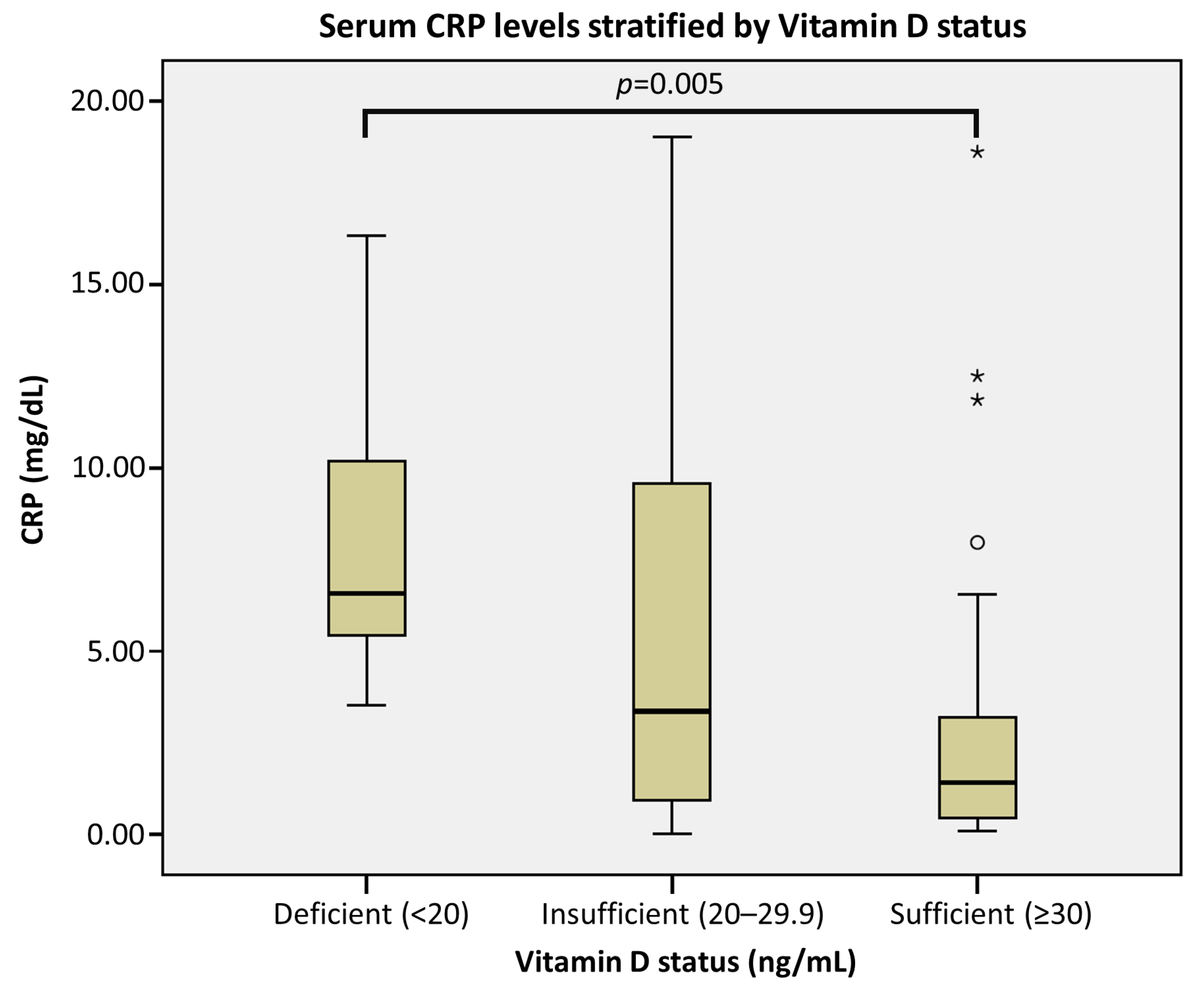
| CRP (mg/dL), Median (IQR) | 3.13 (0.95–7.65) | 1.42 (0.43–4.05) | 3.84 (1.05–9.93) | 0.025 * |
| Visible Bloody Stool, n (%) | 44 (62.9%) | 12 (48.0%) | 32 (71.1%) | 0.073 |
| Culture-confirmed Salmonella, n (%) | 28 (40.0%) | 6 (24.0%) | 22 (48.9%) | 0.047 * |
| Univariate Analysis | Multivariable Analysis † | |||
|---|---|---|---|---|
| Variable | OR (95% CI) | p | aOR (95% CI) | p |
| Suboptimal 25(OH)D (<30 ng/mL) | 3.03 (1.02–8.99) | 0.046 * | 3.11 (1.00–9.67) | 0.051 |
| Age (years, per 1-year increase) | 0.96 (0.84–1.11) | 0.590 | 0.94 (0.81–1.09) | 0.431 |
| Sex, male | 0.42 (0.16–1.11) | 0.080 | 0.46 (0.17–1.27) | 0.136 |
| Visible bloody stool, yes ‡ | 2.48 (0.87–7.08) | 0.090 | — | — |
| Hospital Length of stay (days, per 1-day increase) ‡ | 1.2 (0.98–1.46) | 0.081 | — | — |
| Model 1 | Model 2 | Model 3 | Model 4 | ||
|---|---|---|---|---|---|
| Analysis Type | Univariate | Multivariable † | Multivariable † | Multivariable † | |
| 25(OH)D specification | Continuous | Continuous | Categorical (<30 vs. ≥30) | Categorical (<20 vs. ≥20) | |
| Variables | |||||
| 25(OH)D | B (95% CI) | −0.060 (−0.101 to −0.018) | −0.050 (−0.093 to −0.006) | 0.647 (−0.109 to 1.404) | 1.249 (0.287 to 2.212) |
| exp(B) (95% CI) | 0.94 (0.90–0.98) | 0.95 (0.91–0.99) | 1.91 (0.90–4.07) | 3.49 (1.33–9.13) | |
| p | 0.006 ** | 0.026 * | 0.092 | 0.012 * | |
| Age (years) | B (95% CI) | — | 0.081 (−0.022 to 0.184) | 0.097 (−0.005 to 0.200) | 0.092 (−0.007 to 0.191) |
| p | — | 0.119 | 0.063 | 0.069 | |
| Sex, male | B (95% CI) | — | −0.127 (−0.837 to 0.583) | −0.155 (−0.876 to 0.566) | −0.148 (−0.847 to 0.551) |
| p | — | 0.722 | 0.669 | 0.674 | |
Disclaimer/Publisher’s Note: The statements, opinions and data contained in all publications are solely those of the individual author(s) and contributor(s) and not of MDPI and/or the editor(s). MDPI and/or the editor(s) disclaim responsibility for any injury to people or property resulting from any ideas, methods, instructions or products referred to in the content. |
© 2026 by the authors. Licensee MDPI, Basel, Switzerland. This article is an open access article distributed under the terms and conditions of the Creative Commons Attribution (CC BY) license.
Share and Cite
Hung, H.-H.; Lee, H.-C.; Yeung, C.-Y.; Chan, W.-T.; Chang, S.-W.; Sun, F.-J.; Jiang, C.-B. Suboptimal Vitamin D Status Is Associated with Salmonella Infection and Elevated C-Reactive Protein in Hospitalized Children with Acute Gastroenteritis: A Retrospective Cohort Study. Nutrients 2026, 18, 827. https://doi.org/10.3390/nu18050827
Hung H-H, Lee H-C, Yeung C-Y, Chan W-T, Chang S-W, Sun F-J, Jiang C-B. Suboptimal Vitamin D Status Is Associated with Salmonella Infection and Elevated C-Reactive Protein in Hospitalized Children with Acute Gastroenteritis: A Retrospective Cohort Study. Nutrients. 2026; 18(5):827. https://doi.org/10.3390/nu18050827
Chicago/Turabian StyleHung, Hua-Hsi, Hung-Chang Lee, Chun-Yan Yeung, Wai-Tao Chan, Szu-Wen Chang, Fang-Ju Sun, and Chuen-Bin Jiang. 2026. "Suboptimal Vitamin D Status Is Associated with Salmonella Infection and Elevated C-Reactive Protein in Hospitalized Children with Acute Gastroenteritis: A Retrospective Cohort Study" Nutrients 18, no. 5: 827. https://doi.org/10.3390/nu18050827
APA StyleHung, H.-H., Lee, H.-C., Yeung, C.-Y., Chan, W.-T., Chang, S.-W., Sun, F.-J., & Jiang, C.-B. (2026). Suboptimal Vitamin D Status Is Associated with Salmonella Infection and Elevated C-Reactive Protein in Hospitalized Children with Acute Gastroenteritis: A Retrospective Cohort Study. Nutrients, 18(5), 827. https://doi.org/10.3390/nu18050827