Propolis in Obesity and Related Metabolic Disorders: Mechanistic and Clinical Insights—A Scoping Review

Abstract
1. Introduction
2. Methods
3. Biochemical Composition and Key Bioactive Constituents of Propolis
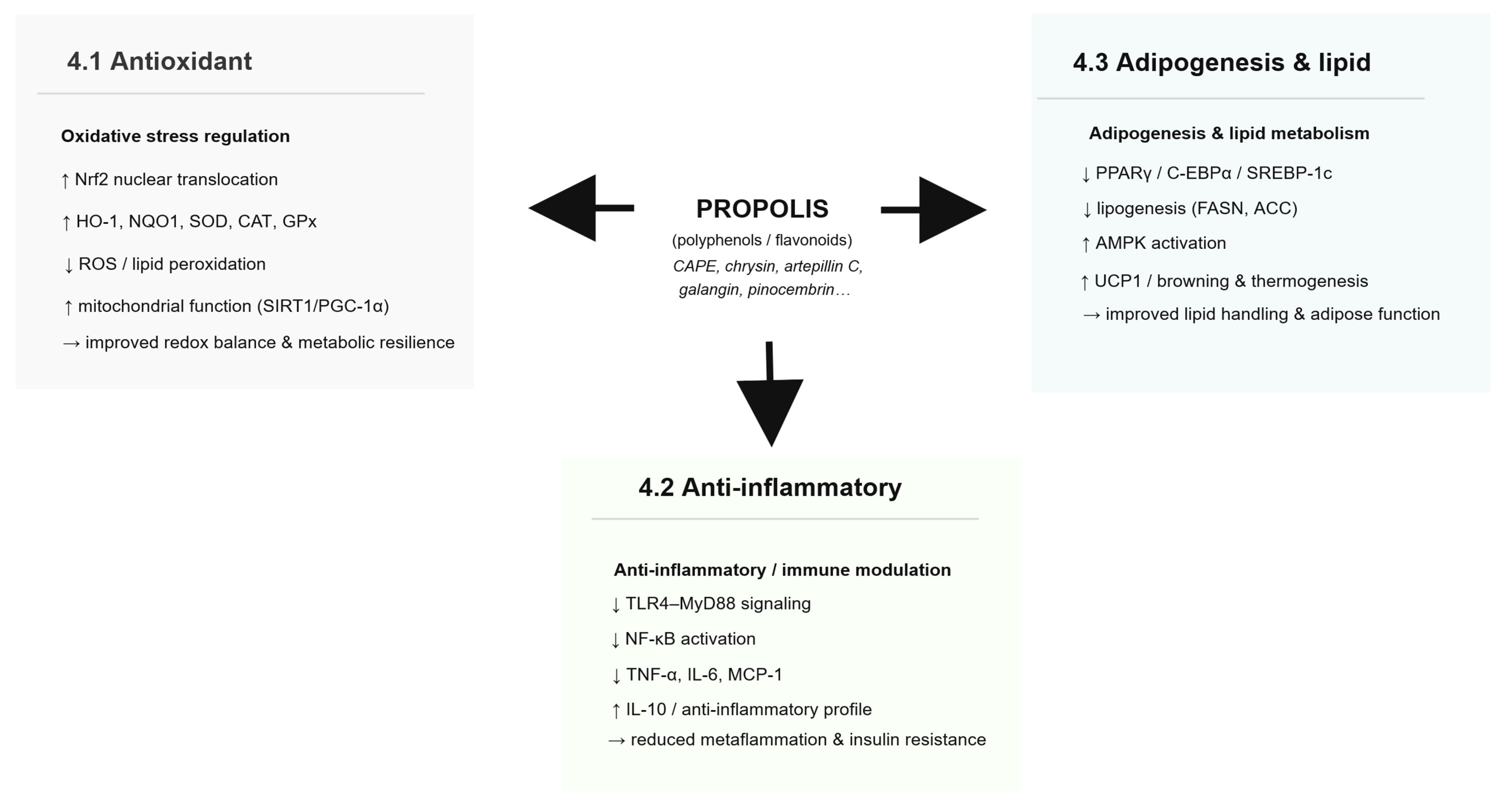
4. Therapeutic Mechanisms of Propolis Relevant to Obesity
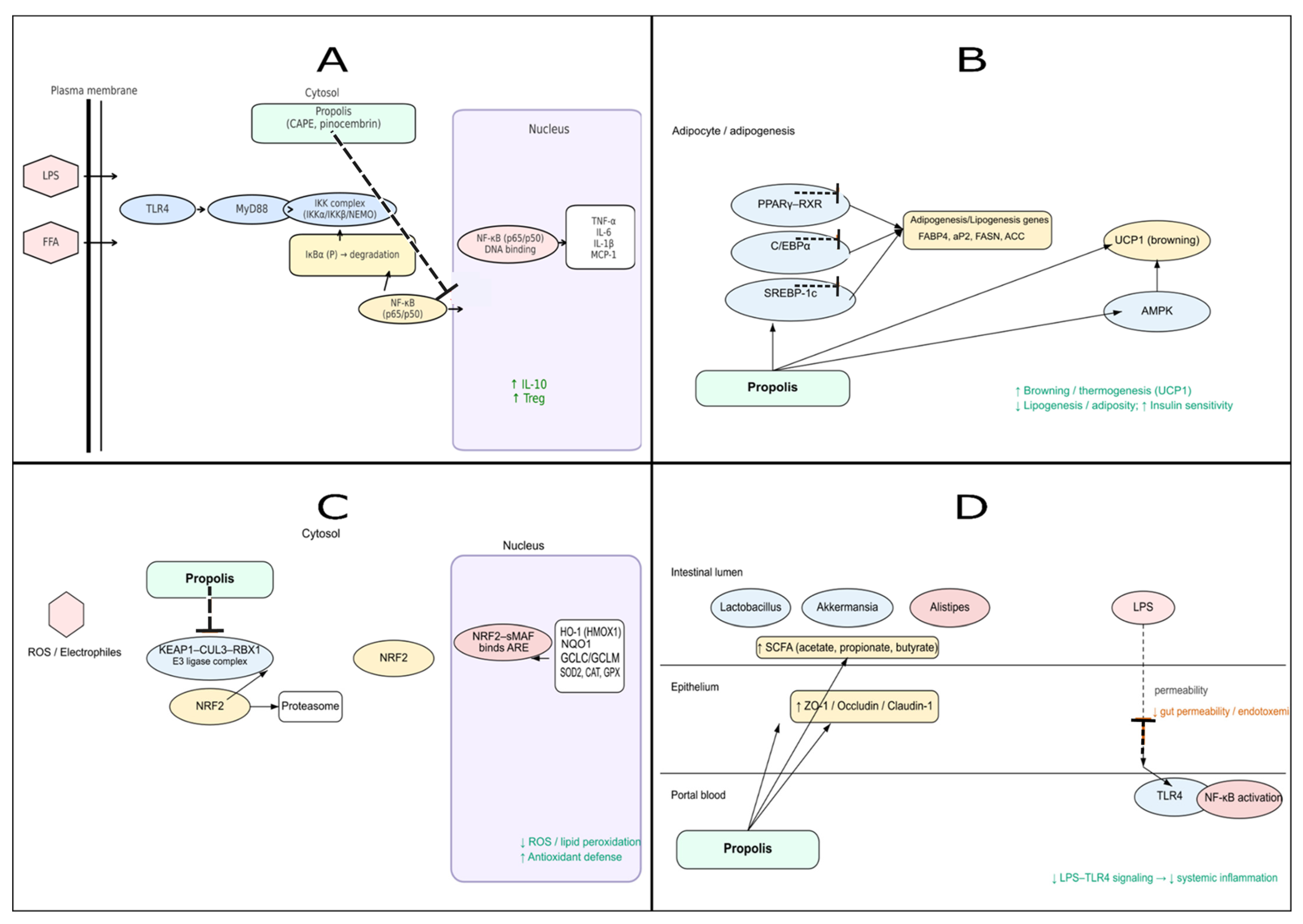
- (A).
- NF-κB–mediated inflammatory signaling: Propolis is proposed to attenuate TLR4/MyD88-dependent NF-κB activation, which may reduce downstream expression of pro-inflammatory cytokines (TNF-α, IL-6, IL-1β, MCP-1) and may promote anti-inflammatory mediators (e.g., upregulation of IL-10 and Treg).
- (B).
- Adipogenesis and lipid metabolism: Propolis may modulate transcriptional regulators of adipocyte differentiation (PPARγ–RXR, C/EBPα, SREBP-1c) and downstream adipogenic/lipogenic genes (FABP4, aP2, FASN, ACC), while potentially activating AMPK and UCP1. Collectively, these effects may contribute to enhanced browning/thermogenesis, reduced lipogenesis, and improved insulin sensitivity.
- (C).
- Nrf2-driven antioxidant response: Propolis may interfere with KEAP1-mediated degradation of Nrf2, thereby facilitating nuclear translocation and activation of ARE-dependent antioxidant genes (HO-1, NQO1, SOD, CAT, GPx). These mechanisms may reduce ROS and lipid peroxidation and support restoration of redox balance.
- (D).
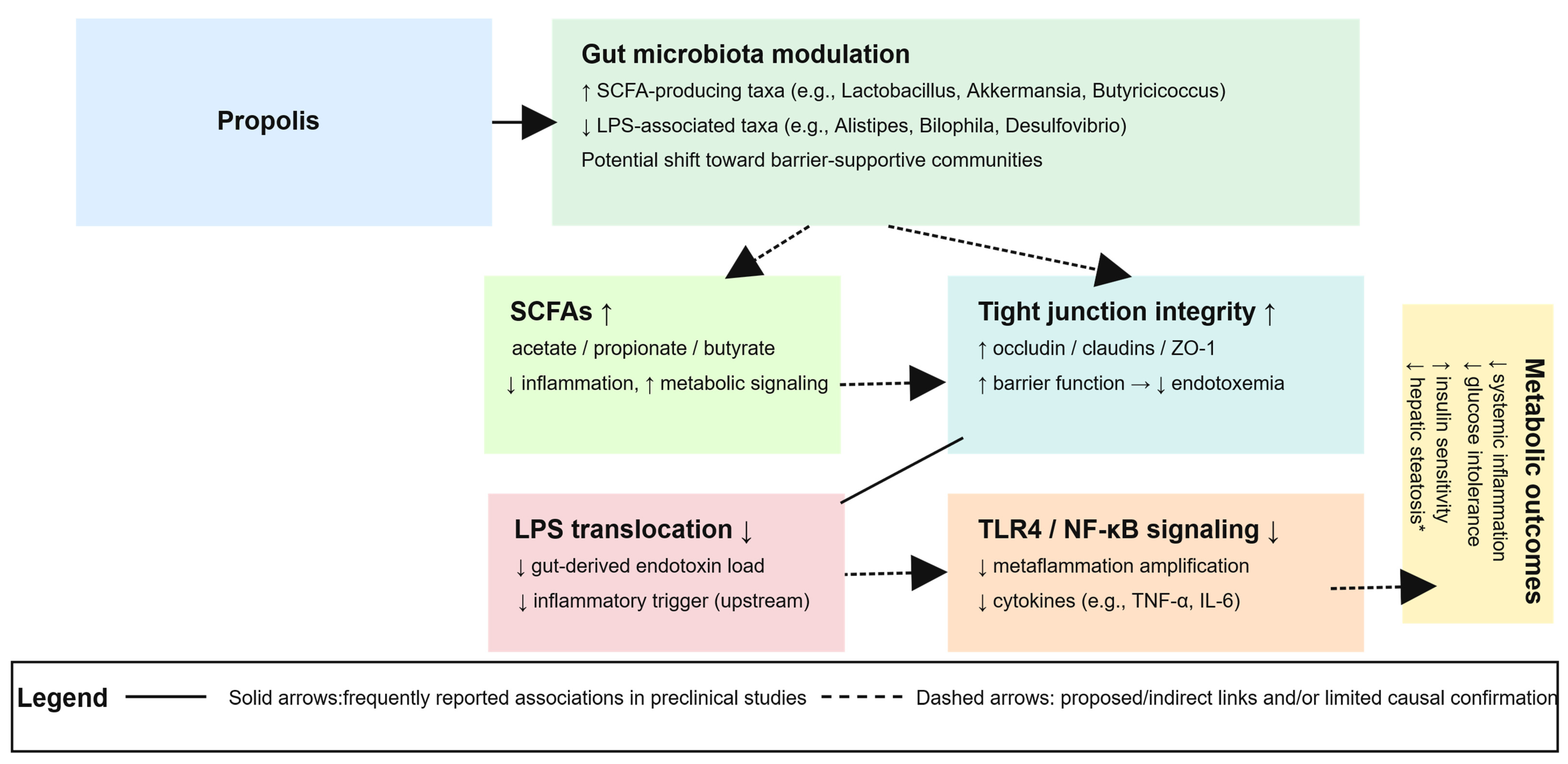
- Gut microbiota and barrier integrity: Propolis may promote beneficial microbes (e.g., Lactobacillus, Akkermansia) and short-chain fatty acid production, while potentially reducing inflammation-associated taxa (e.g., Alistipes). These changes may enhance epithelial barrier proteins (ZO-1, Occludin, Claudin-1), reduce intestinal permeability/endotoxemia, and attenuate systemic inflammation via downregulation of LPS–TLR4 signaling.
4.1. Antioxidant Mechanisms and Oxidative Stress Regulation
4.1.1. In Vitro Findings
4.1.2. In Vivo Findings
4.1.3. Clinical Findings
4.2. Anti-Inflammatory Mechanisms and Immune Modulation
4.2.1. In Vitro Findings
4.2.2. In Vivo Findings
4.2.3. Clinical Findings
4.3. Adipogenesis and Lipid Metabolism Homeostasis
4.3.1. In Vitro Findings
4.3.2. In Vivo Findings
4.3.3. Clinical Findings
4.4. Gut-Microbiota Interactions
4.4.1. In Vitro Findings
4.4.2. In Vivo Findings
4.4.3. Clinical Findings
5. Propolis in Obesity-Linked Chronic Diseases: Evidence from Experimental and Clinical Studies
5.1. Obesity
5.2. Diabetes Mellitus
5.3. Metabolic Syndrome
5.4. Non-Alcoholic Fatty Liver Disease
6. Conclusions
Supplementary Materials
Author Contributions
Funding
Institutional Review Board Statement
Informed Consent Statement
Data Availability Statement
Acknowledgments
Conflicts of Interest
References
- World Health Organization (WHO). One in Eight People Are Now Living with Obesity. Available online: https://www.who.int/news/item/01-03-2024-one-in-eight-people-are-now-living-with-obesity (accessed on 16 April 2025).
- Hay, S.I. Global, regional, and national prevalence of adult overweight and obesity, 1990–2021, with forecasts to 2050: A forecasting study for the global burden of disease study 2021. Lancet 2025, 405, 813–838. [Google Scholar] [CrossRef] [PubMed]
- Kloock, S.; Ziegler, C.G.; Dischinger, U. Obesity and its comorbidities, current treatment options and future perspectives: Challenging bariatric surgery? Pharmacol. Ther. 2023, 251, 108549. [Google Scholar] [CrossRef] [PubMed]
- Aruwa, C.E.; Sabiu, S. Adipose tissue inflammation linked to obesity: A review of current understanding, therapies and relevance of phyto-therapeutics. Heliyon 2024, 10, e23114. [Google Scholar] [CrossRef] [PubMed]
- Ahmad, B.; Friar, E.P.; Vohra, M.S.; Garrett, M.D.; Serpell, C.J.; Fong, I.L.; Wong, E.H. Mechanisms of action for the anti-obesogenic activities of phytochemicals. Phytochemistry 2020, 180, 112513. [Google Scholar] [CrossRef]
- Galassetti, P. Inflammation and Oxidative Stress in Obesity, Metabolic Syndrome, and Diabetes. Exp. Diabetes Res. 2012, 2012, 943706. [Google Scholar] [CrossRef]
- McArdle, M.A.; Finucane, O.M.; Connaughton, R.M.; McMorrow, A.M.; Roche, H.M. Mechanisms of obesity-induced inflammation and insulin resistance: Insights into the emerging role of nutritional strategies. Front. Endocrinol. 2013, 4, 52. [Google Scholar] [CrossRef]
- Apovian, C.M. Obesity: Definition, Comorbidities, Causes, and Burden. Am. J. Manag. Care 2016, 22, 176–185. [Google Scholar]
- Kumar, M.; Kaushik, D.; Kaur, J.; Proestos, C.; Oz, F.; Oz, E.; Gupta, P.; Kundu, P.; Kaur, A.; Anisha, A.; et al. A critical review on obesity: Herbal approach, bioactive compounds, and their mechanism. Appl. Sci. 2022, 12, 8342. [Google Scholar] [CrossRef]
- Ramírez-Moreno, E.; Arias-Rico, J.; Jiménez-Sánchez, R.C.; Estrada-Luna, D.; Jiménez-Osorio, A.S.; Zafra-Rojas, Q.Y.; Ariza-Ortega, J.A.; Flores-Chávez, O.R.; Morales-Castillejos, L.; Sandoval-Gallegos, E.M. Role of Bioactive compounds in obesity: Metabolic mechanism focused on inflammation. Foods 2022, 11, 1232. [Google Scholar] [CrossRef]
- Suran, J.; Cepanec, I.; Masek, T.; Radic, B.; Radic, S.; Gajger, I.T.; Vlainic, J. Propolis extract and its bioactive compounds-from traditional to modern extraction technologies. Molecules 2021, 26, 2930. [Google Scholar] [CrossRef]
- Zhu, L.; Zhang, J.; Yang, H.; Li, G.; Li, H.; Deng, Z.; Zhang, B. Propolis polyphenols: A review on the composition and anti-obesity mechanism of different types of propolis polyphenols. Front. Nutr. 2023, 10, 1066789. [Google Scholar] [CrossRef] [PubMed]
- Zullkiflee, N.; Taha, H.; Usman, A. Propolis: Its role and efficacy in human health and diseases. Molecules 2022, 27, 6120. [Google Scholar] [CrossRef] [PubMed]
- Zulhendri, F.; Lesmana, R.; Tandean, S.; Christoper, A.; Chandrasekaran, K.; Irsyam, I.; Suwantika, A.A.; Abdulah, R.; Wathoni, N. Recent update on the anti-inflammatory activities of propolis. Molecules 2022, 27, 8473. [Google Scholar] [CrossRef] [PubMed]
- Almuhayawi, M.S. Propolis as a novel antibacterial agent. Saudi J. Biol. Sci. 2020, 27, 3079–3086. [Google Scholar] [CrossRef]
- Touzani, S.; Embaslat, W.; Imtara, H.; Kmail, A.; Kadan, S.; Zaid, H.; ElArabi, I.; Badiaa, L.; Saad, B. Evaluation of the potential use of propolis as a multitarget therapeutic product: Physicochemical properties, chemical composition, and immunomodulatory, antibacterial and anticancer properties. Biomed Res. Int. 2019, 2019, 4836378. [Google Scholar] [CrossRef]
- Goncalves, V.C.; Fonseca, V.S.D.; Faria, D.D.; Izidoro, M.A.; Berretta, A.A.; Almeida, A.C.G.D.; Fonseca, F.L.A.; Scorza, F.A.; Scorza, C.A. Propolis induces cardiac metabolism changes in 6-hydroxydopamine animal model: A dietary intervention as a potential cardioprotective approach in parkinson’s disease. Front. Pharmacol. 2022, 13, 1013703. [Google Scholar] [CrossRef]
- El-Kersh, D.M.; Abou El-Ezz, R.F.; Ramadan, E.; El-kased, R.F. In Vitro and in vivo burn healing study of standardized propolis: Unveiling its antibacterial, antioxidant and anti-inflammatory actions in relation to its phytochemical profiling. PLoS ONE 2024, 19, e0302795. [Google Scholar] [CrossRef]
- Barber, T.M.; Kabisch, S.; Randeva, H.S.; Pfeiffer, A.F.H.; Weickert, M.O. Implications of resveratrol in obesity and insulin resistance: A state-of-the-art review. Nutrients 2022, 14, 2870. [Google Scholar] [CrossRef]
- Casanova, E.; Salvadó, J.; Crescenti, A.; Gibert-Ramos, A. Epigallocatechin gallate modulates muscle homeostasis in type 2 diabetes and obesity by targeting energetic and redox pathways: A narrative review. Int. J. Mol. Sci. 2019, 20, 532. [Google Scholar] [CrossRef]
- Farhat, G.; Drummond, S.; Al-Dujaili, E.A.S. Polyphenols and Their role in obesity management: A systematic review of randomized clinical trials. Phytother. Res. 2017, 31, 1005–1018. [Google Scholar] [CrossRef]
- Mehta, J.; Rayalam, S.; Wang, X.Y. Cytoprotective Effects of natural compounds against oxidative stress. Antioxidants 2018, 7, 147. [Google Scholar] [CrossRef]
- Yi, R.H.; Liu, Y.; Zhang, X.; Sun, X.C.; Wang, N.N.; Zhang, C.; Deng, H.Y.; Yao, X.F.; Wang, S.P.; Yang, G. Unraveling quercetin’s potential: A comprehensive review of its properties and mechanisms of action, in diabetes and obesity complications. Phytother. Res. 2024, 38, 5641–5656. [Google Scholar] [CrossRef] [PubMed]
- Tricco, A.C.; Lillie, E.; Zarin, W.; O’Brien, K.K.; Colquhoun, H.; Levac, D.; Moher, D.; Peters, M.D.J.; Horsley, T.; Weeks, L.; et al. PRISMA extension for scoping reviews (PRISMA-ScR): Checklist and explanation. Ann. Intern. Med. 2018, 169, 467–473. [Google Scholar] [CrossRef] [PubMed]
- Arksey, H.; O’Malley, L. Scoping studies: Towards a methodological framework. Int. J. Soc. Res. Methodol. 2005, 8, 19–32. [Google Scholar] [CrossRef]
- Levac, D.; Colquhoun, H.; O’Brien, K.K. Scoping studies: Advancing the methodology. Implement. Sci. 2010, 5, 69. [Google Scholar] [CrossRef]
- Zabaiou, N.; Fouache, A.; Trousson, A.; Baron, S.; Zellagui, A.; Lahouel, M.; Lobaccaro, J.M.A. Biological properties of propolis extracts: Something new from an ancient product. Chem. Phys. Lipids 2017, 207, 214–222. [Google Scholar] [CrossRef]
- Przybylek, I.; Karpinski, T.M. Antibacterial properties of propolis. Molecules 2019, 24, 2047. [Google Scholar] [CrossRef]
- Kuropatnicki, A.K.; Szliszka, E.; Krol, W. Historical aspects of propolis research in modern times. Evid. Based Complement. Alternat Med. 2013, 2013, 964149. [Google Scholar] [CrossRef]
- Anjum, S.I.; Ullah, A.; Khan, K.A.; Attaullah, M.; Khan, H.; Ali, H.; Bashir, M.A.; Tahir, M.; Ansari, M.J.; Ghramh, H.A.; et al. Composition and functional properties of propolis (bee glue): A review. Saudi J. Biol. Sci. 2019, 26, 1695–1703. [Google Scholar] [CrossRef]
- Forma, E.; Brys, M. Anticancer activity of propolis and its compounds. Nutrients 2021, 13, 2594. [Google Scholar] [CrossRef]
- Alday, E.; Valencia, D.; Garibay-Escobar, A.; Dominguez-Esquivel, Z.; Piccinelli, A.L.; Rastrelli, L.; Monribot-Villanueva, J.; Guerrero-Analco, J.A.; Robles-Zepeda, R.E.; Hernandez, J.; et al. Plant origin authentication of Sonoran Desert propolis: An antiproliferative propolis from a semi-arid region. Naturwissenschaften 2019, 106, 25. [Google Scholar] [CrossRef] [PubMed]
- Hossain, R.; Quispe, C.; Khan, R.A.; Saikat, A.S.M.; Ray, P.; Ongalbek, D.; Yeskaliyeva, B.; Jain, D.; Smeriglio, A.; Trombetta, D.; et al. Propolis: An update on its chemistry and pharmacological applications. Chin. Med. 2022, 17, 100. [Google Scholar] [CrossRef] [PubMed]
- Salleh, S.N.A.S.; Wan Lim, W.M.; Hanapiah, N.A.M. A comprehensive review on chemical compounds, biological actions and potential health benefits of stingless bee propolis. Sains Malaysiana 2022, 51, 733–745. [Google Scholar] [CrossRef]
- Salatino, A.; Teixeira, E.W.; Negri, G.; Message, D. Origin and chemical variation of Brazilian propolis. Evid. Based Complement. Alternat Med. 2005, 2, 33–38. [Google Scholar] [CrossRef]
- Ristivojevic, P.; Trifkovic, J.; Andric, F.; Milojkovic-Opsenica, D. Poplar-type propolis: Chemical composition, botanical origin and biological activity. Nat. Prod. Commun. 2015, 10, 1869–1876. [Google Scholar] [CrossRef]
- Bastos, E.M.; Santana, R.A.; Calaca-Costa, A.G.; Thiago, P.S. Interaction between Apis mellifera L. and Baccharis dracunculifolia DC, that favours green propolis production in Minas Gerais. Braz. J. Biol. 2011, 71, 727–734. [Google Scholar] [CrossRef]
- Rajan, M.B.; Tavares, D.; de Oliveira, C.S.; de Oliveira, D.G.; Narain, N. Optimization of solvent extraction and HPLC-DAD method parameters for determination of phenolic compounds in various Brazilian propolis. J. Food Sci. Technol. 2018, 55, 1234–1243. [Google Scholar] [CrossRef]
- Ccana-Ccapatinta, G.V.; Mejía, J.A.A.; Tanimoto, M.H.; Groppo, M.; Carvalho, J.; Bastos, J.K. Dalbergia ecastaphyllum (L.) Taub. and Symphonia globulifera L.f.: The botanical sources of isoflavonoids and benzophenones in Brazilian red propolis. Molecules 2020, 25, 2060. [Google Scholar] [CrossRef]
- Dezmirean, D.S.; Paşca, C.; Moise, A.R.; Bobiş, O. Plant sources responsible for the chemical composition and main bioactive properties of poplar-type propolis. Plants 2020, 10, 22. [Google Scholar] [CrossRef]
- Park, Y.K.; Alencar, S.M.; Aguiar, C.L. Botanical origin and chemical composition of Brazilian propolis. J. Agric. Food Chem. 2002, 50, 2502–2506. [Google Scholar] [CrossRef]
- Silva, B.B.; Rosalen, P.L.; Cury, J.A.; Ikegaki, M.; Souza, V.C.; Esteves, A.; Alencar, S.M. Chemical composition and botanical origin of red propolis, a new type of Brazilian propolis. Evid.-Based Complement. Altern. 2008, 5, 313–316. [Google Scholar] [CrossRef]
- Stavropoulou, M.I.; Stathopoulou, K.; Cheilari, A.; Benaki, D.; Gardikis, K.; Chinou, I.; Aligiannis, N. NMR metabolic profiling of Greek propolis samples: Comparative evaluation of their phytochemical compositions and investigation of their anti-ageing and antioxidant properties. J. Pharmaceut. Biomed. 2021, 194, 113814. [Google Scholar] [CrossRef] [PubMed]
- Trusheva, B.; Popova, M.; Bankova, V.; Simova, S.; Marcucci, M.C.; Miorin, P.L.; da Rocha Pasin, F.; Tsvetkova, I. Bioactive constituents of Brazilian red propolis. Evid. Based Complement. Altern. Med. 2006, 3, 249–254. [Google Scholar] [CrossRef] [PubMed]
- Santos, L.M.; Fonseca, M.S.; Sokolonski, A.R.; Deegan, K.R.; Araujo, R.P.; Umsza-Guez, M.A.; Barbosa, J.D.; Portela, R.D.; Machado, B.A. Propolis: Types, composition, biological activities, and veterinary product patent prospecting. J. Sci. Food Agric. 2020, 100, 1369–1382. [Google Scholar] [CrossRef] [PubMed]
- Regueira, M.S.N.; Tintino, S.R.; da Silva, A.R.P.; Costa, M.D.S.; Boligon, A.A.; Matias, E.F.F.; de Queiroz Balbino, V.; Menezes, I.R.A.; Melo Coutinho, H.D. Seasonal variation of Brazilian red propolis: Antibacterial activity, synergistic effect and phytochemical screening. Food Chem. Toxicol. 2017, 107, 572–580. [Google Scholar] [CrossRef]
- Paulino, N.; Abreu, S.R.; Uto, Y.; Koyama, D.; Nagasawa, H.; Hori, H.; Dirsch, V.M.; Vollmar, A.M.; Scremin, A.; Bretz, W.A. Anti-inflammatory effects of a bioavailable compound, Artepillin C, in Brazilian propolis. Eur. J. Pharmacol. 2008, 587, 296–301. [Google Scholar] [CrossRef]
- Seibert, J.B.; Bautista-Silva, J.P.; Amparo, T.R.; Petit, A.; Pervier, P.; Dos Santos Almeida, J.C.; Azevedo, M.C.; Silveira, B.M.; Brandao, G.C.; de Souza, G.H.B.; et al. Development of propolis nanoemulsion with antioxidant and antimicrobial activity for use as a potential natural preservative. Food Chem. 2019, 287, 61–67. [Google Scholar] [CrossRef]
- Kucukler, S.; Benzer, F.; Yildirim, S.; Gur, C.; Kandemir, F.M.; Bengu, A.S.; Ayna, A.; Caglayan, C.; Dortbudak, M.B. Protective effects of chrysin against oxidative stress and inflammation induced by lead acetate in rat kidneys: A biochemical and histopathological approach. Biol. Trace Elem. Res. 2021, 199, 1501–1514. [Google Scholar] [CrossRef]
- Gebhard, C.; Stahli, B.E.; Largiader, S.; Holy, E.W.; Akhmedov, A.; Camici, G.G.; Luscher, T.F.; Tanner, F.C. Caffeic acid phenethyl ester inhibits endothelial tissue factor expression. Biol. Pharm. Bull. 2013, 36, 1032–1035. [Google Scholar] [CrossRef][Green Version]
- Rivera, L.; Moron, R.; Sanchez, M.; Zarzuelo, A.; Galisteo, M. Quercetin ameliorates metabolic syndrome and improves the inflammatory status in obese Zucker rats. Obesity 2008, 16, 2081–2087. [Google Scholar] [CrossRef]
- Kumar, S.; Alagawadi, K.R. Anti-obesity effects of galangin, a pancreatic lipase inhibitor in cafeteria diet fed female rats. Pharm. Biol. 2013, 51, 607–613. [Google Scholar] [CrossRef]
- Gomez-Caravaca, A.M.; Gomez-Romero, M.; Arraez-Roman, D.; Segura-Carretero, A.; Fernandez-Gutierrez, A. Advances in the analysis of phenolic compounds in products derived from bees. J. Pharm. Biomed. Anal. 2006, 41, 1220–1234. [Google Scholar] [CrossRef]
- Devequi-Nunes, D.; Machado, B.A.S.; Barreto, G.A.; Reboucas Silva, J.; da Silva, D.F.; da Rocha, J.L.C.; Brandao, H.N.; Borges, V.M.; Umsza-Guez, M.A. Chemical characterization and biological activity of six different extracts of propolis through conventional methods and supercritical extraction. PLoS ONE 2018, 13, e0207676. [Google Scholar] [CrossRef] [PubMed]
- Burdock, G.A. Review of the biological properties and toxicity of bee propolis (propolis). Food Chem. Toxicol. 1998, 36, 347–363. [Google Scholar] [CrossRef]
- Brailo, V.; Boras, V.V.; Alajbeg, I.; Juras, V. Delayed contact sensitivity on the lips and oral mucosa due to propolis-case report. Med. Oral Patol. Oral Cir. Bucal 2006, 11, E303–E304. [Google Scholar]
- Arvouet-Grand, A.; Lejeune, B.; Bastide, P.; Pourrat, A.; Legret, P. Propolis extract. Part 6. Subacute toxicity and cutaneous primary irritation index. Drug Chem. Toxicol. 1993, 16, 165–177. [Google Scholar]
- Hollands, I.; Vázquez, A.; Gra, B.; Sotolongo, M. Evaluation of the subchronic toxicity of Cuban propolis. J. Ethnopharmacol. 1994, 43, 187–190. [Google Scholar]
- Gritsenko, V.I.; Tikhonov, O.I.; Priakhin, O.R. Study of the polysaccharide preparation, propolis. Farm. Zh. 1977, 3, 92–93. [Google Scholar]
- Christoper, A.; Herman, H.; Abdulah, R.; Zulhendri, F.; Lesmana, R. Short Communication: The Effect of propolis extract treatment on the Lee index and brain-body weight ratio in diet-induced obesity rats. Biochem. Biophys. Rep. 2025, 42, 102039. [Google Scholar] [CrossRef]
- Tian, S.; Zhao, H.; Guo, H.; Feng, W.; Jiang, C.; Jiang, Y. Propolis ethanolic extract attenuates D-gal-induced C2C12 cell injury by modulating Nrf2/HO-1 and p38/p53 signaling pathways. Int. J. Mol. Sci. 2023, 24, 6408. [Google Scholar] [CrossRef]
- Chen, Y.W.; Chen, Y.H.; Yu, Y.H. Taiwanese green propolis ethanol extract promotes adipocyte differentiation and alleviates TNF-α-mediated down-regulation of adiponectin expression. Evid. Based Complement. Altern. Med. 2018, 2018, 6341575. [Google Scholar]
- Yadav, R.; Swetanshu; Singh, P. The molecular mechanism of obesity: The science behind natural exercise yoga and healthy diets in the treatment of obesity. Curr. Probl. Cardiol. 2024, 49, 102345. [Google Scholar] [CrossRef] [PubMed]
- Nicze, M.; Dec, A.; Borowka, M.; Krzyzak, D.; Boldys, A.; Buldak, L.; Okopien, B. Molecular mechanisms behind obesity and their potential exploitation in current and future therapy. Int. J. Mol. Sci. 2024, 25, 8202. [Google Scholar] [CrossRef]
- Wu, Q.; Li, J.; Hao, S.; Guo, Y.; Li, Z.; Liu, Z.; Xuan, H. Caffeic acid phenethyl ester inhibits MDA-MB-231 cell proliferation in inflammatory microenvironment by suppressing glycolysis and lipid metabolism. Biomed. Pharmacother. 2023, 168, 115766. [Google Scholar] [CrossRef] [PubMed]
- Kitamura, H.; Saito, N.; Fujimoto, J.; Nakashima, K.I.; Fujikura, D. Brazilian propolis ethanol extract and its component kaempferol induce myeloid-derived suppressor cells from macrophages of mice in vivo and in vitro. BMC Complement. Altern. Med. 2018, 18, 138. [Google Scholar] [CrossRef]
- El Adaouia Taleb, R.; Djebli, N.; Chenini, H.; Sahin, H.; Kolayli, S. In vivo and in vitro anti-diabetic activity of ethanolic propolis extract. J. Food Biochem. 2020, 44, e13267. [Google Scholar] [CrossRef]
- Iio, A.; Ohguchi, K.; Inoue, H.; Maruyama, H.; Araki, Y.; Nozawa, Y.; Ito, M. Ethanolic extracts of Brazilian red propolis promote adipocyte differentiation through Pparγ activation. Phytomedicine 2010, 17, 974–979. [Google Scholar] [CrossRef]
- Bhatti, J.S.; Bhatti, G.K.; Reddy, P.H. Mitochondrial dysfunction and oxidative stress in metabolic disorders—A step towards mitochondria based therapeutic strategies. Biochim. Biophys. Acta Mol. Basis Dis. 2017, 1863, 1066–1077. [Google Scholar] [CrossRef]
- Masschelin, P.M.; Cox, A.R.; Chernis, N.; Hartig, S.M. The Impact of oxidative stress on adipose tissue energy balance. Front. Physiol. 2019, 10, 1638. [Google Scholar] [CrossRef]
- Manna, P.; Jain, S.K. Obesity, oxidative stress, adipose tissue dysfunction, and the associated health risks: Causes and therapeutic strategies. Metab. Syndr. Relat. Disord. 2015, 13, 423–444. [Google Scholar] [CrossRef]
- Houstis, N.; Rosen, E.D.; Lander, E.S. Reactive oxygen species have a causal role in multiple forms of insulin resistance. Nature 2006, 440, 944–948. [Google Scholar] [CrossRef] [PubMed]
- Furukawa, S.; Fujita, T.; Shimabukuro, M.; Iwaki, M.; Yamada, Y.; Nakajima, Y.; Nakayama, O.; Makishima, M.; Matsuda, M.; Shimomura, I. Increased oxidative stress in obesity and its impact on metabolic syndrome. J. Clin. Investig. 2004, 114, 1752–1761. [Google Scholar] [CrossRef] [PubMed]
- Kitamura, H. Effects of propolis extract and propolis-derived compounds on obesity and diabetes: Knowledge from cellular and animal models. Molecules 2019, 24, 4394. [Google Scholar] [CrossRef] [PubMed]
- Tsai, Y.C.; Wang, Y.H.; Liou, C.C.; Lin, Y.C.; Huang, H.; Liu, Y.C. Induction of oxidative DNA damage by flavonoids of propolis: Its mechanism and implication about antioxidant capacity. Chem. Res. Toxicol. 2012, 25, 191–196. [Google Scholar] [CrossRef]
- Russo, A.; Longo, R.; Vanella, A. Antioxidant activity of propolis: Role of caffeic acid phenethyl ester and galangin. Fitoterapia 2002, 73, S21–S29. [Google Scholar] [CrossRef]
- Zheng, Y.Z.; Deng, G.; Liang, Q.; Chen, D.F.; Guo, R.; Lai, R.C. Antioxidant activity of quercetin and its glucosides from propolis: A theoretical study. Sci. Rep. 2017, 7, 7543. [Google Scholar] [CrossRef]
- Bea, F.; Hudson, F.N.; Chait, A.; Kavanagh, T.J.; Rosenfeld, M.E. Induction of glutathione synthesis in macrophages by oxidized low-density lipoproteins is mediated by consensus antioxidant response elements. Circ. Res. 2003, 92, 386–393. [Google Scholar] [CrossRef]
- Zhang, J.; Cao, X.; Ping, S.; Wang, K.; Shi, J.; Zhang, C.; Zheng, H.; Hu, F. Comparisons of ethanol extracts of chinese propolis (poplar type) and poplar gums based on the antioxidant activities and molecular mechanism. Evid. Based Complement. Altern. Med. 2015, 2015, 307594. [Google Scholar] [CrossRef]
- Scorza, C.; Goncalves, V.; Finsterer, J.; Scorza, F.; Fonseca, F. Exploring the prospective role of propolis in modifying aging hallmarks. Cells 2024, 13, 390. [Google Scholar] [CrossRef]
- Nadia, B.H.; Wided, K.; Kheira, B.; Hassiba, R.; Lamia, B.; Rhouati, S.; Alyane, M.; Zellagui, A.; Lahouel, M. Disruption of mitochondrial membrane potential by ferulenol and restoration by propolis extract: Antiapoptotic role of propolis. Acta Biol. Hung. 2009, 60, 385–398. [Google Scholar] [CrossRef]
- Balion, Z.; Ramanauskiene, K.; Jekabsone, A.; Majiene, D. The role of mitochondria in brain cell protection from ischaemia by differently prepared propolis extracts. Antioxidants 2020, 9, 1262. [Google Scholar] [CrossRef] [PubMed]
- Nascimento, T.S.; Silva, I.S.M.; Alves, M.; Gouveia, B.B.; Barbosa, L.M.R.; Macedo, T.J.S.; Santos, J.M.S.; Monte, A.P.O.; Matos, M.H.T.; Padilha, F.F.; et al. Effect of red propolis extract isolated or encapsulated in nanoparticles on the in vitro culture of sheep preantral follicle: Impacts on antrum formation, mitochondrial activity and glutathione levels. Reprod. Domest. Anim. 2019, 54, 31–38. [Google Scholar] [CrossRef] [PubMed]
- Bittencourt, M.L.F.; Ribeiro, P.R.; Franco, R.L.P.; Hilhorst, H.W.M.; de Castro, R.D.; Fernandez, L.G. Metabolite profiling, antioxidant and antibacterial activities of Brazilian propolis: Use of correlation and multivariate analyses to identify potential bioactive compounds. Food Res. Int. 2015, 76, 449–457. [Google Scholar] [CrossRef] [PubMed]
- Cardinault, N.; Tourniaire, F.; Astier, J.; Couturier, C.; Perrin, E.; Dalifard, J.; Seipelt, E.; Mounien, L.; Letullier, C.; Bonnet, L.; et al. Poplar propolis ethanolic extract reduces body weight gain and glucose metabolism disruption in high-fat diet-fed mice. Mol. Nutr. Food Res. 2020, 64, e2000275. [Google Scholar] [CrossRef]
- Cardinault, N.; Tourniaire, F.; Astier, J.; Couturier, C.; Bonnet, L.; Seipelt, E.; Karkeni, E.; Letullier, C.; Dlalah, N.; George, S.; et al. Botanic origin of propolis extract powder drives contrasted impact on diabesity in high-fat-fed mice. Antioxidants 2021, 10, 411. [Google Scholar] [CrossRef]
- Dinkova-Kostova, A.T.; Abramov, A.Y. The emerging role of Nrf2 in mitochondrial function. Free Radic. Biol. Med. 2015, 88, 179–188. [Google Scholar] [CrossRef]
- Piantadosi, C.A.; Suliman, H.B. Redox regulation of mitochondrial biogenesis. Free Radic. Biol. Med. 2012, 53, 2043–2053. [Google Scholar] [CrossRef]
- Zhang, Y.; Deng, Q.; Hong, H.; Qian, Z.; Wan, B.; Xia, M. Caffeic acid phenethyl ester inhibits neuro-inflammation and oxidative stress following spinal cord injury by mitigating mitochondrial dysfunction via the SIRT1/PGC1alpha/DRP1 signaling pathway. J. Transl. Med. 2024, 22, 304. [Google Scholar] [CrossRef]
- Heshmatipour, H.; Vajdi, M.; Tabrizi, F.P.F.; Golpour-Hamedani, S.; Askari, G. Effects of propolis supplementation on inflammation and oxidative stress markers: A GRADE-assessed systematic review and meta-analysis of clinical trials. J. Funct. Foods 2025, 134, 107036. [Google Scholar] [CrossRef]
- Bahari, H.; Shahraki Jazinaki, M.; Aliakbarian, M.; Rashidmayvan, M.; Golafrouz, H.; Rahnama, I.; Khodashahi, R.; Malekahmadi, M. Propolis supplementation on inflammatory and oxidative stress biomarkers in adults: A systematic review and meta-analysis of randomized controlled trials. Front. Nutr. 2025, 12, 1542184. [Google Scholar] [CrossRef]
- Toreti, V.C.; Sato, H.H.; Pastore, G.M.; Park, Y.K. Recent progress of propolis for its biological and chemical compositions and its botanical origin. Evid. Based Complement. Altern. Med. 2013, 2013, 697390. [Google Scholar] [CrossRef] [PubMed]
- Silva-Carvalho, R.; Baltazar, F.; Almeida-Aguiar, C. Propolis: A complex natural product with a plethora of biological activities that can be explored for drug development. Evid. Based Complement. Altern. Med. 2015, 2015, 206439. [Google Scholar] [CrossRef] [PubMed]
- Wieczorek, P.P.; Hudz, N.; Yezerska, O.; Horcinova-Sedlackova, V.; Shanaida, M.; Korytniuk, O.; Jasicka-Misiak, I. Chemical variability and pharmacological potential of propolis as a source for the development of new pharmaceutical products. Molecules 2022, 27, 1600. [Google Scholar] [CrossRef] [PubMed]
- Cox, A.J.; West, N.P.; Cripps, A.W. Obesity, inflammation, and the gut microbiota. Lancet Diabetes Endocrinol. 2015, 3, 207–215. [Google Scholar] [CrossRef]
- Gkrinia, E.M.M.; Belancic, A. The mechanisms of chronic inflammation in obesity and potential therapeutic strategies: A narrative review. Curr. Issues Mol. Biol. 2025, 47, 357. [Google Scholar] [CrossRef]
- Ahima, R.S.; Lazar, M.A. Adipokines and the peripheral and neural control of energy balance. Mol. Endocrinol. 2008, 22, 1023–1031. [Google Scholar] [CrossRef]
- Park, H.S.; Park, J.Y.; Yu, R. Relationship of obesity and visceral adiposity with serum concentrations of CRP, TNF-α and IL-6. Diabetes Res. Clin. Pr. 2005, 69, 29–35. [Google Scholar] [CrossRef]
- de Rooij, S.R.; Nijpels, G.; Nilsson, P.M.; Nolan, J.J.; Gabriel, R.; Bobbioni-Harsch, E.; Mingrone, G.; Dekker, J.M. Low-grade chronic inflammation in the relationship between insulin sensitivity and cardiovascular disease (RISC) population associations with insulin resistance and cardiometabolic risk profile. Diabetes Care 2009, 32, 1295–1301. [Google Scholar] [CrossRef]
- Barateiro, A.; Mahú, I.; Domingos, A.I. Leptin resistance and the neuro-adipose connection. Front. Endocrinol. 2017, 8, 45. [Google Scholar] [CrossRef]
- Gan, L.X.; Guo, K.Y.; Cremona, M.L.; McGraw, T.E.; Leibel, R.L.; Zhang, Y.Y. TNF-α up-regulates protein level and cell surface expression of the leptin receptor by stimulating its export via a PKC-dependent mechanism. Endocrinology 2012, 153, 5821–5833. [Google Scholar] [CrossRef]
- Wang, B.; Wood, I.S.; Trayhurn, P. Hypoxia induces leptin gene expression and secretion in human preadipocytes: Differential effects of hypoxia on adipokine expression by preadipocytes. J. Endocrinol. 2008, 198, 127–134. [Google Scholar] [CrossRef] [PubMed]
- Zhang, Y.Y.; Chua, S. Leptin function and regulation. Compr. Physiol. 2018, 8, 351–369. [Google Scholar] [CrossRef]
- Choi, S.S.; Cha, B.Y.; Iida, K.; Lee, Y.S.; Yonezawa, T.; Teruya, T.; Nagai, K.; Woo, J.T. Artepillin C, as a PPARgamma ligand, enhances adipocyte differentiation and glucose uptake in 3T3-L1 cells. Biochem. Pharmacol. 2011, 81, 925–933. [Google Scholar] [CrossRef] [PubMed]
- Song, Y.S.; Park, E.H.; Hur, G.M.; Ryu, Y.S.; Lee, Y.S.; Lee, J.Y.; Kim, Y.M.; Jin, C. Caffeic acid phenethyl ester inhibits nitric oxide synthase gene expression and enzyme activity. Cancer Lett. 2002, 175, 53–61. [Google Scholar] [CrossRef]
- Hotamisligil, G.S. Inflammation, metaflammation and immunometabolic disorders. Nature 2017, 542, 177–185. [Google Scholar] [CrossRef]
- Lee, Y.S.; Huh, J.Y.; Hwang, I.; Kim, J.I.; Kim, J.B. Hypoxia-mediated chronic inflammation is necessary for long term but not short term HFD-induced insulin resistance. Diabetes 2011, 60, 2474–2483. [Google Scholar] [CrossRef]
- Dos Santos, F.F.; Morais-Urano, R.P.; Cunha, W.R.; de Almeida, S.G.; Cavallari, P.; Manuquian, H.A.; Pereira, H.A.; Furtado, R.; Santos, M.F.C.; Amdrade, E.S.M.L. A review on the anti-inflammatory activities of Brazilian green, brown and red propolis. J. Food Biochem. 2022, 46, e14350. [Google Scholar] [CrossRef]
- Boufadi, M.Y.; Soubhye, J.; Van Antwerpen, P. Anti-inflammatory, antioxidant effects, and bioaccessibility of Tigzirt propolis. J. Food Biochem. 2021, 45, e13663. [Google Scholar] [CrossRef]
- Hsieh, C.Y.; Li, L.H.; Rao, Y.K.; Ju, T.C.; Nai, Y.S.; Chen, Y.W.; Hua, K.F. Mechanistic insight into the attenuation of gouty inflammation by Taiwanese green propolis via inhibition of the NLRP3 inflammasome. J. Cell Physiol. 2019, 234, 4081–4094. [Google Scholar] [CrossRef]
- Jalali, M.; Ranjbar, T.; Mosallanezhad, Z.; Mahmoodi, M.; Moosavian, S.P.; Ferns, G.A.; Jalali, R.; Sohrabi, Z. Effect of propolis intake on serum c-reactive protein (CRP) and tumor necrosis factor-alpha (TNF-α) levels in adults: A systematic review and meta-analysis of clinical trials. Complement. Ther. Med. 2020, 50, 102380. [Google Scholar] [CrossRef]
- Abbasi, E.; Bagherniya, M.; Soleimani, D.; Ghasemi-Tehrani, H.; Abbaspour, M.; Clark, C.C.T.; Askari, G. The effects of propolis supplementation on high-sensitivity C-reactive protein, testosterone hormone, and metabolic profile in women with polycystic ovary syndrome: A randomized, triple-blinded, placebo-controlled clinical trial. Phytother. Res. 2023, 37, 5366–5377. [Google Scholar] [CrossRef]
- Soleimani, D.; Rezaie, M.; Rajabzadeh, F.; Gholizadeh Navashenaq, J.; Abbaspour, M.; Miryan, M.; Razmpour, F.; Ranjbar, G.; Rezvani, R.; Jarahi, L.; et al. Protective effects of propolis on hepatic steatosis and fibrosis among patients with nonalcoholic fatty liver disease (NAFLD) evaluated by real-time two-dimensional shear wave elastography: A randomized clinical trial. Phytother. Res. 2021, 35, 1669–1679. [Google Scholar] [CrossRef]
- Moreno, M.J.; Martinez, J.A. Adipose tissue: A storage and secretory organ. An. Sist. Sanit. Navar. 2002, 25, 29–39. [Google Scholar] [CrossRef]
- Lefterova, M.I.; Lazar, M.A. New developments in adipogenesis. Trends Endocrinol. Metab. 2009, 20, 107–114. [Google Scholar] [CrossRef] [PubMed]
- Tang, Q.Q.; Lane, M.D. Adipogenesis: From stem cell to adipocyte. Annu. Rev. Biochem. 2012, 81, 715–736. [Google Scholar] [CrossRef] [PubMed]
- Pei, H.; Yao, Y.; Yang, Y.; Liao, K.; Wu, J.R. Kruppel-like factor KLF9 regulates PPARgamma transactivation at the middle stage of adipogenesis. Cell Death Differ. 2011, 18, 315–327. [Google Scholar] [CrossRef] [PubMed]
- Christodoulides, C.; Lagathu, C.; Sethi, J.K.; Vidal-Puig, A. Adipogenesis and WNT signalling. Trends Endocrinol. Metab. 2009, 20, 16–24. [Google Scholar] [CrossRef]
- Kim, G.; Lee, J.; Ha, J.; Kang, I.; Choe, W. Endoplasmic reticulum stress and its impact on adipogenesis: Molecular mechanisms implicated. Nutrients 2023, 15, 5082. [Google Scholar] [CrossRef]
- Cho, H.; Kim, K.; Kim, N.; Woo, M.; Kim, H.Y. Effect of propolis phenolic compounds on free fatty acid receptor 4 activation. Food Sci. Biotechnol. 2020, 29, 579–584. [Google Scholar] [CrossRef]
- Kong, L.; Zhang, Y.; Feng, Z.; Dong, J.; Zhang, H. Phenolic compounds of propolis alleviate lipid metabolism disorder. Evid. Based Complement. Altern. Med. 2021, 2021, 7615830. [Google Scholar] [CrossRef]
- Ahn, S.; Kim, J.; An, S.; Pyo, J.J.; Jung, D.; Lee, J.; Hwang, S.Y.; Gong, J.; Shin, I.; Kim, H.P.; et al. 2-Phenyl-8-(1-phenylallyl)-chromenone compounds have a pan-PPAR modulator pharmacophore. Bioorg. Med. Chem. 2019, 27, 2948–2958. [Google Scholar] [CrossRef] [PubMed]
- Nakashima, K.; Murakami, T.; Tanabe, H.; Inoue, M. Identification of a naturally occurring retinoid X receptor agonist from Brazilian green propolis. Biochim. Biophys. Acta 2014, 1840, 3034–3041. [Google Scholar] [CrossRef] [PubMed]
- Chien, Y.H.; Yu, Y.H.; Chen, Y.W. Taiwanese green propolis ameliorates metabolic syndrome via remodeling of white adipose tissue and modulation of gut microbiota in diet-induced obese mice. Biomed. Pharmacother. 2023, 160, 114386. [Google Scholar] [CrossRef] [PubMed]
- Megantara, I.; Karisa, P.; Pakpahan, W.I.; Sylviana, N.; Goenawan, H. Molecular mechanisms of propolis in adipogenesis, lipid metabolism and white adipose tissue browning: A systematic review of preclinical studies. Adipocyte 2025, 14, 2576894. [Google Scholar] [CrossRef]
- Nakajima, M.; Arimatsu, K.; Minagawa, T.; Matsuda, Y.; Sato, K.; Takahashi, N.; Nakajima, T.; Yamazaki, K. Brazilian propolis mitigates impaired glucose and lipid metabolism in experimental periodontitis in mice. BMC Complement. Altern. Med. 2016, 16, 329. [Google Scholar] [CrossRef]
- Ichi, I.; Hori, H.; Takashima, Y.; Adachi, N.; Kataoka, R.; Okihara, K.; Hashimoto, K.; Kojo, S. The beneficial effect of propolis on fat accumulation and lipid metabolism in rats fed a high-fat diet. J. Food Sci. 2009, 74, H127–H131. [Google Scholar] [CrossRef]
- Huang, X.; Wu, X.; Yan, S.; Lan, T. Lipid-lowering effect of propolis in mice with Triton-WR1339-induced hyperlipidemia and its mechanism for regulating lipid metabolism. Nan Fang Yi Ke Da Xue Xue Bao 2018, 38, 1020–1024. [Google Scholar] [CrossRef]
- Shin, S.H.; Seo, S.G.; Min, S.; Yang, H.; Lee, E.; Son, J.E.; Kwon, J.Y.; Yue, S.; Chung, M.Y.; Kim, K.H.; et al. Caffeic acid phenethyl ester, a major component of propolis, suppresses high fat diet-induced obesity through inhibiting adipogenesis at the mitotic clonal expansion stage. J. Agric. Food Chem. 2014, 62, 4306–4312. [Google Scholar] [CrossRef]
- Khoshandam, A.; Hedayatian, A.H.; Mollazadeh, A.R.; Razavi, B.M.; Hosseinzadeh, H. Propolis and its constituents against cardiovascular risk factors including obesity, hypertension, atherosclerosis, diabetes, and dyslipidemia: A comprehensive review. Iran J. Basic Med. Sci. 2023, 26, 853–871. [Google Scholar] [CrossRef]
- Mujica, V.; Orrego, R.; Perez, J.; Romero, P.; Ovalle, P.; Zuniga-Hernandez, J.; Arredondo, M.; Leiva, E. The role of propolis in oxidative stress and lipid metabolism: A randomized controlled trial. Evid. Based Complement. Altern. Med. 2017, 2017, 4272940. [Google Scholar] [CrossRef]
- Zakerkish, M.; Jenabi, M.; Zaeemzadeh, N.; Hemmati, A.A.; Neisi, N. The Effect of Iranian Propolis on glucose metabolism, lipid profile, insulin resistance, renal function and inflammatory biomarkers in patients with type 2 diabetes mellitus: A randomized double-blind clinical trial. Sci. Rep. 2019, 9, 7289. [Google Scholar] [CrossRef] [PubMed]
- Maddahi, M.; Nattagh-Eshtivani, E.; Jokar, M.; Barati, M.; Tabesh, H.; Safarian, M.; Khosravi, M. The effect of propolis supplementation on cardiovascular risk factors in women with rheumatoid arthritis: A double-blind, placebo, controlled randomized clinical trial. Phytother. Res. 2023, 37, 5424–5434. [Google Scholar] [CrossRef] [PubMed]
- Borrego-Ruiz, A.; Borrego, J.J. The gut microbiome in human obesity: A comprehensive review. Biomedicines 2025, 13, 2173. [Google Scholar] [CrossRef] [PubMed]
- Cheng, Z.; Zhang, L.; Yang, L.; Chu, H. The critical role of gut microbiota in obesity. Front. Endocrinol. 2022, 13, 1025706. [Google Scholar] [CrossRef]
- Liu, Z.; Li, Z.; Guo, Y.; Li, Y.; Xuan, H. The protective effects of propolis against lipopolysaccharide-induced acute liver injury by modulating serum metabolites and gut flora. Sci. Rep. 2025, 15, 16959. [Google Scholar] [CrossRef]
- Aabed, K.; Shafi Bhat, R.; Moubayed, N.; Al-Mutiri, M.; Al-Marshoud, M.; Al-Qahtani, A.; Ansary, A. Ameliorative effect of probiotics (Lactobacillus paracaseii and Protexin(R)) and prebiotics (propolis and bee pollen) on clindamycin and propionic acid-induced oxidative stress and altered gut microbiota in a rodent model of autism. Cell. Mol. Biol. 2019, 65, 1–7. [Google Scholar] [CrossRef]
- Ayad, A.S.; Benchaabane, S.; Daas, T.; Smagghe, G.; Loucif-Ayad, W. Propolis stands out as a multifaceted natural product: Meta-analysis on its sources, bioactivities, applications, and future perspectives. Life 2025, 15, 764. [Google Scholar] [CrossRef]
- Deng, Y.; Liu, D.; Dissanayake, I.; Jaye, K.; Bhuyan, D.J.; Low, M.; Li, C.G. Propolis as a functional food ingredient: Modulation of gut microbiota and implications for chronic disease management. Food Res. Int. 2025, 218, 116836. [Google Scholar] [CrossRef]
- Garzarella, E.U.; Navajas-Porras, B.; Perez-Burillo, S.; Ullah, H.; Esposito, C.; Santarcangelo, C.; Hinojosa-Nogueira, D.; Pastoriza, S.; Zaccaria, V.; Xiao, J.; et al. Evaluating the effects of a standardized polyphenol mixture extracted from poplar-type propolis on healthy and diseased human gut microbiota. Biomed. Pharmacother. 2022, 148, 112759. [Google Scholar] [CrossRef]
- Sun, Y.; Huang, W.; Shang, Y.; Sharaf El-Din, M.G.; Hang, H.; Wang, P.; Zhang, C.; Huang, Y.; Wang, K. propolis modulates the gut microbiota-gut hormone-liver AMPK axis to ameliorate high-fat diet-induced metabolic disorders in rats. Nutrients 2025, 17, 3114. [Google Scholar] [CrossRef]
- Wang, K.; Jin, X.; You, M.; Tian, W.; Le Leu, R.K.; Topping, D.L.; Conlon, M.A.; Wu, L.; Hu, F. Dietary Propolis ameliorates dextran sulfate sodium-induced colitis and modulates the gut microbiota in rats fed a western diet. Nutrients 2017, 9, 875. [Google Scholar] [CrossRef] [PubMed]
- Guan, R.; Ma, N.; Liu, G.; Wu, Q.; Su, S.; Wang, J.; Geng, Y. Ethanol extract of propolis regulates type 2 diabetes in mice via metabolism and gut microbiota. J. Ethnopharmacol. 2023, 310, 116385. [Google Scholar] [CrossRef] [PubMed]
- Xue, M.; Liu, Y.; Xu, H.; Zhou, Z.; Ma, Y.; Sun, T.; Liu, M.; Zhang, H.; Liang, H. Propolis modulates the gut microbiota and improves the intestinal mucosal barrier function in diabetic rats. Biomed. Pharmacother. 2019, 118, 109393. [Google Scholar] [CrossRef] [PubMed]
- Byrne, C.S.; Chambers, E.S.; Morrison, D.J.; Frost, G. The role of short chain fatty acids in appetite regulation and energy homeostasis. Int. J. Obes. 2015, 39, 1331–1338. [Google Scholar] [CrossRef]
- Okamura, T.; Hamaguchi, M.; Bamba, R.; Nakajima, H.; Yoshimura, Y.; Kimura, T.; Hashimoto, Y.; Majima, S.; Senmaru, T.; Ushigome, E.; et al. Brazilian green propolis improves gut microbiota dysbiosis and protects against sarcopenic obesity. J. Cachexia Sarcopenia Muscle 2022, 13, 3028–3047. [Google Scholar] [CrossRef]
- Zheng, Y.; Wu, Y.; Tao, L.; Chen, X.; Jones, T.J.; Wang, K.; Hu, F. Chinese Propolis prevents obesity and metabolism syndromes induced by a high fat diet and accompanied by an altered gut microbiota structure in mice. Nutrients 2020, 12, 959. [Google Scholar] [CrossRef]
- Huang, S.; Yang, X.; Ma, J.; Li, C.; Wang, Y.; Wu, Z. Ethanol extract of propolis relieves exercise-induced fatigue via modulating the metabolites and gut microbiota in mice. Front. Nutr. 2025, 12, 1549913. [Google Scholar] [CrossRef]
- Kabali, S.; Unlu Sogut, M.; Oner, N.; Kara, A. Protective effects of propolis supplementation on aflatoxin b1-induced oxidative stress, antioxidant status, intestinal barrier damage, and gut microbiota in rats. Mol. Nutr. Food Res. 2025, 69, e70052. [Google Scholar] [CrossRef]
- Fonseca, L.; Ribeiro, M.; Schultz, J.; Borges, N.A.; Cardozo, L.; Leal, V.O.; Ribeiro-Alves, M.; Paiva, B.R.; Leite, P.E.C.; Sanz, C.L.; et al. Effects of propolis supplementation on gut microbiota and uremic toxin profiles of patients undergoing hemodialysis. Toxins 2024, 16, 416. [Google Scholar] [CrossRef]
- Hallajzadeh, J.; Milajerdi, A.; Amirani, E.; Attari, V.E.; Maghsoudi, H.; Mirhashemi, S.M. Effects of propolis supplementation on glycemic status, lipid profiles, inflammation and oxidative stress, liver enzymes, and body weight: A systematic review and meta-analysis of randomized controlled clinical trials. J. Diabetes Metab. Disord. 2021, 20, 831–843. [Google Scholar] [CrossRef]
- Kanazashi, M.; Iida, T.; Nakanishi, R.; Tanaka, M.; Ikeda, H.; Takamiya, N.; Maeshige, N.; Kondo, H.; Nishigami, T.; Harada, T.; et al. Brazilian propolis intake decreases body fat mass and oxidative stress in community-dwelling elderly females: A randomized placebo-controlled trial. Nutrients 2023, 15, 364. [Google Scholar] [CrossRef] [PubMed]
- Moayedi, F.; Taghian, F.; Dehkordi, K.J.; Hosseini, S.A. Cumulative effects of exercise training and consumption of propolis on managing diabetic dyslipidemia in adult women: A single-blind, randomized, controlled trial with pre-post-intervention assessments. J. Physiol. Sci. 2023, 73, 17. [Google Scholar] [CrossRef] [PubMed]
- Ochoa-Morales, P.D.; González-Ortiz, M.; Martínez-Abundis, E.; Pérez-Rubio, K.G.; Patiño-Laguna, A.D.J. Anti-hyperglycemic effects of propolis or metformin in type 2 diabetes mellitus A randomized controlled trial. Int. J. Vitam. Nutr. Res. 2023, 93, 498–506. [Google Scholar] [CrossRef] [PubMed]
- Nikbaf-Shandiz, M.; Tutunchi, H.; Khoshbaten, M.; Bonab, H.N.; Ebrahimi-Mameghani, M. Propolis supplementation in obese patients with non-alcoholic fatty liver disease: Effects on glucose homeostasis, lipid profile, liver function, anthropometric indices and meta-inflammation. Food Funct. 2022, 13, 11568–11578. [Google Scholar] [CrossRef]
- Samadi, N.; Mozaffari-Khosravi, H.; Rahmanian, M.; Askarishahi, M. Effects of bee propolis supplementation on glycemic control, lipid profile and insulin resistance indices in patients with type 2 diabetes: A randomized, double-blind clinical trial. J. Integr. Med. 2017, 15, 124–134. [Google Scholar] [CrossRef]
- El-Sharkawy, H.M.; Anees, M.M.; Van Dyke, T.E. Propolis improves periodontal status and glycemic control in patients with type 2 diabetes mellitus and chronic periodontitis: A randomized clinical trial. J. Periodontol. 2016, 87, 1418–1426. [Google Scholar] [CrossRef]
- Zhao, L.T.; Pu, L.L.; Wei, J.Y.; Li, J.H.; Wu, J.Q.; Xin, Z.H.; Gao, W.N.; Guo, C.J. Brazilian green propolis improves antioxidant function in patients with type 2 diabetes mellitus. Int. J. Environ. Res. Public Health 2016, 13, 498. [Google Scholar] [CrossRef]
- Liu, T.; Li, Z.Z.; Xie, Q.Y.; Shu, X.; Yu, W.J.; Cao, J.Z.; Luo, L.P. Long-term propolis intake-induced liver lipid remodeling in mice: Effects on phospholipid-to-glycerolipid metabolism and free fatty acid-mediated thermogenesis. J. Agric. Food Chem. 2024, 72, 27043–27052. [Google Scholar] [CrossRef]
- Oršolić, N.; Landeka Jurčević, I.; Đikić, D.; Rogić, D.; Odeh, D.; Balta, V.; Perak Junaković, E.; Terzić, S.; Jutrić, D. Effect of propolis on diet-induced hyperlipidemia and atherogenic indices in mice. Antioxidants 2019, 8, 156. [Google Scholar] [CrossRef]
- Emil, A.B.; Hassan, N.H.; Ibrahim, S.; Hassanen, E.I.; Eldin, Z.E.; Ali, S.E. Propolis extract nanoparticles alleviate diabetes-induced reproductive dysfunction in male rats: Antidiabetic, antioxidant, and steroidogenesis modulatory role. Sci. Rep. 2024, 14, 30607. [Google Scholar] [CrossRef]
- Hafez, S.M.; Ibrahim, H.F.; Abdelmohsen, S.R.; Yasin, N.A.E.; Abouelela, Y.S.; Aboelsoud, H.A. The potential protective effect of propolis on diabetic nephropathy induced by streptozotocin in adult albino rats. Ultrastruct. Pathol. 2024, 48, 338–350. [Google Scholar] [CrossRef] [PubMed]
- Nna, V.U.; Abu Bakar, A.B.; Md Lazin, M.; Mohamed, M. Antioxidant, anti-inflammatory and synergistic anti-hyperglycemic effects of Malaysian propolis and metformin in streptozotocin-induced diabetic rats. Food Chem. Toxicol. 2018, 120, 305–320. [Google Scholar] [CrossRef] [PubMed]
- Usman, U.Z.; Bakar, A.B.A.; Mohamed, M. Propolis improves pregnancy outcomes and placental oxidative stress status in streptozotocin-induced diabetic rats. BMC Complement. Altern. Med. 2018, 18, 324. [Google Scholar] [CrossRef] [PubMed]
- Zhu, W.; Chen, M.; Shou, Q.; Li, Y.; Hu, F. Biological activities of chinese propolis and brazilian propolis on streptozotocin-induced type 1 diabetes mellitus in rats. Evid. Based Complement. Altern. Med. 2011, 2011, 468529. [Google Scholar] [CrossRef]
- Hassan, O.S.; Megahed, M.A.; Ghazal, N.A. White adipose tissues and skeletal muscles as a target of chrysin during the treatment of obesity in rats. Sci. Rep. 2025, 15, 1011. [Google Scholar] [CrossRef]
- Zhang, Z.Y.; He, Z.Z.; Wang, X.Y.; Huang, B.Y.; Zhang, W.R.; Sha, Y.W.; Pang, W.J. A natural small molecule pinocembrin resists high-fat diet-induced obesity through GPR120-ERK1/2 pathway. J. Nutr. Biochem. 2025, 135, 109772. [Google Scholar] [CrossRef]
- Siddiqui, M.A.; Badruddeen; Akhtar, J.; Uddin, S.; Chandrashekharan, S.M.; Ahmad, M.; Khan, M.I.; Khalid, M. Chrysin modulates protein kinase IKKε/TBK1, insulin sensitivity and hepatic fatty infiltration in diet-induced obese mice. Drug Develop. Res. 2022, 83, 194–207. [Google Scholar] [CrossRef]
- Yuvaraj, S.; Vasudevan, V.; Puhari, S.S.M.; Sasikumar, S.; Ramprasath, T.; Selvi, M.S.; Selvam, G.S. Chrysin reduces heart endoplasmic reticulum stress-induced apoptosis by inhibiting PERK and Caspase 3-7 in high-fat diet-fed rats. Mol. Biol. Rep. 2024, 51, 678. [Google Scholar] [CrossRef]
- Nishikawa, S.; Hyodo, T.; Aoyama, H.; Miyata, R.; Kumazawa, S.; Tsuda, T. Artepillin C, a Key component of Brazilian Propolis, induces thermogenesis in inguinal white adipose tissue of mice through a creatine-metabolism-related thermogenic pathway (vol 68, pg 1007, 2020). J. Agr. Food Chem. 2020, 68, 2606. [Google Scholar] [CrossRef]
- Zhang, J.F.; Wu, J.W.; Shi, X.C.; Li, D.F.; Yang, S.Z.; Zhang, R.X.; Xia, B.; Yang, G.S. A propolis-derived small molecule tectochrysin ameliorates type 2 diabetes in mice by activating insulin receptor β. Mol. Nutr. Food Res. 2024, 68, 2300283. [Google Scholar] [CrossRef]
- Zhao, Y.; Li, B.; Liu, J.; Chen, L.; Teng, H. Galangin prevents against ethanol-induced intestinal barrier dysfunction and NLRP3 inflammasome activation via NF-κB/MAPK signaling pathways in mice and Caco-2 cells. J. Agric. Food Chem. 2024, 72, 9376–9388. [Google Scholar] [CrossRef] [PubMed]
- Zhong, X.C.; Liu, Y.M.; Gao, X.X.; Krausz, K.W.; Niu, B.; Gonzalez, F.J.; Xie, C. Caffeic acid phenethyl ester suppresses intestinal FXR signaling and ameliorates nonalcoholic fatty liver disease by inhibiting bacterial bile salt hydrolase activity. Acta Pharmacol. Sin. 2023, 44, 145–156. [Google Scholar] [CrossRef] [PubMed]
- Cai, W.; Xu, J.; Li, G.; Liu, T.; Guo, X.; Wang, H.; Luo, L. Ethanol extract of propolis prevents high-fat diet-induced insulin resistance and obesity in association with modulation of gut microbiota in mice. Food Res. Int. 2020, 130, 108939. [Google Scholar] [CrossRef] [PubMed]
- Aliakbarian, M.; Jazinaki, M.S.; Bahari, H.; Rashidmayvan, M.; Golafrouz, H.; Khodashahi, R.; Pahlavani, N. Effects of propolis consumption on liver enzymes and obesity indices in adults: A systematic review and dose-response meta-analysis. Curr. Dev. Nutr. 2024, 8, 104438. [Google Scholar] [CrossRef]
- Koya-Miyata, S.; Arai, N.; Mizote, A.; Taniguchi, Y.; Ushio, S.; Iwaki, K.; Fukuda, S. Propolis prevents diet-induced hyperlipidemia and mitigates weight gain in diet-induced obesity in mice. Biol. Pharm. Bull. 2009, 32, 2022–2028. [Google Scholar] [CrossRef]
- Sakai, T.; Ohhata, M.; Fujii, M.; Oda, S.; Kusaka, Y.; Matsumoto, M.; Nakamoto, A.; Taki, T.; Nakamoto, M.; Shuto, E. Brazilian green propolis promotes weight loss and reduces fat accumulation in C57BL/6 mice fed a high-fat diet. Biol. Pharm. Bull. 2017, 40, 391–395. [Google Scholar] [CrossRef]
- Washio, K.; Shimamoto, Y.; Kitamura, H. Brazilian propolis extract increases leptin expression in mouse adipocytes. Biomed. Res. 2015, 36, 343–346. [Google Scholar] [CrossRef]
- Christoper, A.; Gunawan, E.; Herman, H.; Abdulah, R.; Zulhendri, F.; Popova, M.; Trusheva, B.; Bankova, V.; Lesmana, R. The role of Indonesian stingless bee Geniotrigona thoracica propolis extract in ameliorating obesity and modulating inflammation and autophagy process in the brain after palmitic-based high-fat diet exposure. J. Funct. Foods 2025, 128, 106831. [Google Scholar] [CrossRef]
- Lisbona González, M.J.; Reyes Botella, C.; Muñoz Soto, E.; Olmedo Gaya, M.V.; Moreno Fernández, J.; Díaz Castro, J. Body composition, mineral metabolism, and endocrine function of adipose tissue: Influence of a nutritional supplement of propolis. Nutr. Hosp. 2021, 38, 585–591. [Google Scholar] [CrossRef]
- Rahayu, N.; Nur, A.N.U.; Diniyah, A.B.; Fendi, F. Propolis and honey trigona decrease leptin levels of central obesity patients. Enferm. Clin. 2020, 30, 96–99. [Google Scholar]
- Sun, H.; Saeedi, P.; Karuranga, S.; Pinkepank, M.; Ogurtsova, K.; Duncan, B.B.; Stein, C.; Basit, A.; Chan, J.C.N.; Mbanya, J.C.; et al. IDF Diabetes Atlas: Global, regional and country-level diabetes prevalence estimates for 2021 and projections for 2045. Diabetes Res. Clin. Pract. 2022, 183, 109119. [Google Scholar] [CrossRef] [PubMed]
- Afsharpour, F.; Javadi, M.; Hashemipour, S.; Koushan, Y.; Haghighian, H.K. Propolis supplementation improves glycemic and antioxidant status in patients with type 2 diabetes: A randomized, double-blind, placebo-controlled study. Complement. Ther. Med. 2019, 43, 283–288. [Google Scholar] [CrossRef] [PubMed]
- Chen, L.H.; Chien, Y.W.; Chang, M.L.; Hou, C.C.; Chan, C.H.; Tang, H.W.; Huang, H.Y. Taiwanese green propolis ethanol extract delays the progression of type 2 diabetes mellitus in rats treated with streptozotocin/high-fat diet. Nutrients 2018, 10, 503. [Google Scholar] [CrossRef] [PubMed]
- Cunha, G.A.D.; Carlstrom, P.F.; Franchin, M.; Alencar, S.M.; Ikegaki, M.; Rosalen, P.L. A systematic review of the potential effects of propolis extracts on experimentally-induced diabetes. Planta Med. 2023, 89, 236–244. [Google Scholar] [CrossRef]
- Gao, W.; Pu, L.; Wei, J.; Yao, Z.; Wang, Y.; Shi, T.; Zhao, L.; Jiao, C.; Guo, C. Serum antioxidant parameters are significantly increased in patients with type 2 diabetes mellitus after consumption of chinese propolis: A randomized controlled trial based on fasting serum glucose level. Diabetes Ther. 2018, 9, 101–111. [Google Scholar] [CrossRef]
- Laaroussi, H.; Bakour, M.; Ousaaid, D.; Aboulghazi, A.; Ferreira-Santos, P.; Genisheva, Z.; Teixeira, J.A.; Lyoussi, B. Effect of antioxidant-rich propolis and bee pollen extracts against D-glucose induced type 2 diabetes in rats. Food Res. Int. 2020, 138, 109802. [Google Scholar] [CrossRef]
- Sameni, H.R.; Ramhormozi, P.; Bandegi, A.R.; Taherian, A.A.; Mirmohammadkhani, M.; Safari, M. Effects of ethanol extract of propolis on histopathological changes and anti-oxidant defense of kidney in a rat model for type 1 diabetes mellitus. J. Diabetes Investig. 2016, 7, 506–513. [Google Scholar] [CrossRef]
- Wong, C.N.; Lee, S.K.; Liew, K.B.; Chew, Y.L.; Chua, A.L. Mechanistic insights into propolis in targeting type 2 diabetes mellitus: A systematic review. Planta Med. 2025, 91, 496–512. [Google Scholar] [CrossRef]
- Farida, S.; Pratiwi, D.K.; Sari, M.; Andriani, A.M.; Dewi, R.; Winarti, W.; Ananda, R.; Azzahra, T.A.; Rahmawati, S.I.; Putra, M.Y.; et al. In vitro study on antidiabetic and antihypertensive activities of ethanolic extract of propolis of Indonesian stingless bee Tetragonula sapiens. J. King Saud. Univ. Sci. 2023, 35, 102712. [Google Scholar] [CrossRef]
- Aga, M.; Arai, N.; Ohashi, E.; Ariyasu, T.; Arai, S.; Iwaki, K.; Ohta, T.; Fukuda, S. Propolis enhances adipocyte differentiation and prevents insulin resistance in 3T3-L1 cells (Propolis improves insulin resistance in vitro). Nippon Shokuhin Kagaku Kogaku Kaishi 2009, 56, 31–39. [Google Scholar] [CrossRef]
- Sarikurkcu, H.H.S.O.; Demir, I.; Korkmaz, E.; Yildiz, M.; Ozen, T. Investigating the hepatoprotective and antidiabetic properties of cryogenically pulverized Turkish propolis water extracts in streptozotocin-induced diabetic rats. S. Afr. J. Bot. 2024, 174, 927–936. [Google Scholar]
- El Menyiy, N.; Al-Wali, N.; El Ghouizi, A.; El-Guendouz, S.; Salom, K.; Lyoussi, B. Potential therapeutic effect of Moroccan propolis in hyperglycemia, dyslipidemia, and hepatorenal dysfunction in diabetic rats. Iran. J. Basic Med. Sci. 2019, 22, 1331–1339. [Google Scholar] [CrossRef] [PubMed]
- Kitamura, H.; Naoe, Y.; Kimura, S.; Miyamoto, T.; Okamoto, S.; Toda, C.; Shimamoto, Y.; Iwanaga, T.; Miyoshi, I. Beneficial effects of Brazilian propolis on type 2 diabetes in ob/ob mice: Possible involvement of immune cells in mesenteric adipose tissue. Adipocyte 2013, 2, 227–236. [Google Scholar] [CrossRef] [PubMed]
- Karimian, J.; Hadi, A.; Pourmasoumi, M.; Najafgholizadeh, A.; Ghavami, A. The efficacy of propolis on markers of glycemic control in adults with type 2 diabetes mellitus: A systematic review and meta-analysis. Phytother. Res. 2019, 33, 1616–1626. [Google Scholar] [CrossRef]
- Mosallanezhad, Z.; Clark, C.; Bahreini, F.; Motamed, Z.; Mosallanezhad, A.; Hosseini, S.F.; Shaban-Khalaf, A.; Sohrabi, Z. Effect of propolis on glycemic control in patients with type 2 diabetes: An updated systematic review and meta-analysis of randomized controlled trials. Nutr. Food Sci. 2021, 51, 1124–1137. [Google Scholar] [CrossRef]
- Yousefi, M.; Hashemipour, S.; Shiri-Shahsavar, M.R.; Koushan, Y.; Hosseini, H.K. Reducing the inflammatory interleukins with anti-inflammatory and antioxidant effects of propolis in patients with type 2 diabetes: Double-blind, randomized controlled clinical trial. Via Medica 2023, 12, 327–335. [Google Scholar] [CrossRef]
- Sani, L.; Cardinault, N.; Astier, J.; Darmon, P.; Landrier, J.F. Poplar propolis improves insulin homeostasis in non-diabetic insulin-resistant volunteers with obesity: A crossover randomized controlled trial. Antioxidants 2023, 12, 1481. [Google Scholar] [CrossRef]
- Sartori, D.R.S. Propolis Effect on Streptozotocin-Induced Diabetic Rats. Ph.D. Thesis, São Paulo State University, São Paulo, Brazil, 2009. [Google Scholar]
- Salas, A.L.; Mehltreter, M.I.; Eugenia Orqueda, M.; Correa Uriburu, F.M.; García, M.E.; Pérez, M.J.; Alvarez, M.D.L.A.; Ponessa, G.I.; Maldonado, L.M.; Zampini, I.C.; et al. Zuccagnia-type propolis from Argentina: A potential functional ingredient in food to pathologies associated to metabolic syndrome and oxidative stress. J. Food Sci. 2020, 85, 2578–2588. [Google Scholar] [CrossRef]
- Wang, L.; Zhou, L.; Liu, S.; Liu, Y.; Zhao, J.; Chen, Y.; Liu, Y. Artepillin C time-dependently alleviates metabolic syndrome in obese mice by regulating CREB/CRTC2-BMAL1 signaling. Nutrients 2023, 15, 1644. [Google Scholar] [CrossRef]
- Ahmed, Y.B.; Jasim, S.; Mustafa, Y.F.; Hussien, B.; Diwan, T.M.; Singh, M. The effects of propolis supplementation on lipid profiles in adults with metabolic syndrome and related disorders: A systematic review and meta-analysis of randomized controlled trials. Hum. Nutr. Metab. 2024, 37, 200276. [Google Scholar] [CrossRef]
- Gholami, Z.; Maracy, M.R.; Paknahad, Z. The effects of MIND diet and propolis supplementation on metabolic syndrome: A randomized controlled clinical trial. Heliyon 2024, 10, e34493. [Google Scholar] [CrossRef] [PubMed]
- Sajjadi, S.S.; Bagherniya, M.; Soleimani, D.; Siavash Dastjerdi, M.; Askari, G. Effect of propolis on mood, quality of life, and metabolic profiles in subjects with metabolic syndrome: A randomized clinical trial. Sci. Rep. 2023, 13, 4452. [Google Scholar] [CrossRef] [PubMed]
- Younossi, Z.M.; Koenig, A.B.; Abdelatif, D.; Fazel, Y.; Henry, L.; Wymer, M. Global epidemiology of nonalcoholic fatty liver disease-Meta-analytic assessment of prevalence, incidence, and outcomes. Hepatology 2016, 64, 73–84. [Google Scholar] [CrossRef] [PubMed]
- Abd-Elrazek, A.M.; Ibrahim, S.R.; El-dash, H.A. The ameliorative effect of Apium graveolens & curcumin against Non-alcoholic fatty liver disease induced by high fructose-high fat diet in rats. Future J. Pharm. Sci. 2022, 8, 26. [Google Scholar] [CrossRef]
- Jin, X.; Wang, K.; Li, Q.; Tian, W.; Xue, X.; Wu, L.; Hu, F. Antioxidant and anti-inflammatory effects of Chinese propolis during palmitic acid-induced lipotoxicity in cultured hepatocytes. J. Funct. Foods 2017, 34, 216–223. [Google Scholar] [CrossRef]
- Liu, P.P.; Wu, P.X.; Yang, B.D.; Wang, T.Q.; Li, J.D.; Song, X.H.; Sun, W.L. Kaempferol prevents the progression from simple steatosis to non-alcoholic steatohepatitis by inhibiting the NF-KB pathway in oleic acid-induced HepG2 cells and high-fat diet-induced rats. J. Funct. Foods 2021, 85, 104655. [Google Scholar] [CrossRef]
- Nazari-Bonab, H.; Nikbaf-Shandiz, M.; Tutunchi, H.; Ebrahimi-Mameghani, M. Effects of propolis supplementation on prooxidant-antioxidant balance, oxidative stress biomarkers, and body composition in obese patients with NAFLD: A double-blind randomized controlled clinical trial. Health Promot. Perspect. 2024, 14, 286–296. [Google Scholar] [CrossRef]
- Pai, S.A.; Munshi, R.P.; Panchal, F.H.; Gaur, I.S.; Juvekar, A.R. Chrysin ameliorates nonalcoholic fatty liver disease in rats. Naunyn-Schmiedeberg’s Arch. Pharmacol. 2019, 392, 1617–1628. [Google Scholar] [CrossRef]
- Kismet, K.; Ozcan, C.; Kuru, S.; Gençay Çelemli, Ö.G.; Celepli, P.; Şeneş, M.; Guclu, T.; Sorkun, K.; Hücümenǒglu, S.; Besler, T. Does propolis have any effect on non-alcoholic fatty liver disease? Biomed. Pharmacother. 2017, 90, 863–871. [Google Scholar] [CrossRef]
- Ogawa, T.; Terada, T. The beneficial effect of brazilian propolis for liver damage through endoplasmic reticulum stress. Biol. Pharm. Bull. 2024, 47, 1265–1274. [Google Scholar] [CrossRef]
- Tutunchi, H.; Arefhosseini, S.; Ebrahimi-Mameghani, M. Clinical effectiveness of a-lipoic acid, myo-inositol and propolis supplementation on metabolic profiles and liver function in obese patients with NAFLD: A randomized controlled clinical trial. Clin. Nutr. ESPEN 2023, 54, 412–420. [Google Scholar] [CrossRef]



| Propolis Type | Key Marker Compounds | Botanical Source (Genus) | Geographical Distribution |
|---|---|---|---|
| Poplar-type | Chrysin, Pinocembrin, Galangin, CAPE, Caffeic acid, p-Coumaric acid | Populus spp. [40] | Europe, North America, Asia |
| Baccharis-type (Green) | Artepillin C, Kaempferide, p-Coumaric acid, Drupanin | Baccharis dracunculifolia [41] | Brazil |
| Red Propolis | Formononetin, Vestitol, Neovestitol, Isoliquiritigenin | Dalbergia ecastophyllum [42] | Brazil |
| Mediterranean-type | Quercetin, Apigenin, Luteolin, Pinobanksin | Populus, Pinus spp., and wild herbs [43] | Turkey, Greece, Italy |
| Dalbergia-type | Liquiritigenin, Isoliquiritigenin, Prenylated benzophenones | Dalbergia spp. [39] | Cuba, Venezuela |
| Study | Population | Baseline BMI/Adiposity | Study Design | Propolis Preparation/Standardization | Propolis Dose/Duration | Dietary Control | Primary Endpoint(s) | Main Findings |
|---|---|---|---|---|---|---|---|---|
| [152] | 53 healthy women | BMI: 23.7 ± 0.7 (PLA) vs. 24.0 ± 0.6 (PRO); DXA fat%: 32.4 ± 1.2 vs. 33.0 ± 1.0 | Double-blind RCT | Brazilian green propolis extract (Propolis 300®); standardization: NR. | 454 mg/day for 12 weeks | Habitual diet and physical activity maintained; dietary intake not quantified (NR). | DXA fat mass (sample size calculated for fat mass) | ↓ DXA fat mass (−0.3 kg vs. placebo) ↓ body fat % (−0.8%) ↑ adiponectin ↓ d-ROMs ↑ SOD (trend) |
| [153] | 60 diabetic women with dyslipidemia | NR (reported anthropometrics included weight and WHR) | Single-blind, 4 arms | Propolis capsule (500 mg/day); origin/chemical standardization: NR | 500 mg/day for 8 weeks | 3-day 24 h dietary recall used to monitor intake | Lipid profile and oxidative stress markers (TAC), adiponectin | ↑ TAC, ↑ adiponectin; ↓ TC ↓ TG ↓ LDL, ↓ IL-6 |
| [154] | 36 newly diagnosed T2DM patients | BMI: 25–34.9 kg/m2; baseline BMI: NR | Double-blind, placebo-controlled RCT | Commercial propolis (NOW; purity > 95%); markers/polyphenols: NR. | 2 × 300 mg/day for 12 weeks | NR (if not described as food record/recall) | Glycemic indices (FPG, HbA1c) and insulin sensitivity | ↓ FPG vs. placebo (p = 0.004) ↓ HbA1c vs. placebo (p = 0.049) ↓ 2 h PG (within-group, p < 0.05) ↑ insulin sensitivity (Matsuda index) |
| [155] | 44 obese NAFLD patients | No significant between-group change in BMI or weight | Double-blind RCT | Propolis supplement; chemical standardization: NR | 500 mg/day for 8 weeks | Calorie-restricted diet (−500 kcal/day) + 3-day food record | Glycemic indices (insulin, HOMA-IR, FPG), NAFLD score, QUICKI | ↓ FBS (p = 0.037) ↓ Insulin (p = 0.040) ↓ HOMA-IR (p = 0.007) ↑ QUICKI (p = 0.015) ↓ NAFLD fibrosis score (p = 0.013); NNT ≈ 3 |
| [156] | 66 T2DM patients | BMI: NR (unless baseline table provides) | RCT | Propolis supplement; origin/standardization: NR | 900 mg/day for 12 weeks | NR | Glycemic control (FPG, HbA1c) | ↓ FBG (−17.8 mg/dL vs. +6.5 mg/dL placebo, p = 0.01) ↓ HbA1c (p < 0.05) ↓ TC (p = 0.01) ↓ LDL (p < 0.05) |
| [157] | 50 T2DM patients with chronic periodontitis | BMI: NR (unless baseline table provides) | RCT | BioPropolis® (IBE Pharma, Cairo, Egypt); chemical standardization: NR | 400 mg/day for 6 months | NR | HbA1c (primary); periodontal healing parameters | ↓ HbA1c (−0.96%, 6 months, p < 0.01) ↓ FPG (p < 0.05) |
| [158] | 65 patients with T2DM | BMI measured (baseline BMI available in paper; if not in table: NR) | RCT | Brazilian green propolis ethanol extract; chemical standardization: NR | 900 mg/day for 18 weeks | 5-day 24 h dietary recall | Inflammation/oxidative stress (TNF-α, GSH, polyphenols), glycemic indices (HbA1c) | No significant between-group difference in FBG or HbA1c ↑ GSH (within-group, p < 0.05) ↑ total polyphenols (within-group, p < 0.05) ↓ carbonyls (within-group, p < 0.05) ↓ TNF-α (within-group, p < 0.05) |
| Study | Animal Model | Intervention | Dose/Route/Duration | Experimental Setup | Metabolic Outcomes | Mechanisms/Key Findings |
|---|---|---|---|---|---|---|
| [159] | Mice (long-term intake) | Chinese propolis (dietary) | 200 mg/kg/day/drinking water/16 weeks | Long-term feeding model | ↓ Adiposity, altered liver lipid composition | Phospholipid remodeling; altered glycerolipid metabolism. |
| [160] | HFD-fed mice | Ethanolic extract of propolis (EEP) | 50 mg/kg/day/oral gavage/ 30 days | Hyperlipidemia model | ↓ TG, ↓ LDL, ↑ HDL, ↓ Atherogenic index | Improved lipid profile; ↑ antioxidant markers. |
| [161] | STZ-induced diabetic rats | Propolis vs. nano-propolis | 100 mg/kg/day/oral administration/60 days | Diabetic + standard vs. nano-formulations | ↑ GSH, ↓ MDA, ↑ Testosterone, ↑ Sperm quality, ↑ CYP11A1, ↑ HSD-3β | Nano-formulation vs. crude: stronger antioxidant and steroidogenesis-related outcomes. |
| [162] | STZ-diabetic rats | Egyptian propolis | 300 mg/kg/day/oral gavage/28 days | Diabetic nephropathy model | ↓ Renal markers, ↓ oxidative stress, improved histology | Renoprotection; ↓ oxidative stress; improved histology. |
| [163] | Diabetic rats | Malaysian propolis | 300 mg/kg/day/oral administration/4 weeks | STZ-induced diabetes | ↓ ALT/AST, ↓ MDA, ↓ IL-6, ↓ TNF-α | Hepatoprotection; antioxidant and anti-inflammatory activity. |
| [164] | Diabetic pregnant rats | Malaysian propolis | 300 mg/kg/day/oral administration/4 weeks | STZ-induced gestational diabetes | ↓ FPG, ↑ conception rate, ↓ oxidative stress in placenta | Improved pregnancy outcomes; ↓ placental oxidative stress markers. |
| [165] | STZ-induced diabetic rats | Chinese and Brazilian propolis | 100 mg/kg/day/oral administration/twice daily for 8 weeks | STZ-induced diabetes model | ↓ Body weight loss ↓ Fasting blood glucose, ↓ HbA1c, ↓ Total cholesterol, ↓ triglycerides | Improved glycemic and lipid parameters; enhanced antioxidant activity and metabolic regulation. |
| Study | Animal Model | Intervention | Dose & Duration | Experimental Setup | Metabolic Outcomes | Mechanisms/Key Findings |
|---|---|---|---|---|---|---|
| [166] | Obese rats (HFD-induced) | Chrysin | 100 mg/kg/day/oral gavage/8 weeks | Control, HFD-obese, chrysin, swimming, combo | ↓ Weight, ↓ Insulin, ↓ TNF-α, ↑ PPAR-γ, ↓ miR-27a, ↓ MDA | ↓ weight gain; ↓ inflammatory markers; strongest effects with combined swimming. |
| [167] | HFD-induced obese mice | Pinocembrin (propolis flavonoid) | 20 mg/kg/day/oral gavage/10 weeks | HFD ± pinocembrin | ↓ Weight, ↑ Insulin sensitivity, ↓ adipose inflammation | Improved metabolic outcomes; GPR120/ERK1/2 pathway modulation. |
| [168] | HFD-induced obese mice | Chrysin (a flavonoid from propolis) | 60–200 mg/kg/oral gavage/4–10 weeks | Diet-induced obesity & inflammation | ↓ Glucose, ↓ insulin, ↓ inflammation | Improved insulin sensitivity; IKK/TBK1 pathway modulation. |
| [169] | HFD-fed rats | Chrysin (flavonoid) | 100 mg/kg/day, 30 days (route NR) | Diet-induced dyslipidemia | ↓ ALT/AST/CK-MB; ↓ TC, TG, LDL, VLDL; ↓ ROS & inflammatory genes; ↑ Nrf2 & eNOS | Antioxidant and anti-inflammatory effects; vascular protection; possible microbiota involvement. |
| [170] | C57BL/6J mice | Artepillin C (Brazilian propolis component) | 10 mg/kg/day/oral administration/28 days | Cold exposure-induced thermogenesis model | ↑ iWAT thermogenesis, ↑ core temperature | ↑ thermogenesis; beige adipocyte markers; creatine-metabolism pathways implicated. |
| [171] | Diabetic mice (HFD/STZ) | Tectochrysin (propolis flavonoid) | 10–30 mg/kg/day/oral gavage/4 weeks | Type 2 diabetes model (diet + STZ) | ↓ Glucose, improved lipid profile | Improved insulin sensitivity; AMPK activation. |
| [172] | Ethanol-fed mice | Galangin (propolis flavonoid) | 50 mg/kg/day/oral gavage/14 days | Alcohol-induced gut barrier damage | ↑ Gut barrier, ↓ IL-1β, ↑ SCFAs | ↓ NLRP3 inflammasome activation; improved gut barrier markers. |
| [173] | C57BL/6 mice | CAPE (from propolis) | 75 mg/kg/day/oral gavage/8 weeks | HFD-induced NAFLD | ↓ Bile acids, ↑ FXR, ↑ GLP-1, improved liver histology | Microbiota–FXR axis modulation; ceramide-related pathways implicated. |
Disclaimer/Publisher’s Note: The statements, opinions and data contained in all publications are solely those of the individual author(s) and contributor(s) and not of MDPI and/or the editor(s). MDPI and/or the editor(s) disclaim responsibility for any injury to people or property resulting from any ideas, methods, instructions or products referred to in the content. |
© 2026 by the authors. Licensee MDPI, Basel, Switzerland. This article is an open access article distributed under the terms and conditions of the Creative Commons Attribution (CC BY) license.
Share and Cite
İmre, K.E.; Akyol, A. Propolis in Obesity and Related Metabolic Disorders: Mechanistic and Clinical Insights—A Scoping Review. Nutrients 2026, 18, 826. https://doi.org/10.3390/nu18050826
İmre KE, Akyol A. Propolis in Obesity and Related Metabolic Disorders: Mechanistic and Clinical Insights—A Scoping Review. Nutrients. 2026; 18(5):826. https://doi.org/10.3390/nu18050826
Chicago/Turabian Styleİmre, Kadriye Elif, and Aslı Akyol. 2026. "Propolis in Obesity and Related Metabolic Disorders: Mechanistic and Clinical Insights—A Scoping Review" Nutrients 18, no. 5: 826. https://doi.org/10.3390/nu18050826
APA Styleİmre, K. E., & Akyol, A. (2026). Propolis in Obesity and Related Metabolic Disorders: Mechanistic and Clinical Insights—A Scoping Review. Nutrients, 18(5), 826. https://doi.org/10.3390/nu18050826