Interactive and Play-Based Group Education Is Associated with Improvements in Carbohydrate Counting Skills and Self-Care Confidence in Children and Adolescents with Type 1 Diabetes: An Exploratory Study

 ,
,
Abstract
1. Introduction
2. Materials and Methods
2.1. Design and Participants
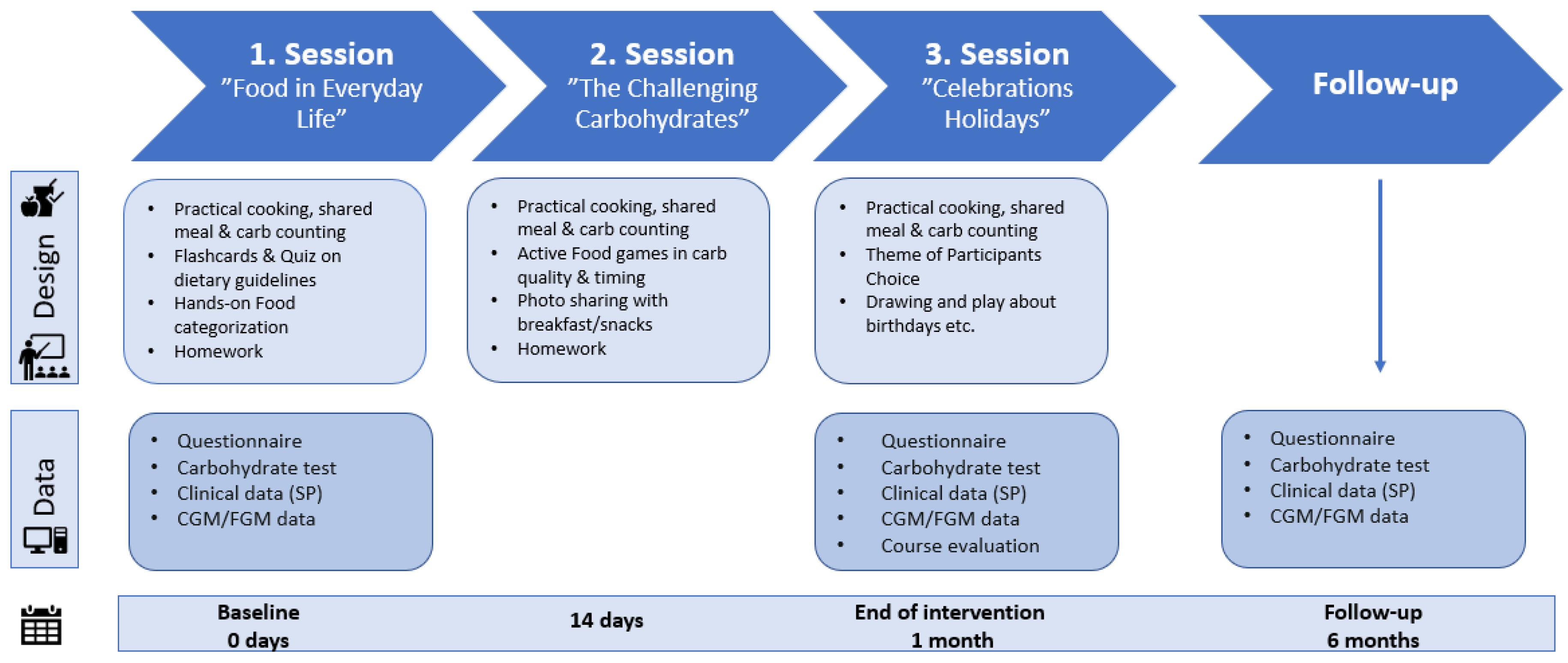
2.2. Education Program
2.3. Data Collection and Management
2.3.1. Medical Data
2.3.2. Glucose Sensor Data
2.3.3. Questionnaires
2.4. Ethics
2.5. Data Analysis
3. Results
3.1. Study Population
3.2. Carbohydrate Estimation
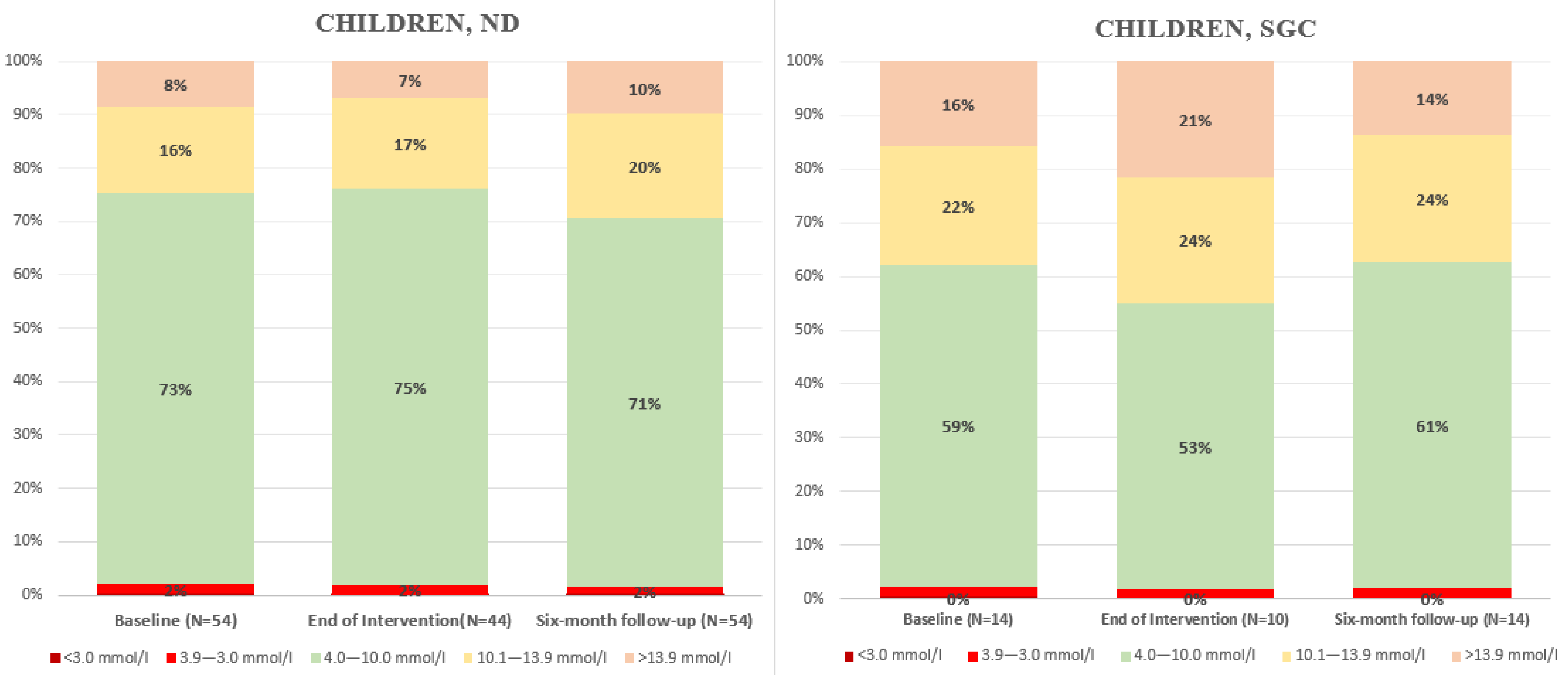
3.3. Glucose Sensor Data Results
3.4. Postprandial Blood Glucose Fluctuations
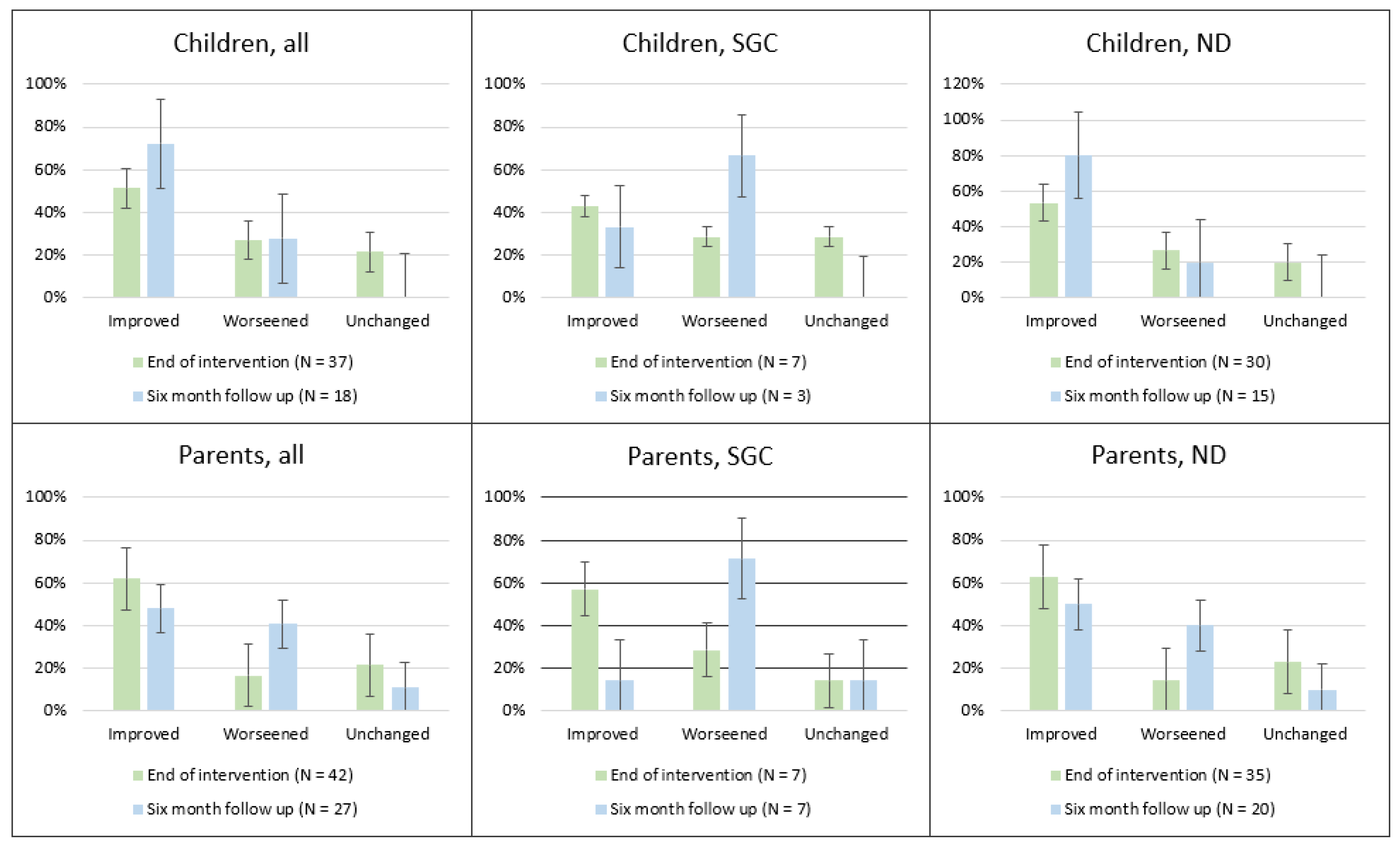
3.5. Self-Reported Data on Everyday Life Changes
4. Discussion
5. Conclusions
Supplementary Materials
Author Contributions
Funding
Institutional Review Board Statement
Informed Consent Statement
Data Availability Statement
Acknowledgments
Conflicts of Interest
Abbreviations
| T1D | Type 1 diabetes |
| HbA1c | Hemoglobin A1c |
| SDCC | Steno Diabetes Center Copenhagen |
| MDI | Multiple daily injections |
| SP | Sundhedsplatformen (national electronic medical journal system) |
| TIR | Time-in-range |
| TAR | Time-above-range |
| TBR | Time-below-range |
| CV | Coefficient of variation |
| ND | Newly Diagnosed |
| SGC | Suboptimal Glycemic Control |
| FGM | Flash glucose monitoring |
| CGM | Continuous glucose monitoring |
| SD | Standard deviations |
| AUC | Area under the curve |
| BMI | Body mass index |
References
- Chiang, J.L.; Kirkman, M.S.; Laffel, L.M.B.; Peters, A.L. Type 1 Diabetes Through the Life Span: A Position Statement of the American Diabetes Association. Diabetes Care 2014, 37, 2034–2054. [Google Scholar] [CrossRef]
- Svensson, J.; Cerqueira, C.; Kjærsgaard, P.; Lyngsøe, L.; Hertel, N.T.; Madsen, M.; Mortensen, H.B.; Johannesen, J. Danish Registry of Childhood and Adolescent Diabetes. Clin. Epidemiol. 2016, 8, 679–683. [Google Scholar] [CrossRef] [PubMed]
- Patterson, C.C.; Harjutsalo, V.; Rosenbauer, J.; Neu, A.; Cinek, O.; Skrivarhaug, T.; Rami-Merhar, B.; Soltesz, G.; Svensson, J.; Parslow, R.C.; et al. Trends and cyclical variation in the incidence of childhood type 1 diabetes in 26 European centres in the 25 year period 1989–2013: A multicentre prospective registration study. Diabetologia 2019, 62, 408–417. [Google Scholar] [CrossRef]
- Rawshani, A.; Rawshani, A.; Franzén, S.; Eliasson, B.; Svensson, A.M.; Miftaraj, M.; McGuire, D.K.; Sattar, N.; Rosengren, A.; Gudbjörnsdottir, S. Mortality and Cardiovascular Disease in Type 1 and Type 2 Diabetes. N. Engl. J. Med. 2017, 376, 1407–1418. [Google Scholar] [CrossRef]
- Carstensen, B.; Rønn, P.F.; Jørgensen, M.E. Lifetime risk and years lost to type 1 and type 2 diabetes in Denmark, 1996–2016. BMJ Open Diabetes Res. Care 2021, 9, e001065. [Google Scholar] [CrossRef]
- Pambianco, G.; Costacou, T.; Ellis, D.; Becker, D.J.; Klein, R.; Orchard, T.J. The 30-year natural history of type 1 diabetes complications: The Pittsburgh Epidemiology of Diabetes Complications Study experience. Diabetes 2006, 55, 1463–1469. [Google Scholar] [CrossRef]
- Samuelsson, U.; Steineck, I.; Gubbjornsdottir, S. A high mean-HbA1c value 3-15 months after diagnosis of type 1 diabetes in childhood is related to metabolic control, macroalbuminuria, and retinopathy in early adulthood--a pilot study using two nation-wide population based quality registries. Pediatr. Diabetes 2014, 15, 229–235. [Google Scholar] [CrossRef]
- Hesse, D.; Boysen, L.; Ridderstråle, M. Adult-onset type 1 diabetes: Predictors of glycaemic control. Endocrinol. Diabetes Metab. 2018, 1, e00038. [Google Scholar] [CrossRef] [PubMed]
- Mazarello Paes, V.; Barrett, J.K.; Taylor-Robinson, D.C.; Chesters, H.; Charalampopoulos, D.; Dunger, D.B.; Viner, R.M.; Stephenson, T.J. Effect of early glycemic control on HbA1c tracking and development of vascular complications after 5 years of childhood onset type 1 diabetes: Systematic review and meta-analysis. Pediatr. Diabetes 2019, 20, 494–509. [Google Scholar] [CrossRef]
- American Diabetes Association. 13. Children and Adolescents: Standards of Medical Care in Diabetes—2021. Diabetes Care 2020, 44, S180–S199. [Google Scholar] [CrossRef] [PubMed]
- Smart, C.E.; Annan, F.; Higgins, L.A.; Jelleryd, E.; Lopez, M.; Acerini, C.L. ISPAD Clinical Practice Consensus Guidelines 2018: Nutritional management in children and adolescents with diabetes. Pediatr. Diabetes 2018, 19, 136–154. [Google Scholar] [CrossRef] [PubMed]
- Silverstein, J.; Klingensmith, G.; Copeland, K.; Plotnick, L.; Kaufman, F.; Laffel, L.; Deeb, L.; Grey, M.; Anderson, B.; Holzmeister, L.A.; et al. Care of children and adolescents with type 1 diabetes: A statement of the American Diabetes Association. Diabetes Care 2005, 28, 186–212. [Google Scholar] [CrossRef]
- Mehta, S.N.; Quinn, N.; Volkening, L.K.; Laffel, L.M.B. Impact of Carbohydrate Counting on Glycemic Control in Children with Type 1 Diabetes. Diabetes Care 2009, 32, 1014–1016. [Google Scholar] [CrossRef] [PubMed]
- Builes-Montaño, C.E.; Ortiz-Cano, N.A.; Ramirez-Rincón, A.; Rojas-Henao, N.A. Efficacy and safety of carbohydrate counting versus other forms of dietary advice in patients with type 1 diabetes mellitus: A systematic review and meta-analysis of randomised clinical trials. J. Hum. Nutr. Diet. 2022, 35, 1030–1042. [Google Scholar] [CrossRef] [PubMed]
- Wiyono, L.; Ghitha, N.; Clarisa, D.; Larasati, A. Carbohydrate counting implementation on pediatric type 1 diabetes mellitus: Systematic review and meta-analysis. Ann. Pediatr. Endocrinol. Metab. 2023, 28, 206–214. [Google Scholar] [CrossRef]
- Donzeau, A.; Bonnemaison, E.; Vautier, V.; Menut, V.; Houdon, L.; Bendelac, N.; Bismuth, E.; Bouhours-Nouet, N.; Quemener, E.; Baron, S.; et al. Effects of advanced carbohydrate counting on glucose control and quality of life in children with type 1 diabetes. Pediatr. Diabetes 2020, 21, 1240–1248. [Google Scholar] [CrossRef]
- Besser, R.E.J.; Bell, K.J.; Couper, J.J.; Ziegler, A.G.; Wherrett, D.K.; Knip, M.; Speake, C.; Casteels, K.; Driscoll, K.A.; Jacobsen, L.; et al. ISPAD Clinical Practice Consensus Guidelines 2022: Stages of type 1 diabetes in children and adolescents. Pediatr. Diabetes 2022, 23, 1175–1187. [Google Scholar] [CrossRef]
- Bishop, F.K.; Maahs, D.M.; Spiegel, G.; Owen, D.; Klingensmith, G.J.; Bortsov, A.; Thomas, J.; Mayer-Davis, E.J. The Carbohydrate Counting in Adolescents With Type 1 Diabetes (CCAT)Study. Diabetes Spectr. 2009, 22, 56–62. [Google Scholar] [CrossRef]
- Pinhas-Hamiel, O.; Hamiel, U.; Levy-Shraga, Y. Eating disorders in adolescents with type 1 diabetes: Challenges in diagnosis and treatment. World J. Diabetes 2015, 6, 517–526. [Google Scholar] [CrossRef]
- Rigby, K.R.; Iturbe, I.; Candler, T.; Anderson, R.; Hamilton-Shield, J.P.; Hinton, E.C. A scoping review exploring research investigating the influence of carbohydrate counting on eating behaviour and/or disordered eating in type 1 diabetes. Diabetes Res. Clin. Pract. 2025, 222, 112068. [Google Scholar] [CrossRef]
- Martin, R.; Davis, A.; Pigott, A.; Cremona, A. A scoping review exploring the role of the dietitian in the identification and management of eating disorders and disordered eating in adolescents and adults with type 1 diabetes mellitus. Clin. Nutr. ESPEN 2023, 58, 375–387. [Google Scholar] [CrossRef]
- Selskab, D.E. Diabetesstyregruppe S. Kliniske Retningslinier for Behandling af Børn Med Type 1 og Type 2 Diabetes. 2009. Available online: https://endocrinology.dk/Kliniske%20retningslinier%20-%20Diabetes%20hos%20boern%20og%20unge.pdf (accessed on 1 January 2026).
- Annan, S.F.; Higgins, L.A.; Jelleryd, E.; Hannon, T.; Rose, S.; Salis, S.; Baptista, J.; Chinchilla, P.; Marcovecchio, M.L. ISPAD Clinical Practice Consensus Guidelines 2022: Nutritional management in children and adolescents with diabetes. Pediatric Diabetes 2022, 23, 1297–1321. [Google Scholar] [CrossRef]
- Amiel, S.; Beveridge, S.; Bradley, C.; Gianfrancesco, C.; Heller, S.; James, P.; McKeown, N.; Newton, D.; Newton, L.; Oliver, L.; et al. Training in flexible, intensive insulin management to enable dietary freedom in people with type 1 diabetes: Dose adjustment for normal eating (DAFNE) randomised controlled trial. BMJ 2002, 325, 746–749. [Google Scholar] [CrossRef]
- Price, K.J.; Knowles, J.A.; Fox, M.; Wales, J.K.H.; Heller, S.; Eiser, C.; Freeman, J.V.; The KICk–OFF Study Group. Effectiveness of the Kids in Control of Food (KICk–OFF) structured education course for 11–16 year olds with Type 1 diabetes. Diabetic Medicine 2016, 33, 192–203. [Google Scholar] [CrossRef]
- Des Jarlais, D.C.; Lyles, C.; Crepaz, N. Improving the reporting quality of nonrandomized evaluations of behavioral and public health interventions: The TREND statement. Am. J. Public Health 2004, 94, 361–366. [Google Scholar] [CrossRef]
- Varni, J.W.; Burwinkle, T.M.; Jacobs, J.R.; Gottschalk, M.; Kaufman, F.; Jones, K.L. The PedsQL in type 1 and type 2 diabetes: Reliability and validity of the Pediatric Quality of Life Inventory Generic Core Scales and type 1 Diabetes Module. Diabetes Care 2003, 26, 631–637. [Google Scholar] [CrossRef]
- Borgers, N.; de Leeuw, E.; Hox, J. Children as Respondents in Survey Research: Cognitive Development and Response Quality 1. Bull. Methodol. Sociol. 2000, 66, 66–75. [Google Scholar] [CrossRef]
- Schouw, N.; Skouboe, A.G.; Bruun, J.M.; Ewers, B. Validation Data Based on a Web-Based Photographic Questionnaire for Assessment of Skills in Estimating Carbohydrate Portion Sizes in Adults with Type 1 Diabetes. Clin. Nutr. Food Sci. 2019, 2, 54–56. [Google Scholar]
- Battelino, T.; Danne, T.; Bergenstal, R.M.; Amiel, S.A.; Beck, R.; Biester, T.; Bosi, E.; Buckingham, B.A.; Cefalu, W.T.; Close, K.L.; et al. Clinical Targets for Continuous Glucose Monitoring Data Interpretation: Recommendations From the International Consensus on Time in Range. Diabetes Care 2019, 42, 1593–1603. [Google Scholar] [CrossRef]
- Edwards, S.; He, X.; Wang, W.; Poon, J.-L.; Meadows, E.; Price, D.; Johnson, J.; Wolpert, H.; Polonsky, W. Use of Connected Pen as a Diagnostic Tool to Evaluate Missed Bolus Dosing Behavior in People with Type 1 and Type 2 Diabetes. Diabetes Technol. Ther. 2021, 24, 61–66. [Google Scholar] [CrossRef]
- Norlander, L.M.; Anderson, S.; Levy, C.J.; Ekhlaspour, L.; Lam, D.W.; Hsu, L.; Loebner, S.E.; Ogyaadu, S.J.; O’malley, G.; Levister, C.M.; et al. Late and Missed Meal Boluses with Multiple Daily Insulin Injections. Diabetes 2018, 67, 992-P. [Google Scholar] [CrossRef]
- Markowitz, J.T.; Garvey, K.C.; Laffel, L.M. Developmental changes in the roles of patients and families in type 1 diabetes management. Curr. Diabetes Rev. 2015, 11, 231–238. [Google Scholar] [CrossRef]
- Prahalad, P.; Zaharieva, D.P.; Addala, A.; New, C.; Scheinker, D.; Desai, M.; Hood, K.K.; Maahs, D.M. Improving Clinical Outcomes in Newly Diagnosed Pediatric Type 1 Diabetes: Teamwork, Targets, Technology, and Tight Control-The 4T Study. Front. Endocrinol. 2020, 11, 360. [Google Scholar] [CrossRef]
- Campbell, M.S.; Schatz, D.A.; Chen, V.; Wong, J.C.; Steck, A.; Tamborlane, W.V.; Smith, J.; Beck, R.W.; Cengiz, E.; Laffel, L.M.; et al. A contrast between children and adolescents with excellent and poor control: The T1D Exchange clinic registry experience. Pediatr. Diabetes 2014, 15, 110–117. [Google Scholar] [CrossRef]
- Kenowitz, J.R.; Hoogendoorn, C.J.; Commissariat, P.V.; Gonzalez, J.S. Diabetes-specific self-esteem, self-care and glycaemic control among adolescents with Type 1 diabetes. Diabet. Med. 2020, 37, 760–767. [Google Scholar] [CrossRef] [PubMed]
- Cheng, L.J.; Wang, W.; Lim, S.T.; Wu, V.X. Factors associated with glycaemic control in patients with diabetes mellitus: A systematic literature review. J. Clin. Nurs. 2019, 28, 1433–1450. [Google Scholar] [CrossRef]
- Hawkes, C.P.; Willi, S.M.; Murphy, K.M. A structured 1-year education program for children with newly diagnosed type 1 diabetes improves early glycemic control. Pediatr. Diabetes 2019, 20, 460–467. [Google Scholar] [CrossRef]
- Datye, K.A.; Boyle, C.T.; Simmons, J.; Moore, D.J.; Jaser, S.S.; Sheanon, N.; Kittelsrud, J.M.; Woerner, S.E.; Miller, K.M. Timing of Meal Insulin and Its Relation to Adherence to Therapy in Type 1 Diabetes. J. Diabetes. Sci. Technol. 2018, 12, 349–355. [Google Scholar] [CrossRef]
- Laugesen, C.; Ritschel, T.; Ranjan, A.G.; Hsu, L.; Jørgensen, J.B.; Svensson, J.; Ekhlaspour, L.; Buckingham, B.; Nørgaard, K. Impact of Missed and Late Meal Boluses on Glycemic Outcomes in Automated Insulin Delivery-Treated Children and Adolescents with Type 1 Diabetes: A Two-Center, Population-Based Cohort Study. Diabetes Technol. Ther. 2024, 26, 897–907. [Google Scholar] [CrossRef]
- Hessler, D.M.; Fisher, L.; Guzman, S.; Strycker, L.; Polonsky, W.H.; Ahmann, A.; Aleppo, G.; Argento, N.B.; Henske, J.; Kim, S.; et al. EMBARK: A Randomized, Controlled Trial Comparing Three Approaches to Reducing Diabetes Distress and Improving HbA1c in Adults With Type 1 Diabetes. Diabetes Care 2024, 47, 1370–1378. [Google Scholar] [CrossRef]
- Murphy, H.R.; Wadham, C.; Rayman, G.; Skinner, T.C. Approaches to integrating paediatric diabetes care and structured education: Experiences from the Families, Adolescents, and Children’s Teamwork Study (FACTS). Diabet. Med. 2007, 24, 1261–1268. [Google Scholar] [CrossRef]
- American Diabetes Association Professional Practice Committee. 14. Children and Adolescents: Standards of Care in Diabetes—2025. Diabetes Care 2024, 48, S283–S305. [Google Scholar] [CrossRef]
- Pedersen, Z.O.; Jacobsen, S.S.; Ewers, B.; Grabowski, D. Exploring Family Perspectives on a Group-Based Hands-on Advanced Carbohydrate Counting Education Program for Children and Adolescents with Type 1 Diabetes: A Qualitative Study. Nutrients 2024, 16, 1618. [Google Scholar] [CrossRef]
- Ersig, A.L.; Tsalikian, E.; Coffey, J.; Williams, J.K. Stressors in Teens with Type 1 Diabetes and Their Parents: Immediate and Long-Term Implications for Transition to Self-Management. J. Pediatr. Nurs. 2016, 31, 390–396. [Google Scholar] [CrossRef] [PubMed]
- Davidson, M.; Penney, E.D.; Muller, B.; Grey, M. Stressors and self-care challenges faced by adolescents living with type 1 diabetes. Appl. Nurs. Res. 2004, 17, 72–80. [Google Scholar] [CrossRef]
- Cao, Y.; Chen, R.C.; Katz, A.J. Why is a small sample size not enough? Oncologist 2024, 29, 761–763. [Google Scholar] [CrossRef]



| All (n = 77) | ND (n = 55) | SGC (n = 22) | |
|---|---|---|---|
| Age, years | 10 (±3) | 9 (±3) | 12 (±2) |
| Gender, females, n (%) | 42 (55) | 26 (47) | 16 (73) |
| Diabetes duration, days | 540 (±961) | 115 (±84) | 1605 (±1291) |
| BMI, kg/m2 | 19 (16, 20) | 17 (16, 19) | 21 (19, 22) |
| HbA1c, %/mmol/mol | 8.7/72 (±29) | 9.2/77 (±32) | 7.8/62 (±18) |
| TIR, % | 70 (±20) | 74 (±16) | 59 (±24) |
| Insulin pump, n (%) | 24 (31) | 7 (13) | 17 (77) |
| MDI + sensor, n (%) | 76 (99) | 54 (98) | 22 (100) |
| Baseline (n = 67) | End of Intervention (n = 42) | Six-Months Follow-Up (n = 18) | |||||||||||||||||
|---|---|---|---|---|---|---|---|---|---|---|---|---|---|---|---|---|---|---|---|
| Selected Questions from the “Everyday Life” Questionnaire—Children | Not at All | A Little/To a Lesser Extent | Some/To Some Extent | Quite a Lot/To a Great Extent | Extremely/To a Very Great Extent | Do Not Know | Not at All | A Little/To a Lesser Extent | Some/To Some Extent | Quite a Lot/To a Great Extent | Extremely/To a Very Great Extent | Do Not Know | p | Not at All | A Little/To a Lesser Extent | Some/To Some Extent | Quite a Lot/To a Great Extent | Extremely/To a Very Great Extent | p |
| Diabetes management | |||||||||||||||||||
| Can you count carbohydrates by yourself? | 22% | 15% | 22% | 19% | 21% | 12% | 14% | 21% | 29% | 24% | <0.001 | 0% | 6% | 22% | 56% | 17% | 0.066 | ||
| Are you able to dose your meal insulin by yourself? | 9% | 3% | 10% | 18% | 60% | 5% | 0% | 5% | 14% | 76% | 0.005 | 0% | 0% | 0% | 28% | 72% | 0.049 | ||
| Dietary practice | |||||||||||||||||||
| Do you eat according to dietary recommendations? | 8% | 8% | 11% | 9% | 65% | 8% | 10% | 13% | 10% | 3% | 58% | 0.393 | 11% | 11% | 28% | 17% | 33% | 0.095 | |
| Do you ever feel angry, irritated, or sad because of diabetes? | 26% | 29% | 23% | 15% | 8% | 25% | 38% | 15% | 13% | 10% | 0.333 | 0% | 50% | 28% | 17% | 6% | 0.013 | ||
| Carbohydrate counting and perceptions | |||||||||||||||||||
| Is it difficult to count carbohydrates? | 13% | 36% | 22% | 9% | 19% | 17% | 37% | 20% | 22% | 5% | 0.031 | 23% | 36% | 23% | 5% | 5% | 0.905 | ||
| Baseline (n = 72) | End of Intervention (n = 44) | p | Six-Months Follow-Up (n = 17) | p | ||||||||||||||||
|---|---|---|---|---|---|---|---|---|---|---|---|---|---|---|---|---|---|---|---|---|
| Selected Questions from the “Everyday Life” Questionnaire—Parents | Not at All (1) | A Little/To a Lesser Extent (2) | Some/To Some Extent (3) | Quite a Lot/To a Great Extent (4) | Extremely/To a Very Great Extent (5) | Do Not Know (6) | Not at All (1) | A Little/To a Lesser Extent (2) | Some/To Some Extent (3) | Quite a Lot/To a Great Extent (4) | Extremely/To a Very Great Extent (5) | Do Not Know (6) | Not at All (1) | A little/To a Lesser Extent (2) | Some/To Some Extent (3) | Quite a Lot/To a Great Extent (4) | Extremely/To a Very Great Extent (5) | Do Not Know (6) | ||
| Diabetes management | ||||||||||||||||||||
| To what extent can your child count carbohydrates by itself? | 22% | 22% | 26% | 21% | 8% | 14% | 23% | 41% | 16% | 7% | 0.049 | 10% | 7% | 40% | 27% | 17% | 0.002 | |||
| To what extent can your child calculate the amount of insulin needed for the food eaten? | 24% | 6% | 25% | 26% | 19% | 14% | 22% | 18% | 29% | 18% | 0.051 | 10% | 3% | 14% | 45% | 28% | 0.050 | |||
| To what extent do you feel alone with diabetes? | 17% | 36% | 31% | 14% | 3% | 9% | 36% | 38% | 16% | 2% | 0.221 | 10% | 45% | 28% | 14% | 3% | 0.477 | |||
| Dietary practice | ||||||||||||||||||||
| To what extent do you observe that your child eats healthily? | 1% | 13% | 39% | 47% | 0% | 4% | 4% | 47% | 40% | 4% | 0.623 | 4% | 14% | 38% | 45% | 0% | 0.056 | |||
| To what extent do food or insulin cause conflicts? | 21% | 28% | 35% | 13% | 4% | 18% | 41% | 23% | 14% | 5% | 0.618 | 21% | 38% | 28% | 14% | 0% | 0.678 | |||
| Carbohydrate counting | ||||||||||||||||||||
| Do you find it difficult to count carbohydrates? | 14% | 44% | 28% | 7% | 7% | 22% | 42% | 22% | 9% | 4% | 0.372 | 17% | 62% | 14% | 4% | 4% | 0.067 | |||
Disclaimer/Publisher’s Note: The statements, opinions and data contained in all publications are solely those of the individual author(s) and contributor(s) and not of MDPI and/or the editor(s). MDPI and/or the editor(s) disclaim responsibility for any injury to people or property resulting from any ideas, methods, instructions or products referred to in the content. |
© 2026 by the authors. Licensee MDPI, Basel, Switzerland. This article is an open access article distributed under the terms and conditions of the Creative Commons Attribution (CC BY) license.
Share and Cite
Jacobsen, S.S.; Pedersen, Z.O.; Nyholm-Christensen, E.; Ewers, B. Interactive and Play-Based Group Education Is Associated with Improvements in Carbohydrate Counting Skills and Self-Care Confidence in Children and Adolescents with Type 1 Diabetes: An Exploratory Study. Nutrients 2026, 18, 790. https://doi.org/10.3390/nu18050790
Jacobsen SS, Pedersen ZO, Nyholm-Christensen E, Ewers B. Interactive and Play-Based Group Education Is Associated with Improvements in Carbohydrate Counting Skills and Self-Care Confidence in Children and Adolescents with Type 1 Diabetes: An Exploratory Study. Nutrients. 2026; 18(5):790. https://doi.org/10.3390/nu18050790
Chicago/Turabian StyleJacobsen, Sabine Schade, Zandra Overgaard Pedersen, Emilie Nyholm-Christensen, and Bettina Ewers. 2026. "Interactive and Play-Based Group Education Is Associated with Improvements in Carbohydrate Counting Skills and Self-Care Confidence in Children and Adolescents with Type 1 Diabetes: An Exploratory Study" Nutrients 18, no. 5: 790. https://doi.org/10.3390/nu18050790
APA StyleJacobsen, S. S., Pedersen, Z. O., Nyholm-Christensen, E., & Ewers, B. (2026). Interactive and Play-Based Group Education Is Associated with Improvements in Carbohydrate Counting Skills and Self-Care Confidence in Children and Adolescents with Type 1 Diabetes: An Exploratory Study. Nutrients, 18(5), 790. https://doi.org/10.3390/nu18050790