Safety and Tolerability of the Gut Bacterium Phascolarctobacterium faecium DSM 32890

 , , , , , , ,
Abstract
1. Introduction
2. Materials and Methods
2.1. Bacterial Culture Conditions and Quantification
2.2. Animal Experiment Design
2.3. Hematological and Biochemical Analyses
2.4. Bacterial Translocation Analyses
2.5. Gene Expression Analysis
2.6. Determination of Total IgA and Cytokine Concentrations
2.7. Histological Analysis
2.8. Intervention Trial in Humans
2.9. Pre-Processing and Sequencing of Rat Fecal Samples
2.10. Microbiota Diversity Analysis
2.11. Statistical Analysis
3. Results
3.1. Repeated-Dose 28-Day Oral Toxicity Study
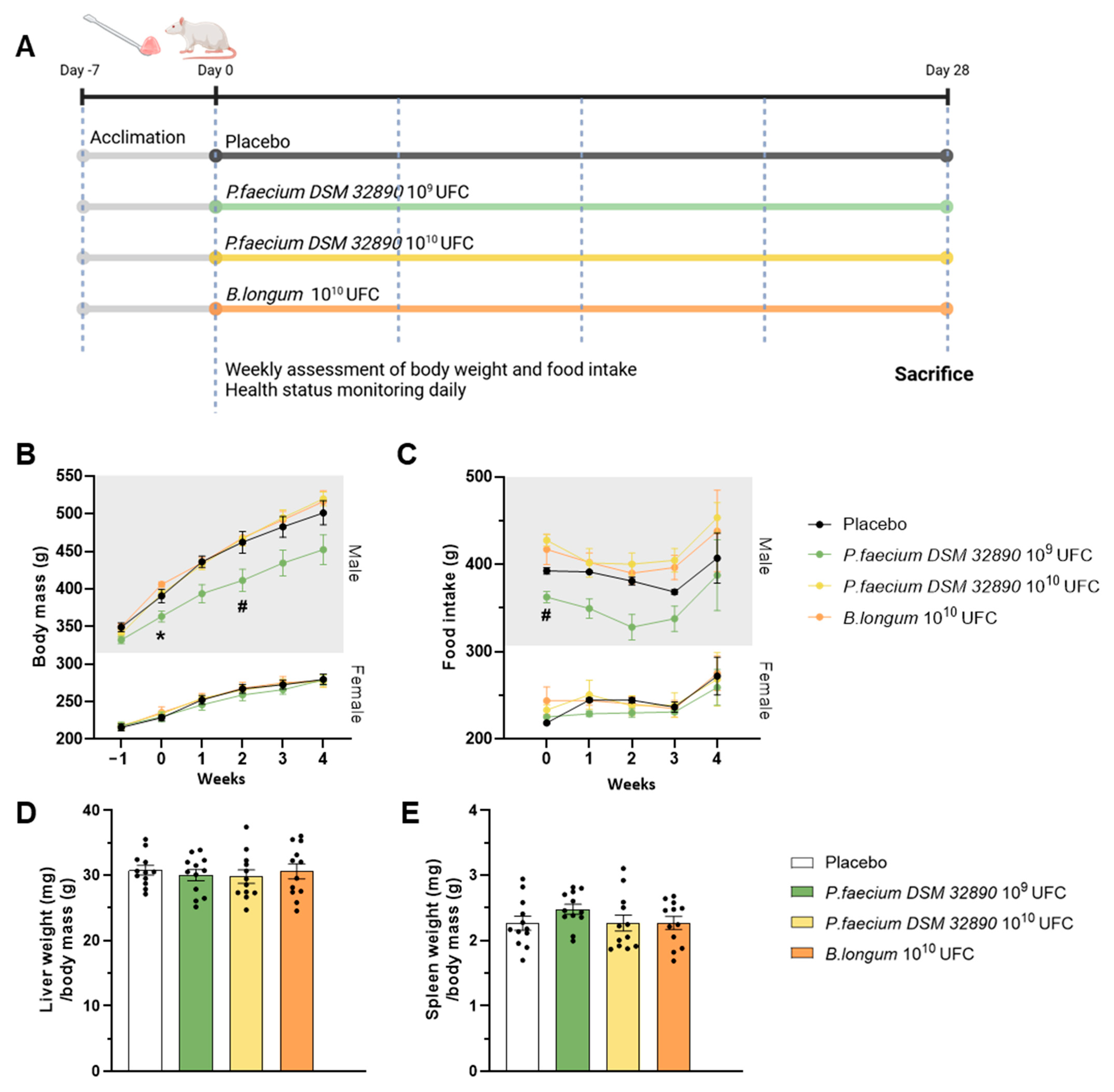
3.1.1. Behavioral, Physiological, and Macroscopic Examinations
3.1.2. Translocation, Hematology and Biochemistry
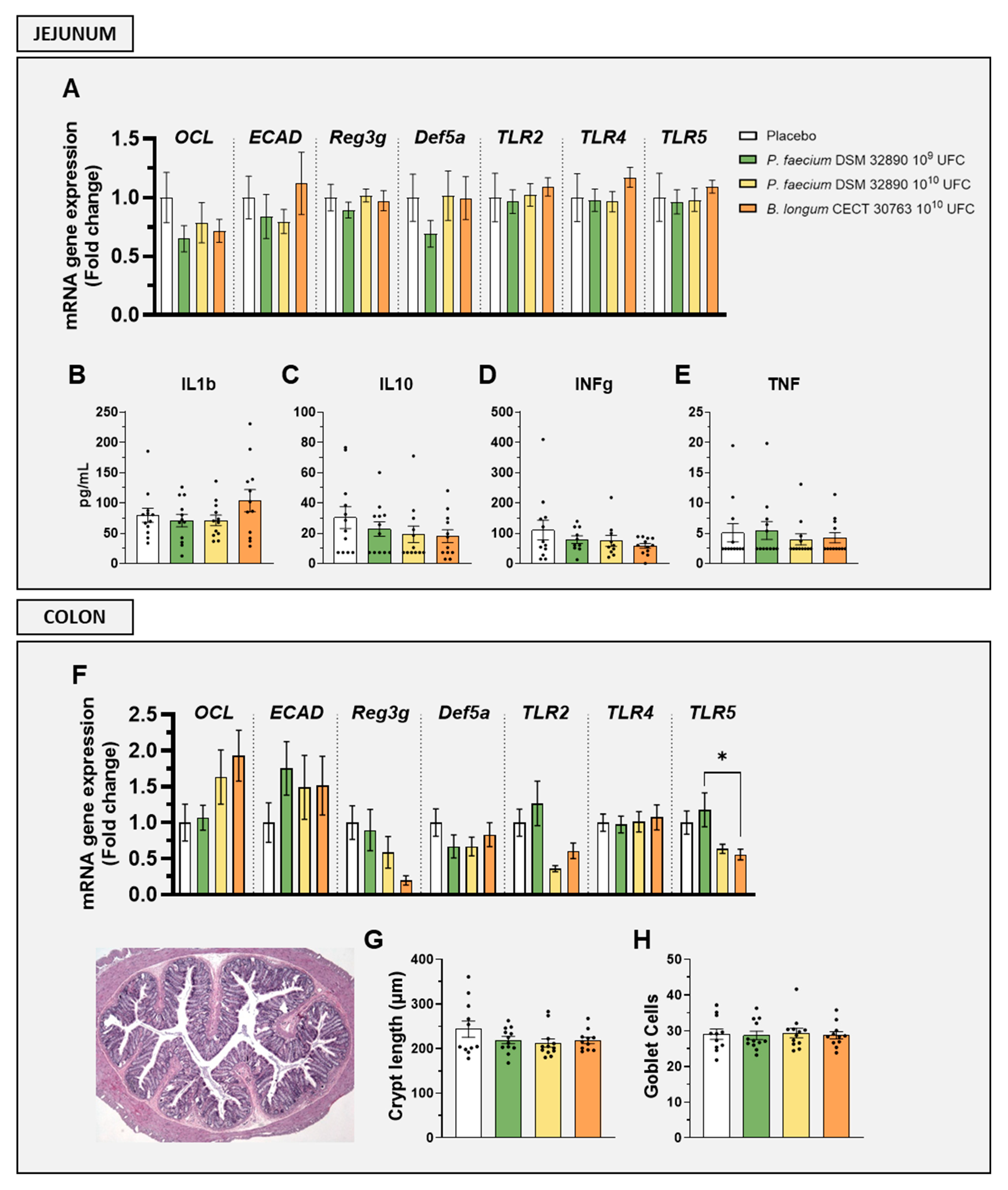
3.1.3. Intestinal Histology, Gut Barrier and Immunological Markers
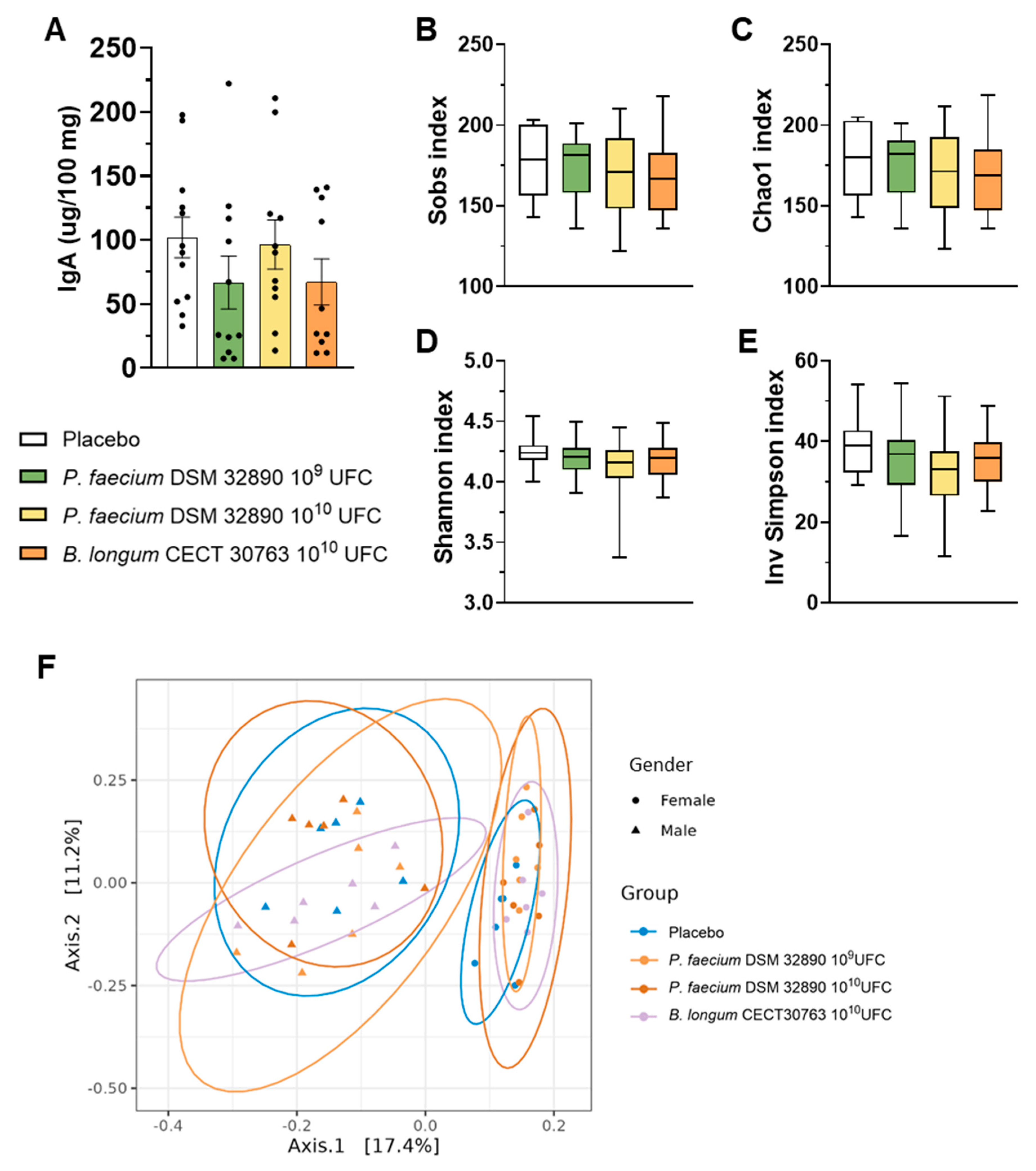
3.1.4. Influence on Gut Microbiota
3.2. Safety and Tolerability in Humans
3.2.1. Study Population Features
3.2.2. Hematological and Biochemical Profiles in Humans
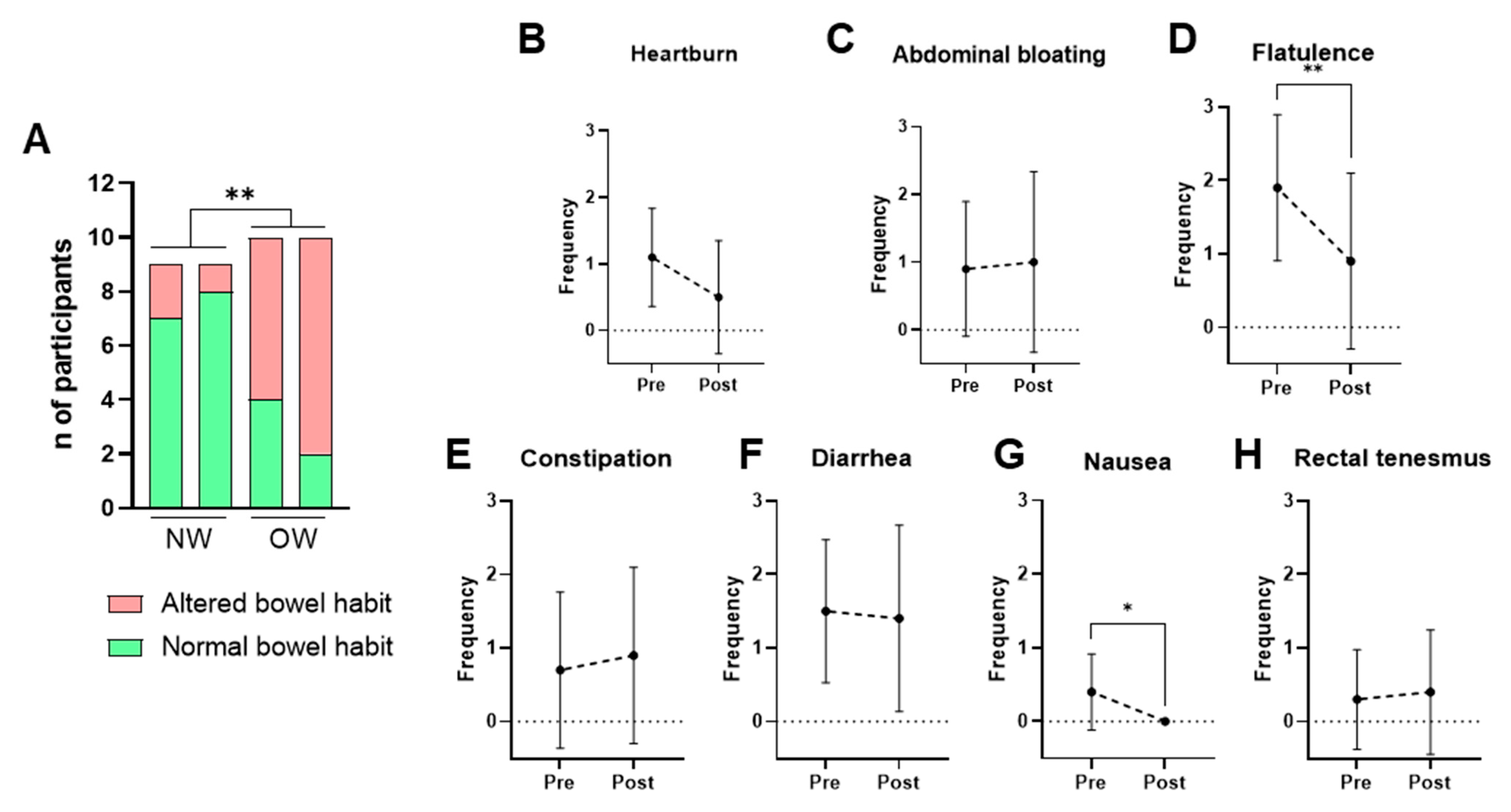
3.2.3. Bowel Habits and Gastrointestinal Symptoms
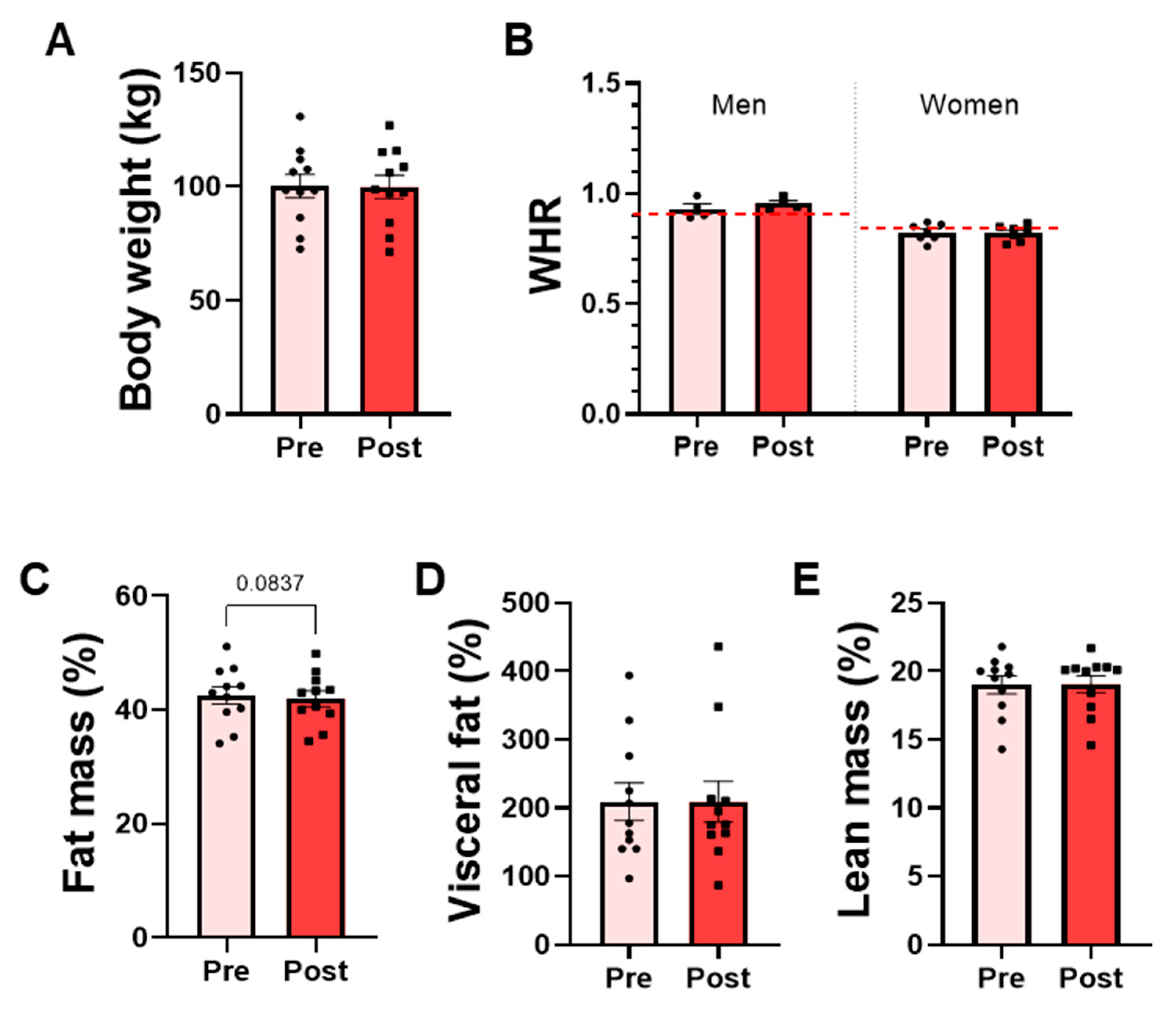
3.2.4. Effects on Body Composition
4. Discussion
5. Conclusions
Supplementary Materials
Author Contributions
Funding
Institutional Review Board Statement
Informed Consent Statement
Data Availability Statement
Acknowledgments
Conflicts of Interest
Abbreviations
| ALP | Aspartate aminotransferase |
| ALT | Alanine aminotransferase |
| BMI | Body mass index |
| CFUs | Colony-forming units |
| CSIC | Spanish National Research Council |
| Def5a | Alpha-Defensin 5 |
| DII | Dietary Inflammatory Index |
| ECAD | Epithelial cadherin |
| Ecad | E-cadherin |
| GH | General Health |
| GMH | General Mental Health |
| GPH | General Physical Health |
| HbA1c | Glycated hemoglobin |
| HEI | Healthy Eating Index |
| INFg | Interferon γ |
| MCHC | Mean Corpuscular Hemoglobin Concentration |
| METs | Metabolic Equivalent Task units |
| MLNs | Mesenteric lymph nodes |
| NW | Normal weight |
| OCL | Occludin |
| OW | Overweight |
| PBS | Phosphate-buffered saline |
| Reg3g | Regenerating islet-derived protein 3 gamma |
| SCFA | Short chain fatty acid |
| SD | Standard deviation |
| TNFa | Tumor necrosis factor α |
| TSS | Total Sum Scaling |
| WHR | Waist-to-Hip Ratio |
References
- Obesity and Overweight. Available online: https://www.who.int/news-room/fact-sheets/detail/obesity-and-overweight (accessed on 16 October 2025).
- Stanislawski, M.A.; Dabelea, D.; Lange, L.A.; Wagner, B.D.; Lozupone, C.A. Gut Microbiota Phenotypes of Obesity. npj Biofilms Microbiomes 2019, 5, 18. [Google Scholar] [CrossRef] [Scilit] [PubMed]
- Amabebe, E.; Robert, F.O.; Agbalalah, T.; Orubu, E.S.F. Microbial Dysbiosis-Induced Obesity: Role of Gut Microbiota in Homoeostasis of Energy Metabolism. Br. J. Nutr. 2020, 123, 1127–1137. [Google Scholar] [CrossRef] [Scilit]
- Liébana-García, R.; López-Almela, I.; Olivares, M.; Romaní-Pérez, M.; Manghi, P.; Torres-Mayo, A.; Tolosa-Enguís, V.; Flor-Duro, A.; Bullich-Vilarrubias, C.; Rubio, T.; et al. Gut Commensal Phascolarctobacterium faecium Retunes Innate Immunity to Mitigate Obesity and Metabolic Disease in Mice. Nat. Microbiol. 2025, 10, 1310–1322. [Google Scholar] [CrossRef] [Scilit]
- Romaní-Pérez, M.; López-Almela, I.; Bullich-Vilarrubias, C.; Rueda-Ruzafa, L.; Gómez Del Pulgar, E.M.; Benítez-Páez, A.; Liebisch, G.; Lamas, J.A.; Sanz, Y. Holdemanella Biformis Improves Glucose Tolerance and Regulates GLP-1 Signaling in Obese Mice. FASEB J. 2021, 35, e21734. [Google Scholar] [CrossRef] [Scilit]
- Tamayo, M.; Agusti, A.; Molina-Mendoza, G.V.; Rossini, V.; Frances-Cuesta, C.; Tolosa-Enguís, V.; Sanz, Y. Bifidobacterium longum CECT 30763 Improves Depressive- and Anxiety-like Behavior in a Social Defeat Mouse Model through the Immune and Dopaminergic Systems. Brain Behav. Immun. 2025, 125, 35–57. [Google Scholar] [CrossRef] [Scilit]
- European Union. Commission Regulation (EC) No 440/2008 of 30 May 2008 Laying Down Test Methods Pursuant to Regulation (EC) No 1907/2006 of the European Parliament and of the Council (REACH). Off. J. Eur. Union 2008, L 142, 1–739. Available online: https://www.boe.es/buscar/doc.php?id=DOUE-L-2008-80933 (accessed on 15 April 2025).
- Fernández-Murga, M.L.; Sanz, Y. Safety Assessment of Bacteroides Uniformis CECT 7771 Isolated from Stools of Healthy Breast-Fed Infants. PLoS ONE 2016, 11, e0145503. [Google Scholar] [CrossRef] [Scilit]
- Gómez Del Pulgar, E.M.; Benítez-Páez, A.; Sanz, Y. Safety Assessment of Bacteroides Uniformis CECT 7771, a Symbiont of the Gut Microbiota in Infants. Nutrients 2020, 12, 551. [Google Scholar] [CrossRef] [Scilit]
- PROMIS. Available online: https://www.healthmeasures.net/explore-measurement-systems/promis (accessed on 28 October 2025).
- IPAQ. Available online: https://sites.google.com/view/ipaq/home (accessed on 28 October 2025).
- Investigators Tools. Available online: http://www.predimed.es/investigators-tools.html (accessed on 15 April 2025).
- Takahashi, S.; Tomita, J.; Nishioka, K.; Hisada, T.; Nishijima, M. Development of a Prokaryotic Universal Primer for Simultaneous Analysis of Bacteria and Archaea Using Next-Generation Sequencing. PLoS ONE 2014, 9, e105592. [Google Scholar] [CrossRef] [Scilit] [PubMed]
- Lundberg, D.S.; Yourstone, S.; Mieczkowski, P.; Jones, C.D.; Dangl, J.L. Practical Innovations for High-Throughput Amplicon Sequencing. Nat. Methods 2013, 10, 999–1002. [Google Scholar] [CrossRef] [Scilit]
- Wingett, S.W.; Andrews, S. FastQ Screen: A Tool for Multi-Genome Mapping and Quality Control. F1000Research 2018, 7, 1338. [Google Scholar] [CrossRef] [Scilit]
- Ewels, P.; Magnusson, M.; Lundin, S.; Käller, M. MultiQC: Summarize Analysis Results for Multiple Tools and Samples in a Single Report. Bioinformatics 2016, 32, 3047–3048. [Google Scholar] [CrossRef] [Scilit]
- Callahan, B.J.; McMurdie, P.J.; Rosen, M.J.; Han, A.W.; Johnson, A.J.A.; Holmes, S.P. DADA2: High-Resolution Sample Inference from Illumina Amplicon Data. Nat. Methods 2016, 13, 581–583. [Google Scholar] [CrossRef] [Scilit]
- Quast, C.; Pruesse, E.; Yilmaz, P.; Gerken, J.; Schweer, T.; Yarza, P.; Peplies, J.; Glöckner, F.O. The SILVA Ribosomal RNA Gene Database Project: Improved Data Processing and Web-Based Tools. Nucleic Acids Res. 2013, 41, D590. [Google Scholar] [CrossRef] [Scilit]
- McMurdie, P.J.; Holmes, S. Phyloseq: An R Package for Reproducible Interactive Analysis and Graphics of Microbiome Census Data. PLoS ONE 2013, 8, e61217. [Google Scholar] [CrossRef] [Scilit]
- DRV Finder. Available online: https://multimedia.efsa.europa.eu/drvs/index.htm (accessed on 3 November 2025).
- Romaní-Pérez, M.; Agusti, A.; Sanz, Y. Innovation in Microbiome-Based Strategies for Promoting Metabolic Health. Curr. Opin. Clin. Nutr. Metab. Care 2017, 20, 484–491. [Google Scholar] [CrossRef] [Scilit]
- Ikeyama, N.; Murakami, T.; Toyoda, A.; Mori, H.; Iino, T.; Ohkuma, M.; Sakamoto, M. Microbial Interaction between the Succinate-Utilizing Bacterium Phascolarctobacterium faecium and the Gut Commensal Bacteroides Thetaiotaomicron. MicrobiologyOpen 2020, 9, e1111. [Google Scholar] [CrossRef] [Scilit] [PubMed]
- Du, Y.; He, C.; An, Y.; Huang, Y.; Zhang, H.; Fu, W.; Wang, M.; Shan, Z.; Xie, J.; Yang, Y.; et al. The Role of Short Chain Fatty Acids in Inflammation and Body Health. Int. J. Mol. Sci. 2024, 25, 7379. [Google Scholar] [CrossRef] [Scilit] [PubMed]
- Pitt, J.; Bauter, M.R.; Kumar, R.; Hasselwander, O.; Hibberd, A.A.; Kane, H.; Wang, Q.; Auzanneau, I.; Bry, S.; David, E.; et al. Safety Evaluation of Akkermansia massiliensis Sp. Nov. DSM 33459. Toxicol. Rep. 2025, 14, 102042. [Google Scholar] [CrossRef] [Scilit] [PubMed]
- Huo, L.; Chen, Q.; Jia, S.; Zhang, Y.; Wang, L.; Li, X.; Li, Z.; Sun, B.; Shan, J.; Lin, J.; et al. Gut Microbiome Promotes Succinate-Induced Ulcerative Colitis by Enhancing Glycolysis through SUCNR1/NF-κB Signaling Pathway. Am. J. Physiol. Cell Physiol. 2025, 329, C440–C454. [Google Scholar] [CrossRef] [Scilit]
- Lv, M.; Li, L.; Li, W.; Yang, F.; Hu, Q.; Xiong, D. Mechanism Research on the Interaction Regulation of Escherichia and IFN-γ for the Occurrence of T2DM. Ann. Palliat. Med. 2021, 10, 10391–10400. [Google Scholar] [CrossRef] [Scilit]
- Thaiss, C.A.; Itav, S.; Rothschild, D.; Meijer, M.T.; Levy, M.; Moresi, C.; Dohnalová, L.; Braverman, S.; Rozin, S.; Malitsky, S.; et al. Persistent Microbiome Alterations Modulate the Rate of Post-Dieting Weight Regain. Nature 2016, 540, 544–551. [Google Scholar] [CrossRef] [Scilit]
- Gilbert, J.A.; Azad, M.B.; Bäckhed, F.; Blaser, M.J.; Byndloss, M.; Chiu, C.Y.; Chu, H.; Dugas, L.R.; Elinav, E.; Gibbons, S.M.; et al. Clinical Translation of Microbiome Research. Nat. Med. 2025, 31, 1099–1113. [Google Scholar] [CrossRef] [Scilit] [PubMed]
- Ghaffar, T.; Valeriani, F.; Romano Spica, V. The Sex Related Differences in Health and Disease: A Systematic Review of Sex-Specific Gut Microbiota and Possible Implications for Microbial Pathogenesis. Microb. Pathog. 2025, 209, 108094. [Google Scholar] [CrossRef] [Scilit]
- Khiaolaongam, W.; Boonyapranai, K.; Sitdhipol, J.; Thaveethaptaikul, P.; Khongrum, J.; Chonpathompikunlert, P.; Ounjaijean, S. Bifidobacterium animalis Subsp. Lactis TISTR 2591 Improves Glycemic Control and Immune Response in Adults with Type 2 Diabetes Mellitus: A Randomized, Double-Blind, Placebo-Controlled Crossover Clinical Trial. Nutrients 2025, 17, 3097. [Google Scholar] [CrossRef] [Scilit]
- Younossi, Z.M.; Koenig, A.B.; Abdelatif, D.; Fazel, Y.; Henry, L.; Wymer, M. Global Epidemiology of Nonalcoholic Fatty Liver Disease-Meta-Analytic Assessment of Prevalence, Incidence, and Outcomes. Hepatology 2016, 64, 73–84. [Google Scholar] [CrossRef] [Scilit]
- Zeng, Q.; Li, P.; Wu, H.; Zhuang, Y.; Zhang, Y.; Asemani, S.; Jamilian, P.; Jamali, M.; Yu, H. Probiotics and Gastrointestinal Disorders: An Umbrella Meta-Analysis of Therapeutic Efficacy. Eur. J. Med. Res. 2025, 30, 515. [Google Scholar] [CrossRef] [Scilit] [PubMed]
- Martinez, R.C.R.; Bedani, R.; Saad, S.M.I. Scientific Evidence for Health Effects Attributed to the Consumption of Probiotics and Prebiotics: An Update for Current Perspectives and Future Challenges. Br. J. Nutr. 2015, 114, 1993–2015. [Google Scholar] [CrossRef] [Scilit]
- Khatun, R.; Bhattacharya, M. Probiotics Drinks: Balancing the Benefits with Possible Side-Effects. Int. J. Biotech Trends Technol. 2024, 14, 6–14. [Google Scholar] [CrossRef] [Scilit]
- Zhang, Y.; Gu, Y.; Ren, H.; Wang, S.; Zhong, H.; Zhao, X.; Ma, J.; Gu, X.; Xue, Y.; Huang, S.; et al. Gut Microbiome-Related Effects of Berberine and Probiotics on Type 2 Diabetes (the PREMOTE Study). Nat. Commun. 2020, 11, 5015. [Google Scholar] [CrossRef] [Scilit]
- Soltani, S.; Ashoori, M.; Dehghani, F.; Meshkini, F.; Clayton, Z.S.; Abdollahi, S. Effects of Probiotic/Synbiotic Supplementation on Body Weight in Patients with Diabetes: A Systematic Review and Meta-Analyses of Randomized-Controlled Trials. BMC Endocr. Disord. 2023, 23, 86. [Google Scholar] [CrossRef] [Scilit] [PubMed]
- Cristofori, F.; Dargenio, V.N.; Dargenio, C.; Miniello, V.L.; Barone, M.; Francavilla, R. Anti-Inflammatory and Immunomodulatory Effects of Probiotics in Gut Inflammation: A Door to the Body. Front. Immunol. 2021, 12, 578386. [Google Scholar] [CrossRef] [Scilit] [PubMed]



| Placebo | P. faecium 109 | P. faecium 1010 | B. longum 1010 | p-Value | |
|---|---|---|---|---|---|
| WBC (109/L) | 12.24 ± 3.18 | 13.78 ± 5.1 | 13.18 ± 4.98 | 14.76 ± 3.83 | ns |
| Neu # (109/L) | 1.72 ± 0.81 | 1.78 ± 0.63 | 1.58 ± 0.96 | 1.88 ± 0.96 | ns |
| Lym # (109/L) | 9.66 ± 2.18 | 11.18 ± 4.35 | 10.69 ± 4.13 | 12.03 ± 2.83 | ns |
| Mon # (109/L) | 0.68 ± 0.36 | 0.65 ± 0.38 | 0.72 ± 0.44 | 0.66 ± 0.25 | ns |
| Eos # (109/L) | 0.16 ± 0.1 | 0.15 ± 0.08 | 0.16 ± 0.08 | 0.15 ± 0.06 | ns |
| Bas # (109/L) | 0.02 ± 0.02 | 0.03 ± 0.02 | 0.03 ± 0.02 | 0.03 ± 0.02 | ns |
| Neu % (%) | 13.42 ± 3.95 | 13.5 ± 3.32 | 11.84 ± 4.93 | 12.27 ± 3.64 | ns |
| Lym % (%) | 79.95 ± 5.99 | 80.72 ± 4.39 | 81.61 ± 7.06 | 82.08 ± 4.12 | ns |
| Mon % (%) | 5.26 ± 1.88 | 4.59 ± 1.87 | 5.22 ± 2.07 | 4.46 ± 1.03 | ns |
| Eos % (%) | 1.21 ± 0.52 | 1.03 ± 0.4 | 1.14 ± 0.41 | 1.02 ± 0.39 | ns |
| Bas % (%) | 0.17 ± 0.11 | 0.17 ± 0.07 | 0.19 ± 0.1 | 0.18 ± 0.08 | ns |
| RBC (1012/L) | 8.02 ± 1.85 | 8.78 ± 1.95 | 8.51 ± 1.91 | 8.85 ± 0.51 | ns |
| HGB (g/L) | 15.12 ± 3.36 | 16.58 ± 3.62 | 16.48 ± 3.59 | 17.24 ± 1 | ns |
| HCT (%) | 40.61 ± 8.89 | 44.59 ± 9.76 | 44.2 ± 9.71 | 46.08 ± 2.55 | ns |
| MCV (fL) | 50.88 ± 1.92 | 50.96 ± 1.79 | 52.05 ± 1.29 | 52.11 ± 1.32 | ns |
| MCH (pg) | 18.93 ± 0.78 | 18.96 ± 0.97 | 19.38 ± 0.42 | 19.5 ± 0.55 | ns |
| MCHC (g/dL) | 37.15 ± 0.75 | 37.23 ± 0.73 | 37.3 ± 0.84 | 37.44 ± 0.7 | ns |
| RDW-CV (%) | 12.01 ± 0.51 | 12.4 ± 0.63 | 12.17 ± 0.52 | 12.18 ± 0.62 | ns |
| PLT (109/L) | 501.58 ± 304.79 | 682.67 ± 278.9 | 835 ± 325.41 | 536.42 ± 336.4 | ns |
| MPV (fL) | 6.93 ± 0.66 | 6.72 ± 0.43 | 6.44 ± 0.33 | 6.47 ± 0.45 | ns |
| A/G | 1.68 ± 0.27 | 1.76 ± 0.42 | 1.58 ± 0.18 | 1.66 ± 0.19 | ns |
| B/C | 30.12 ± 4.71 | 26.36 ± 3.39 | 30.18 ± 7.26 | 30.33 ± 3.49 | ns |
| C-Ca (mg/dL) | 11.43 ± 0.37 | 11.18 ± 1.19 | 11.58 ± 0.36 | 11.83 ± 0.22 | ns |
| GLOB (g/dL) | 2.42 ± 0.3 | 2.41 ± 0.6 | 2.46 ± 0.27 | 2.53 ± 0.21 | ns |
| UREA (mg/dL) | 37.45 ± 3.94 | 34.62 ± 5.46 | 40.37 ± 11.38 | 38.08 ± 4.77 | ns |
| ALB (g/dL) | 3.95 ± 0.22 | 3.99 ± 0.41 | 3.95 ± 0.33 | 4.14 ± 0.33 | ns |
| ALP (U/L) | 187.92 ± 53.58 | 171.75 ± 25.11 | 173.33 ± 48.37 | 169.17 ± 35.27 | ns |
| ALT (U/L) | 39.67 ± 7.25 | 42.58 ± 10.99 | 34.58 ± 5.21 | 37.17 ± 6.28 | ns |
| AMY (U/L) | 312.25 ± 31.97 | 310.83 ± 34.86 | 315.67 ± 34.54 | 315.08 ± 31.48 | ns |
| BUN (mg/dL) | 17.52 ± 1.87 | 16.17 ± 2.55 | 18.88 ± 5.36 | 17.8 ± 2.22 | ns |
| CHOL (mg/dL) | 91.17 ± 23.24 | 97.25 ± 17.07 | 102.17 ± 18.95 | 95.75 ± 12.59 | ns |
| CREA (mg/dL) | 0.58 ± 0.06 | 0.59 ± 0.08 | 0.62 ± 0.06 | 0.59 ± 0.06 | ns |
| GLU (mg/dL) | 197 ± 24.62 | 188.33 ± 33.79 | 207.75 ± 27.46 | 226.17 ± 57.07 | ns |
| LIPA (U/L) | 28.5 ± 2.15 | 29 ± 1.76 | 28.42 ± 1.73 | 28 ± 1.21 | ns |
| PHOS (mg/dL) | 6.23 ± 0.83 | 6.96 ± 1.01 | 6.91 ± 0.95 | 8.2 ± 1.54 | * |
| TBIL (mg/dL) | 0.04 ± 0.1 | 0.05 ± 0.1 | 0 ± 0 | 0.04 ± 0.07 | ns |
| TP (g/dL) | 6.37 ± 0.28 | 6.36 ± 0.89 | 6.55 ± 0.22 | 6.68 ± 0.37 | ns |
| Total Population (N = 20) | Normal Weight (NW) (N = 9) | Overweight (OW) (N = 11) | p-Value | |
|---|---|---|---|---|
| Age | 39.90 ± 14.03 | 38.89 ± 11.47 | 40.73 ± 16.34 | 0.7716 |
| Female | 11 (55.0%) | 4 (44.4%) | 7 (63.6%) | >0.9999 |
| Weight (kg) | 84.97 ± 22.73 | 66.00 ± 10.16 | 100.48 ± 17.63 | <0.0001 |
| Height (cm) | 170.55 ± 6.67 | 174.67 ± 6.32 | 167.18 ± 5.21 | 0.0119 |
| BMI (kg/m2) | 29.43 ± 8.53 | 21.53 ± 2.16 | 35.89 ± 5.70 | <0.0001 |
| Smokers | 7 (35.0%) | 3 (33.3%) | 4 (36.4%) | >0.9999 |
| Ethnicity | ||||
| Caucasian | 19 (95.0%) | 9 (100%) | 10 (90.9%) | >0.9999 |
| Other | 1 (5.0%) | 0 | 1 (9.1%) | |
| Diseases (presence or absence) | 0.0648 | |||
| Hypertension | 6 (30.0%) | 0 | 6 (54.5%) | 0.0141 |
| Dyslipidemia | 3 (15.0%) | 2 (22.2%) | 1 (9.1%) | 0.5658 |
| Headache | 3 (15.0%) | 1 (11.1%) | 2 (18.2%) | >0.9999 |
| Hormonal disorders | 2 (10.0%) | 0 | 2 (18.2%) | 0.4789 |
| Others | 3 (15.0%) | 0 | 3 (27.3%) | 0.4789 |
| Gastrointestinal symptoms | ||||
| Vomit | 0 | 0 | 0 | >0.9999 |
| Diarrhoea | 4 (20.0%) | 1 (11.1%) | 3 (27.3%) | 0.5913 |
| Constipation | 4 (20.0%) | 0 | 4 (36.4%) | 0.0941 |
| Stomach pain | 2 (10.0%) | 1 (11.1%) | 1 (9.1%) | >0.9999 |
| None | 11 (55.0%) | 8 (88.9%) | 3 (27.3%) | 0.0098 |
| Surgeries or hospitalizations | 12 (60.0%) | 3 (33.3%) | 9 (81.8%) | 0.0648 |
| Medication intake in the last month | 10 (50.0%) | 3 (33.3%) | 7 (63.6%) | 0.3698 |
Disclaimer/Publisher’s Note: The statements, opinions and data contained in all publications are solely those of the individual author(s) and contributor(s) and not of MDPI and/or the editor(s). MDPI and/or the editor(s) disclaim responsibility for any injury to people or property resulting from any ideas, methods, instructions or products referred to in the content. |
© 2026 by the authors. Licensee MDPI, Basel, Switzerland. This article is an open access article distributed under the terms and conditions of the Creative Commons Attribution (CC BY) license.
Share and Cite
Tamayo, M.; Tolosa-Enguis, V.; Alabadi, B.; Olivares, M.; Romera, S.; Orti, L.; Terrado, E.; Flor Duro, A.; Morillas, C.; Codoñer, P.; et al. Safety and Tolerability of the Gut Bacterium Phascolarctobacterium faecium DSM 32890. Nutrients 2026, 18, 498. https://doi.org/10.3390/nu18030498
Tamayo M, Tolosa-Enguis V, Alabadi B, Olivares M, Romera S, Orti L, Terrado E, Flor Duro A, Morillas C, Codoñer P, et al. Safety and Tolerability of the Gut Bacterium Phascolarctobacterium faecium DSM 32890. Nutrients. 2026; 18(3):498. https://doi.org/10.3390/nu18030498
Chicago/Turabian StyleTamayo, Maria, Veronica Tolosa-Enguis, Blanca Alabadi, Marta Olivares, Sergio Romera, Leticia Orti, Elisabet Terrado, Alejandra Flor Duro, Carlos Morillas, Pilar Codoñer, and et al. 2026. "Safety and Tolerability of the Gut Bacterium Phascolarctobacterium faecium DSM 32890" Nutrients 18, no. 3: 498. https://doi.org/10.3390/nu18030498
APA StyleTamayo, M., Tolosa-Enguis, V., Alabadi, B., Olivares, M., Romera, S., Orti, L., Terrado, E., Flor Duro, A., Morillas, C., Codoñer, P., Real, J. T., & Sanz, Y. (2026). Safety and Tolerability of the Gut Bacterium Phascolarctobacterium faecium DSM 32890. Nutrients, 18(3), 498. https://doi.org/10.3390/nu18030498