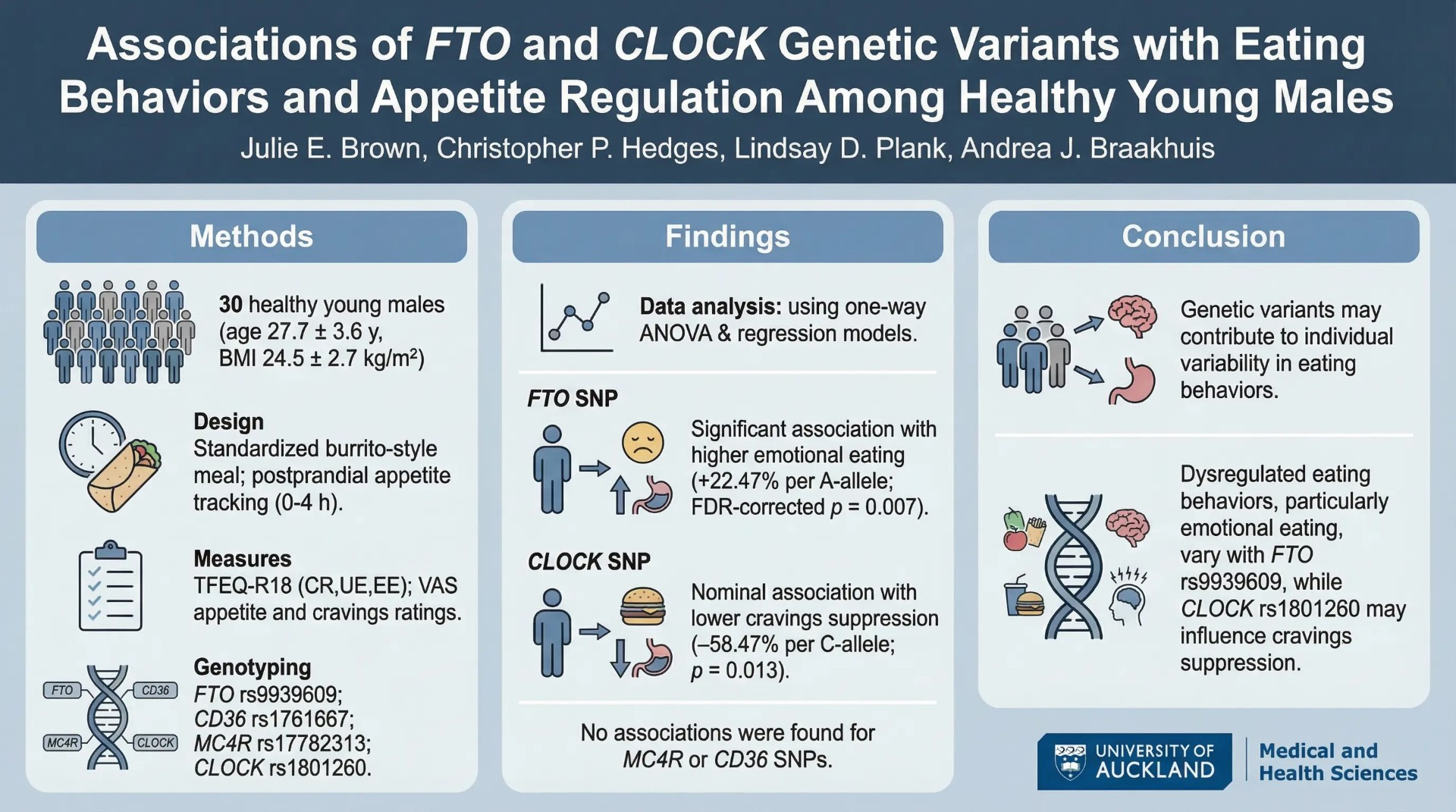
Associations of FTO and CLOCK Genetic Variants with Emotional Eating and Reward-Related Appetite Regulation Among Healthy Young Adult Males: An Exploratory Secondary Analysis


Abstract
1. Introduction
Aim
2. Methods and Materials
2.1. Study Design and Setting
2.2. Participant Recruitment and Eligibility Criteria
2.3. Eating Behavior Assessment (TFEQ-R18)
2.4. Appetite Assessment and Standardized Test Meal
2.5. Composite Appetite and Cravings Suppression Scores
2.6. Genetic Analysis and SNP Selection
2.7. Data Analysis and Statistics
2.8. Statistical Adjustment for Multiple Comparisons
3. Results
3.1. Allele Frequencies and Reliability
3.2. Descriptive Analysis
3.3. Genotype Group Comparisons (One-Way ANOVA)
3.4. Additive Linear Regression Models
3.5. Multiple Testing Correction
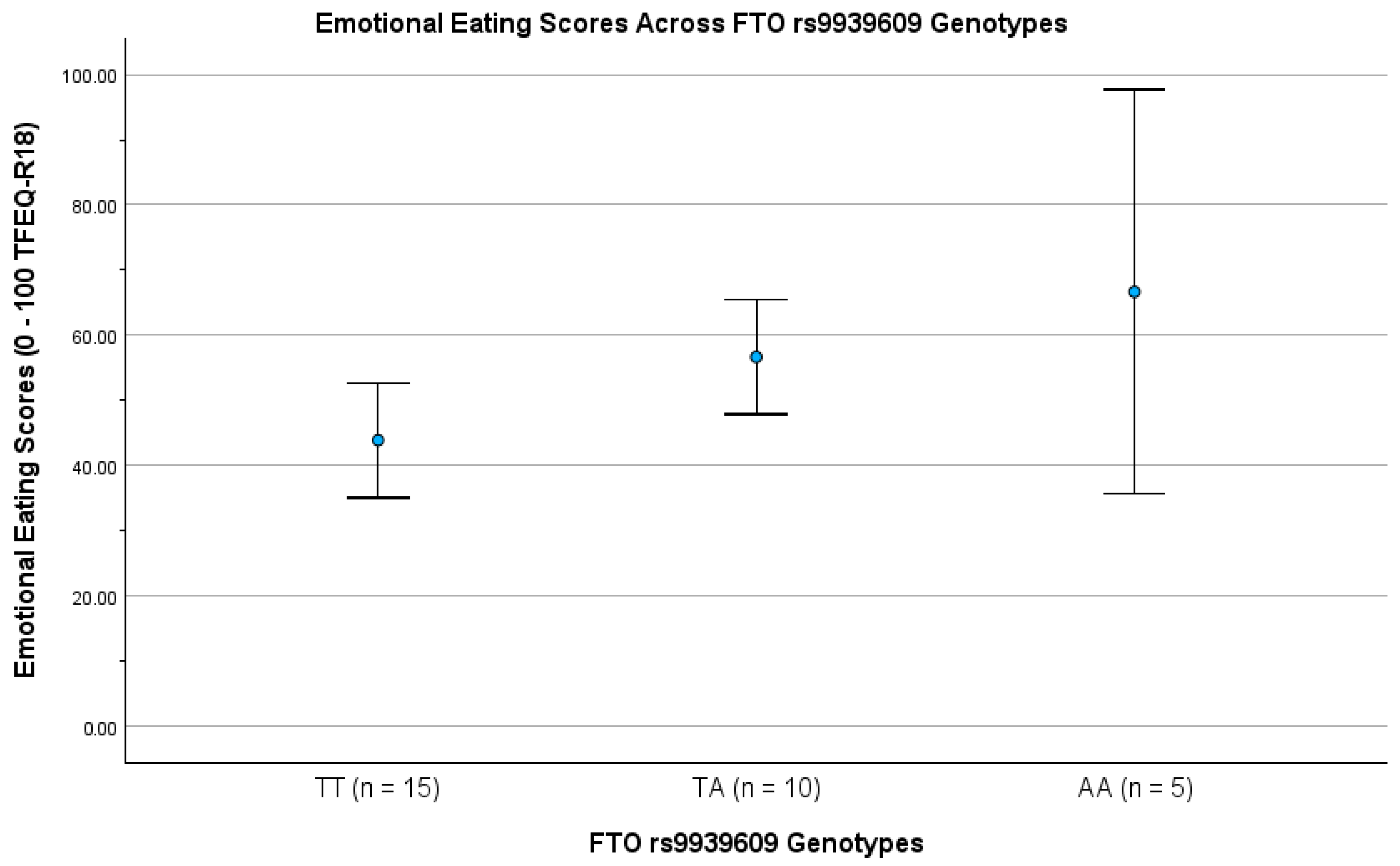
3.6. Genotype–Phenotype Association: FTO rs9939609 and EE
3.7. Effect Size Interpretation
4. Discussion
4.1. Strengths and Limitations
4.2. Future Directions
5. Conclusions
Supplementary Materials
Author Contributions
Funding
Institutional Review Board Statement
Informed Consent Statement
Data Availability Statement
Conflicts of Interest
Abbreviations
| AUC | Area under the curve |
| BH-FDR | Benjamini–Hochberg false discovery rate |
| BMI | Body Mass Index |
| CCK | Cholecystokinin |
| CD36 | Cluster of Differentiation 36 |
| CI | Confidence interval |
| CLOCK | Circadian Locomotor Output Cycles Kaput |
| CR | Cognitive restraint |
| EE | Emotional eating |
| FTO | Fat Mass and Obesity-Associated |
| GLP-1 | Glucagon-like peptide-1 |
| GWAS | Genome-wide association studies |
| HWE | Hardy–Weinberg Equilibrium |
| MC4R | Melanocortin 4 receptor |
| PYY | Peptide YY |
| PFC | Prospective food consumption |
| SNP | Single nucleotide polymorphism |
| TFEQ | Three-Factor Eating Questionnaire |
| UE | Uncontrolled eating |
| VAS | Visual Analogue Scale |
References
- Stover, P.J.; Field, M.S.; Andermann, M.L.; Bailey, R.L.; Batterham, R.L.; Cauffman, E.; Frühbeck, G.; Iversen, P.O.; Starke-Reed, P.; Sternson, S.M.; et al. Neurobiology of eating behavior, nutrition, and health. J. Intern. Med. 2023, 294, 582–604. [Google Scholar] [CrossRef] [Scilit]
- Asamane, E.A.; Greig, C.A.; Aunger, J.A.; Thompson, J.L. Perceptions and Factors Influencing Eating Behaviours and Physical Function in Community-Dwelling Ethnically Diverse Older Adults: A Longitudinal Qualitative Study. Nutrients 2019, 11, 1224. [Google Scholar] [CrossRef] [Scilit]
- Paquet, C. Environmental Influences on Food Behaviour. Int. J. Environ. Res. Public Health 2019, 16, 2763. [Google Scholar] [CrossRef] [Scilit]
- Higgs, S. Social norms and their influence on eating behaviours. Appetite 2015, 86, 38–44. [Google Scholar] [CrossRef] [Scilit]
- Jinnette, R.; Narita, A.; Manning, B.; McNaughton, S.A.; Mathers, J.C.; Livingstone, K.M. Does Personalized Nutrition Advice Improve Dietary Intake in Healthy Adults? A Systematic Review of Randomized Controlled Trials. Adv. Nutr. 2021, 12, 657–669. [Google Scholar] [CrossRef] [Scilit]
- Herle, M.; Smith, A.D.; Kininmonth, A.; Llewellyn, C. The Role of Eating Behaviours in Genetic Susceptibility to Obesity. Curr. Obes. Rep. 2020, 9, 512–521. [Google Scholar] [CrossRef] [Scilit]
- Cifuentes, L.; Acosta, A. Homeostatic regulation of food intake. Clin. Res. Hepatol. Gastroenterol. 2022, 46, 101794. [Google Scholar] [CrossRef] [Scilit]
- Berthoud, H.R.; Münzberg, H.; Morrison, C.D. Blaming the Brain for Obesity: Integration of Hedonic and Homeostatic Mechanisms. Gastroenterology 2017, 152, 1728–1738. [Google Scholar] [CrossRef] [Scilit] [PubMed]
- Szalanczy, A.M.; Key, C.-C.; Solberg Woods, L.C. Genetic variation in satiety signaling and hypothalamic inflammation: Merging fields for the study of obesity. J. Nutr. Biochem. 2022, 101, 108928. [Google Scholar] [CrossRef] [Scilit] [PubMed]
- Ahima, R.S.; Antwi, D.A. Brain regulation of appetite and satiety. Endocrinol. Metab. Clin. N. Am. 2008, 37, 811–823. [Google Scholar] [CrossRef] [Scilit] [PubMed]
- de Wouters d’Oplinter, A.; Huwart, S.J.P.; Cani, P.D.; Everard, A. Gut microbes and food reward: From the gut to the brain. Front. Neurosci. 2022, 16, 947240. [Google Scholar] [CrossRef] [Scilit]
- Stover, P.J. Human nutrition and genetic variation. Food Nutr. Bull. 2007, 28, S101–S115. [Google Scholar] [CrossRef] [Scilit]
- Jacob, R.; Drapeau, V.; Tremblay, A.; Provencher, V.; Bouchard, C.; Pérusse, L. The role of eating behavior traits in mediating genetic susceptibility to obesity. Am. J. Clin. Nutr. 2018, 108, 445–452. [Google Scholar] [CrossRef] [Scilit]
- Brown, J.E.; Morton, L.; Braakhuis, A.J. Exploring Genetic Modifiers Influencing Adult Eating Behaviour: A Scoping Review. Appetite 2025, 214, 108193. [Google Scholar] [CrossRef] [Scilit]
- Gkouskou, K.G.; Georgiopoulos, G.; Vlastos, I.; Lazou, E.; Chaniotis, D.; Papaioannou, T.G.; Mantzoros, C.S.; Sanoudou, D.; Eliopoulos, A.G. CYP1A2 polymorphisms modify the association of habitual coffee consumption with appetite, macronutrient intake, and body mass index: Results from an observational cohort and a cross-over randomized study. Int. J. Obes. 2022, 46, 162–168. [Google Scholar] [CrossRef] [Scilit]
- Kawafune, K.; Hachiya, T.; Nogawa, S.; Takahashi, S.; Jia, H.; Saito, K.; Kato, H. Strong association between the 12q24 locus and sweet taste preference in the Japanese population revealed by genome-wide meta-analysis. J. Hum. Genet. 2020, 65, 939–947. [Google Scholar] [CrossRef] [Scilit]
- Farooqi, I.S.; Keogh, J.M.; Yeo, G.S.; Lank, E.J.; Cheetham, T.; O’Rahilly, S. Clinical spectrum of obesity and mutations in the melanocortin 4 receptor gene. N. Engl. J. Med. 2003, 348, 1085–1095. [Google Scholar] [CrossRef] [Scilit] [PubMed]
- Grimm, E.R.; Steinle, N.I. Genetics of eating behavior: Established and emerging concepts. Nutr. Rev. 2011, 69, 52–60. [Google Scholar] [CrossRef] [Scilit] [PubMed]
- Huang, T.; Zheng, Y.; Hruby, A.; Williamson, D.A.; Bray, G.A.; Shen, Y.; Sacks, F.M.; Qi, L. Dietary protein modifies the effect of the MC4R genotype on 2-year changes in appetite and food craving: The POUNDS Lost Trial. J. Nutr. 2017, 147, 439–444. [Google Scholar] [CrossRef] [Scilit]
- Loos, R.J.F.; Lindgren, C.M.; Li, S.; Wheeler, E.; Zhao, J.H.; Prokopenko, I.; Inouye, M.; Freathy, R.M.; Attwood, A.P.; Beckmann, J.S.; et al. Common variants near MC4R are associated with fat mass, weight and risk of obesity. Nat. Genet. 2008, 40, 768–775. [Google Scholar] [CrossRef] [Scilit] [PubMed]
- Harbron, J.; van der Merwe, L.; Zaahl, M.G.; Kotze, M.J.; Senekal, M. Fat mass and obesity-associated (FTO) gene polymorphisms are associated with physical activity, food intake, eating behaviors, psychological health, and modeled change in body mass index in overweight/obese Caucasian adults. Nutrients 2014, 6, 3130–3152. [Google Scholar] [CrossRef] [Scilit]
- Frayling, T.M.; Timpson, N.J.; Weedon, M.N.; Zeggini, E.; Freathy, R.M.; Lindgren, C.M.; Perry, J.R.B.; Elliott, K.S.; Lango, H.; Rayner, N.W.; et al. A common variant in the FTO gene is associated with body mass index and predisposes to childhood and adult obesity. Science 2007, 316, 889–894. [Google Scholar] [CrossRef] [Scilit]
- Magno, F.C.C.M.; Guaraná, H.C.; Fonseca, A.C.P.; Cabello, G.M.K.; Carneiro, J.R.I.; Pedrosa, A.P.; Ximenes, A.C.; Rosado, E.L. Influence of FTO rs9939609 polymorphism on appetite, ghrelin, leptin, IL6, TNFα levels, and food intake of women with morbid obesity. Diabetes Metab. Syndr. Obes. 2018, 11, 199–207. [Google Scholar] [CrossRef] [Scilit]
- Rijo-Ferreira, F.; Takahashi, J.S. Genomics of circadian rhythms in health and disease. Genome Med. 2019, 11, 82. [Google Scholar] [CrossRef] [Scilit]
- Espinosa-Salinas, I.; San-Cristobal, R.; Colmenarejo, G.; Loria-Kohen, V.; Molina, S.; Reglero, G.; de Molina, A.R.; Martinez, J.A. Polymorphic Appetite Effects on Waist Circumference Depend on rs3749474 CLOCK Gene Variant. Nutrients 2020, 12, 1846. [Google Scholar] [CrossRef] [Scilit] [PubMed]
- Barragán, R.; Fernández-Carrión, R.; Asensio-Márquez, E.M.; Ortega-Azorín, C.; Álvarez-Sala, A.; Pérez-Fidalgo, A.; Sorlí, J.V.; Portolés, O.; González-Monje, I.; St-Onge, M.P.; et al. Timing of Meals and Sleep in the Mediterranean Population: The Effect of Taste, Genetics, Environmental Determinants, and Interactions on Obesity Phenotypes. Nutrients 2023, 15, 708. [Google Scholar] [CrossRef] [Scilit] [PubMed]
- Karmous, I.; Plesnik, J.; Khan, A.S.; Sery, O.; Abid, A.; Mankai, A.; Aouidet, A.; Khan, N.A. Orosensory detection of bitter in fat-taster healthy and obese participants: Genetic polymorphism of CD36 and TAS2R38 [Research Support, Non-U.S. Gov’t]. Clin. Nutr. 2018, 37, 313–320. [Google Scholar] [CrossRef] [Scilit] [PubMed]
- Degrace-Passilly, P.; Besnard, P. CD36 and taste of fat. Curr. Opin. Clin. Nutr. Metab. Care 2012, 15, 107–111. [Google Scholar] [CrossRef] [Scilit]
- Melis, M.; Carta, G.; Pintus, S.; Pintus, P.; Piras, C.A.; Murru, E.; Manca, C.; Di Marzo, V.; Banni, S.; Barbarossa, I.T. Polymorphism rs1761667 in the CD36 gene is associated to changes in fatty acid metabolism and circulating endocannabinoid levels distinctively in normal weight and obese subjects. Front. Physiol. 2017, 8, 1006. [Google Scholar] [CrossRef] [Scilit]
- Plesník, J.; Šerý, O.; Khan, A.S.; Bielik, P.; Khan, N.A. The rs1527483, but not rs3212018, CD36 polymorphism associates with linoleic acid detection and obesity in Czech young adults. Br. J. Nutr. 2018, 119, 472–478. [Google Scholar] [CrossRef] [Scilit]
- Yu, J.H.; Kim, M.S. Molecular mechanisms of appetite regulation. Diabetes Metab. J. 2012, 36, 391–398. [Google Scholar] [CrossRef] [Scilit]
- Ordovas, J.M. Genotype-phenotype associations: Modulation by diet and obesity. Obesity 2008, 16, S40–S46. [Google Scholar] [CrossRef] [Scilit]
- Ellis, A.; Rozga, M.; Braakhuis, A.; Monnard, C.R.; Robinson, K.; Sinley, R.; Wanner, A.; Vargas, A.J. Effect of Incorporating Genetic Testing Results into Nutrition Counseling and Care on Health Outcomes: An Evidence Analysis Center Systematic Review—Part II. J. Acad. Nutr. Diet. 2021, 121, 582–605.e17. [Google Scholar] [CrossRef] [Scilit]
- de Lauzon-Guillain, B.; Clifton, E.A.; Day, F.R.; Clément, K.; Brage, S.; Forouhi, N.G.; Griffin, S.J.; Koudou, Y.A.; Pelloux, V.; Wareham, N.J.; et al. Mediation and modification of genetic susceptibility to obesity by eating behaviors. Am. J. Clin. Nutr. 2017, 106, 996–1004. [Google Scholar] [CrossRef] [Scilit] [PubMed]
- Pham, T.; Knowles, S.; Bermingham, E.; Brown, J.; Hannaford, R.; Cameron-Smith, D.; Braakhuis, A. Plasma Amino Acid Appearance and Status of Appetite Following a Single Meal of Red Meat or a Plant-Based Meat Analog: A Randomized Crossover Clinical Trial. Curr. Dev. Nutr. 2022, 6, nzac082. [Google Scholar] [CrossRef] [Scilit]
- Brown, J.E.; Pham, T.; Burden, H.; Braakhuis, A.J. Specific Genotypes Associated with Differences in Fasting Insulin Levels and Body Mass Index in Healthy Young Males: Implications for Gene-Nutrient Interactions-an Exploratory Study. Curr. Dev. Nutr. 2023, 7, 102018. [Google Scholar] [CrossRef] [Scilit] [PubMed]
- Stunkard, A.J.; Messick, S. The three-factor eating questionnaire to measure dietary restraint, disinhibition and hunger. J. Psychosom. Res. 1985, 29, 71–83. [Google Scholar] [CrossRef] [Scilit]
- de Lauzon, B.; Romon, M.; Deschamps, V.; Lafay, L.; Borys, J.-M.; Karlsson, J.; Ducimetière, P.; Charles, M.A. The Three-Factor Eating Questionnaire-R18 is able to distinguish among different eating patterns in a general population. J. Nutr. 2004, 134, 2372–2380. [Google Scholar] [CrossRef] [Scilit] [PubMed]
- Flint, A.; Raben, A.; Blundell, J.E.; Astrup, A. Reproducibility, power and validity of visual analogue scales in assessment of appetite sensations in single test meal studies. Int. J. Obes. Relat. Metab. Disord. 2000, 24, 38–48. [Google Scholar] [CrossRef] [Scilit]
- Gibbons, C.; Hopkins, M.; Beaulieu, K.; Oustric, P.; Blundell, J.E. Issues in Measuring and Interpreting Human Appetite (Satiety/Satiation) and Its Contribution to Obesity. Curr. Obes. Rep. 2019, 8, 77–87. [Google Scholar] [CrossRef] [Scilit]
- Rahati, S.; Qorbani, M.; Naghavi, A.; Pishva, H. Association and interaction of the MC4R rs17782313 polymorphism with plasma ghrelin, GLP-1, cortisol, food intake and eating behaviors in overweight/obese Iranian adults. BMC Endocr. Disord. 2022, 22, 234. [Google Scholar] [CrossRef] [Scilit]
- Amr, A.M.; Anderson, G.H.; Vien, S.; Fabek, H. Potatoes Compared with Rice in Meals with either Animal or Plant Protein Reduce Postprandial Glycemia and Increase Satiety in Healthy Adults: A Randomized Crossover Study. J. Nutr. 2024, 154, 2999–3011. [Google Scholar] [CrossRef] [Scilit]
- Rahati, S.; Qorbani, M.; Naghavi, A.; Nia, M.H.; Pishva, H. Association between CLOCK 3111 T/C polymorphism with ghrelin, GLP-1, food timing, sleep and chronotype in overweight and obese Iranian adults. BMC Endocr. Disord. 2022, 22, 147. [Google Scholar] [CrossRef] [Scilit]
- Lairon, D.; Lopez-Miranda, J.; Williams, C. Methodology for studying postprandial lipid metabolism. Eur. J. Clin. Nutr. 2007, 61, 1145–1161. [Google Scholar] [CrossRef] [Scilit]
- Mullins, V.A.; Bresette, W.; Johnstone, L.; Hallmark, B.; Chilton, F.H. Genomics in Personalized Nutrition: Can You “Eat for Your Genes”? Nutrients 2020, 12, 3118. [Google Scholar] [CrossRef] [Scilit]
- Sherry, S.T.; Ward, M.-H.; Kholodov, M.; Baker, J.; Phan, L.; Smigielski, E.M.; Sirotkin, K. dbSNP: The NCBI database of genetic variation. Nucleic Acids Res. 2001, 29, 308–311. [Google Scholar] [CrossRef] [Scilit]
- Schneider, V.A.; Graves-Lindsay, T.; Howe, K.; Bouk, N.; Chen, H.-C.; Kitts, P.A.; Murphy, T.D.; Pruitt, K.D.; Thibaud-Nissen, F.; Albracht, D.; et al. Evaluation of GRCh38 and de novo haploid genome assemblies demonstrates the enduring quality of the reference assembly. Genome Res. 2017, 27, 849–864. [Google Scholar] [CrossRef] [Scilit] [PubMed]
- Liu, X.; Li, C.; Sun, X.; Yu, Y.; Si, S.; Hou, L.; Yan, R.; Yu, Y.; Li, M.; Li, H.; et al. Genetically Predicted Insomnia in Relation to 14 Cardiovascular Conditions and 17 Cardiometabolic Risk Factors: A Mendelian Randomization Study. J. Am. Heart Assoc. 2021, 10, e020187. [Google Scholar] [CrossRef] [Scilit] [PubMed]
- Little, J.; Higgins, J.P.; Ioannidis, J.P.; Moher, D.; Gagnon, F.; Von Elm, E.; Khoury, M.J.; Cohen, B.; Davey-Smith, G.; Grimshaw, J.; et al. STrengthening the REporting of Genetic Association Studies (STREGA)—An extension of the STROBE statement. Genet. Epidemiol. 2009, 33, 581–598. [Google Scholar] [CrossRef] [Scilit] [PubMed]
- Mishra, P.; Pandey, C.M.; Singh, U.; Gupta, A.; Sahu, C.; Keshri, A. Descriptive statistics and normality tests for statistical data. Ann. Card. Anaesth. 2019, 22, 67–72. [Google Scholar] [CrossRef] [Scilit]
- Cole, T.J. Sympercents: Symmetric percentage differences on the 100 log(e) scale simplify the presentation of log transformed data. Stat. Med. 2000, 19, 3109–3125. [Google Scholar] [CrossRef] [Scilit] [PubMed]
- Benjamini, Y.; Drai, D.; Elmer, G.; Kafkafi, N.; Golani, I. Controlling the false discovery rate in behavior genetics research. Behav. Brain Res. 2001, 125, 279–284. [Google Scholar] [CrossRef] [Scilit]
- Blundell, J.; De Graaf, C.; Hulshof, T.; Jebb, S.; Livingstone, B.; Lluch, A.; Mela, D.; Salah, S.; Schuring, E.; Van Der Knaap, H.; et al. Appetite control: Methodological aspects of the evaluation of foods. Obes. Rev. 2010, 11, 251–270. [Google Scholar] [CrossRef] [Scilit]
- Gudmundsson, S.; Singer-Berk, M.; Watts, N.A.; Phu, W.; Goodrich, J.K.; Solomonson, M.; Genome Aggregation Database Consortium; Rehm, H.L.; MacArthur, D.G.; O’Donnell-Luria, A. Variant interpretation using population databases: Lessons from gnomAD. Hum. Mutat. 2022, 43, 1012–1030. [Google Scholar] [CrossRef] [Scilit]
- Bhagwat, M. Searching NCBI’s dbSNP Database. Curr. Protoc. Bioinform. 2010, 32, 1–19. [Google Scholar] [CrossRef] [Scilit]
- Antontseva, E.V.; Degtyareva, A.O.; Korbolina, E.E.; Damarov, I.S.; Merkulova, T.I. Human-genome single nucleotide polymorphisms affecting transcription factor binding and their role in pathogenesis. Vavilov J. Genet. Breed. 2023, 27, 662–675. [Google Scholar] [CrossRef] [Scilit]
- Nawi, F.A.M.; Malek, A.T.A.; Faizal, S.M.; Wan, M.W.M. A Review on the Internal Consistency of a Scale: The Empirical Example of the Influence of Human Capital Investment on Malcom Baldridge Quality Principles in TVET Institutions. Asian People J. 2020, 3, 19–29. [Google Scholar] [CrossRef] [Scilit]
- Bland, J.M.; Altman, D.G. Cronbach’s alpha. BMJ 1997, 314, 572. [Google Scholar] [CrossRef] [Scilit] [PubMed]
- Taber, K.S. The Use of Cronbach’s Alpha When Developing and Reporting Research Instruments in Science Education. Res. Sci. Educ. 2017, 48, 1273–1296. [Google Scholar] [CrossRef] [Scilit]
- Magno, F.C.C.M.; Guaraná, H.C.; da Fonseca, A.C.P.; Pedrosa, A.P.; Zembrzuski, V.M.; Cabello, P.H.; Cabello, G.M.K.; Carneiro, J.R.I.; Rosado, E.L. Association of the MC4R rs17782313 polymorphism with plasma ghrelin, leptin, IL6 and TNFα concentrations, food intake and eating behaviors in morbidly obese women. Eat. Weight Disord. 2021, 26, 1079–1087. [Google Scholar] [CrossRef] [Scilit] [PubMed]
- Huang, T.; Qi, Q.; Li, Y.; Hu, F.B.; Bray, G.A.; Sacks, F.M.; Williamson, D.A.; Qi, L. FTO genotype, dietary protein, and change in appetite: The Preventing Overweight Using Novel Dietary Strategies trial. Am. J. Clin. Nutr. 2014, 99, 1126–1130. [Google Scholar] [CrossRef] [Scilit] [PubMed]
- Madrigal-Juarez, A.; Martínez-López, E.; Sanchez-Murguia, T.; la Vega, L.M.-D.; Rodriguez-Echevarria, R.; Sepulveda-Villegas, M.; Torres-Valadez, R.; Torres-Castillo, N. FTO genotypes (rs9939609 T>A) are Associated with Increased Added Sugar Intake in Healthy Young Adults. Lifestyle Genom. 2023, 16, 214–223. [Google Scholar] [CrossRef] [Scilit]
- Dougkas, A.; Yaqoob, P.; Givens, D.I.; Reynolds, C.K.; Minihane, A.M. The impact of obesity-related SNP on appetite and energy intake. Br. J. Nutr. 2013, 110, 1151–1156. [Google Scholar] [CrossRef] [Scilit]
- López-Guimerà, G.; Dashti, H.S.; Smith, C.E.; Sánchez-Carracedo, D.; Ordovas, J.M.; Garaulet, M. CLOCK 3111 T/C SNP interacts with emotional eating behavior for weight-loss in a Mediterranean population. PLoS ONE 2014, 9, e99152. [Google Scholar] [CrossRef] [Scilit] [PubMed]
- Lopez-Minguez, J.; Gomez-Abellan, P.; Garaulet, M. Circadian rhythms, food timing and obesity. Proc. Nutr. Soc. 2016, 75, 501–511. [Google Scholar] [CrossRef] [Scilit] [PubMed]
- Barakat, S.; McLean, S.A.; Bryant, E.; Le, A.; Marks, P.; Touyz, S.; Maguire, S. Risk factors for eating disorders: Findings from a rapid review. J. Eat. Disord. 2023, 11, 8. [Google Scholar] [CrossRef] [Scilit]
- Chamoun, E.; Mutch, D.M.; Allen-Vercoe, E.; Buchholz, A.C.; Duncan, A.M.; Spriet, L.L.; Haines, J.; Ma, D.W.L.; on behalf of the Guelph Family Health Study. A review of the associations between single nucleotide polymorphisms in taste receptors, eating behaviors, and health. Crit. Rev. Food Sci. Nutr. 2018, 58, 194–207. [Google Scholar] [CrossRef] [Scilit]
- Smit, R.A.J.; Wade, K.H.; Hui, Q.; Arias, J.D.; Yin, X.; Christiansen, M.R.; Yengo, L.; Preuss, M.H.; Nakabuye, M.; Rocheleau, G.; et al. Polygenic prediction of body mass index and obesity through the life course and across ancestries. Nat. Med. 2025, 31, 3151–3168. [Google Scholar] [CrossRef] [Scilit]
- Chermon, D.; Birk, R. Predisposition of the Common MC4R rs17782313 Female Carriers to Elevated Obesity and Interaction with Eating Habits. Genes 2023, 14, 1996. [Google Scholar] [CrossRef] [Scilit]
- Whatnall, M.C.; Hutchesson, M.J.; Sharkey, T.; Haslam, R.L.; Bezzina, A.; Collins, C.E.; Tzelepis, F.; Ashton, L.M. Recruiting and retaining young adults: What can we learn from behavioural interventions targeting nutrition, physical activity and/or obesity? A systematic review of the literature. Public Health Nutr. 2021, 24, 5686–5703. [Google Scholar] [CrossRef] [Scilit]
- Timasheva, Y.; Balkhiyarova, Z.; Avzaletdinova, D.; Morugova, T.; Korytina, G.F.; Nouwen, A.; Prokopenko, I.; Kochetova, O. Mendelian Randomization Analysis Identifies Inverse Causal Relationship between External Eating and Metabolic Phenotypes. Nutrients 2024, 16, 1166. [Google Scholar] [CrossRef] [Scilit] [PubMed]
- Obregon, A.M.; Oyarce, K.; Santos, J.L.; Valladares, M.; Goldfield, G. Association of the melanocortin 4 receptor gene rs17782313 polymorphism with rewarding value of food and eating behavior in Chilean children. J. Physiol. Biochem. 2017, 73, 29–35. [Google Scholar] [CrossRef] [Scilit] [PubMed]
- Perneger, T.V. What’s wrong with Bonferroni adjustments. BMJ 1998, 316, 1236–1238. [Google Scholar] [CrossRef] [Scilit]
- Groenwold, R.H.H.; Goeman, J.J.; Cessie, S.L.; Dekkers, O.M. Multiple testing: When is many too much? Eur. J. Endocrinol. 2021, 184, E11–E14. [Google Scholar] [CrossRef] [Scilit] [PubMed]
- Han, P.; Keast, R.S.; Roura, E. Salivary leptin and TAS1R2/TAS1R3 polymorphisms are related to sweet taste sensitivity and carbohydrate intake from a buffet meal in healthy young adults. Br. J. Nutr. 2017, 118, 763–770. [Google Scholar] [CrossRef] [Scilit]
- Franzago, M.; Di Nicola, M.; Fraticelli, F.; Marchioni, M.; Stuppia, L.; Vitacolonna, E. Nutrigenetic variants and response to diet/lifestyle intervention in obese subjects: A pilot study. Acta Diabetol. 2022, 59, 69–81. [Google Scholar] [CrossRef] [Scilit]
- Chamoun, E.; Liu, A.S.; Duizer, L.M.; Feng, Z.; Darlington, G.; Duncan, A.M.; Haines, J.; Ma, D.W. Single nucleotide polymorphisms in sweet, fat, umami, salt, bitter and sour taste receptor genes are associated with gustatory function and taste preferences in young adults. Nutr. Res. 2021, 85, 40–46. [Google Scholar] [CrossRef] [Scilit]
- Llewellyn, C.; Wardle, J. Behavioral susceptibility to obesity: Gene–environment interplay in the development of weight. Physiol. Behav. 2015, 152, 494–501. [Google Scholar] [CrossRef] [Scilit]
- Nielsen, D.E.; El-Sohemy, A. Disclosure of genetic information and change in dietary intake: A randomized controlled trial. PLoS ONE 2014, 9, e112665. [Google Scholar] [CrossRef] [Scilit]
- Oikarinen, N.; Jokelainen, T.; Heikkilä, L.; Nurkkala, M.; Hukkanen, J.; Salonurmi, T. Low eating self-efficacy is associated with unfavorable eating behavior tendencies among individuals with overweight and obesity. Sci. Rep. 2023, 13, 7730. [Google Scholar] [CrossRef] [Scilit]
- Dubois, L.; Bédard, B.; Goulet, D.; Prud’homme, D.; Tremblay, R.E.; Boivin, M. Eating behaviors, dietary patterns and weight status in emerging adulthood and longitudinal associations with eating behaviors in early childhood. Int. J. Behav. Nutr. Phys. Act. 2022, 19, 139. [Google Scholar] [CrossRef] [Scilit] [PubMed]

| Characteristics (N = 30) | Mean ± SD |
|---|---|
| Age (years) | 27.7 ± 3.62 |
| Body weight (kg) | 76.6 ± 10.0 |
| Height (cm) | 176.6 ± 5.80 |
| Body mass index (BMI) (kg/m2) | 24.5 ± 2.69 |
| Hunger (VAS, 0–100) | 72.7 ± 25.3 |
| Satiety (VAS, 0–100) | 32.4 ± 26.6 |
| Fullness (VAS, 0–100) | 34.4 ± 33.6 |
| Prospective food consumption (VAS, 0–100) | 29.2 ± 23.3 |
| Desire for sweet foods (VAS, 0–100) | 48.0 ± 28.1 |
| Desire for salty foods (VAS, 0–100) | 43.9 ± 19.1 |
| Desire for savory foods (VAS, 0–100) | 33.0 ± 22.8 |
| Desire for fatty foods (VAS, 0–100) | 52.1 ± 23.3 |
| Gene | SNP rsID | Population | Allele Frequency | Genotype Frequency | ||
| FTO | rs9939609 | Reference | T = 0.60, A = 0.40 | TT = 42%, TA = 44%, AA = 13% | ||
| FTO | rs9939609 | Study cohort (N = 30) | T = 0.67, A = 0.33 | TT = 15 (50%), TA = 10 (33%), AA = 5 (17%) | ||
| CD36 | rs1761667 | Reference | G = 0.52, A = 0.48 | GG = 27%, GA = 50%, AA = 23% | ||
| CD36 | rs1761667 | Study cohort (N = 30) | G = 0.62, A = 0.38 | GG = 11 (37%), GA = 15 (50%), AA = 4 (13%) | ||
| MC4R | rs17782313 | Reference | T = 0.77, C = 0.23 | TT = 61%, CT = 34%, CC = 5% | ||
| MC4R | rs17782313 | Study cohort (N = 30) | T = 0.72, C = 0.28 | TT = 15 (50%), CT = 13 (43%), CC = 2 (7%) | ||
| CLOCK | rs1801260 | Reference | T = 0.64, C = 0.36 | TT = 54%, CT = 38%, CC = 7% | ||
| CLOCK | rs1801260 | Study cohort (N = 30) | T = 0.78, C = 0.22 | TT = 19 (63%), CT = 9 (30%), CC = 2 (7%) | ||
| Metric | Mean | SD | SE | 95% CI (Lower) | 95% CI (Upper) |
|---|---|---|---|---|---|
| Cognitive restraint (%) | 50.42 | 16.30 | 3.03 | 44.23 | 56.61 |
| Uncontrolled eating (%) | 53.52 | 13.28 | 2.47 | 48.47 | 58.56 |
| Emotional eating (%) | 51.94 | 17.96 | 3.34 | 45.12 | 58.77 |
| Appetite suppression (AUC) | 154.09 | 106.99 | 19.53 | 115.80 | 192.38 |
| Cravings suppression (AUC) | 101.20 | 82.84 | 15.12 | 71.55 | 130.84 |
| SNP (rs ID) | Outcome | F-Value | p Value | η2 |
|---|---|---|---|---|
| FTO rs9939609 | Emotional eating | 4.16 | 0.027 * | 0.236 |
| CLOCK rs1801260 | Uncontrolled eating | 5.61 | 0.009 ** | 0.294 |
| CLOCK rs1801260 | Cravings suppression | 3.63 | 0.040 * | 0.212 |
| MC4R rs17782313 | Cognitive restraint | 2.73 | 0.083 | 0.168 |
| MC4R rs17782313 | Cravings suppression | 2.65 | 0.089 | 0.164 |
| CD36 rs1761667 | No significant differences observed |
| Outcome | SNP | β Unstd. (Unadjusted) | 95% CI (Unadjusted) | p (Unadjusted) | β Unstd. (Adjusted) | 95% CI (Adjusted) | p (Adjusted) |
|---|---|---|---|---|---|---|---|
| Cognitive restraint | FTO | 2.13 | [−6.30, 10.55] | 0.610 | 2.04 | [−6.39, 10.48] | 0.623 |
| CD36 | −6.02 | [−15.18, 3.15] | 0.189 | −7.61 | [−18.04, 2.82] | 0.146 | |
| MC4R | 5.06 | [−5.01, 15.12] | 0.312 | 5.53 | [−4.83, 15.89] | 0.282 | |
| CLOCK | −3.78 | [−13.92, 6.37 ] | 0.452 | −2.96 | [−13.46, 7.54] | 0.567 | |
| Uncontrolled eating | FTO | 3.94 | [−2.78, 10.67] | 0.240 | 3.76 | [−2.79, 10.31] | 0.249 |
| CD36 | 0.18 | [−7.52, 7.88] | 0.962 | −1.49 | [−10.10, 7.12] | 0.726 | |
| MC4R | 1.58 | [−6.75, 9.91] | 0.701 | 2.72 | [−5.62, 11.06] | 0.508 | |
| CLOCK | −3.54 | [−11.78, 4.70] | 0.387 | −3.51 | [−11.78, 4.75] | 0.390 | |
| Emotional eating | FTO | 11.67 | [3.50, 19.83] | 0.007 * | 11.41 | [3.58, 19.23] | 0.006 * |
| CD36 | 5.38 | [−4.82, 15.59] | 0.289 | 4.30 | [−7.22, 15.81] | 0.450 | |
| MC4R | 1.49 | [−9.79, 12.77] | 0.789 | 3.20 | [−8.08, 14.47] | 0.565 | |
| CLOCK | −4.42 | [−15.59, 6.74] | 0.424 | −4.58 | [−15.74, 6.59] | 0.407 | |
| Appetite suppression | FTO | −28.52 | [−82.03, 24.99] | 0.284 | −27.27 | [−81.12, 26.59] | 0.308 |
| CD36 | −21.28 | [−81.73, 39.17] | 0.477 | −13.71 | [−84.00, 56.58] | 0.692 | |
| MC4R | 1.83 | [−64.32, 67.98] | 0.955 | −5.88 | [−74.55, 62.80] | 0.862 | |
| CLOCK | −4.45 | [−70.58, 61.69] | 0.891 | −4.08 | [−72.58, 64.42] | 0.904 | |
| Cravings suppression | FTO | −10.60 | [−52.70, 31.50] | 0.610 | −9.57 | [−51.58, 32.44] | 0.644 |
| CD36 | −35.91 | [−81.05, 9.24] | 0.114 | −25.18 | [−78.33, 27.98] | 0.339 | |
| MC4R | 30.27 | [−19.59, 80.14] | 0.224 | 22.84 | [−29.09, 74.78] | 0.374 | |
| CLOCK | −59.17 | [−104.98, −13.35] | 0.013 * | −53.24 | [−101.26, −5.23] | 0.031 |
Disclaimer/Publisher’s Note: The statements, opinions and data contained in all publications are solely those of the individual author(s) and contributor(s) and not of MDPI and/or the editor(s). MDPI and/or the editor(s) disclaim responsibility for any injury to people or property resulting from any ideas, methods, instructions or products referred to in the content. |
© 2026 by the authors. Licensee MDPI, Basel, Switzerland. This article is an open access article distributed under the terms and conditions of the Creative Commons Attribution (CC BY) license.
Share and Cite
Brown, J.E.; Hedges, C.P.; Plank, L.D.; Braakhuis, A.J. Associations of FTO and CLOCK Genetic Variants with Emotional Eating and Reward-Related Appetite Regulation Among Healthy Young Adult Males: An Exploratory Secondary Analysis. Nutrients 2026, 18, 400. https://doi.org/10.3390/nu18030400
Brown JE, Hedges CP, Plank LD, Braakhuis AJ. Associations of FTO and CLOCK Genetic Variants with Emotional Eating and Reward-Related Appetite Regulation Among Healthy Young Adult Males: An Exploratory Secondary Analysis. Nutrients. 2026; 18(3):400. https://doi.org/10.3390/nu18030400
Chicago/Turabian StyleBrown, Julie E., Christopher P. Hedges, Lindsay D. Plank, and Andrea J. Braakhuis. 2026. "Associations of FTO and CLOCK Genetic Variants with Emotional Eating and Reward-Related Appetite Regulation Among Healthy Young Adult Males: An Exploratory Secondary Analysis" Nutrients 18, no. 3: 400. https://doi.org/10.3390/nu18030400
APA StyleBrown, J. E., Hedges, C. P., Plank, L. D., & Braakhuis, A. J. (2026). Associations of FTO and CLOCK Genetic Variants with Emotional Eating and Reward-Related Appetite Regulation Among Healthy Young Adult Males: An Exploratory Secondary Analysis. Nutrients, 18(3), 400. https://doi.org/10.3390/nu18030400