Antioxidant Activity and Dose-Dependent Toxicity of a Traditionally Consumed Ipomoea pes-caprae Infusion Evaluated in a Triple-Negative Breast Cancer Xenograft Model

 ,
,  , ,
, ,  , , , , , ,
  and
and 
Abstract
1. Introduction
2. Materials and Methods
2.1. Preparation of Ipomoea pes-caprae Infusion
2.2. Preliminary Phytochemical Screening, Thin-Layer Chromatography (TLC), and Spectroscopic Profile
Acid Hydrolysis of IPCAE
2.3. DPPH Radical Scavenging Activity of Polyphenols from IPCAE
2.4. Total Polyphenol Content Determination by the Folin Ciocalteu Method
2.5. Reducing Sugar Content
2.6. Cell Line Model
2.7. Preliminary Acute Oral Toxicity Evaluation
2.8. In Vivo Tumor Model
2.9. Experimental Design and Treatments
2.10. Outcome Measures
2.11. Statistical Analysis
2.12. Ethical Statement
3. Results
3.1. Phytochemical Characterization and Spectroscopic Profile of the Aqueous Infusion of IPCAE
3.2. Polyphenol Content, Antioxidant Activity, and Reducing Sugar Determination of IPCAE
3.3. Chromatographic Analysis
3.4. Preliminary Acute Toxicity Evaluation, Tumor Progression, Adverse Effects, and Survival
4. Discussion
5. Conclusions
Supplementary Materials
Author Contributions
Funding
Institutional Review Board Statement
Informed Consent Statement
Data Availability Statement
Acknowledgments
Conflicts of Interest
References
- Bray, F.; Laversanne, M.; Sung, H.; Ferlay, J.; Siegel, R.L.; Soerjomataram, I.; Jemal, A. Global Cancer Statistics 2022: GLOBOCAN Estimates of Incidence and Mortality Worldwide for 36 Cancers in 185 Countries. CA Cancer J. Clin. 2024, 74, 229–263. [Google Scholar] [CrossRef] [PubMed]
- Elmadani, M.; Mokaya, P.O.; Omer, A.A.A.; Kiptulon, E.K.; Klara, S.; Orsolya, M. Cancer Burden in Europe: A Systematic Analysis of the GLOBOCAN Database (2022). BMC Cancer 2025, 25, 447. [Google Scholar] [CrossRef] [PubMed]
- Perou, C.M. Molecular Stratification of Triple-Negative Breast Cancers. Oncologist 2011, 16, 61–70. [Google Scholar] [CrossRef] [PubMed]
- Bauer, K.R.; Brown, M.; Cress, R.D.; Parise, C.A.; Caggiano, V. Descriptive Analysis of Estrogen Receptor (ER)-negative, Progesterone Receptor (PR)-negative, and HER2-negative Invasive Breast Cancer, the So-called Triple-negative Phenotype. Cancer 2007, 109, 1721–1728. [Google Scholar] [CrossRef] [PubMed]
- Czaczkowska, L.; Jabłó Nska, E.; Ratajczak-Wrona, W. Endocrine Disruptors and Breast Cancer: A Comprehensive Review. Biomedicines 2025, 13, 2774. [Google Scholar] [CrossRef] [PubMed]
- Lee, J.S.; Yost, S.E.; Yuan, Y. Neoadjuvant Treatment for Triple Negative Breast Cancer: Recent Progresses and Challenges. Cancers 2020, 12, 1404. [Google Scholar] [CrossRef] [PubMed]
- Dent, R.; Trudeau, M.; Pritchard, K.I.; Hanna, W.M.; Kahn, H.K.; Sawka, C.A.; Lickley, L.A.; Rawlinson, E.; Sun, P.; Narod, S.A. Triple-Negative Breast Cancer: Clinical Features and Patterns of Recurrence. Clin. Cancer Res. 2007, 13, 4429–4434. [Google Scholar] [CrossRef] [PubMed]
- Alonso-Castro, A.J.; Villarreal, M.L.; Salazar-Olivo, L.A.; Gomez-Sanchez, M.; Dominguez, F.; Garcia-Carranca, A. Mexican Medicinal Plants Used for Cancer Treatment: Pharmacological, Phytochemical and Ethnobotanical Studies. J. Ethnopharmacol. 2011, 133, 945–972. [Google Scholar] [CrossRef] [PubMed]
- Sofowora, A.; Ogunbodede, E.; Onayade, A. The Role and Place of Medicinal Plants in the Strategies for Disease Prevention. Afr. J. Tradit. Complement. Altern. Med. 2013, 10, 210–229. [Google Scholar] [CrossRef] [PubMed]
- Akinniyi, G.; Lee, J.; Kim, H.; Lee, J.G.; Yang, I. A Medicinal Halophyte Ipomoea pes-caprae (Linn.) R. Br.: A Review of Its Botany, Traditional Uses, Phytochemistry, and Bioactivity. Mar. Drugs 2022, 20, 329. [Google Scholar] [CrossRef] [PubMed]
- Ipomoea pes-caprae—Ficha Informativa. Available online: http://www.conabio.gob.mx/malezasdemexico/convolvulaceae/ipomoea-pes-caprae/fichas/ficha.htm (accessed on 20 May 2026).
- da Silva Barth, C.; Tolentino de Souza, H.G.; Rocha, L.W.; da Silva, G.F.; dos Anjos, M.F.; Pastor, V.D.A.; Belle Bresolin, T.M.; Garcia Couto, A.; Roberto Santin, J.; Meira Quintão, N.L. Ipomoea pes-caprae (L.) R. Br (Convolvulaceae) Relieved Nociception and Inflammation in Mice—A Topical Herbal Medicine against Effects Due to Cnidarian Venom-Skin Contact. J. Ethnopharmacol. 2017, 200, 156–164. [Google Scholar] [CrossRef] [PubMed]
- Zhong, F.; Li, S.; Pan, X.; Wen, J.; Xie, J.; Du, Z.; Hao, E.; Deng, J.; Hou, X. Investigating the Mechanism of Action of Ipomoea pes-caprae in the Treatment of Rheumatoid Arthritis Based on Serum Metabolomics and Network Pharmacology. Mar. Drugs 2025, 23, 114. [Google Scholar] [CrossRef] [PubMed]
- Panichakul, T.; Ponnikorn, S.; Tupchiangmai, W.; Haritakun, W.; Srisanga, K. Skin Anti-Aging Potential of Ipomoea pes-caprae Ethanolic Extracts on Promoting Cell Proliferation and Collagen Production in Human Fibroblasts (CCD-986sk Cells). Pharmaceuticals 2022, 15, 969. [Google Scholar] [CrossRef] [PubMed]
- Saengkhae, C.; Uawongyart, N.; Osiri, S.; Srisook, K.; Tangwattanachuleeporn, M. Antioxidant and Anti-Inflammatory Activities of Different Solvent Extracts from Ipomoea pes-caprae (L.) R. Br. in Lipopolysaccharide Stimulated RAW 264.7 Macrophages. Trends Sci. 2021, 18, 1404. [Google Scholar] [CrossRef]
- Venkataraman, N.D.; Atleeb, W.C.; Prabhuc, T.P.; Kannana, R. Anti-Inflammatory Potential of Ethanolic Extracts from Aerial Parts of Ipomoea pes-caprae (L.) R.Br Using Cotton Pellet Induced Granuloma Model. J. Appl. Pharm. Sci. 2013, 3, 061–063. [Google Scholar] [CrossRef]
- Ullah, A.; Munir, S.; Badshah, S.L.; Khan, N.; Ghani, L.; Poulson, B.G.; Emwas, A.H.; Jaremko, M. Important Flavonoids and Their Role as a Therapeutic Agent. Molecules 2020, 25, 5243. [Google Scholar] [CrossRef] [PubMed]
- Rodríguez-Negrete, E.V.; Morales-González, Á.; Madrigal-Santillán, E.O.; Sánchez-Reyes, K.; Álvarez-González, I.; Madrigal-Bujaidar, E.; Valadez-Vega, C.; Chamorro-Cevallos, G.; Garcia-Melo, L.F.; Morales-González, J.A. Phytochemicals and Their Usefulness in the Maintenance of Health. Plants 2024, 13, 523. [Google Scholar] [CrossRef] [PubMed]
- Bejuco de Mar (Ipomoea pes-caprae). Available online: https://enciclovida.mx/especies/163755-ipomoea-pes-caprae (accessed on 20 May 2026).
- Ipomoea pes-caprae (L.) R. Br. Available online: https://datosabiertos.unam.mx/IBUNAM:MEXU:311512 (accessed on 20 May 2026).
- Universidad Autónoma del Carmen Unacar Noticias: Ficha Botánica de la Riñonina. Available online: https://www.unacar.mx/comunicacion_social_unacar/unacar/noticia_unacar.php?not=aDhTZjNYRW94ZHM9 (accessed on 22 June 2026).
- Ramesh, A.; Sundarraj, P.; Balamani, J. Phytochemical Evaluation of Leaf and Stem of Ipomoea pes-caprae (L) R. Br. Int. J. Adv. Res. 2019, 7, 139–149. [Google Scholar] [CrossRef] [PubMed]
- Meira, M.; da Silva, E.P.; David, J.M.; David, J.P. Review of the Genus Ipomoea: Traditional Uses, Chemistry and Biological Activities. Rev. Bras. Farmacogn. 2012, 22, 682–713. [Google Scholar] [CrossRef]
- U.S. Food and Drug Administration. Estimating the Maximum Safe Starting Dose in Initial Clinical Trials for Therapeutics in Adult Healthy Volunteers|FDA. Available online: https://www.fda.gov/regulatory-information/search-fda-guidance-documents/estimating-maximum-safe-starting-dose-initial-clinical-trials-therapeutics-adult-healthy-volunteers (accessed on 28 June 2026).
- Reagan-Shaw, S.; Nihal, M.; Ahmad, N. Dose Translation from Animal to Human Studies Revisited. FASEB J. 2008, 22, 659–661. [Google Scholar] [CrossRef] [PubMed]
- Studzińska-Sroka, E.; Galanty, A.; Gościniak, A.; Wieczorek, M.; Kłaput, M.; Dudek-Makuch, M.; Cielecka-Piontek, J. Herbal Infusions as a Valuable Functional Food. Nutrients 2021, 13, 4051. [Google Scholar] [CrossRef] [PubMed]
- Oloya, B.; Namukobe, J.; Ssengooba, W.; Afayoa, M.; Byamukama, R. Phytochemical Screening, Antimycobacterial Activity and Acute Toxicity of Crude Extracts of Selected Medicinal Plant Species Used Locally in the Treatment of Tuberculosis in Uganda. Trop. Med. Health 2022, 50, 16. [Google Scholar] [CrossRef] [PubMed]
- Cortes-Alvarez, S.I.; Delgado-Enciso, I.; Rodriguez-Hernandez, A.; Hernandez-Fuentes, G.A.; Aurelien-Cabezas, N.S.; Moy-Lopez, N.A.; Cortes-Alvarez, N.Y.; Guzman-Muñiz, J.; Guzman-Esquivel, J.; Rodriguez-Sanchez, I.P.; et al. Efficacy of Hot Tea Infusion vs. Ethanolic Extract of Moringa Oleifera for the Simultaneous Treatment of Nonalcoholic Fatty Liver, Hyperlipidemia, and Hyperglycemia in a Murine Model Fed with a High-Fat Diet. J. Nutr. Metab. 2024, 2024, 2209581. [Google Scholar] [CrossRef] [PubMed]
- Bitwell, C.; Indra, S.S.; Luke, C.; Kakoma, M.K. A Review of Modern and Conventional Extraction Techniques and Their Applications for Extracting Phytochemicals from Plants. Sci. Afr. 2023, 19, e01585. [Google Scholar] [CrossRef]
- Shaikh, J.R.; Patil, M. Qualitative Tests for Preliminary Phytochemical Screening: An Overview. Int. J. Chem. Stud. 2020, 8, 603–608. [Google Scholar] [CrossRef]
- Gwatidzo, L.; Dzomba, P.; Mangena, M. TLC Separation and Antioxidant Activity of Flavonoids from Carissa Bispinosa, Ficus Sycomorus, and Grewia Bicolar Fruits. Nutrire 2018, 43, 3. [Google Scholar] [CrossRef]
- Beas-Guzmán, O.F.; Cabrera-Licona, A.; Hernández-Fuentes, G.A.; Ceballos-Magaña, S.G.; Guzmán-Esquivel, J.; De-León-Zaragoza, L.; Ramírez-Flores, M.; Diaz-Martinez, J.; Garza-Veloz, I.; Martínez-Fierro, M.L.; et al. Ethanolic Extract of Averrhoa Carambola Leaf Has an Anticancer Activity on Triple-Negative Breast Cancer Cells: An In Vitro Study. Pharmaceutics 2024, 17, 2. [Google Scholar] [CrossRef] [PubMed]
- Cabrera-Licona, A.; Hernández-Fuentes, G.A.; Beas-Guzmán, O.F.; Hernández-Rangel, A.E.; Diaz-Martinez, J.; Montesinos-López, O.A.; Guzmán-Esquivel, J.; Cervantes-Kardasch, V.H.; Ramírez-Flores, M.; Rodriguez-Hernandez, A.; et al. Exploring the Anticancer Activity of Artocarpus Heterophyllus Leaves: Selective Effects on Triple-Negative Breast Cancer and HPV16-Positive Tumorigenic Cells. Life 2025, 15, 1090. [Google Scholar] [CrossRef] [PubMed]
- Halim, A.; Torley, P.J.; Farahnaky, A.; Majzoobi, M. Investigating the Effects of Acid Hydrolysis on Physicochemical Properties of Quinoa and Faba Bean Starches as Compared to Cassava Starch. Foods 2024, 13, 3885. [Google Scholar] [CrossRef] [PubMed]
- Effects of Varying Conditions of Acid Hydrolysis on Some Physicochemical Properties of Ipomoea Batatas Starch|Request PDF. Available online: https://www.researchgate.net/publication/281423008_Effects_of_varying_conditions_of_acid_hydrolysis_on_some_physicochemical_properties_of_Ipomoea_Batatas_starch (accessed on 20 May 2026).
- Mabry, T.J.; Markham, K.R.; Thomas, M.B. The Aglycone and Sugar Analysis of Flavonoid Glycosides. In The Systematic Identification of Flavonoids; Springer: Berlin/Heidelberg, Germany, 1970; pp. 23–32. [Google Scholar] [CrossRef]
- Zain, M.S.C.; Jakariah, N.A.; Yeoh, J.X.; Lee, S.Y.; Shaari, K. Ultrasound-Assisted Extraction of Polyphenolic Contents and Acid Hydrolysis of Flavonoid Glycosides from Oil Palm (Elaeis Guineensis Jacq.) Leaf: Optimization and Correlation with Free Radical Scavenging Activity. Processes 2020, 8, 1540. [Google Scholar] [CrossRef]
- Foti, M.C. Use and Abuse of the DPPH(•) Radical. J. Agric. Food Chem. 2015, 63, 8765–8776. [Google Scholar] [CrossRef] [PubMed]
- Baliyan, S.; Mukherjee, R.; Priyadarshini, A.; Vibhuti, A.; Gupta, A.; Pandey, R.P.; Chang, C.-M. Determination of Antioxidants by DPPH Radical Scavenging Activity and Quantitative Phytochemical Analysis of Ficus Religiosa. Molecules 2022, 27, 1326. [Google Scholar] [CrossRef] [PubMed]
- Hudz, N.; Yezerska, O.; Shanajda, M.; Horčinová Sedláčková, V.; Wieczorek, P.P. Application of the Folin-Ciocalteu Method to the Evaluation of Salvia Sclarea Extracts. Pharmacia 2019, 66, 209–215. [Google Scholar] [CrossRef]
- Hernández-Rangel, A.E.; Cabrera-Licona, A.; Hernandez-Fuentes, G.A.; Beas-Guzmán, O.F.; Martínez-Martínez, F.J.; Alcalá-Pérez, M.A.; Montes-Galindo, D.A.; Rodriguez-Sanchez, I.P.; Martinez-Fierro, M.L.; Casarez-Price, J.C.; et al. Ethanolic Extract of Salvia Officinalis Leaves Affects Viability, Survival, Migration, and the Formation and Growth of 3D Cultures of the Tumourigenic Murine HPV-16+-Related Cancer Cell Line. Biomedicines 2024, 12, 1804. [Google Scholar] [CrossRef] [PubMed]
- Gusakov, A.V.; Kondratyeva, E.G.; Sinitsyn, A.P. Comparison of Two Methods for Assaying Reducing Sugars in the Determination of Carbohydrase Activities. Int. J. Anal. Chem. 2011, 2011, 283658. [Google Scholar] [CrossRef] [PubMed]
- Khatri, D.; Chhetri, S.B.B. Reducing Sugar, Total Phenolic Content, and Antioxidant Potential of Nepalese Plants. BioMed Res. Int. 2020, 2020, 7296859. [Google Scholar] [CrossRef] [PubMed]
- Foroodi, F.; Duivenvoorden, W.C.; Singh, G. Interactions of Doxycycline with Chemotherapeutic Agents in Human Breast Adenocarcinoma MDA-MB-231 Cells. Anticancer Drugs 2009, 20, 115–122. [Google Scholar] [CrossRef] [PubMed]
- Kamiya, T.; Yamaguchi, Y.; Oka, M.; Hara, H. Combined Action of FOXO1 and Superoxide Dismutase 3 Promotes MDA-MB-231 Cell Migration. Free Radic. Res. 2022, 56, 106–114. [Google Scholar] [CrossRef] [PubMed]
- Swami, S.; Mughees, M.; Kauser, S.; Wajid, S. Evaluation of Acute Oral Toxicity of Ipomoea Turpethum Extract Loaded Polymeric Nanoparticles in Wistar Rats. Front. Pharmacol. 2023, 14, 1086581. [Google Scholar] [CrossRef] [PubMed]
- Manigauha, A.; Kharya, M.D.; Ganesh, N. In Vivo Antitumor Potential of Ipomoea pes-caprae on Melanoma Cancer. Pharmacogn. Mag. 2015, 11, 426. [Google Scholar] [CrossRef] [PubMed]
- Pari, G.S.; Netski, D.; St. Jeor, S.; McCarthy, D.; Smith, J.; Georgio, D.; Von Hofe, E. Generation of a Nude Mouse Tumor Model for in Vivo Replication of Human Cytomegalovirus. J. Infect. Dis. 1998, 177, 523–528. [Google Scholar] [CrossRef] [PubMed]
- Staab, H.J.; Heilbronner, H.; Schrader, M.; Anderer, F.A. In Vivo Induction of Neoplastic Growth in Nude Mouse Connective Tissue Adjacent to Xenografted Human Tumors. J. Cancer Res. Clin. Oncol. 1983, 106, 27. [Google Scholar] [CrossRef] [PubMed]
- Brown, A.; Kumar, S.; Tchounwou, P.B. Cisplatin-Based Chemotherapy of Human Cancers. J. Cancer Sci. Ther. 2019, 11, 97. [Google Scholar] [PubMed]
- Hernández-Fuentes, G.A.; Delgado-Enciso, I.; Enríquez-Maldonado, I.G.; Delgado-Machuca, J.J.; Zaizar-Fregoso, S.A.; Hernandez-Rangel, A.E.; Garcia-Casillas, A.C.; Guzman-Esquivel, J.; Rodriguez-Sanchez, I.P.; Martinez-Fierro, M.L.; et al. Antitumor Effects of Annopurpuricin A, an Acetogenin from the Roots of Annona Purpurea. Rev. Bras. Farmacogn. 2023, 34, 111–121. [Google Scholar] [CrossRef]
- Leary, S.R.A.; Underwood, W.; Raymond, A.; Samuel, C.; Greenacre, C.; Gwaltney-Brant, S.; Grandin, T.; McCrackin, M.A.; Meyer, R.; Miller, D.; et al. AVMA Guidelines for the Euthanasia of Animals: 2020 Edition; 2020.0.1.; American Veterinary Medical Association: Schaumburg, IL, USA, 2020; Volume 1. [Google Scholar]
- Dudley, W.N.; Benuzillo, J.G.; Carrico, M.S. SPSS and SAS Programming for the Testing of Mediation Models. Nurs. Res. 2004, 53, 59–62. [Google Scholar] [CrossRef] [PubMed]
- Rosner, B. Fundamentals of Biostatistics, 7th ed.; Cengage Learning, Inc.: Boston, MA, USA, 2010; Volume 1. [Google Scholar]
- Secretaría de Agricultura, Ganadería, Desarrollo Rural y Pesca. Mexican Norm NOM 0062-ZOO-1999 Entitled Technical Specifications for the Production, Care and Use of Laboratory Animals; Gobierno de México: México City, Mexico, 1999; pp. 1–59.
- Martínez, M.; Pereira, C.; González, F.; Benítez, B. Screening Fitoquímico Preliminar de Chloroleucon Tenuiflorum (Benth.) Barneby & J.M. Grimes. Steviana 2021, 2, 45–54. [Google Scholar] [CrossRef]
- Godlewska, K.; Pacyga, P.; Najda, A.; Michalak, I. Investigation of Chemical Constituents and Antioxidant Activity of Biologically Active Plant-Derived Natural Products. Molecules 2023, 28, 5572. [Google Scholar] [CrossRef] [PubMed]
- Krysa, M.; Szymańska-Chargot, M.; Zdunek, A. FT-IR and FT-Raman Fingerprints of Flavonoids—A Review. Food Chem. 2022, 393, 133430. [Google Scholar] [CrossRef] [PubMed]
- Dunkel, R.; Wu, X. Identification of Organic Molecules from a Structure Database Using Proton and Carbon NMR Analysis Results. J. Magn. Reson. 2007, 188, 97–110. [Google Scholar] [CrossRef] [PubMed]
- Sinha, R.; Gadhwal, M.; Joshi, U.; Srivastava, S.; Govil, G. Modifying Effect of Quercetin on Model Biomembranes: Studied by Molecular Dynamic Simulation, DSC and NMR. Int. J. Curr. Pharm. Res. 2012, 4, 70–79. [Google Scholar]
- Sisa, M.; Bonnet, S.L.; Ferreira, D.; Van der Westhuizen, J.H. Photochemistry of Flavonoids. Molecules 2010, 15, 5196–5245. [Google Scholar] [CrossRef] [PubMed]
- Ojo, O.; Basiru, A.; Ojo, A.; Olayide, I.; Akinyemi, A.; Adewale Oluwaseun, F.; Ebenezer, A.; Boligon, A.; Campos, M. HPLC-DAD Fingerprinting Analysis, Antioxidant Activity of Phenolic Extracts from Blighia Sapida Bark and Its Inhibition of Cholinergic Enzymes Linked to Alzheimer’s Disease. Jordan J. Biol. Sci. 2017, 10, 257–264. [Google Scholar]
- Ross, K.A.; Beta, T.; Arntfield, S.D. A Comparative Study on the Phenolic Acids Identified and Quantified in Dry Beans Using HPLC as Affected by Different Extraction and Hydrolysis Methods. Food Chem. 2009, 113, 336–344. [Google Scholar] [CrossRef]
- Nariya, P.B.; Bhalodia, N.R.; Shukla, V.J.; Acharya, R.; Nariya, M.B. In Vitro Evaluation of Antioxidant Activity of Cordia Dichotoma (Forst f.) Bark. Ayu 2013, 34, 124. [Google Scholar] [CrossRef] [PubMed]
- Lo Scalzo, R. Organic Acids Influence on DPPH Scavenging by Ascorbic Acid. Food Chem. 2008, 107, 40–43. [Google Scholar] [CrossRef]
- Escobar-Puentes, A.A.; Palomo, I.; Rodríguez, L.; Fuentes, E.; Villegas-Ochoa, M.A.; González-Aguilar, G.A.; Olivas-Aguirre, F.J.; Wall-Medrano, A. Sweet Potato (Ipomoea batatas L.) Phenotypes: From Agroindustry to Health Effects. Foods 2022, 11, 1058. [Google Scholar] [CrossRef] [PubMed]
- Pan, J.T.; Yu, B.W.; Yin, Y.Q.; Li, J.H.; Wang, L.; Guo, L.B.; Shen, Z. Bin Four New Pentasaccharide Resin Glycosides from Ipomoea Cairica with Strong α-Glucosidase Inhibitory Activity. Molecules 2015, 20, 6601–6610. [Google Scholar] [CrossRef] [PubMed]
- Fan, B.Y.; Lu, Y.; Yang, M.; Li, J.L.; Chen, G.T. Evolvulins I and II, Resin Glycosides with a Trihydroxy Aglycone Unit from Evolvulus Alsinoides. Org. Lett. 2019, 21, 6548–6551. [Google Scholar] [CrossRef] [PubMed]
- Yu, B.; Luo, J.; Wang, J.; Zhang, D.; Yu, S.; Kong, L. Pentasaccharide Resin Glycosides from Ipomoea Cairica and Their Cytotoxic Activities. Phytochemistry 2013, 95, 421–427. [Google Scholar] [CrossRef] [PubMed]
- Key HMBC Correlations from H to C for Cairicoside I (1).|Download Scientific Diagram. Available online: https://www.researchgate.net/figure/Key-HMBC-correlations-from-H-to-C-for-cairicoside-I-1_fig2_275046297 (accessed on 20 May 2026).
- Zolla, C. Traditional Medicine in Latin America, with Particular Reference to Mexico. J. Ethnopharmacol. 1980, 2, 37–41. [Google Scholar] [CrossRef] [PubMed]
- Hernandez-Fuentes, G.A.; Gómez-Bueno, J.d.D.; Pérez-Santos, V.M.; Valle-Capitaine, I.J.; Villaseñor-Gonzalez, P.M.; Hernández-Zamorano, C.J.; Silva-Vázquez, C.G.; Cruz-Ruiz, M.d.l.; Diaz-Martinez, J.; Garza-Veloz, I.; et al. Comparing Perspectives on Traditional and Complementary Medicine Use in Oncology: Insights from Healthcare Professionals and Oncology Patients in Western Mexico. Curr. Oncol. 2025, 32, 71. [Google Scholar] [CrossRef] [PubMed]
- Monzavi, S.M.; Muhammadnejad, S.; Mansouri, V.; Ashraf, H.; Ahmadbeigi, N. Unwanted Disorders and Xenogeneic Graft-versus-host Disease in Experimental Immunodeficient Mice: How to Evaluate and How to Report. Anim. Model. Exp. Med. 2024, 8, 20. [Google Scholar] [CrossRef] [PubMed]
- Workman, P.; Aboagye, E.O.; Balkwill, F.; Balmain, A.; Bruder, G.; Chaplin, D.J.; Double, J.A.; Everitt, J.; Farningham, D.A.H.; Glennie, M.J.; et al. Guidelines for the Welfare and Use of Animals in Cancer Research. Br. J. Cancer 2010, 102, 1555–1577. [Google Scholar] [CrossRef] [PubMed]
- Vitale, C.; Ruiba, A.; Dondero, A.; Serra, M.; Tassistro, A.; Bottino, C.; Castriconi, R. Advancements and Challenges in Mouse Models for NK Cell-Based Cancer Immunotherapy. Cancers 2026, 18, 384. [Google Scholar] [CrossRef] [PubMed]
- Valdivia-Correa, B.; Gómez-Gutiérrez, C.; Uribe, M.; Méndez-Sánchez, N. Herbal Medicine in Mexico: A Cause of Hepatotoxicity. A Critical Review. Int. J. Mol. Sci. 2016, 17, 235. [Google Scholar] [CrossRef] [PubMed]
- Atanasov, A.G.; Waltenberger, B.; Pferschy-Wenzig, E.M.; Linder, T.; Wawrosch, C.; Uhrin, P.; Temml, V.; Wang, L.; Schwaiger, S.; Heiss, E.H.; et al. Discovery and Resupply of Pharmacologically Active Plant-Derived Natural Products: A Review. Biotechnol. Adv. 2015, 33, 1582–1614. [Google Scholar] [CrossRef] [PubMed]



| Metabolites | IPCAE (1 mg/mL) | Observation/Reaction Intensity |
|---|---|---|
| Alkaloids | – | Not detected with Dragendorff’s, Mayer’s, and Wagner’s reagents |
| Flavonoids | +++ | Strong positive reaction (Shinoda and Marini Bettolo tests) |
| Saponins | ++ | Moderate foam formation and partial hemolysis on blood agar |
| Tannins | + | Weak bluish-black coloration with FeCl3 |
| Terpenoids | + | Weak reddish-brown interface in Salkowski test |
| Anthraquinones | – | Not detected by Bornträger’s test |
| Test | Concentration/Result | Reaction/Observation |
|---|---|---|
| Total polyphenol content (Folin–Ciocalteu method) | 7.29 µg GAE/mg extract (equivalent to 7.29 µg GAE/mL infusion) | Positive reaction for phenolic compounds; the infusion appeared as a brown powder after lyophilization |
| Antioxidant activity (DPPH assay) | 72.25 ± 1.25% radical inhibition at 1 mg/mL extract concentration | Strong antioxidant capacity with notable DPPH radical scavenging activity |
| Reducing sugars (DNS method) | 124.56 ± 4.5 µg/mL | Strong orange-red coloration observed at 1 mg/mL extract concentration |
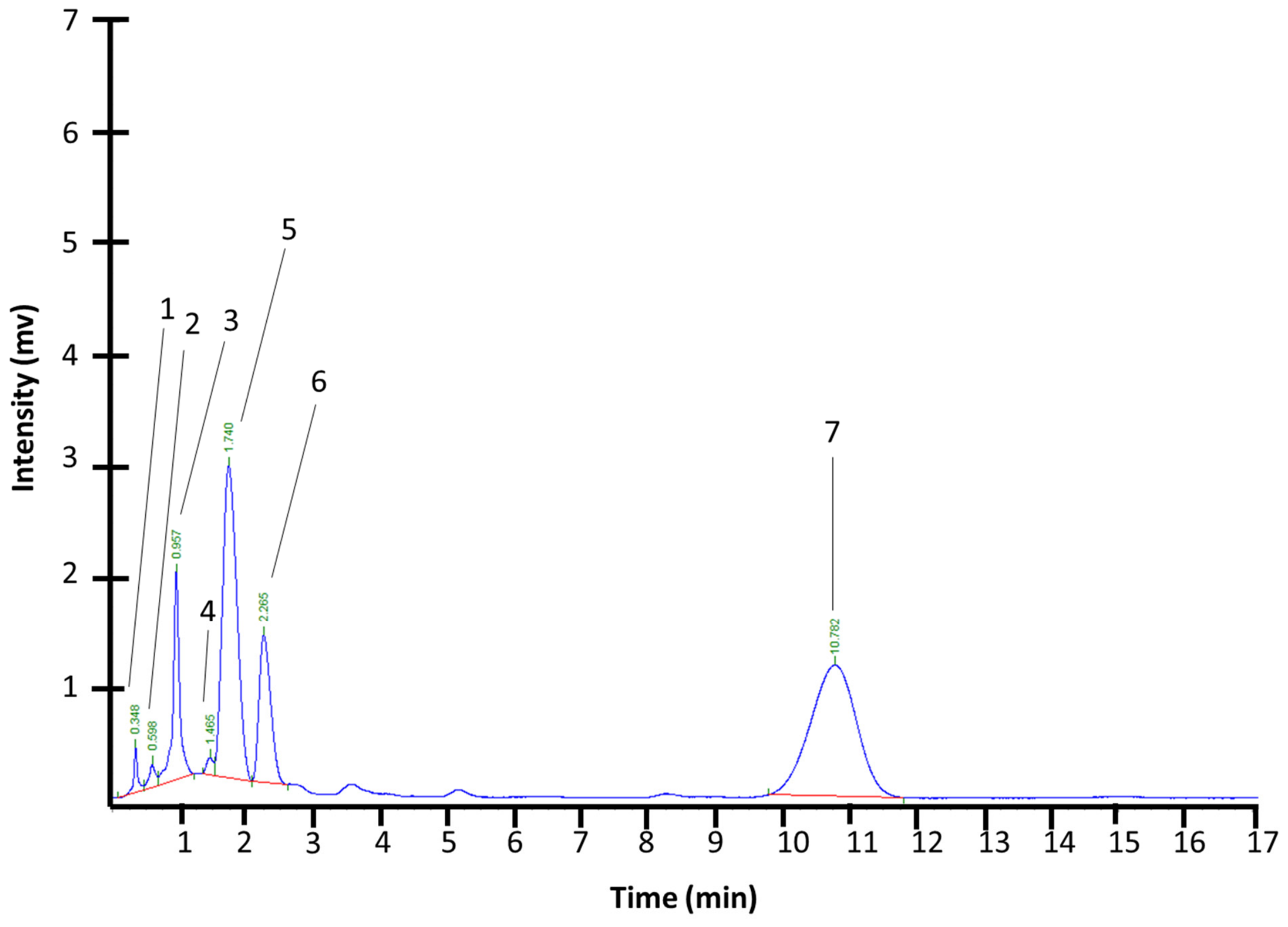
| Peak No. | Retention Time (min) | Peak Height | Peak Area | Relative Area (%) |
|---|---|---|---|---|
| 1 | 0.348 | 383.730 | 1597.150 | 1.2249 |
| 2 | 0.598 | 197.212 | 1363.244 | 1.0455 |
| 3 | 0.957 | 1859.102 | 12,843.156 | 9.8495 |
| 4 | 1.465 | 145.250 | 1046.369 | 0.8025 |
| 5 | 1.740 | 2801.125 | 41,696.031 | 31.9771 |
| 6 | 2.265 | 1315.563 | 15,794.600 | 12.1130 |
| 7 | 10.782 | 1171.277 | 56,052.898 | 42.9875 |
| Total | 7873.258 | 130,393.448 | 100.0000 |
Disclaimer/Publisher’s Note: The statements, opinions and data contained in all publications are solely those of the individual author(s) and contributor(s) and not of MDPI and/or the editor(s). MDPI and/or the editor(s) disclaim responsibility for any injury to people or property resulting from any ideas, methods, instructions or products referred to in the content. |
© 2026 by the authors. Licensee MDPI, Basel, Switzerland. This article is an open access article distributed under the terms and conditions of the Creative Commons Attribution (CC BY) license.
Share and Cite
Llerenas-Aguirre, K.I.; Hernández-Fuentes, G.A.; Toscano-Velázquez, J.A.; Cabrera-Licona, A.; Rojas-Larios, F.; Delgado-Enciso, O.G.; Garza-Veloz, I.; Galván-Salazar, H.R.; Meza-Robles, C.; Ramírez-Flores, M.; et al. Antioxidant Activity and Dose-Dependent Toxicity of a Traditionally Consumed Ipomoea pes-caprae Infusion Evaluated in a Triple-Negative Breast Cancer Xenograft Model. Nutrients 2026, 18, 2248. https://doi.org/10.3390/nu18142248
Llerenas-Aguirre KI, Hernández-Fuentes GA, Toscano-Velázquez JA, Cabrera-Licona A, Rojas-Larios F, Delgado-Enciso OG, Garza-Veloz I, Galván-Salazar HR, Meza-Robles C, Ramírez-Flores M, et al. Antioxidant Activity and Dose-Dependent Toxicity of a Traditionally Consumed Ipomoea pes-caprae Infusion Evaluated in a Triple-Negative Breast Cancer Xenograft Model. Nutrients. 2026; 18(14):2248. https://doi.org/10.3390/nu18142248
Chicago/Turabian StyleLlerenas-Aguirre, Karla I., Gustavo A. Hernández-Fuentes, José A. Toscano-Velázquez, Ariana Cabrera-Licona, Fabian Rojas-Larios, Osiris G. Delgado-Enciso, Idalia Garza-Veloz, Héctor R. Galván-Salazar, Carmen Meza-Robles, Mario Ramírez-Flores, and et al. 2026. "Antioxidant Activity and Dose-Dependent Toxicity of a Traditionally Consumed Ipomoea pes-caprae Infusion Evaluated in a Triple-Negative Breast Cancer Xenograft Model" Nutrients 18, no. 14: 2248. https://doi.org/10.3390/nu18142248
APA StyleLlerenas-Aguirre, K. I., Hernández-Fuentes, G. A., Toscano-Velázquez, J. A., Cabrera-Licona, A., Rojas-Larios, F., Delgado-Enciso, O. G., Garza-Veloz, I., Galván-Salazar, H. R., Meza-Robles, C., Ramírez-Flores, M., Carrazco-Peña, K. B., Guzmán-Esquivel, J., Diaz-Martinez, J., Martinez-Fierro, M. L., & Delgado-Enciso, I. (2026). Antioxidant Activity and Dose-Dependent Toxicity of a Traditionally Consumed Ipomoea pes-caprae Infusion Evaluated in a Triple-Negative Breast Cancer Xenograft Model. Nutrients, 18(14), 2248. https://doi.org/10.3390/nu18142248