Lepidium Meyenii Walp. (Maca) and Blood Biomarkers of Muscle Damage and Post-Exertion Protein Degradation: A Systematic Review and Meta-Analysis of Preclinical Studies

 , , , and
Abstract
1. Introduction
2. Materials and Methods
2.1. Selection Criteria
2.2. Search Strategy and Information Sources
2.3. Data Extraction
2.4. Risk of Publication Bias Among Studies
2.5. Assessment of Methodological Quality and Risk of Bias in Individual Studies
2.6. Statistical Analysis and Synthesis of Results
3. Results
3.1. Studies Selection
3.2. Assessment of Methodological Quality of Individual Studies
3.3. Meta-Analysis
3.4. Evaluation of the Quality of Evidence (GRADE)
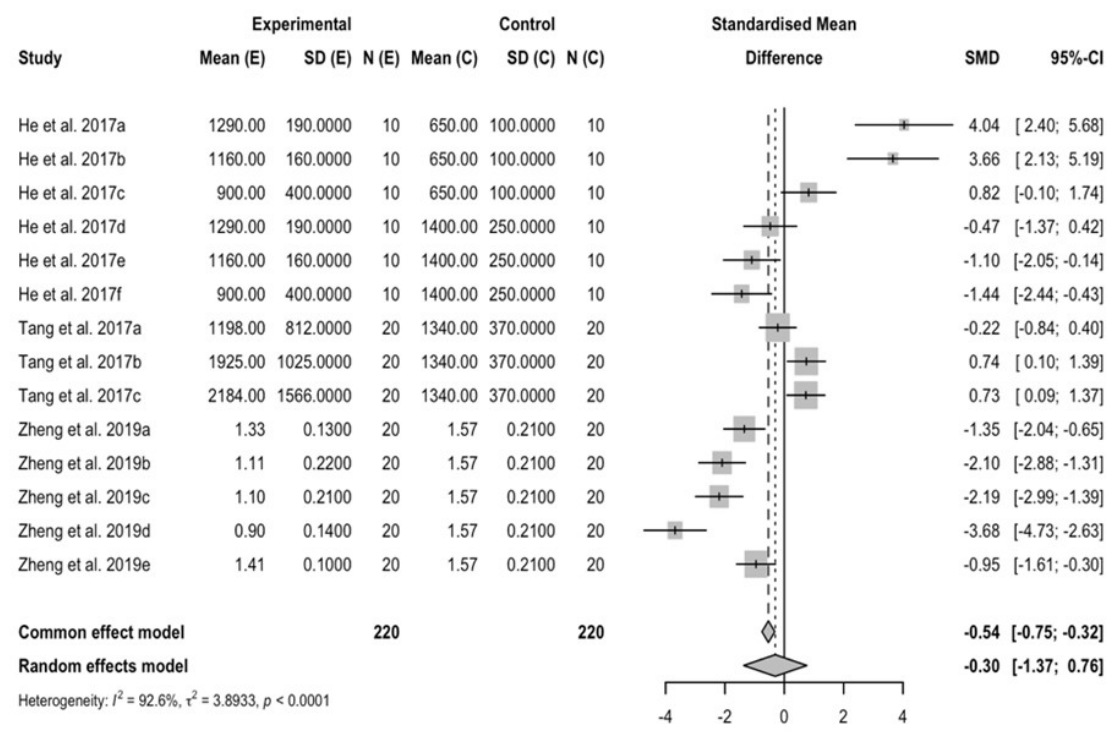
3.5. Effect of L. meyenii on Creatine Kinase
3.6. Effect of L. meyenii on Lactate Dehydrogenase
3.7. Effect of L. meyenii on Blood Urea Nitrogen
3.8. Exploratory Analysis by Type of Preparation and Dose
4. Discussion
4.1. Effect of L. meyenii on Creatine Kinase
4.2. Effect of L. meyenii on Lactate Dehydrogenase
4.3. Effects of L. meyenii on Blood Urea Nitrogen
4.4. Limitations
5. Conclusions
6. Prospects for L. meyenii Supplementation in Humans
Author Contributions
Funding
Institutional Review Board Statement
Informed Consent Statement
Data Availability Statement
Conflicts of Interest
Abbreviations
| AST | aspartate aminotransferase |
| ATP | adenosine triphosphate |
| ATP-PC CYCLE | adenosine triphosphate-phosphocreatine cycle |
| CAMARADES | Collaborative Approach for the Analysis of Animal Data from Experimental Studies |
| CAT | catalase |
| CK | creatine kinase |
| CRP | C-reactive protein |
| EIMD | exercise-induced muscle damage |
| ES | effect size |
| GPx | glutathione peroxidase |
| GRADE | Grading of Recommendations Assessment, Development and Evaluation |
| CI | Confidence Interval |
| IL-6 | interleukin-6 |
| MDA | malondialdehyde |
| LDH | lactate dehydrogenase |
| MLMA | multilevel meta-analytic models |
| NAD | nicotinamide adenine dinucleotide |
| NADH | nicotinamide adenine dinucleotide + hydrogen |
| NOS | Newcastle Ottawa Scale |
| ROS | reactive oxygen species |
| RVE | robust variance estimation |
| SMD | standardized mean differences |
| SOD | superoxide dismutase |
| TNF-a | tumor necrosis factor-alpha |
| WOS | Web of Science |
References
- Oxley, R.A.; Peart, D.J. The Effect of Curcumin Supplementation on Functional Strength Outcomes and Markers of Exercise-Induced Muscle Damage: A Systematic Review and Meta-Analysis. Nutr. Health 2024, 30, 77–92. [Google Scholar] [PubMed]
- Warburton, D.E.R.; Nicol, C.W.; Bredin, S.S.D. Health Benefits of Physical Activity: The Evidence. CMAJ 2006, 174, 801–809. [Google Scholar] [CrossRef] [PubMed]
- Suchomel, T.J.; Nimphius, S.; Stone, M.H. The Importance of Muscular Strength in Athletic Performance. Sports Med. 2016, 46, 1419–1449. [Google Scholar] [CrossRef] [PubMed]
- Newton, M.J.; Morgan, G.T.; Sacco, P.; Chapman, D.W.; Nosaka, K. Comparison of Responses to Strenuous Eccentric Exercise of the Elbow Flexors between Resistance-Trained and Untrained Men. J. Strength Cond. Res. 2008, 22, 597–607. [Google Scholar] [CrossRef] [PubMed]
- Tékus, E.; Szénási, N.L.; Szabó, E.; Heckel, Z.; Mintál, T.; Kőszegi, T.; Atlasz, T.; Gazdag, Z.; Váczi, M.; Wilhelm, M. Well-Trained Elders Have Antioxidant Responses and an Equal Magnitude of EIMD as Young Adults. Int. J. Environ. Res. Public Health 2022, 19, 8889. [Google Scholar] [CrossRef] [PubMed]
- Plattner, K.; Lambert, M.I.; Tam, N.; Baumeister, J. The Response of Cortical Alpha Activity to Pain and Neuromuscular Changes Caused by Exercise-Induced Muscle Damage. Scand. J. Med. Sci. Sports 2014, 24, 166–178. [Google Scholar] [CrossRef] [PubMed]
- Byrne, C.; Eston, R.G.; Edwards, R.H.T. Characteristics of Isometric and Dynamic Strength Loss Following Eccentric Exercise-Induced Muscle Damage. Scand. J. Med. Sci. Sports 2001, 11, 134–140. [Google Scholar] [CrossRef]
- Salem, A.; Ben Maaoui, K.; Jahrami, H.; AlMarzooqi, M.A.; Boukhris, O.; Messai, B.; Clark, C.C.T.; Glenn, J.M.; Ghazzaoui, H.A.; Bragazzi, N.L.; et al. Attenuating Muscle Damage Biomarkers and Muscle Soreness After an Exercise-Induced Muscle Damage with Branched-Chain Amino Acid (BCAA) Supplementation: A Systematic Review and Meta-Analysis with Meta-Regression. Sports Med. Open 2024, 10, 42. [Google Scholar] [CrossRef] [PubMed]
- Douglas, J.; Pearson, S.; Ross, A.; McGuigan, M. Eccentric Exercise: Physiological Characteristics and Acute Responses. Sports Med. 2017, 47, 663–675. [Google Scholar] [PubMed]
- Byrne, C.; Eston, R. The Effect of Exercise-Induced Muscle Damage on Isometric and Dynamic Knee Extensor Strength and Vertical Jump Performance. J. Sports Sci. 2002, 20, 417–425. [Google Scholar] [CrossRef] [PubMed]
- Clarkson, P.M.; Hubal, M.J. Authors: Exercise-Induced Muscle Damage in Humans Literature Review Contraction-Induced Muscle Injury. Am. J. Phys. Med. Rehabil. 2001, 81, S52–S69. [Google Scholar] [CrossRef]
- Xu, F.; Zeng, J.; Liu, X.; Lai, J.; Xu, J. Exercise-Induced Muscle Damage and Protein Intake: A Bibliometric and Visual Analysis. Nutrients 2022, 14, 4288. [Google Scholar] [CrossRef] [PubMed]
- Hyldahl, R.D.; Hubal, M.J. Lengthening Our Perspective: Morphological, Cellular, and Molecular Responses to Eccentric Exercise. Muscle Nerve 2014, 49, 155–170. [Google Scholar] [PubMed]
- Mackey, A.L.; Kjaer, M. The Breaking and Making of Healthy Adult Human Skeletal Muscle in Vivo. Skelet. Muscle 2017, 7, 24. [Google Scholar] [CrossRef] [PubMed]
- Delsmann, M.M.; Stürznickel, J.; Amling, M.; Ueblacker, P.; Rolvien, T. Musculoskeletal Laboratory Diagnostics in Competitive Sport. Orthopade 2021, 50, 700–712. [Google Scholar] [CrossRef] [PubMed]
- Lee, E.C.; Fragala, M.S.; Kavouras, S.A.; Queen, R.M.; Pryor, J.L.; Casa, D.J. Biomarkers in Sports and Exercise: Tracking Health, Performance, and Recovery in Athletes. J. Strength Cond. Res. 2017, 21, 2920–2937. [Google Scholar] [CrossRef] [PubMed]
- Macero Mendez, R.M.; Baculima Tenesaca, J.M.; Agreda Orellana, I.S.; Cárdenas Carrera, J.C. Marcadores de Daño Muscular Deportistas Jóvenes de La Federación Deportiva de La Provincia Azuay, Ecuador. Acta Bioquím. Clín. Latinoam. 2021, 55, 3–10. [Google Scholar]
- Ozkan, I.; Ibrahim, C.H. Dehydration, Skeletal Muscle Damage and Inflammation before the Competitions among the Elite Wrestlers. J. Phys. Ther. Sci. 2016, 28, 162–168. [Google Scholar] [CrossRef] [PubMed]
- Heckel, Z.; Atlasz, T.; Tékus, É.; Kőszegi, T.; Laczkó, J.; Váczi, M. Monitoring Exercise-Induced Muscle Damage Indicators and Myoelectric Activity during Two Weeks of Knee Extensor Exercise Training in Young and Old Men. PLoS ONE 2019, 14, e0224866. [Google Scholar] [CrossRef] [PubMed]
- Tuttle, C.S.L.; Thang, L.A.N.; Maier, A.B. Markers of Inflammation and Their Association with Muscle Strength and Mass: A Systematic Review and Meta-Analysis. Ageing Res. Rev. 2020, 64, 101185. [Google Scholar] [CrossRef] [PubMed]
- Bernecker, C.; Scherr, J.; Schinner, S.; Braun, S.; Scherbaum, W.A.; Halle, M. Evidence for an Exercise Induced Increase of TNF-α and IL-6 in Marathon Runners. Scand. J. Med. Sci. Sports 2013, 23, 207–214. [Google Scholar] [CrossRef] [PubMed]
- Nieman, D.C.; Konrad, M.; Henson, D.A.; Kennerly, K.; Shanely, R.A.; Wallner-Liebmann, S.J. Variance in the Acute Inflammatory Response to Prolonged Cycling Is Linked to Exercise Intensity. J. Interferon Cytokine Res. 2012, 32, 12–17. [Google Scholar] [CrossRef] [PubMed]
- Windsor, M.T.; Bailey, T.G.; Perissiou, M.; Meital, L.; Golledge, J.; Russell, F.D.; Askew, C.D. Cytokine Responses to Acute Exercise in Healthy Older Adults: The Effect of Cardiorespiratory Fitness. Front. Physiol. 2018, 9, 203. [Google Scholar] [CrossRef] [PubMed]
- Cheng, A.J.; Jude, B.; Lanner, J.T. Intramuscular Mechanisms of Overtraining. Redox Biol. 2020, 35, 101480. [Google Scholar] [CrossRef] [PubMed]
- Kreider, R.B.; Wilborn, C.D.; Taylor, L.; Campbell, B.; Almada, A.L.; Collins, R.; Cooke, M.; Earnest, C.P.; Greenwood, M.; Kalman, D.S.; et al. ISSN Exercise and Sport Nutrition Review: Research and Recommendations. J. Int. Soc. Sports Nutr. 2010, 7, 7. [Google Scholar] [CrossRef]
- Knapik, J.J.; Steelman, R.A.; Hoedebecke, S.S.; Austin, K.G.; Farina, E.K.; Lieberman, H.R. Prevalence of Dietary Supplement Use by Athletes: Systematic Review and Meta-Analysis. Sports Med. 2016, 46, 103–123. [Google Scholar] [PubMed]
- Kerksick, C.M.; Wilborn, C.D.; Roberts, M.D.; Smith-Ryan, A.; Kleiner, S.M.; Jäger, R.; Collins, R.; Cooke, M.; Davis, J.N.; Galvan, E.; et al. ISSN Exercise & Sports Nutrition Review Update: Research & Recommendations. J. Int. Soc. Sports Nutr. 2018, 15, 38. [Google Scholar] [CrossRef] [PubMed]
- del Carpio, N.U.; Alvarado-Corella, D.; Quiñones-Laveriano, D.M.; Araya-Sibaja, A.; Vega-Baudrit, J.; Monagas-Juan, M.; Navarro-Hoyos, M.; Villar-López, M. Exploring the Chemical and Pharmacological Variability of Lepidium meyenii: A Comprehensive Review of the Effects of Maca. Front. Pharmacol. 2024, 15, 1360422. [Google Scholar] [CrossRef] [PubMed]
- Zhu, H.; Wang, R.; Hua, H.; Qian, H.; Du, P. Deciphering the Potential Role of Maca Compounds Prescription Influencing Gut Microbiota in the Management of Exercise-Induced Fatigue by Integrative Genomic Analysis. Front. Nutr. 2022, 9, 1004174. [Google Scholar] [CrossRef] [PubMed]
- Ikeuchi, M.; Koyama, T.; Takei, S.; Kino, T.; Yazawa, K. Effects of Benzylglucosinolate on Endurance Capacity in Mice. J. Health Sci. 2009, 55, 178–182. [Google Scholar] [CrossRef]
- Yang, Q.; Jin, W.; Lv, X.; Dai, P.; Ao, Y.; Wu, M.; Deng, W.; Yu, L. Effects of Macamides on Endurance Capacity and Anti-Fatigue Property in Prolonged Swimming Mice. Pharm. Biol. 2016, 54, 827–834. [Google Scholar] [CrossRef] [PubMed]
- Wasilewicz, A.; Grienke, U. Maca (Lepidium meyenii) as a Functional Food and Dietary Supplement: A Review on Analytical Studies. Foods 2026, 15, 306. [Google Scholar] [CrossRef] [PubMed]
- Ikeuchi, S.; Minamida, M.; Nakamura, T.; Konishi, M.; Kamioka, H. Exploratory Systematic Review and Meta-Analysis of Panax Genus Plant Ingestion Evaluation in Exercise Endurance. Nutrients 2022, 14, 1185. [Google Scholar] [CrossRef] [PubMed]
- Tinsley, G.M.; Jagim, A.R.; Potter, G.D.M.; Garner, D.; Galpin, A.J. Rhodiola Rosea as an Adaptogen to Enhance Exercise Performance: A Review of the Literature. Br. J. Nutr. 2024, 131, 461–473. [Google Scholar] [CrossRef] [PubMed]
- Minich, D.M.; Ross, K.; Frame, J.; Fahoum, M.; Warner, W.; Meissner, H.O. Not All Maca Is Created Equal: A Review of Colors, Nutrition, Phytochemicals, and Clinical Uses. Nutrients 2024, 16, 530. [Google Scholar] [CrossRef] [PubMed]
- Beharry, S.; Heinrich, M. Is the Hype around the Reproductive Health Claims of Maca (Lepidium meyenii Walp.) Supported by Scientific Evidence? J. Ethnopharmacol. 2018, 211, 126–170. [Google Scholar] [CrossRef] [PubMed]
- Gonzales, G.F. Ethnobiology and Ethnopharmacology of Lepidium meyenii (Maca), a Plant from the Peruvian Highlands. Evid.-Based Complement. Altern. Med. 2012, 2012, 193496. [Google Scholar] [CrossRef] [PubMed]
- Shang, R.-G.; Yang, P.; Wang, B.-Y.; Zhao, Z.-L. Transcriptome Analysis of Maca (Lepidium meyenii) Root at Different Developmental Stages. Appl. Plant Sci. 2018, 6, e1206. [Google Scholar] [CrossRef] [PubMed]
- Clément, C.; Grados, D.A.D.; Avula, B.I.A.; Mayer, A.C.; Aguirre, D.D.P.; Manrique, I.; Kreuzar, M. Influence of Colour Type and Previous Cultivation on Secondary Metabolites in Hypocotyls and Leaves of Maca (Lepidium meyenii Walpers). J. Sci. Food Agric. 2010, 90, 861–869. [Google Scholar] [CrossRef] [PubMed]
- Xu, Q.; Monagas, M.J.; Kassymbek, Z.K.; Belsky, J.L. Controlling the Quality of Maca (Lepidium meyenii) Dietary Supplements: Development of Compendial Procedures for the Determination of Intact Glucosinolates in Maca Root Powder Products. J. Pharm. Biomed. Anal. 2021, 199, 114063. [Google Scholar] [CrossRef] [PubMed]
- Zhou, Y.; Li, P.; Brantner, A.; Wang, H.; Shu, X.; Yang, J.; Si, N.; Han, L.; Zhao, H.; Bian, B. Chemical Profiling Analysis of Maca Using UHPLC-ESI-Orbitrap MS Coupled with UHPLC-ESI-QqQ MS and the Neuroprotective Study on Its Active Ingredients. Sci. Rep. 2017, 7, srep44660. [Google Scholar] [CrossRef] [PubMed]
- Huang, Y.J.; Peng, X.R.; Qiu, M.H. Progress on the Chemical Constituents Derived from Glucosinolates in Maca (Lepidium meyenii). Nat. Prod. Bioprospect. 2018, 8, 405–412. [Google Scholar] [CrossRef] [PubMed]
- Korkmaz, S. Antioxidants in Maca (Lepidium meyenii) as a Supplement in Nutrition. In Antioxidants in Foods and Its Applications; Shalaby, E., Azzam, G.M., Eds.; IntechOpen: Rijeka, Croatia, 2018; p. 7. ISBN 978-1-78923-379-7. [Google Scholar]
- Huerta Ojeda, Á.; Rodríguez Rojas, J.; Cancino-López, J.; Barahona-Fuentes, G.; Pavez, L.; Yeomans-Cabrera, M.-M.; Jorquera-Aguilera, C. Effects of Maca (Lepidium meyenii Walp.) on Physical Performance in Animals and Humans: A Systematic Review and Meta-Analysis. Nutrients 2025, 17, 107. [Google Scholar] [CrossRef]
- Huerta Ojeda, Á.; Rodríguez Rojas, J.; Cuevas Guíñez, J.; Ciriza Velásquez, S.; Cancino-López, J.; Barahona-Fuentes, G.; Yeomans-Cabrera, M.-M.; Pavez, L.; Jorquera-Aguilera, C. The Effects of Maca (Lepidium meyenii Walp) on Cellular Oxidative Stress: A Systematic Review and Meta-Analysis. Antioxidants 2024, 13, 1046. [Google Scholar] [CrossRef] [PubMed]
- Fei, W.; Zhang, J.; Yu, S.; Yue, N.; Ye, D.; Zhu, Y.; Tao, R.; Chen, Y.; Chen, Y.; Li, A.; et al. Antioxidative and Energy Metabolism-Improving Effects of Maca Polysaccharide on Cyclophosphamide-Induced Hhepatotoxicity Mice via Metabolomic Analysis and Keap1-Nrf2 Pathway. Nutrients 2022, 14, 4264. [Google Scholar] [CrossRef] [PubMed]
- Wan, D.; Li, H.; Xiang, J.; Yi, F.; Xu, L.; Jiang, B.; Xiao, P. Aqueous Extract of Black Maca (Lepidium meyenii) Prevents Metabolic Disorder and Improves Learning and Memory in Ovariectomized Mice Fed a High-Fat, High-Sugar Diet. Front. Pharmacol. 2018, 48, 268–280. [Google Scholar] [CrossRef]
- Del Rio, D.; Stewart, A.J.; Pellegrini, N. A Review of Recent Studies on Malondialdehyde as Toxic Molecule and Biological Marker of Oxidative Stress. Nutr. Metab. Cardiovasc. Dis. 2005, 15, 316–328. [Google Scholar] [CrossRef] [PubMed]
- Zhu, H.; Xu, W.; Wang, N.; Jiang, W.; Cheng, Y.; Guo, Y.; Yao, W.; Hu, B.; Du, P.; Qian, H. Anti-Fatigue Effect of Lepidium meyenii Walp. (Maca) on Preventing Mitochondria-Mediated Muscle Damage and Oxidative Stress in Vivo and Vitro. Food Funct. 2021, 12, 3132–3141. [Google Scholar] [CrossRef] [PubMed]
- Tang, W.; Jin, L.; Xie, L.; Huang, J.; Wang, N.; Chu, B.; Dai, X.; Liu, Y.; Wang, R.; Zhang, Y. Structural Characterization and Antifatigue Effect In Vivo of Maca (Lepidium meyenii Walp) Polysaccharide. J. Food Sci. 2017, 82, 757–764. [Google Scholar] [CrossRef] [PubMed]
- Choi, E.H.; Kang, J.I.; Cho, J.Y.; Lee, S.H.; Kim, T.S.; Yeo, I.H.; Chun, H.S. Supplementation of Standardized Lipid-Soluble Extract from Maca (Lepidium meyenii) Increases Swimming Endurance Capacity in Rats. J. Funct. Foods 2012, 4, 568–573. [Google Scholar] [CrossRef]
- Page, M.J.; McKenzie, J.E.; Bossuyt, P.M.; Boutron, I.; Hoffmann, T.C.; Mulrow, C.D.; Shamseer, L.; Tetzlaff, J.M.; Akl, E.A.; Brennan, S.E.; et al. The PRISMA 2020 Statement: An Updated Guideline for Reporting Systematic Reviews. BMJ 2021, 372, n71. [Google Scholar] [CrossRef] [PubMed]
- Ma, L.-L.; Wang, Y.-Y.; Yang, Z.-H.; Huang, D.; Weng, H.; Zeng, X.-T. Methodological Quality (Risk of Bias) Assessment Tools for Primary and Secondary Medical Studies: What Are They and Which Is Better? Mil. Med. Res. 2020, 7, 2–11. [Google Scholar] [CrossRef] [PubMed]
- Chen, X.-F.; Liu, Y.-Y.; Cao, M.-J.; Zhang, L.-J.; Sun, L.-C.; Su, W.-J.; Liu, G.-M. Hypoxia Tolerance and Fatigue Relief Produced by Lepidium meyenii and Its Water-Soluble Polysaccharide in Mice. Food Sci. Technol. Res. 2016, 22, 611–621. [Google Scholar] [CrossRef]
- Egger, M.; Smith, G.D.; Schneider, M.; Minder, C. Bias in Meta-Analysis Detected by a Simple, Graphical Test, Graphical Test. BMJ 1997, 316, 629–634. [Google Scholar] [CrossRef] [PubMed]
- López-López, J.A.; Page, M.J.; Lipsey, M.W.; Higgins, J.P. Dealing with Effect Size Multiplicity in Systematic Reviews and Meta-Analyses. Res. Synth. Methods 2018, 9, 336–351. [Google Scholar] [CrossRef] [PubMed]
- Mishra, P.; Singh, U.; Pandey, C.M.; Mishra, P.; Pandey, G. Application of Student’s t-Test, Analysis of Variance, and Covariance. Ann. Card. Anaesth. 2019, 22, 407–411. [Google Scholar] [CrossRef] [PubMed]
- He, J.-C.; Li, R.-W.; Zhu, H.-Y. The Effects of Polysaccharides from Maca (Lepidium meyenii Walp.) on Exhaustive Exercise-Induced Oxidative Damage in Rats. Biomed. Res. 2017, 28, 122–128. [Google Scholar]
- Zheng, B.L.; He, K.; Hwang, Z.Y.; Lu, Y.; Yan, S.J.; Kim, C.H.; Zheng, Q.Y. Effect of Aqueous Extract from Lepidium meyenii on Mouse Behavior in Forced Swimming Test. In Quality Management of Nutraceuticals; ACS Symposium Series; American Chemical Society: Washington, DC, USA, 2001; Volume 803, pp. 258–268. ISBN 9780841237735. [Google Scholar]
- Zheng, Y.; Zhang, W.-C.; Wu, Z.-Y.; Fu, C.-X.; Hui, A.-L.; Gao, H.; Chen, P.-P.; Du, B.; Zhang, H.-W. Two Macamide Extracts Relieve Physical Fatigue by Attenuating Muscle Damage in Mice. J. Sci. Food Agric. 2019, 99, 1405–1412. [Google Scholar] [CrossRef] [PubMed]
- Li, J.; Sun, Q.; Meng, Q.; Wang, L.; Xiong, W.; Zhang, L. Anti-Fatigue Activity of Polysaccharide Fractions from Lepidium meyenii Walp. (Maca). Int. J. Biol. Macromol. 2017, 95, 1305–1311. [Google Scholar] [CrossRef] [PubMed]
- Li, Y.; Xin, Y.; Xu, F.; Zheng, M.; Xi, X.; Cui, X.; Cao, H.; Guo, H.; Han, C. Maca Polysaccharides: Extraction Optimization, Structural Features and Anti-Fatigue Activities. Int. J. Biol. Macromol. 2018, 115, 618–624. [Google Scholar] [CrossRef] [PubMed]
- Li, R.-W.; He, J.-C.; Song, D.-H. Anti-Physical Fatigue Effect of Polysaccharides from Lepidium meyenii. Walp. and the Possible Mechanisms. Biomed. Res. 2017, 28, S433–S438. [Google Scholar]
- Li, J.; Chen, L.; Li, J.; Duan, Z.; Zhu, S.; Fan, L. The Composition Analysis of Maca (Lepidium meyenii Walp.) from Xinjiang and Its Antifatigue Activity. J. Food Qual. 2017, 2017, 2904951. [Google Scholar] [CrossRef]
- Liu, T.; Peng, Z.; Lai, W.; Shao, Y.; Gao, Q.; He, M.; Zhou, W.; Guo, L.; Kang, J.; Jin, X.; et al. The Efficient Synthesis and Anti-Fatigue Activity Evaluation of Macamides: The Unique Bioactive Compounds in Maca. Molecules 2023, 28, 3943. [Google Scholar] [CrossRef] [PubMed]
- Bilal, T.; Abas, I.; Korkmaz, S.; Ates, A.; Keser, O.; Kumas, C. Effects of Maca (Lepidium meyenii Walp) Powder on Serum Indices and Metabolic Responses in Racehorses. J. Anim. Plant Sci. 2016, 26, 901–908. [Google Scholar]
- Zhu, H.; Wang, R.; Hua, H.; Cheng, Y.; Guo, Y.; Qian, H.; Du, P. The Macamide Relieves Fatigue by Acting as Inhibitor of Inflammatory Response in Exercising Mice: From Central to Peripheral. Eur. J. Pharmacol. 2022, 917, 174758. [Google Scholar] [CrossRef] [PubMed]
- Chen, H.; Han, Y.; Jahan, I.; Wu, S.; Clark, B.C.; Wiseman, J.S. Extracts of Maca (Lepidium meyenii) Root Induce Increased Glucose Uptake by Inhibiting Mitochondrial Function in an Adipocyte Cell Line. J. Herb. Med. 2019, 17–18, 100282. [Google Scholar] [CrossRef]
- Powers, S.K.; Ji, L.L.; Kavazis, A.N.; Jackson, M.J. Reactive Oxygen Species: Impact on Skeletal Muscle. Compr. Physiol. 2011, 1, 941–969. [Google Scholar] [CrossRef]
- Martín Boffi, F. Entrenamiento y Adaptación Muscular. Sustratos y Vías Metabólicas Para La Producción de Energía. Rev. Bras. Zootec. 2008, 37, 197–201. [Google Scholar] [CrossRef]
- Baird, M.F.; Graham, S.M.; Baker, J.S.; Bickerstaff, G.F. Creatine-Kinase- and Exercise-Related Muscle Damage Implications for Muscle Performance and Recovery. J. Nutr. Metab. 2012, 2012, 960363. [Google Scholar] [CrossRef] [PubMed]
- Neumann, D.; Schlattner, U.; Wallimann, T. A Molecular Approach to the Concerted Action of Kinases Involved in Energy Homoeostasis. Biochem. Soc. Trans. 2003, 31, 169–174. [Google Scholar] [CrossRef] [PubMed]
- Stožer, A.; Vodopivc, P.; Bombek, L.K. Pathophysiology of Exercise-Induced Muscle Damage and Its Structural, Functional, Metabolic, and Clinical Consequences. Physiol. Res. 2020, 69, 565–598. [Google Scholar] [CrossRef] [PubMed]
- Cabral, B.M.I.; Edding, S.N.; Portocarrero, J.P.; Lerma, E.V. Rhabdomyolysis. Dis. Mon. 2020, 66, 101015. [Google Scholar] [CrossRef] [PubMed]
- Mittal, M.; Siddiqui, M.R.; Tran, K.; Reddy, S.P.; Malik, A.B. Reactive Oxygen Species in Inflammation and Tissue Injury. Antioxid. Redox Signal. 2014, 20, 1126–1167. [Google Scholar] [CrossRef] [PubMed]
- Radák, Z.; Kaneko, T.; Tahara, S.; Nakamoto, H.; Ohno, H.; Sasvári, M.; Nyakas, C.; Goto, S. The Effect of Exercise Training on Oxidative Damage of Lipids, Proteins, and DNA in Rat Skeletal Muscle: Evidence for Beneficial Outcomes. Free Radic. Biol. Med. 1999, 27, 69–74. [Google Scholar] [CrossRef] [PubMed]
- Ward, M.M. Factors Predictive of Acute Renal Failure in Rhabdomyolysis. Arch. Intern. Med. 1988, 148, 1553–1557. [Google Scholar] [CrossRef]
- Brancaccio, P.; Maffulli, N.; Buonauro, R.; Limongelli, F.M. Serum Enzyme Monitoring in Sports Medicine. Clin. Sports Med. 2008, 27, 1–18. [Google Scholar] [CrossRef] [PubMed]
- Klapcinska, A.; Iskra, J.; Poprezecki, S.; Grzesiok, K. The Effects of Sprint 300m Running on Plasma Lactate, Uric Acid, Creatine Kinase and Lactate Dehydrogenase in Competitive Hurdlers and Untrained Men. J. Sports Med. Physcial Fit. 2001, 41, 306–311. [Google Scholar]
- Torres, P.A.; Helmstetter, J.A.; Kaye, A.M.; Kaye, A.D. Rhabdomyolysis: Pathogenesis, Diagnosis, and Treatment. Ochsner J. 2015, 15, 58–69. [Google Scholar] [PubMed]
- Jang, H.J.; Lee, J.D.; Jeon, H.S.; Kim, A.R.; Kim, S.; Lee, H.S.; Kim, K.B. Metabolic Profiling of Eccentric Exercise-Induced Muscle Damage in Human Urine. Toxicol. Res. 2018, 34, 199–210. [Google Scholar] [CrossRef] [PubMed]
- Yoma, M.; Herrington, L.; Mackenzie, T.A. Cumulative Effects of a Week’s Training Loads on Shoulder Physical Qualities and Wellness in Competitive Swimmers. Int. J. Sports Phys. Ther. 2021, 16, 1470–1484. [Google Scholar] [CrossRef] [PubMed]
- Simmons, P.S.; Miles, J.M.; Gench, J.E.; Haymond, M.W. Increased Proteolysis an Effect of Increases in Plasma Cortisol within the Physiologic Range. J. Clin. Investig. 1984, 73, 412–420. [Google Scholar] [CrossRef] [PubMed]
- Zhou, W.; Zeng, G.; Lyu, C.; Kou, F.; Zhang, S.; Wei, H. Effect of Exhaustive Exercise on Plasma Metabolic Profiles of Male and Female Rats. J. Sports Sci. Med. 2019, 18, 253–263. [Google Scholar] [PubMed]
- Holeček, M. Origin and Roles of Alanine and Glutamine in Gluconeogenesis in the Liver, Kidneys, and Small Intestine under Physiological and Pathological Conditions. Int. J. Mol. Sci. 2024, 25, 7037. [Google Scholar] [CrossRef] [PubMed]
- Haralambie, G.; Berg, A. Serum Urea and Amino Nitrogen Changes with Exercise Duration. Eur. J. Appl. Physiol. 1976, 36, 39–48. [Google Scholar] [CrossRef] [PubMed]
- Brancaccio, P.; Lippi, G.; Maffulli, N. Biochemical Markers of Muscular Damage. Clin. Chem. Lab. Med. 2010, 48, 757–767. [Google Scholar] [CrossRef] [PubMed]
- Rojano-Ortega, D.; Peña Amaro, J.; Berral-Aguilar, A.J.; Berral-de la Rosa, F.J. Effects of Beetroot Supplementation on Recovery After Exercise-Induced Muscle Damage: A Systematic Review. Sports Health 2022, 14, 556–565. [Google Scholar] [CrossRef] [PubMed]
- Lee, E.; Park, M.; Kim, B.; Kang, S. Effect of Black Maca Supplementation on Inflammatory Markers and Physical Fitness in Male Elite Athletes. Nutrients 2023, 15, 1618. [Google Scholar] [CrossRef] [PubMed]
- Liu, M.-C.; Weng, P.-W.; Chien, Y.-H.; Wu, M.-H.; Hsu, W.-B.; Chen, S.-W.; Yang, M.-T. Effects of Lepidium meyenii (Maca) Extract Supplementation on Oxidative Stress, Muscle Damage, and Aerobic Capacity after Exhaustive Endurance Exercise. Isokinet. Exerc. Sci. 2024, 32, 349–357. [Google Scholar] [CrossRef]
- Honma, A.; Fujiwara, Y.; Takei, S.; Kino, T. The Improvement of Daily Fatigue in Women Following the Intake of Maca (Lepidium meyenii) Extract Containing Benzyl Glucosinolate. Funct. Foods Health Dis. 2022, 12, 175–187. [Google Scholar] [CrossRef]





| Blood Markers of Post-Exertion Muscle Damage | |||||||
|---|---|---|---|---|---|---|---|
| Authors | Objective | Participants or Sample | Independent Variable | Dependent Variable | Supplementation Protocol | Results | Effect |
| Bilal et al. [66] | To investigate the effects of maca on serum indices and metabolic responses in racehorses | Racehorses: EG1 (n = 6) EG2 (n = 6) CG (n = 6) | EG: MPB CG: Basal diet | CK and LDH | Maca root extract powder: EG1: Basal diet + 50 g·day EG2: Basal diet + 75 g·day CG: Basal diet | CK (IU·L): EG1 post-test = 117.83 vs. CG post-test = 160.17 EG2 post-test = 176.80 vs. CG post-test = 160.17 LDH (IU·L): EG1 post-test = 288.80 vs. CG post-test = 272.83 EG2 post-test = 274.81 vs. CG post-test = 272.83 | CK (IU·L): EG1 post test vs. CG ↓ EG2 post test vs. CG ↑ LDH (IU·L): EG1 post-test vs. CG ↑ EG2 post-test vs. CG ↑ |
| Chen et al. [54] | To investigate the effects of L. meyenii (maca) on hypoxia tolerance and fatigue relief and to determine its active constituents | Mice: EG1 (n = 12) EG2 (n = 12) EG3 (n = 12) EG4 (n = 12) EG5 (n = 12) EG6 (n = 12) EG7 (n = 12) EG8 (n = 12) EG9 (n = 12) CG (n = 12) | EG: MPB, ME and MWP CG: PL | LDH | MP: EG1 (high-dose): 1 g·kg−1 EG2 (medium-dose): 0.5 g·kg−1 EG3 (low-dose): 0.1 g·kg−1 MAE: EG4 (high-dose): 1 g·kg−1 EG5 (medium-dose): 0.5 g·kg−1 EG6 (low-dose): 0.1 g·kg−1 MWP: EG7 (high-dose): 1 g·kg−1 EG8 (medium-dose): 0.5 g·kg−1 EG9 (low-dose): 0.1 g·kg−1 CG: distilled water | LDH (IU·L): MP groups: EG1 = 1388 ± 149 vs. CG = 445 ± 63; p < 0.01 EG2 = 714 ± 870 vs. CG = 445 ± 63; p > 0.05 EG3 = 650 ± 12 vs. CG = 445 ± 63; p > 0.05 MAE groups: EG4 = 1008 ± 802 vs. CG = 445 ± 63; p > 0.05 EG5 = 454 ± 46 vs. CG = 445 ± 63; p > 0.05 EG6 = 652 ± 106 vs. CG = 445 ± 63; p > 0.05 MWP groups: EG7 = 845 ± 681 vs. CG = 445 ± 63; p > 0.05 EG8 = 1156 ± 1091 vs. CG = 445 ± 63; p > 0.05 EG9 = 554 ± 43 vs. CG = 445 ± 63; p > 0.05 | LDH (IU·L): MP groups: EG1 vs. CG ↑ EG2 vs. CG ↔ EG3 vs. CG ↔ MAE groups: EG4 vs. CG ↔ EG5 vs. CG ↔ EG6 vs. CG ↔ MWP groups: EG7 vs. CG ↑ EG8 vs. CG ↔ EG9 vs. CG ↔ |
| Choi et al. [51] | To investigate the effect of standardized LME obtained by supercritical fluid extraction of maca on swimming endurance capacity, serum biochemical parameters, and antioxidant status in a weight-loaded forced swimming rat model | Mice: EG1 (n = 20) EG2 (n = 20) CG (n = 20) | EG1 and EG2: LME CG: PL | LDH | LME: EG1: 30 mg·10 mL·kg−1 EG2: 100 mg·10 mL·kg−1 CG:10 mL·kg−1 sterile water | LDH (U·L): EG1 = 316 ± 16 vs. CG = 426 ± 53; p > 0.05 EG2 = 300 ± 12 vs. CG = 426 ± 53; p < 0.05 | LDH (U·L): EG1 vs. CG ↔ EG2 vs. CG ↓ |
| He et al. [58] | To investigate the effects of MP on oxidative damage induced by exhaustive swimming exercise using rat models | Mice: EG1 (n = 10) EG2 (n = 10) EG3 (n = 10) CG1 (n = 10) CG2 (n = 10) | EG: MP CG: PL | CK and LDH | MP EG1: exercise + 50 mg·kg−1 EG2: exercise + 100 mg·kg−1 EG3: exercise + 200 mg·kg−1 CG1: sedentary + distilled water CG2: exercise + distilled water | CK (U·L): EG1 = 1290 ± 190 vs. CG1= 650 ± 100; p < 0.05 EG1 = 1290 ± 190 vs. CG2= 1400 ± 250; p < 0.05 EG2 = 1160 ± 160 vs. CG1= 650 ± 100; p < 0.05 EG2 = 1160 ± 160 vs. CG2= 1400 ± 250; p < 0.05 EG3 = 900 ± 400 vs. CG1= 650 ± 100; p < 0.05 EG3 = 900 ± 400 vs. CG2= 1400 ± 250; p < 0.05 CG1 = 650 ± 100 vs. CG2= 1400 ± 250; p < 0.05 LDH (IU·L): EG1 = 1750 ± 250 vs. CG1 = 1250 ± 200; p < 0.05 EG1 = 1750 ± 250 vs. CG2 = 2000 ± 300; p < 0.05 EG2 = 1550 ± 350 vs. CG1 = 1250 ± 200; p < 0.05 EG2 = 1550 ± 350 vs. CG2 = 2000 ± 300; p < 0.05 EG3 = 1490 ± 290 vs. CG1 = 1250 ± 200; p < 0.05 EG3 = 1490 ± 290 vs. CG2 = 2000 ± 300; p < 0.05 CG1 = 1250 ± 200 vs. CG2= 2000 ± 300; p < 0.05 CG1 = 188 ± 34 vs. CG2= 114 ± 21; p < 0.05 | CK (U·L): EG1 vs. CG1 ↑ EG1 vs. CG2 ↓ EG2 vs. CG1 ↑ EG2 vs. CG2 ↓ EG3 vs. CG1 ↑ EG3 vs. CG2 ↓ CG1 vs. CG2 ↓ LDH (IU·L): EG1 vs. CG1 ↑ EG1 vs. CG2 ↓ EG2 vs. CG1 ↑ EG2 vs. CG2 ↓ EG3 vs. CG1 ↑ EG3 vs. CG2 ↓ CG1 vs. CG2 ↓ CG1 vs. CG2 ↓ |
| Li et al. [61] | To isolate and characterize the purified MP and specify the anti-fatigue composition of MP | Mice: EG1 (n = 10) EG2 (n = 10) EG3 (n = 10) EG4 (n = 10) CG (n = 10) | EG: MP CG: PL | LDH | MP-1 EG1: 100 mg·kg−1 EG2: 20 mg·kg−1 MP-2 EG3: 100 mg·kg−1 EG4: 20 mg·kg−1 CG: saline solution | LDH (IU·L): EG1 = 208 ± 12 vs. CG = 300 ± 21; p < 0.05 EG2 = 275 ± 12.5 vs. CG = 300 ± 21; p < 0.05 EG1 = 190 ± 22.5 vs. CG = 300 ± 21; p < 0.05 EG1 = 278 ± 32 vs. CG = 300 ± 21; p <0.05 | LDH (IU·L): EG1 vs. CG ↓ EG2 vs. CG ↓ EG3 vs. CG ↓ EG4 vs. CG ↓ |
| Liu et al. [65] | To investigate the anti-fatigue capacity of NBH | Mice EG1 (n = 6) EG2 (n = 6) CG (n = 6) | EG: ME and NBH CG: PL | LDH | ME EG1: 1000 mg·kg−1 extract of maca NBH EG2: 10 mg·kg−1 CG: distilled water | LDH (IU·L): EG1 = 5950 ± 50 vs. CG = 6800 ± 200; p < 0.01 EG2 = 5100 ± 150 vs. CG = 6800 ± 200; p < 0.01 | LDH (U·L): EG1 vs. CG ↓ EG2 vs. CG ↓ |
| Tang et al. [50] | To investigate the antifatigue effect of MP was also evaluated by using a mouse weight-loaded swimming model to provide a theoretical basis and practical guidance for the comprehensive exploration of MP | Mice: EG1 (n = 20) EG2 (n = 20) EG3 (n = 20) CG (n = 20) | EG: MP CG: PL | LDH and CK | MP EG1: 100 mg·kg−1 EG2: 50 mg·kg−1 EG3: 25 mg·kg−1 CG: distilled water | LDH (U·L): EG1 = 583 ± 253 vs. CG = 785 ± 190; p > 0.05 EG2 = 545 ± 238 vs. CG = 785 ± 190; p < 0.05 EG3 = 541 ± 102 vs. CG = 785 ± 190; p < 0.01 CK (U·L): EG1 = 1198 ± 812 vs. CG = 1340 ± 370; p > 0.05 EG2 = 1925 ± 1025 vs. CG = 1340 ± 370; p > 0.05 EG3 = 2184 ± 1566 vs. CG = 1340 ± 370; p < 0.05 | LDH (U·L): EG1 vs. CG ↔ EG2 vs. CG ↓ EG3 vs. CG ↓ CK (U·L): EG1 vs. CG ↔ EG2 vs. CG ↔ EG3 vs. CG ↑ |
| Yang et al. [31] | To investigate the effects of macamides on endurance capacity and anti-fatigue properties in prolonged swimming mice | Mice: EG1 (n = 10) EG2 (n = 10) EG3 (n = 10) EG4 (n = 10) EG5 (n = 10) EG6 (n = 10) CG (n = 10) | EG: N-benzyllinoleamide, N-benzyloleamide and N-benzylpalmitamideCG: PL | LDH | N-benzyllinoleamide EG1: 12 mg·10 mL·kg−1 EG2: 40 mg·10 mL·kg−1 N-benzyloleamide EG3: 12 mg·10 mL·kg−1 EG4: 40 mg·10 mL·kg−1 N-benzylpalmitamide EG5: 12 mg·10 mL·kg−1 EG6: 40 mg·10 mL·kg−1 CG: distilled water | LDH (U·L): EG1 = 2998.77 ± 290.11 vs. CG = 3182.35 ± 290.11; p > 0.05 EG2 = 2785.25 ± 357.2 vs. CG = 3182.35 ± 290.11; p < 0.05 EG3 = 2980. 67 ± 334.91 vs. CG = 3182.35 ± 290.11; p > 0.05 EG4 = 2793.74 ± 210.59 vs. CG = 3182.35 ± 290.11; p < 0.05 EG5 = 3051.26 ± 293.14 vs. CG = 3182.35 ± 290.11; p > 0.05 EG6 = 2821.05 ± 236.97 vs. CG = 3182.35 ± 290.11; p < 0.05 | LDH (U·L): EG1 vs. CG ↔ EG2 vs. CG ↓ EG3 vs. CG ↔ EG4 vs. CG ↓ EG5 vs. CG ↔ EG6 vs. CG ↓ |
| Zheng et al. [59] | To investigate the activity of energy enhancement of aqueous extracts from roots of Maca on the behavior in mice using FST | Mice: EG (n = 15) CG (n = 15) | EG: MacaForceAQ-2 CG: PL | LDH | MacaForce AQ-2 EG: 40 mg·kg−1 CG: 10% ethanol/water solution | LDH (U·100 mL) EG = 586.9 ± 42.9 vs. CG = 391.5 ± 56.1; p < 0.01 | LDH (U·100 mL) EG vs. CG ↑ |
| Zheng et al. [60] | To investigate the effect of two macamides extracts on attenuating muscle damage | Mice: EG1 (n = 20) EG2 (n = 20) EG3 (n = 20) EG4 (n = 20) EG5 (n = 20) CG (n = 20) | EG: CME, PME, and Maca tablet CG: PL | LDH and CK | CME EG1: 30 mg·kg−1 EG2: 120 mg·kg−1 PME EG3: 8 mg·kg−1 EG4: 32 mg·kg−1 Maca tablet EG5: 165 mg·kg−1 CG: aqueous solution | LDH (U·L) EG1 = 6189.05 ± 177.50 vs. CG = 6734.89 ± 184.29; p < 0.05 EG2 = 5755.18 ± 172.09 vs. CG = 6734.89 ± 184.29; p < 0.05 EG3 = 6021.62 ± 192.15 vs. CG = 6734.89 ± 184.29; p < 0.05 EG4 = 5385.07 ± 189.50 vs. CG = 6734.89 ± 184.29; p < 0.05 EG5 = 6334.33 ± 110.47 vs. CG = 6734.89 ± 184.29; p > 0.05 CK (U·mL): EG1 = 1.33 ± 0.13 vs. CG = 1.57 ± 0.21; p < 0.05 EG2 = 1.11 ± 0.22 vs. CG = 1.57 ± 0.21; p < 0.05 EG3 = 1.10 ± 0.21 vs. CG = 1.57 ± 0.21; p < 0.05 EG4 = 0.90 ± 0.14 vs. CG = 1.57 ± 0.21; p < 0.05 EG5 = 1.41 ± 0.10 vs. CG = 1.57 ± 0.21; p < 0.05 | LDH (U·L) EG1 vs. CG ↓ EG2 vs. CG ↓ EG3 vs. CG ↓ EG4 vs. CG ↓ EG5 vs. CG ↔ CK (U·mL): EG1 vs. CG ↓ EG2 vs. CG ↓ EG3 vs. CG ↓ EG4 vs. CG ↓ EG5 vs. CG ↓ |
| Zhu et al. [49] | To investigate the role of ME on muscle during exercise-induced fatigue both in vivo and in vitro | Mice: EG1 (n = 10) EG2 (n = 10) CG1 (n = 10) CG2 (n = 10) | EG: ME and caffeine CG: PL and PL + exercis | LDH | ME: EG1: 10 mL·kg−1 EG2: 10 mg·kg−1 caffeine CG1: 10 mL·kg−1 sterile water CG2: 10 mL·kg−1 sterile water + exercise | LDH (ng·L): EG1 = 25.46 ± 3.21 vs. CG2 = 33.85 ± 0.38; p < 0.05 EG2 = 24.78 ± 2.65 vs. CG2 = 33.85 ± 0.38; p < 0.05 CG2 = 33.85 ± 0.38 vs. CG1 = 27.35 ± 1.55; p < 0.05 | LDH (ng·L): EG1 vs. CG2 ↓ EG2 vs. CG2 ↓ CG2 vs. CG1 ↑ |
| Zhu et al. [29] | To explore the underlying mechanism of the MCP, a prescription for management of exercise-induced fatigue | Mice EG1 (n = 10) EG2 (n = 10) EG3 (n = 10) EG4 (n = 10) CG (n = 10 | EG: MCP CG: PL | LDH | MCP EG1: 1.0 g·kg−1 MCP EG2: 2.0 g·kg−1 MCP EG3: 4.0 g·kg−1 MCP EG4: 10 mg·kg−1 caffeine CG1: 1.0 g·kg−1 sterile water CG2: 1.0 g·kg−1 sterile water + Ex | LDH (ng·L): EG1 = 28.0 ± 3.1 vs. CG1 = 30 ± 1; p > 0.05 EG1 = 28.0 ± 3.1 vs. CG2 = 34.2 ± 0.4; p < 0.01 EG2 = 24.9 ± 2.1 vs. CG1 = 30 ± 1; p > 0.05 EG2 = 24.9 ± 2.1 vs. CG2 = 34.2 ± 0.4; p < 0.01 EG3 = 28.2 ± 1.2 vs. CG1 = 30 ± 1; p > 0.05 EG3 = 28.2 ± 1.2 vs. CG2 = 34.2 ± 0.4; p < 0.01 EG4 = 23 ± 2.0 vs. CG1 = 30 ± 1; p > 0.05 EG4 = 23 ± 2.0 vs. CG2 = 34.2 ± 0.4; p < 0.01 CG1 = 30 ± 1 vs. CG2 = 34.2 ± 0.4; p < 0.05 | LDH (ng·L): EG1 vs. CG1 ↔ EG1 vs. CG2 ↓ EG2 vs. CG2 ↔ EG2 vs. CG2 ↓ EG3 vs. CG1 ↔ EG3 vs. CG2 ↓ EG3 vs. CG1 ↓ EG4 vs. CG1 ↓ CG1 vs. CG2 ↓ |
| Blood markers of post-exertion protein degradation | |||||||
| Authors | Objective | Participants or sample | Independent variable | Dependent variable | Supplementation protocol | Results | Effect |
| Bilal et al. [66] | To investigate the effects of maca on serum indices and metabolic responses in racehorses | Racehorses: EG1 (n = 6) EG2 (n = 6) CG (n = 6) | EG: MPB CG: Basal diet | BUN | Maca root extract powder: EG1: Basal diet + 50 g·day EG2: Basal diet + 75 g·day CG: Basal diet | BUN (mg·dL): EG1 post-test = 11.50 vs. CG post-test = 12.00 EG12 post-test = 12.70 vs. CG post-test = 12.00 | BUN (mg·dL): EG1 post test vs. CG ↓ EG2 post test vs. CG ↑ |
| Chen et al. [54] | To investigate the effects of L. meyenii (maca) on hypoxia tolerance and fatigue relief and to determine its active constituents | Mice: EG1 (n = 12) EG2 (n = 12) EG3 (n = 12) EG4 (n = 12) EG5 (n = 12) EG6 (n = 12) EG7 (n = 12) EG8 (n = 12) EG9 (n = 12) CG (n = 12) | EG: MPB, ME and MWP CG: PL | BUN | MP: EG1 (high-dose): 1 g·kg−1 EG2 (medium-dose): 0.5 g·kg−1 EG3 (low-dose): 0.1 g·kg−1 MAE: EG4 (high-dose): 1 g·kg−1 EG5 (medium-dose): 0.5 g·kg−1 EG6 (low-dose): 0.1 g·kg−1 MWP: EG7 (high-dose): 1 g·kg−1 EG8 (medium-dose): 0.5 g·kg−1 EG9 (low-dose): 0.1 g·kg−1 CG: distilled water | BUN (mmol·L): MP groups: EG1 = 5.77 ± 0.63 vs. CG = 8.17 ± 0.55; p < 0.01 EG2 = 4.95 ± 0.03 vs. CG = 8.17 ± 0.55; p < 0.01 EG3 = 5.42 ± 0.23 vs. CG = 8.17 ± 0.55; p < 0.01 MAE groups: EG4 = 6.12 ± 0.09 vs. CG = 8.17 ± 0.55; p < 0.05 EG5 = 7.61 ± 0.56 vs. CG = 8.17 ± 0.55; p > 0.05 EG6 = 5.99 ± 0.36 vs. CG = 8.17 ± 0.55; p < 0.01 MWP groups: EG7 = 10.98 ± 1.81 vs. CG = 8.17 ± 0.55; p > 0.05 EG8 = 9.56 ± 1.05 vs. CG = 8.17 ± 0.55; p > 0.05 EG9 = 10.48 ± 1.62 vs. CG = 8.17 ± 0.55; p > 0.05 | BUN (mmol·L): MP groups: EG1 vs. CG ↓ EG2 vs. CG ↓ EG3 vs. CG ↓ MAE groups: EG4 vs. CG ↓ EG5 vs. CG ↓ EG6 vs. CG ↓ MWP groups: EG7 vs. CG ↔ EG8 vs. CG ↔ EG9 vs. CG ↔ |
| Li et al. [61] | To isolate and characterize the purified MP and specify the anti-fatigue composition of MP | Mice: EG1 (n = 10) EG2 (n = 10) EG3 (n = 10) EG4 (n = 10) CG (n = 10) | EG: MP CG: PL | BUN | MP-1 EG1: 100 mg·kg−1 EG2: 20 mg·kg−1 MP-2 EG3: 100 mg·kg−1 EG4: 20 mg·kg−1 CG: saline solution | BUN (mmol·L): EG1 = 8.97 ± 1.13 vs. CG = 14.35 ± 1.55; p < 0.05 EG2 = 11.2 ± 1.75 vs. CG = 14.35 ± 1.55; p < 0.05 EG3 = 8.35 ± 1.56 vs. CG = 14.35 ± 1.55; p < 0.05 EG4 = 11.25 ± 1.25 vs. CG = 14.35 ± 1.55; p < 0.05 | BUN (mmol·L): EG1 vs. CG ↓ EG2 vs. CG ↓ EG3 vs. CG ↓ EG4 vs. CG ↓ |
| Li et al. [63] | To investigate the anti-physical fatigue effect of MCP and the possible mechanisms | Mice: EG1 (n = 12) EG2 (n = 12) EG3 (n = 12) CG (n = 12) | EG: MCP CG: PL | BUN | MCP EG1: 500 mg·kg−1 EG2: 1000 mg·kg−1 EG3: 2000 mg·kg−1 CG: distilled water | BUN (mmol·L): EG1 = 10.45 ± 1.15 vs. CG = 10.7 ± 1.8; p > 0.05 EG2 = 9.99 ± 2.08 vs. CG =10.7 ± 1.8; p > 0.05 EG3 = 8.50 ± 1.50 vs. CG =10.7 ± 1.8; p < 0.05 | BUN (mmol·L): EG1 vs. CG ↔ EG2 vs. CG ↔ EG3 vs. CG ↓ |
| Li et al. [64] | To test the antifatigue effect of Xinjiang maca, to provide theoretical support for further development of health care products made of Xinjiang maca | Mice: EG1 (n = 40) EG2 (n = 40) EG3 (n = 40) CG (n = 40) | EG: Yellow maca root CG: PL | BUN | Maca treatment: EG1: 40 mg·kg−1 EG2: 400 mg·kg−1 EG3: 1200 mg·kg−1 CG: distilled water | BUN (mmol·L): EG1 = 18.50 ± 1.75 vs. CG = 11.15 ± 0.95; p < 0.05 EG2 = 15.25 ± 1.75 vs. CG = 11.15 ± 0.95; p < 0.05 EG3 = 30.25 ± 1.90 vs. CG = 11.15 ± 0.95; p < 0.05 | BUN (mmol·L): EG1 vs. CG ↑ EG2 vs. CG ↑ EG3 vs. CG ↑ |
| Li et al. [62] | To study the MP anti-fatigue activity for further development in industrial production. | Mice: EG1 (n = 10) EG2 (n = 10) EG3 (n = 10) CG (n = 10) | EG: MP CG: PL | BUN | MCP EG1: 150 mg·kg−1 EG2: 300 mg·kg−1 EG3: 600 mg·kg−1 CG: distilled water | BUN (nmol·L): EG1 = 8.6 ± 0.9 vs. CG = 10.4 ± 2.4; p < 0.01 EG2 = 9.45 ± 0.97 vs. CG = 10.4 ± 2.4; p > 0.05 EG3 = 9.65 ± 1.15 vs. CG = 10.4 ± 2.4; p > 0.05 | BUN (nmol·L): EG1 vs. CG ↓ EG2 vs. CG ↔ EG3 vs. CG ↔ |
| Liu et al. [65] | To investigate the anti-fatigue capacity of NBH | Mice EG1 (n = 6) EG2 (n = 6) CG (n = 6) | EG: ME and NBH CG: PL | BUN | ME EG1: 1000 mg·kg−1 extract of maca NBH EG2: 10 mg·kg−1 CG: distilled water | BUN (mmol·L) EG1 = 9.3 ± 0.6 vs. CG = 10.5 ± 0.3; p < 0.05 EG2 = 8.7 ± 0.5 vs. CG = 10.5 ± 0.3; p < 0.05 | BUN (mmol·L) EG1 vs. CG ↓ EG2 vs. CG ↓ |
| Tang et al. [50] | To investigate the antifatigue effect of MP was also evaluated by using a mouse weight-loaded swimming model to provide a theoretical basis and practical guidance for the comprehensive exploration of MP | Mice: EG1 (n = 20) EG2 (n = 20) EG3 (n = 20) CG (n = 20) | EG: MP CG: PL | BUN | MP EG1: 100 mg·kg−1 EG2: 50 mg·kg−1 EG3: 25 mg·kg−1 CG: distilled water | BUN (mmol·L): EG1 = 7.83 ± 0.52 vs. CG = 8.36 ± 1.12; p < 0.05 EG2 = 6.85 ± 0.98 vs. CG = 8.36 ± 1.12; p < 0.01 EG3 = 7.55 ± 0.53 vs. CG = 8.36 ± 1.12; p < 0.01 | BUN (mmol·L): EG1 vs. CG ↓ EG2 vs. CG ↓ EG3 vs. CG ↓ |
| Yang et al. [31] | To investigate the effects of macamides on endurance capacity and anti-fatigue properties in prolonged swimming mice | Mice: EG1 (n = 10) EG2 (n = 10) EG3 (n = 10) EG4 (n = 10) EG5 (n = 10) EG6 (n = 10) CG (n = 10) | EG: N-benzyllinoleamide, N-benzyloleamide and N-benzylpalmitamideCG: PL | BUN | N- benzyllinoleamide EG1: 12 mg·10 mL·kg−1 EG2: 40 mg·10 mL·kg−1 N-benzyloleamide EG3: 12 mg·10 mL·kg−1 EG4: 40 mg·10 mL·kg−1 N-benzylpalmitamide EG5: 12 mg·10 mL·kg−1 EG6: 40 mg·10 mL·kg−1 CG: distilled water | BUN (mmol·L): EG1 = 6.41 ± 0.66 vs. CG = 6.99 ± 0.76; p > 0.05 EG2 = 6.67 ± 0.83 vs. CG = 6.99 ± 0.76; p > 0.05 EG3 = 6.44 ± 0.99 vs. CG = 6.99 ± 0.76; p > 0.05 EG4 = 6.79 ± 1.00 vs. CG = 6.99 ± 0.76; p > 0.05 EG5 = 6.82 ± 0.84 vs. CG = 6.99 ± 0.76; p > 0.05 EG6 =7.13 ± 0.94 vs. CG = 6.99 ± 0.76; p > 0.05 | BUN (mmol·L): EG1 vs. CG ↔ EG2 vs. CG ↔ EG3 vs. CG ↔ EG4 vs. CG ↔ EG5 vs. CG ↔ EG6 vs. CG ↔ |
| Zheng et al. [60] | To investigate the effect of two macamides extracts on attenuating muscle damage | Mice: EG1 (n = 20) EG2 (n = 20) EG3 (n = 20) EG4 (n = 20) EG5 (n = 20) CG (n = 20) | EG: CME, PME, and Maca tablet CG: PL | BUN | CME EG1: 30 mg·kg−1 EG2: 120 mg·kg−1 PME EG3: 8 mg·kg−1 EG4: 32 mg·kg−1 Maca tablet EG5: 165 mg·kg−1 CG: aqueous solution | BUN (mmol·L) EG1 = 8.59 ± 0.23 vs. CG = 9.10 ± 0.38; p > 0.05 EG2 = 8.54 ± 0.25 vs. CG = 9.10 ± 0.38; p > 0.05 EG3 = 8.16 ± 0.22 vs. CG = 9.10 ± 0.38; p < 0.05 EG4 = 8.14 ± 0.23 vs. CG = 9.10 ± 0.38; p < 0.05 EG5 = 8.82 ± 0.27 vs. CG = 9.10 ± 0.38; p > 0.05 | BUN (mmol·L) EG1 vs. CG ↔ EG2 vs. CG ↔ EG3 vs. CG ↓ EG4 vs. CG ↓ EG5 vs. CG ↔ |
| Zhu et al. [49] | To investigate the role of ME on muscle during exercise-induced fatigue both in vivo and in vitro | Mice: EG1 (n = 10) EG2 (n = 10) CG1 (n = 10) CG2 (n = 10) | EG: ME and caffeine CG: PL and PL + exercise | BUN | ME: EG1: 10 mL·kg−1 EG2: 10 mg·kg−1 caffeine CG1: 10 mL·kg−1 sterile water CG2: 10 mL·kg−1 sterile water + exercise | BUN (μmol·L): EG1 = 106.3 ± 3.1 vs. CG1 = 84.5 ± 8.5; p < 0.05 EG1 = 106.3 ± 3.1 vs. CG2 = 119.4 ± 11.6; p < 0.05 EG2 = 99.4 ± 12.7 vs. CG2 = 119.4 ± 11.6; p < 0.05 CG2 = 119.4 ± 11.6 vs. CG1 = 84.5 ± 8.5; p < 0.05 | BUN (μmol·L): EG1 vs. CG1 ↑ EG1 vs. CG2 ↓ EG2 vs. CG2 ↓ CG2 vs. CG1 ↑ |
| Zhu et al. [29] | To explore the underlying mechanism of the MCP, a prescription for management of exercise-induced fatigue | Mice EG1 (n = 10) EG2 (n = 10) EG3 (n = 10) EG4 (n = 10) CG (n = 10 | EG: MCP CG: PL | BUN | MCP EG1: 1.0 g·kg−1 MCP EG2: 2.0 g·kg−1 MCP EG3: 4.0 g·kg−1 MCP EG4: 10 mg·kg−1 caffeine CG1: 1.0 g·kg−1 sterile water CG2: 1.0 g·kg−1 sterile water + Ex | BUN (μmol·L): EG1 = 93 ± 1 vs. CG1 = 97 ± 3; p > 0.05 EG1 = 93 ± 1 vs. CG2 = 111 ± 6; p < 0.05 EG2 = 94 ± 9 vs. CG1 = 97 ± 3; p > 0.05 EG2 = 94 ± 9 vs. CG2 = 111 ± 6; p < 0.01 EG3 = 96 ± 6 vs. CG1 = 97 ± 3; p > 0.05 EG3 = 96 ± 6 vs. CG2 = 111 ± 6; p < 0.01 EG4 = 104 ± 3 vs. CG1 = 97 ± 3; p > 0.05 EG4 = 104 ± 3 vs. CG2 = 111 ± 6; p < 0.01 CG1 = 97 ± 3 vs. CG2 = 111 ± 6; p < 0.01 | BUN (μmol·L): EG1 vs. CG1 ↔ EG1 vs. CG2 ↓ EG2 vs. CG1 ↔ EG2 vs. CG2 ↓ EG3 vs. CG1 ↔ EG3 vs. CG2 ↓ EG4 vs. CG1 ↔ EG4 vs. CG2 ↓ CG1 vs. CG2 ↓ |
| Biomarker | Dose | N Effects | N Studies | SMD [95% CI] | p-Value | I2 (%) | Model |
|---|---|---|---|---|---|---|---|
| CK | Low (all) | 11 | 3 | 0.29 [−5.45, 6.03] | 0.847 | 97.4 | MLMA/RVE |
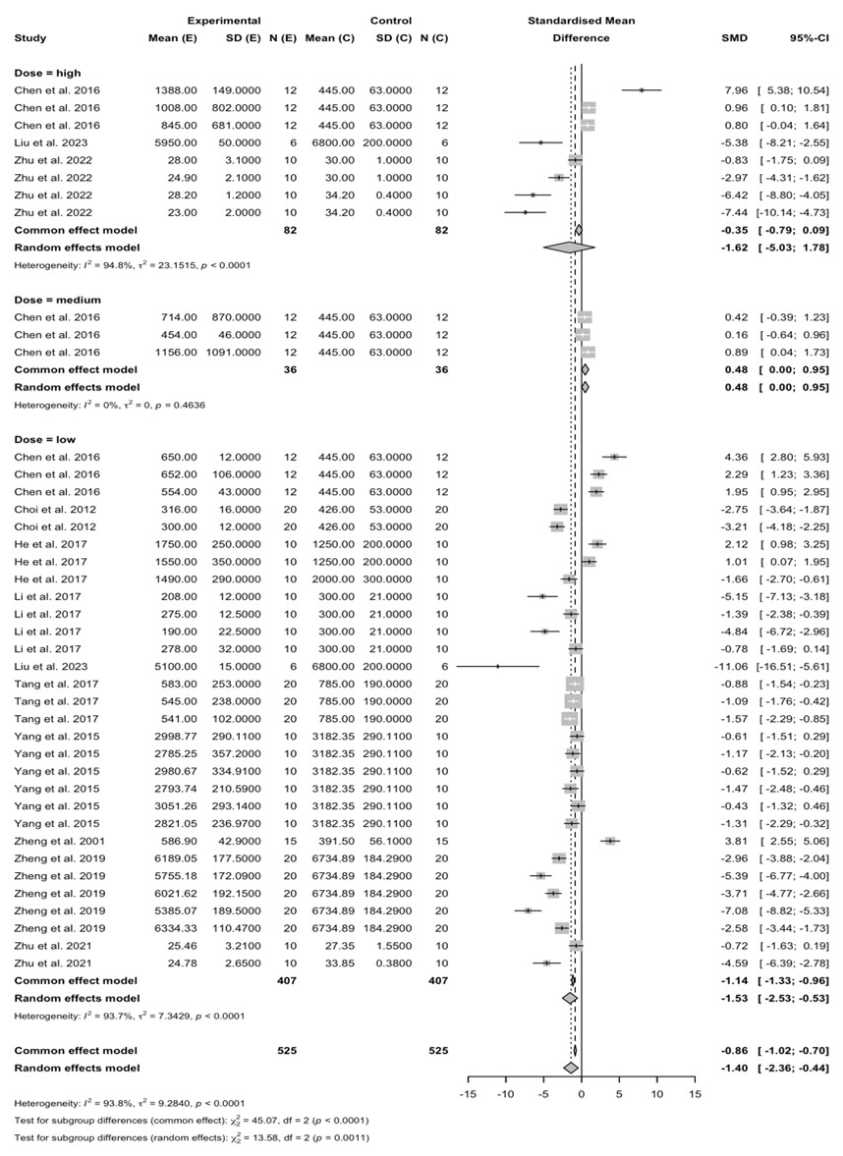
| LDH | All | 39 | 10 | −1.37 [−3.34, 0.59] | 0.148 | 97.2 | MLMA/RVE |
| LDH | Low | 28 | 9 | −1.21 [−3.82, 1.40] | 0.317 | 98.0 | RVE |
| LDH | Moderate | 3 | 1 | Not estimable (single study) | — | — | — |
| LDH | High | 8 | 3 | −1.24 [−11.62, 9.15] | 0.652 | 98.3 | RVE |
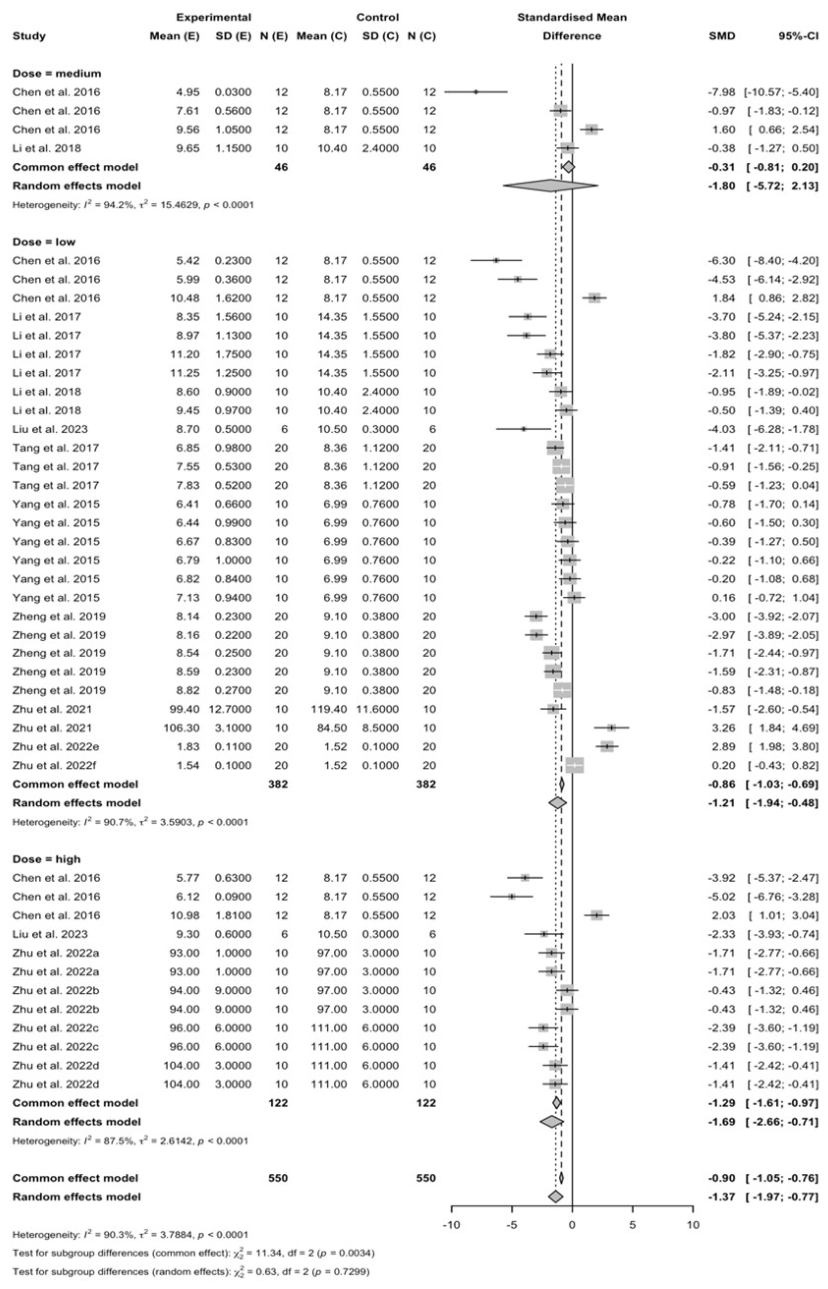
| BUN | All | 43 | 11 | −0.37 [−2.16, 1.42] | 0.657 | 97.8 | MLMA/RVE |
| BUN | Low | 26 | 9 | −0.68 [−2.67, 1.31] | 0.455 | 97.3 | RVE |
| BUN | Moderate | 6 | 4 | −0.68 [−5.44, 4.09] | 0.641 | 98.4 | RVE |
| BUN | High | 11 | 5 | 1.24 [−6.04, 8.52] | 0.660 | 99.2 | RVE |
| Outcome | Risk of Bias | Inconsistency | Imprecision | Indirectness | Publication Bias | Certainty |
|---|---|---|---|---|---|---|
| CK | Not serious (CAMARADES adequate) | Serious (I2 = 97.4%) | Serious (very wide CI, non-significant) | Serious (animal models predominant) | Not reliably assessable (few studies) | Very low |
| LDH | Some concerns | Serious (I2 = 97.2%) | Serious (CI includes 0) | Serious (animal models predominant) | Not reliably assessable (few studies) | Very low |
| BUN | Not serious (CAMARADES adequate) | Serious (I2 = 97.8%) | Serious (CI includes 0) | Some indirectness (mixed models) | Not reliably assessable (few studies) | Very low |
| Panel A. Subgroup Analysis by Preparation Type | ||||
| Biomarker | Preparation | N Studies | SMD [95% CI] | p-value |
| LDH | Purified/isolated compound | 7 | −2.04 [−3.97, −0.12] | 0.041 |
| LDH | Whole/crude extract | 4 | −0.09 [−2.70, 2.52] | 0.925 |
| BUN | Purified/isolated compound | 9 | 0.91 [−2.56, 4.39] | 0.569 |
| BUN | Whole/crude extract | 3 | −4.19 [−12.97, 4.58] | 0.259 |
| Panel B. Meta-regression (preparation type + dose, ln mg/kg) | ||||
| Biomarker | Moderator | β [95% CI] | p-value | |
| LDH | Purified/isolated vs. whole/crude | −1.95 [−5.83, 1.93] | 0.151 | |
| LDH | Dose (per 1-unit increase in ln mg/kg) | −0.08 [−0.67, 0.51] | 0.737 | |
| LDH | Omnibus test of moderators (QM, df = 2) | — | 0.319 | |
| BUN | Purified/isolated vs. whole/crude | 5.38 [−34.74, 45.49] | 0.352 | |
| BUN | Dose (per 1-unit increase in ln mg/kg) | 0.42 [−0.10, 0.94] | 0.094 | |
| BUN | Omnibus test of moderators (QM, df = 2) | — | 0.381 | |
Disclaimer/Publisher’s Note: The statements, opinions and data contained in all publications are solely those of the individual author(s) and contributor(s) and not of MDPI and/or the editor(s). MDPI and/or the editor(s) disclaim responsibility for any injury to people or property resulting from any ideas, methods, instructions or products referred to in the content. |
© 2026 by the authors. Licensee MDPI, Basel, Switzerland. This article is an open access article distributed under the terms and conditions of the Creative Commons Attribution (CC BY) license.
Share and Cite
Rodríguez Rojas, J.; Huerta Ojeda, Á.; Barahona-Fuentes, G.; Jorquera-Aguilera, C.; Cancino-López, J.; Yeomans-Cabrera, M.-M.; Pavez, L.; Jara-Gutiérrez, C.; Chirosa-Ríos, L.J. Lepidium Meyenii Walp. (Maca) and Blood Biomarkers of Muscle Damage and Post-Exertion Protein Degradation: A Systematic Review and Meta-Analysis of Preclinical Studies. Nutrients 2026, 18, 2009. https://doi.org/10.3390/nu18122009
Rodríguez Rojas J, Huerta Ojeda Á, Barahona-Fuentes G, Jorquera-Aguilera C, Cancino-López J, Yeomans-Cabrera M-M, Pavez L, Jara-Gutiérrez C, Chirosa-Ríos LJ. Lepidium Meyenii Walp. (Maca) and Blood Biomarkers of Muscle Damage and Post-Exertion Protein Degradation: A Systematic Review and Meta-Analysis of Preclinical Studies. Nutrients. 2026; 18(12):2009. https://doi.org/10.3390/nu18122009
Chicago/Turabian StyleRodríguez Rojas, Javiera, Álvaro Huerta Ojeda, Guillermo Barahona-Fuentes, Carlos Jorquera-Aguilera, Jorge Cancino-López, María-Mercedes Yeomans-Cabrera, Leonardo Pavez, Carlos Jara-Gutiérrez, and Luis Javier Chirosa-Ríos. 2026. "Lepidium Meyenii Walp. (Maca) and Blood Biomarkers of Muscle Damage and Post-Exertion Protein Degradation: A Systematic Review and Meta-Analysis of Preclinical Studies" Nutrients 18, no. 12: 2009. https://doi.org/10.3390/nu18122009
APA StyleRodríguez Rojas, J., Huerta Ojeda, Á., Barahona-Fuentes, G., Jorquera-Aguilera, C., Cancino-López, J., Yeomans-Cabrera, M.-M., Pavez, L., Jara-Gutiérrez, C., & Chirosa-Ríos, L. J. (2026). Lepidium Meyenii Walp. (Maca) and Blood Biomarkers of Muscle Damage and Post-Exertion Protein Degradation: A Systematic Review and Meta-Analysis of Preclinical Studies. Nutrients, 18(12), 2009. https://doi.org/10.3390/nu18122009