Article

Main Outcomes of the HEBE Trial: Improving Cardiorespiratory Fitness and Body Composition Through a Tailored Feasible Lifestyle Program

by
Daniela Lucini
1,2,*,
Federica Rota
3,
Giuseppe Marano
4,
Gianluigi Oggionni
1,
Ester Luconi
4,
Simona Iodice
3,
Francesca Bianchi
5,6,
Chiara Mandò
4,
Giuseppina Bernardelli
2,3,
Mara Malacarne
1,
Silvana Castaldi
5,7,
Patrizia Boracchi
4,
Valentina Bollati
4,8,
Mario Clerici
9,10,†,
Elia Mario Biganzoli
4,8,† and
on behalf of the HEBE Consortium
1
Department of Medical Biotechnology and Translational Medicine, Department of Excellence 2023–2027, University of Milan, 20129 Milan, Italy
2
Exercise Medicine Unit, IRCCS Istituto Auxologico Italiano, 20135 Milan, Italy
3
Department of Clinical Sciences and Community Health, Department of Excellence 2023–2027, University of Milan, 20122 Milan, Italy
4
Department of Biomedical and Clinical Sciences, University of Milan, 20122 Milan, Italy
5
Department of Biomedical Science for Health, University of Milan, 20133 Milan, Italy
6
Laboratorio Morfologia Umana Applicata, IRCCS Policlinico San Donato, 20097 Milan, Italy
7
Fondazione IRCCS Ca’ Granda Ospedale Maggiore Policlinico, 20122 Milan, Italy
8
INES (INitiative of Epigenetics for Smiles), Università Degli Studi di Milano, 20122 Milan, Italy
9
Department of Pathophysiology and Transplantation, University of Milan, 20122 Milan, Italy
10
Don C. Gnocchi Foundation, Istituto di Ricovero e Cura a Carattere Scientifico (IRCCS) Foundation, 20148 Milan, Italy
*
Author to whom correspondence should be addressed.
These authors contributed equally to this work.
The full list of HEBE consortium members included the following investigators (in alphabetical order): Ambrogi Federico, Arosio Beatrice, Aureli Massimo, Baron Giovanna, Baruscotti Mirko, Battaglia Cristina, Bellocchi Chiara, Bellosta Stefano, Bernardelli Clara, Bernardelli Giuseppina, Bianchi Francesca, Biganzoli Elia, Bollati Valentina, Bonomi Marco, Bravi Francesca, Brocca Paola, Brucato Antonio, Bucchi Annalisa, Camera Marina, Caporale Nicolò, Cappelletti Graziella, Caretti Anna, Casati Lavinia, Castaldi Silvana, Castiglioni Sara, Cattaneo Maria Grazia, Cazzola Roberta, Centanni Stefano, Cetin Irene, Chiaramonte Raffaella, Chiodini Iacopo, Chiricozzi Elena, Ciana Paolo, Citro Valentina, Clerici Mario Salvatore, Cogliati Chiara Beatrice, Corbetta Sabrina Luigia, D’addio Francesca, D’amato Alfonsina, Dallanoce Clelia Mariangiola Luisa, Dei Cas Michele Vittorio, Del Favero Elena, Delle Fave Antonella, Dias Rodrigues Gabriel, Dozio Elena, Edefonti Valeria, Fenizia Claudio, Ferrari Luca, Ferraroni Monica, Fiorina Paolo, Fornasari Diego Maria Michele, Fumagalli Marta, Gagliano Nicoletta, Galliera Emanuela Rita, Geginat Jens Albrecht Ernst, Giannandrea Domenica, Ingegnoli Francesca, La Porta Caterina, La Vecchia Carlo, Lecca Davide, Lesma Elena Anna, Limonta Patrizia, Loretelli Cristian, Lucini Daniela, Mandò Chiara, Martini Valeria, Matera Carlo, Montano Nicola, Pantoni Leonardo, Papini Nadia, Paroni Rita Clara, Perego Carla, Persani Luca, Pistocchi Anna, Platonova Natalia, Podda Gianmarco, Risé Patrizia Tiziana, Riva Paola Vanda, Rizzo Angela Maria, Rondelli Valeria Maria, Rossi Marta, Rota Federica, Ruscica Massimiliano, Savasi Valeria Maria, Scavone Mariangela, Sfondrini Lucia, Sironi Luigi, Sommariva Michele, Testa Giuseppe, Tobaldini Eleonora, Tringali Cristina Alessandra, Verduci Elvira, Vicenzi Marco, Viganò Caterina Adele, Vistoli Giulio, Vitale Giovanni. All the HEBE members are affiliated with the University of Milan, Milan, Italy. e-mail: hebe@unimi.it.
Nutrients 2026, 18(12), 1918; https://doi.org/10.3390/nu18121918 (registering DOI)
Submission received: 15 May 2026 / Revised: 8 June 2026 / Accepted: 9 June 2026 / Published: 12 June 2026
(This article belongs to the Special Issue Effects of Exercise and Diet on Health)

Abstract

Background/Objectives: Lifestyle Modification Programs (LMPs) based on exercise and nutrition aim to prevent/manage chronic diseases and foster well-being. However, moving LMPs from research to medical practice can be challenging, as programs must be both effective and feasible. The primary goal of this study was to assess cardiorespiratory fitness (CRF) changes according to an LMP, measured through VO2max, as a key indicator of health outcomes and intervention efficacy. Methods: In this single-arm intervention study, 100 subjects were enrolled; per-protocol analysis of main parameters was performed on 85 participants (15 were excluded due to medical/technical reasons). A feasible intervention program (of low resource intensity with only two physician/patient encounters) provided personalized exercise prescription, optimized nutritional habits based on the Mediterranean diet and Healthy Eating Plate principles, and supported behaviour change. We assessed CRF through VO2max, a key indicator of health outcomes and intervention efficacy. We also analyzed, using regression analysis, the relationship between VO2max (the gold-standard measure of CRF) and METSpeak, a simpler, feasible parameter of CRF derived from Exercise Stress Testing. Body composition (BC) and AHA diet score were also measured at baseline and post-6-month intervention. Statistical analyses included paired comparisons and multivariable regression to explore factors influencing CRF changes. Results: Analysis on the primary outcome, VO2max, was performed according to the intention-to-treat principle and per-protocol. This feasible protocol resulted in a significant increase in VO2max, improvements in fat-free mass, and a reduction in fat mass. Overall, 42.4% of participants achieved an improvement of ≥1 MET, a change previously associated with reduced mortality risk. Older participants tend to experience smaller improvements in VO2max. Conclusions: Although observing an improvement in CRF and BC following an LMP is not surprising, the strength of the study is to show the feasibility of implementing an effective, feasible LMP into clinical routine, supporting the integration of such programs into clinical practice.

1. Introduction

Physical activity/exercise, along with healthy nutrition, is widely recognized as a fundamental tool to foster well-being, prevent and manage chronic non-communicable diseases (CNCDs), and improve quality of life at all ages [1,2,3,4,5]. It is endorsed in international guidelines for its ability to prevent more than 70% of cardiometabolic diseases and over 40% of cancer-related deaths. It directly acts on multiple control mechanisms, reducing systemic inflammation, promoting immune, metabolic and autonomic regulation [5,6,7,8,9], improving cardiorespiratory fitness (CRF) [10,11,12,13,14], and modulating “inflamm-ageing” [15,16].
Lifestyle Modification Programs (LMPs) based on exercise and healthy nutrition represent, therefore, a promising approach to prevent/manage CNCDs [17,18,19,20]. However, to move from research settings to routine clinical practice, these programs must be both efficacious, capable of improving underlying pathogenetic mechanisms, and feasible, ensuring accessibility and cost-effectiveness. Although multifactorial and tailored, supervised programs are often the most effective [18,19,20], they are typically resource-intensive and time-consuming, requiring financial investment and multidisciplinary interventions. Conversely, overly simplistic programs, based solely on general lifestyle counselling, frequently fail to produce meaningful results due to a lack of clear clinical goals and reliable outcome markers [21,22].
CRF represents a gold-standard marker for monitoring the effectiveness of LMPs [23,24]. It directly reflects aerobic capacity (Volume of Maximal Oxygen uptake (VO2max) assessed through a cardiopulmonary exercise test (CPX)), and it is often expressed in metabolic equivalents (METs), which represent multiples of the basal rate of oxygen consumption at rest, a derived practical, standardized measure of physical fitness [14,25,26] frequently used in clinical practice. Both VO2max and METs at exercise peak (METSpeak) are inversely and strongly associated with all-cause mortality [11,12,13,14,16,25,26]. Recent evidence has demonstrated that even a modest improvement in CRF, such as an increase of 1 MET from the initial assessment, is associated with a significant reduction in mortality risk, regardless of baseline CRF levels [11].
This study was conducted as part of the HEBE Project (Healthy Aging Versus Inflamm-Aging: The Role of Physical Exercise in Modulating the Biomarkers of Age-Associated and Environmentally Determined Chronic Diseases), an ongoing initiative funded by the University of Milan. HEBE is a pre–post single-arm clinical trial, initiated in 2022, involving over 100 researchers working collaboratively to explore the role of physical exercise in modulating inflamm-ageing and its impact on health and CNCD risk [27]. The project includes 10 Lines of Research; this study is part of Line 1 (“proof of concept”), which aimed to evaluate the feasibility of implementing, into clinical routine, an effective, well-accepted LMP, requiring low economic resources, thereby overcoming the main organizational and economic barriers usually encountered when transitioning LMPs from research settings to clinical practice.
The primary goal of this study was to assess CRF changes according to the LMP, measured through VO2max, as a key indicator of health outcomes and intervention efficacy, implementing a feasible clinical protocol based on exercise prescription, complemented by optimization of nutritional habits, stress management, smoking cessation, sleep hygiene, and support for behaviour change, with the potential for integration into routine clinical practice.

2. Materials and Methods

2.1. Study Design

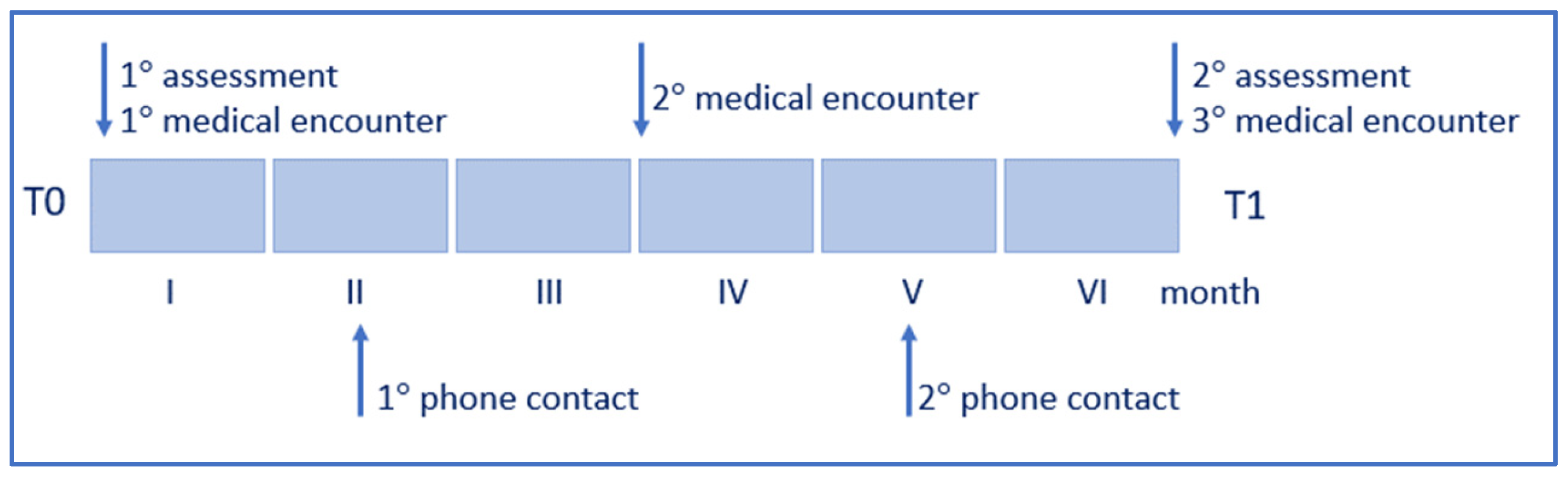
This is a six-month interventional trial involving a single group of 100 participants (registered in Clinicaltrials.gov (NCT05815732) 14 April 2023—retrospectively registered, https://clinicaltrials.gov/study/NCT05815732 accessed on 1 June 2026) that has been previously described, including the details of the power calculation [27]. We previously published the entire protocol [27] and the methodology for participant selection. Figure 1 reports the timeline of assessments, medical encounters, and follow-up activities of the six-month interventional trial. Sample size was based on the primary endpoint, namely the change in VO2max during the observation period. Assuming a two-sided paired Student’s t-test with a significance level of α = 0.05, a sample of 100 paired pre- and post-intervention observations provided 80% power to detect an effect size of d = 0.28, defined as the mean difference divided by the standard deviation of the paired differences. According to Cohen’s criteria, this effect size lies between small (0.2) and medium (0.5) magnitude effects and was considered appropriate for the objectives of the study.
All University of Milan employees were contacted via email and invited to complete a lifestyle questionnaire, which also included a request to indicate their willingness to participate in the personalized intervention program. Briefly, a total of 983 participants, representing 21.9% of the University of Milan workforce, completed the initial lifestyle assessment questionnaire. Three hundred and ninety individuals indicated interest in taking part in the program. From this pool, 100 subjects who met the inclusion criteria [27] (age 18–70 years, no competitive physical activities, absence of any main cardiometabolic, oncologic, neurodegenerative or psychiatric conditions within the past three years) were stratified into groups based on the following criteria: (i) age—50% younger than 50 years and 50% aged 50 years or older; (ii) sex—50% female and 50% male; and (iii) Body Mass Index (BMI)—50% with BMI < 25 and 50% with BMI ≥ 25. Resulting from the above criteria, a total of 8 strata were formed. The strata were balanced with respect to the predefined criteria, and, within each stratum, subjects were enrolled sequentially according to their response date. In the event of exhaustion of the available participants within a specific stratum, additional participants were recruited following the order of their expression of interest.
Each subject followed a personalized physical exercise program and optimization of nutritional habits, with clinical and biological assessments performed at baseline (T0) and at the end of the intervention (T1). Informed consent was obtained from all individuals participating in the study. The study protocol adhered to the ethical principles outlined in the Declaration of Helsinki and complied with Title 45 of the U.S. Code of Federal Regulations, Part 46, Protection of Human Subjects, revised on 13 November 2001, and effective as of 13 December 2001. The HEBE study received ethics approval from the University of Milan’s Ethical Committee (Approval No. 62/22, dated 30 June 2022) and the IRCCS Istituto Auxologico’s Ethical Committee (Approval Code: 2022071912, dated 27 July 2022). At baseline (T0), all participants signed an agreement consenting to the use of their anonymized data for population studies and potential publications. Participants confirmed that they understood they could not be identified through any published results, as all data were fully anonymized by the authors.

2.2. Assessments

All subjects underwent the following assessment, both at T0 (baseline) and T1 (after 6 months of intervention):
  • Medical history and physical examination, including anthropometric measurements (body weight, height, and waist circumference) and hemodynamics (resting systolic and diastolic blood pressure, heart rate). Biological sampling included fasting plasma glucose and lipid profile. Based on clinical and anthropometric measurements, metabolic syndrome was defined according to guidelines [28].
  • Body composition was assessed using bioelectrical impedance analysis [29] (BIA, Bodystat Quadscan 4000, BodyStat Ltd., Sulby, Isle of Man, British Isles, UK), providing estimates of fat mass (FM) and fat-free mass (FFM). The Fat Mass Index (FMi) and Fat-Free Mass Index (FFMi) were calculated to normalize FM and FFM values for height, using the following formulas: FMi = FM (kg)/height (m2); FFMi = FFM (kg)/height (m2).
  • Lifestyle
An ad hoc questionnaire was employed to quantify lifestyle [30,31,32,33,34,35]. Physical activity (total activity volume) was assessed using the International Physical Activity Questionnaire (IPAQ) [36], as were sedentariness, sleep, smoking, alcohol consumption, stress, and somatic symptoms perception. The quality of nutrition was assessed using the American Heart Association Healthy Diet Score (AHA score) [37], which considers the consumption of fruits/vegetables, fish, sweetened beverages, whole grains, and sodium. Appendix A1 reports the details of the lifestyle assessment.
  • Cardiopulmonary Fitness Testing
Aerobic fitness, the primary outcome of the study, was assessed through maximal oxygen consumption (VO2max) [24]. A standard incremental cycle ergometer test (Custo Cardio 300, Ottobrunn, Germany; VYNTUS CPX, Hoechberg, Germany) was performed, with a duration of approximately 10 ± 2 min, to ensure that a respiratory exchange ratio (RER) of ≥1.1 was achieved. During the test, heart rhythm and frequency were monitored using a 12-lead ECG, and ventilatory and gas-exchange parameters were analyzed breath-by-breath. The VO2max was calculated as the highest oxygen uptake achieved during the test. Additionally, the peak METs reached (METSpeak) were determined using the following formula [38]:
Peak MET = 1 + (12 × Work)/(3.5 × Weight),
where Work is the maximal workload (watts) and Weight is body weight (kg).
We also performed other functional tests to complement VO2max: the 6-min walking test (6MWT) was performed following international guidelines [39], and handgrip strength (HGS) was used to assess muscular strength using isometric dynamometry [40], in a sitting position, with the elbow bent at a 90-degree angle, repeated three times for both the right and left arms. We considered the average of the three readings.

2.3. Lifestyle Prescription Program

At T0, all enrolled subjects received a tailored exercise prescription and optimization of nutritional habits, made by a physician who has specific certified training in internal medicine and clinical psychology, following recent guidelines [1,3,41]. Table 1 reports the main steps of the first visit (T0). The specific methodology followed for prescription has already been described [20]. Briefly, in the first encounter, after having established an empathic relationship with the subject, considering their expectations of the program, the analysis of the lifestyle assessment and of the clinical test results permitted the subject’s clinical status to be shown and specific clinical goals to be defined. Then, cognitive resources were given to translate into practical action the possibility of realizing the desired behavioural change (for instance, how to select the best moment in the day to perform exercise, or how to select a realistic modality of exercise). Subsequently, the specific exercise prescription was presented. In particular, it was discussed how to follow and check the training heart rate, how to overcome common barriers, and how to perceive the initial benefit granted by the intervention. In the second visit, after a simple medical assessment of weight, waist circumference, blood pressure and basal heart rate, the obtained results and barriers encountered were discussed using a problem-solving approach. The subject was encouraged to ask for more details on how to improve behaviour and to discover the required cognitive and practical resources that best account for their needs, raising their awareness of the consequences of the new behaviour on their quality of life and well-being. Moreover, the subject was helped in defining further steps towards the long-term goal, regaining control of their life and well-being.

2.3.1. Exercise Prescription

The exercise prescription provided a clear definition of the modality, intensity, frequency, duration, and progression of exercise, and was based on individual characteristics, limitations, and preferences. It aimed to improve cardiorespiratory fitness, and the volume of prescribed endurance aerobic exercise was at least the volume recommended by international guidelines [1,3] to improve health, corresponding to at least 150 min of aerobic endurance activity per week. This volume could be exceeded as long as it was within 300 min of aerobic endurance activity per week. Training heart rate was calculated using the Heart Rate Reserve Formula [(Maximal Heart Rate − Resting Heart Rate) × %value of exercise intensity) + Resting Heart Rate] following more recent guidelines [3], verifying that it was below the anaerobic threshold, estimated by a CPX. Moreover, flexibility and strength exercises were prescribed according to individual characteristics to improve joint flexibility and muscular strength (accompanied by video tutorials), and counselling to reduce sedentary time was provided. Subjects independently decided, after a specific discussion with the physician, where to perform the prescribed exercise (indoors—at a gym or at home—or outdoors, or both), and training sessions were unsupervised. A wearable device (Fitbit Inspire 3) was employed to check training HR during exercise.

2.3.2. Nutrition

No specific prescription for a nutritional program was made, as the main focus of the study was on the exercise prescription. We only considered an optimization of nutritional habits, which was guided by the principles of the Mediterranean diet and the Healthy Eating Plate. In particular, participants were encouraged to structure their meals according to balanced proportions: approximately half of the plate composed of vegetables and fruits, one quarter of whole grain carbohydrates, and one quarter of protein sources (such as unprocessed white meat, fish, dairy, eggs, legumes, and nuts), highlighting the importance of portion balance among food groups. All subjects were advised to consume 0.8–1.0 g of protein per kilogram of body weight, to prefer extra virgin olive oil as the main source of added fat, and to prioritize whole grains, fruits, and vegetables in their daily diet [42]. While participants were free to choose specific foods, they were instructed to adhere to these general principles of dietary composition and balance.

2.3.3. Other Lifestyles

We also provided written guidance on proper nutrition and other healthy lifestyles through materials available on the HEBE website (https://hebe.unimi.it, accessed on 1 June 2026) [1,2,3,6,17,28,37,42]. This platform was specifically developed and curated by researchers from the University of Milan with expertise in the relevant fields, ensuring that all recommendations and information are grounded in scientific evidence and evidence-based medicine. A cognitive–behavioural approach was employed to enhance participants’ motivation [17,43,44]. The intervention was further supported by guidance on stress management and smoking cessation.
Additionally, participants attended a third medical encounter dedicated to reviewing results, receiving feedback, and discussing future recommendations.
At T1, participants’ overall satisfaction with the program and the perceived difficulty in adhering to it were assessed using rating scales from 0 (“lowest satisfaction” or “lowest difficulty”) to 10 (“highest satisfaction” or “highest difficulty”) for each measure. Additionally, participants evaluated their perceived well-being by comparing their condition before and after the intervention, choosing among the following options: “much worse,” “worse,” “no change,” “improved,” or “much improved [45].
Appendix A.2 provides details on additional parameters collected, the analysis of which will be reported in future publications.

2.4. Outcomes

The primary outcome was the change in VO2max (aerobic capacity) from baseline to six months, while the secondary outcomes were changes in body composition and other functional parameters (including variables derived from CPX/exercise stress test, 6 min walking test, handgrip and blood examination).

2.5. Statistical Analysis

Categorical variables were summarized using counts and percentages. For each numerical variable, distributions at baseline, post-intervention, and pre–post changes were examined using histograms, and outliers were identified. Because several variables showed skewed distributions and/or outlying values, numerical variables were generally summarized using the median and interquartile range (25th–75th percentiles).

2.5.1. Analysis of the Main Outcome

The primary outcome (pre–post change in VO2max) showed an approximately symmetric distribution and no relevant outliers. Inspection of the histogram and normal Q–Q plot further indicated that the distribution was reasonably consistent with normality. Therefore, the effect of the lifestyle program was assessed using a paired t-test (two-tailed, α = 0.05), and the respective 95% confidence interval for the mean pre–post difference was also calculated.
In addition, factors associated with a greater or lesser change in VO2max were investigated using multivariable linear regression models (ordinary least squares). The dependent variable was the pre–post change in VO2max. Covariates were selected a priori and included: baseline VO2max, gender, age, volume of vigorous and moderate physical activity (<600 vs. ≥600 MET × min/week), AHA score (0–1, 2–3, 4–5), perceived stress score (0–10 Likert scale), metabolic syndrome (yes/no), fat-free mass (%) and overall satisfaction with the program (0–10 Likert scale). Continuous variables were modelled as linear terms, whereas categorical variables were represented through indicator variables. Model assumptions were assessed using graphical diagnostics, including evaluation of the linearity of continuous covariate effects, homoscedasticity, and approximate normality of residuals.
The analyses described above were based on the intention-to-treat principle. Therefore, all available participant data were used, and missing values were handled using multiple imputation [46,47,48] by chained equations (MICE) [49,50] under the missing-at-random (MAR) assumption. In this approach, missing values are iteratively estimated using regression models based on the information available from complete variables.
The imputation model included the primary outcome, all covariates described above, and the sampling strata. Linear regression models were used to impute continuous variables, whereas logistic regression models were used for binary and categorical variables.
Twenty imputed datasets were generated, exceeding the percentage of missing data in the primary outcome, as recommended in the literature [50]. Estimates obtained from the imputed datasets were combined using Rubin’s rule [48]. In addition, the same analysis was performed only on participants who completed the treatment (per-protocol analysis).

2.5.2. Analysis of the Secondary Outcomes

All analyses of secondary outcomes were exploratory and were performed on participants who completed the program (per-protocol sample). This approach was adopted to evaluate the effect of the intervention among participants who adequately adhered to the exercise program. Consistent with TREND recommendations [51], results were primarily interpreted through effect estimates and their precision rather than through hypothesis testing.
Confidence intervals at the 95% level of the median pre–post difference and the relative difference between proportions were reported, respectively, for numerical and categorical outcomes. For numerical outcomes, the CIs were obtained using quantile regression [52], with standard errors obtained via bootstrap resampling (1000 replications).
For categorical outcomes, the relative difference was calculated as the percentage change between post-treatment and pre-treatment proportions, i.e., 100 × (p1 − p0)/p0, where p1 and p0 denote the post-treatment and pre-treatment proportions, respectively.
Confidence intervals were adjusted for multiple comparisons (49 outcomes) using the Bonferroni correction, resulting in an overall confidence level of approximately 99.9%.
Differences were considered statistically significant when the corresponding confidence interval did not include zero.
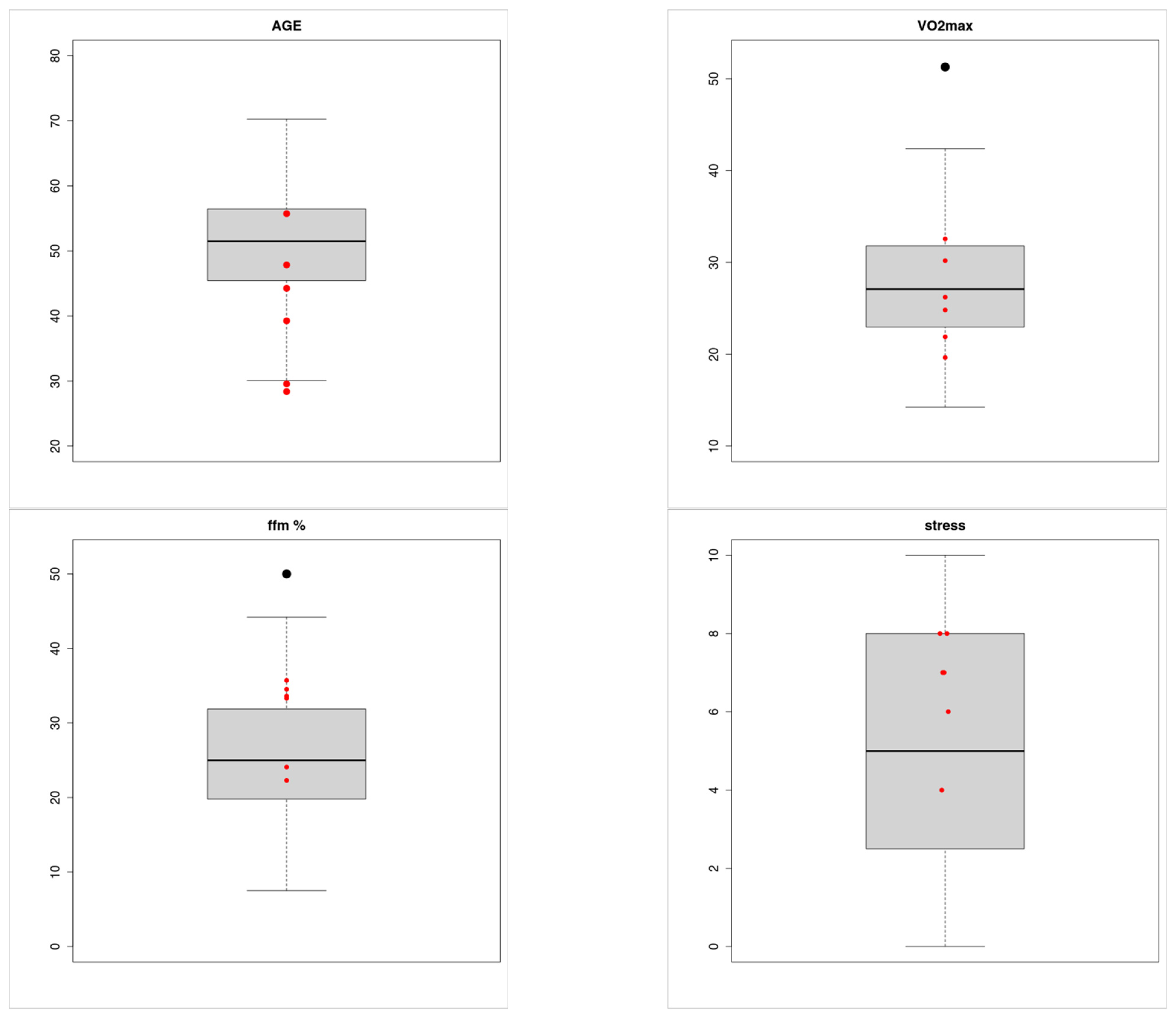
The potential bias attributable to the exclusion of participants who discontinued the program was investigated by comparing the distributions of baseline characteristics between completers and non-completers. The comparisons were performed on a restricted set of representative demographics (age, gender), lifestyle indicators (physical activity, AHA score, perceived stress score, metabolic syndrome) and test parameters (percentage of fat-free mass, VO2max). For categorical variables, Cramer’s V index was calculated; this index ranges from 0 to 1, with values close to 0 indicating similarity between the two groups. For numerical variables, the distributions in the completers group were represented using boxplots, and the corresponding values for non-completers were overlaid. Good overlap between these distributions indicates comparability between the two groups.
The correlation between VO2max and peak METs was assessed using scatterplots and Pearson’s correlation coefficient (r). Linear regression was used to quantify the expected change in VO2max associated with a 1-MET increase in peak METs. Finally, the impact of the stratified sampling design on the results was assessed through a sensitivity analysis using sampling weights [50]. All analyses were conducted in R version 4.4.0 [53] using the packages vtable [54], mice [55], and survey [56].

3. Results

3.1. Population

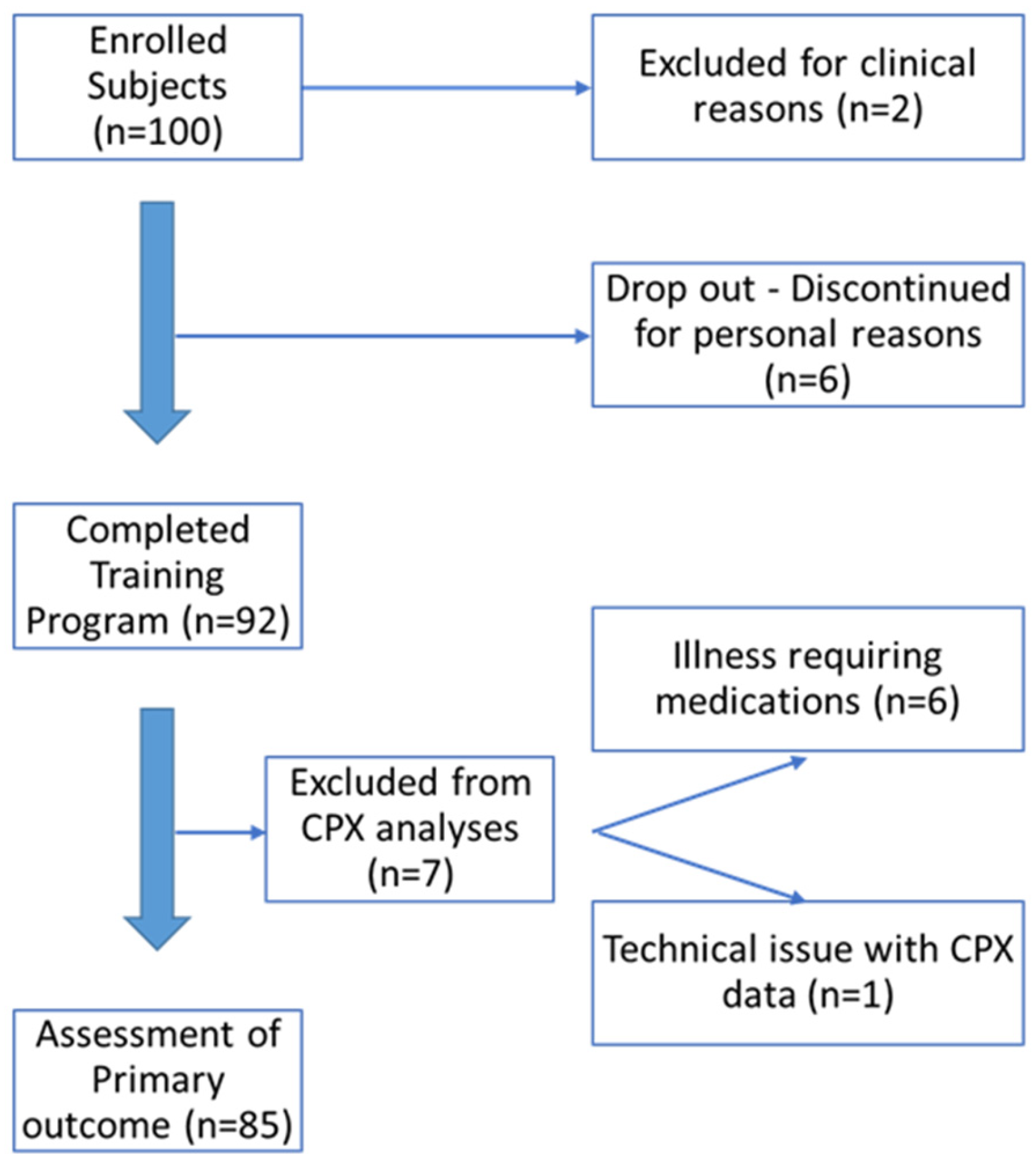
Among the 100 participants enrolled, two were excluded following a post-enrollment assessment that revealed ineligibility (Figure 2). The reasons for exclusion included medical conditions identified during the initial evaluation that were deemed incompatible with the intervention. The baseline characteristics of the remaining 98 are reported in Appendix A, Table A1 and Table A2. Among the 98 participants who underwent the physical exercise program (LMP), six voluntarily discontinued the program for personal reasons (Figure 2). These 98 were included in the intention-to-treat analysis, and 92 in the per-protocol analysis, except for the cardiopulmonary exercise test (CPX) parameter analysis. In fact, in the latter case, six further participants were excluded because they developed illnesses during the intervention that required medical treatment, as prescribed by their general practitioners, using medications that could significantly influence the measured parameters (e.g., beta-blockers). Furthermore, one participant was excluded due to technical issues encountered during the analysis of cardiopulmonary exercise (CPX) test data. In conclusion, per-protocol analysis of CPX parameters was performed on 85 participants. We report blood test results (fasting plasma glucose and lipid profile), perception of satisfaction and difficulty of the program and lifestyles parameters in Appendix A (respectively Table A2, Table A3, Table A4 and Table A5). We reported the summary of primary outcome in Table 2, while the secondary outcomes are summarized in Table 3 and Table 4.
At baseline, the maximum proportion of missing data was 4/92 for lifestyle indicators (4.3%, Table A4 and Table A5), 2/92 for cardiopulmonary parameters, reported in Table 3, 1/92 for body measurements, reported in Table 4, and no missing values for blood test parameters (Table A3). After the completion of the program, the highest proportion of missing data was obtained in 9/92 participants who did not report alcohol consumption (Table A5).
The overall satisfaction with the program was high, with at least 75% of the participants’ scores being 8/10 or more (1st quartile), and 83.7% of the participants declared that the overall perception of well-being was improved or much improved (see Table A3).

3.2. Main Outcome: Cardiopulmonary Test

The mean pre–post difference in VO2max estimated by intention-to-treat analysis was 2.86 mL/kg/min, with a 95% CI of 2.23 to 3.55 mL/kg/min, showing statistical evidence of improvement in aerobic fitness (p < 0.0001, Table 2). Similar results were obtained in the per-protocol sample, with a mean pre–post difference equal to 2.95 mL/kg/min and a 95% CI of 2.32 to 3.57 mL/kg/min (p < 0.0001). These results are consistent with those obtained by sensitivity analysis (Table 2).

3.3. Secondary Outcomes

3.3.1. Functional Parameters

At T1, significant improvements were observed in several key cardiopulmonary and functional parameters compared to T0 (Table 3). Statistically significant changes are indicated, showing improvements in VO2max, METSpeak, anaerobic threshold (AT) parameters, workload, and 6MWT performance.
Considering the overall group, METSpeak improved from 8.5 to 9.4 (Δ 0.7, 95% CI: 0.3, 1.1). METSpeak increased with a median difference of 0.7 (95% CI: 0.3 to 1.1). Notably, 42.4% of participants achieved an improvement of ≥1 MET, a change previously shown to be associated with a lower mortality risk [11], even though we may not argue a specific reduction in mortality risk in our population.
Improvements were also observed in AT % peak VO2, AT VO2 (mL/min/kg), AT Load (Watt), and peak Load (Watt). Functional capacity, assessed via the 6MWT, improved significantly, with distances increasing with a median difference of 27.0 m (95% CI: 13.5 to 47.5).
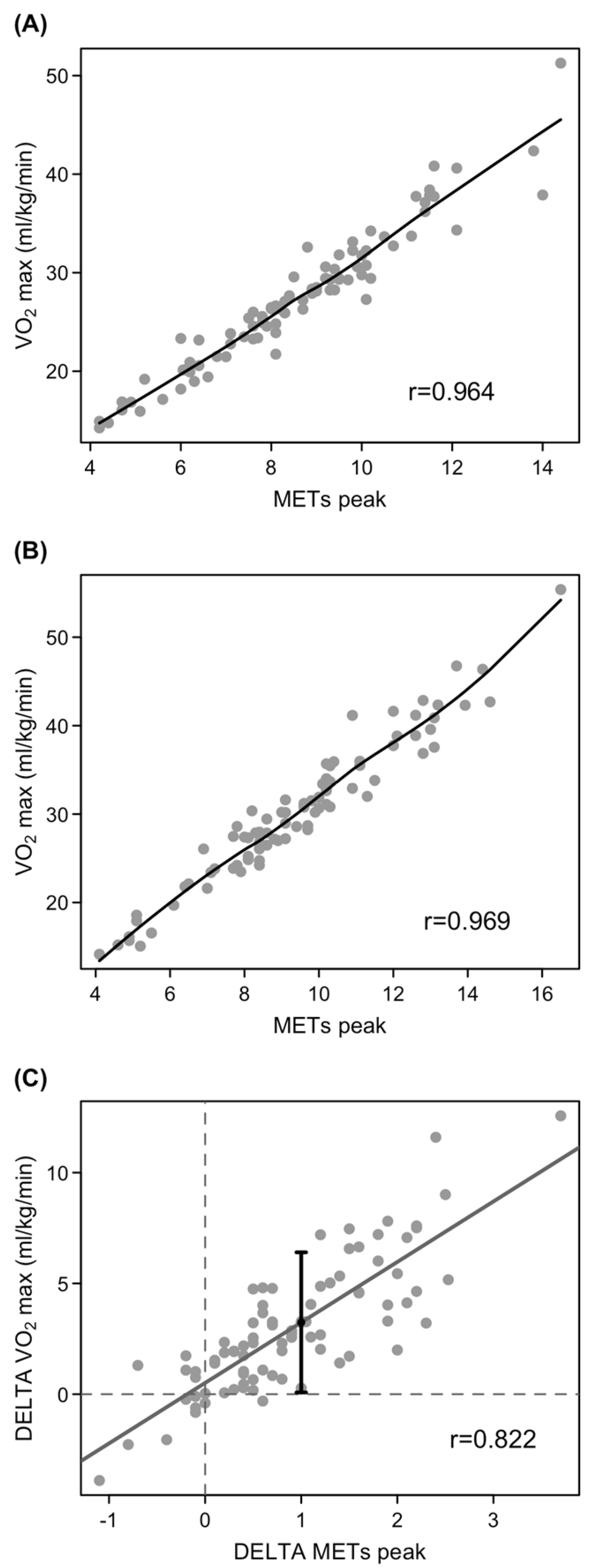
Figure 3 shows a strong positive correlation between VO2max and METSpeak at baseline (Figure 3A) and at the end of the program (Figure 3B), with correlation coefficients of r = 0.964 and r = 0.969, respectively. This indicates a very strong association between maximal oxygen uptake and metabolic equivalents at peak exercise. Furthermore, the observed improvements in VO2max and METSpeak after the intervention support the effectiveness of the lifestyle management program in enhancing cardiorespiratory fitness. Figure 3C shows the pre–post differences in these parameters. The estimate of the average pre–post difference in VO2max conditional on a 1-unit increase in METSpeak is 3.24 mL/min/kg, with a 95% prediction interval of 0.078 to 6.40 mL/min/kg. These results emphasize the proportional relationship between the improvements in VO2max and METSpeak, strengthening the role of METSpeak as a proxy of VO2max, both at baseline and in response to the intervention.

3.3.2. Body Composition Changes

Body composition changes from T0 to T1 (Table 4) showed significant improvements in median fat mass (kg), median fat mass (%), fat-free mass (%), and total Body Water (%). We did not observe a reduction in fat-free mass (Kg). BMI showed a trend toward reduction, with a difference of −0.5 kg/m2 (95% CI: −0.95 to −0.05), although the corresponding CIobtained within sensitivity analysis did not confirm the statistical significance of this result. Changes in waist circumference were statistically significant, with a difference of −3.0 cm (95% CI: −5.8 to −0.2); however, as above for BMI, the sensitivity analysis did not confirm statistical significance.

3.3.3. Multivariable Regression Model

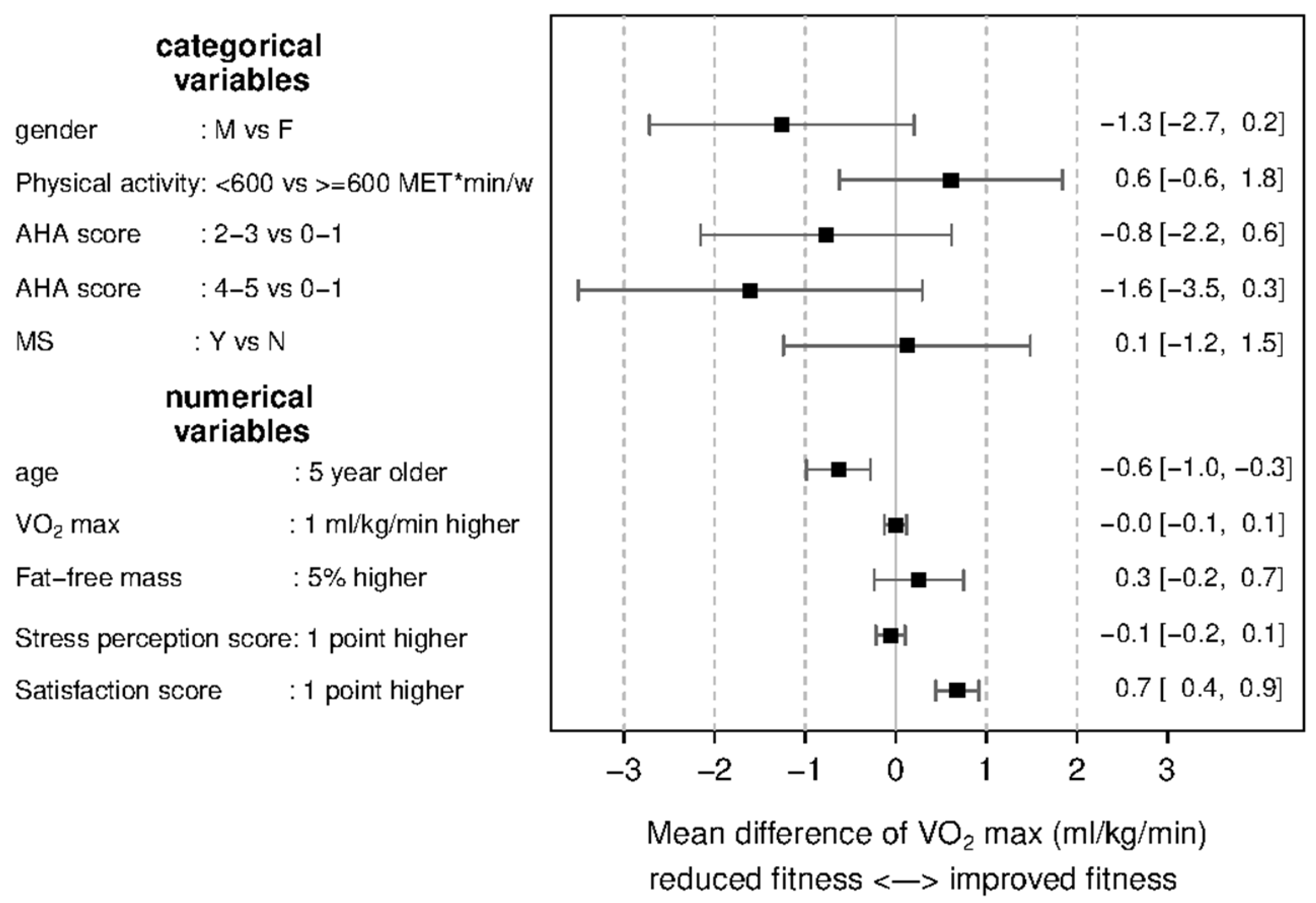
To investigate the factors influencing the change in VO2max (delta VO2max), a multivariable regression model was estimated, with the following explanatory variables: age, gender, baseline VO2max (VO2max at T0), and program satisfaction. The estimates of the effects of these variables are shown in Figure 4. In detail, age was negatively associated with delta VO2max, with an estimated mean decrease of −0.63 mL/kg/min per 5-year increase in age (95% CI: −0.99 to −0.28) (adjusted for all the other variables in the regression model, described above). This estimate indicates that older participants tend to experience smaller improvements in VO2max. Notably, program satisfaction was positively associated with delta VO2max, with an adjusted estimated mean 0.68-unit increase in delta VO2max for every one-point increase in the perceived satisfaction score (95% CI: 0.44 to 0.92). The model estimates also suggest that worse lifestyle parameters (physical activity < 600 METs, or lower AHA diet scores) are associated with a greater estimated improvement in VO2max, even if these changes do not reach statistical significance.

3.3.4. Other Lifestyle Components/Parameters

Table A4 and Table A5 reports differences in the other lifestyle components/parameters. Notably, the median difference in hours of sedentary behaviours was significantly reduced at T1. No significant differences were noted regarding changes before and after intervention regarding quality of nutrition (AHA score), alcohol consumption, sleep, perception of stress, fatigue and somatic symptoms, perception of quality of health, performance and sleep; nevertheless, a slight reduction in the perception of fatigue and stress and an improvement in the perception of quality of health, performance and sleep may be noted.

3.3.5. Check of Non-Completers’ Data

Comparison between completers and non-completers showed similarity across most baseline characteristics. The main differences concerned gender and age distribution, with non-completers being more frequently male (5/6, 83.3%; versus 44.6% of completers; Table A6) and generally younger than participants who completed the program (Figure A1). Considering the limited number of subjects in the non-completer group, the relevance of these differences is not easy to assess.

4. Discussion

In this study, we observed that the applied lifestyle management program (LMP), based on tailored exercise prescription, optimization of nutritional habits, motivation to change and unsupervised training, was linked to improved body composition and increasing cardiorespiratory fitness in a cohort of university employees. Notably, 42.4% of participants achieved an improvement of ≥1 METSpeak, a change associated with a lower mortality risk [11], particularly among young participants.

4.1. Cardiorespiratory Fitness to Monitor LMPs

Clinical medicine encompasses a wide range of practices aimed at treating, managing, and preventing many CNCDs, as well as promoting overall well-being. Among these actions, lifestyle improvement may play an important role. However, translating LMPs from research settings into routine clinical practice remains challenging [57,58]. Two essential conditions must be met: interventions should effectively target mechanisms responsible for diseases to treat or prevent by defining clear clinical goals and reliable outcome markers, while also being feasible, accessible, and cost-effective. In this regard, the prescription of exercise, much like pharmacological therapy, requires individualized assessment and well-defined clinical goals to ensure its effectiveness [1,3,21,41,59]. Aerobic endurance exercise performed at moderate intensity for 150–300 min per week is required to improve CRF in adults, while strength training is necessary to improve muscular strength and mass [1,3]. The primary goal of this study was to assess CRF changes by an LMP, given that CRF is associated with reduced total mortality and improved cardiovascular and oncologic risk factors, psychosocial functioning, and well-being [10,11,12,13]. To achieve this goal, we prescribed exercise after cardiopulmonary exercise testing (CPX) to assess baseline CRF and determine training heart rates tailored to individual characteristics and clinical goals [1,3,20]. CPX is the gold standard for assessing CRF [24]; however, its use in clinical practice is often limited by cost and logistical challenges [11,14,23,26,60]. METSpeak is, instead, simply derived from standardized exercise testing (a more commonly used clinical test), and it represents a practical measure of exercise capacity [11,26]. Notably, METSpeak is inversely and strongly associated with all-cause mortality, with a 1-MET improvement linked to lower mortality risk [11]. Our analysis quantified the relationship between changes in VO2max and METSpeak, showing that a 1-MET improvement corresponds to an average increase of 3.24 mL/min/kg in VO2max. This finding is not surprising, as the algorithms used to estimate both VO2max and METSpeak consider intertwined parameters; consequently, the strength of the correlation is not unexpected. Nevertheless, it may corroborate the usage of a simple parameter derived from a simple ECG stress test (METSpeak) as a practical proxy to estimate cardiorespiratory fitness in a clinical setting where more complex and costly evaluations, such as cardiopulmonary exercise testing, are not readily available.
A further point to consider is that another cardinal CPX variable, such as VE/VCO2 slope, which was within the normal range in our cohort, did not change after the intervention. This is physiologically consistent, as changes in VE/VCO2 slope are typically more evident in populations with cardiopulmonary disease, where ventilatory inefficiency is present and may improve with targeted interventions [61,62]. Hence, the improvements we observed in exercise capacity are more likely explained by peripheral and metabolic adaptations to training rather than by changes in ventilatory efficiency, which were already preserved at baseline [61,62].
In this study, the overall group of participants significantly improved CRF; notably, 42.4% of subjects achieved a clinically meaningful increase in 1 MET at peak exercise after the LMP, even though we may not argue a specific reduction in mortality risk in our population. We also observed that younger participants tended to experience greater improvements in VO2max. These data highlight that preventive strategies may be particularly effective in younger individuals, despite the fact that they may be less inclined to modify their behaviour, due to a perception of being healthy. While it is well established that young subjects exhibit a wide range of VO2max values [63], less is known regarding the influence of age on improvements in cardiorespiratory fitness following an LMP. Ageing is associated with reduced cardiovascular reserve, impaired vascular function and diminished mitochondrial efficiency, all of which limit the magnitude of achievable improvements in VO2max [64]. The available literature on this topic is limited and shows inconsistent findings [65,66,67]; therefore, our results may contribute to a better understanding of this field. It is important to note that these results were achieved without supervised training in a controlled environment, but rather through unsupervised training and self-managed meal preparation.

4.2. Body Composition

In addition, we observed a significant improvement in body composition, suggesting an important role of exercise in directly affecting metabolism and, at the same time, supporting the concept that physical activity and a well-balanced diet are most effective when combined within a comprehensive approach.
Interestingly, we did not observe a reduction in fat-free mass (Kg); rather, a slight, albeit non-significant, increase was detected. These data suggest that the LMP employed was effective in avoiding fat-free mass loss, which frequently characterizes these programs [68]. Nevertheless, we have to consider that bioelectrical impedance analysis has known limitations related to hydration status and measurement variability, which may call for caution in the interpretation of these results. Moreover, the lack of statistical significance in the reduction in waist circumference and BMI after sensitivity analysis suggests that the impact on central obesity should be considered with caution.

4.3. LMPs in Clinical Settings

The traditional approach to preventing several chronic diseases, based on the reduction in cardiometabolic risk through parameters such as lipid profile, blood pressure, and glucose level, is now increasingly complemented by strategies targeting the improvement of behaviours such as physical activity, healthy nutrition, stress management, smoking cessation, and good sleep hygiene (LMPs) [69,70]. This shift represents an important change in perspective, emphasizing feasible behaviour changes regardless of calculated cardiac risk [31], a concept particularly important for younger individuals, who are often characterized by low estimated cardiac risk. In this study, the observed results were achieved by employing an LMP which was highly feasible from both economic and organizational perspectives. The program involved only two in-person visits with an internal medicine physician, to prescribe exercise and provide guidance on proper nutrition (along with advice on stress management and smoking cessation). These were complemented by two phone consultations with a physiotherapist to support adherence and maintain motivation. A third, final medical encounter at the end of the program was dedicated to results review and motivation reinforcement. Participants were free to choose whether to perform exercise indoors (e.g., at home or in a gym) or outdoors, according to their preferences and logistical constraints. They were also free to decide the meal composition, while respecting the Mediterranean diet and Healthy Eating Plate principles. No specific recommendations were provided regarding the precise dosage of single macronutrients, with the exception of protein intake of 0.8–1.0 g per kilogram of body weight, derived from unprocessed white meat, fish, dairy products, eggs, legumes and nuts, as suggested by international guidelines [42].
A cognitive–behavioural approach was employed to motivate participants to adopt and maintain lifestyle changes (see Table 1) [17,43,44]. In particular, a patient empowerment approach [70] and the 5A model of implementing behavioural changes were considered, as recently recommended by medical scientific statements [71,72]. While specific cognitive–behavioural therapy may be more suitable for individuals with psychological impairments, training physicians in basic cognitive–behavioural techniques can improve the effectiveness and sustainability of LMPs [17,43,44,71,72]. In this study, we integrated this behavioural approach into routine internal medicine encounters with a patient, combining motivation techniques with traditional internal medicine practice. This strategy appears to be effective in empowering participants [68], even in the absence of chronic disease, and may be easily employed in a clinical setting [71,72]. Notably, sedentary habits were reduced, overall satisfaction with the program was positively associated with improvement in VO2max, and the employed statistical analysis suggests that worse lifestyle parameters (physical activity < 600 METs, or lower AHA diet scores) were associated with a greater estimated improvement in VO2max. Even if these latter changes did not reach statistical significance, they suggest that subjects characterized by unhealthy behaviour were motivated to improve their habits.
The importance of health literacy in influencing adherence to exercise programs needs to be discussed. It is well recognized [73] that an elevated level of health literacy facilitates the adoption of a healthy lifestyle, and that improving health literacy is a cornerstone of patients’ empowerment [70], particularly in non-supervised exercise programs, which need self-management capabilities [74]. Social research [75] found that a higher level of education in adults is linked to more physical activity.
In our study, we enrolled, by design, employees of the University of Milan (59.2% holding a PhD or postgraduate degree), and it may be argued that they have higher health literacy compared to the general population. Nevertheless, we have to consider that during the first medical visits, we dedicated time to improve health literacy, considering their level of knowledge and their clinical goals, as a pivotal strategy to increase their adherence to the program, independently of their educational degree. Obviously, socioeconomically diverse populations might require a different approach.

4.4. LMPs and Perceived Well-Being

An LMP represents one of the main strategies to improve overall well-being and reduce stress perception [76,77], as already observed in other studies [78,79], including studies conducted by our research group [31,32,33,34]. In this specific study, 83.7% of subjects who completed the program reported an improvement in their perceived personal well-being, and overall satisfaction with the program was high, with most participants rating the program at eight (on a 0–10 scale). Interestingly, 53.1% of participants reported a desire to increase their level of physical activity, while 22.4% expressed a willingness to adopt a healthier diet. The study did not unveil any significant differences in perceived stress, fatigue, or symptoms, although a slight improvement was observed. However, these findings should be interpreted with caution, given the limited sample size.
Similarly, the handgrip test showed no significant improvement in muscular strength, although an increase was observed in the reported frequency of strength and flexibility exercise sessions. These exercise modalities were also prescribed, along with video tutorials to support adherence. Nevertheless, we must consider that only strength exercises of moderate intensity were prescribed [1] to subjects without sarcopenia or muscular diseases, in combination with appropriate nutritional guidance, which may have contributed to the preservation of fat-free mass. The possibility of tailoring the progression of strength exercises with the help of an exercise physiologist might further improve muscle strength and mass, although this would likely increase the overall cost of the LMP.

4.5. Clinical Implications

The strength of the present study is to show the feasibility of implementing into clinical routine an effective, feasible and well-accepted LMP, thereby overcoming the main organizational and economic barriers usually encountered when transitioning LMPs from research settings to clinical practice. LMPs demonstrate substantial cost savings and elevated Returns On Investments [80,81]; on the other hand, the cost to perform them (due to the costs of many professionals, the cost of fitness centres, etc.) and organizational barriers may represent an issue to their realization in primary care settings. Our study required low economic resources (corresponding to the cost of three medical visits and the cost of a CPX or a less expensive stress ECG to tailor exercise prescription and to monitor results). Participants may decide where and how to perform exercise, based also on their own economic availability. This intervention model might offer significant scalability in different primary care settings and applicability to diverse populations.

4.6. Limitations

We have to recognize some limitations of our study, in particular, the following:
-
It is a single-arm (pre–post) study, a condition which limits the isolation of the effect of the intervention from other experimental variables, unmeasured confounders, and potential observation effects such as the Hawthorne effect. Consequently, the findings should be interpreted with caution, and causal inferences cannot be established. Moreover, we do not have data on long-term follow-up data, and we may not demonstrate the maintenance of behavioural and physiological improvements in the long term.
-
The sample size was calculated to detect a clinically relevant increase in VO2max as the primary endpoint, and the follow-up was limited to six months due to funding constraints. In addition to the previous limitations, secondary outcomes were analyzed on a per-protocol basis, which may introduce selection bias and further reduce the effective sample size. Accordingly, inferences for secondary endpoints should be interpreted with caution. The stratified sampling plan ensured adequate representation of key subgroups and improved the precision of estimates within the target population. In addition, a weighted sensitivity analysis was performed to account for potential imbalances across strata, thereby enhancing the robustness of the findings. Nevertheless, the generalizability of the results to a broader population of healthy individuals remains limited, mainly by the study’s eligibility criteria and setting. In particular, the sample consists exclusively of employees of the University of Milan with a very high educational level (59.2% holding a PhD or postgraduate degree), limiting the generalizability of the results to populations with lower health literacy. Moreover, we did not assess the intervention effects after 6 months due to financial restraints.
-
This paper focuses primarily on CRF and a subset of clinical variables commonly collected in trials. Other CPX variables were included in the text to provide a clinically meaningful, although not exhaustive, characterization of general cardiopulmonary status, without unnecessarily increasing methodological complexity or overextending the scope of the manuscript. We are planning another manuscript devoted to these data. Moreover, future analyses will explore the multi-omics biomarkers collected during the study to investigate interactions between immunological, metabolic, and autonomic control mechanisms.
-
We mainly focused on exercise, which was tailored and prescribed, and it might be most responsible for the observed improvements; however, the counselling given on nutrition and other lifestyle components, albeit limited, might contribute to the observed results. Nevertheless, distinguishing the relative contribution of different lifestyle components may not have significant clinical relevance, considering that the preventive/therapeutic action of lifestyle improvement is more efficacious when all lifestyle components are considered and that improving one lifestyle component (in particular exercise) may also foster improvements in others [82].
-
The retrospective registration of the trial may represent a limitation, considering that prospective registration is generally preferred for interventional studies
-
We did not report in the present paper the data regarding the assessment of physical activity using a wearable device because we are preparing other papers on these specific (and other) data, considering that the HEBE study was designed to collect many markers and many different papers are planned. Anyway, this specific point was not a main goal of the present study, which focused on cardiorespiratory fitness, the strongest parameter affected by physical training, which may determine health outcomes.

5. Conclusions

This study provides evidence that implementing a feasible, cost-effective, and well-accepted LMP in routine clinical practice is feasible. The program induced significant improvements in CRF and body composition, highlighting its potential to support long-term health benefits. Tailored exercise prescription and optimization of nutritional habits, supported by limited physician encounters and digital resources, proved effective in achieving meaningful outcomes without imposing excessive costs or logistical challenges. The ability to integrate tailored LMPs into routine care with minimal time and economic investment represents a valuable opportunity for both patients and healthcare institutions, offering a scalable solution to promote health and prevent chronic diseases in clinical settings.

Author Contributions

D.L., F.R., F.B., C.M., V.B., M.C. and E.M.B. are part of the Core Team who conceived and designed the entire “HEBE Project” and the protocol of the present study. D.L. designed and conducted the clinical work with the contributions from G.O., G.B. and M.M. Data collection and preliminary analysis were performed by D.L., G.O., G.B., M.M., F.R., S.C. and V.B., E.M.B., G.M., E.L., S.I. and P.B. performed statistical analysis. D.L., E.M.B., V.B. and M.C. wrote the manuscript with contributions from G.O., E.L., G.M., F.B., D.L., E.M.B., V.B. and M.C. supervised the project. All authors and members of the “HEBE project” commented and reviewed the final manuscript and approved its publication. All authors have read and agreed to the published version of the manuscript.

Funding

This work was supported by the University of Milan, “Grandi Sfide di Ateneo” (GSA—Line 6 of the Research Support Plan 2021, Award Numbers PSRL621MCLER_01). This work was also partially supported by the Italian Ministry of Health.

Institutional Review Board Statement

The protocol of this study followed the principles of the Declaration of Helsinki and Title 45, US Code of Federal Regulations, Part 46, Protection of Human Subjects, Revised 13 November 2001, effective 13 December 2001. The HEBE study received ethics approval from the University of Milan Ethical Committee (Approval No. 62/22, dated 30 June 2022) and the IRCCS Istituto Auxologico Ethical Committee (Approval Code: 2022071912, dated 27 July 2022). The study was registered in Clinicaltrials.gov (NCT05815732) 14 April 2023—retrospectively registered, https://clinicaltrials.gov/study/NCT05815732, accessed on 1 June 2026.

Informed Consent Statement

Informed consent was obtained from all subjects involved in the study. Written informed consent has been obtained from the patients to publish this paper.

Data Availability Statement

The datasets used and/or analyzed during the current study are available from the corresponding author on reasonable request to be assessed by the HEBE project board.

Conflicts of Interest

The authors declare no conflicts of interest.

Abbreviations

The following abbreviations are used in this manuscript:
AHA scoreAmerican Heart Association score
ATAnaerobic threshold
BCBody composition
BMIBody mass index
CIConfidence interval
CNCDChronic non-communicable disease
CPXCardiopulmonary exercise test
CRFCardiorespiratory Fitness
DAPDiastolic arterial pressure
DELTAPre–post differences
FFemale
FMFat mass
FMiFat mass index
FFMFat-free mass
FFMiFat-free mass index
HDLHigh-density lipoprotein
HGHandgrip
HRHeart rate
IPAQInternational physical activity questionnaire
ITTIntention-to-treat
LDLLow-density lipoprotein
LMPsLifestyle modification programs
MMale
MARMissingness at random
METsMetabolic equivalents
METSpeakMetabolic equivalents at exercise peak
MICEMultiple imputation by chain equations
MSMetabolic syndrome
OOxygen
p0Pre-treatment outcome proportions
p1Post-treatment outcome proportions
q2525th percentile
q7575th percentile
RDRelative difference
SAPSystolic arterial pressure
T0Baseline
T1End of the intervention
VVolume
VEVentilation
VO2maxVolume of maximal oxygen
WWatt
4S-QShort–subjective stress-related somatic symptoms questionnaire
6MWTSix-minute walking test
ΔDelta

Appendix A

Appendix A.1. Lifestyle Assessment

-
Physical activity (total activity volume) was assessed by the International Physical Activity Questionnaire (IPAQ) [36], which focuses on intensity (nominally estimated in Metabolic Equivalents (METs) according to the type of activity) and duration (in minutes) of physical activity, considering the following levels: brisk walking (≈3.3 METs), other activities of moderate intensity (≈4.0 METs) and activities of vigorous intensity (≈8.0 METs). We use the following equations to guess weekly physical activity volume: moderate-intensity [MET·minutes/week] = (3.3 × minutes of brisk walking × days of brisk walking) + (4.0 × minutes of other moderate-intensity activity × days of other moderate-intensity activities); vigorous-intensity: [MET·minutes/week] = 8.0 × minutes of vigorous-intensity activity × days of vigorous-intensity activity; and total weekly physical activity volume [MET·minutes/week] = sum of Moderate + Vigorous MET·minutes/week scores.
-
We also assessed the frequency of regular strength and flexibility exercises, considering the following scale: never; sometimes; 1 section/week; 2–3 sections/week; more than 3 sections/week.
-
Sedentary behaviour was assessed by asking the number of hours spent in sedentary behaviour (for instance, studying, sitting, driving, TV viewing, computer or smart devices usage) during weekly working days or weekend days.
-
Nutrition was assessed using the American Heart Association Healthy Diet Score (AHA score) [37], taking into consideration fruits/vegetables, fish, sweetened beverages, whole grains, and sodium consumption.
-
Sleep was assessed by inquiring about the number of hours on average slept every night and asking about the perception of sleep quality
-
Stress and somatic symptom perception were assessed using a self-administered questionnaire [30,31,32,33,34,35], providing nominal self-rated scales (higher values indicate higher degrees of symptoms) focusing on: (i) the appraisal of the overall stress and fatigue perception by evaluation scales with integer scores from 0 (‘no perception’) to 10 (‘highest perception’) for each measure; (ii) the Short–Subjective Stress-related Somatic Symptoms Questionnaire (4S-Q), inquiring about four somatic symptoms accounting for the majority of somatic complaints. For scoring purposes, each response will be coded from 0 (‘no feeling’) to 10 (‘a strong feeling’); thus, the total score ranges from 0 to 40. Moreover, we also assessed the following:
-
Perception of quality of sleep, quality of health, and quality of life were assessed using evaluation scales from 0 (‘worst quality) to 10 (‘best quality’) for each measure.
-
Smoke behaviour: We considered non-smokers all subjects who reported having never smoked or having stopped smoking for more than one year.
-
We enquired about the usage of alcohol, considering Italian habits, asking about the number of glasses of wine or beer consumed per week and the number of glasses of spirits consumed per week.
-
Gum bleeding was evaluated considering the following choices: “yes”, “no”, or “sometimes”.
-
Work-related discomfort was evaluated considering the following choices: “no”, “sometimes”, “yes”, or “no response”.

Appendix A.2. Ongoing Multi-Omics Analysis and Study of the Autonomic Nervous System (ANS)

While the primary outcomes of VO2max are the focus of this paper, biological samples collected during the study (blood, urine, saliva, and nasal swabs) are being analyzed as part of a comprehensive multi-omics investigation. This analysis aims to explore biomarkers of systemic inflammation and other indicators related to the study objectives, with results to be reported in future publications. Similarly, the results of the ANS will be part of future publications.
Table A1. Baseline description of the study subjects (N = 98).
Variable
Age (years): median (q25–q75)51.1 (45.0–56.2)
Role:
UNIMI Faculty38 (38.8%)
Technical and Administrative Staff45 (45.9%)
Researcher15 (15.3%)
Gender: Female52 (53.1%)
Education Level
High School Diploma4 (4.1%)
Bachelor’s Degree26 (26.5%)
PhD/Postgraduate Specialization68 (59.2%)
Frequency of medical consultations for
health status assessment
Never1 (1.0%)
Once per year42 (42.9%)
Once every 2 years3 (3.1%)
Regularly for specific medical issues14 (14.3%)
Only when experiencing illness38 (38.8%)
Presence of Chronic Disease
No71 (72.4%)
Yes23 (23.5%)
No response4 (4.1%)
Work-related Discomfort
No57 (58.2%)
Sometimes27 (27.6%)
Yes13 (13.3%)
No response1 (1.0%)
Lifestyle Goals for Improvement
Eating a healthier diet22 (22.4%)
Becoming more physically active52 (53.1%)
Managing stress21 (21.4%)
Quitting smoking3 (3.1%)
Age is reported as median (25th and 75th percentiles) and all other parameters as absolute number (percentage).
Table A2. Blood test parameters before T0 and after T1 intervention.
T0
Median, 25th–75th
Percentile
Unweighted
T1
Median, 25th–75th Percentile
Unweighted
Median Difference Between
T1 and T0
Fasting Blood Glucose (mg/dL)89 (85; 96)90 (83; 95)
missing: 4 (4.3%)
−2.0 (−7.3, 3.3)
missing: 4 (4.3%)
Triglycerides (mg/dL)82 (62; 118)74 (61; 92)
missing: 4 (4.3%)
−6.0 (−14.6, 2.6)
missing: 4 (4.3%)
Total Cholesterol (mg/dL)210 (179; 232)188 (170; 218)
missing: 4 (4.3%)
−8.0 (−16.2, 0.2)
missing: 4 (4.3%)
HDL Cholesterol (mg/dL)60 (50;70)55 (50; 71)
missing: 4 (4.3%)
−1.0 (−4.4, 2.4)
missing: 4 (4.3%)
LDL Cholesterol (mg/dL)124 (104; 147)112 (96; 133)
missing: 4 (4.3%)
−7.0 (−15.0, 1.0)
missing: 4 (4.3%)
Table A3. Perception of satisfaction, difficulty and overall well-being.
Satisfaction with the Program: median (q25; q75)8 (8; 10)
No response
Perceived Difficulty in Following Program: median (q25; q75)7 (3.7 (7.6%)3; 8)
No response7 (7.6%)
Overall Perception of Well-Being
Much Worse0 (0.0%)
Worse1 (1.1%)
No Change6 (6.5%)
Improved56 (60.9%)
Much Improved21 (22.8%)
No response8 (8.7%)
Reasons for Non-Adherence * (N = 63)
Lack of Time42 (66.7%)
Motivation Issues7 (11.1%)
Difficulty Following the Program4 (6.3%)
Health Issues16 (25.4%)
Other Reasons8 (12.7%)
* Participants were allowed to indicate one or more reasons; q25= 25-th, q75 = 75th percentiles.
Table A4. Differences in the other lifestyle components/parameters.
T0
N (%)
T1
N (%)
Probability of:Relative Difference Between
T1 and T0
Smoke
Non-smoker/ex-smoker
Smokers
Missing

87 (94.6%)
5 (5.4%)
-

84 (91.3%)
4 (4.3%)
4 (4.3%)

Being non-ssmoker OR former smoker:

0.7% (−1.7, 3.2%)
Gum Bleeding
No
Sometime
Yes
Missing

79 (85.9%)
0 (0.0%)
13 (14.1%)
-

79 (85.9%)
5 (5.4%)
4 (4.3%)
4 (4.3%)

No bleeding:

4.6% (−12.2%, 24.6%)
Flexibility exercise
(Stretching)
No
sometimes
1 session/week
2–3 sessions/week
More than 3 sessions/week
Missing

49 (53.3%)
24 (26.1%)
8 (8.7%)
8 (8.7%)
3 (3.3%)
-

26 (28.3%)
20 (21.7%)
25 (27.2%)
11 (12.0%)
6 (6.5%)
4 (4.3%)

Doing weekly stretching (any frequency)

37.2% (−3.4%, 95.0%)
Strength Exercises
No
sometimes
1 session/week
2–3 sessions/week
More than 3 sessions/week
Missing

21 (22.8%)
49 (53.3%)
21 (22.8%)
1 (1.1%)
0 (0.0%)
-

21 (22.8%)
41 (44.6%)
26 (28.3%)
0 (0.0%)
0 (0.0%)
4 (4.3%)

Doing weekly exercise (any frequency)

3.0% (−14.7%, 24.4%)
Table A5. Differences in the other lifestyle components/parameters.
ParameterT0
Median, 25th–75th Percentile
Unweighted
T1
Median, 25th–75th Percentile
Unweighted
Median Difference Between
T1 and T0
METs TOT (MET·minutes/week)1114 (511; 1760)1774 (1094; 2449)434 (44, 824)
-4 (4.4%)4 (4.4%)
Sedentary behaviours (hours) *55 (48; 65)51 (41; 59)−5 (−8.5, −1.5)
missing2 (2.2%)7 (7.8%)9 (9.8%)
Wine/beer (glasses/week)2 (0; 4)1 (0; 3)0 (−1.0, 0.0)
missing1 (1.1%)9 (10.0%)10 (10.9%)
Spirits (glasses/week)0 (0; 0)0 (0; 0)0 **
missing 1 (1.1%)7 (7.8%)8 (8.7%)
4SQ score (a.u.)6 (2; 15)4 (0; 12)−1.0 (−3.7, 1.7)
missing-4 (5.5%)5 (5.5%)
Stress Perception score (a.u.)5.0 (2.8; 8.0)4.0 (2.0; 7.0)−1.0 (−2.6, 0.6)
missing-4 (4.4%)4 (4.4%)
Fatigue Perception score (a.u.)7.0 (3.0; 8.0)4.0 (3.0; 8.8)−1.0 (−2.6, 0.6)
missing-4 (4.4%)4 (4.4%)
AHA healthy diet score (a.u.)2.5 (2.0; 3.0)3.0 (2.0; 4.0)0.0 (−0.3, 0.3)
missing-4 (4.4%)4 (4.4%)
Sleep (hours/day)7.0 (6.0; 7.0)7.0 (6.0; 7.0)0 **
missing-4 (4.4%)4 (4.4%)
Perception of sleep quality (a.u.)6.0 (5.0; 8.0)7.0 (6.0; 8.0)0 (−0.6, 0.6)
missing-4 (4.4%)4 (4.4%)
Perception of health quality (a.u.)7.0 (6.0; 8.0)8.0 (7.0; 8.0)1 (−0.6, 2.6)
missing-4 (4.4%)4 (4.4%)
Perception of job performance (a.u.)7.0 (6.0; 8.0)8.0 (7.0; 8.0)0 (−1.2, 1.2)
missing-4 (4.4%)4 (4.4%)
Abbreviations: 4SQ = Short–Subjective Stress-related Somatic Symptoms Questionnaire; AHA = American Heart Association; a.u. = arbitrary unis; * significant difference indicated by a 95% CI that does not overlap with the value zero; ** confidence intervals not reported, due to unreliable estimate of the standard error of the median with quantile regression method and/or weighted methods (due to the fact no change was observed in sleep hours for 48 over 85 participants, and no change in spirit consumption for 67/85 participants).
Table A6. Distribution of categorical variables in completer and non-completer groups.
ParameterCompleters
(n = 92)
Non-Completers
(n = 6)
Cramer V
Gender 0.404
Female51 (55.4%)1 (16.7%)
Male 41 (44.6%)5 (83.3%)
Physical activity 0.082
<600 MET minutes/week54 (58.7%)4 (66.7%)
600 MET minutes/week38 (41.3%)2 (33.3%)
AHA score 0.188
0–116 (17.4%)2 (33.3%)
2–360 (65.2%)3 (50.0%)
4–516 (17.4%)1 (16.7%)
Metabolic syndrome 0.093
No69 (75.8%)5 (83.3%)
Yes 22 (24.2%)1 (16.7%)
Abbreviations: MET = metabolic equivalent; AHA = American Heart Association.
Figure A1. Distribution of numerical variables in completer and non-completer groups. The boxplots show the distributions of the pertinent variables in the completers, and the grey arrows in the non-completers.
Nutrients 18 01918 g0a1

References

  1. Bull, F.C.; Al-Ansari, S.S.; Biddle, S.; Borodulin, K.; Buman, M.P.; Cardon, G.; Carty, C.; Chaput, J.P.; Chastin, S.; Chou, R.; et al. World Health Organization 2020 Guidelines on Physical Activity and Sedentary Behaviour. Br. J. Sports Med. 2020, 54, 1451–1462. [Google Scholar] [CrossRef]
  2. Sallis, R.E. Exercise Is Medicine and Physicians Need to Prescribe It! Br. J. Sports Med. 2009, 43, 3–4. [Google Scholar] [CrossRef]
  3. Pelliccia, A.; Sharma, S.; Gati, S.; Bäck, M.; Börjesson, M.; Caselli, S.; Collet, J.P.; Corrado, D.; Drezner, J.A.; Halle, M.; et al. 2020 ESC Guidelines on Sports Cardiology and Exercise in Patients with Cardiovascular Disease. Eur. Heart J. 2021, 42, 17–96. [Google Scholar] [CrossRef]
  4. Valenzuela, P.L.; Ruilope, L.M.; Santos-Lozano, A.; Wilhelm, M.; Kränkel, N.; Fiuza-Luces, C.; Lucia, A. Exercise Benefits in Cardiovascular Diseases: From Mechanisms to Clinical Implementation. Eur. Heart J. 2023, 44, 1874–1889. [Google Scholar] [CrossRef]
  5. Oppert, J.M.; Bellicha, A.; Ciangura, C. Physical Activity in Management of Persons with Obesity. Eur. J. Intern. Med. 2021, 93, 8–12. [Google Scholar] [CrossRef] [PubMed]
  6. Argentieri, M.A.; Amin, N.; Nevado-Holgado, A.J.; Sproviero, W.; Collister, J.A.; Keestra, S.M.; Kuilman, M.M.; Ginos, B.N.R.; Ghanbari, M.; Doherty, A.; et al. Integrating the Environmental and Genetic Architectures of Aging and Mortality. Nat. Med. 2025, 31, 1016–1025. [Google Scholar] [CrossRef]
  7. Silverman, M.N.; Deuster, P.A. Biological Mechanisms Underlying the Role of Physical Fitness in Health and Resilience. Interface Focus 2014, 4, 20140040. [Google Scholar] [CrossRef]
  8. Nieman, D.C.; Wentz, L.M. The Compelling Link between Physical Activity and the Body’s Defense System. J. Sport Health Sci. 2019, 8, 201–217. [Google Scholar] [CrossRef] [PubMed]
  9. Fiuza-Luces, C.; Valenzuela, P.L.; Gálvez, B.G.; Ramírez, M.; López-Soto, A.; Simpson, R.J.; Lucia, A. The Effect of Physical Exercise on Anticancer Immunity. Nat. Rev. Immunol. 2024, 24, 282–293. [Google Scholar] [CrossRef] [PubMed]
  10. Bishop, V.S. Exercise and the Autonomic Nervous System. In Primer on the Autonomic Nervous System, 2nd ed.; Academic Press: Cambridge, MA, USA, 2004; pp. 183–184. [Google Scholar] [CrossRef]
  11. Kokkinos, P.; Faselis, C.; Samuel, I.B.H.; Lavie, C.J.; Zhang, J.; Vargas, J.D.; Pittaras, A.; Doumas, M.; Karasik, P.; Moore, H.; et al. Changes in Cardiorespiratory Fitness and Survival in Patients With or Without Cardiovascular Disease. J. Am. Coll. Cardiol. 2023, 81, 1137–1147. [Google Scholar] [CrossRef]
  12. Kodama, S.; Saito, K.; Tanaka, S.; Maki, M.; Yachi, Y.; Asumi, M.; Sugawara, A.; Totsuka, K.; Shimano, H.; Ohashi, Y.; et al. Cardiorespiratory Fitness as a Quantitative Predictor of All-Cause Mortality and Cardiovascular Events in Healthy Men and Women: A Meta-Analysis. JAMA 2009, 301, 2024–2035. [Google Scholar] [CrossRef]
  13. Cumming, G.R. Physical Fitness and Cardiovascular Health. Circulation 1968, 37, 4–7. [Google Scholar] [CrossRef]
  14. Lang, J.J.; Prince, S.A.; Merucci, K.; Cadenas-Sanchez, C.; Chaput, J.P.; Fraser, B.J.; Manyanga, T.; McGrath, R.; Ortega, F.B.; Singh, B.; et al. Cardiorespiratory Fitness Is a Strong and Consistent Predictor of Morbidity and Mortality among Adults: An Overview of Meta-Analyses Representing over 20.9 Million Observations from 199 Unique Cohort Studies. Br. J. Sports Med. 2024, 58, 556–566. [Google Scholar] [CrossRef] [PubMed]
  15. Nilsson, M.I.; Bourgeois, J.M.; Nederveen, J.P.; Leite, M.R.; Hettinga, B.P.; Bujak, A.L.; May, L.; Lin, E.; Crozier, M.; Rusiecki, D.R.; et al. Lifelong Aerobic Exercise Protects against Inflammaging and Cancer. PLoS ONE 2019, 14, e0210863. [Google Scholar] [CrossRef] [PubMed]
  16. Woods, J.A.; Wilund, K.R.; Martin, S.A.; Kistler, B.M. Exercise, Inflammation and Aging. Aging Dis. 2011, 3, 130. [Google Scholar]
  17. Rippe, J.M.; Frates, B. Academic Lifestyle Medicine and Physician Education. Am. J. Lifestyle Med. 2025, 19, 15598276251355164. [Google Scholar] [CrossRef]
  18. Stead, M.; Craigie, A.M.; Macleod, M.; McKell, J.; Caswell, S.; Steele, R.J.C.; Anderson, A.S. Why Are Some People More Successful at Lifestyle Change than Others? Factors Associated with Successful Weight Loss in the BeWEL Randomised Controlled Trial of Adults at Risk of Colorectal Cancer. Int. J. Behav. Nutr. Phys. Act. 2015, 12, 87. [Google Scholar] [CrossRef] [PubMed]
  19. Murray, J.; Craigs, C.L.; Hill, K.M.; Honey, S.; House, A. A Systematic Review of Patient Reported Factors Associated with Uptake and Completion of Cardiovascular Lifestyle Behaviour Change. BMC Cardiovasc. Disord. 2012, 12, 120. [Google Scholar] [CrossRef]
  20. Lucini, D.; Pagani, M. Exercise Prescription to Foster Health and Well-Being: A Behavioral Approach to Transform Barriers into Opportunities. Int. J. Environ. Res. Public Health 2021, 18, 968. [Google Scholar] [CrossRef] [PubMed]
  21. Friedberg, M.W.; Schneider, E.C.; Rosenthal, M.B.; Volpp, K.G.; Werner, R.M. Association between Participation in a Multipayer Medical Home Intervention and Changes in Quality, Utilization, and Costs of Care. JAMA 2014, 311, 815–825. [Google Scholar] [CrossRef]
  22. Song, Z.; Baicker, K. Effect of a Workplace Wellness Program on Employee Health and Economic Outcomes: A Randomized Clinical Trial. JAMA 2019, 321, 1491–1501. [Google Scholar] [CrossRef]
  23. Ross, R.; Blair, S.N.; Arena, R.; Church, T.S.; Després, J.P.; Franklin, B.A.; Haskell, W.L.; Kaminsky, L.A.; Levine, B.D.; Lavie, C.J.; et al. Importance of Assessing Cardiorespiratory Fitness in Clinical Practice: A Case for Fitness as a Clinical Vital Sign: A Scientific Statement from the American Heart Association. Circulation 2016, 134, e653–e699. [Google Scholar] [CrossRef] [PubMed]
  24. Wasserman, K.; Van Kessel, A.L.; Burton, G.G. Interaction of Physiological Mechanisms during Exercise. J. Appl. Physiol. 1967, 22, 71–85. [Google Scholar] [CrossRef] [PubMed]
  25. Kokkinos, P.; Faselis, C.; Samuel, I.B.H.; Pittaras, A.; Doumas, M.; Murphy, R.; Heimall, M.S.; Sui, X.; Zhang, J.; Myers, J. Cardiorespiratory Fitness and Mortality Risk Across the Spectra of Age, Race, and Sex. J. Am. Coll. Cardiol. 2022, 80, 598–609. [Google Scholar] [CrossRef]
  26. Fletcher, G.F.; Ades, P.A.; Kligfield, P.; Arena, R.; Balady, G.J.; Bittner, V.A.; Coke, L.A.; Fleg, J.L.; Forman, D.E.; Gerber, T.C.; et al. Exercise Standards for Testing and Training: A Scientific Statement from the American Heart Association. Circulation 2013, 128, 873–934. [Google Scholar] [CrossRef] [PubMed]
  27. Bianchi, F.; Biganzoli, E.M.; Bollati, V.; Clerici, M.; Lucini, D.; Mandò, C.; Rota, F. HEBE Project: Healthy Aging versus Inflamm-Aging: The Role of Physical Exercise in Modulating the Biomarkers of Age-Associated and Environmentally Determined Chronic Diseases, Study Protocol. PLoS ONE 2024, 19, e0300011. [Google Scholar] [CrossRef]
  28. Grundy, S.M.; Hansen, B.; Smith, S.C.; Cleeman, J.I.; Kahn, R.A. Clinical Management of Metabolic Syndrome: Report of the American Heart Association/National Heart, Lung, and Blood Institute/American Diabetes Association Conference on Scientific Issues Related to Management. Arterioscler. Thromb. Vasc. Biol. 2004, 24, e19–e24. [Google Scholar] [CrossRef]
  29. Benton, M.J.; Swan, P.D.; Schlairet, M.C.; Sanderson, S. Comparison of Body Composition Measurement With Whole Body Multifrequency Bioelectrical Impedance and Air Displacement Plethysmography in Healthy Middle-Aged Women. Health Care Women Int. 2011, 32, 1068–1078. [Google Scholar] [CrossRef]
  30. Lucini, D.; Riva, S.; Pizzinelli, P.; Pagani, M. Stress Management at the Worksite: Reversal of Symptoms Profile and Cardiovascular Dysregulation. Hypertension 2007, 49, 291–297. [Google Scholar] [CrossRef]
  31. Lucini, D.; Luconi, E.; Giovanelli, L.; Marano, G.; Bernardelli, G.; Guidetti, R.; Morello, E.; Cribellati, S.; Brambilla, M.M.; Biganzoli, E.M. Assessing Lifestyle in a Large Cohort of Undergraduate Students: Significance of Stress, Exercise and Nutrition. Nutrients 2024, 16, 4339. [Google Scholar] [CrossRef]
  32. Solaro, N.; Oggionni, G.; Bernardelli, G.; Malacarne, M.; Pagani, E.; Ferrari, M.; Parati, G.; Lucini, D. Lifestyle and Perceived Well-Being in Children and Teens: Importance of Exercise and Sedentary Behavior. Nutrients 2370 17, 2370. [CrossRef]
  33. Lucini, D.; Malacarne, M.; Gatzemeier, W.; Pagani, E.; Bernardelli, G.; Parati, G.; Pagani, M. Evidence of Better Autonomic, Metabolic and Psychological Profile in Breast Cancer Survivors Meeting Current Physical Activity Recommendations: An Observational Study. J. Pers. Med. 2022, 12, 273. [Google Scholar] [CrossRef]
  34. Lucini, D.; Malacarne, M.; Gatzemeier, W.; Pagani, M. A Simple Home-Based Lifestyle Intervention Program to Improve Cardiac Autonomic Regulation in Patients with Increased Cardiometabolic Risk. Sustainability 2020, 12, 7671. [Google Scholar] [CrossRef]
  35. Lucini, D.; Solaro, N.; Lesma, A.; Gillet, V.B.; Pagani, M. Health Promotion in the Workplace: Assessing Stress and Lifestyle with an Intranet Tool. J. Med. Internet Res. 2011, 13, e88. [Google Scholar] [CrossRef] [PubMed]
  36. Craig, C.L.; Marshall, A.L.; Sjöström, M.; Bauman, A.E.; Booth, M.L.; Ainsworth, B.E.; Pratt, M.; Ekelund, U.; Yngve, A.; Sallis, J.F.; et al. International Physical Activity Questionnaire: 12-Country Reliability and Validity. Med. Sci. Sports Exerc. 2003, 35, 1381–1395. [Google Scholar] [CrossRef] [PubMed]
  37. Lloyd-Jones, D.M.; Hong, Y.; Labarthe, D.; Mozaffarian, D.; Appel, L.J.; Van Horn, L.; Greenlund, K.; Daniels, S.; Nichol, G.; Tomaselli, G.F.; et al. Defining and Setting National Goals for Cardiovascular Health Promotion and Disease Reduction: The American Heart Association’s Strategic Impact Goal through 2020 and Beyond. Circulation 2010, 121, 586–613. [Google Scholar] [CrossRef]
  38. Rost, R.; Hollmann, W. Belastungsuntersuchungen in Der Praxis: Grundlagen, Technik Und Interpretation Ergometrischer Untersuchungsverfahren; Thieme: Stuttgart, Germany, 1982. [Google Scholar]
  39. Agarwala, P.; Salzman, S.H. Six-Minute Walk Test: Clinical Role, Technique, Coding, and Reimbursement. Chest 2020, 157, 603–611. [Google Scholar] [CrossRef]
  40. Tomkinson, G.R.; Lang, J.J.; Rubín, L.; McGrath, R.; Gower, B.; Boyle, T.; Klug, M.G.; Mayhew, A.J.; Blake, H.T.; Ortega, F.B.; et al. International Norms for Adult Handgrip Strength: A Systematic Review of Data on 2.4 Million Adults Aged 20 to 100+ Years from 69 Countries and Regions. J. Sport Health Sci. 2024, 14, 101014. [Google Scholar] [CrossRef]
  41. Maslov, P.Z.; Schulman, A.; Lavie, C.J.; Narula, J. Personalized Exercise Dose Prescription. Eur. Heart J. 2018, 39, 2346–2355. [Google Scholar] [CrossRef]
  42. Mozaffarian, D. Dietary and Policy Priorities for Cardiovascular Disease, Diabetes, and Obesity: A Comprehensive Review. Circulation 2016, 133, 187–225. [Google Scholar] [CrossRef]
  43. Kurnik Mesarič, K.; Pajek, J.; Logar Zakrajšek, B.; Bogataj, Š.; Kodrič, J. Cognitive Behavioral Therapy for Lifestyle Changes in Patients with Obesity and Type 2 Diabetes: A Systematic Review and Meta-Analysis. Sci. Rep. 2023, 13, 12793. [Google Scholar] [CrossRef]
  44. Spring, B.; Ockene, J.K.; Gidding, S.S.; Mozaffarian, D.; Moore, S.; Rosal, M.C.; Brown, M.D.; Vafiadis, D.K.; Cohen, D.L.; Burke, L.E.; et al. Better Population Health through Behavior Change in Adults: A Call to Action. Circulation 2013, 128, 2169–2176. [Google Scholar] [CrossRef]
  45. Friedel, A.L.; Siegel, S.; Kirstein, C.F.; Gerigk, M.; Bingel, U.; Diehl, A.; Steidle, O.; Haupeltshofer, S.; Andermahr, B.; Chmielewski, W.; et al. Measuring Patient Experience and Patient Satisfaction-How Are We Doing It and Why Does It Matter? A Comparison of European and U.S. American Approaches. Healthcare 2023, 11, 797. [Google Scholar] [CrossRef] [PubMed]
  46. White, I.R.; Horton, N.J.; Carpenter, J.; Pocock, S.J. Strategy for Intention to Treat Analysis in Randomised Trials with Missing Outcome Data. BMJ 2011, 342, 910–912. [Google Scholar] [CrossRef] [PubMed]
  47. Rubin, D.B. Multiple Imputation for Nonresponse in Surveys; Wiley: Hoboken, NJ, USA, 1987. [Google Scholar] [CrossRef]
  48. White, I.R.; Royston, P.; Wood, A.M. Multiple Imputation Using Chained Equations: Issues and Guidance for Practice. Stat. Med. 2011, 30, 377–399. [Google Scholar] [CrossRef]
  49. Fitzmaurice, M.; Laird, N.; Ware, J. Applied Longitudinal Analysis, 2nd ed.; John Wiley & Sons: Hoboken, NJ, USA, 2011. [Google Scholar]
  50. Heeringa, S.G.; West, B.T.; Berglund, P.A. Applied Survey Data Analysis; Taylor & Francis: London, UK, 2010. [Google Scholar] [CrossRef]
  51. Des Jarlais, D.C.; Lyles, C.; Crepaz, N. Improving the Reporting Quality of Nonrandomized Evaluations of Behavioral and Public Health Interventions: The TREND Statement. Am. J. Public Health 2004, 94, 361–366. [Google Scholar] [CrossRef] [PubMed]
  52. Koenker, R. Quantile Regression. In Quantile Regression; Cambridge University Press: Cambridge, UK, 2005; pp. 1–349. [Google Scholar] [CrossRef]
  53. R Foundation for Statistical Computing, Vienna. R: A Language and Environment for Statistical Computing. Available online: https://www.r-project.org/ (accessed on 1 June 2026).
  54. Huntington-Klein, N. Variable Table for Variable Documentation • Vtable. Available online: https://nickch-k.github.io/vtable/ (accessed on 31 August 2025).
  55. van Buuren, S.; Groothuis-Oudshoorn, K. Mice: Multivariate Imputation by Chained Equations in R. J. Stat. Softw. 2011, 45, 1–67. [Google Scholar] [CrossRef]
  56. Lumley, T. Analysis of Complex Survey Samples. J. Stat. Softw. 2004, 9, 1–19. [Google Scholar] [CrossRef]
  57. Deslippe, A.L.; Soanes, A.; Bouchaud, C.C.; Beckenstein, H.; Slim, M.; Plourde, H.; Cohen, T.R. Barriers and Facilitators to Diet, Physical Activity and Lifestyle Behavior Intervention Adherence: A Qualitative Systematic Review of the Literature. Int. J. Behav. Nutr. Phys. Act. 2023, 20, 14. [Google Scholar] [CrossRef]
  58. Kulmala, J.; Rosenberg, A.; Ngandu, T.; Hemiö, K.; Tenkula, T.; Hyytiä, A.; Vienola, M.; Huhtamäki-Kuoppala, M.; Saarinen, A.; Korkki, S.; et al. Facilitators and Barriers to Implementing Lifestyle Intervention Programme to Prevent Cognitive Decline. Eur. J. Public Health 2021, 31, 816–822. [Google Scholar] [CrossRef]
  59. Narducci, D.M. Black Box Warning: When Exercise Is Not Medicine. Br. J. Sports Med. 2023, 57, 134–136. [Google Scholar] [CrossRef]
  60. Schumacher, B.T.; Di, C.; Bellettiere, J.; Lamonte, M.J.; Simonsick, E.M.; Parada, H.; Hooker, S.P.; Lacroix, A.Z. Validation, Recalibration, and Predictive Accuracy of Published VO2max Prediction Equations for Adults Ages 50–96 Yr. Med. Sci. Sports Exerc. 2023, 55, 322–332. [Google Scholar] [CrossRef] [PubMed]
  61. Campodonico, J.; Willixhofer, R.; Salvioni, E.; Rangel, L.G.G.; Benitez-Perez, R.E.; Mapelli, M.; Agostoni, P. Ventilation Efficiency during Exercise: The Delicate Balance behind Carbon Dioxide Removal. Eur. J. Prev. Cardiol. 2025, zwaf678. [Google Scholar] [CrossRef] [PubMed]
  62. Kowalski, T.; Kasiak, P.; Chomiuk, T.; Mamcarz, A.; Śliż, D. Optimizing the Interpretation of Cardiopulmonary Exercise Testing in Endurance Athletes: Precision Approach for Health and Performance. Transl. Sports Med. 2025, 2025, 5904935. [Google Scholar] [CrossRef]
  63. Peterman, J.E.; Arena, R.; Myers, J.; Marzolini, S.; Ades, P.A.; Savage, P.D.; Lavie, C.J.; Kaminsky, L.A. Reference Standards for Cardiorespiratory Fitness by Cardiovascular Disease Category and Testing Modality: Data from Friend. J. Am. Heart Assoc. 2021, 10, 22336. [Google Scholar] [CrossRef] [PubMed]
  64. Zheng, P.; Yan, W.; Ding, Y.; Zhang, Y.; Chen, Z.; Qian, J.; Ge, J. Cardiovascular Ageing: Hallmarks, Signaling Pathways, Diseases and Therapeutic Targets. Signal Transduct. Target. Ther. 2026, 11, 142. [Google Scholar] [CrossRef] [PubMed]
  65. Ozaki, H.; Loenneke, J.P.; Thiebaud, R.S.; Abe, T. Resistance Training Induced Increase in VO2max in Young and Older Subjects. Eur. Rev. Aging Phys. Act. 2013, 10, 107–116. [Google Scholar] [CrossRef]
  66. Bacon, A.P.; Carter, R.E.; Ogle, E.A.; Joyner, M.J. VO2max Trainability and High Intensity Interval Training in Humans: A Meta-Analysis. PLoS ONE 2013, 8, e73182. [Google Scholar] [CrossRef]
  67. Crowley, E.; Powell, C.; Carson, B.P.; Davies, R.W. The Effect of Exercise Training Intensity on VO2max in Healthy Adults: An Overview of Systematic Reviews and Meta-Analyses. Transl. Sports Med. 2022, 2022, 9310710. [Google Scholar] [CrossRef]
  68. McCarthy, D.; Berg, A. Weight Loss Strategies and the Risk of Skeletal Muscle Mass Loss. Nutrients 2021, 13, 2473. [Google Scholar] [CrossRef]
  69. Martin, S.S.; Aday, A.W.; Allen, N.B.; Almarzooq, Z.I.; Anderson, C.A.M.; Arora, P.; Avery, C.L.; Baker-Smith, C.M.; Bansal, N.; Beaton, A.Z.; et al. 2025 Heart Disease and Stroke Statistics: A Report of US and Global Data From the American Heart Association. Circulation 2025, 151, e41–e660. [Google Scholar] [CrossRef]
  70. Varela, A.J.; Gallamore, M.J.; Hansen, N.R.; Martin, D.C. Patient Empowerment: A Critical Evaluation and Prescription for a Foundational Definition. Front. Psychol. 2024, 15, 1473345. [Google Scholar] [CrossRef] [PubMed]
  71. Laddu, D.; Neeland, I.J.; Carnethon, M.; Stanford, F.C.; Mongraw-Chaffin, M.; Gibbs, B.B.; Ndumele, C.E.; Longenecker, C.T.; Chung, M.L.; Rao, G. Implementation of Obesity Science Into Clinical Practice: A Scientific Statement From the American Heart Association. Circulation 2024, 150, e7–e19. [Google Scholar] [CrossRef] [PubMed]
  72. Kris-Etherton, P.M.; Petersen, K.S.; Després, J.P.; Anderson, C.A.M.; Deedwania, P.; Furie, K.L.; Lear, S.; Lichtenstein, A.H.; Lobelo, F.; Morris, P.B.; et al. Strategies for Promotion of a Healthy Lifestyle in Clinical Settings: Pillars of Ideal Cardiovascular Health: A Science Advisory from the American Heart Association. Circulation 2021, 144, E495–E514. [Google Scholar] [CrossRef]
  73. Buja, A.; Rabensteiner, A.; Sperotto, M.; Grotto, G.; Bertoncello, C.; Cocchio, S.; Baldovin, T.; Contu, P.; Lorini, C.; Baldo, V. Health Literacy and Physical Activity: A Systematic Review. J. Phys. Act. Health 2020, 17, 1259–1274. [Google Scholar] [CrossRef]
  74. Lorig, K.R.; Holman, H.R. Self-Management Education: History, Definition, Outcomes, and Mechanisms. Ann. Behav. Med. 2003, 26, 1–7. [Google Scholar] [CrossRef]
  75. Unlike Less Educated People, College Grads More Active on Weekends than Weekdays|ScienceDaily. Available online: https://www.sciencedaily.com/releases/2014/08/140819082914.htm#google_vignette (accessed on 4 June 2026).
  76. Stress Management|American Heart Association. Available online: https://www.heart.org/en/healthy-living/healthy-lifestyle/stress-management (accessed on 17 July 2025).
  77. Stress. Available online: https://www.who.int/news-room/questions-and-answers/item/stress (accessed on 17 July 2025).
  78. Park, S.; Jang, M.K. Associations Between Workplace Exercise Interventions and Job Stress Reduction: A Systematic Review. Workplace Health Saf. 2019, 67, 592–601. [Google Scholar] [CrossRef]
  79. Schuch, F.B.; Stubbs, B.; Meyer, J.; Heissel, A.; Zech, P.; Vancampfort, D.; Rosenbaum, S.; Deenik, J.; Firth, J.; Ward, P.B.; et al. Physical Activity Protects from Incident Anxiety: A Meta-Analysis of Prospective Cohort Studies. Depress. Anxiety 2019, 36, 846–858. [Google Scholar] [CrossRef]
  80. Zeng, W.; Stason, W.B.; Fournier, S.; Razavi, M.; Ritter, G.; Strickler, G.K.; Bhalotra, S.M.; Shepard, D.S. Benefits and Costs of Intensive Lifestyle Modification Programs for Symptomatic Coronary Disease in Medicare Beneficiaries. Am. Heart J. 2013, 165, 785–792. [Google Scholar] [CrossRef]
  81. Alencar, M.; Sauls, R.; Whetten, J. Cost-Effectiveness of a Lifestyle and Behavioral Care Model Targeting Cardiometabolic Disease Progression. Int. J. Environ. Res. Public Health 2026, 23, 526. [Google Scholar] [CrossRef] [PubMed]
  82. Hajat, C.; Kotzen, D.; Stein, E.; Yach, D. Physical Activity Is Associated with Improvements in Other Lifestyle Behaviours. BMJ Open Sport Exerc. Med. 2019, 5, e000500. [Google Scholar] [CrossRef]
Figure 1. Timeline of assessments, medical encounters, and follow-up activities over the six-month intervention.
Nutrients 18 01918 g001
Figure 2. Flowchart of study participants from T0 to T1, including outcome analysis.
Nutrients 18 01918 g002
Figure 3. Correlation and regression analysis between VO2max and METSpeak. Panel (A): scatterplot between measurements at baseline (T0) of VO2max and METSpeak; panel (B): scatterplot between measurements at program completion (T1) of VO2max and METSpeak; panel (C): scatterplot and regression line between pre–post differences (DELTA) of the same variables. The black curves in panels (A,B) were obtained using a nonparametric regression (lowess smoother). The black line in panel (C) is the regression line, and the interval is the prediction interval for delta VO2max conditional on DELTA METSpeak = 1.
Nutrients 18 01918 g003
Figure 4. Forest plot showing effect estimates and respective 95% CIs from multivariable regression model. Black squares represent the estimates of regression coefficients from the multivariate regression model and the straight lines represent the respective 95% CIs The regression coefficients provide estimates of mean between-group differences in delta VO2max (for categorical variables) or the mean change in delta VO2max associated with a pre-fixed increase in the respective variable (numerical variables). For example, the mean ΔVO2max is −1.3 mL/kg/min lower in males versus females (categorical variable), with a 95% CI of −2.7 to 0.2 mL/kg/min. In a similar fashion, the mean ΔVO2max of two subjects with a 5-year difference in age (numerical variable) is −0.6 mL/kg/min lower in the elder one, with a 95% CI of −1.0 to −0.3 mL/kg/min. MS = metabolic syndrome.
Nutrients 18 01918 g004
Table 1. Overview of activities and assessments in the first medical visits.
1° VISIT
ACTIONS
AIMS
Welcome
Introduce the program and define the subject’s and physician’s roles & responsibilities
Establish an empathic, maieutic relationship, understanding the subject’s concerns and circumstances
Clinical history and clinical assessment
Definition of the subject’s health status
Collection of anthropometric, hemodynamic data and general clinical assessment
Analysis of lifestyle assessment
Analysis of performed tests
Explanation of diagnosis and specific benefits derived from lifestyle change
Make the subject aware of their clinical condition
Clear up facts from the subject’s interpretation of the personal implications
Support the subject in learning how lifestyle change may ameliorate their health and reduce cardio/metabolic/oncologic risk, using their own history
Allow the subject to elicit desire and motivation to change
Allow the subject to raise any questions to have tailored answers
Setting specific individual goals
Allow the subject to express their reasons for change
Assure the subject that they will have all the necessary support
Prioritize behaviour/issues for change (patient–physician alliance)
Define long-term goal/s and steps (short-term goals) to reach it/them
Education about physical activity/nutrition, tailored exercise prescription, and optimization of nutritional habits
Provide knowledge and skills for exercise/nutrition
Help the patient discover and define practical strategies to reduce sedentariness during their normal daily activities
Help the patient to understand the role of different nutrients and their different contribution to body mass composition
Ensure that the patient realizes the importance of exercise/nutrition and may be capable of appreciating any single improvement
Elicit in the subject the desire to adhere to the program, taking into account medical guidelines, personal clinical needs and the subject’s preferences
Explain the importance of other components of lifestyle (smoking, sleep, stress) and their relationship with exercise/nutrition habits
Table 2. Assessment of aerobic fitness through VO2max.
VO2max
(mL/kg/min)
Baseline (T0)
Mean, sd
End Treatment (T1)
Mean, sd
Pre–Post Difference:
Est (95% CI)
Pre–Post Difference:
t, df, p
Intention-to treat
Sensitivity analysis
27.3, 6.9
26.9, 6.7
30.1, 8.0
29.4, 7.6
2.86 (2.23, 3.55)
2.45 (1.76, 3.14)
9.03, 78.3, <0.0001 *
6.95, 60.3, <0.0001 *
Per-protocol
Sensitivity analysis
27.4, 7.1
27.0, 6.9
30.2, 8.0
29.5, 7.7
2.95 (2.32, 3.57)
2.45 (1.85, 3.05)
9.35, 84, <0.0001 *
8.15, 76, <0.0001 *
Estimates according to intention-to-treat principle were obtained on the complete sample (N = 98), using imputation methods to handle dropouts and missing values; per-protocol estimates were obtained for participants who completed the assessment of the primary outcome (N = 85). In both cases, sensitivity analysis was performed to assess the potential impact of the stratified sampling plan. * p < 0.05.
Table 3. Cardiopulmonary and functional outcomes at T0 and T1, with differences between time points.
ParameterT0
Median, (q25; q75)
T1
Median, (q25; q75)
Difference Between
T1 and T0
(est, 95% CI)
Difference Between
T1 and T0
(Sensitivity Analysis)
Load (Watt) *168 (127; 197)176 (136; 224)14.0 (7.3, 20.7)12.0 (5.0, 21.0)
FC rest (b/min)79 (72; 88)79 (72; 87)0.0 (−4.5, 4.5)0.0 (−3.0, 6.0)
FC peak (b/min)165 (156; 173)167 (157; 176)2.0 (−0.6, 4.6)0.0 (−2.0, 4.0)
SAP rest (mmHg) *120 (110;120)110 (110; 116)−10.0 (−18.3, −1.7)−10.0 (−10.0, 0.0)
SAP peak (mmHg)160 (150; 180)160 (150; 170)0.0 (−3.4, 3.4)0.0 (0.0, 10.0)
DAP rest (mmHg)80 (70;80)70 (70; 80)−5.0 (−14.7, 4.7)−10.0 (−10.0, 0.0)
DAP peak (mmHg)80 (80;80)80 (70; 80)0 (−2.5, 2.5)0.0 (0.0, 15.0)
VE/VCO2 slope26 (24; 29)26 (24; 29)−0.03 (−1.4, 1.1)−0.03 (−1.91, 1.70)
VO2/Work(mL/min)/Watt)9.7 (9;10)9.8 (9.1; 10)0.04 (−0.39, 0.43)−0.14 (−0.73, 0.50)
AT % peak VO2 *76 (68; 85)86 (84; 88)9.0 (4.3, 13.7)6.0 (2.0, 16.0)
AT Load (Watt) *123 (98; 147)147 (112; 196)28.0 (12.7, 43.3)21.0 (8.0, 35.0)
AT VO2 (mL/min/kg) *22 (18;25)26 (22; 31)4.5 (2.6, 6.4)3.3 (1.7, 5.9)
METs peak *8.5 (7.1; 10.0)9.4 (8; 11)0.7 (0.3, 1.1)0.6 (0.3, 1.3)
6MWT (m) *648 (604; 682)678 (630; 720)27.0 (13.5, 40.5)30.0 (9.0, 57.0)
HG right arm mean (Kg)36 (28; 43)35 (27; 43)0.2 (−0.8, 1.2)0.5 (−0.9, 1.4)
HG left arm mean (Kg)32 (26; 40)31 (27; 40)0.6 (−0.2, 1.5)0.7 (−0.4, 1.9)
Data are presented as medians at enrollment (T0) and at the end of the exercise program (T1), along with the median change (T1 vs. T0). In addition, the median change obtained from the weighted analysis was presented. The number of missing observations ranged from 0 to 2 in the data at T0 and from 0 to 5 in the data at T1 and in the pre–post data. * Significant difference indicated by a 95% CI (unweighted analysis) that does not overlap with the value zero. Abbreviations: HR = heart rate; SAP = systolic arterial pressure; DAP = diastolic arterial pressure; V = volume; VE/VCO2 slope = relationship between ventilation and carbon dioxide production (VE vs. VCO2), calculated from start to the respiratory compensation point; VO2/Work = relationship between oxygen uptake and external work rate during CPX; AT = anaerobic threshold; O = oxygen; MET = metabolic equivalent; 6MWT = six-minute walking test; HG = handgrip. q25 = 25th percentile; q75 = 75th percentile.
Table 4. Body composition parameters before and after the lifestyle management program.
ParameterT0
Median,
(q25; q75)
T1
Median,
(q25; q75)
Difference Between
T1 and T0
(est, 95% CI)
Difference Between
T1 and T0
(Sensitivity Analysis)
Height (cm)172 (166; 177)---
Weight (Kg)74 (67; 90)74 (64; 83)−1.5 (−3.3, 0.3)−1.0 (−2.0, 1.0)
Hydration (%)74 (73; 74)74 (73; 74)0.1 (−0.06, 0.3)0.2 (0.1, 0.6)
Waist Circumference (cm) *92 (83; 100)88 (79; 95)−3.0 (−5.8, −0.2)−2.0 (−4.0, 0.0)
BMI (kg/m2) *26 (23; 28)24 (23; 27)−0.5 (−1.0, −0.1)−0.4 (−0.8, 0.2)
Fat-Free Mass (Kg)58 (48; 64)59 (48; 65)0.8 (−0.2, 1.8)0.7 (−0.1, 2.2)
Fat Mass (Kg) *19 (13; 24)15 (11; 20)−3.3 (−5.1, −1.5)−2.7 (−4.7, −0.6)
Total Body Water (L)43 (34; 48)45 (35; 48)0.7 (−0.01, 1.4)0.7 (0.0, 1.3)
Body Cellular Mass (%)30 (24; 35)30 (25; 35)0.2 (−0.5, 0.9)0.3 (−0.6, 1.3)
Fat-Free Mass (%) *75 (68; 80)79 (74; 84)3.7 (1.6, 5.8)3.7 (1.2, 5.9)
Fat Mass (%) *25 (20; 32)21 (16; 27).−3.7 (−5.8, −1.6)−3.7 (−5.4, −0.4)
Total Body Water (%) *55 (50; 59)58 (55; 62)2.9 (1.4, 4.4)2.9 (0.6, 4.3)
Fat Mass Index (FMi) *0.00069 (0.00046; 0.00085)0.00051 (0.00038; 0.00068)−0.00011 (−0.00018,
−0.00005)
−0.000099 (−0.00017,
−0.00002)
Fat-Free Mass Index (FFMi)19 (18; 22)19 (18; 21)0.3 (−0.1, 0.6)0.3 (−0.1, 0.6)
Data are presented as medians at enrollment (T0) and at the end of the exercise program (T1), along with the median change (T1 vs. T0). In addition, the median change obtained from the weighted analysis is presented. q25 = 25th percentile; q75 = 75th percentile. One missing observation at T0 and 5 or 6 missing at T1 (depending on which parameter). * Significant difference indicated by a 95% CI that does not overlap with the value zero.
Disclaimer/Publisher’s Note: The statements, opinions and data contained in all publications are solely those of the individual author(s) and contributor(s) and not of MDPI and/or the editor(s). MDPI and/or the editor(s) disclaim responsibility for any injury to people or property resulting from any ideas, methods, instructions or products referred to in the content.