Psychological Determinants of Purchasing Behavior Among Individuals Indifferent to Reduced-Salt Products

Abstract
1. Introduction
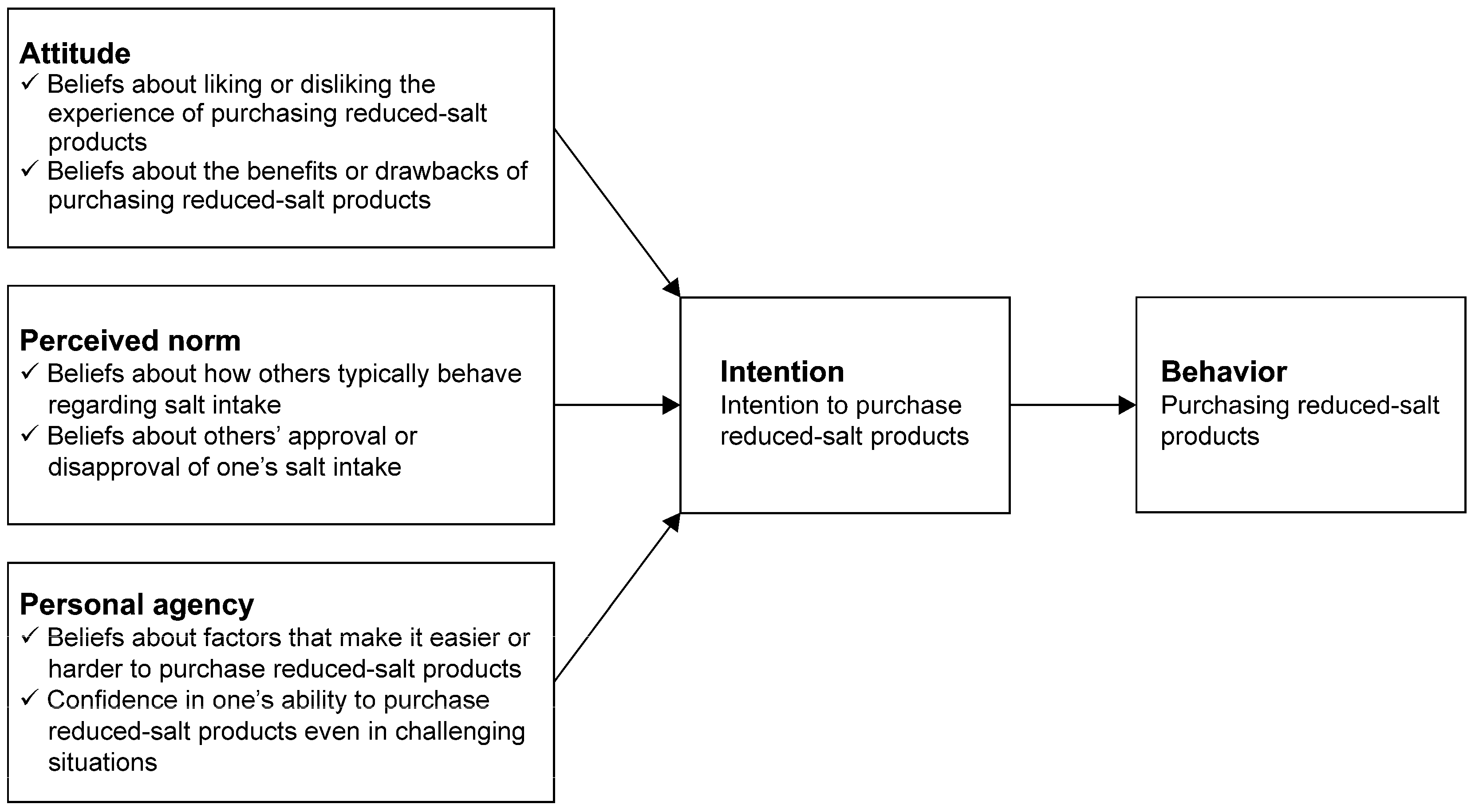
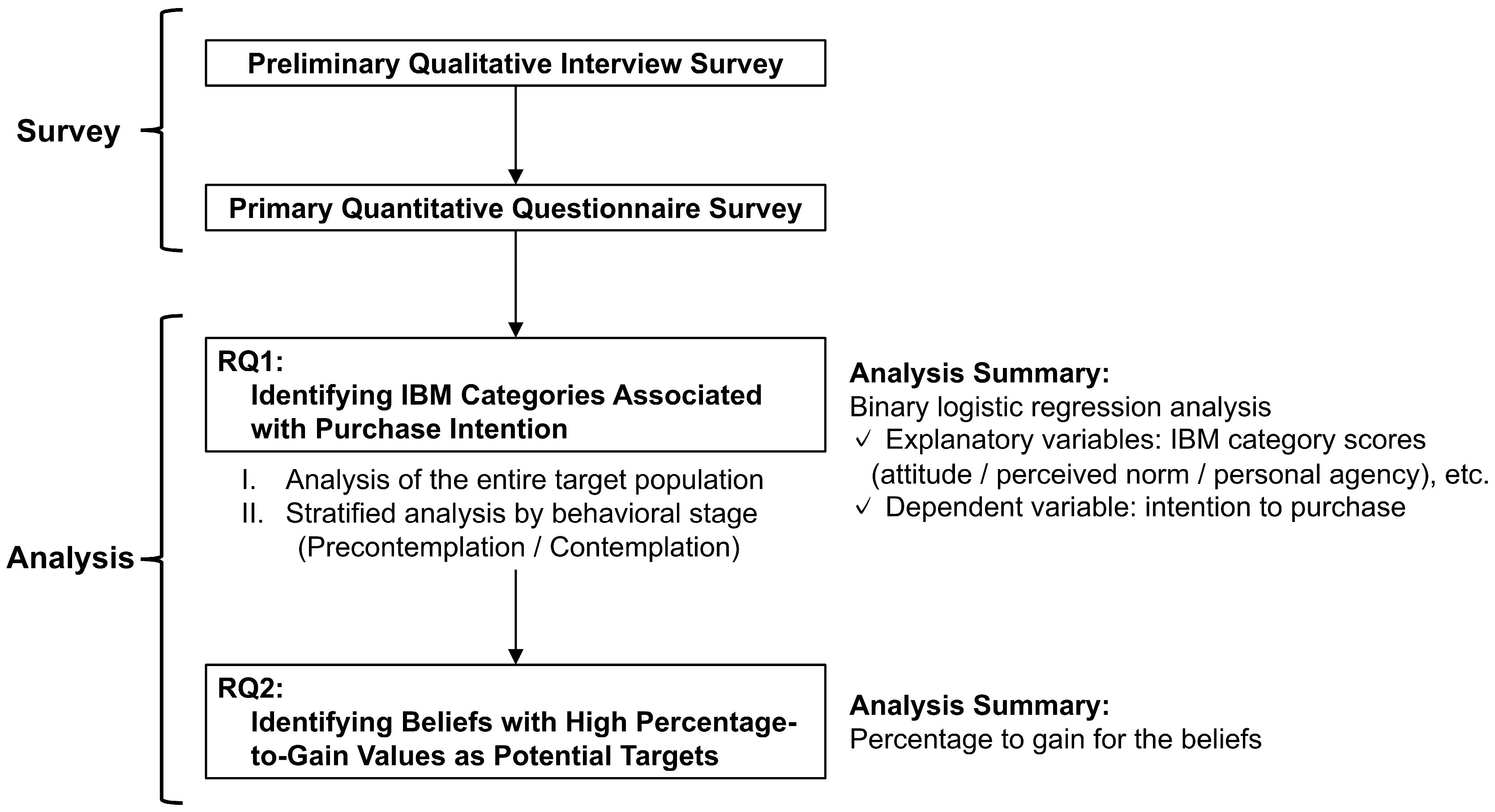
- RQ1: Which IBM category is most strongly associated with purchase intention for reduced-salt products?
- RQ2: Which specific beliefs show the highest percentage-to-gain values as potential targets for future communication or food environment interventions?
2. Materials and Methods
- Precontemplation stage: not actively planning to purchase.
- Contemplation stage: actively planning to purchase.
2.1. Preliminary Qualitative Interview Survey
2.1.1. Study Participant and Selection Process
- Healthy men and women aged 18 to 59 residing in Japan;
- Individuals not actively purchasing reduced-salt products.
- Individuals who self-identify as having slightly elevated blood pressure *;
- Individuals who have been diagnosed with hypertension.
2.1.2. Screening Questionnaire
2.1.3. Interviews
2.2. Primary Quantitative Questionnaire Survey
2.2.1. Study Participant and Selection Process
- Men and women aged 18 to 59 residing in Japan;
- Individuals not actively purchasing reduced-salt products.
- Individuals who perceive themselves to have elevated blood pressure *;
- Individuals who have been diagnosed with hypertension.
2.2.2. Screening Questionnaire
2.2.3. Main Survey Questionnaire
2.3. Analysis
2.3.1. IBM Category Scores
2.3.2. Stratified Analysis by Behavioral Stage
2.3.3. Identifying IBM Categories Associated with Purchase Intention
- Model 1: Each IBM category score individually.
- Model 2: Each IBM category score adjusted for age and gender.
2.3.4. Sensitivity Analysis
2.3.5. Identifying Promising Beliefs Using Percentage-to-Gain Analysis
2.3.6. Other Statistical Analyses
2.4. Ethics Approval and Informed Consent
3. Results
3.1. Preliminary Qualitative Interview Survey
3.2. Primary Quantitative Questionnaire Survey
3.3. RQ1: Which IBM Category Is Most Strongly Associated with Purchase Intention for Reduced-Salt Products?
3.4. RQ2: Which Specific Beliefs Show the Highest Percentage-to-Gain Values as Potential Targets for Future Communication or Food Environment Interventions?
4. Discussion
5. Conclusions
Supplementary Materials
Author Contributions
Funding
Institutional Review Board Statement
Informed Consent Statement
Data Availability Statement
Acknowledgments
Conflicts of Interest
References
- GBD 2017 Diet Collaborators. Health effects of dietary risks in 195 countries, 1990–2017: A systematic analysis for the Global Burden of Disease Study 2017. Lancet 2019, 393, 1958–1972. [Google Scholar] [CrossRef]
- Rust, P.; Ekmekcioglu, C. Impact of Salt Intake on the Pathogenesis and Treatment of Hypertension. Adv. Exp. Med. Biol. 2017, 956, 61–84. [Google Scholar] [CrossRef]
- World Health Organization. WHO Global Report on Sodium Intake Reduction; World Health Organization: Geneva, Switzerland, 2023. [Google Scholar]
- Ministry of Health, Labour and Welfare (Japan). The National Health and Nutrition Survey in Japan, 2023; Ministry of Health, Labour and Welfare (Japan): Tokyo, Japan, 2023.
- Ministry of Education, Culture, Sports, Science and Technology (Japan). Standard Tables of Food Composition in Japan 2020, 8th Revised ed.; Ministry of Education, Culture, Sports, Science and Technology (Japan): Tokyo, Japan, 2020.
- Khalesi, S.; Williams, E.; Irwin, C.; Johnson, D.W.; Webster, J.; McCartney, D.; Jamshidi, A.; Vandelanotte, C. Reducing salt intake: A systematic review and meta-analysis of behavior change interventions in adults. Nutr. Rev. 2022, 80, 723–740. [Google Scholar] [CrossRef] [PubMed]
- Kitaoka, K.; Nagaoka, J.; Matsuoka, T.; Shigemura, C.; Harada, K.; Aoi, W.; Wada, S.; Asano, H.; Sakane, N.; Higashi, A. Dietary intervention with cooking instructions and self-monitoring of the diet in free-living hypertensive men. Clin. Exp. Hypertens. 2013, 35, 120–127. [Google Scholar] [CrossRef]
- Miura, S.; Yamaguchi, Y.; Urata, H.; Himeshima, Y.; Otsuka, N.; Tomita, S.; Yamatsu, K.; Nishida, S.; Saku, K. Efficacy of a multicomponent program (patient-centered assessment and counseling for exercise plus nutrition [PACE+ Japan]) for lifestyle modification in patients with essential hypertension. Hypertens. Res. 2004, 27, 859–864. [Google Scholar] [CrossRef]
- Nakano, M.; Eguchi, K.; Sato, T.; Onoguchi, A.; Hoshide, S.; Kario, K. Effect of Intensive Salt-Restriction Education on Clinic, Home, and Ambulatory Blood Pressure Levels in Treated Hypertensive Patients During a 3-Month Education Period. J. Clin. Hypertens. 2016, 18, 385–392. [Google Scholar] [CrossRef]
- Takashashi, Y.; Sasaki, S.; Takahashi, M.; Okubo, S.; Hayashi, M.; Tsugane, S. A population-based dietary intervention trial in a high-risk area for stomach cancer and stroke: Changes in intakes and related biomarkers. Prev. Med. 2003, 37, 432–441. [Google Scholar] [CrossRef]
- Newson, R.S.; Elmadfa, I.; Biro, G.; Cheng, Y.; Prakash, V.; Rust, P.; Barna, M.; Lion, R.; Meijer, G.W.; Neufingerl, N.; et al. Barriers for progress in salt reduction in the general population. An international study. Appetite 2013, 71, 22–31. [Google Scholar] [CrossRef]
- Tanoue, Y.; Rauniyar, S.K.; Uchibori, M.; Ghaznavi, C.; Tomoi, H.; Ueta, M.; Prommas, P.; Cao, A.; Yoneoka, D.; Kawashima, T.; et al. Analysis of factors associated with public attitudes towards salt reduction: A multicountry cross-sectional survey. BMJ Open 2024, 14, e086467. [Google Scholar] [CrossRef] [PubMed]
- Tanemura, N.; Kashino, I.; Araki, M. Differences in preferences for health-promoting food appeals by health behavior stages. Nutr. Food Sci. 2025, 55, 551–573. [Google Scholar] [CrossRef]
- Ajzen, I. The theory of planned behavior. Organ. Behav. Hum. Decis. Process. 1991, 50, 179–211. [Google Scholar] [CrossRef]
- Michie, S.; van Stralen, M.M.; West, R. The behaviour change wheel: A new method for characterising and designing behaviour change interventions. Implement. Sci. 2011, 6, 42. [Google Scholar] [CrossRef]
- Fishbein, M. A reasoned action approach to health promotion. Med. Decis. Mak. 2008, 28, 834–844. [Google Scholar] [CrossRef] [PubMed]
- Fishbein, M.; Ajzen, I. Predicting and Changing Behavior: The Reasoned Action Approach; Psychology Press: New York, NY, USA, 2010; 518p. [Google Scholar]
- Institute of Medicine (US). Committee on Communication for Behavior Change in the 21st Century: Improving the Health of Diverse Populations. In Speaking of Health: Assessing Health Communication Strategies for Diverse Populations; National Academies Press: Washington, DC, USA, 2002. [Google Scholar]
- Painter, J.E.; Sales, J.M.; Pazol, K.; Wingood, G.M.; Windle, M.; Orenstein, W.A.; DiClemente, R.J. Psychosocial correlates of intention to receive an influenza vaccination among rural adolescents. Health Educ. Res. 2010, 25, 853–864. [Google Scholar] [CrossRef]
- Koesnoe, S.; Siddiq, T.H.; Pelupessy, D.C.; Yunihastuti, E.; Awanis, G.S.; Widhani, A.; Karjadi, T.H.; Maria, S.; Hasibuan, A.S.; Rengganis, I.; et al. Using Integrative Behavior Model to Predict COVID-19 Vaccination Intention among Health Care Workers in Indonesia: A Nationwide Survey. Vaccines 2022, 10, 719. [Google Scholar] [CrossRef]
- Alemayehu, W.A.; Maritz, J.; Roets, L. Application of Integrated Behavioral Model (IBM) to measure intention to get early screening and treatment of Sexually Transmitted Infections (STIs) among HIV at- risk sub-populations in Ethiopia. Afr. Health Sci. 2021, 21, 538–546. [Google Scholar] [CrossRef]
- Koulouvari, A.D.; Margariti, A.; Sakellari, E.; Barbouni, A.; Lagiou, A. Applications of Behavioral Change Theories and Models in Health Promotion Interventions: A Rapid Review. Behav. Sci. 2025, 15, 580. [Google Scholar] [CrossRef]
- Branscum, P.; Lora, K. Using the Integrative Behavioral Model to Predict Monitoring of Fruit and Vegetable Consumption Among Hispanic Mothers. Fam. Community Health 2017, 40, 32–38. [Google Scholar] [CrossRef] [PubMed]
- Hornik, R.; Woolf, K.D. Using Cross-Sectional Surveys to Plan Message Strategies. Soc. Mark. Q. 1999, 5, 34–41. [Google Scholar] [CrossRef]
- Brennan, E.; Gibson, L.A.; Kybert-Momjian, A.; Liu, J.; Hornik, R.C. Promising Themes for Antismoking Campaigns Targeting Youth and Young Adults. Tob. Regul. Sci. 2017, 3, 29–46. [Google Scholar] [CrossRef] [PubMed]
- Rath, J.M.; Romberg, A.R.; Perks, S.N.; Edwards, D.; Vallone, D.M.; Hair, E.C. Identifying message themes to prevent e-cigarette use among youth and young adults. Prev. Med. 2021, 150, 106683. [Google Scholar] [CrossRef]
- Yang, S.; Shen, L.; Gregory, S.; Probst, B.; Farrar-Edwards, D.; Passmore, S.R. Applying the Hornik & Woolf Approach to Identify Messaging Themes and Improve COVID-19 Vaccine Confidence Among Federally Qualified Health Centers’ Workforce in Wisconsin. J. Health. Commun. 2023, 28, 507–525. [Google Scholar] [CrossRef]
- Prochaska, J.O.; Velicer, W.F. The transtheoretical model of health behavior change. Am. J. Health Promot. 1997, 12, 38–48. [Google Scholar] [CrossRef]
- Consumer Affairs Agency (Japan). “Attachment2: Notes on Preparation of Application Forms for Food for Specified Health Use” of “Permission etc. for Labeling of Food for Specified Health Use”. In Shoshokuhyo Notice No. 259, Issued by the Deputy Commissioner of the Consumer Affairs Agency, Dated October 30, 2014; Consumer Affairs Agency (Japan): Tokyo, Japan, 2014. [Google Scholar]
- Sandelowski, M. 10 Key Questions over Qualitative Research: Collected Papers of Margarete Sandelowski; Yatsu, H.; Eto, H., Translators; IGAKU-SHOIN Ltd.: Tokyo, Japan, 2013; xi, 205p. [Google Scholar]
- Benner, P. Interpretive Phenomenology: Embodiment, Caring, and Ethics in Health and Illness; SAGE Publications, Inc.: Thousand Oaks, CA, USA, 1994. [Google Scholar] [CrossRef]
- Umemura, S.; Arima, H.; Arima, S.; Asayama, K.; Dohi, Y.; Hirooka, Y.; Horio, T.; Hoshide, S.; Ikeda, S.; Ishimitsu, T.; et al. The Japanese Society of Hypertension Guidelines for the Management of Hypertension (JSH 2019). Hypertens. Res. 2019, 42, 1235–1481. [Google Scholar] [CrossRef] [PubMed]
- Statistics Bureau, Ministry of Internal Affairs and Communications (Japan). Population Estimates as of October 1, 2023. Available online: https://www.stat.go.jp/data/jinsui/2023np/index.html (accessed on 29 July 2024).
- Tamaki, J.; Kikuchi, Y.; Yoshita, K.; Takebayashi, T.; Chiba, N.; Tanaka, T.; Okamura, T.; Kasagi, F.; Minai, J.; Ueshima, H.; et al. Stages of change for salt intake and urinary salt excretion: Baseline results from the High-Risk and Population Strategy for Occupational Health Promotion (HIPOP-OHP) study. Hypertens. Res. 2004, 27, 157–166. [Google Scholar] [CrossRef]
- Ahn, S.H.; Kwon, J.S.; Kim, K.; Kim, H.K. Stages of Behavioral Change for Reducing Sodium Intake in Korean Consumers: Comparison of Characteristics Based on Social Cognitive Theory. Nutrients 2017, 9, 808. [Google Scholar] [CrossRef]
- Mork, T.; Lahteenmaki, L.; Grunert, K.G. Determinants of intention to reduce salt intake and willingness to purchase salt-reduced food products: Evidence from a web survey. Appetite 2019, 139, 110–118. [Google Scholar] [CrossRef] [PubMed]
- Shepherd, R.; Farleigh, C.A. Attitudes and personality related to salt intake. Appetite 1986, 7, 343–354. [Google Scholar] [CrossRef]
- Moghaddam, F.G.; Salmani, F.; Chahkandak, F.H.; Norozi, E. Is the Theory of Planned Behavior a good model for predicting salt consumption behavior in pregnant women? A structural equation modeling approach. J. Educ. Health Promot. 2023, 12, 197. [Google Scholar] [CrossRef]
- Beckerman, J.P.; Alike, Q.; Lovin, E.; Tamez, M.; Mattei, J. The Development and Public Health Implications of Food Preferences in Children. Front. Nutr. 2017, 4, 66. [Google Scholar] [CrossRef] [PubMed]
- Liem, D.G. Infants’ and Children’s Salt Taste Perception and Liking: A Review. Nutrients 2017, 9, 1011. [Google Scholar] [CrossRef] [PubMed]
- Hornik, R.C.; Volinsky, A.C.; Mannis, S.; Gibson, L.; Brennan, E.; Lee, S.J.; Tan, A.S.L. Validating the Hornik & Woolf approach to choosing media campaign themes: Do promising beliefs predict behavior change in a longitudinal study? Commun. Methods Meas. 2019, 13, 60–68. [Google Scholar] [CrossRef] [PubMed]



| Category | Item Count | Belief Items (No.) | |
|---|---|---|---|
| Attitude | (positive) | 9 | 1–9 |
| (negative) | 11 | 10–20 | |
| Perceived norm | 12 | 21–32 | |
| Personal agency | 16 | 33–48 |
| Characteristics | All (N = 800) | Men (N = 400) | Women (N = 400) | p-Value | ||||
|---|---|---|---|---|---|---|---|---|
| n | % | n | % | n | % | |||
| Age (in years) [mean (SD)] | 47.2 | (8.6) | 48.6 | (8.1) | 45.8 | (9.0) | <0.001 | |
| Current behavioral stage for purchasing reduced-salt products | ||||||||
| Precontemplation | 649 | 81.1 | 335 | 83.8 | 314 | 78.5 | 0.071 | |
| Contemplation | 151 | 18.9 | 65 | 16.3 | 86 | 21.5 | ||
| Region of residence | ||||||||
| Hokkaido and Tohoku | 86 | 10.8 | 43 | 10.8 | 43 | 10.8 | 1.000 | |
| Kanto | 280 | 35.0 | 140 | 35.0 | 140 | 35.0 | ||
| Chubu | 134 | 16.8 | 67 | 16.8 | 67 | 16.8 | ||
| Kinki | 142 | 17.8 | 71 | 17.8 | 71 | 17.8 | ||
| Chugoku and Shikoku | 68 | 8.5 | 34 | 8.5 | 34 | 8.5 | ||
| Kyushu and Okinawa | 90 | 11.3 | 45 | 11.3 | 45 | 11.3 | ||
| Occupation | ||||||||
| Company employee | 314 | 39.3 | 215 | 53.8 | 99 | 24.8 | <0.001 | |
| Government employee | 40 | 5.0 | 27 | 6.8 | 13 | 3.3 | ||
| Self-employed/private business | 65 | 8.1 | 50 | 12.5 | 15 | 3.8 | ||
| Company officer | 11 | 1.4 | 9 | 2.3 | 2 | 0.5 | ||
| Medical professional | 19 | 2.4 | 7 | 1.8 | 12 | 3.0 | ||
| Homemaker | 92 | 11.5 | 2 | 0.5 | 90 | 22.5 | ||
| Student | 10 | 1.3 | 3 | 0.8 | 7 | 1.8 | ||
| Part-time job | 152 | 19.0 | 25 | 6.3 | 127 | 31.8 | ||
| Unemployed | 90 | 11.3 | 58 | 14.5 | 32 | 8.0 | ||
| Other | 7 | 0.9 | 4 | 1.0 | 3 | 0.8 | ||
| Household size | ||||||||
| 1 person (the person lives alone) | 192 | 24.0 | 117 | 29.3 | 75 | 18.8 | <0.001 | |
| 2 people | 217 | 27.1 | 90 | 22.5 | 127 | 31.8 | ||
| 3 or more people | 391 | 48.9 | 193 | 48.3 | 198 | 49.5 | ||
| Household annual income | ||||||||
| Less than 2 million yen | 92 | 11.5 | 53 | 13.3 | 39 | 9.8 | 0.001 | |
| 2 million yen to less than 4 million yen | 155 | 19.4 | 74 | 18.5 | 81 | 20.3 | ||
| 4 million yen to less than 6 million yen | 110 | 13.8 | 55 | 13.8 | 55 | 13.8 | ||
| 6 million yen and more | 251 | 31.4 | 144 | 36.0 | 107 | 26.8 | ||
| Do not want to answer | 192 | 24.0 | 74 | 18.5 | 118 | 29.5 | ||
| Chronic diseases other than hypertension | ||||||||
| Present | 73 | 9.1 | 39 | 9.8 | 34 | 8.5 | 0.624 | |
| Absent | 727 | 90.9 | 361 | 90.3 | 366 | 91.5 | ||
| Intention to purchase reduced-salt products | ||||||||
| Present | 267 | 33.4 | 116 | 29.0 | 151 | 37.8 | 0.011 | |
| Absent | 533 | 66.6 | 284 | 71.0 | 249 | 62.3 | ||
| IBM category score (points) [mean (SD)] | ||||||||
| Attitude | 3.06 | (0.33) | 3.04 | (0.32) | 3.09 | (0.35) | 0.049 | |
| Perceived norm | 2.98 | (0.54) | 2.93 | (0.51) | 3.03 | (0.56) | 0.013 | |
| Personal agency | 3.31 | (0.68) | 3.21 | (0.65) | 3.42 | (0.68) | <0.001 | |
| IBM Category Score | OR | 95% CI | p-Value | ||
|---|---|---|---|---|---|
| Lower | Upper | ||||
| Attitude | |||||
| Model 1 | 13.08 | 7.21 | 23.73 | <0.001 | |
| Model 2 | 12.56 | 6.93 | 22.79 | <0.001 | |
| Perceived norm | |||||
| Model 1 | 1.72 | 1.29 | 2.28 | <0.001 | |
| Model 2 | 1.67 | 1.25 | 2.23 | <0.001 | |
| Personal agency | |||||
| Model 1 | 3.74 | 2.74 | 4.87 | <0.001 | |
| Model 2 | 3.65 | 2.74 | 4.86 | <0.001 | |
| IBM Category Score | Behavioral Stage | Intention to Purchase Reduced-Salt Products | p-Value | |||
|---|---|---|---|---|---|---|
| Absent | Present | |||||
| Mean | SE | Mean | SE | |||
| Attitude | Precontemplation | 2.99 | (0.01) | 3.23 | (0.03) | <0.001 |
| Contemplation | 3.14 | (0.07) | 3.19 | (0.03) | 0.489 | |
| All | 2.99 | (0.01) | 3.21 | (0.02) | <0.001 | |
| Perceived norm | Precontemplation | 2.92 | (0.02) | 3.04 | (0.05) | 0.031 |
| Contemplation | 3.21 | (0.16) | 3.13 | (0.05) | 0.632 | |
| All | 2.93 | (0.02) | 3.08 | (0.03) | <0.001 | |
| Personal agency | Precontemplation | 3.14 | (0.03) | 3.56 | (0.05) | <0.001 |
| Contemplation | 3.43 | (0.16) | 3.71 | (0.05) | 0.112 | |
| All | 3.15 | (0.03) | 3.64 | (0.04) | <0.001 | |
| IBM Category Score | Precontemplation | Contemplation | |||||||
|---|---|---|---|---|---|---|---|---|---|
| OR | 95% CI | p-Value | OR | 95% CI | p-Value | ||||
| Lower | Upper | Lower | Upper | ||||||
| Attitude | |||||||||
| Model 1 | 18.60 | 8.60 | 40.26 | <0.001 | 1.83 | 0.31 | 10.82 | 0.504 | |
| Model 2 | 18.40 | 8.51 | 39.78 | <0.001 | 1.60 | 0.24 | 10.53 | 0.622 | |
| Perceived norm | |||||||||
| Model 1 | 1.54 | 1.05 | 2.24 | 0.025 | 0.79 | 0.33 | 1.90 | 0.600 | |
| Model 2 | 1.50 | 1.03 | 2.19 | 0.036 | 0.70 | 0.28 | 1.73 | 0.437 | |
| Personal agency | |||||||||
| Model 1 | 3.13 | 2.20 | 4.43 | <0.001 | 1.91 | 0.89 | 4.09 | 0.097 | |
| Model 2 | 3.08 | 2.16 | 4.38 | <0.001 | 1.78 | 0.81 | 3.90 | 0.150 | |
| Men | Women | ||||
|---|---|---|---|---|---|
| Belief Item | IBM Category | Percentage to Gain (%) | Belief Item | IBM Category | Percentage to Gain (%) |
| 29 | Perceived norm | 20.2 | 6 | Attitude | 29.1 |
| 9 | Attitude | 17.6 | 44 | Personal agency | 19.4 |
| 41 | Personal agency | 16.9 | 9 | Attitude | 17.8 |
| 44 | Personal agency | 16.7 | 48 | Personal agency | 15.5 |
| 5 | Attitude | 15.9 | 41 | Personal agency | 14.6 |
Disclaimer/Publisher’s Note: The statements, opinions and data contained in all publications are solely those of the individual author(s) and contributor(s) and not of MDPI and/or the editor(s). MDPI and/or the editor(s) disclaim responsibility for any injury to people or property resulting from any ideas, methods, instructions or products referred to in the content. |
© 2026 by the authors. Licensee MDPI, Basel, Switzerland. This article is an open access article distributed under the terms and conditions of the Creative Commons Attribution (CC BY) license.
Share and Cite
Akamatsu, Y.; Nakadate, M.; Tanemura, N.; Kobori, M. Psychological Determinants of Purchasing Behavior Among Individuals Indifferent to Reduced-Salt Products. Nutrients 2026, 18, 1800. https://doi.org/10.3390/nu18111800
Akamatsu Y, Nakadate M, Tanemura N, Kobori M. Psychological Determinants of Purchasing Behavior Among Individuals Indifferent to Reduced-Salt Products. Nutrients. 2026; 18(11):1800. https://doi.org/10.3390/nu18111800
Chicago/Turabian StyleAkamatsu, Yasunori, Misako Nakadate, Nanae Tanemura, and Masuko Kobori. 2026. "Psychological Determinants of Purchasing Behavior Among Individuals Indifferent to Reduced-Salt Products" Nutrients 18, no. 11: 1800. https://doi.org/10.3390/nu18111800
APA StyleAkamatsu, Y., Nakadate, M., Tanemura, N., & Kobori, M. (2026). Psychological Determinants of Purchasing Behavior Among Individuals Indifferent to Reduced-Salt Products. Nutrients, 18(11), 1800. https://doi.org/10.3390/nu18111800