Essential Trace Elements Zinc, Iron, Copper and Attention-Deficit/Hyperactivity Disorder in Children and Adolescents: A Systematic Review and Meta-Analysis of Case–Control Studies


Abstract
1. Introduction
2. Methods
2.1. Literature Search
2.2. Study Selection
2.3. Quality Assessment
2.4. Data Extraction and Analysis
3. Results
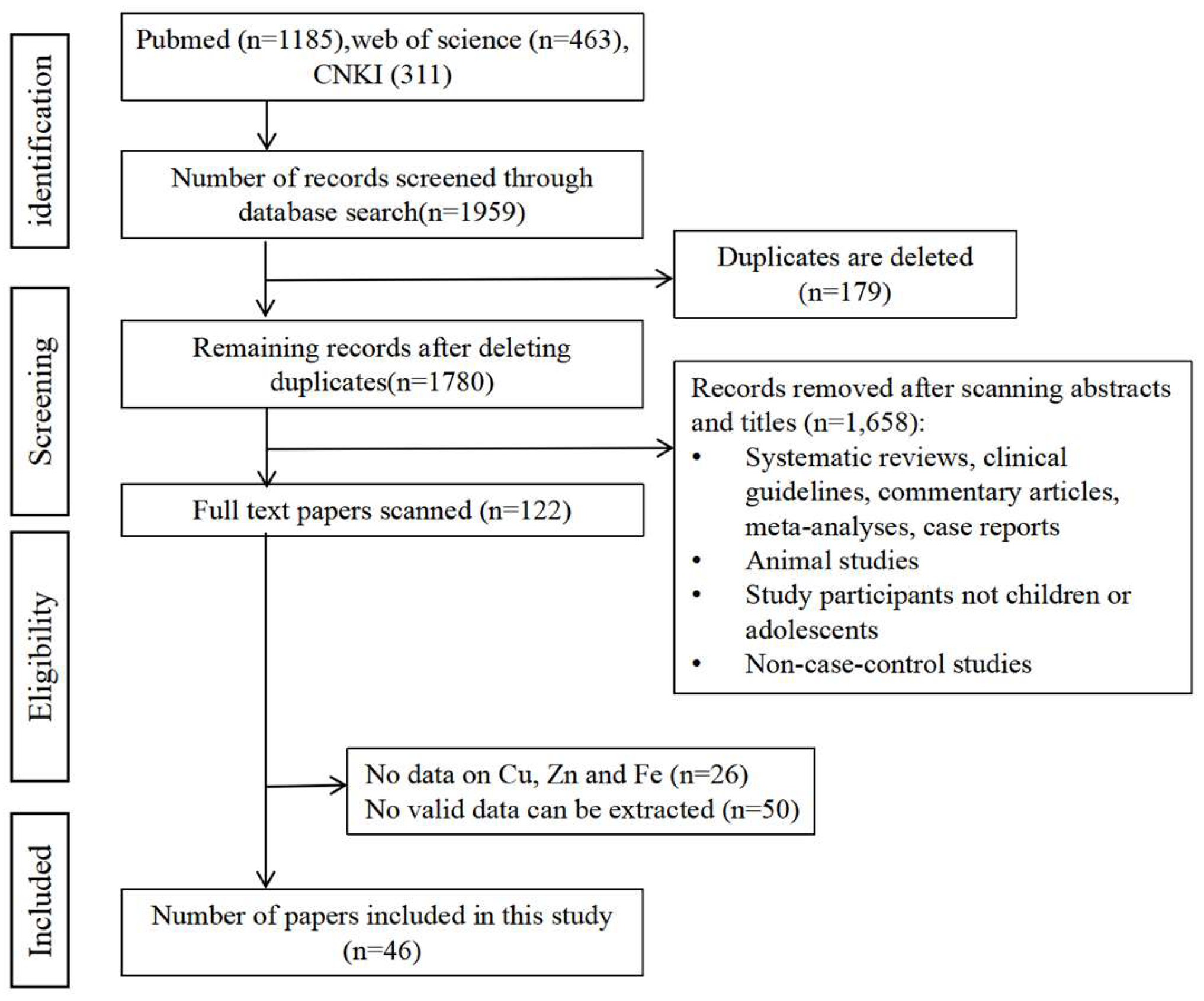
3.1. Search Results
3.2. Characteristics of Included Studies
3.3. Findings from the Studies
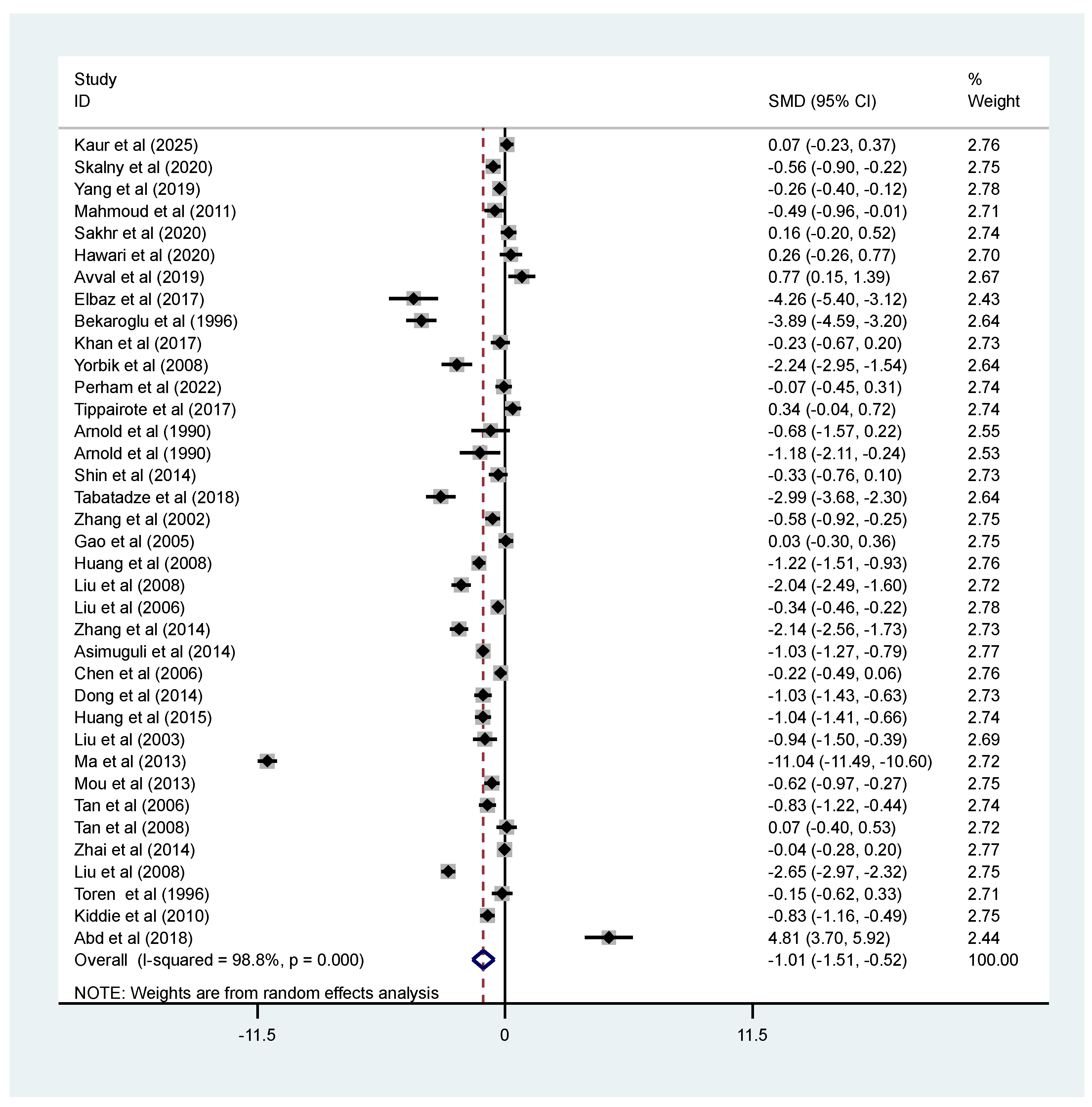
3.3.1. Meta-Analysis of Mean Zn Levels
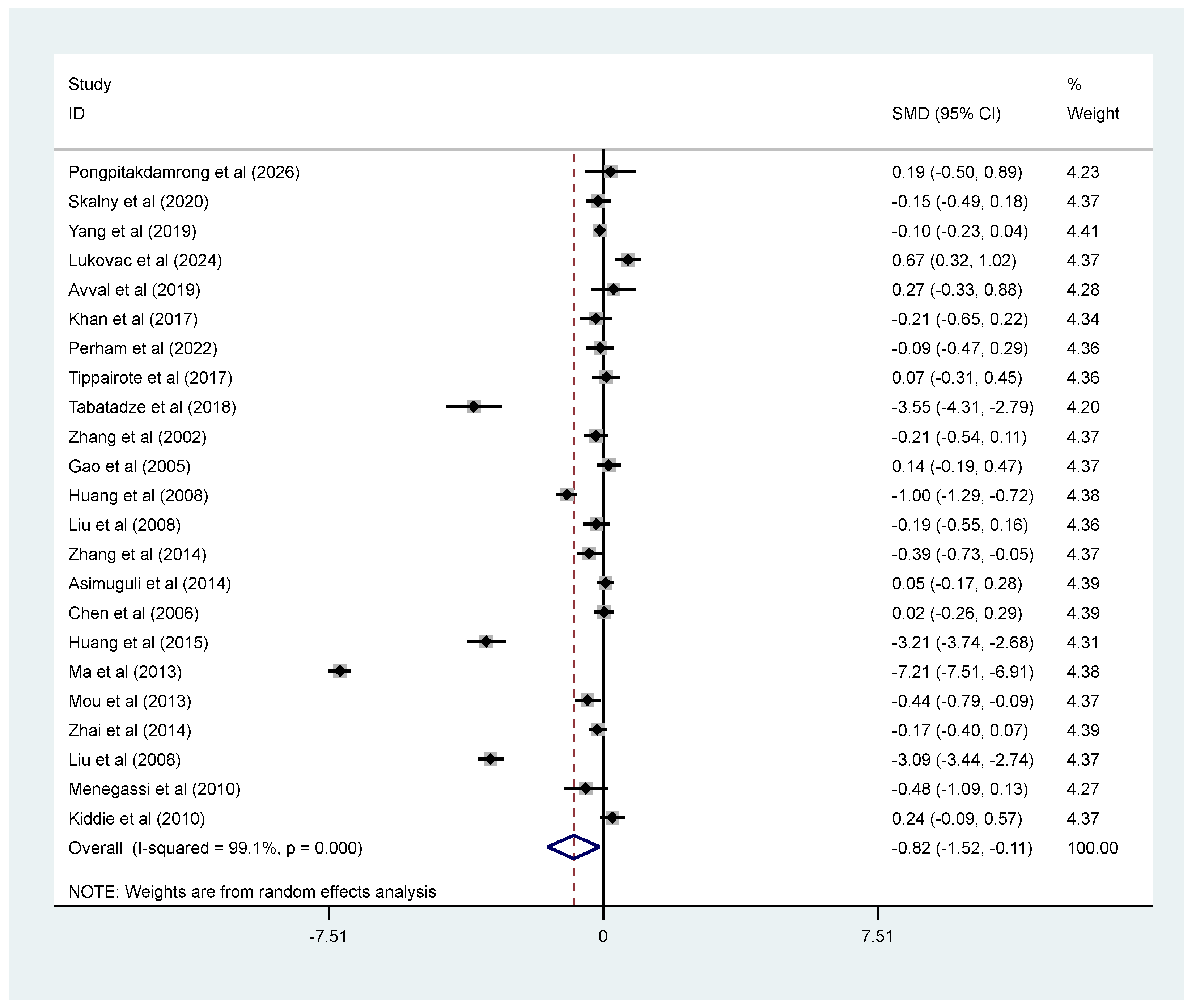
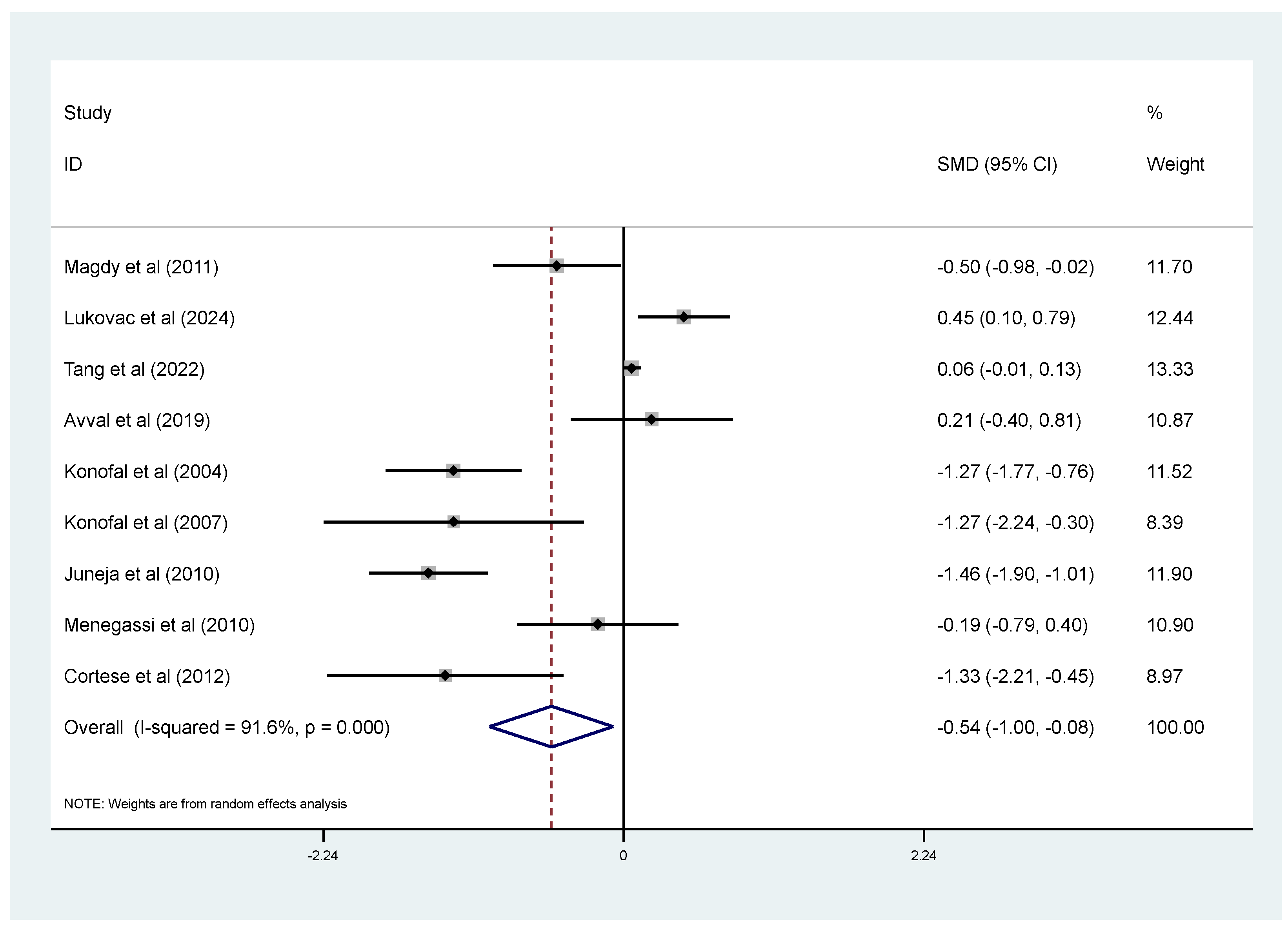
3.3.2. Meta-Analysis of Mean Fe and Ferritin Levels
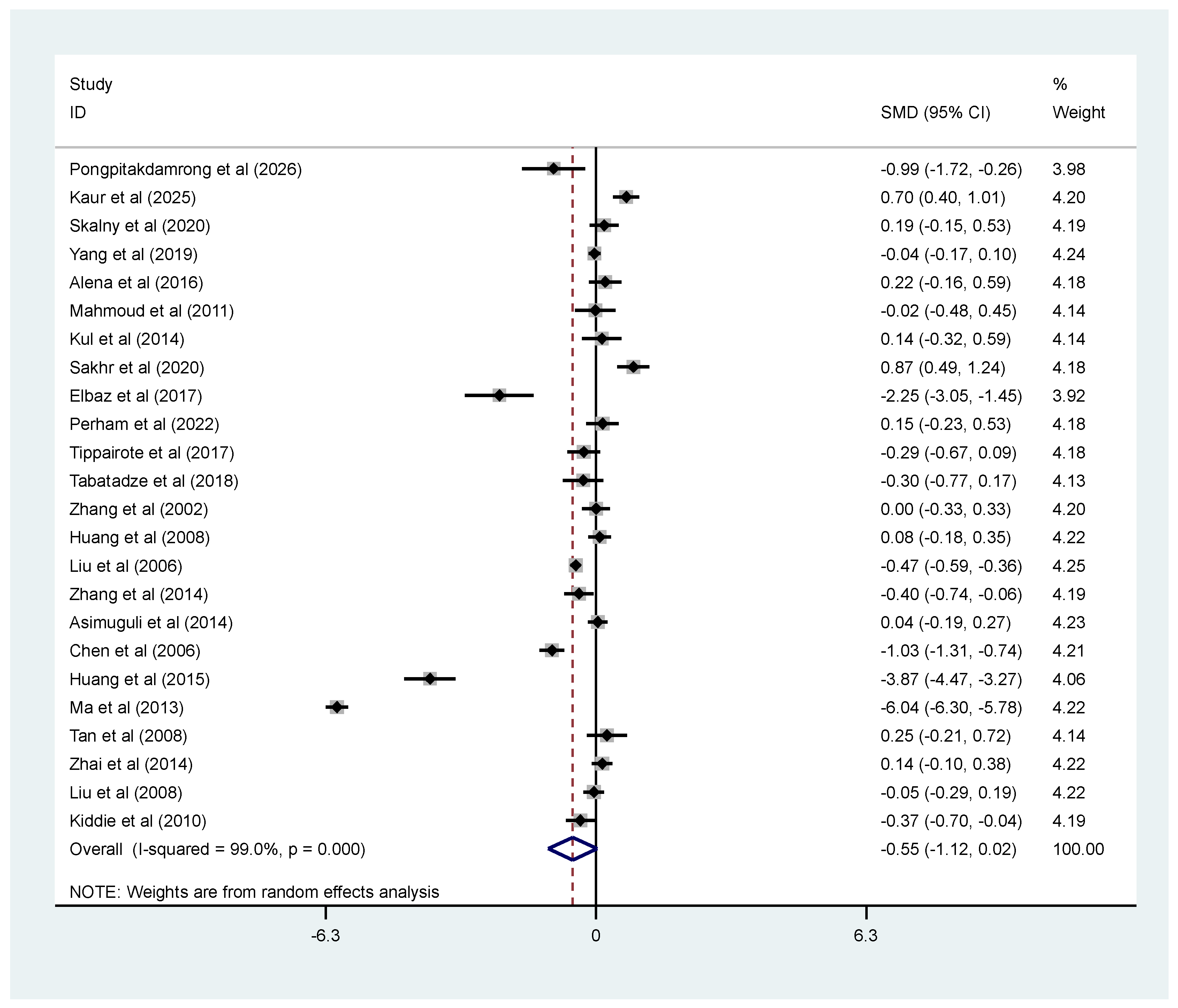
3.3.3. Meta-Analysis of Mean Cu Levels
3.4. Sensitivity Analyses and Publication Bias Diagnostics
3.5. Heterogeneity Test, Meta-Regression and Trim-And-Fill Analysis
4. Discussion
5. Conclusions
Supplementary Materials
Author Contributions
Funding
Data Availability Statement
Acknowledgments
Conflicts of Interest
References
- Berger, I. Diagnosis of attention deficit hyperactivity disorder: Much ado about something. Isr. Med. Assoc. J. 2011, 13, 571–574. [Google Scholar]
- Wolraich, M.L.; Hagan, J.F., Jr.; Allan, C.; Chan, E.; Davison, D.; Earls, M.; Evans, S.W.; Flinn, S.K.; Froehlich, T.; Frost, J.; et al. Clinical Practice Guideline for the Diagnosis, Evaluation, and Treatment of Attention-Deficit/Hyperactivity Disorder in Children and Adolescents. Pediatrics 2019, 144, e20192528. [Google Scholar] [CrossRef] [PubMed]
- Salari, N.; Ghasemi, H.; Abdoli, N.; Rahmani, A.; Shiri, M.H.; Hashemian, A.H.; Akbari, H.; Mohammadi, M. The global prevalence of ADHD in children and adolescents: A systematic review and meta-analysis. Ital. J. Pediatr. 2023, 49, 48. [Google Scholar] [CrossRef]
- Bitsko, R.H.; Claussen, A.H.; Lichstein, J.; Black, L.I.; Jones, S.E.; Danielson, M.L.; Hoenig, J.M.; Davis Jack, S.P.; Brody, D.J.; Gyawali, S.; et al. Mental Health Surveillance Among Children—United States, 2013–2019. MMWR Suppl. 2022, 71, 1–42. [Google Scholar] [CrossRef]
- Liu, A.; Xu, Y.; Yan, Q.; Tong, L. The Prevalence of Attention Deficit/Hyperactivity Disorder among Chinese Children and Adolescents. Sci. Rep. 2018, 8, 11169. [Google Scholar] [CrossRef]
- Mckay, E.; Kirk, H.; Martin, R.; Cornish, K. Social difficulties in adolescent attention deficit hyperactivity disorder: Social motivation, social anxiety and symptom severity as contributing factors. J. Clin. Psychol. 2023, 79, 1113–1129. [Google Scholar] [CrossRef] [PubMed]
- Faraone, S.V.; Perlis, R.H.; Doyle, A.E.; Smoller, J.W.; Goralnick, J.J.; Holmgren, M.A.; Sklar, P. Molecular genetics of attention-deficit/hyperactivity disorder. Biol. Psychiatry 2005, 57, 1313–1323. [Google Scholar] [CrossRef] [PubMed]
- Sciberras, E.; Mulraney, M.; Silva, D.; Coghill, D. Prenatal Risk Factors and the Etiology of ADHD-Review of Existing Evidence. Curr. Psychiatry Rep. 2017, 19, 1. [Google Scholar] [CrossRef]
- Anjos, T.; Altmäe, S.; Emmett, P.; Tiemeier, H.; Closa-Monasterolo, R.; Luque, V.; Wiseman, S.; Pérez-García, M.; Lattka, E.; Demmelmair, H.; et al. Nutrition and neurodevelopment in children: Focus on NUTRIMENTHE project. Eur. J. Nutr. 2013, 52, 1825–1842. [Google Scholar] [CrossRef]
- Predescu, E.; Vaidean, T.; Rapciuc, A.M.; Sipos, R. Metabolomic Markers in Attention-Deficit/Hyperactivity Disorder (ADHD) among Children and Adolescents—A Systematic Review. Int. J. Mol. Sci. 2024, 25, 4385. [Google Scholar] [CrossRef]
- Tripp, G.; Wickens, J.R. Neurobiology of ADHD. Neuropharmacology 2009, 57, 579–589. [Google Scholar] [CrossRef] [PubMed]
- Biederman, J. Attention-deficit/hyperactivity disorder: A selective overview. Biol. Psychiatry 2005, 57, 1215–1220. [Google Scholar] [CrossRef]
- Tinkov, A.A.; Mazaletskaya, A.L.; Ajsuvakova, O.P.; Bjørklund, G.; Huang, P.T.; Chernova, L.N.; Skalny, A.A.; Skalny, A.V. ICP-MS Assessment of Hair Essential Trace Elements and Minerals in Russian Preschool and Primary School Children with Attention-Deficit/Hyperactivity Disorder (ADHD). Biol. Trace Elem. Res. 2020, 196, 400–409. [Google Scholar] [CrossRef]
- Tabatadze, T.; Kherkheulidze, M.; Kandelaki, E.; Kavlashvili, N.; Ivanashvili, T. Attention Deficit Hyperactivity Disorder and Hair Heavy Metal and Essential Trace Element Concentrations. Is There a Link? Georgian Med. News 2018, 284, 88–92. [Google Scholar]
- Yang, R.; Zhang, Y.; Gao, W.; Lin, N.; Li, R.; Zhao, Z. Blood Levels of Trace Elements in Children with Attention-Deficit Hyperactivity Disorder: Results from a Case-Control Study. Biol. Trace Elem. Res. 2019, 187, 376–382. [Google Scholar] [CrossRef]
- Viktorinova, A.; Ursinyova, M.; Trebaticka, J.; Uhnakova, I.; Durackova, Z.; Masanova, V. Changed Plasma Levels of Zinc and Copper to Zinc Ratio and Their Possible Associations with Parent- and Teacher-Rated Symptoms in Children with Attention-Deficit Hyperactivity Disorder. Biol. Trace Elem. Res. 2016, 169, 1–7. [Google Scholar] [CrossRef]
- Skalny, A.V.; Mazaletskaya, A.L.; Ajsuvakova, O.P.; Bjørklund, G.; Skalnaya, M.G.; Chao, J.C.; Chernova, L.N.; Shakieva, R.A.; Kopylov, P.Y.; Skalny, A.A.; et al. Serum zinc, copper, zinc-to-copper ratio, and other essential elements and minerals in children with attention deficit/hyperactivity disorder (ADHD). J. Trace Elem. Med. Biol. 2020, 58, 126445. [Google Scholar] [CrossRef]
- Pongpitakdamrong, A.; Uengarporn, N.; Chirawatkul, P.; Kongpuang, M. Trace Element Imbalances in ADHD: Hair Mineral Profiling via Synchrotron X-ray Fluorescence and Wavelength-Dispersive X-ray Fluorescence. Biol. Trace Elem. Res. 2026, 204, 2675–2685. [Google Scholar] [CrossRef] [PubMed]
- Elbaz, F.; Zahra, S.; Hanafy, H. Magnesium, zinc and copper estimation in children with attention deficit hyperactivity disorder (ADHD). Egypt. J. Med. Hum. Genet. 2017, 18, 153–163. [Google Scholar] [CrossRef]
- Tippairote, T.; Temviriyanukul, P.; Benjapong, W.; Trachootham, D. Hair Zinc and Severity of Symptoms Are Increased in Children with Attention Deficit and Hyperactivity Disorder: A Hair Multi-Element Profile Study. Biol. Trace Elem. Res. 2017, 179, 185–194. [Google Scholar] [CrossRef]
- Avval, F.Z.; Rad, M. Assessment of serum levels of iron and zinc in children with ADHD compared to healthy controls: A case-control study. Iran. J. Psychiatry Behav. Sci. 2019, 13, e66332. [Google Scholar] [CrossRef]
- Nayak, S.; Sahu, S.; Patra, S.; John, J. Assessment of Copper and Zinc Levels in Hair and Urine of Children with Attention Deficit Hyperactivity Disorder: A Case-Control Study in Eastern India. Cureus 2021, 13, e20692. [Google Scholar] [CrossRef]
- Russo, A.J. Decreased Serum Cu/Zn SOD Associated with High Copper in Children with Attention Deficit Hyperactivity Disorder (ADHD). J. Cent. Nerv. Syst. Dis. 2010, 2, 9–14. [Google Scholar] [CrossRef]
- Li, Y.; Cha, C.; Lv, X.; Liu, J.; He, J.; Pang, Q.; Meng, L.; Kuang, H.; Fan, R. Association between 10 urinary heavy metal exposure and attention deficit hyperactivity disorder for children. Environ. Sci. Pollut. Res. Int. 2020, 27, 31233–31242. [Google Scholar] [CrossRef] [PubMed]
- Kaur, S.; Canals-Sans, J.; Morales-Hidalgo, P.; Alda, J.A.; Arija, V. Investigating the Association Between Heavy Metals and Attention Deficit Hyperactivity Disorder in Children: An Exploratory Study. J. Atten. Disord. 2025, 29, 423–436. [Google Scholar] [CrossRef]
- Lukovac, T.; Hil, O.A.; Popović, M.; Jovanović, V.; Savić, T.; Pavlović, A.M.; Pavlović, D. Serum Biomarker Analysis in Pediatric ADHD: Implications of Homocysteine, Vitamin B12, Vitamin, D. Ferritin, and Iron Levels. Children 2024, 11, 497. [Google Scholar] [CrossRef]
- Schachter, H.M.; Pham, B.; King, J.; Langford, S.; Moher, D. How efficacious and safe is short-acting methylphenidate for the treatment of attention-deficit disorder in children and adolescents? A meta-analysis. CMAJ Can. Med. Assoc. J. 2001, 165, 1475–1488. [Google Scholar]
- Abhishek, F.; Gugnani, J.S.; Kaur, H.; Damera, A.R.; Mane, R.; Sekhri, A.; Singh, G.; Kaur, G. Dietary Interventions and Supplements for Managing Attention-Deficit/Hyperactivity Disorder (ADHD): A Systematic Review of Efficacy and Recommendations. Cureus 2024, 16, e69804. [Google Scholar] [CrossRef] [PubMed]
- Granero, R.; Pardo-Garrido, A.; Carpio-Toro, I.L.; Ramírez-Coronel, A.A.; Martínez-Suárez, P.C.; Reivan-Ortiz, G.G. The Role of Iron and Zinc in the Treatment of ADHD among Children and Adolescents: A Systematic Review of Randomized Clinical Trials. Nutrients 2021, 13, 4059. [Google Scholar] [CrossRef]
- Talebi, S.; Miraghajani, M.; Ghavami, A.; Mohammadi, H. The effect of zinc supplementation in children with attention deficit hyperactivity disorder: A systematic review and dose-response meta-analysis of randomized clinical trials. Crit. Rev. Food Sci. Nutr. 2022, 62, 9093–9102. [Google Scholar] [CrossRef]
- Christian, P.; Zavala, E.; Hurley, K.M.; Khatry, S.K.; Leclerq, S.C.; Fune Wu, L.S.; Tielsch, J.M.; Katz, J.; Murray-Kolb, L.E. Prenatal and preschool micronutrient supplementation and behavioral outcomes in school-aged children in Nepal-a cohort study. Am. J. Clin. Nutr. 2025, 122, 1788–1796. [Google Scholar] [CrossRef]
- Mahmoud, M.M.; El-Mazary, A.A.; Maher, R.M.; Saber, M.M. Zinc, ferritin, magnesium and copper in a group of Egyptian children with attention deficit hyperactivity disorder. Ital. J. Pediatr. 2011, 37, 60. [Google Scholar] [CrossRef]
- Sakhr, H.M.; Hassan, M.H.; Desoky, T. Possible Associations of Disturbed Neurometals and Ammonia with Glycaemic Control in Type 1 Diabetic Children with Attention Deficit Hyperactivity Disorder. Biol. Trace Elem. Res. 2020, 198, 68–76. [Google Scholar] [CrossRef]
- Hawari, I.; Eskandar, M.B.; Alzeer, S. The Role of Lead, Manganese, and Zinc in Autism Spectrum Disorders (ASDs) and Attention-Deficient Hyperactivity Disorder (ADHD): A Case-Control Study on Syrian Children Affected by the Syrian Crisis. Biol. Trace Elem. Res. 2020, 197, 107–114. [Google Scholar] [CrossRef]
- Bekaroğlu, M.; Aslan, Y.; Gedik, Y.; Değer, O.; Mocan, H.; Erduran, E.; Karahan, C. Relationships between serum free fatty acids and zinc, and attention deficit hyperactivity disorder: A research note. J. Child Psychol. Psychiatry Allied Discip. 1996, 37, 225–227. [Google Scholar] [CrossRef]
- Khan, S.A. Levels of zinc, magnesium and iron in children with attention deficit hyperactivity disorder. Electron. J. Biol. 2017, 13, 183–187. [Google Scholar]
- Yorbik, O.; Ozdag, M.F.; Olgun, A.; Senol, M.G.; Bek, S.; Akman, S. Potential effects of zinc on information processing in boys with attention deficit hyperactivity disorder. Prog. Neuropsychopharmacol. Biol. Psychiatry 2008, 32, 662–667. [Google Scholar] [CrossRef] [PubMed]
- Perham, J.C.; Shaikh, N.I.; Lee, A.; Darling, K.A.; Rucklidge, J.J. Toward ‘element balance’ in ADHD: An exploratory case control study employing hair analysis. Nutr. Neurosci. 2022, 25, 11–21. [Google Scholar] [CrossRef] [PubMed]
- Arnold, L.E.; Votolato, N.A.; Kleykamp, D.; Baker, G.B.; Bornstein, R.A. Does hair zinc predict amphetamine improvement of ADD/hyperactivity? Int. J. Neurosci. 1990, 50, 103–107. [Google Scholar] [CrossRef]
- Shin, D.-W.; Kim, E.-J.; Oh, K.-S.; Shin, Y.-C.; Lim, S.-W. The relationship between hair zinc and lead levels and clinical features of attention-deficit hyperactivity disorder. J. Korean Acad. Child Adolesc. Psychiatry 2014, 25, 28–36. [Google Scholar] [CrossRef]
- Zhang, Q.W.; Zhu, H.Q. Relationship between attention deficit/hyperactivity disorder and levels of blood lead and trace elements in children. Zhejiang Med. 2002, 24, 5–7. [Google Scholar]
- Gao, T.Y.; Shi, X.L.; Zhao, C.J. Diagnostic value of the integrated visual and auditory continuous performance test in children with ADHD and its correlation with blood levels of lead, iron, and zinc. Chin. J. Child Health Care 2005, 13, 33–35+38. [Google Scholar]
- Huang, J.H.; Zhou, C.; Situ, J.Y.; Luo, Y.W. Relationship between attention deficit hyperactivity disorder and trace elements in children. J. Pract. Med. 2008, 24, 2443–2444. [Google Scholar]
- Liu, D.L.; Deng, H.; Lyu, J.H.; Hao, C.W. Relationship between attention deficit hyperactivity disorder and blood trace element levels. J. Univ. South China (Med. Ed.) 2008, 36, 796–797. [Google Scholar]
- Liu, H.Y.; Zheng, F.L.; Shi, S.T.; Shi, M.Z.; Ni, L.X.; Zhou, J.J.; Li, L.J. Correlation between attention deficit hyperactivity disorder and serum elements in children of four ethnic groups in Yunnan Province. Chin. J. Sch. Dr. 2006, 20, 349–351. [Google Scholar]
- Zhang, C.L. Study on the relationship between children’s hyperkinetic syndrome and blood trace element levels. China Pract. Med. 2014, 9, 87–88. [Google Scholar]
- Asimuguli, K.L.M.; Reyila, A.B.L.; Arzuguli, Y.H.F. Analysis of element levels in children aged 6–12 with hyperkinetic syndrome. Matern. Child Health Care China 2014, 29, 5253–5254. [Google Scholar]
- Chen, H.L.; Tang, Y.F.; Wei, L.Y. Analysis of detection results of seven trace elements in peripheral blood of children. Chin. J. Prim. Med. Pharm. 2006, 13, 307–308. [Google Scholar]
- Dong, J.H.; Xu, L.L.; Li, S.J.; Zhang, L.Q. Study on zinc content and T-lymphocyte activity in children with attention deficit hyperactivity disorder. Chin. J. Child Health Care 2014, 22, 967–968. [Google Scholar]
- Huang, S.Y. Study on the relationship between serum trace element levels and behavioral symptoms in children with hyperkinetic syndrome. Chin. J. Clin. Res. 2015, 28, 686–688. [Google Scholar]
- Liu, J.Y. Blood zinc detection in 26 cases of children with hyperkinetic syndrome. J. Zhengzhou Univ. (Med. Sci.) 2003, 38, 640. [Google Scholar]
- Ma, X.X.; Long, K.; Huang, Y.Y.; Tang, J.; Huang, W.X. Analysis of trace element detection results in finger blood of 635 children with hyperkinetic syndrome. Chin. J. Ethnomed. Ethnopharm. 2013, 22, 137. [Google Scholar]
- Mou, W.F.; Song, J.L.; Ding, W. Detection and analysis of lead, zinc, and iron levels in children with attention deficit hyperactivity disorder. Chin. J. Child Health Care 2013, 21, 106–108. [Google Scholar]
- Tan, M.Z.; Liang, H.C.; Chen, L.; Peng, J.Y.; Lin, L.; Zhang, C.L.; Zeng, C.Y. Investigation into the relationship between children’s hyperkinetic syndrome and blood trace element levels. Matern. Child Health Care China 2006, 21, 358–359. [Google Scholar]
- Tan, X.; Li, T.Y.; Mei, Q.X. Correlation between attention deficit hyperactivity disorder and low-level lead exposure in children. J. Chongqing Med. Univ. 2008, 33, 626–628. [Google Scholar]
- Zhai, L.C. Clinical analysis of six serum elements in outpatient children. China J. Pharm. Econ. 2014, 9, 102–103. [Google Scholar]
- Liu, Y.C.; Li, Q. Correlation study between children’s hyperkinetic syndrome and trace elements. J. Clin. Med. Pract. 2008, 12, 88–89. [Google Scholar]
- Tang, C.Y.; Wen, F. Serum ferritin levels in children with attention deficit hyperactivity disorder and tic disorder. World J. Clin. Cases 2022, 10, 7749–7759. [Google Scholar] [CrossRef]
- Kiddie, J.Y.; Weiss, M.D.; Kitts, D.D.; Levy-Milne, R.; Wasdell, M.B. Nutritional status of children with attention deficit hyperactivity disorder: A pilot study. Int. J. Pediatr. 2010, 2010, 767318. [Google Scholar] [CrossRef]
- Toren, P.; Eldar, S.; Sela, B.A.; Wolmer, L.; Weitz, R.; Inbar, D.; Koren, S.; Reiss, A.; Weizman, R.; Laor, N. Zinc deficiency in attention-deficit hyperactivity disorder. Biol. Psychiatry 1996, 40, 1308–1310. [Google Scholar] [CrossRef]
- Konofal, E.; Lecendreux, M.; Arnulf, I.; Mouren, M.C. Iron deficiency in children with attention-deficit/hyperactivity disorder. Arch. Pediatr. Adolesc. Med. 2004, 158, 1113–1115. [Google Scholar] [CrossRef]
- Konofal, E.; Cortese, S.; Marchand, M.; Mouren, M.C.; Arnulf, I.; Lecendreux, M. Impact of restless legs syndrome and iron deficiency on attention-deficit/hyperactivity disorder in children. Sleep Med. 2007, 8, 711–715. [Google Scholar] [CrossRef]
- Juneja, M.; Jain, R.; Singh, V.; Mallika, V. Iron deficiency in Indian children with attention deficit hyperactivity disorder. Indian Pediatr. 2010, 47, 955–958. [Google Scholar] [CrossRef]
- Menegassi, M.; Mello, E.D.; Guimarães, L.R.; Matte, B.C.; Driemeier, F.; Pedroso, G.L.; Rohde, L.A.; Schmitz, M. Food intake and serum levels of iron in children and adolescents with attention-deficit/hyperactivity disorder. Braz. J. Psychiatry 2010, 32, 132–138. [Google Scholar] [CrossRef] [PubMed]
- Cortese, S.; Azoulay, R.; Castellanos, F.X.; Chalard, F.; Lecendreux, M.; Chechin, D.; Delorme, R.; Sebag, G.; Sbarbati, A.; Mouren, M.C.; et al. Brain iron levels in attention-deficit/hyperactivity disorder: A pilot MRI study. World J. Biol. Psychiatry 2012, 13, 223–231. [Google Scholar] [CrossRef] [PubMed]
- Kul, M.; Kara, M.; Nal, F.; Tuzun, Z.; Akbiyik, F. Serum copper and ceruloplasmin levels in children and adolescents with attention deficit hyperactivity disorder. Bull. Clin. Psychopharmacol. 2014, 24, 1. [Google Scholar] [CrossRef]
- Abd El Naby, S.A.; Naguib, Y.M. Sociodemographic, Electrophysiological, and Biochemical Profiles in Children with Attention Deficit Hyperactivity Disorder and/or Epilepsy. Behav. Neurol. 2018, 2018, 8932817. [Google Scholar] [CrossRef]
- Luo, J.; Mo, Y.; Liu, M. Blood and hair zinc levels in children with attention deficit hyperactivity disorder: A meta-analysis. Asian J. Psychiatr. 2020, 47, 101805. [Google Scholar] [CrossRef]
- Ghoreishy, S.M.; Ebrahimi Mousavi, S.; Asoudeh, F.; Mohammadi, H. Zinc status in attention-deficit/hyperactivity disorder: A systematic review and meta-analysis of observational studies. Sci. Rep. 2021, 11, 14612. [Google Scholar] [CrossRef]
- Lepping, P.; Huber, M. Role of zinc in the pathogenesis of attention-deficit hyperactivity disorder: Implications for research and treatment. CNS Drugs 2010, 24, 721–728. [Google Scholar] [CrossRef]
- Faa, G.; Meloni, C.; Lastretti, M.; Pinna, M.; Manchia, M.; Paribello, P. Perturbations of Zinc Homeostasis and Onset of Neuropsychiatric Disorders. Int. J. Mol. Sci. 2025, 26, 10877. [Google Scholar] [CrossRef]
- Gold, M.S.; Blum, K.; Oscar-Berman, M.; Braverman, E.R. Low dopamine function in attention deficit/hyperactivity disorder: Should genotyping signify early diagnosis in children? Postgrad. Med. 2014, 126, 153–177. [Google Scholar] [CrossRef]
- Pivina, L.; Semenova, Y.; Doşa, M.D.; Dauletyarova, M.; Bjørklund, G. Iron Deficiency, Cognitive Functions, and Neurobehavioral Disorders in Children. J. Mol. Neurosci. 2019, 68, 1–10. [Google Scholar] [CrossRef] [PubMed]
- Robberecht, H.; Verlaet, A.A.J.; Breynaert, A.; De Bruyne, T.; Hermans, N. Magnesium, Iron, Zinc, Copper and Selenium Status in Attention-Deficit/Hyperactivity Disorder (ADHD). Molecules 2020, 25, 4440. [Google Scholar] [CrossRef] [PubMed]
- Erikson, K.M.; Jones, B.C.; Hess, E.J.; Zhang, Q.; Beard, J.L. Iron deficiency decreases dopamine D1 and D2 receptors in rat brain. Pharmacol. Biochem. Behav. 2001, 69, 409–418. [Google Scholar] [CrossRef]
- Castellanos, F.X. Toward a pathophysiology of attention-deficit/hyperactivity disorder. Clin. Pediatr. 1997, 36, 381–393. [Google Scholar] [CrossRef] [PubMed]
- Bergdahl, I.A.; Skerfving, S. Biomonitoring of lead exposure-alternatives to blood. J. Toxicol. Environ. Health Part A 2008, 71, 1235–1243. [Google Scholar] [CrossRef]
- Pries, A.M.; Filteau, S.; Ferguson, E.L. Snack food and beverage consumption and young child nutrition in low- and middle-income countries: A systematic review. Matern. Child Nutr. 2019, 15, e12729. [Google Scholar] [CrossRef]
- Suk, W.A.; Ahanchian, H.; Asante, K.A.; Carpenter, D.O.; Diaz-Barriga, F.; Ha, E.H.; Huo, X.; King, M.; Ruchirawat, M.; Da Silva, E.R.; et al. Environmental Pollution: An Under-recognized Threat to Children’s Health, Especially in Low- and Middle-Income Countries. Environ. Health Perspect. 2016, 124, A41–A45. [Google Scholar] [CrossRef]
- Bailey, R.L.; West, K.P., Jr.; Black, R.E. The epidemiology of global micronutrient deficiencies. Ann. Nutr. Metab. 2015, 66, 22–33. [Google Scholar] [CrossRef]
- Muthayya, S.; Rah, J.H.; Sugimoto, J.D.; Roos, F.F.; Kraemer, K.; Black, R.E. The global hidden hunger indices and maps: An advocacy tool for action. PLoS ONE 2013, 8, e67860. [Google Scholar] [CrossRef]
- Gupta, S.; Brazier, A.K.M.; Lowe, N.M. Zinc deficiency in low- and middle-income countries: Prevalence and approaches for mitigation. J. Hum. Nutr. Diet. 2020, 33, 624–643. [Google Scholar] [CrossRef]
- Darnton-Hill, I.; Darnton-Hill, I.; Nalubola, R. Fortification strategies to meet micronutrient needs: Successes and failures. Proc. Nutr. Soc. 2002, 61, 231–241. [Google Scholar] [CrossRef]
- Dórea, J.G. Neurodevelopment and exposure to neurotoxic metal(loid)s in environments polluted by mining, metal scrapping and smelters, and e-waste recycling in low and middle-income countries. Environ. Res. 2021, 197, 111124. [Google Scholar] [CrossRef] [PubMed]
- Bharatraj, D.K.; Yathapu, S.R. Nutrition-pollution interaction: An emerging research area. Indian J. Med. Res. 2018, 148, 697–704. [Google Scholar] [CrossRef] [PubMed]
- Edejer, T.T.; Aikins, M.; Black, R.; Wolfson, L.; Hutubessy, R.; Evans, D.B. Cost effectiveness analysis of strategies for child health in developing countries. BMJ 2005, 331, 1177. [Google Scholar] [CrossRef]
- Soto-Insuga, V.; Calleja, M.L.; Prados, M.; Castaño, C.; Losada, R.; Ruiz-Falcó, M.L. Role of iron in the treatment of attention deficit-hyperactivity disorder. An. Pediatr. 2013, 79, 230–235. [Google Scholar] [CrossRef]
- Bost, M.; Houdart, S.; Oberli, M.; Kalonji, E.; Huneau, J.F.; Margaritis, I. Dietary copper and human health: Current evidence and unresolved issues. J. Trace Elem. Med. Biol. 2016, 35, 107–115. [Google Scholar] [CrossRef] [PubMed]
- Zhou, J.; Tong, J.; Liang, C.; Wu, P.; Ouyang, J.; Cai, W.; Sheng, J.; Gao, G.; Yan, S.; Tao, F.; et al. Prenatal placental metal accumulation and its association with child attention deficit/hyperactivity disorder and autism spectrum disorder symptom at 3 years of age: The role of psychosocial-environmental support in infancy. Environ. Res. 2025, 274, 121294. [Google Scholar] [CrossRef]
- Sanders, A.P.; Claus Henn, B.; Wright, R.O. Perinatal and Childhood Exposure to Cadmium, Manganese, and Metal Mixtures and Effects on Cognition and Behavior: A Review of Recent Literature. Curr. Environ. Health Rep. 2015, 2, 284–294. [Google Scholar] [CrossRef]
- Zhou, J.; Tong, J.; Liang, C.; Wu, P.; Ouyang, J.; Cai, W.; Cheng, L.; Teng, Y.; Sheng, J.; Gao, G.; et al. Prenatal metals and offspring cognitive development: Insights from a large-scale placental bioassay study. Environ. Res. 2025, 267, 120684. [Google Scholar] [CrossRef] [PubMed]
- Peterson, B.S.; Trampush, J.; Brown, M.; Maglione, M.; Bolshakova, M.; Rozelle, M.; Miles, J.; Pakdaman, S.; Yagyu, S.; Motala, A.; et al. Tools for the Diagnosis of ADHD in Children and Adolescents: A Systematic Review. Pediatrics 2024, 153, e2024065854. [Google Scholar] [CrossRef] [PubMed]
- Bansod, B.; Kumar, T.; Thakur, R.; Rana, S.; Singh, I. A review on various electrochemical techniques for heavy metal ions detection with different sensing platforms. Biosens. Bioelectron. 2017, 94, 443–455. [Google Scholar] [CrossRef]
- Caye, A.; Swanson, J.M.; Coghill, D.; Rohde, L.A. Treatment strategies for ADHD: An evidence-based guide to select optimal treatment. Mol. Psychiatry 2019, 24, 390–408. [Google Scholar] [CrossRef]
- Sha’ari, N.; Manaf, Z.A.; Ahmad, M.; Rahman, F.N. Nutritional status and feeding problems in pediatric attention deficit-hyperactivity disorder. Pediatr. Int. 2017, 59, 408–415. [Google Scholar] [CrossRef]
- Misiak, B.; Wójta-Kempa, M.; Samochowiec, J.; Schiweck, C.; Aichholzer, M.; Reif, A.; Samochowiec, A.; Stańczykiewicz, B. Peripheral blood inflammatory markers in patients with attention deficit/hyperactivity disorder (ADHD): A systematic review and meta-analysis. Prog. Neuropsychopharmacol. Biol. Psychiatry 2022, 118, 110581. [Google Scholar] [CrossRef]
- Cortese, S.; Song, M.; Farhat, L.C.; Yon, D.K.; Lee, S.W.; Kim, M.S.; Park, S.; Oh, J.W.; Lee, S.; Cheon, K.A.; et al. Incidence, prevalence, and global burden of ADHD from 1990 to 2019 across 204 countries: Data, with critical re-analysis, from the Global Burden of Disease study. Mol. Psychiatry 2023, 28, 4823–4830. [Google Scholar] [CrossRef] [PubMed]
- Ortiz-Andrellucchi, A.; Henríquez-Sánchez, P.; Sánchez-Villegas, A.; Peña-Quintana, L.; Mendez, M.; Serra-Majem, L. Dietary assessment methods for micronutrient intake in infants, children and adolescents: A systematic review. Br. J. Nutr. 2009, 102, S87–S117. [Google Scholar] [CrossRef]



| First Author | Year of Publication | Country | Region | Age Range (Years) | Sex | Biological Samples | Sample Size | Metal Levels | NOS | |
|---|---|---|---|---|---|---|---|---|---|---|
| Case | Control | |||||||||
| Tabatadze et al. 2018 [14] | 2018 | Georgia | Asia | Total: 6–8 | Boys and girls | Hair | Case: 35 Control: 35 | Zn: 76.64 ± 16.4 Cu: 17.24 ± 5.9 Fe: 10.15 ± 3.4 | Zn: 142.94 ± 26.7 Cu: 18.86 ± 4.9 Fe: 26.16 ± 5.4 | 8 |
| Yang et al. 2019 [15] | 2019 | China | Asia | Case: 8.8 ± 2.1; Control: 8.9 ± 1.7 | Boys and girls | Blood | Case: 419 Control: 395 | Zn: 84.79 ± 12.46 Cu: 22.44 ± 5.39 Fe: 8.15 ± 0.8 | Zn: 88.03 ± 12.38 Cu: 22.64 ± 5.64 Fe: 8.23 ± 0.87 | 9 |
| Viktorinova et al. 2016 [16] | 2016 | Slovakia | Europe | Total: 6–14 | Boys and girls | Blood | Case: 58 Control: 50 | Cu: 18.31 ± 3.34 | Cu: 17.64 ± 2.83 | 8 |
| Skalny et al. 2020 [17] | 2020 | Russia | Europe | Total: 4–9 | Boys and girls | Blood | Case: 68 Control: 68 | Zn: 0.93 ± 0.101 Cu: 1.22 ± 0.23 Fe: 1.24 ± 0.47 | Zn: 1.007 ± 0.166 Cu: 1.18 ± 0.19 Fe: 1.31 ± 0.45 | 7 |
| Pongpitakdamrong et al. 2025 [18] | 2026 | Thailand | Asia | Total: 6–18 | Boys and girls | Hair | Case: 24 Control: 12 | Cu: 7.53 4.26 Fe: 10.6 ± 5.8 | Cu: 21.98 ± 24.99 Fe: 9.16 ± 10.09 | 6 |
| Elbaz et al. 2017 [19] | 2017 | Egypt | Africa | Total: 7.74 ± 1.48 | Boys and girls | Blood | Case: 20 Control: 20 | Zn: 69.68 ± 22.9 Cu: 92.52 ± 57.54 | Zn: 159.54 ± 19.16 Cu: 189.89 ± 20.64 | 6 |
| Tippairote et al. 2017 [20] | 2017 | Thailand | Asia | Total: 3–7 | Boys and girls | Hair | Case: 45 Control: 66 | Zn: 1.95 ± 0.13 Cu: 1.04 ± 0.1 Fe: 1.11 ± 0.13 | Zn: 1.89 ± 0.2 Cu: 1.09 ± 0.21 Fe: 1.1 ± 0.14 | 8 |
| Avval et al. 2019 [21] | 2019 | Iran | Asia | Total: 6–12 | Boys and girls | Blood | Case: 36 Control: 15 | Zn: 85.1 ± 12.59 Fe: 82.9 ± 35.26 Ferritin: 43.4 ± 28.6 | Zn: 74.8 ± 15.09 Fe: 73.2 ± 35.9 Ferritin: 37.8 ± 22.91 | 6 |
| Kaur et al. 2025 [25] | 2025 | Spain | Europe | Total: 6–15 | Boys and girls | Urine | Case: 124 Control: 66 | Zn: 428.88 ± 261.24 Cu: 6.57 ± 3.64 | Zn: 408.5 ± 325.19 Cu: 3.92 ± 3.99 | 8 |
| Lukovac et al. 2024 [26] | 2024 | Serbia | Europe | Total: 6.5–12.5 | Boys | Blood | Case: 67 Control: 66 | Fe: 16.99 ± 5.69 Ferritin: 40.39 ± 18.67 | Fe: 13.75 ± 3.78 Ferritin: 32.72 ± 15.51 | 7 |
| Mahmoud et al. 2011 [32] | 2011 | Egypt | Africa | Total: 5–15 | Boys and girls | Blood | Case: 58 Control: 25 | Zn: 97.5 ± 29.4 Cu: 45.4 ± 26.3 Fe: 24.8 ± 14.1 | Zn: 117.4 ± 60.2 Cu: 45.8 ± 23.05 Fe: 32.6 ± 18.7 | 6 |
| Sakhr et al. 2020 [33] | 2020 | Egypt | Africa | Total: 6–18 | Boys and girls | Blood | Case: 20 Control: 40 | Zn: 78.95 ± 16.4 Cu: 207.85 ± 104.88 | Zn: 84.14 ± 21.14 Cu: 168.25 ± 87.04 | 6 |
| Hawari et al. 2020 [34] | 2020 | Syria | Asia | Total: <12 | Boys and girls | Blood | Case: 29 Control: 30 | Zn: 83.45 ± 13.42 | Zn: 79.97 ± 13.72 | 7 |
| Bekaroglu et al. 1996 [35] | 1996 | Turkey | Europe | Total: 6.5–12 | Boys and girls | Blood | Case: 48 Control: 45 | Zn: 60.6 ± 9.9 | Zn: 105.8 ± 13.2 | 7 |
| Khan 2017 [36] | 2017 | Saudi Arabia | Asia | Total: 5–12 | Boys and girls | Blood | Case: 41 Control: 41 | Zn: 0.46 ± 0.15 Fe: 0.95 ± 0.31 | Zn: 0.50 ± 0.14 Fe: 1.02 ± 0.29 | 7 |
| Yorbik et al. 2008 [37] | 2008 | Turkey | Europe | Total: 7–12 | Boys | Blood | Case: 28 Control: 24 | Zn: 78.5 ± 15.7 | Zn: 107.8 ± 9 | 6 |
| Perham et al. 2022 [38] | 2022 | New Zealand | Oceania | Total: 7–12 | Boys | Hair | Case: 55 Control: 52 | Zn: 168 ± 39 Cu: 31 ± 41 Fe: 13.7 ± 5.6 | Zn: 171 ± 46 Cu: 26 ± 21 Fe: 14.3 ± 7.7 | 7 |
| Arnold et al. 1990 [39] | 1990 | United States | Americas | Total: 6–12 | Boys | Hair Urine | Case: 18 Control: 7 | Zn: 163.6 ± 50.2 Zn: 254.8 ± 77.6 | Zn: 228.7 ± 167.6 Zn: 363.4 ± 125.1 | 6 |
| Shin et al. 2014 [40] | 2014 | South Korea | Asia | Total: 5–15 | Boys and girls | Hair | Case: 41 Control: 42 | Zn: 12.9 ± 7.26 | Zn: 18.69 ± 23.59 | 7 |
| Zhang et al. 2002 [41] | 2002 | China | Asia | Total: 6.5–13.5 | Boys and girls | Blood | Case: 90 Control: 60 | Zn: 12.3 ± 2.3 Cu: 19.9 ± 3.8 Fe: 25.5 ± 5.5 | Zn: 13.6 ± 2.1 Cu: 19.9 ± 4.2 Fe: 26.7 ± 5.8 | 8 |
| Gao et al. 2005 [42] | 2005 | China | Asia | Total: 6–15 | Boys and girls | Blood | Case: 40 Control: 33 | Zn: 118.85 ± 20.69 Fe: 10.85 ± 1.51 | Zn: 118.24 ± 18.85 Fe: 10.66 ± 1.12 | 7 |
| Huang et al. 2008 [43] | 2008 | China | Asia | Total: 6–9 | Boys and girls | Blood | Case: 128 Control: 95 | Zn: 72.24 ± 7.03 Cu: 14.97 ± 3.51 Fe: 7.64 ± 0.59 | Zn: 82.32 ± 9.68 Cu: 14.69 ± 3 Fe: 8.32 ± 0.78 | 8 |
| Liu et al. 2008 [44] | 2008 | China | Asia | Total: 6.3–12.5 | Boys and girls | Blood | Case: 60 Control: 60 | Zn: 63.42 ± 11.9 Fe: 329.15 ± 90.26 | Zn: 88.23 ± 12.37 Fe: 346.15 ± 84.24 | 7 |
| Liu et al. 2006 [45] | 2006 | China | Asia | Total: 6–14 | Boys and girls | Blood | Case: 402 Control: 992 | Zn: 0.78 ± 0.17 Cu: 1 ± 0.2 | Zn: 0.84 ± 0.18 Cu: 1.13 ± 0.3 | 8 |
| Zhang et al. 2014 [46] | 2014 | China | Asia | Total: 1–9 | Boys and girls | Blood | Case: 50 Control: 100 | Zn: 3.75 ± 0.49 Cu: 5.7 ± 1.33 Fe: 21.33 ± 7.85 | Zn: 11.23 ± 4.25 Cu: 6.3 ± 1.58 Fe: 23.57 ± 4.28 | 7 |
| Asimuguli et al. 2014 [47] | 2014 | China | Asia | Total: 6–12 | Boys and girls | Blood | Case: 150 Control: 150 | Zn: 73.95 ± 13.9 Cu: 18.44 ± 4.31 Fe: 8.85 ± 0.7 | Zn: 85.99 ± 9.02 Cu: 18.27 ± 4.23 Fe: 8.81 ± 0.77 | 9 |
| Chen et al. 2006 [48] | 2006 | China | Asia | Total: 1–10 | Boys and girls | Blood | Case: 80 Control: 50 | Zn: 90.85 ± 14.47 Cu: 20.36 ± 6.24 Fe: 8.01 ± 0.6 | Zn: 93.68 ± 12.28 Cu: 25.6 ± 4.38 Fe: 8 ± 0.67 | 7 |
| Dong et al. 2014 [49] | 2014 | China | Asia | Total: 6–7 | Boys and girls | Blood | Case: 60 Control: 50 | Zn: 73.24 ± 9.899 | Zn: 82.51 ± 7.81 | 7 |
| Huang et al. 2015 [50] | 2015 | China | Asia | Total: 3–13 | Boys and girls | Blood | Case: 65 Control: 60 | Zn: 60.12 ± 12.78 Cu: 3.85 ± 0.79 Fe: 62.02 ± 4.58 | Zn: 73.98 ± 14.02 Cu: 12.86 ± 3.26 Fe: 82.96 ± 8.12 | 6 |
| Liu et al. 2003 [51] | 2003 | China | Asia | Total: 6–10 | Boys and girls | Blood | Case: 26 Control: 30 | Zn: 4 ± 1.1 | Zn: 5.2 ± 1.4 | 6 |
| Ma et al. 2013 [52] | 2013 | China | Asia | Total: 1–5 | Boys and girls | Blood | Case: 635 Control: 635 | Zn: 2.3 ± 0.2 Cu: 0.32 ± 0.04 Fe: 158 ± 30 | Zn: 4.3 ± 0.16 Cu: 0.86 ± 0.12 Fe: 362 ± 26.5 | 9 |
| Mou et al. 2013 [53] | 2013 | China | Asia | Total: 6–7 | Boys and girls | Blood | Case: 70 Control: 60 | Zn: 74.39 ± 10.71 Fe: 8.52 ± 0.58 | Zn: 80.6 ± 9.07 Fe: 8.76 ± 0.51 | 8 |
| Tan et al. 2006 [54] | 2006 | China | Asia | Total: 6.8–13.7 | Boys and girls | Blood | Case: 60 Control: 50 | Zn: 62.42 ± 12.8 | Zn: 73.23 ± 13.36 | 7 |
| Tan et al. 2008 [55] | 2008 | China | Asia | Case: 8.32 ± 1.64; Control: 9.02 ± 2.83 | Boys and girls | Blood | Case: 36 Control: 35 | Zn: 13.444 ± 1.98 Cu: 20.058 ± 3.308 | Zn: 13.323 ± 1.718 Cu: 19.229 ± 3.26 | 6 |
| Zhai et al. 2014 [56] | 2014 | China | Asia | Total: 0–14 | Boys and girls | Blood | Case: 86 Control: 308 | Zn: 86.1 ± 30.4 Cu: 18.1 ± 6.1 Fe: 7.9 ± 0.8 | Zn: 93.7 ± 23.2 Cu: 17.3 ± 5.4 Fe: 8.1 ± 1.3 | 8 |
| Liu et al. 2008 [57] | 2008 | China | Asia | Total: 6.5–13.6 | Boys and girls | Blood | Case: 139 Control: 132 | Zn: 5.87 ± 1.1 Cu: 6.32 ± 2.14 Fe: 17.44 ± 2.88 | Zn: 11.07 ± 2.58 Cu: 6.43 ± 2.16 Fe: 27.03 ± 3.32 | 8 |
| Tang et al. 2022 [58] | 2022 | China | Asia | Total: 5–12 | Boys and girls | Blood | Case: 1565 Control: 1694 | Ferritin: 36.63 ± 20.32 | Ferritin: 35.43 ± 20.64 | 9 |
| Kiddie et al. 2010 [59] | 2010 | Canada | Americas | Total: 6–12 | Boys and girls | Blood | Case: 36 Control: 1581 | Zn: 6.6 ± 3.2 Cu: 0.7 ± 0.4 Fe: 17.2 ± 2.34 | Zn: 10.0 ± 9.5 Cu: 1.1 ± 1.1 Fe: 14.1 ± 12.9 | 7 |
| Toren et al. 1996 [60] | 1996 | Israel | Asia | Total: 6–16 | Boys and girls | Blood | Case: 43 Control: 28 | Zn: 6.6 ± 3.2 | Zn: 10.0 ± 9.5 | 6 |
| Konofal et al. 2004 [61] | 2004 | France | Europe | Total: 4–14 | Boys and girls | Blood | Case: 53 Control: 27 | Ferritin: 23 ± 13 | Ferritin: 44 ± 22 | 7 |
| Konofal et al. 2007 [62] | 2007 | France | Europe | Total: 5–9 | Boys and girls | Blood | Case: 10 Control: 10 | Ferritin: 25 ± 15 | Ferritin: 46 ± 8 | 6 |
| Juneja et al. 2010 [63] | 2010 | India | Asia | Total: 6–14 | Boys and girls | Blood | Case: 50 Control: 50 | Ferritin: 6 ± 3.9 | Ferritin: 49 ± 41.6 | 6 |
| Menegassi et al. 2010 [64] | 2010 | Brazil | Americas | Total: 6–15 | Boys and girls | Blood | Case: 22 Control: 21 | Fe: 78.6 ± 24.0 Ferritin: 54.2 ± 17.2 | Fe: 92 ± 31.4 Ferritin: 58.8 ± 28.9 | 6 |
| Cortese et al. 2012 [65] | 2012 | France | Europe | Total: 8–14 | Boys and girls | Blood | Case: 18 Control: 9 | Ferritin: 32.4 ± 13.4 | Ferritin: 51.6 ± 16.4 | 6 |
| Kul et al. 2014 [66] | 2014 | Turkey | Europe | Case: 9.96 ± 2.48; Control: 9.98 ± 1.94 | Boys and girls | Blood | Case: 43 Control: 32 | Cu: 17.3 ± 3.2 | Cu: 16.9 ± 2.6 | 7 |
| Abd et al. 2018 [67] | 2018 | Egypt | Africa | Case: 4.00 ± 2.47; Control: 5.66 ± 3.9 | Boys and girls | Blood | Case: 25 Control: 25 | Zn: 236.63 ± 20.89 | Zn: 144.21 ± 17.4 | 6 |
| Variables | Number of Studies | SMD (95%CI) | I2 | p-Value |
|---|---|---|---|---|
| Zn and ADHD | ||||
| Age | ||||
| ≤12 years old | 25 | −1.25 (−2.05, −0.46) | 99.1% | <0.001 |
| 6–15 years old | 8 | −0.64 (−1.19, −0.08) | 96.5% | <0.001 |
| Biological sample | ||||
| Blood | 30 | −1.09 (−1.66, −0.52) | 99.0% | <0.001 |
| Hair | 5 | −0.71 (−1.65, 0.22) | 94.4% | <0.001 |
| Urine | 2 | −0.47 (−1.68, 0.74) | 83.8% | 0.013 |
| Economic level | ||||
| Developed countries | 7 | −0.37 (−0.70, −0.04) | 72.1% | 0.002 |
| Developing countries | 30 | −1.14 (−1.73, −0.56) | 99.0% | <0.001 |
| Sample size | ||||
| <100 | 15 | −0.77 (−1.51, −0.02) | 95.8% | <0.001 |
| 100–200 | 13 | −0.63 (−1.03, −0.24) | 93.5% | <0.001 |
| >200 | 9 | −1.95 (−3.21, −0.69) | 99.7% | <0.001 |
| Fe and ADHD | ||||
| Age | ||||
| ≤12 years old | 18 | −0.66 (−1.48, 0.15) | 99.2% | <0.001 |
| 6–15 years old | 4 | −0.91 (−2.48, 0.65) | 98.5% | <0.001 |
| Biological sample | ||||
| Blood | 19 | −0.81 (−1.61,− 0.02) | 99.2% | <0.001 |
| Hair | 4 | −0.81 (−2.10, 0.47) | 96.1% | <0.001 |
| Economic level | ||||
| Developing countries | 20 | −0.98 (−1.77, −0.19) | 99.2% | <0.001 |
| Developed countries | 3 | 0.28 (−0.14, 0.70) | 76.4% | 0.015 |
| Sample size | ||||
| <100 | 5 | −0.74 (−1.89, 0.42) | 94.6% | <0.001 |
| 100–200 | 10 | −0.36 (−0.84, 0.11) | 94.2% | <0.001 |
| >200 | 8 | −1.40 (−2.93, 0.12) | 99.7% | <0001 |
| Cu and ADHD | ||||
| Age | ||||
| ≤12 years old | 15 | −0.66 (−1.58, 0.27) | 99.3% | <0.001 |
| 6–15 years old | 6 | 0.20 (−0.25, 0.65) | 94.6% | <0.001 |
| Biological sample | ||||
| Blood | 19 | −0.66 (−1.32, 0.01) | 99.2% | <0.001 |
| Hair | 4 | −0.28 (−0.66, 0.11) | 63.1% | 0.044 |
| Urine | 1 | 0.70 (−0.66, 0.11) | - | - |
| Economic level | ||||
| Developing countries | 19 | −0.74 (−1.41, −0.06) | 99.2% | <0.001 |
| Developed countries | 5 | 0.17 (−0.21, 0.55) | 81.6% | <0.001 |
| Sample size | ||||
| <100 | 6 | −0.46 (−1.05, 0.13) | 86.1% | <0.001 |
| 100–200 | 9 | −0.24 (−0.87, 0.38) | 96.2% | <0.001 |
| >200 | 9 | −0.86 (−1.91, 0.20) | 99.6% | <0.001 |
Disclaimer/Publisher’s Note: The statements, opinions and data contained in all publications are solely those of the individual author(s) and contributor(s) and not of MDPI and/or the editor(s). MDPI and/or the editor(s) disclaim responsibility for any injury to people or property resulting from any ideas, methods, instructions or products referred to in the content. |
© 2026 by the authors. Licensee MDPI, Basel, Switzerland. This article is an open access article distributed under the terms and conditions of the Creative Commons Attribution (CC BY) license.
Share and Cite
Wang, W.; Tian, L.; Xu, H.; Zhou, J.; Geng, M. Essential Trace Elements Zinc, Iron, Copper and Attention-Deficit/Hyperactivity Disorder in Children and Adolescents: A Systematic Review and Meta-Analysis of Case–Control Studies. Nutrients 2026, 18, 1797. https://doi.org/10.3390/nu18111797
Wang W, Tian L, Xu H, Zhou J, Geng M. Essential Trace Elements Zinc, Iron, Copper and Attention-Deficit/Hyperactivity Disorder in Children and Adolescents: A Systematic Review and Meta-Analysis of Case–Control Studies. Nutrients. 2026; 18(11):1797. https://doi.org/10.3390/nu18111797
Chicago/Turabian StyleWang, Wei, Lei Tian, Huiqiong Xu, Jixing Zhou, and Menglong Geng. 2026. "Essential Trace Elements Zinc, Iron, Copper and Attention-Deficit/Hyperactivity Disorder in Children and Adolescents: A Systematic Review and Meta-Analysis of Case–Control Studies" Nutrients 18, no. 11: 1797. https://doi.org/10.3390/nu18111797
APA StyleWang, W., Tian, L., Xu, H., Zhou, J., & Geng, M. (2026). Essential Trace Elements Zinc, Iron, Copper and Attention-Deficit/Hyperactivity Disorder in Children and Adolescents: A Systematic Review and Meta-Analysis of Case–Control Studies. Nutrients, 18(11), 1797. https://doi.org/10.3390/nu18111797