Comparison of Risk Profiles, Nutrient Intake, and Kidney Function of Calcium Oxalate Stone Formers with and without Enteric Hyperoxaluria. A Matched Case-Control Study



Abstract
1. Introduction
2. Materials and Methods
2.1. Study Participants
2.2. Study Procedure
2.3. Statistical Analysis
3. Results
3.1. Patient Characteristics
3.2. Urine Composition
3.3. Dietary Intake
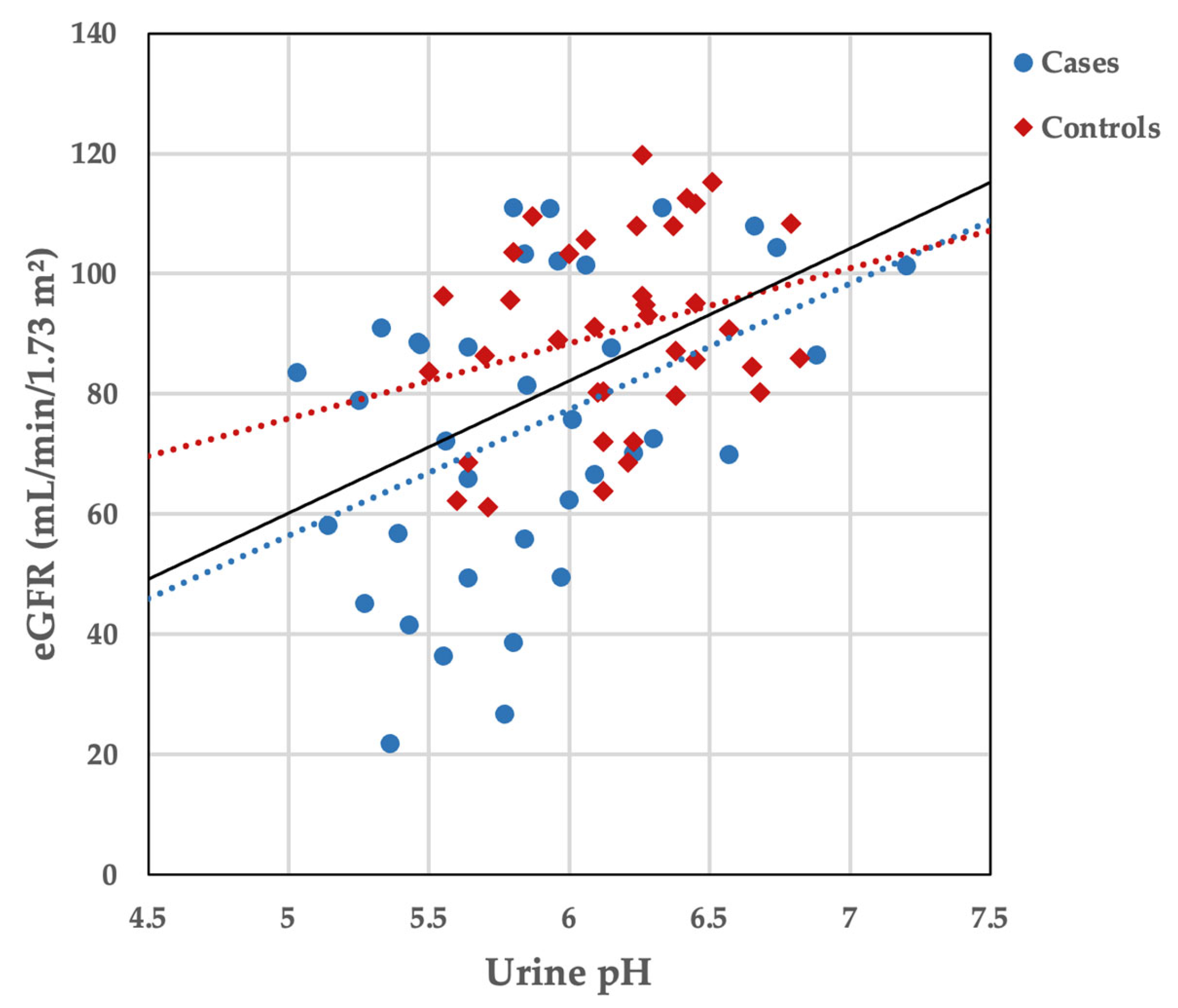
3.4. Multivariable Linear Regression Model for Glomerular Filtration Rate
4. Discussion
5. Conclusions
Author Contributions
Funding
Institutional Review Board Statement
Informed Consent Statement
Data Availability Statement
Conflicts of Interest
Abbreviations
| AP | Activity product |
| BMI | Body mass index |
| CI | Confidence interval |
| CKD | Chronic kidney disease |
| eGFR | Estimated glomerular filtration rate |
| ESWL | Extracorporeal shock wave lithotripsy |
| IQR | Interquartile range |
| MUFA | Monounsaturated fatty acids |
| PUFA | Polyunsaturated fatty acids |
| RS | Relative supersaturation |
| TIA | Transient ischemic attack |
References
- Sorokin, I.; Mamoulakis, C.; Miyazawa, K.; Rodgers, A.; Talati, J.; Lotan, Y. Epidemiology of stone disease across the world. World J. Urol. 2017, 35, 1301–1320. [Google Scholar] [CrossRef] [PubMed]
- Raheem, O.A.; Khandwala, Y.S.; Sur, R.L.; Ghani, K.R.; Denstedt, J.D. Burden of urolithiasis: Trends in prevalence, treatments, and costs. Eur. Urol. Focus 2017, 3, 18–26. [Google Scholar] [CrossRef] [PubMed]
- Lieske, J.C.; Rule, A.D.; Krambeck, A.E.; Williams, J.C.; Bergstralh, E.J.; Mehta, R.A.; Moyer, T.P. Stone composition as a function of age and sex. Clin. J. Am. Soc. Nephrol. 2014, 9, 2141–2146. [Google Scholar] [CrossRef]
- Siener, R.; Herwig, H.; Rüdy, J.; Schaefer, R.M.; Lossin, P.; Hesse, A. Urinary stone composition in Germany: Results from 45,783 stone analyses. World J. Urol. 2022, 40, 1813–1820. [Google Scholar] [CrossRef]
- Asplin, J.R. Hyperoxaluric calcium nephrolithiasis. Endocrinol. Metab. Clin. N. Am. 2002, 31, 927–949. [Google Scholar] [CrossRef]
- Desenclos, J.; Forté, V.; Clément, C.; Daudon, M.; Letavernier, E. Pathophysiology and management of enteric hyperoxaluria. Clin. Res. Hepatol. Gastroenterol. 2024, 48, 102322. [Google Scholar] [CrossRef]
- Siener, R.; Ernsten, C.; Welchowski, T.; Hesse, A. Metabolic profile of calcium oxalate stone patients with enteric hyperoxaluria and impact of dietary intervention. Nutrients 2024, 16, 2688. [Google Scholar] [CrossRef] [PubMed]
- Prochaska, M.; Worcester, E. Risk factors for kidney stone formation following bariatric surgery. Kidney360 2020, 1, 1456–1461. [Google Scholar] [CrossRef]
- Chadwick, V.S.; Modha, K.; Dowling, R.H. Mechanism for hyperoxaluria in patients with ileal dysfunction. N. Engl. J. Med. 1973, 289, 172–176. [Google Scholar] [CrossRef]
- Asplin, J.R. The management of patients with enteric hyperoxaluria. Urolithiasis 2016, 44, 33–43. [Google Scholar] [CrossRef]
- Earnest, D.L.; Johnson, G.; Williams, H.E.; Admirand, W.H. Hyperoxaluria in patients with ileal resection: An abnormality in dietary oxalate absorption. Gastroenterology 1974, 66, 1114–1122. [Google Scholar] [CrossRef]
- Dobbins, J.W.; Binder, H.J. Importance of the colon in enteric hyperoxaluria. N. Engl. J. Med. 1977, 296, 298–301. [Google Scholar] [CrossRef] [PubMed]
- Dobbins, J.W.; Binder, H.J. Effect of bile salts and fatty acids on the colonic absorption of oxalate. Gastroenterology 1976, 70, 1096–1100. [Google Scholar] [CrossRef]
- Alexander, R.T.; Hemmelgarn, B.R.; Wiebe, N.; Bello, A.; Morgan, C.; Samuel, S.; Klarenbach, S.W.; Curhan, G.C.; Tonelli, M. Kidney stones and kidney function loss: A cohort study. BMJ 2012, 345, e5287. [Google Scholar] [CrossRef]
- Kim, J.Y.; Lee, J.K.; Park, J.T.; Chang, T.I. Risk of incident chronic kidney disease among patients with urolithiasis: A nationwide longitudinal cohort study. Clin. Kidney J. 2024, 17, sfae030. [Google Scholar] [CrossRef] [PubMed]
- Gambaro, G.; Croppi, E.; Coe, F.; Lingeman, J.; Moe, O.; Worcester, E.; Buchholz, N.; Bushinsky, D.; Curhan, G.C.; Ferraro, P.M.; et al. Metabolic diagnosis and medical prevention of calcium nephrolithiasis and its systemic manifestations: A consensus statement. J. Nephrol. 2016, 29, 715–734. [Google Scholar] [CrossRef] [PubMed]
- Gambaro, G.; Croppi, E.; Bushinsky, D.; Jaeger, P.; Cupisti, A.; Ticinesi, A.; Mazzaferro, S.; D’Addessi, A.; Ferraro, P.M. The risk of chronic kidney disease associated with urolithiasis and its urological treatments: A review. J. Urol. 2017, 198, 268–273. [Google Scholar] [CrossRef]
- Worcester, E.M.; Parks, J.H.; Evan, A.P.; Coe, F.L. Renal function in patients with nephrolithiasis. J. Urol. 2006, 176, 600–603. [Google Scholar] [CrossRef]
- Rodriguez, A.; Quintero, M.A.; Hazime, H.; Killian, R.; Ducasa, G.M.; Faust, K.M.; Abreu, M.T. Risk factors for chronic kidney disease in patients with Crohn’s disease. Inflamm. Bowel Dis. 2025, 31, 2693–2703. [Google Scholar] [CrossRef]
- Kim, H.J. Metabolic acidosis in chronic kidney disease: Pathogenesis, clinical consequences, and treatment. Electrolytes Blood Press 2021, 19, 29–37. [Google Scholar] [CrossRef]
- Korus, J.; Szymczak, M.; Gołębiowski, M.; Rydzek, J.; Majcherczyk, K.; Wilk, J.; Bułdyś, K.; Zmonarski, S.; Gołębiowski, T. Metabolic acidosis in patients with chronic kidney disease: Diagnosis, pathogenesis, and treatment—A narrative review. Diagnostics 2025, 15, 2052. [Google Scholar] [CrossRef]
- Troxell, M.L.; Houghton, D.C.; Hawkey, M.; Batiuk, T.D.; Bennett, W.M. Enteric oxalate nephropathy in the renal allograft: An underrecognized complication of bariatric surgery. Am. J. Transplant. 2013, 13, 501–509. [Google Scholar] [CrossRef] [PubMed]
- Nasr, S.H.; Valeri, A.M.; Said, S.M.; Sethi, S.; Nath, K.A.; Lieske, J.C.; Bu, L. Clinicopathologic characteristics, etiologies, and outcome of secondary oxalate nephropathy. Mayo Clin. Proc. 2024, 99, 593–606. [Google Scholar] [CrossRef] [PubMed]
- Witting, C.; Langman, C.B.; Assimos, D.; Baum, M.A.; Kausz, A.; Milliner, D.; Tasian, G.; Worcester, E.; Allain, M.; West, M.; et al. Pathophysiology and treatment of enteric hyperoxaluria. Clin. J. Am. Soc. Nephrol. 2021, 16, 487–495. [Google Scholar] [CrossRef]
- Noori, N.; Honarkar, E.; Goldfarb, D.S.; Kalantar-Zadeh, K.; Taheri, M.; Shakhssalim, N.; Parvin, M.; Basiri, A. Urinary lithogenic risk profile in recurrent stone formers with hyperoxaluria: A randomized controlled trial comparing DASH (Dietary Approaches to Stop Hypertension)-style and low-oxalate diets. Am. J. Kidney Dis. 2014, 63, 456–463. [Google Scholar] [CrossRef] [PubMed]
- Hönow, R.; Hesse, A. Comparison of extraction methods for the determination of soluble and total oxalate in foods by HPLC-enzyme-reactor. Food Chem. 2002, 78, 511–521. [Google Scholar] [CrossRef]
- Siener, R. Nutrition and kidney stone disease. Nutrients 2021, 13, 1917. [Google Scholar] [CrossRef]
- Siener, R.; Löhr, P.; Hesse, A. Urinary risk profile, impact of diet, and risk of calcium oxalate urolithiasis in idiopathic uric acid stone disease. Nutrients 2023, 15, 572. [Google Scholar] [CrossRef]
- Hesse, A.; Tiselius, H.-G.; Siener, R.; Hoppe, B. Urinary Stones: Diagnosis, Treatment, and Prevention of Recurrence, 3rd ed.; Karger: Basel, Switzerland, 2009; ISBN 978-3-8055-9149-2. [Google Scholar]
- Siener, R.; Pitzer, M.S.; Speller, J.; Hesse, A. Risk profile of patients with brushite stone disease and the impact of diet. Nutrients 2023, 15, 4092. [Google Scholar] [CrossRef]
- Deutsche Gesellschaft für Urologie e.V.; Arbeitskreis Harnsteine der Akademie der Deutschen Urologen. S2k-Leitlinie zur Diagnostik, Therapie und Metaphylaxe der Urolithiasis (AWMF-Registernummer 043-025), Aktualisierung 2018; Deutsche Gesellschaft für Urologie e.V.; Arbeitskreis Harnsteine der Akademie der Deutschen Urologen: Düsseldorf, Germany, 2019; Available online: https://register.awmf.org/de/leitlinien/detail/043-025 (accessed on 11 August 2025).
- Werness, P.G.; Brown, C.M.; Smith, L.H.; Finlayson, B. EQUIL2: A basic computer program for the calculation of urinary saturation. J. Urol. 1985, 134, 1242–1244. [Google Scholar] [CrossRef]
- Tiselius, H.-G. Medical evaluation of nephrolithiasis. Endocrinol. Metab. Clin. N. Am. 2002, 31, 1031–1050. [Google Scholar] [CrossRef] [PubMed]
- Levey, A.S.; Stevens, L.A.; Schmid, C.H.; Zhang, Y.L.; Castro, A.F.; Feldman, H.I.; Kusek, J.W.; Eggers, P.; van Lente, F.; Greene, T.; et al. A new equation to estimate glomerular filtration rate. Ann. Intern. Med. 2009, 150, 604–612. [Google Scholar] [CrossRef] [PubMed]
- Von Unruh, G.E.; Voss, S.; Sauerbruch, T.; Hesse, A. Reference range for gastrointestinal oxalate absorption measured with a standardized [13C2]oxalate absorption test. J. Urol. 2003, 169, 687–690. [Google Scholar] [CrossRef]
- Voss, S.; Hesse, A.; Zimmermann, D.J.; Sauerbruch, T.; von Unruh, G.E. Intestinal oxalate absorption is higher in idiopathic calcium oxalate stone formers than in healthy controls: Measurements with the [13C2]oxalate absorption test. J. Urol. 2006, 175, 1711–1715. [Google Scholar] [CrossRef] [PubMed]
- Van Buuren, S.; Groothuis-Oudshoorn, K. mice: Multivariate imputation by chained equations in R. J. Stat. Softw. 2011, 45, 1–67. [Google Scholar] [CrossRef]
- Pak, C.Y.C.; Adams-Huet, B.; Poindexter, J.R.; Pearle, M.S.; Peterson, R.D.; Moe, O.W. Rapid communication: Relative effect of urinary calcium and oxalate on saturation of calcium oxalate. Kidney Int. 2004, 66, 2032–2037. [Google Scholar] [CrossRef]
- Siener, R.; Ernsten, C.; Speller, J.; Scheurlen, C.; Sauerbruch, T.; Hesse, A. Intestinal oxalate absorption, enteric hyperoxaluria, and risk of urinary stone formation in patients with Crohn’s disease. Nutrients 2024, 16, 264. [Google Scholar] [CrossRef]
- D’Costa, M.R.; Kausz, A.T.; Carroll, K.J.; Ingimarsson, J.P.; Enders, F.T.; Mara, K.C.; Mehta, R.A.; Lieske, J.C. Subsequent urinary stone events are predicted by the magnitude of urinary oxalate excretion in enteric hyperoxaluria. Nephrol. Dial. Transplant. 2021, 36, 2208–2215. [Google Scholar] [CrossRef]
- Voss, S.; Zimmermann, D.J.; Hesse, A.; von Unruh, G.E. The effect of oral administration of calcium and magnesium on intestinal oxalate absorption in humans. Isot. Environ. Health Stud. 2004, 40, 199–205. [Google Scholar] [CrossRef]
- Andersson, H.; Jagenburg, R. Fat-reduced diet in the treatment of hyperoxaluria in patients with ileopathy. Gut 1974, 15, 360–366. [Google Scholar] [CrossRef]
- Borghi, L.; Schianchi, T.; Meschi, T.; Guerra, A.; Allegri, F.; Maggiore, U.; Novarini, A. Comparison of two diets for the prevention of recurrent stones in idiopathic hypercalciuria. N. Eng. J. Med. 2002, 346, 77–84. [Google Scholar] [CrossRef]
- Skolarikos, A.; Jung, H.; Neisius, A.; Petřík, A.; Kamphuis, G.M.; Davis, N.F.; Somani, B.; Tailly, T.; Lardas, M.; Gambaro, G.; et al. EAU Guidelines on Urolithiasis; EAU Guidelines Office: Arnhem, The Netherlands, 2025; Available online: http://uroweb.org/guidelines/compilations-of-all-guidelines (accessed on 11 August 2025).
- Al-Ghamdi, S.M.; Cameron, E.C.; Sutton, R.A. Magnesium deficiency: Pathophysiologic and clinical overview. Am. J. Kidney Dis. 1994, 24, 737–752. [Google Scholar] [CrossRef]
- Borghi, L.; Meschi, T.; Amato, F.; Briganti, A.; Novarini, A.; Giannini, A. Urinary volume, water and recurrences in idiopathic calcium nephrolithiasis: A 5-year randomized prospective study. J. Urol. 1996, 155, 839–843. [Google Scholar] [CrossRef]
- Puurunen, M.; Kurtz, C.; Wheeler, A.; Mulder, K.; Wood, K.; Swenson, A.; Curhan, G. Twenty-four-hour urine oxalate and risk of chronic kidney disease. Nephrol. Dial. Transplant. 2024, 39, 788–794. [Google Scholar] [CrossRef] [PubMed]
- Waikar, S.S.; Srivastava, A.; Palsson, R.; Shafi, T.; Hsu, C.-Y.; Sharma, K.; Lash, J.P.; Chen, J.; He, J.; Lieske, J.; et al. Association of urinary oxalate excretion with the risk of chronic kidney disease progression. JAMA Intern. Med. 2019, 179, 542–551. [Google Scholar] [CrossRef]
- Hamm, L.L.; Nakhoul, N.; Hering-Smith, K.S. Acid-base homeostasis. Clin. J. Am. Soc. Nephrol. 2015, 10, 2232–2242. [Google Scholar] [CrossRef]
- Simpson, D.P. Citrate excretion: A window on renal metabolism. Am. J. Physiol. 1983, 244, F223–F234. [Google Scholar] [CrossRef] [PubMed]
- Hamm, L.L. Renal handling of citrate. Kidney Int. 1990, 38, 728–735. [Google Scholar] [CrossRef] [PubMed]
- Hauser, W.; Frick, J.; Kunit, G. Alkali citrate for preventing recurrence of calcium oxalate stones. Eur. Urol. 1990, 17, 248–251. [Google Scholar] [CrossRef]
- Trinchieri, A.; Lizzano, R.; Castelnuovo, C.; Zanetti, G.; Pisani, E. Urinary patterns of patients with renal stones associated with chronic inflammatory bowel disease. Arch. Ital. Urol. Androl. 2002, 74, 61–64. [Google Scholar]
- Nakanishi, N.; Fukui, M.; Tanaka, M.; Toda, H.; Imai, S.; Yamazaki, M.; Hasegawa, G.; Oda, Y.; Nakamura, N. Low urine pH is a predictor of chronic kidney disease. Kidney Blood Press. Res. 2012, 35, 77–81. [Google Scholar] [CrossRef]
- Chen, W.; Levy, D.S.; Abramowitz, M.K. Acid base balance and progression of kidney disease. Semin. Nephrol. 2019, 39, 406–417. [Google Scholar] [CrossRef]
- Nagami, G.T.; Kraut, J.A. Regulation of acid-base balance in patients with chronic kidney disease. Adv. Chronic Kidney Dis. 2022, 29, 337–342. [Google Scholar] [CrossRef]
- Kuhn, C.; Mohebbi, N.; Ritter, A. Metabolic acidosis in chronic kidney disease: Mere consequence or also culprit? Pflug. Arch. 2024, 476, 579–592. [Google Scholar] [CrossRef]
- Kidney Disease: Improving Global Outcomes (KDIGO) CKD Work Group. KDIGO 2024 clinical practice guideline for the evaluation and management of chronic kidney disease. Kidney Int. 2024, 105, 117–314. [CrossRef]
- Meschi, T.; Maggiore, U.; Fiaccadori, E.; Schianchi, T.; Bosi, S.; Adorni, G.; Ridolo, E.; Guerra, A.; Allegri, F.; Novarini, A.; et al. The effect of fruits and vegetables on urinary stone risk factors. Kidney Int. 2004, 66, 2402–2410. [Google Scholar] [CrossRef]
- Dang, Z.; He, Y.; Xie, R.; Chen, P.; Dong, F. Plant-based diet and chronic kidney disease: A systematic review and meta-analysis. J. Ren. Nutr. 2025, 35, 517–530. [Google Scholar] [CrossRef]
- Fink, H.A.; Wilt, T.J.; Eidman, K.E.; Garimella, P.S.; MacDonald, R.; Rutks, I.R.; Brasure, M.; Kane, R.L.; Ouellette, J.; Monga, M. Medical management to prevent recurrent nephrolithiasis in adults: A systematic review for an American College of Physicians clinical guideline. Ann. Intern. Med. 2013, 158, 535–543. [Google Scholar] [CrossRef]
- Qaseem, A.; Dallas, P.; Forciea, M.A.; Starkey, M.; Denberg, T.D. Dietary and pharmacologic management to prevent recurrent nephrolithiasis in adults: A clinical practice guideline from the American College of Physicians. Ann. Intern. Med. 2014, 161, 659–667. [Google Scholar] [CrossRef]
- Cheungpasitporn, W.; Rossetti, S.; Friend, K.; Erickson, S.B.; Lieske, J.C. Treatment effect, adherence, and safety of high fluid intake for the prevention of incident and recurrent kidney stones: A systematic review and meta-analysis. J. Nephrol. 2016, 29, 211–219. [Google Scholar] [CrossRef]


| Cases Median (IQR) n (%) | Controls Median (IQR) n (%) | p Value | |
|---|---|---|---|
| Number of patients | 37 | 37 | |
| Gender (women/men) | 10/27 (27.0%/73.0%) | 10/27 (27.0%/73.0%) | 1.000 |
| Age (years) | 48 (20) | 46 (19) | 0.442 |
| Height (cm) | 178 (8) a | 174 (7) | 0.009 |
| Weight (kg) | 75.3 (24.3) a | 80.0 (14.5) | 0.208 |
| BMI (kg/m2) | 24.6 (6.9) a | 26.6 (4.6) | 0.016 |
| BMI < 18.5 kg/m2 | 1/36 (2.8%) | 0/37 (0.0%) | |
| BMI 18.5–24.9 kg/m2 | 19/36 (52.8%) | 13/37 (35.1%) | |
| BMI 25.0–29.9 kg/m2 | 13/36 (36.1%) | 20/37 (54.1%) | |
| BMI ≥ 30.0 kg/m2 | 3/36 (8.3%) | 4/37 (10.8%) | |
| Cardiovascular diseases | |||
| Hypertension | 8/37 (21.6%) | 9/37 (24.3%) | 1.000 |
| Myocardial infarction | 1/37 (2.7%) | 1/37 (2.7%) | 1.000 |
| Stroke/TIA | 1/37 (2.7%) | 1/37 (2.7%) | 1.000 |
| Type 2 diabetes | 2/37 (5.4%) | 3/37 (8.1%) | 1.000 |
| Gallstone/cholecystectomy | 11/37 (29.7%) | 4/37 (10.8%) | 0.065 |
| Oxalate absorption (%) | 14.8 (13.0) b | 8.9 (7.1) c | 0.002 |
| Oxalate absorption ≥ 10.0% | 24/31 (77.4%) | 13/29 (44.8%) | 0.035 |
| Hypercalciuria | 2/37 (5.4%) | 17/37 (45.9%) | <0.001 |
| Absorptive hypercalciuria d | 1/37 (2.7%) | 10/37 (27.0%) | |
| Renal hypercalciuria d | 0/37 (0.0%) | 3/37 (8.1%) | |
| Idiopathic hypercalciuria d | 1/37 (2.7%) | 4/37 (10.8%) | |
| eGFR (mL/min/1.73 m2) | 75.7 (39.9) | 90.7 (24.4) | 0.004 |
| eGFR ≥ 90.0 mL/min/1.73 m2 | 10/37 (27.0%) | 19/37 (51.4%) | |
| eGFR 60.0–89.9 mL/min/1.73 m2 | 16/37 (43.2%) | 18/37 (48.6%) | |
| eGFR 45.0–59.9 mL/min/1.73 m2 | 6/37 (16.2%) | 0/37 (0.0%) | |
| eGFR 30.0–44.9 mL/min/1.73 m2 | 3/37 (8.1%) | 0/37 (0.0%) | |
| eGFR 15.0–29.9 mL/min/1.73 m2 | 2/37 (5.4%) | 0/37 (0.0%) | |
| Blood gas analysis | |||
| pH | 7.40 (0.04) e | 7.42 (0.02) f | 0.001 |
| Bicarbonate (mmol/L) | 23.2 (2.5) e | 25.2 (1.3) f | 0.012 |
| Base excess | −1.6 (2.8) e | 0.8 (1.9) f | 0.001 |
| Metabolic acidosis g | 4/24 (16.7%) | 0/26 (0.0%) | 0.135 |
| Cases Median (IQR) n (%) | Controls Median (IQR) n (%) | p Value | |
|---|---|---|---|
| Age at first stone event (years) | 39 (18) | 32 (18) | 0.201 |
| Duration of stone disease (years) | 9 (14) | 12 (18) | 0.213 |
| Number of stone events in the past year | 4 (28) a | 2 (4) b | 0.067 |
| Number of stone events in total | 20 (45) c | 12 (29) d | 0.444 |
| Anatomic anomalies | 10/37 (27.0%) | 11/37 (29.7%) | 1.000 |
| Stenosis | 3/37 (8.1%) | 1/37 (2.7%) | |
| Kidney cysts | 5/37 (13.5%) | 6/37 (16.2%) | |
| Partial nephrectomy | 0/37 (0.0%) | 1/37 (2.7%) | |
| Total nephrectomy | 1/37 (2.7%) | 0/37 (0.0%) | |
| Total nephrectomy and kidney cysts | 1/37 (2.7%) | 0/37 (0.0%) | |
| Total nephrectomy and stenosis | 0/37 (0.0%) | 1/37 (2.7%) | |
| Pelvic kidney and kidney cysts | 0/37 (0.0%) | 1/37 (2.7%) | |
| Duplex kidney and kidney cysts | 0/37 (0.0%) | 1/37 (2.7%) | |
| Laterality | 0.804 | ||
| Bilateral | 26/37 (70.3%) | 28/37 (75.7%) | |
| Unilateral | 11/37 (29.7%) | 9/37 (24.3%) | |
| Type of stone removal | |||
| Spontaneous passage | 28/37 (75.7%) | 36/37 (97.3%) | 0.021 |
| Spontaneous passage alone | 4/37 (10.8%) | 4/37 (10.8%) | 1.000 |
| ESWL | 25/37 (67.6%) | 29/37 (78.4%) | 0.454 |
| Ureteroscopy | 21/37 (56.8%) | 20/37 (54.1%) | 1.000 |
| Percutaneous nephrolithotomy | 10/37 (27.0%) | 3/37 (8.1%) | 0.065 |
| Open surgery | 4/37 (10.8%) | 5/37 (13.5%) | 1.0000 |
| Cases n = 37 Median (IQR) | Controls n = 37 Median (IQR) | Cases vs. Controls p Value | |||||||
|---|---|---|---|---|---|---|---|---|---|
| Habitual Diet | Balanced Diet | Difference | Habitual Diet | Balanced Diet | Difference | Habitual Diet | Balanced Diet | Difference | |
| Volume | 1.680 (1.020) | 2.060 (0.878) | 0.420 (1.503) | 1.900 (1.090) | 2.370 (0.575) | 0.550 (1.110) | 0.175 | 0.180 | 0.563 |
| pH | 5.68 (0.46) | 5.84 (0.66) | 0.16 (0.61) | 6.14 (0.75) | 6.23 (0.52) | 0.08 (0.58) | <0.001 | 0.002 | 0.599 |
| Density (g/cm3) | 1.010 (0.006) | 1.006 (0.004) | −0.004 (0.005) | 1.010 (0.007) | 1.005 (0.002) | −0.005 (0.008) | 0.777 | 0.343 | 0.777 |
| Sodium (mmol/24 h) | 150 (113) | 113 (62) | −36 (119) | 159 (91) | 104 (40) | −51 (69) | 0.870 | 0.114 | 0.464 |
| Potassium (mmol/24 h) | 45 (22) | 45 (30) | 5 (20) | 51 (27) | 58 (21) | 6 (26) | 0.024 | 0.063 | 0.709 |
| Calcium (mmol/24 h) | 2.68 (2.75) | 2.63 (1.92) | −0.13 (1.25) | 5.42 (5.05) | 4.22 (3.48) | −1.24 (2.55) | <0.001 | <0.001 | 0.002 |
| Magnesium (mmol/24 h) | 1.81 (1.31) | 2.28 (1.67) | 0.54 (0.81) | 4.11 (2.42) | 4.48 (2.01) | 0.12 (1.27) | <0.001 | <0.001 | 0.158 |
| Ammonium (mmol/24 h) | 42.2 (27.3) a | 32.3 (18.8) a | −3.3 (26.6) a | 25.7 (18.6) | 24.8 (13.4) | −5.2 (13.5) | 0.017 | 0.002 | 0.471 |
| Chloride (mmol/24 h) | 181 (130) | 129 (70) | −55 (132) | 153 (88) | 102 (43) | −59 (63) | 0.182 | 0.031 | 0.893 |
| Phosphate (mmol/24 h) | 27.1 (10.8) | 24.8 (7.5) | −1.9 (9.1) | 27.7 (13.1) | 25.6 (8.6) | −1.0 (12.7) | 0.612 | 0.492 | 0.743 |
| Sulfate (mmol/24 h) | 16.9 (9.1) | 14.5 (5.9) | −1.7 (8.2) | 20.2 (7.8) | 16.8 (4.3) | −2.5 (6.5) | <0.001 | <0.001 | 0.162 |
| Creatinine (mmol/24 h) | 13.52 (4.85) | 13.41 (5.05) | −0.41 (2.75) | 13.78 (5.61) | 13.34 (5.67) | −0.73 (2.52) | 0.202 | 0.172 | 0.882 |
| Uric acid (mmol/24 h) | 2.79 (1.19) | 2.49 (1.07) | −0.35 (1.10) | 3.80 (1.43) | 3.18 (0.70) | −0.36 (1.09) | <0.001 | <0.001 | 0.323 |
| Oxalate (mmol/24 h) | 0.702 (0.575) | 0.574 (0.365) | −0.179 (0.279) | 0.350 (0.135) | 0.284 (0.082) | −0.057 (0.160) | <0.001 | <0.001 | 0.035 |
| Citrate (mmol/24 h) | 0.343 (0.964) | 0.857 (2.301) | 0.212 (0.887) | 2.355 (1.955) | 2.834 (2.028) | 0.211 (1.163) | <0.001 | <0.001 | 0.893 |
| RS Uric acid | 1.700 (1.974) | 1.034 (1.179) | −0.593 (1.679) | 1.135 (2.097) | 0.610 (0.972) | −0.459 (1.715) | 0.060 | 0.019 | 0.437 |
| RS CaOx | 9.574 (5.397) | 5.281 (3.730) | −2.869 (5.289) | 5.802 (3.564) | 3.384 (2.168) | −1.804 (3.910) | 0.001 | 0.001 | 0.206 |
| AP Uric acid (10−9) | 1.165 (1.457) | 0.667 (0.854) | −0.377 (1.178) | 0.734 (1.457) | 0.380 (0.634) | −0.296 (1.200) | 0.047 | 0.015 | 0.370 |
| AP CaOx index | 2.201 (1.478) | 1.040 (0.961) | −0.961 (1.477) | 1.020 (0.734) | 0.557 (0.399) | −0.468 (0.742) | <0.001 | <0.001 | 0.009 |
| Reference Range | Cases n = 37 n (%) | Controls n = 37 n (%) | Odds Ratio [95% CI] | p Value | |
|---|---|---|---|---|---|
| Volume | <2.000 L/24 h | 15 (40.5%) | 6 (16.2%) | 0.100 [0.013, 0.781] | 0.012 |
| ≥2.000 L/24 h | 22 (59.5%) | 31 (83.8%) | |||
| pH | <5.80 | 16 (43.2%) | 7 (18.9%) | 0.250 [0.071, 0.886] | 0.035 |
| ≥5.80 | 21 (56.8%) | 30 (81.1%) | |||
| Calcium | <5.00 mmol/24 h | 35 (94.6%) | 20 (54.1%) | 0.063 [0.008, 0.471] | <0.001 |
| ≥5.00 mmol/24 h | 2 (5.4%) | 17 (45.9%) | |||
| Magnesium | <3.00 mmol/24 h | 26 (70.3%) | 5 (13.5%) | 0.045 [0.006, 0.337] | <0.001 |
| ≥3.00 mmol/24 h | 11 (29.7%) | 32 (86.5%) | |||
| Uric acid | <4.00 mmol/24 h | 34 (91.9%) | 31 (83.8%) | 0.400 [0.078, 2.062] | 0.453 |
| ≥4.00 mmol/24 h | 3 (8.1%) | 6 (16.2%) | |||
| Oxalate | <0.45 mmol/24 h | 10 (27.0%) | 36 (97.3%) | 25.000 [3.388, 184.501] | <0.001 |
| ≥0.45 mmol/24 h | 27 (73.0%) | 1 (2.7%) | |||
| Citrate | <1.700 mmol/24 h | 24 (64.9%) | 6 (16.2%) | 0.143 [0.043, 0.479] | <0.001 |
| ≥1.700 mmol/24 h | 13 (35.1%) | 31 (83.8%) |
| Cases n = 31 Median (IQR) | Controls n = 32 Median (IQR) | Cases vs. Controls p Value | |||||
|---|---|---|---|---|---|---|---|
| Habitual Diet | Balanced Diet | Pre-Post Difference a | Habitual Diet | Balanced Diet | Pre-Post Difference a | Pre-Post Difference b | |
| Energy (kcal/day) | 2548 (1001) | 2355 | −193 (1001) * | 2211 (790) | 2355 | 144 (790) | 0.129 |
| Protein (g/day) | 97 (42) | 71 | −26 (42) * | 83 (31) | 71 | −12 (31) * | 0.423 |
| Fat (g/day) | 92 (61) | 81 | −11 (61) * | 80 (31) | 81 | 1 (31) | 0.062 |
| Carbohydrates (g/day) | 293 (82) | 327 | 34 (82) | 257 (111) | 327 | 70 (111) * | 0.353 |
| Fiber (g/day) | 22 (10) | 31 | 9 (10) * | 21 (12) | 31 | 10 (12) * | 0.671 |
| Sodium (mg/day) | 3452 (2519) | 2300 | −1152 (2519) * | 3457 (2118) | 2300 | −1157 (2118) * | 0.532 |
| Potassium (mg/day) | 3275 (1795) | 3390 | 115 (1795) | 3005 (1428) | 3390 | 385 (1428) * | 0.515 |
| Calcium (mg/day) | 890 (345) | 977 | 87 (345) | 883 (369) | 977 | 94 (369) | 0.940 |
| Magnesium (mg/day) | 417 (208) | 341 | −76 (208) * | 376 (131) | 341 | −35 (131) * | 0.901 |
| Phosphorus (mg/day) | 1427 (656) | 1432 | 6 (656) | 1337 (504) | 1432 | 95 (504) | 0.565 |
| Methionine (mg/day) | 2027 (771) | 1415 | −612 (771) * | 1714 (761) | 1415 | −299 (761) * | 0.227 |
| Cysteine (mg/day) | 1270 (597) | 835 | −435 (597) * | 1089 (431) | 835 | −254 (431) * | 0.190 |
| Total oxalate (mg/day) | 151 (118) | 121 | −30 (118) * | 150 (172) | 121 | −29 (172) * | 0.423 |
| Soluble oxalate (mg/day) | 68 (40) | 54 | −14 (40) * | 70 (38) | 54 | −16 (38) * | 0.408 |
| Purines (mg/day) | 449 (340) | 449 | 0 (340) | 407 (277) | 449 | 42 (277) | 0.315 |
| Cholesterol (mg/day) | 376 (294) | 195 | −181 (294) * | 353 (128) | 195 | −158 (128) * | 0.380 |
| MUFA (g/day) | 34 (24) | 26 | −8 (24) * | 30 (16) | 26 | −4 (16) | 0.094 |
| PUFA (g/day) | 12 (7) | 19 | 7 (7) * | 12 (5) | 19 | 7 (5) * | 0.291 |
| Water (mL/day) | 3130 (1268) | 3437 | 307 (1268) | 3038 (1252) | 3437 | 399 (1252) | 0.353 |
| Alcohol (g/day) | 5 (20) | 0 | −5 (20) * | 2 (17) | 0 | −2 (17) * | 0.392 |
| Variable | Coefficient | 95% CI | p Value |
|---|---|---|---|
| (Intercept) | 5.165 | [−76.749, 87.079] | 0.900 |
| Total number of stone events | −0.079 | [−1.026, 0.869] | 0.868 |
| Urine pH | 14.862 | [3.735, 25.989] | 0.010 |
| Urinary oxalate excretion (mmol/24 h) | 8.907 | [−12.249, 30.063] | 0.403 |
| BMI (kg/m2) | −0.216 | [−1.452, 1.020] | 0.728 |
| Patient group (cases) | −15.001 | [−28.290, −1.713] | 0.028 |
| Hypertension (presence) | −15.815 | [−28.309, −3.321] | 0.014 |
| Diabetes mellitus (presence) | 15.698 | [−3.492, 34.888] | 0.107 |
Disclaimer/Publisher’s Note: The statements, opinions and data contained in all publications are solely those of the individual author(s) and contributor(s) and not of MDPI and/or the editor(s). MDPI and/or the editor(s) disclaim responsibility for any injury to people or property resulting from any ideas, methods, instructions or products referred to in the content. |
© 2026 by the authors. Licensee MDPI, Basel, Switzerland. This article is an open access article distributed under the terms and conditions of the Creative Commons Attribution (CC BY) license.
Share and Cite
Ernsten, C.; Spuck, N.; Hesse, A.; Siener, R. Comparison of Risk Profiles, Nutrient Intake, and Kidney Function of Calcium Oxalate Stone Formers with and without Enteric Hyperoxaluria. A Matched Case-Control Study. Nutrients 2026, 18, 1788. https://doi.org/10.3390/nu18111788
Ernsten C, Spuck N, Hesse A, Siener R. Comparison of Risk Profiles, Nutrient Intake, and Kidney Function of Calcium Oxalate Stone Formers with and without Enteric Hyperoxaluria. A Matched Case-Control Study. Nutrients. 2026; 18(11):1788. https://doi.org/10.3390/nu18111788
Chicago/Turabian StyleErnsten, Charlotte, Nikolai Spuck, Albrecht Hesse, and Roswitha Siener. 2026. "Comparison of Risk Profiles, Nutrient Intake, and Kidney Function of Calcium Oxalate Stone Formers with and without Enteric Hyperoxaluria. A Matched Case-Control Study" Nutrients 18, no. 11: 1788. https://doi.org/10.3390/nu18111788
APA StyleErnsten, C., Spuck, N., Hesse, A., & Siener, R. (2026). Comparison of Risk Profiles, Nutrient Intake, and Kidney Function of Calcium Oxalate Stone Formers with and without Enteric Hyperoxaluria. A Matched Case-Control Study. Nutrients, 18(11), 1788. https://doi.org/10.3390/nu18111788