Depressive Symptoms Associated with Decreased Choline Intake in Lactating Mothers of Preterm Infants
 , , , and
Abstract
1. Introduction
2. Materials and Methods
2.1. Participants
2.2. Questionnaires
2.3. Statistical Analysis
3. Results
3.1. Characteristics by EPDS Screening Status
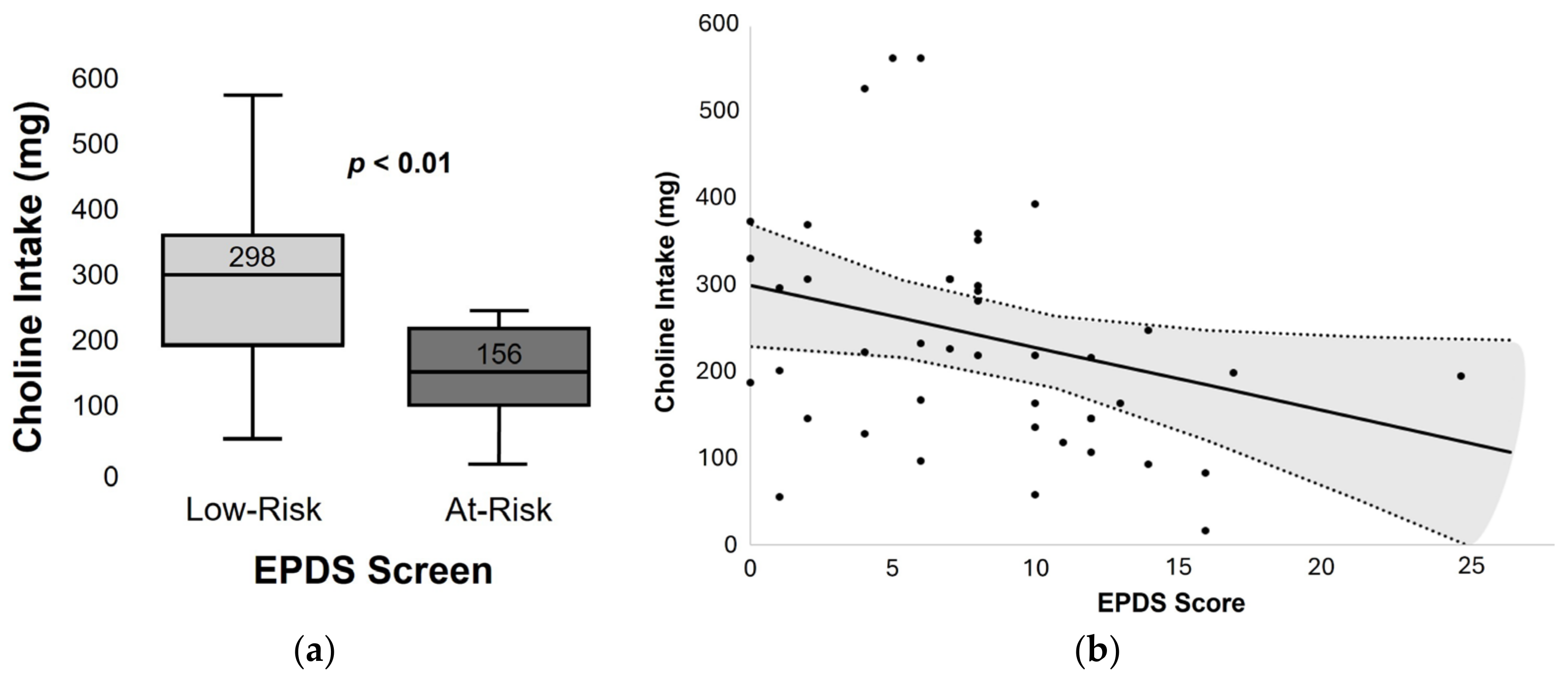
3.2. EPDS Score and Choline Intake
4. Discussion
Limitations
5. Conclusions
Author Contributions
Funding
Institutional Review Board Statement
Informed Consent Statement
Data Availability Statement
Conflicts of Interest
Abbreviations
| EPDS | Edinburgh Postnatal Depression Scale |
| IQR | Interquartile Range |
| NICU | Neonatal Intensive Care Unit |
References
- Wallace, T.C.; Blusztajn, J.K.; Caudill, M.A.; Klatt, K.C.; Zeisel, S.H. Choline: The Neurocognitive Essential Nutrient of Interest to Obstetricians and Gynecologists. J. Diet. Suppl. 2020, 17, 733–752. [Google Scholar] [CrossRef]
- Wallace, T.C.; Fulgoni, V.L. Usual Choline Intakes Are Associated with Egg and Protein Food Consumption in the United States. Nutrients 2017, 9, 839. [Google Scholar] [CrossRef] [PubMed]
- Derbyshire, E.; Obeid, R. Choline, Neurological Development and Brain Function: A Systematic Review Focusing on the First 1000 Days. Nutrients 2020, 12, 1731. [Google Scholar] [CrossRef] [PubMed]
- Institute of Medicine (US) Standing Committee on the Scientific Evaluation of Dietary Reference Intakes and its Panel on Folate, Other B Vitamins, and Choline. Dietary Reference Intakes for Thiamin, Riboflavin, Niacin, Vitamin B6, Folate, Vitamin B12, Pantothenic Acid, Biotin, and Choline; The National Academies Press: Washington, DC, USA, 1998.
- Blusztajn, J.K.; Mellott, T.J. Choline nutrition programs brain development via DNA and histone methylation. Cent. Nerv. Syst. Agents Med. Chem. 2012, 12, 82–94. [Google Scholar] [CrossRef] [PubMed]
- Li, J.; Kang, X.; Zhang, L.; Luo, J.; Zhang, D. Dietary choline is inversely associated with depressive symptoms: A cross-sectional study of the National Health and Nutrition Examination Survey (NHANES) 2011 to 2018. J. Affect. Disord. 2022, 301, 23–29. [Google Scholar] [CrossRef]
- Erdoğdu, M.; İlhan, N. Postpartum depression, perceived social support, and quality of life in mothers of preterm infants: A cross-sectional correlational study. Psychol. Health Med. 2026, 1–15. [Google Scholar] [CrossRef]
- de Paula Eduardo, J.A.F.; de Rezende, M.G.; Menezes, P.R.; Del-Ben, C.M. Preterm birth as a risk factor for postpartum depression: A systematic review and meta-analysis. J. Affect. Disord. 2019, 259, 392–403. [Google Scholar] [CrossRef]
- Helle, N.; Barkmann, C.; Bartz-Seel, J.; Diehl, T.; Ehrhardt, S.; Hendel, A.; Nestoriuc, Y.; Schulte-Markwort, M.; von der Wense, A.; Bindt, C. Very low birth-weight as a risk factor for postpartum depression four to six weeks postbirth in mothers and fathers: Cross-sectional results from a controlled multicentre cohort study. J. Affect. Disord. 2015, 180, 154–161. [Google Scholar] [CrossRef]
- Pace, C.C.; Spittle, A.J.; Molesworth, C.M.; Lee, K.J.; Northam, E.A.; Cheong, J.L.Y.; Davis, P.G.; Doyle, L.W.; Treyvaud, K.; Anderson, P.J. Evolution of Depression and Anxiety Symptoms in Parents of Very Preterm Infants During the Newborn Period. JAMA Pediatr. 2016, 170, 863–870. [Google Scholar] [CrossRef]
- Vigod, S.N.; Villegas, L.; Dennis, C.; Ross, L.E. Prevalence and risk factors for postpartum depression among women with preterm and low-birth-weight infants: A systematic review. BJOG 2010, 117, 540–550. [Google Scholar] [CrossRef]
- Wisner, K.L.; Sit, D.K.Y.; McShea, M.C.; Rizzo, D.M.; Zoretich, R.A.; Hughes, C.L.; Eng, H.F.; Luther, J.F.; Wisniewski, S.R.; Costantino, M.L.; et al. Onset timing, thoughts of self-harm, and diagnoses in postpartum women with screen-positive depression findings. JAMA Psychiatry 2013, 70, 490–498. [Google Scholar] [CrossRef]
- Clark, C.T.; Sit, D.K.; Zumpf, K.B.; Ciolino, J.D.; Yang, A.; Fisher, S.D.; Wisner, K.L. A comparison of symptoms of bipolar and unipolar depression in postpartum women. J. Affect. Disord. 2022, 303, 82–90. [Google Scholar] [CrossRef]
- Opie, R.S.; Uldrich, A.C.; Ball, K. Maternal Postpartum Diet and Postpartum Depression: A Systematic Review. Matern. Child Health J. 2020, 24, 966–978. [Google Scholar] [CrossRef]
- Yang, C.; Zhao, A.; Lan, H.; Ren, Z.; Zhang, J.; Szeto, I.M.; Wang, P.; Zhang, Y. Association Between Dietary Quality and Postpartum Depression in Lactating Women: A Cross-Sectional Survey in Urban China. Front. Nutr. 2021, 8, 705353. [Google Scholar] [CrossRef] [PubMed]
- Mudd, A.T.; Getty, C.M.; Dilger, R.N. Maternal Dietary Choline Status Influences Brain Gray and White Matter Development in Young Pigs. Curr. Dev. Nutr. 2018, 2, nzy015. [Google Scholar] [CrossRef] [PubMed]
- Wang, Y.; Surzenko, N.; Friday, W.B.; Zeisel, S.H. Maternal dietary intake of choline in mice regulates development of the cerebral cortex in the offspring. FASEB J. 2016, 30, 1566–1578. [Google Scholar] [CrossRef] [PubMed]
- Liu, M.; Yu, B.; Xia, Y.; Cheng, Q.; Chen, Y.; Gao, X.; Wu, S.; Wang, F.; Li, T.; Xiao, L.; et al. Choline transporters are required for oligodendrocyte differentiation and myelin sheath formation in mouse postnatal brain. Cell. Rep. 2025, 44, 115852. [Google Scholar] [CrossRef]
- Lewis, E.D.; Subhan, F.B.; Bell, R.C.; McCargar, L.J.; Curtis, J.M.; Jacobs, R.L.; Field, C.J.; APrON Team. Estimation of choline intake from 24 h dietary intake recalls and contribution of egg and milk consumption to intake among pregnant and lactating women in Alberta. Br. J. Nutr. 2014, 112, 112–121. [Google Scholar] [CrossRef]
- Bailey, R.L.; Pac, S.G.; Fulgoni, V.L., III; Reidy, K.C.; Catalano, P.M. Estimation of Total Usual Dietary Intakes of Pregnant Women in the United States. JAMA Netw. Open 2019, 2, e195967. [Google Scholar] [CrossRef]
- EFSA Panel on Dietetic Products, Nutrition and Allergies (NDA). Dietary Reference Values for choline. EFSA J. 2016, 14, e04484. [Google Scholar] [CrossRef]
- Ilcol, Y.O.; Ozbek, R.; Hamurtekin, E.; Ulus, I.H. Choline status in newborns, infants, children, breast-feeding women, breast-fed infants and human breast milk. J. Nutr. Biochem. 2005, 16, 489–499. [Google Scholar] [CrossRef]
- Signore, C.; Ueland, P.M.; Troendle, J.; Mills, J.L. Choline concentrations in human maternal and cord blood and intelligence at 5 y of age. Am. J. Clin. Nutr. 2008, 87, 896–902. [Google Scholar] [CrossRef] [PubMed]
- Grassl, S.M. Choline transport in human placental brush-border membrane vesicles. Biochim. Biophys. Acta 1994, 1194, 203–213. [Google Scholar] [CrossRef]
- Minarski, M.; Maas, C.; Heinrich, C.; Böckmann, K.A.; Bernhard, W.; Shunova, A.; Poets, C.F.; Franz, A.R. Choline and Betaine Levels in Plasma Mirror Choline Intake in Very Preterm Infants. Nutrients 2023, 15, 4758. [Google Scholar] [CrossRef]
- Ross, R.G.; Hunter, S.K.; McCarthy, L.; Beuler, J.; Hutchison, A.K.; Wagner, B.D.; Leonard, S.; Stevens, K.E.; Freedman, R. Perinatal choline effects on neonatal pathophysiology related to later schizophrenia risk. Am. J. Psychiatry 2013, 170, 290–298. [Google Scholar] [CrossRef]
- Caudill, M.A.; Strupp, B.J.; Muscalu, L.; Nevins, J.E.H.; Canfield, R.L. Maternal choline supplementation during the third trimester of pregnancy improves infant information processing speed: A randomized, double-blind, controlled feeding study. FASEB J. 2018, 32, 2172–2180. [Google Scholar] [CrossRef] [PubMed]
- Hunter, S.K.; Hoffman, M.C.; McCarthy, L.; D’Alessandro, A.; Wyrwa, A.; Noonan, K.; Christians, U.; Nakimuli-Mpungu, E.; Zeisel, S.H.; Law, A.J.; et al. Black American Maternal Prenatal Choline, Offspring Gestational Age at Birth, and Developmental Predisposition to Mental Illness. Schizophr. Bull. 2021, 47, 896–905. [Google Scholar] [CrossRef] [PubMed]
- Cox, J.L.; Holden, J.M.; Sagovsky, R. Detection of postnatal depression. Development of the 10-item Edinburgh Postnatal Depression Scale. Br. J. Psychiatry 1987, 150, 782–786. [Google Scholar] [CrossRef]
- Levis, B.; Negeri, Z.; Sun, Y.; Benedetti, A.; Thombs, B.D.; DEPRESsion Screening Data (DEPRESSD) EPDS Group. Accuracy of the Edinburgh Postnatal Depression Scale (EPDS) for screening to detect major depression among pregnant and postpartum women: Systematic review and meta-analysis of individual participant data. BMJ 2020, 371, m4022. [Google Scholar] [CrossRef]
- Stefana, A.; Mirabella, F.; Gigantesco, A.; Camoni, L.; Perinatal Mental Health Network. The screening accuracy of the Edinburgh Postnatal Depression Scale (EPDS) to detect perinatal depression with and without the self-harm item in pregnant and postpartum women. J. Psychosom. Obstet. Gynaecol. 2024, 45, 2404967. [Google Scholar] [CrossRef]
- U.S. Department of Agriculture, Agricultural Research Service. USDA National Nutrient Database for Standard Reference, Legacy Release: Choline, Total (mg). 2018. Available online: https://www.nal.usda.gov/sites/default/files/page-files/choline.pdf (accessed on 1 March 2026).
- NIH Office of Dietary Supplements. Choline. Available online: https://ods.od.nih.gov/factsheets/Choline-HealthProfessional/#en11 (accessed on 1 April 2026).
- Streb, W.; Olma, A.; Pajor, M.; Suchodolski, A.; Staśkiewicz-Bartecka, W.; Stanjek-Cichoracka, A.; Mitręga, K.; Kowalczyk, J.; Kalarus, Z. Assessing Choline, Carnitine, and Betaine Intake and Their Effects on Trimethylamine N-Oxide Levels: Validation of a Dietary Questionnaire in a Central European Population. Nutrients 2025, 17, 2263. [Google Scholar] [CrossRef] [PubMed]
- Carter, R.C.; Jacobson, S.W.; Booley, S.; Najaar, B.; Dodge, N.C.; Bechard, L.J.; Meintjes, E.M.; Molteno, C.D.; Duggan, C.P.; Jacobson, J.L.; et al. Development and validation of a quantitative choline food frequency questionnaire for use with drinking and non-drinking pregnant women in Cape Town, South Africa. Nutr. J. 2018, 17, 108. [Google Scholar] [CrossRef] [PubMed]
- IBM Corp. IBM SPSS Statistics, version 28.0.0.0; IBM Corp.: Armonk, NY, USA, 2021. [Google Scholar]
- Perazzo, S.I.; Hoge, M.K.; Shaw, R.J.; Gillispie-Bell, V.; Soghier, L. Improving parental mental health in the perinatal period: A review and analysis of quality improvement initiatives. Semin. Perinatol. 2024, 48, 151906. [Google Scholar] [CrossRef] [PubMed]
- Poly, C.; Massaro, J.M.; Seshadri, S.; Wolf, P.A.; Cho, E.; Krall, E.; Jacques, P.F.; Au, R. The relation of dietary choline to cognitive performance and white-matter hyperintensity in the Framingham Offspring Cohort. Am. J. Clin. Nutr. 2011, 94, 1584–1591. [Google Scholar] [CrossRef]
- Buchman, A.L.; Sohel, M.; Brown, M.; Jenden, D.J.; Ahn, C.; Roch, M.; Brawley, T.L. Verbal and visual memory improve after choline supplementation in long-term total parenteral nutrition: A pilot study. J. Parenter. Enter. Nutr. 2001, 25, 30–35. [Google Scholar] [CrossRef]
- Naber, M.; Hommel, B.; Colzato, L.S. Improved human visuomotor performance and pupil constriction after choline supplementation in a placebo-controlled double-blind study. Sci. Rep. 2015, 5, 13188. [Google Scholar] [CrossRef]
- Fischer, L.M.; daCosta, K.A.; Kwock, L.; Stewart, P.W.; Lu, T.; Stabler, S.P.; Allen, R.H.; Zeisel, S.H. Sex and menopausal status influence human dietary requirements for the nutrient choline. Am. J. Clin. Nutr. 2007, 85, 1275–1285. [Google Scholar] [CrossRef]
- Nurk, E.; Refsum, H.; Bjelland, I.; Drevon, C.A.; Tell, G.S.; Ueland, P.M.; Vollset, S.E.; Engedal, K.; Nygaard, H.A.; Smith, D.A. Plasma free choline, betaine and cognitive performance: The Hordaland Health Study. Br. J. Nutr. 2013, 109, 511–519. [Google Scholar] [CrossRef]
- Riley, C.A.; Renshaw, P.F. Brain choline in major depression: A review of the literature. Psychiatry Res. Neuroimaging 2018, 271, 142–153. [Google Scholar] [CrossRef]
- Gianmauro, P.; Valentina, Z.; Marta, B.; Carola, C.; Taljinder, S.; De Risio, L.; Mauro, P.; Francesca, Z.; Rossella, C. Neuroimaging insights from Wistar-Kyoto rats under chronic mild stress: Morphological and metabolic brain correlates of treatment-resistant depression. Sci. Rep. 2026, 16, 10868. [Google Scholar] [CrossRef]
- Ende, G.; Braus, D.F.; Walter, S.; Weber-Fahr, W.; Henn, F.A. The hippocampus in patients treated with electroconvulsive therapy: A proton magnetic resonance spectroscopic imaging study. Arch. Gen. Psychiatry 2000, 57, 937–943. [Google Scholar] [CrossRef]
- Hong, S.; Choi, C.; Park, C.; Moon, H.; Hong, K.S.; Cheong, C.; Chae, J.; Choe, B. Specific hippocampal choline decrease in an animal model of depression. Br. J. Radiol. 2009, 82, 549–553. [Google Scholar] [CrossRef] [PubMed]
- Zhou, H.; Gao, Y.; Dong, T.; Wang, J.; Liu, Z. Magnetic resonance spectroscopy studies in children and adolescents with depression: A systematic review and meta-analysis. J. Affect. Disord. 2025, 389, 119747. [Google Scholar] [CrossRef] [PubMed]
- Bernhard, W.; Raith, M.; Kunze, R.; Koch, V.; Heni, M.; Maas, C.; Abele, H.; Poets, C.F.; Franz, A.R. Choline concentrations are lower in postnatal plasma of preterm infants than in cord plasma. Eur. J. Nutr. 2015, 54, 733–741. [Google Scholar] [CrossRef] [PubMed]
- Bernhard, W.; Full, A.; Arand, J.; Maas, C.; Poets, C.F.; Franz, A.R. Choline supply of preterm infants: Assessment of dietary intake and pathophysiological considerations. Eur. J. Nutr. 2013, 52, 1269–1278. [Google Scholar] [CrossRef]
- Bernhard, W.; Böckmann, K.; Maas, C.; Mathes, M.; Hövelmann, J.; Shunova, A.; Hund, V.; Schleicher, E.; Poets, C.F.; Franz, A.R. Combined choline and DHA supplementation: A randomized controlled trial. Eur. J. Nutr. 2020, 59, 729–739. [Google Scholar] [CrossRef]
- Shunova, A.; Böckmann, K.A.; Minarski, M.; Franz, A.R.; Wiechers, C.; Poets, C.F.; Bernhard, W. Choline Content of Term and Preterm Infant Formulae Compared to Expressed Breast Milk-How Do We Justify the Discrepancies? Nutrients 2020, 12, 3815. [Google Scholar] [CrossRef]
- Davenport, C.; Yan, J.; Taesuwan, S.; Shields, K.; West, A.A.; Jiang, X.; Perry, C.A.; Malysheva, O.V.; Stabler, S.P.; Allen, R.H.; et al. Choline intakes exceeding recommendations during human lactation improve breast milk choline content by increasing PEMT pathway metabolites. J. Nutr. Biochem. 2015, 26, 903–911. [Google Scholar] [CrossRef]
- Fischer, L.M.; da Costa, K.A.; Galanko, J.; Sha, W.; Stephenson, B.; Vick, J.; Zeisel, S.H. Choline intake and genetic polymorphisms influence choline metabolite concentrations in human breast milk and plasma. Am. J. Clin. Nutr. 2010, 92, 336–346. [Google Scholar] [CrossRef]
- Holmes-McNary, M.Q.; Cheng, W.L.; Mar, M.H.; Fussell, S.; Zeisel, S.H. Choline and choline esters in human and rat milk and in infant formulas. Am. J. Clin. Nutr. 1996, 64, 572–576. [Google Scholar] [CrossRef]
- Boeke, C.E.; Gillman, M.W.; Hughes, M.D.; Rifas-Shiman, S.L.; Villamor, E.; Oken, E. Choline intake during pregnancy and child cognition at age 7 years. Am. J. Epidemiol. 2013, 177, 1338–1347. [Google Scholar] [CrossRef]
- Hunter, S.K.; Hoffman, M.C.; D’Alessandro, A.; Walker, V.K.; Balser, M.; Noonan, K.; Law, A.J.; Freedman, R. Maternal prenatal choline and inflammation effects on 4-year-olds’ performance on the Wechsler Preschool and Primary Scale of Intelligence-IV. J. Psychiatr. Res. 2021, 141, 50–56. [Google Scholar] [CrossRef] [PubMed]
- Younge, N.; Goldstein, R.F.; Bann, C.M.; Hintz, S.R.; Patel, R.M.; Smith, P.B.; Bell, E.F.; Rysavy, M.A.; Duncan, A.F.; Vohr, B.R.; et al. Survival and Neurodevelopmental Outcomes among Periviable Infants. N. Engl. J. Med. 2017, 376, 617–628. [Google Scholar] [CrossRef]
- Doyle, L.W.; Spittle, A.; Anderson, P.J.; Cheong, J.L.Y. School-aged neurodevelopmental outcomes for children born extremely preterm. Arch. Dis. Child. 2021, 106, 834–838. [Google Scholar] [CrossRef] [PubMed]
- Bell, E.F.; Hintz, S.R.; Hansen, N.I.; Bann, C.M.; Wyckoff, M.H.; DeMauro, S.B.; Walsh, M.C.; Vohr, B.R.; Stoll, B.J.; Carlo, W.A.; et al. Mortality, In-Hospital Morbidity, Care Practices, and 2-Year Outcomes for Extremely Preterm Infants in the US, 2013-2018. JAMA 2022, 327, 248–263. [Google Scholar] [CrossRef]
- Cheong, J.L.Y.; Olsen, J.E.; Lee, K.J.; Spittle, A.J.; Opie, G.F.; Clark, M.; Boland, R.A.; Roberts, G.; Josev, E.K.; Davis, N.; et al. Temporal Trends in Neurodevelopmental Outcomes to 2 Years After Extremely Preterm Birth. JAMA Pediatr. 2021, 175, 1035–1042. [Google Scholar] [CrossRef] [PubMed]
- Ganz, A.B.; Klatt, K.C.; Caudill, M.A. Common Genetic Variants Alter Metabolism and Influence Dietary Choline Requirements. Nutrients 2017, 9, 837. [Google Scholar] [CrossRef]
- Ivanov, A.; Nash-Barboza, S.; Hinkis, S.; Caudill, M.A. Genetic variants in phosphatidylethanolamine N-methyltransferase and methylenetetrahydrofolate dehydrogenase influence biomarkers of choline metabolism when folate intake is restricted. J. Am. Diet. Assoc. 2009, 109, 313–318. [Google Scholar] [CrossRef]
- King, J.H.; Kwan, S.T.C.; Bae, S.; Klatt, K.C.; Yan, J.; Malysheva, O.V.; Jiang, X.; Roberson, M.S.; Caudill, M.A. Maternal choline supplementation alters vitamin B-12 status in human and murine pregnancy. J. Nutr. Biochem. 2019, 72, 108210. [Google Scholar] [CrossRef]


| Characteristic | Total Cohort (n = 43) | EPDS Screening Status | p-Value * | |
|---|---|---|---|---|
| Low-Risk Score < 10 (n = 25) | At-Risk Score 10–30 (n = 18) | |||
| Maternal | ||||
| Age (years), median (IQR) | 32 (30, 34) | 32 (31, 34) | 32 (28, 33) | 0.29 |
| Primiparity, n (%) | 20 (47) | 12 (48) | 8 (44) | 0.82 |
| Race, n (%) | 0.29 | |||
| White | 20 (47) | 11 (44) | 9 (50) | |
| Asian/Pacific Islander | 1 (2) | 0 (0) | 1 (6) | |
| Black/African American | 15 (35) | 8 (32) | 7 (39) | |
| Multiple/Other | 7 (16) | 6 (24) | 1 (6) | |
| Hispanic/Latino Ethnicity, n (%) | 7 (16) | 5 (20) | 2 (11) | 0.39 |
| Education | 0.80 | |||
| Less Than High School | 3 (7) | 2 (8) | 1 (6) | |
| High School | 11 (26) | 6 (24) | 5 (28) | |
| Any College | 16 (37) | 9 (36) | 7 (39) | |
| Graduate Degree | 11 (26) | 8 (32) | 3 (17) | |
| Not Reported | 2 (5) | 0 (0) | 2 (11) | |
| Psychiatric Diagnosis, n (%) | 10 (23) | 7 (28) | 3 (17) | 0.39 |
| Infant | ||||
| Birth Gestational Age (weeks), median (IQR) | 28.7 (25.6, 32.0) | 28.9 (25.9, 31.7) | 28.2 (25.5, 32.3) | 0.88 |
| Birth Weight (kg), median (IQR) | 1.05 (0.83, 1.56) | 1.03 (0.86, 1.67) | 1.08 (0.80, 1.61) | 0.81 |
| Length of Hospital Stay (days), median (IQR) | 66 (33, 113) | 53 (32, 99) | 86 (47, 158) | 0.09 |
| Invasive Mechanical Ventilation (days), median (IQR) | 6 (0, 38) | 3 (0, 33) | 8 (0, 59) | 0.56 |
| Necrotizing Enterocolitis, n (%) | 10 (23) | 5 (20) | 5 (28) | 0.55 |
| Intraventricular Hemorrhage ≥ Grade 2, n (%) | 9 (21) | 3 (12) | 6 (33) | 0.09 |
| Characteristic | Total Cohort (n = 43) | EPDS Screening Status | p-Value * | |
|---|---|---|---|---|
| Low-Risk Score < 10 (n = 25) | At-Risk Score 10–30 (n = 18) | |||
| Depression Screening | ||||
| Postnatal Age (days), median (IQR) | 46 (23, 73) | 30 (16, 59) | 48 (26, 85) | 0.12 |
| EPDS Score | ||||
| Median (IQR) | 8 (4, 12) | 8 (2, 8) | 12 (10, 15) | <0.01 |
| Range | 0–25 | 0–8 | 6–25 | |
| Choline Intake | ||||
| Choline intake (mg) | ||||
| Median (IQR) | 221 (147, 308) | 298 (196, 357) | 156 (105, 218) | <0.01 |
| Range | 18–564 | 56–564 | 18–396 | |
| Recommended Dietary Choline Intake Quartile, n (%) | <0.01 | |||
| Q1 (<25%): <138 mg | 9 (21) | 3 (12) | 6 (33) | |
| Q2 (25–50%): 138–275 mg | 18 (42) | 7 (28) | 11 (61) | |
| Q3 (50–75%): 276–413 mg | 13 (30) | 12 (48) | 1 (6) | |
| Q4 (>75%): >413 mg | 3 (7) | 3 (12) | 0 (0) | |
Disclaimer/Publisher’s Note: The statements, opinions and data contained in all publications are solely those of the individual author(s) and contributor(s) and not of MDPI and/or the editor(s). MDPI and/or the editor(s) disclaim responsibility for any injury to people or property resulting from any ideas, methods, instructions or products referred to in the content. |
© 2026 by the authors. Licensee MDPI, Basel, Switzerland. This article is an open access article distributed under the terms and conditions of the Creative Commons Attribution (CC BY) license.
Share and Cite
Ottolini, K.M.; Spurney, G.; Wisner, K.L.; Pen, R.G.; Ngwa, J.; Limperopoulos, C.; Andescavage, N. Depressive Symptoms Associated with Decreased Choline Intake in Lactating Mothers of Preterm Infants. Nutrients 2026, 18, 1728. https://doi.org/10.3390/nu18111728
Ottolini KM, Spurney G, Wisner KL, Pen RG, Ngwa J, Limperopoulos C, Andescavage N. Depressive Symptoms Associated with Decreased Choline Intake in Lactating Mothers of Preterm Infants. Nutrients. 2026; 18(11):1728. https://doi.org/10.3390/nu18111728
Chicago/Turabian StyleOttolini, Katherine Marie, Gracie Spurney, Katherine Leah Wisner, Renee Geyao Pen, Julius Ngwa, Catherine Limperopoulos, and Nickie Andescavage. 2026. "Depressive Symptoms Associated with Decreased Choline Intake in Lactating Mothers of Preterm Infants" Nutrients 18, no. 11: 1728. https://doi.org/10.3390/nu18111728
APA StyleOttolini, K. M., Spurney, G., Wisner, K. L., Pen, R. G., Ngwa, J., Limperopoulos, C., & Andescavage, N. (2026). Depressive Symptoms Associated with Decreased Choline Intake in Lactating Mothers of Preterm Infants. Nutrients, 18(11), 1728. https://doi.org/10.3390/nu18111728