Effects of Taurine-, Caffeine-, and Phosphatidylserine-Containing Supplementation Protocols on Physical and Cognitive Performance in Professional Male Football Players



Abstract
1. Introduction
2. Materials and Methods
2.1. Study Design and Participants
2.2. Experimental Design and Supplementation
- Group P (placebo): lactose capsules;
- Group TC: taurine (1500 mg) + caffeine (200 mg);
- Group TCP: taurine (1500 mg) + caffeine (150 mg) + phosphatidylserine (300 mg/day for 10 days prior to testing).
2.3. Training Protocol
2.4. Performance Monitoring
2.5. Psychomotor and Speed Testing
2.6. Statistical Analysis
3. Results
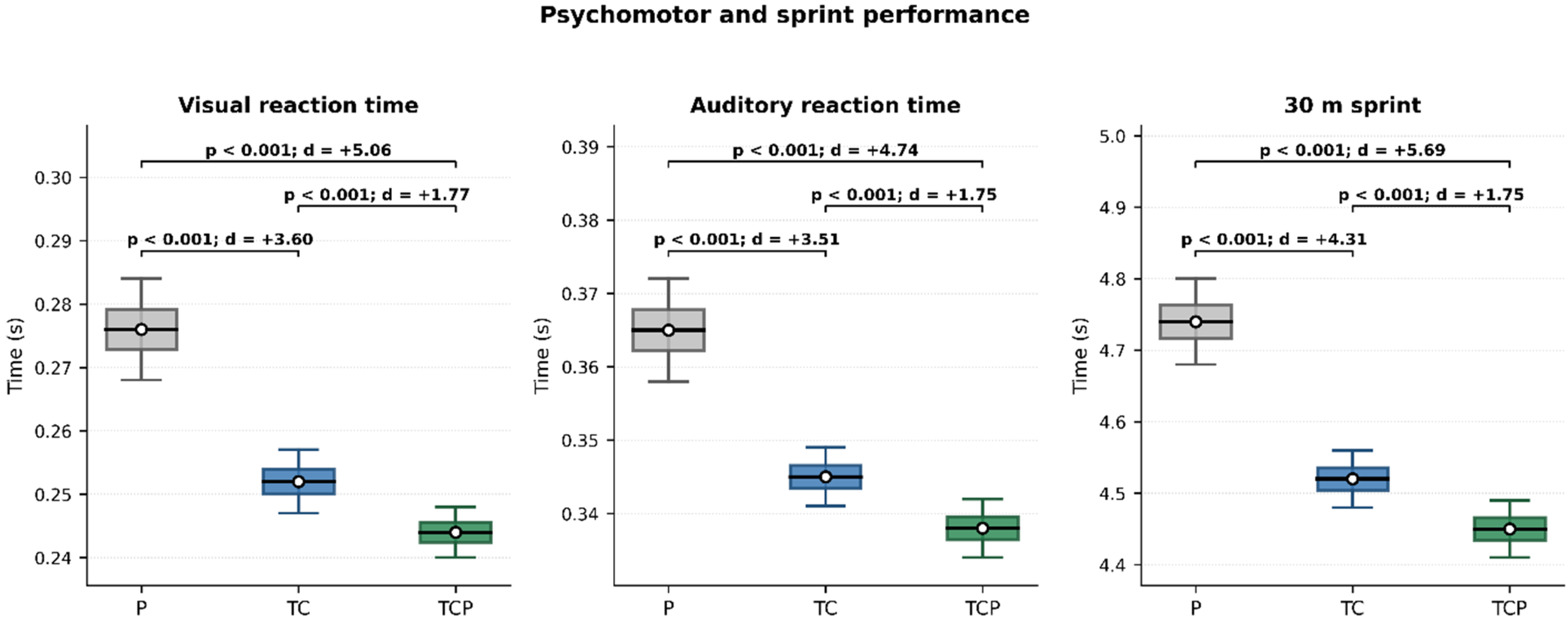
3.1. Psychomotor and Sprint Performance
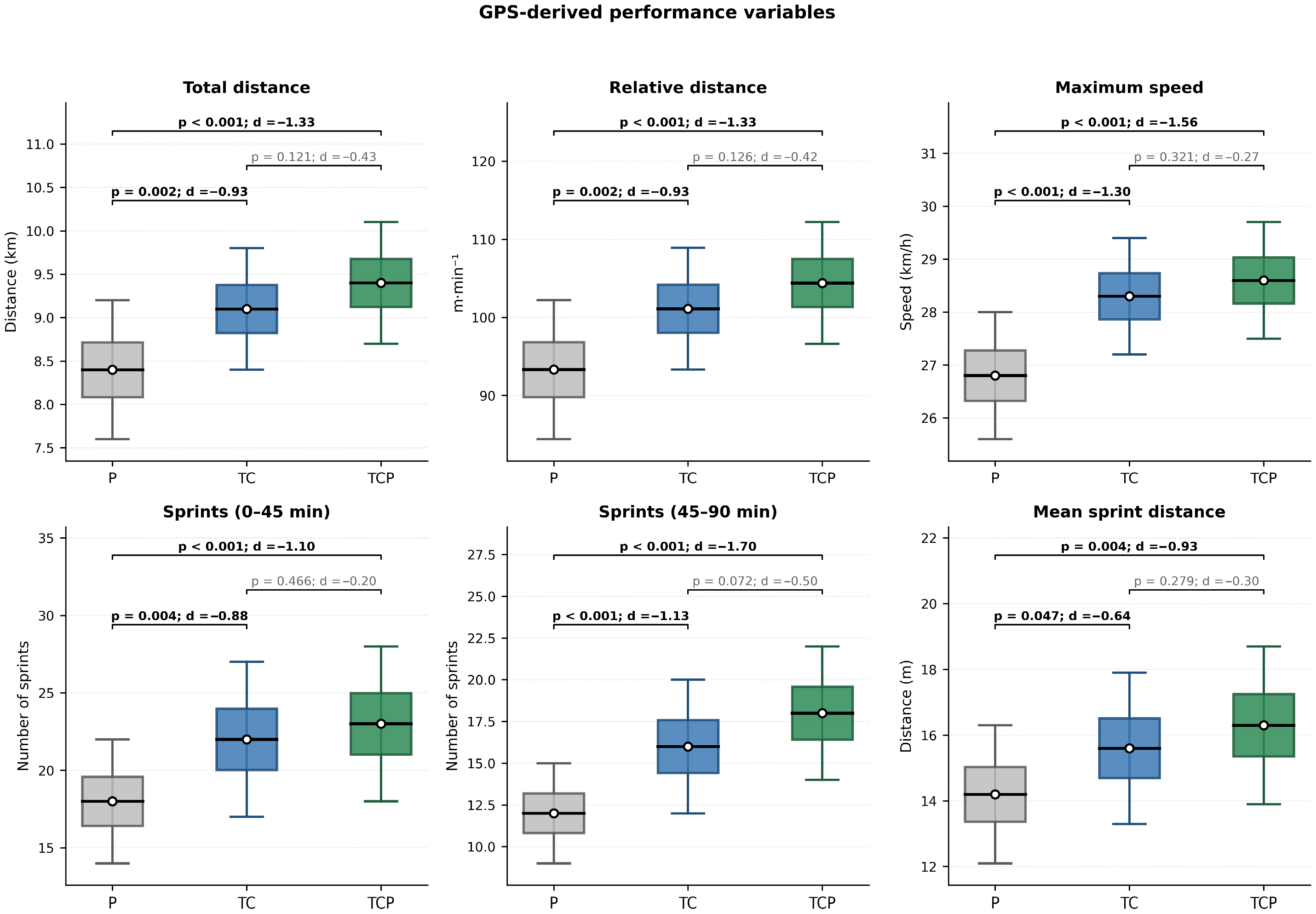
3.2. GPS-Derived Performance Variables
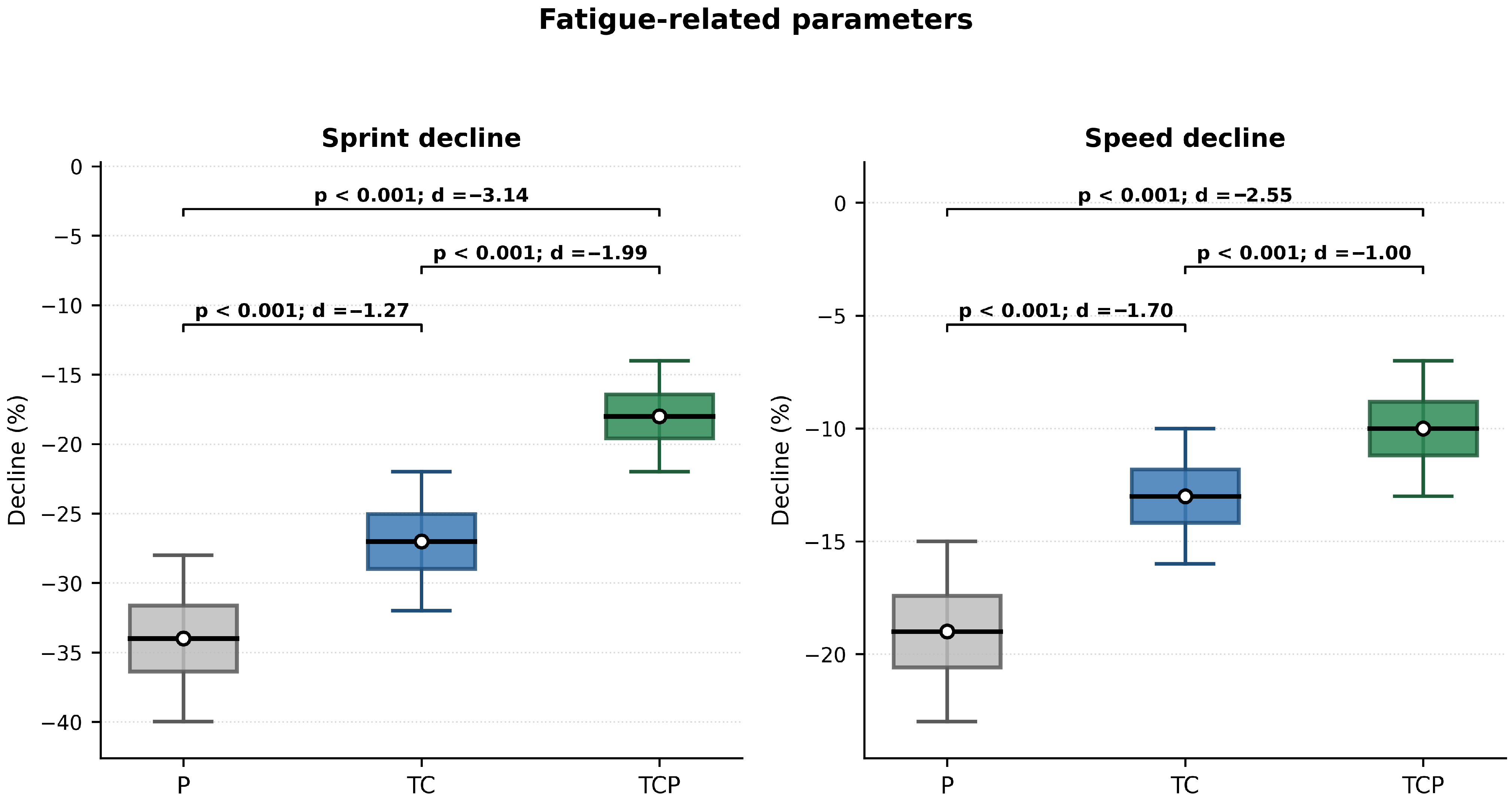
3.3. Fatigue-Related Parameters
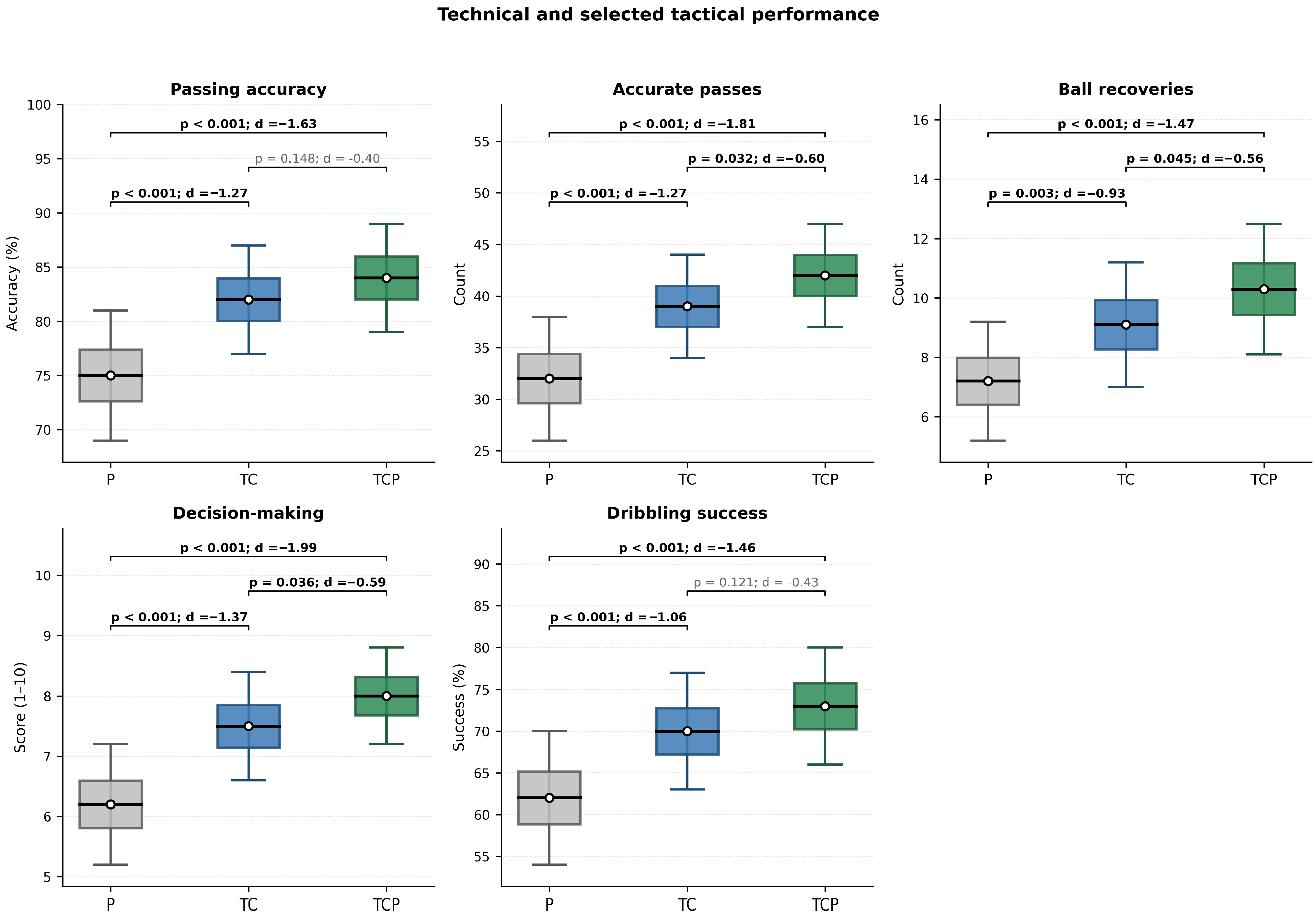
3.4. Technical and Tactical Performance
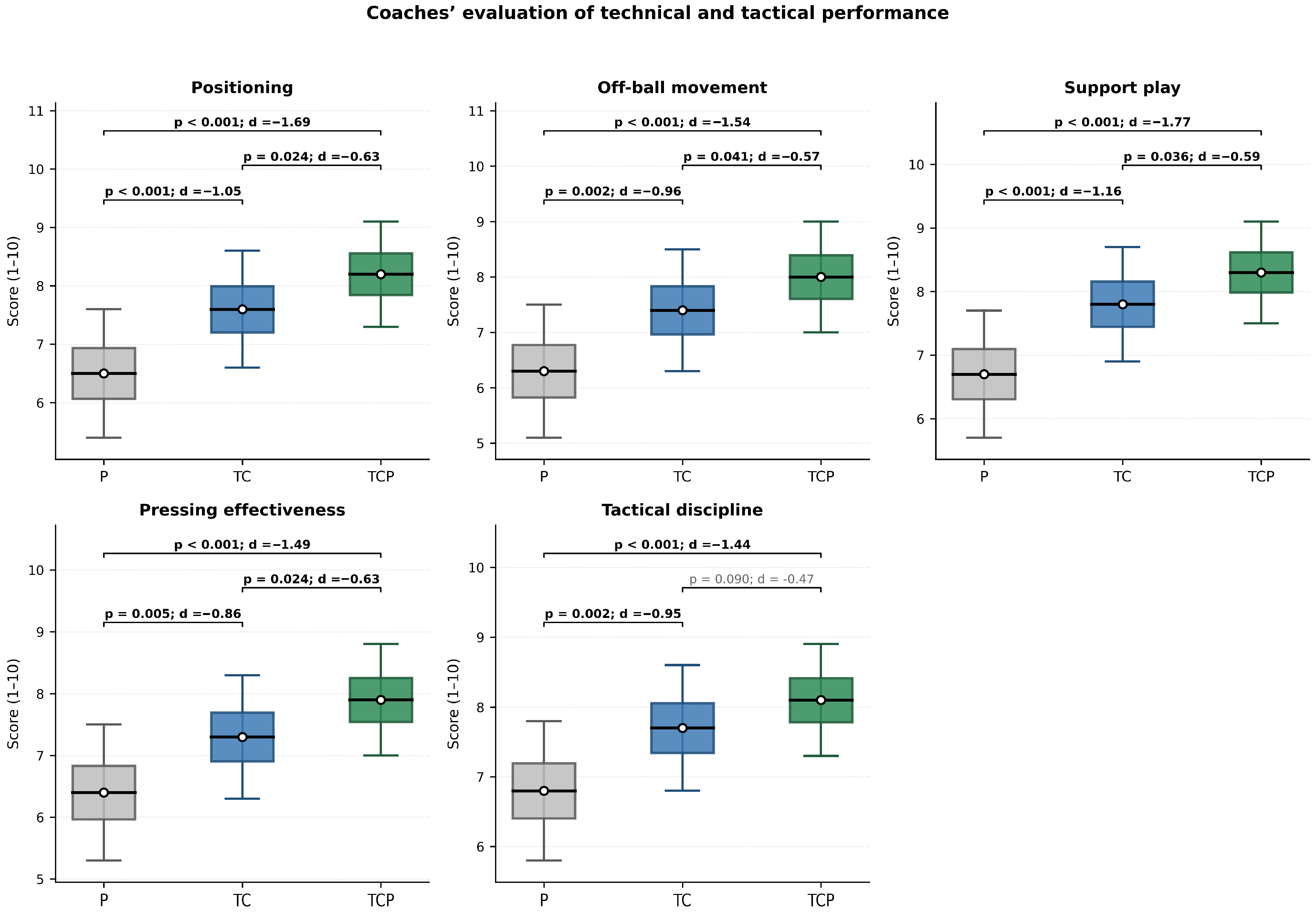
3.5. Technical and Tactical Performance (Coaches’ Evaluation)
3.6. Summary of Results
4. Discussion
4.1. Potential Combined Effects of the Supplement Components
4.2. Cognitive and Technical Performance
4.3. Central Fatigue and Maintaining Intensity in the Second Half
4.4. Validity of Coaching Assessments
4.5. Limitations and Future Research Directions
5. Conclusions
Author Contributions
Funding
Institutional Review Board Statement
Informed Consent Statement
Data Availability Statement
Conflicts of Interest
References
- Mizera, K.; Kłosek, M.; Kęska, A.; Pilis, W. The Influence of Caffeine and Guarana on Dehydration of Young Soccer Players and Physiological Aspects of Dehydration of the Athlete’s Body. Pol. J. Sport Tour. 2023, 30, 17–21. [Google Scholar] [CrossRef]
- Calvo, J.L.; Ramos-Campo, D.J.; Avila-Gandia, V.; Perez-Piñero, S.; Rubio-Arias, J.A. Caffeine and Cognitive Functions in Sports: A Systematic Review and Meta-Analysis. Nutrients 2021, 13, 868. [Google Scholar] [CrossRef]
- Kennedy, D.O. Mental Performance and Sport: Caffeine and Co-Consumed Bioactive Ingredients. Sports Med. 2022, 52, 69–90. [Google Scholar] [CrossRef]
- Irwin, C.; McCartney, D.; Desbrow, B. Effects of Acute Caffeine Consumption Following Sleep Loss on Cognitive Performance and Mood State: A Systematic Review and Meta-Analysis. Neurosci. Biobehav. Rev. 2020, 108, 877–888. [Google Scholar] [CrossRef] [PubMed]
- Deng, H.; Wang, L.; Liu, P.; Bin Naharudin, M.N.; Fan, X. Effects of Caffeine and Taurine on Physical and Cognitive Performance: A Systematic Review and Network Meta-Analysis. J. Int. Soc. Sports Nutr. 2025, 22, 2566371. [Google Scholar] [CrossRef] [PubMed]
- Kingsley, M.; Miller, M.; Kilduff, L.P.; McEneny, J.; Benton, D. Effects of Phosphatidylserine Supplementation on Exercise Capacity during Cycling in Active Males. Med. Sci. Sports Exerc. 2006, 38, 64–71. [Google Scholar] [CrossRef] [PubMed]
- Glade, M.J.; Smith, K. Phosphatidylserine and the Human Brain. Nutrition 2015, 31, 781–786. [Google Scholar] [CrossRef]
- De Nys, L.; Anderson, K.; Ofosu, E.F.; Ryde, G.C.; Connelly, J.; Whittaker, A.C. The Effects of Physical Activity on Cortisol and Sleep: A Systematic Review and Meta-Analysis. Psychoneuroendocrinology 2022, 143, 105843. [Google Scholar] [CrossRef]
- Guest, N.S.; VanDusseldorp, T.A.; Nelson, M.T.; Grgic, J.; Schoenfeld, B.J.; Jenkins, N.D.; Arent, S.M.; Antonio, J.; Stout, J.R.; Trexler, E.T.; et al. International society of sports nutrition position stand: Caffeine and exercise performance. J. Int. Soc. Sports Nutr. 2021, 18, 1. [Google Scholar] [CrossRef]
- Wang, Z.; Qiu, B.; Gao, J.; Del Coso, J. Effects of Caffeine Intake on Endurance Running Performance and Time to Exhaustion: A Systematic Review and Meta-Analysis. Nutrients 2022, 15, 148. [Google Scholar] [CrossRef]
- Merckx, C.; De Paepe, B. The Role of Taurine in Skeletal Muscle Functioning and Its Potential as a Supportive Treatment for Duchenne Muscular Dystrophy. Metabolites 2022, 12, 193. [Google Scholar] [CrossRef]
- Ozan, M.; Buzdagli, Y.; Eyipinar, C.D.; Baygutalp, N.K.; Yüce, N.; Oget, F.; Kan, E.; Baygutalp, F. Does Single or Combined Caffeine and Taurine Supplementation Improve Athletic and Cognitive Performance without Affecting Fatigue Level in Elite Boxers? A Double-Blind, Placebo-Controlled Study. Nutrients 2022, 14, 4399. [Google Scholar] [CrossRef] [PubMed]
- Yildirim, U.C.; Akcay, N.; Alexe, D.I.; Esen, O.; Gulu, M.; Cîrtiţă-Buzoianu, C.; Cinarli, F.S.; Cojocaru, M.; Sari, C.; Alexe, C.I.; et al. Acute Effect of Different Doses of Caffeinated Chewing Gum on Exercise Performance in Caffeine-Habituated Male Soccer Players. Front. Nutr. 2023, 10, 1251740. [Google Scholar] [CrossRef]
- Lovallo, W.R.; Farag, N.H.; Vincent, A.S.; Thomas, T.L.; Wilson, M.F. Cortisol responses to mental stress, exercise, and meals following caffeine intake in men and women. Pharmacol. Biochem. Behav. 2006, 83, 441–447. [Google Scholar] [CrossRef]
- Nogueira-de-Almeida, C.A.; Zotarelli-Filho, I.J.; Nogueira-de-Almeida, M.E. Neuronutrients and central nervous system: A systematic review. Cent. Nerv. Syst. Agents Med. Chem. 2023, 23, 1–12. [Google Scholar] [CrossRef] [PubMed]
- Starks, M.A.; Starks, S.L.; Kingsley, M.; Purpura, M.; Jäger, R. The effects of phosphatidylserine on endocrine response to moderate intensity exercise. J. Int. Soc. Sports Nutr. 2008, 5, 11. [Google Scholar] [CrossRef] [PubMed]
- Giesbrecht, T.; Rycroft, J.A.; Rowson, M.J.; De Bruin, E.A. The combination of L-theanine and caffeine improves cognitive performance and increases subjective alertness. Nutr. Neurosci. 2010, 13, 283–290. [Google Scholar] [CrossRef]
- Chen, J.; Li, J.; Xu, H.; Li, J.; Yuan, Y.; Xu, X.; Bi, Y. Phosphatidylserine: An overview on functionality, processing techniques, patents, and prospects. Grain Oil Sci. Technol. 2023, 6, 206–218. [Google Scholar] [CrossRef]
- Welch, J.; Bashir, H.; Daniels, S. The Effect of Phosphatidylserine Supplementation on Athletic Performance: A Systematic Review of Randomized Clinical Trials. J. Sports Sci. Nutr. 2023, 4, 170–175. [Google Scholar] [CrossRef]
- Vestberg, T.; Gustafson, R.; Maurex, L.; Ingvar, M.; Petrovic, P. Executive functions predict the success of top-soccer players. PLoS ONE 2012, 7, e34731. [Google Scholar] [CrossRef]
- Kim, H.Y.; Huang, B.X.; Spector, A.A. Phosphatidylserine in the brain: Metabolism and function. Prog. Lipid Res. 2014, 56, 1–18. [Google Scholar] [CrossRef] [PubMed]
- Foskett, A.; Ali, A.; Gant, N. Caffeine enhances cognitive function and skill performance during simulated soccer activity. Int. J. Sport Nutr. Exerc. Metab. 2009, 19, 410–423. [Google Scholar] [CrossRef]
- Ferreira, R.E.S.; Pacheco, R.L.; de Oliveira Cruz Latorraca, C.; Riera, R.; Eid, R.G.; Martimbianco, A.L.C. Effects of Caffeine Supplementation on Physical Performance of Soccer Players: Systematic Review and Meta-Analysis. Sports Health 2021, 13, 347–358. [Google Scholar] [CrossRef]
- Jin, P.; Zhao, Z.Q.; Zhu, X.F. The relationship between sport types, sex and visual attention as assessed in a multiple object tracking task. Front. Psychol. 2023, 14, 1099254. [Google Scholar] [CrossRef]
- Mohr, M.; Krustrup, P.; Bangsbo, J. Match performance of high-standard soccer players with special reference to development of fatigue. J. Sports Sci. 2003, 21, 519–528. [Google Scholar] [CrossRef] [PubMed]
- Dias da Silva, R.A.; Idelfonso, R.O.; Couto, B.P.; Drummond, M.D.M. Caffeine supplementation does not increase performance on professional soccer official matches. Rev. Bras. Cienc. Esporte 2024, 46, e20240011. [Google Scholar] [CrossRef]
- Salinero, J.J.; Lara, B.; Del Coso, J. Effects of acute ingestion of caffeine on team sports performance: A systematic review and meta-analysis. Res. Sports Med. 2019, 27, 238–256. [Google Scholar] [CrossRef]
- De Carvalho, F.G.; Galan, B.S.M.; Santos, P.C.; Pritchett, K.; Pfrimer, K.; Ferriolli, E.; Papoti, M.; Marchini, J.S.; de Freitas, E.C. Taurine: A Potential Ergogenic Aid for Preventing Muscle Damage and Protein Catabolism and Decreasing Oxidative Stress Produced by Endurance Exercise. Front. Physiol. 2017, 8, 710. [Google Scholar] [CrossRef]
- Meeusen, R.; Watson, P.; Hasegawa, H.; Roelands, B.; Piacentini, M.F. Central fatigue: The serotonin hypothesis and beyond. Sports Med. 2006, 36, 881–909. [Google Scholar] [CrossRef]
- Liu, J.; Rong, W. Effects of Taurine Combined with Caffeine on Repetitive Sprint Exercise Performance and Cognition in a Hypoxic Environment. Sci. Rep. 2025, 15, 5386. [Google Scholar] [CrossRef]
- Feng, L.; Du, W.; Wang, X.; Cao, H.; Ji, Z.; Li, F.; Cao, J.; Zhou, Z. Acute Caffeine Ingestion Improves Sport-Specific and Cognitive Performance in Elite Badminton Athletes. Front. Nutr. 2025, 12, 1673882. [Google Scholar] [CrossRef]
- Mor, H.; Mor, A.; Abdioğlu, M.; Tohănean, D.I.; Savu, C.V.; Acar, G.C.; Moraru, C.E.; Alexe, D.I. The Acute Effects of Caffeine Supplementation on Anaerobic Performance and Functional Strength in Female Soccer Players. Nutrients 2025, 17, 2156. [Google Scholar] [CrossRef]
- Pan, P.; Li, F.; Han, B.; Yuan, B.; Liu, T. Exploring the impact of professional soccer substitute players on physical and technical performance. BMC Sports Sci. Med. Rehabil. 2023, 15, 143. [Google Scholar] [CrossRef]
- Bangsbo, J.; Mohr, M.; Krustrup, P. Physical and metabolic demands of training and match-play in the elite football player. J. Sports Sci. 2006, 24, 665–674. [Google Scholar] [CrossRef]
- Raglin, J.; Szabo, A.; Lindheimer, J.B.; Beedie, C. Understanding placebo and nocebo effects in the context of sport: A psychological perspective. Eur. J. Sport Sci. 2020, 20, 293–301. [Google Scholar] [CrossRef] [PubMed]
- Torres-Ronda, L.; Beanland, E.; Whitehead, S.; Sweeting, A.; Clubb, J. Tracking systems in team sports: A narrative review of applications of the data and sport specific analysis. Sports Med. Open 2022, 8, 15. [Google Scholar] [CrossRef]




| (a) | |||||
| Parameter | P (n = 27) M ± SD [95% CI] | TC (n = 27) M ± SD [95% CI] | TCP (n = 27) M ± SD [95% CI] | p (ANOVA) | η2 |
| Visual reaction time (s) | 0.276 ± 0.008 [0.273, 0.279] | 0.252 ± 0.005 [0.250, 0.254] | 0.244 ± 0.004 [0.242, 0.246] | <0.001 | 0.34 |
| Auditory reaction time (s) | 0.365 ± 0.007 [0.362, 0.368] | 0.345 ± 0.004 [0.343, 0.347] | 0.338 ± 0.004 [0.336, 0.340] | <0.001 | 0.29 |
| 30 m sprint (s) | 4.74 ± 0.06 [4.72, 4.76] | 4.52 ± 0.04 [4.50, 4.54] | 4.45 ± 0.04 [4.43, 4.47] | <0.001 | 0.36 |
| (b) | |||||
| Parameter | Comparison | Mean Diff. [95% CI] | Cohen’s d (Mag.) | p (Holm–Bonferroni) | |
| Visual reaction time (s) | P vs. TC | +0.024 [0.020, 0.028] | +3.60 (huge) | <0.001 * | |
| P vs. TCP | +0.032 [0.029, 0.035] | +5.06 (huge) | <0.001 * | ||
| TC vs. TCP | +0.008 [0.006, 0.010] | +1.77 (v.large) | <0.001 * | ||
| Auditory reaction time (s) | P vs. TC | +0.020 [0.017, 0.023] | +3.51 (huge) | <0.001 * | |
| P vs. TCP | +0.027 [0.024, 0.030] | +4.74 (huge) | <0.001 * | ||
| TC vs. TCP | +0.007 [0.005, 0.009] | +1.75 (v.large) | <0.001 * | ||
| 30 m sprint (s) | P vs. TC | +0.22 [0.19, 0.25] | +4.31 (huge) | <0.001 * | |
| P vs. TCP | +0.29 [0.26, 0.32] | +5.69 (huge) | <0.001 * | ||
| TC vs. TCP | +0.07 [0.05, 0.09] | +1.75 (v.large) | <0.001 * | ||
| (a) | |||||
| Parameter | P (n = 27) M ± SD [95% CI] | TC (n = 27) M ± SD [95% CI] | TCP (n = 27) M ± SD [95% CI] | p (ANOVA) | η2 |
| Total distance (km) | 8.40 ± 0.80 [8.08, 8.72] | 9.10 ± 0.70 [8.82, 9.38] | 9.40 ± 0.70 [9.12, 9.68] | <0.01 | 0.18 |
| Distance (m·min−1) | 93.3 ± 8.9 [89.8, 96.8] | 101.1 ± 7.8 [98.0, 104.2] | 104.4 ± 7.8 [101.3, 107.5] | <0.01 | 0.20 |
| Sprints (0–45 min) | 18.0 ± 4.0 [16.4, 19.6] | 22.0 ± 5.0 [20.0, 24.0] | 23.0 ± 5.0 [21.0, 25.0] | <0.05 | 0.14 |
| Sprints (45–90 min) | 12.0 ± 3.0 [10.8, 13.2] | 16.0 ± 4.0 [14.4, 17.6] | 18.0 ± 4.0 [16.4, 19.6] | <0.01 | 0.19 |
| Max speed (km/h) | 26.8 ± 1.2 [26.3, 27.3] | 28.3 ± 1.1 [27.9, 28.7] | 28.6 ± 1.1 [28.2, 29.0] | <0.01 | 0.17 |
| Mean sprint distance (m) | 14.2 ± 2.1 [13.4, 15.0] | 15.6 ± 2.3 [14.7, 16.5] | 16.3 ± 2.4 [15.4, 17.2] | <0.05 | 0.13 |
| (b) | |||||
| Parameter | Comparison | Mean Diff. [95% CI] | Cohen’s d (Mag.) | p (Holm–Bonferroni) | |
| Total distance (km) | P vs. TC | −0.70 [−1.11, −0.29] | −0.93 (large) | 0.002 * | |
| P vs. TCP | −1.00 [−1.41, −0.59] | −1.33 (v.large) | <0.001 * | ||
| TC vs. TCP | −0.30 [−0.68, 0.08] | −0.43 (small) | 0.121 | ||
| Distance (m·min−1) | P vs. TC | −7.8 [−12.4, −3.2] | −0.93 (large) | 0.002 * | |
| P vs. TCP | −11.1 [−15.7, −6.5] | −1.33 (v.large) | <0.001 * | ||
| TC vs. TCP | −3.3 [−7.6, 1.0] | −0.42 (small) | 0.126 | ||
| Sprints (0–45 min) | P vs. TC | −4.0 [−6.5, −1.5] | −0.88 (large) | 0.004 * | |
| P vs. TCP | −5.0 [−7.5, −2.5] | −1.10 (large) | <0.001 * | ||
| TC vs. TCP | −1.0 [−3.7, 1.7] | −0.20 (small) | 0.466 | ||
| Sprints (45–90 min) | P vs. TC | −4.0 [−5.9, −2.1] | −1.13 (large) | <0.001 * | |
| P vs. TCP | −6.0 [−7.9, −4.1] | −1.70 (v.large) | <0.001 * | ||
| TC vs. TCP | −2.0 [−4.2, 0.2] | −0.50 (med.) | 0.072 | ||
| Max speed (km/h) | P vs. TC | −1.5 [−2.1, −0.9] | −1.30 (v.large) | <0.001 * | |
| P vs. TCP | −1.8 [−2.4, −1.2] | −1.56 (v.large) | <0.001 * | ||
| TC vs. TCP | −0.3 [−0.9, 0.3] | −0.27 (small) | 0.321 | ||
| Mean sprint distance (m) | P vs. TC | −1.4 [−2.6, −0.2] | −0.64 (med.) | 0.047 * | |
| P vs. TCP | −2.1 [−3.3, −0.9] | −0.93 (large) | 0.004 * | ||
| TC vs. TCP | −0.7 [−2.0, 0.6] | −0.30 (small) | 0.279 | ||
| (a) | |||||
| Parameter | P (n = 27) M ± SD [95% CI] | TC (n = 27) M ± SD [95% CI] | TCP (n = 27) M ± SD [95% CI] | p (ANOVA) | η2 |
| Sprint decline (%) | −34.0 ± 6.0 [−36.4, −31.6] | −27.0 ± 5.0 [−29.0, −25.0] | −18.0 ± 4.0 [−19.6, −16.4] | <0.001 | 0.22 |
| Speed decline (%) | −19.0 ± 4.0 [−20.6, −17.4] | −13.0 ± 3.0 [−14.2, −11.8] | −10.0 ± 3.0 [−11.2, −8.8] | <0.001 | 0.18 |
| (b) | |||||
| Parameter | Comparison | Mean Diff. [95% CI] | Cohen’s d (Mag.) | p (Holm–Bonferroni) | |
| Sprint decline (%) | P vs. TC | −7.0 [−10.0, −4.0] | −1.27 (v.large) | <0.001 * | |
| P vs. TCP | −16.0 [−18.8, −13.2] | −3.14 (huge) | <0.001 * | ||
| TC vs. TCP | −9.0 [−11.5, −6.5] | −1.99 (v.large) | <0.001 * | ||
| Speed decline (%) | P vs. TC | −6.0 [−7.9, −4.1] | −1.70 (v.large) | <0.001 * | |
| P vs. TCP | −9.0 [−10.9, −7.1] | −2.55 (huge) | <0.001 * | ||
| TC vs. TCP | −3.0 [−4.6, −1.4] | −1.00 (large) | <0.001 * | ||
| (a) | |||||
| Parameter | P (n = 27) M ± SD [95% CI] | TC (n = 27) M ± SD [95% CI] | TCP (n = 27) M ± SD [95% CI] | p (ANOVA) | η2 |
| Passing accuracy (%) | 75.0 ± 6.0 [72.6, 77.4] | 82.0 ± 5.0 [80.0, 84.0] | 84.0 ± 5.0 [82.0, 86.0] | <0.001 | 0.24 |
| Accurate passes (n) | 32.0 ± 6.0 [29.6, 34.4] | 39.0 ± 5.0 [37.0, 41.0] | 42.0 ± 5.0 [40.0, 44.0] | <0.001 | 0.21 |
| Ball recoveries (n) | 7.20 ± 2.00 [6.41, 7.99] | 9.10 ± 2.10 [8.27, 9.93] | 10.30 ± 2.20 [9.43, 11.17] | <0.01 | 0.17 |
| Decision-making (1–10) | 6.20 ± 1.00 [5.80, 6.60] | 7.50 ± 0.90 [7.14, 7.86] | 8.00 ± 0.80 [7.68, 8.32] | <0.001 | 0.26 |
| Dribbling success (%) | 62.0 ± 8.0 [58.8, 65.2] | 70.0 ± 7.0 [67.2, 72.8] | 73.0 ± 7.0 [70.2, 75.8] | <0.001 | 0.22 |
| (b) | |||||
| Parameter | Comparison | Mean Diff. [95% CI] | Cohen’s d (Mag.) | p (Holm–Bonferroni) | |
| Passing accuracy (%) | P vs. TC | −7.0 [−10.0, −4.0] | −1.27 (v.large) | <0.001 * | |
| P vs. TCP | −9.0 [−12.0, −6.0] | −1.63 (v.large) | <0.001 * | ||
| TC vs. TCP | −2.0 [−4.7, 0.7] | −0.40 (small) | 0.148 | ||
| Accurate passes (n) | P vs. TC | −7.0 [−10.0, −4.0] | −1.27 (v.large) | <0.001 * | |
| P vs. TCP | −10.0 [−13.0, −7.0] | −1.81 (v.large) | <0.001 * | ||
| TC vs. TCP | −3.0 [−5.7, −0.3] | −0.60 (med.) | 0.032 * | ||
| Ball recoveries (n) | P vs. TC | −1.90 [−3.02, −0.78] | −0.93 (large) | 0.003 * | |
| P vs. TCP | −3.10 [−4.25, −1.95] | −1.47 (v.large) | <0.001 * | ||
| TC vs. TCP | −1.20 [−2.37, −0.03] | −0.56 (med.) | 0.045 * | ||
| Decision-making (1–10) | P vs. TC | −1.30 [−1.82, −0.78] | −1.37 (v.large) | <0.001 * | |
| P vs. TCP | −1.80 [−2.29, −1.31] | −1.99 (v.large) | <0.001 * | ||
| TC vs. TCP | −0.50 [−0.97, −0.03] | −0.59 (med.) | 0.036 * | ||
| Dribbling success (%) | P vs. TC | −8.0 [−12.1, −3.9] | −1.06 (large) | <0.001 * | |
| P vs. TCP | −11.0 [−15.1, −6.9] | −1.46 (v.large) | <0.001 * | ||
| TC vs. TCP | −3.0 [−6.8, 0.8] | −0.43 (small) | 0.121 | ||
| (a) | |||||
| Parameter | P (n = 27) M ± SD [95% CI] | TC (n = 27) M ± SD [95% CI] | TCP (n = 27) M ± SD [95% CI] | p (ANOVA) | η2 |
| Positioning (1–10) | 6.50 ± 1.10 [6.06, 6.94] | 7.60 ± 1.00 [7.20, 8.00] | 8.20 ± 0.90 [7.84, 8.56] | <0.001 | 0.25 |
| Off-ball movement (1–10) | 6.30 ± 1.20 [5.83, 6.77] | 7.40 ± 1.10 [6.96, 7.84] | 8.00 ± 1.00 [7.60, 8.40] | <0.001 | 0.23 |
| Support play (1–10) | 6.70 ± 1.00 [6.30, 7.10] | 7.80 ± 0.90 [7.44, 8.16] | 8.30 ± 0.80 [7.98, 8.62] | <0.001 | 0.24 |
| Pressing effectiveness (1–10) | 6.40 ± 1.10 [5.96, 6.84] | 7.30 ± 1.00 [6.90, 7.70] | 7.90 ± 0.90 [7.54, 8.26] | <0.01 | 0.19 |
| Tactical discipline (1–10) | 6.80 ± 1.00 [6.40, 7.20] | 7.70 ± 0.90 [7.34, 8.06] | 8.10 ± 0.80 [7.78, 8.42] | <0.001 | 0.22 |
| (b) | |||||
| Parameter | Comparison | Mean Diff. [95% CI] | Cohen’s d (Mag.) | p (Holm–Bonferroni) | |
| Positioning (1–10) | P vs. TC | −1.10 [−1.67, −0.53] | −1.05 (large) | <0.001 * | |
| P vs. TCP | −1.70 [−2.25, −1.15] | −1.69 (v.large) | <0.001 * | ||
| TC vs. TCP | −0.60 [−1.12, −0.08] | −0.63 (med.) | 0.024 * | ||
| Off-ball movement (1–10) | P vs. TC | −1.10 [−1.73, −0.47] | −0.96 (large) | 0.002 * | |
| P vs. TCP | −1.70 [−2.30, −1.10] | −1.54 (v.large) | <0.001 * | ||
| TC vs. TCP | −0.60 [−1.17, −0.03] | −0.57 (med.) | 0.041 * | ||
| Support play (1–10) | P vs. TC | −1.10 [−1.62, −0.58] | −1.16 (large) | <0.001 * | |
| P vs. TCP | −1.60 [−2.09, −1.11] | −1.77 (v.large) | <0.001 * | ||
| TC vs. TCP | −0.50 [−0.97, −0.03] | −0.59 (med.) | 0.036 * | ||
| Pressing effectiveness (1–10) | P vs. TC | −0.90 [−1.47, −0.33] | −0.86 (large) | 0.005 * | |
| P vs. TCP | −1.50 [−2.05, −0.95] | −1.49 (v.large) | <0.001 * | ||
| TC vs. TCP | −0.60 [−1.12, −0.08] | −0.63 (med.) | 0.024 * | ||
| Tactical discipline (1–10) | P vs. TC | −0.90 [−1.42, −0.38] | −0.95 (large) | 0.002 * | |
| P vs. TCP | −1.30 [−1.79, −0.81] | −1.44 (v.large) | <0.001 * | ||
| TC vs. TCP | −0.40 [−0.87, 0.07] | −0.47 (small) | 0.090 | ||
Disclaimer/Publisher’s Note: The statements, opinions and data contained in all publications are solely those of the individual author(s) and contributor(s) and not of MDPI and/or the editor(s). MDPI and/or the editor(s) disclaim responsibility for any injury to people or property resulting from any ideas, methods, instructions or products referred to in the content. |
© 2026 by the authors. Licensee MDPI, Basel, Switzerland. This article is an open access article distributed under the terms and conditions of the Creative Commons Attribution (CC BY) license.
Share and Cite
Mizera, K.; Mizgała-Izworska, E.; Mizera, J.; Mackiewicz, J. Effects of Taurine-, Caffeine-, and Phosphatidylserine-Containing Supplementation Protocols on Physical and Cognitive Performance in Professional Male Football Players. Nutrients 2026, 18, 1684. https://doi.org/10.3390/nu18111684
Mizera K, Mizgała-Izworska E, Mizera J, Mackiewicz J. Effects of Taurine-, Caffeine-, and Phosphatidylserine-Containing Supplementation Protocols on Physical and Cognitive Performance in Professional Male Football Players. Nutrients. 2026; 18(11):1684. https://doi.org/10.3390/nu18111684
Chicago/Turabian StyleMizera, Krzysztof, Elżbieta Mizgała-Izworska, Justyna Mizera, and Jan Mackiewicz. 2026. "Effects of Taurine-, Caffeine-, and Phosphatidylserine-Containing Supplementation Protocols on Physical and Cognitive Performance in Professional Male Football Players" Nutrients 18, no. 11: 1684. https://doi.org/10.3390/nu18111684
APA StyleMizera, K., Mizgała-Izworska, E., Mizera, J., & Mackiewicz, J. (2026). Effects of Taurine-, Caffeine-, and Phosphatidylserine-Containing Supplementation Protocols on Physical and Cognitive Performance in Professional Male Football Players. Nutrients, 18(11), 1684. https://doi.org/10.3390/nu18111684