Delphi Consensus on the Role of Venoactive Nutraceuticals in the Management of Chronic Venous Disease: A Position Statement of the Italian Society of Angiology and Vascular Medicine (SIAPAV)

 , and
, and
Abstract
1. Introduction
2. Materials and Methods
2.1. Study Design and Participants
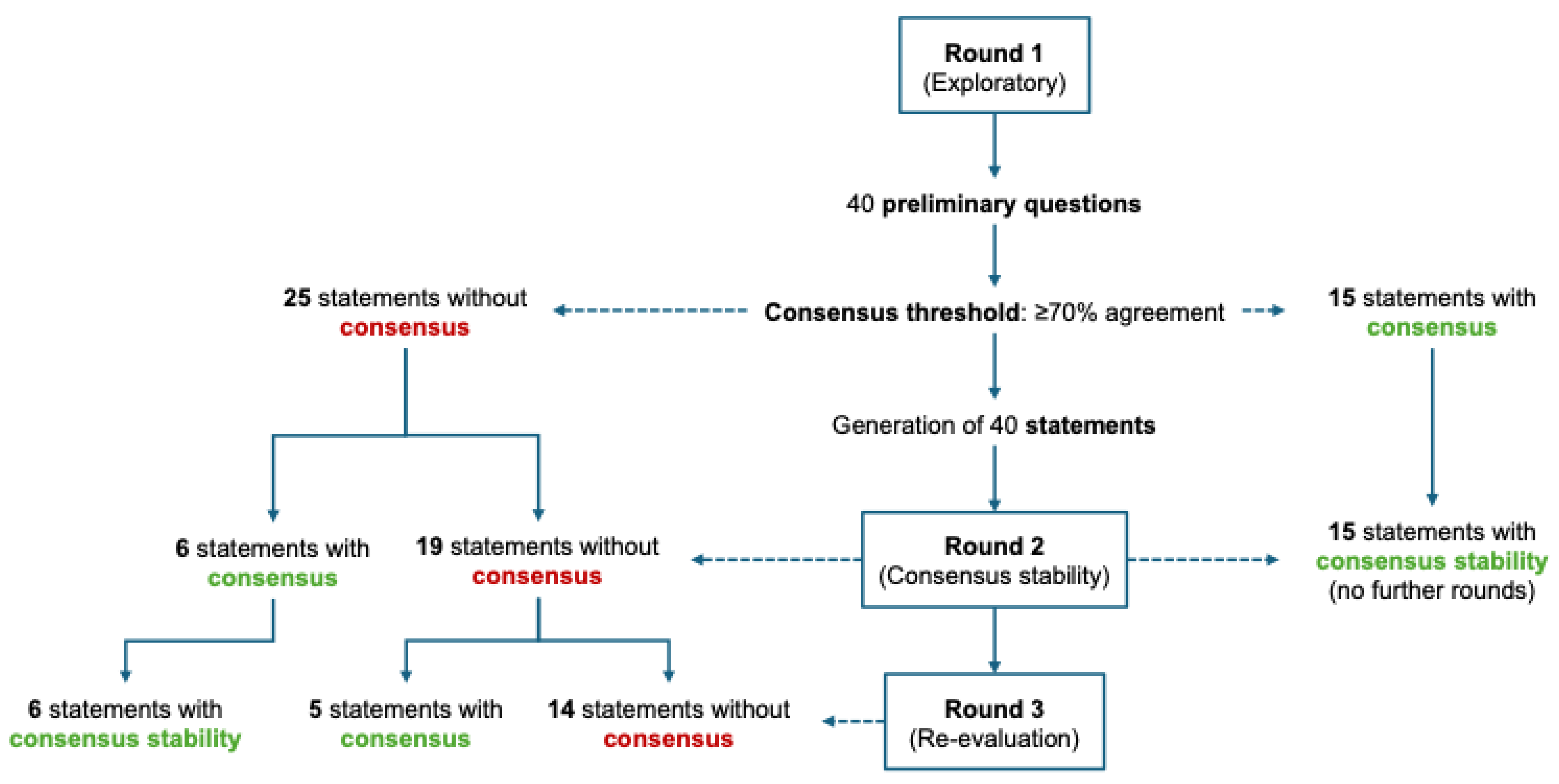
2.2. Delphi Procedure
2.3. Outcome Definitions
3. Results
3.1. Statements and Commentary
3.1.1. Classification and Assessment
3.1.2. Indications for Venoactive Nutraceuticals by CEAP Stage
3.1.3. Individual Agents
3.1.4. Combination Regimens
3.1.5. Topical Formulations
3.1.6. Statements Without Consensus
4. Discussion
5. Conclusions
Supplementary Materials
Author Contributions
Funding
Data Availability Statement
Acknowledgments
Conflicts of Interest
Abbreviations
| ACR | American College of Radiology |
| AVF | American Venous Forum |
| AVLS | American Vein and Lymphatic Society |
| CVD | Chronic Venous Disease |
| CVI | Chronic Venous Insufficiency |
| CEAP | Clinical, Etiological, Anatomical, and Pathophysiological classification |
| ESVS | European Society for Vascular Surgery |
| IUA | International Union of Angiology |
| MPFF | Micronized Purified Flavonoid Fraction |
| PROM | Patient-Reported Outcome Measure |
| QoL | Quality of Life |
| RCT | Randomized Controlled Trial |
| r-VCSS | Revised Venous Clinical Severity Score |
| SIAPAV | Società Italiana di Angiologia e Patologia Vascolare/Italian Society of Angiology and Vascular Medicine |
| SVS | Society for Vascular Surgery |
References
- Salim, S.; Machin, M.; Patterson, B.O.; Onida, S.; Davies, A.H. Global Epidemiology of Chronic Venous Disease: A Systematic Review With Pooled Prevalence Analysis. Ann. Surg. 2021, 274, 971–976. [Google Scholar] [CrossRef]
- Lurie, F.; Passman, M.; Meisner, M.; Dalsing, M.; Masuda, E.; Welch, H.; Bush, R.L.; Blebea, J.; Carpentier, P.H.; De Maeseneer, M.; et al. The 2020 update of the CEAP classification system and reporting standards. J. Vasc. Surg. Venous Lymphat. Disord. 2020, 8, 342–352. [Google Scholar] [CrossRef]
- De Maeseneer, M.G.; Kakkos, S.K.; Aherne, T.; Baekgaard, N.; Black, S.; Blomgren, L.; Bradbury, A.; Bækgaard, N.; Becquemin, J.P.; Bounameaux, H.; et al. Editor's Choice—European Society for Vascular Surgery (ESVS) 2022 Clinical Practice Guidelines on the Management of Chronic Venous Disease of the Lower Limbs. Eur. J. Vasc. Endovasc. Surg. 2022, 63, 184–267. [Google Scholar]
- Gloviczki, P.; Lawrence, P.F.; Wasan, S.M.; Meissner, M.H.; Almeida, J.; Brown, K.R.; Min, R.; Eklöf, B.; Nicolaides, A.N.; van Rij, A.; et al. The 2023 Society for Vascular Surgery, American Venous Forum, and American Vein and Lymphatic Society clinical practice guidelines for the management of varicose veins of the lower extremities. Part II: Endorsed by the Society of Interventional Radiology and the Society for Vascular Medicine. J. Vasc. Surg. Venous Lymphat. Disord. 2024, 12, 101670. [Google Scholar] [PubMed]
- Nicolaides, A.; Kakkos, S.; Baekgaard, N.; Comerota, A.; de Maeseneer, M.; Eklof, B.; Giannoukas, A.D.; Lugli, M.; Maleti, O.; Myers, K.; et al. Management of chronic venous disorders of the lower limbs. Guidelines According to Scientific Evidence. Part, I. Int. Angiol. 2018, 37, 181–254. [Google Scholar] [CrossRef] [PubMed]
- Mansilha, A.; Gianesini, S.; Ulloa, J.H.; Lobastov, K.; Wang, J.; Freitag, A.; Schaible, K.R.; Martin, M.; Yaltirik, P.; Nicolaides, A.N. Pharmacological treatment for chronic venous disease: An umbrella review of systematic reviews. Int. Angiol. 2022, 41, 249–257. [Google Scholar] [CrossRef] [PubMed]
- Eklof, B.; Perrin, M.; Delis, K.T.; Rutherford, R.B.; Gloviczki, P. Updated terminology of chronic venous disorders: The VEIN-TERM transatlantic interdisciplinary consensus document. J. Vasc. Surg. 2009, 49, 498–501. [Google Scholar] [CrossRef]
- Rochon, P.J.; Reghunathan, A.; Kapoor, B.S.; Kalva, S.P.; Fidelman, N.; Majdalany, B.S.; Abujudeh, H.; Caplin, D.M.; Eldrup-Jørgensen, J.; Farsad, K.; et al. ACR Appropriateness Criteria(R) Lower Extremity Chronic Venous Disease. J. Am. Coll. Radiol. 2023, 20, S481–S500. [Google Scholar] [CrossRef]
- Jantet, G. Chronic venous insufficiency: Worldwide results of the RELIEF study. Reflux assEssment and quaLity of lIfe improvEment with micronized Flavonoids. Angiology 2002, 53, 245–256. [Google Scholar] [CrossRef]
- Kakkos, S.K.; Nicolaides, A.N. Efficacy of micronized purified flavonoid fraction (Daflon(R)) on improving individual symptoms, signs and quality of life in patients with chronic venous disease: A systematic review and meta-analysis of randomized double-blind placebo-controlled trials. Int. Angiol. 2018, 37, 143–154. [Google Scholar] [CrossRef]
- Cazaubon, M.; Benigni, J.P.; Steinbruch, M.; Jabbour, V.; Gouhier-Kodas, C. Is There a Difference in the Clinical Efficacy of Diosmin and Micronized Purified Flavonoid Fraction for the Treatment of Chronic Venous Disorders? Review of Available Evidence. Vasc. Health Risk Manag. 2021, 17, 591–600. [Google Scholar] [CrossRef]
- Steinbruch, M.; Nunes, C.; Gama, R.; Kaufman, R.; Gama, G.; Suchmacher Neto, M.; Nigri, R.; Cytrynbaum, N.; Brauer Oliveira, L.; Bertaina, I.; et al. Is Nonmicronized Diosmin 600 mg as Effective as Micronized Diosmin 900 mg plus Hesperidin 100 mg on Chronic Venous Disease Symptoms? Results of a Noninferiority Study. Int. J. Vasc. Med. 2020, 2020, 4237204. [Google Scholar] [CrossRef] [PubMed]
- Buso, G.; Santini, P.; Ghirardini, F.; Cannavacciuolo, F.; Visona, A.; Zalunardo, B.; Pola, R.; Martini, R. The role of Bromelain and Liposomal Vitamin C in the treatment of chronic venous disease. Vasa 2025, 54, 164–176. [Google Scholar] [CrossRef] [PubMed]
- Kalus, U.; Koscielny, J.; Grigorov, A.; Schaefer, E.; Peil, H.; Kiesewetter, H. Improvement of cutaneous microcirculation and oxygen supply in patients with chronic venous insufficiency by orally administered extract of red vine leaves AS 195: A randomised, double-blind, placebo-controlled, crossover study. Drugs R&D 2004, 5, 63–71. [Google Scholar]
- Rabe, E.; Stucker, M.; Esperester, A.; Schafer, E.; Ottillinger, B. Efficacy and tolerability of a red-vine-leaf extract in patients suffering from chronic venous insufficiency--results of a double-blind placebo-controlled study. Eur. J. Vasc. Endovasc. Surg. 2011, 41, 540–547. [Google Scholar] [CrossRef]
- Kim, S.M.; Joh, J.H.; Jung, I.M.; Kim, M.J.; Lee, S.S.; Hwang, H.P.; Kang, J.M.; Jung, H.J.; Yang, S.-S.; Min, S.K.; et al. Vitis Vinifera Seed Extract Versus Micronized Purified Flavonoid Fraction for Patients with Chronic Venous Disease: A Randomized Noninferiority Trial. Ann. Vasc. Surg. 2024, 109, 177–186. [Google Scholar] [CrossRef] [PubMed]
- Cataldi, A.; Gasbarro, V.; Viaggi, R.; Soverini, R.; Gresta, E.; Mascoli, F. Effectiveness of the combination of alpha tocopherol, rutin, melilotus, and centella asiatica in the treatment of patients with chronic venous insufficiency. Minerva Cardioangiol. 2001, 49, 159–163. [Google Scholar]
- Pittler, M.H.; Ernst, E. Horse chestnut seed extract for chronic venous insufficiency. Cochrane Database Syst. Rev. 2012, 11, CD003230. [Google Scholar] [CrossRef]
- Boisnic, S.; Branchet, M.C.; Gouhier-Kodas, C.; Verriere, F.; Jabbour, V. Anti-inflammatory and antiradical effects of a 2% diosmin cream in a human skin organ culture as model. J. Cosmet. Dermatol. 2018, 17, 848–854. [Google Scholar] [CrossRef]
- Berg, D. Venous constriction by local administration of ruscus extract. Fortschr. Med. 1990, 108, 473–476. [Google Scholar]
- De Sanctis, M.T.; Incandela, L.; Belcaro, G.; Cesarone, M.R. Topical treatment of venous microangiopathy in patients with venous ulceration with Essaven gel--a placebo-controlled, randomized study. Angiology 2001, 52 (Suppl. S3), S29–S34. [Google Scholar] [CrossRef]
- Diehm, C.; Trampisch, H.J.; Lange, S.; Schmidt, C. Comparison of leg compression stocking and oral horse-chestnut seed extract therapy in patients with chronic venous insufficiency. Lancet 1996, 347, 292–294. [Google Scholar] [CrossRef]
- Aziz, Z.; Tang, W.L.; Chong, N.J.; Tho, L.Y. A systematic review of the efficacy and tolerability of hydroxyethylrutosides for improvement of the signs and symptoms of chronic venous insufficiency. J. Clin. Pharm. Ther. 2015, 40, 177–185. [Google Scholar] [CrossRef]
- Petruzzellis, V.; Troccoli, T.; Candiani, C.; Guarisco, R.; Lospalluti, M.; Belcaro, G.; Dugall, M. Oxerutins (Venoruton): Efficacy in chronic venous insufficiency--a double-blind, randomized, controlled study. Angiology 2002, 53, 257–263. [Google Scholar] [CrossRef]
- Kiesewetter, H.; Koscielny, J.; Kalus, U.; Vix, J.M.; Peil, H.; Petrini, O.; van Toor, B.S.J.; de Mey, C. Efficacy of orally administered extract of red vine leaf AS 195 (folia vitis viniferae) in chronic venous insufficiency (stages I–II). A randomized, double-blind, placebo-controlled trial. Arzneimittelforschung 2000, 50, 109–117. [Google Scholar]
- Azhdari, M.; Zilaee, M.; Karandish, M.; Hosseini, S.A.; Mansoori, A.; Zendehdel, M.; Khodarahpour, S. Red vine leaf extract (AS 195) can improve some signs and symptoms of chronic venous insufficiency, a systematic review. Phytother. Res. 2020, 34, 2577–2585. [Google Scholar] [CrossRef] [PubMed]
- Romano, A.; Curcio, A.; Marchitto, N.; Paparello, P.; Pironti, M.; Raimondi, G. A topical combination of blackberry, Centella asiatica, sodium hyaluronate, vitamin E and Melilotus to relieve legs symptoms of venous insufficiency. Veins Lymphat. 2020, 9, 8465. [Google Scholar] [CrossRef]
- Fraga, L.N.; Milenkovic, D.; Lajolo, F.M.; Hassimotto, N.M.A. Association between Single Nucleotide Polymorphisms of SULT1A1, SULT1C4, ABCC2 and Phase II Flavanone Metabolites Excretion after Orange Juice Intake. Nutrients 2022, 14, 3770. [Google Scholar] [CrossRef] [PubMed]
- Miller, R.J.; Jackson, K.G.; Dadd, T.; Mayes, A.E.; Brown, A.L.; Lovegrove, J.A.; Minihane, A.M. The impact of the catechol-O-methyltransferase genotype on vascular function and blood pressure after acute green tea ingestion. Mol. Nutr. Food Res. 2012, 56, 966–975. [Google Scholar] [CrossRef]


| Domain | Statement | Agreement (%) | |||
|---|---|---|---|---|---|
| 1st Round (N = 21) | 2nd Round (N = 21) | 3rd Round (N = 19) | Consensus (≥70%) | ||
| Classification and assessment | Use of CEAP classification in routine CVD care | 81.0 | 90.5 | – | Yes |
| Adoption of 2020 revision of the CEAP classification | 76.2 | 81.0 | – | Yes | |
| Clinical distinction between CVD (C0–C2) from CVI (C3–C6) | 85.7 | 100.0 | – | Yes | |
| Classification of patients as symptomatic vs. asymptomatic | 76.2 | 81.0 | – | Yes | |
| Use of validated QoL questionnaires in routine practice | 14.3 | 52.4 | 47.4 | No | |
| Indications across CEAP classes | Use of venoactive nutraceuticals in C0 | 66.7 | 71.4 | 84.2 | Yes |
| Use of venoactive nutraceuticals in C1–C2 | 81.0 | 95.2 | – | Yes | |
| Use of venoactive nutraceuticals in C3–C6 | 90.5 | 90.5 | – | Yes | |
| Use of guideline-endorsed venoactives in symptomatic CVD | 85.7 | 90.5 | – | Yes | |
| Single-agent selection | MPFF to be used in CVD | 85.7 | 90.5 | – | Yes |
| MPFF considered effective in improving symptoms of CVD | 76.2 | 85.7 | – | Yes | |
| Diosmin to be used in CVD | 71.5 | 95.2 | – | Yes | |
| Diosmin considered effective in improving symptoms of CVD | 66.7 | 95.2 | 100.0 | Yes | |
| Ruscus extract to be used in CVD | 28.6 | 47.6 | 52.6 | No | |
| Ruscus extract considered effective in improving symptoms of CVD | 33.4 | 57.1 | 52.6 | No | |
| Horse chestnut extract to be used in CVD | 28.5 | 52.4 | 57.9 | No | |
| Horse chestnut extract considered effective in improving symptoms of CVD | 23.8 | 47.6 | 57.9 | No | |
| Hydroxyethylrutosides to be used in CVD | 14.3 | 42.9 | 61.1 | No | |
| Hydroxyethylrutosides considered effective in improving symptoms of CVD | 23.8 | 42.9 | 42.1 | No | |
| Red vine leaf extract to be used in CVD | 23.8 | 42.9 | 26.3 | No | |
| Red vine leaf extract considered effective in improving symptoms of CVD | 23.8 | 38.1 | 21.1 | No | |
| Hesperidin to be used in CVD | 66.7 | 85.7 | 89.5 | Yes | |
| Hesperidin considered effective in improving symptoms of CVD | 62.0 | 85.7 | 73.7 | Yes | |
| Anthocyanosides to be used in CVD | 28.6 | 38.1 | 63.2 | No | |
| Anthocyanosides considered effective in improving symptoms of CVD | 28.5 | 42.9 | 42.1 | No | |
| β-arbutin to be used in CVD | 0.0 | 23.8 | 26.3 | No | |
| β-arbutin considered effective in improving symptoms of CVD | 0.0 | 23.8 | 26.3 | No | |
| Guidelines to be updated to reflect the role of nutraceuticals in CVD treatment based on new evidence | 76.2 | 85.7 | – | Yes | |
| Combination regimens | Combination therapy to be used in symptomatic CVD | 76.1 | 100.0 | – | Yes |
| Combination therapy considered more effective than monotherapy | 90.5 | 100.0 | – | Yes | |
| Specific oral combination (diosmin + ruscus + melilotus + Vitis vinifera + horse chestnut extract) considered a reasonable first-line conservative option | 76.2 | 85.7 | – | Yes | |
| Topical agents | Use topical agents in C0 | 28.5 | 19.0 | 22.2 | No |
| Use topical agents in C1–C2 | 42.9 | 66.7 | 78.9 | Yes | |
| Use topical agents in C3–C6 | 66.6 | 81.0 | 84.2 | Yes | |
| Topicals agents should reduce edema and hematoma | 9.5 | 66.7 | 94.7 | Yes | |
| Topicals agents should reduce itching and burning | 19.0 | 57.1 | 84.2 | Yes | |
| Topicals agents should reduce heaviness | 33.3 | 71.4 | 84.2 | Yes | |
| Topical agents should improve skin changes | 0.0 | 61.9 | 73.7 | Yes | |
| Topicals agents should have all the above effects | 38.1 | 61.9 | 84.2 | Yes | |
| Specific topical combination (diosmin + ruscus + melilotus + Vitis vinifera + horse chestnut extract) considered a reasonable option | 90.5 | 90.5 | – | Yes | |
Disclaimer/Publisher’s Note: The statements, opinions and data contained in all publications are solely those of the individual author(s) and contributor(s) and not of MDPI and/or the editor(s). MDPI and/or the editor(s) disclaim responsibility for any injury to people or property resulting from any ideas, methods, instructions or products referred to in the content. |
© 2025 by the authors. Licensee MDPI, Basel, Switzerland. This article is an open access article distributed under the terms and conditions of the Creative Commons Attribution (CC BY) license (https://creativecommons.org/licenses/by/4.0/).
Share and Cite
Buso, G.; Santini, P.; Ghirardini, F.; Bigolin, P.; Martini, R.; on behalf of the SIAPAV Working Group on Venoactive Nutraceuticals. Delphi Consensus on the Role of Venoactive Nutraceuticals in the Management of Chronic Venous Disease: A Position Statement of the Italian Society of Angiology and Vascular Medicine (SIAPAV). Nutrients 2025, 17, 3830. https://doi.org/10.3390/nu17243830
Buso G, Santini P, Ghirardini F, Bigolin P, Martini R, on behalf of the SIAPAV Working Group on Venoactive Nutraceuticals. Delphi Consensus on the Role of Venoactive Nutraceuticals in the Management of Chronic Venous Disease: A Position Statement of the Italian Society of Angiology and Vascular Medicine (SIAPAV). Nutrients. 2025; 17(24):3830. https://doi.org/10.3390/nu17243830
Chicago/Turabian StyleBuso, Giacomo, Paolo Santini, Francesca Ghirardini, Paola Bigolin, Romeo Martini, and on behalf of the SIAPAV Working Group on Venoactive Nutraceuticals. 2025. "Delphi Consensus on the Role of Venoactive Nutraceuticals in the Management of Chronic Venous Disease: A Position Statement of the Italian Society of Angiology and Vascular Medicine (SIAPAV)" Nutrients 17, no. 24: 3830. https://doi.org/10.3390/nu17243830
APA StyleBuso, G., Santini, P., Ghirardini, F., Bigolin, P., Martini, R., & on behalf of the SIAPAV Working Group on Venoactive Nutraceuticals. (2025). Delphi Consensus on the Role of Venoactive Nutraceuticals in the Management of Chronic Venous Disease: A Position Statement of the Italian Society of Angiology and Vascular Medicine (SIAPAV). Nutrients, 17(24), 3830. https://doi.org/10.3390/nu17243830