Body Composition and Survival in Locally Advanced Rectal Cancer Patients Treated with Neoadjuvant Radiochemotherapy

 , ,
, ,
Abstract
1. Introduction
2. Materials and Methods
2.1. Study Design and Study Population
2.2. Methods
2.3. Statistical Analysis
3. Results
4. Discussion
5. Conclusions
Author Contributions
Funding
Institutional Review Board Statement
Informed Consent Statement
Data Availability Statement
Conflicts of Interest
References
- Didkowska, J. Cancer in Poland in 2021. Warsaw 2023. Available online: https://onkologia.org.pl/sites/default/files/publications/2024-02/0_krn-2023-book-2024-02-13-pass.pdf (accessed on 22 May 2025).
- Dyzmann-Sroka, A. Cancer in the Region of Greater Poland. 2022. Available online: https://wco.pl/wrn/u/publications/biuletyn-2021-www-658bfa587f4cc486584026.pdf?v7 (accessed on 22 May 2025).
- Cruz-Jentoft, A.J.; Sayer, A.A. Sarcopenia. Lancet 2019, 393, 2636–2646. [Google Scholar] [CrossRef] [Scilit] [PubMed]
- Hopkins, J.J.; Reif, R.L.; Bigam, D.L.; Baracos, V.E.; Eurich, D.T.; Sawyer, M.B. The Impact of Muscle and Adipose Tissue on Long-term Survival in Patients With Stage I to III Colorectal Cancer. Dis. Colon Rectum 2019, 62, 549–560. [Google Scholar] [CrossRef] [Scilit] [PubMed]
- Feliciano, E.M.C.; Kroenke, C.H.; Meyerhardt, J.A.; Prado, C.M.; Bradshaw, P.T.; Kwan, M.L.; Xiao, J.; Alexeeff, S.; Corley, D.; Weltzien, E.; et al. Association of Systemic Inflammation and Sarcopenia With Survival in Nonmetastatic Colorectal Cancer: Results From the C SCANS Study. JAMA Oncol. 2017, 3, e172319. [Google Scholar] [CrossRef] [Scilit] [PubMed]
- Choi, M.H.; Oh, S.N.; Lee, I.K.; Oh, S.T.; Won, D.D. Sarcopenia is negatively associated with long-term outcomes in locally advanced rectal cancer. J. Cachexia Sarcopenia Muscle 2018, 9, 53–59. [Google Scholar] [CrossRef] [Scilit]
- Yamano, T.; Tomita, N.; Sato, T.; Hayakawa, K.; Kamikonya, N.; Matoba, S.; Uki, A.; Baba, H.; Oya, N.; Hasegawa, H.; et al. Influence of chemoradiotherapy on nutritional status in locally advanced rectal cancer: Prospective multicenter study. Nutrition 2020, 77, 110807. [Google Scholar] [CrossRef] [Scilit]
- Bai, S.X.; Wang, W.L.; Zhou, H.Q.; Dong, H.M.; Wang, G.; Chen, W.W.; Li, G.D.; Chen, J.; Lu, D.; Mo, B.R. A clinical study on the nutritional status of patients with locally advanced rectal cancer during chemo-radiotherapy. Ann. Ital. Chir. 2023, 94, 73–81. [Google Scholar]
- Takeda, Y.; Akiyoshi, T.; Matsueda, K.; Fukuoka, H.; Ogura, A.; Miki, H.; Hiyoshi, Y.; Nagasaki, T.; Konishi, T.; Fujimoto, Y.; et al. Skeletal muscle loss is an independent negative prognostic factor in patients with advanced lower rectal cancer treated with neoadjuvant chemoradiotherapy. PLoS ONE 2018, 13, e0195406. [Google Scholar] [CrossRef] [Scilit]
- Bahadoer, R.R.; Dijkstra, E.A.; van Etten, B.; Marijnen, C.A.M.; Putter, H.; Kranenbarg, E.M.; Roodvoets, A.G.H.; Nagtegaal, I.D.; Beets-Tan, R.G.H.; Blomqvist, L.K.; et al. Short-course radiotherapy followed by chemotherapy before total mesorectal excision (TME) versus preoperative chemoradiotherapy, TME, and optional adjuvant chemotherapy in locally advanced rectal cancer (RAPIDO): A randomised, open-label, phase 3 trial. Lancet Oncol. 2021, 22, 29–42. [Google Scholar] [CrossRef] [Scilit]
- Boutin, R.D.; Yao, L.; Canter, R.J.; Lenchik, L. Sarcopenia: Current Concepts and Imaging Implications. Am. J. Roentgenol. 2015, 205, W255–W266. [Google Scholar] [CrossRef] [Scilit]
- Prado, C.M.; Lieffers, J.R.; McCargar, L.J.; Reiman, T.; Sawyer, M.B.; Martin, L.; Baracos, V.E. Prevalence and clinical implications of sarcopenic obesity in patients with solid tumours of the respiratory and gastrointestinal tracts: A population-based study. Lancet Oncol. 2008, 9, 629–635. [Google Scholar] [CrossRef] [Scilit]
- Wadolowska, L.; Krusinska, B. The manual for developing of nutritional data from the KomPAN questionnaire. In Dietary Habits and Nutrition Beliefs Questionnaire and the Manual for Developing Nutritional Data; Gawęcki, J., Ed.; Committee of Human Nutrition Science, Polish Academy of Sciences: Olsztyn, Poland, 2018; pp. 34–52. Available online: http://www.knozc.pan.pl/ (accessed on 25 September 2025).
- Nishikawa, H.; Shiraki, M.; Hiramatsu, A.; Moriya, K.; Hino, K.; Nishiguchi, S. Japan Society of Hepatology guidelines for sarcopenia in liver disease (1st edition): Recommendation from the working group for creation of sarcopenia assessment criteria. Hepatol. Res. 2016, 46, 951–963. [Google Scholar] [CrossRef] [Scilit] [PubMed]
- Ghalehtaki, R.; Nourbakhsh, F.; Abyaneh, R.; Sharifian, A.; Pashapour-Khoyi, S.; Aghili, M.; Gambacorta, M.A.; Couñago, F. Optimal Sequence for Total Neoadjuvant Therapy in Locally Advanced Rectal Cancer: An Evidence-Based Review. Cancer Med. 2024, 13, e70291. [Google Scholar] [CrossRef] [Scilit] [PubMed]
- Mardas, M.; Jamka, M.; Mądry, R.; Walkowiak, J.; Krótkopad, M.; Stelmach-Mardas, M. Dietary habits changes and quality of life in patients undergoing chemotherapy for epithelial ovarian cancer. Support Care Cancer 2015, 23, 1015–1023. [Google Scholar] [CrossRef] [Scilit] [PubMed]
- Li, H.; Chen, Y.; Jia, H.; Ye, R.; Li, T. Visceral adipose tissue predicts perioperative complications of total neoadjuvant therapy for locally advanced rectal cancer: A multicenter real-world study. Surgery 2025, 185, 109548. [Google Scholar] [CrossRef] [Scilit]
- Huang, W.; Feng, Z.; Ma, M.; Song, F.; Zeng, S.; Shao, F.; Yu, X.; Rong, P.; Chen, J. Different impacts of adipose tissue dynamics on prognosis in patients with resectable locally advanced rectal cancer treated with and without neoadjuvant treatment. Front. Oncol. 2024, 14, 1421651. [Google Scholar] [CrossRef] [Scilit]
- Bocca, G.; Mastoridis, S.; Yeung, T.; James, D.R.C.; Cunningham, C. Visceral-to-subcutaneous fat ratio exhibits strongest association with early post-operative outcomes in patients undergoing surgery for advanced rectal cancer. Int. J. Color. Dis. 2022, 37, 1893–1900. [Google Scholar] [CrossRef] [Scilit]
- Clark, W.; Siegel, E.M.; Chen, Y.A.; Zhao, X.; Parsons, C.M.; Hernandez, J.M.; Weber, J.; Thareja, S.; Choi, J.; Shibata, D. Quantitative measures of visceral adiposity and body mass index in predicting rectal cancer outcomes after neoadjuvant chemoradiation. J. Am. Coll. Surg. 2013, 216, 1070–1081. [Google Scholar] [CrossRef] [Scilit]
- Nattenmüller, J.; Böhm, J.; Bagdassarjan, A.; Kulu, Y.; Gigic, B.; Schneider, M.; Kauczor, H.U.; Ulrich, C.M.; Ulrich, A. CT-Quantified Adipose Tissue Distribution: Risk or Protective Factor for Complications after Rectal Cancer Surgery? Obes. Facts 2019, 12, 259–271. [Google Scholar] [CrossRef] [Scilit]
- Pacquelet, B.; Morello, R.; Pelage, J.P.; Eid, Y.; Lebreton, G.; Alves, A.; Fohlen, A. Abdominal adipose tissue quantification and distribution with CT: Prognostic value for surgical and oncological outcome in patients with rectal cancer. Eur. Radiol. 2022, 32, 6258–6269. [Google Scholar] [CrossRef] [Scilit]
- Luo, Y.; Liu, J.; Huang, J.; Ma, L.; Li, Z. The Ratio of Visceral to Subcutaneous Adipose Tissue Is Associated With Postoperative Anastomotic Leakage in Patients With Rectal Cancer With Gender Differences in Opposite Direction. Cancer Med. 2025, 14, e70933. [Google Scholar] [CrossRef] [Scilit]
- van Vugt, J.L.; Levolger, S.; Gharbharan, A.; Koek, M.; Niessen, W.J.; Burger, J.W.; Willemsen, S.P.; de Bruin, R.W.; IJzermans, J.N. A comparative study of software programmes for cross-sectional skeletal muscle and adipose tissue measurements on abdominal computed tomography scans of rectal cancer patients. J. Cachexia Sarcopenia Muscle 2017, 8, 285–297. [Google Scholar] [CrossRef] [Scilit] [PubMed]
- Liu, J.; Yu, X.; Huang, X.; Lai, Q.; Chen, J. Associations of muscle and adipose tissue parameters with long-term outcomes in middle and low rectal cancer: A retrospective cohort study. Cancer Imaging 2023, 23, 5. [Google Scholar] [CrossRef] [Scilit] [PubMed]
- Temel, E.; Kaya, M.; Mirzayeva, L. Investigation of the relationship between mesorectal adipose tissue volume measured by computed tomography and histopathological prognostic features in patients with rectal cancer. Eur. J. Radiol. 2025, 190, 112261. [Google Scholar] [CrossRef] [Scilit]
- De Nardi, P.; Salandini, M.; Chiari, D.; Pecorelli, N.; Cristel, G.; Damascelli, A.; Ronzoni, M.; Massimino, L.; De Cobelli, F.; Braga, M. Changes in body composition during neoadjuvant therapy can affect prognosis in rectal cancer patients: An exploratory study. Curr. Probl. Cancer 2020, 44, 100510. [Google Scholar] [CrossRef] [Scilit]
- Levolger, S.; van Vledder, M.G.; Alberda, W.J.; Verhoef, C.; de Bruin, R.W.F.; IJzermans, J.N.M.; Burger, J.W. Muscle wasting and survival following pre-operative chemoradiotherapy for locally advanced rectal carcinoma. Clin. Nutr. 2018, 37, 1728–1735. [Google Scholar] [CrossRef] [Scilit]
- Wei, M.; Hong, W.; Cao, K.; Loft, M.; Gibbs, P.; Yeung, J.M. Artificial intelligence measured 3D lumbosacral body composition and clinical outcomes in rectal cancer patients. ANZ J. Surg. 2025, 95, 163–168. [Google Scholar] [CrossRef] [Scilit]
- Chiloiro, G.; Cintoni, M.; Palombaro, M.; Romano, A.; Reina, S.; Pulcini, G.; Corvari, B.; Di Franco, S.; Meldolesi, E.; Egidi, G.; et al. Impact of body composition parameters on radiation therapy compliance in locally advanced rectal cancer: A retrospective observational analysis. Clin. Transl. Radiat. Oncol. 2024, 47, 100789. [Google Scholar] [CrossRef] [Scilit]
- Mols, R.; Huybrechts, I.; Skeie, G. High consumption of ultra-processed food and risk of colorectal cancer: The Norwegian Women and Cancer cohort study. Br. J. Nutr. 2025, 16, 1–10. [Google Scholar] [CrossRef] [Scilit]
- El Kinany, K.; Huybrechts, I.; Hatime, Z.; El Asri, A.; Boudouaya, H.A.; Deoula, M.M.S.; Kampman, E.; El Rhazi, K. Food processing groups and colorectal cancer risk in Morocco: Evidence from a nationally representative case-control study. Eur. J. Nutr. 2022, 61, 2507–2515. [Google Scholar] [CrossRef] [Scilit]
- Deoula, M.S.; El Kinany, K.; Huybrechts, I.; Gunter, M.J.; Hatime, Z.; Boudouaya, H.A.; Benslimane, A.; Nejjari, C.; El Abkari, M.; Badre, W.; et al. Consumption of meat, traditional and modern processed meat and colorectal cancer risk among the Moroccan population: A large-scale case-control study. Int. J. Cancer 2020, 146, 1333–1345. [Google Scholar] [CrossRef] [Scilit]
- Hullings, A.G.; Sinha, R.; Liao, L.M.; Freedman, N.D.; Graubard, B.I.; Loftfield, E. Whole grain and dietary fiber intake and risk of colorectal cancer in the NIH-AARP Diet and Health Study cohort. Am. J. Clin. Nutr. 2020, 112, 603–612. [Google Scholar] [CrossRef] [Scilit]
- Jones, P.; Cade, J.E.; Evans, C.E.L.; Hancock, N.; Greenwood, D.C. Does adherence to the World Cancer Research Fund/American Institute of Cancer Research cancer prevention guidelines reduce risk of colorectal cancer in the UK Women’s Cohort Study? Br. J. Nutr. 2018, 119, 340–348. [Google Scholar] [CrossRef] [Scilit]
- Korczak, J.; Mardas, M.; Litwiniuk, M.; Bogdański, P.; Stelmach-Mardas, M. Androgen Deprivation Therapy for Prostate Cancer Influences Body Composition Increasing Risk of Sarcopenia. Nutrients 2023, 15, 1631. [Google Scholar] [CrossRef] [Scilit]
- Osmański, R.; Mardas, M.; Radomyski, P.; Litwiniuk, M.; Stelmach-Mardas, M. Changes in nutritional status in hepatocellular carcinoma patients treated with sorafenib. Support Care Cancer 2025, 33, 901. [Google Scholar] [CrossRef] [Scilit] [PubMed]
- Charrière, K.; Ragusa, A.; Genoux, B.; Vilotitch, A.; Artemova, S.; Dumont, C.; Beaudoin, P.A.; Madiot, P.E.; Ferretti, G.R.; Bricault, I.; et al. ODIASP: An Open-Source Software for Automated SMI Determination-Application to an Inpatient Population. J. Cachexia Sarcopenia Muscle 2025, 16, e70023. [Google Scholar] [CrossRef] [Scilit] [PubMed]
- Cao, K.; Yeung, J.; Arafat, Y.; Choi, C.; Wei, M.Y.K.; Chan, S.; Lee, M.; Baird, P.N.; Yeung, J.M.C. Can AI-based body composition assessment outperform body surface area in predicting dose-limiting toxicities for colonic cancer patients on chemotherapy? J. Cancer Res. Clin. Oncol. 2023, 149, 13915–13923. [Google Scholar] [CrossRef] [Scilit] [PubMed]
- Soria-Utrilla, V.; Sánchez-Torralvo, F.J.; Palmas-Candia, F.X.; Fernández-Jiménez, R.; Mucarzel-Suarez-Arana, F.; Guirado-Peláez, P.; Olveira, G.; García-Almeida, J.M.; Burgos-Peláez, R. AI-Assisted Body Composition Assessment Using CT Imaging in Colorectal Cancer Patients: Predictive Capacity for Sarcopenia and Malnutrition Diagnosis. Nutrients 2024, 16, 1869. [Google Scholar] [CrossRef] [Scilit]
- Urooj, B.; Ko, Y.; Na, S.; Kim, I.O.; Lee, E.H.; Cho, S.; Jeong, H.; Khang, S.; Lee, J.; Kim, K.W. Implementation of Fully Automated AI-Integrated System for Body Composition Assessment on Computed Tomography for Opportunistic Sarcopenia Screening: Multicenter Prospective Study. JMIR Form. Res. 2025, 9, e69940. [Google Scholar] [CrossRef] [Scilit]



| Study population (no) | 216 |
| Females/Males (no) | 87/129 |
| (%) | 40/60 |
| Age (mean ± SD) | 61.2 ± 8.7 |
| TNM classification no (%) | |
| T2 | 4 (1.9) |
| T3 | 144 (66.7) |
| T4 | 68 (31.5) |
| N0 | 10 (4.6) |
| N1 | 30 (13.9) |
| N2 | 174 (80.6) |
| N3 | 1 (0.5) |
| Tumor grade no (%) | |
| 1 | 30 (13.9) |
| 2 | 105 (48.6) |
| 3 | 12 (5.6) |
| N/A | 69 (31.9) |
| Treatment | |
| lcCRT | 166 (76.9) |
| tnCRT | 50 (23.1) |
| Body mass kg (mean ± SD) | 76.6 ± 15.5 |
| Body Heigh cm (mean ± SD) | 169 ± 9.7 |
| BMI kg/m2 (mean ± SD) | 26.8 ± 4.7 |
| <18.5 no (%) | 3 (1.4) |
| 18.5–25 | 77 (35.6) |
| 25–30 | 94 (43.5) |
| >30 | 42 (19.5) |
| NRS no (%) | |
| 1–2 | 191 (88.4) |
| 3–5 | 25 (11.6) |
| Analyzed Parameter | Female | Male | p-Value | ||
|---|---|---|---|---|---|
| Mean | SD | Mean | SD | ||
| BMI [kg/m2] | 26.97 | 4.999 | 26.65 | 4.439 | 0.624 |
| SATI [cm2/m2] | 83.66 | 41.78 | 48.68 | 26.47 | <0.0001 |
| VATI [cm2/m2] | 51.20 | 33.21 | 64.37 | 35.38 | 0.0065 |
| SMI [cm2/m2] | 47.59 | 7.707 | 57.03 | 9.443 | <0.0001 |
| PMI [cm2/m2] | 5.38 | 1.27 | 7.62 | 1.97 | <0.0001 |
| Analyzed Parameter | HR (95% CI) | p-Value | HR (95% CI) | p-Value |
|---|---|---|---|---|
| PFS | OS | |||
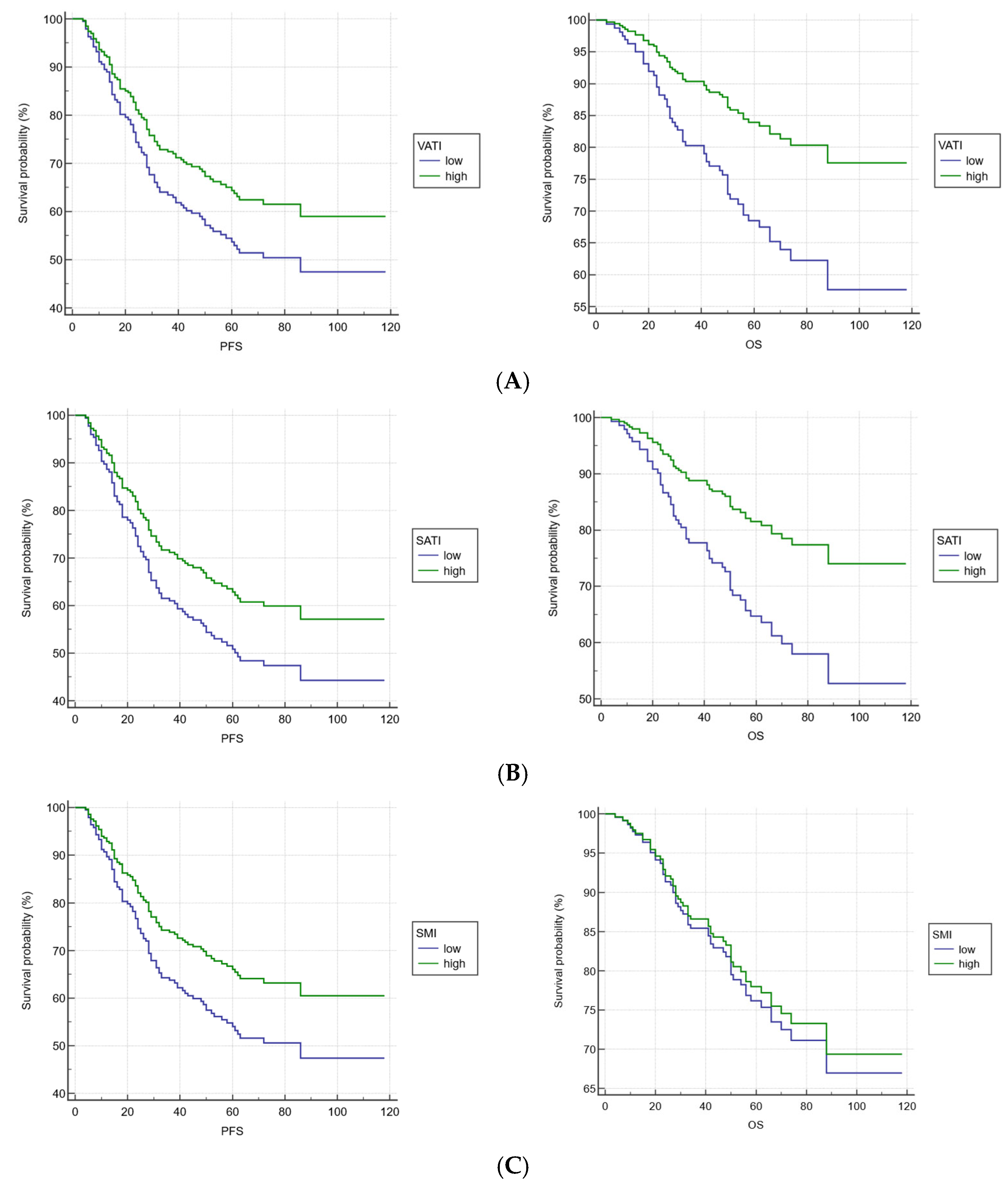
| SMI [cm2/m2] | 0.6728 (0.4031–1.1231) | 0.1295 | 0.9128 (0.4703–1.7720) | 0.7876 |
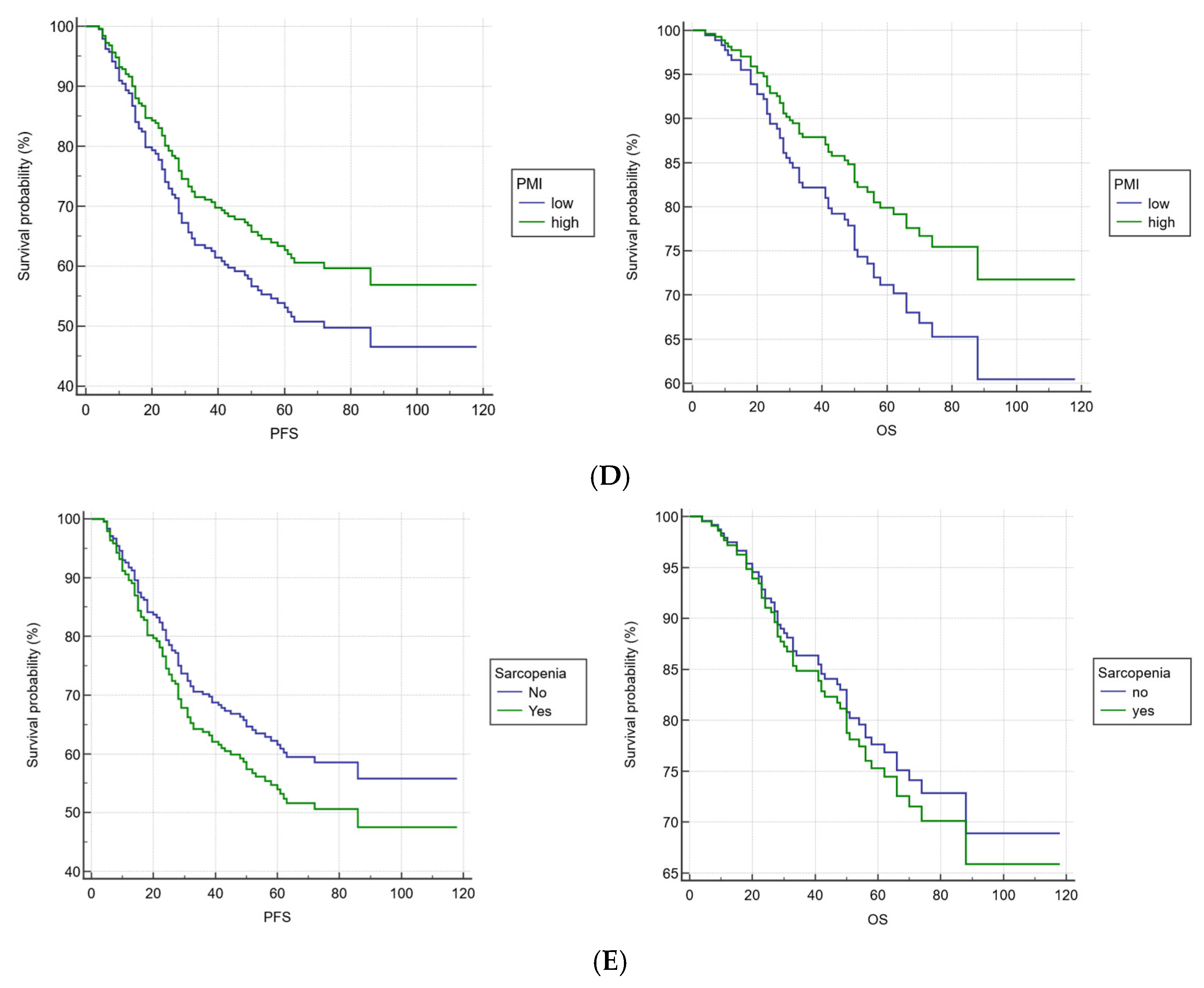
| PMI [cm2/m2] | 0.7385 (0.4628–1.1785) | 0.2036 | 0.6592 (0.3684–1.1794) | 0.6592 |
| Sarcopenia [cm2/m2] | 1.2733 (0.7589–2.1363) | 0.3602 | 1.1207 (0.5681–2.2107) | 0.7424 |
| VATI [cm2/m2] | 0.7084 (0.4055–1.2376) | 0.2259 | 0.4618 (0.2194–0.9719) | 0.0419 |
| SATI [cm2/m2] | 0.6864 (0.932–1.1981) | 0.1855 | 0.4707 (0.2286–0.9693) | 0.0409 |
| Analyzed Factor | Female (no = 39) | Male (no = 53) | p-Value |
|---|---|---|---|
| Meal number no (%) | p > 0.05 | ||
| 2–3 | 11 (28) | 26 (49) | |
| 4 | 15 (38) | 14 (26) | |
| 5 | 13 (34) | 13 (25) | |
| Red meat intake no (%) | p > 0.05 | ||
| Less than once a week | 12 (31) | 15 (28) | |
| More than once a week | 27 (69) | 38 (72) | |
| Processed meat intake no (%) | p > 0.05 | ||
| Less than once a week | 4 (10) | 3 (6) | |
| More than once a week | 35 (90) | 50 (94) | |
| Fast food intake no (%) | p > 0.05 | ||
| Less than once a week | 39 (100) | 51 (96) | |
| More than once a week | 0 (0) | 2 (4) | |
| Sweets intake no (%) | p > 0.05 | ||
| Less than once a week | 11 (28) | 14 (26) | |
| More than once a week | 28 (72) | 39 (74) | |
| Fruit no (%) | p > 0.05 | ||
| Less than once a week | 1 (2.5) | 0 (0) | |
| More than once a week | 38 (97.5) | 53 (100) | |
| Vegetables no (%) | p > 0.05 | ||
| Less than once a week | 1 (2.5) | 2 (4) | |
| More than once a week | 38 (97.5) | 51 (96) | |
| Fish no (%) | 0.0723 | ||
| Less than once a week | 17 (44) | 13 (25) | |
| More than once a week | 22 (56) | 40 (75) | |
| Eggs no (%) | p > 0.05 | ||
| Less than once a week | 4 (10) | 8 (15) | |
| More than once a week | 35 (90) | 45 (85) | |
| Sweet drinks no (%) | p > 0.05 | ||
| Less than once a week | 36 (92) | 44 (83) | |
| More than once a week | 3 (8) | 9 (17) | |
| Alcohol no (%) | 0.0043 | ||
| Less than once a week | 39 (100) | 43 (81) | |
| More than once a week | 0 (0) | 10 (19) | |
| Tobacco no (%) | p > 0.05 | ||
| No | 31 (79) | 40 (75) | |
| Yes | 8 (21) | 13 (25) | |
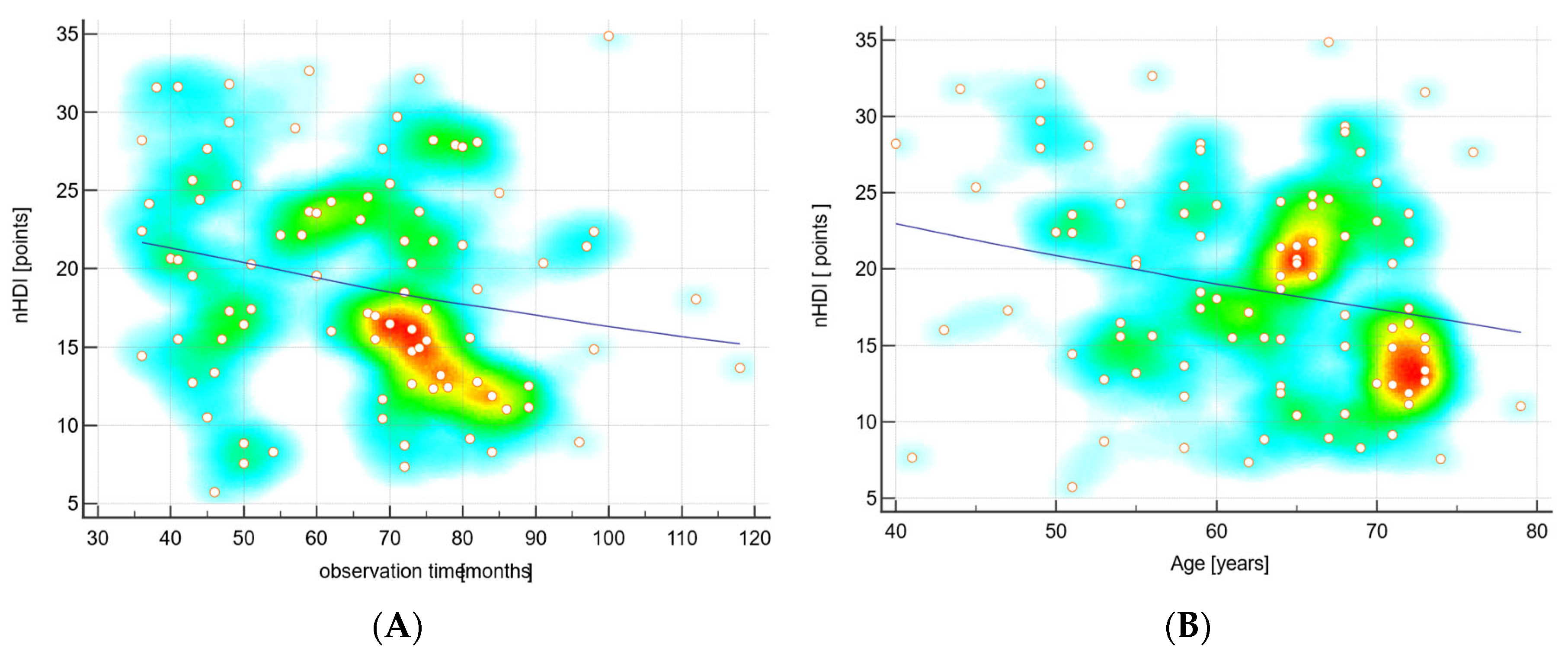
| nHDI mean ± SD | 15.9 ± 7.12 | 21.2 ± 6.26 | 0.0002 |
| nHDI no (%) | p > 0.05 | ||
| low | 39 (100) | 52 (98.1) | |
| moderate | 0 (0) | 1 (1.9) | |
| heigh | 0 (0) | 0 (0) |
Disclaimer/Publisher’s Note: The statements, opinions and data contained in all publications are solely those of the individual author(s) and contributor(s) and not of MDPI and/or the editor(s). MDPI and/or the editor(s) disclaim responsibility for any injury to people or property resulting from any ideas, methods, instructions or products referred to in the content. |
© 2025 by the authors. Licensee MDPI, Basel, Switzerland. This article is an open access article distributed under the terms and conditions of the Creative Commons Attribution (CC BY) license (https://creativecommons.org/licenses/by/4.0/).
Share and Cite
Kolenda, P.; Mardas, M.; Radomyski, P.; Trojanowski, M.; Litwiniuk, M.; Warchoł, W.; Stelmach-Mardas, M. Body Composition and Survival in Locally Advanced Rectal Cancer Patients Treated with Neoadjuvant Radiochemotherapy. Nutrients 2025, 17, 3309. https://doi.org/10.3390/nu17203309
Kolenda P, Mardas M, Radomyski P, Trojanowski M, Litwiniuk M, Warchoł W, Stelmach-Mardas M. Body Composition and Survival in Locally Advanced Rectal Cancer Patients Treated with Neoadjuvant Radiochemotherapy. Nutrients. 2025; 17(20):3309. https://doi.org/10.3390/nu17203309
Chicago/Turabian StyleKolenda, Piotr, Marcin Mardas, Piotr Radomyski, Maciej Trojanowski, Maria Litwiniuk, Wojciech Warchoł, and Marta Stelmach-Mardas. 2025. "Body Composition and Survival in Locally Advanced Rectal Cancer Patients Treated with Neoadjuvant Radiochemotherapy" Nutrients 17, no. 20: 3309. https://doi.org/10.3390/nu17203309
APA StyleKolenda, P., Mardas, M., Radomyski, P., Trojanowski, M., Litwiniuk, M., Warchoł, W., & Stelmach-Mardas, M. (2025). Body Composition and Survival in Locally Advanced Rectal Cancer Patients Treated with Neoadjuvant Radiochemotherapy. Nutrients, 17(20), 3309. https://doi.org/10.3390/nu17203309