Disclosure of Genotype Information to Reduce Caffeine Intake in Slow Metabolizers: Findings from a Randomized Controlled Trial on Personalized Dietary Interventions


Abstract
1. Introduction
2. Materials and Methods
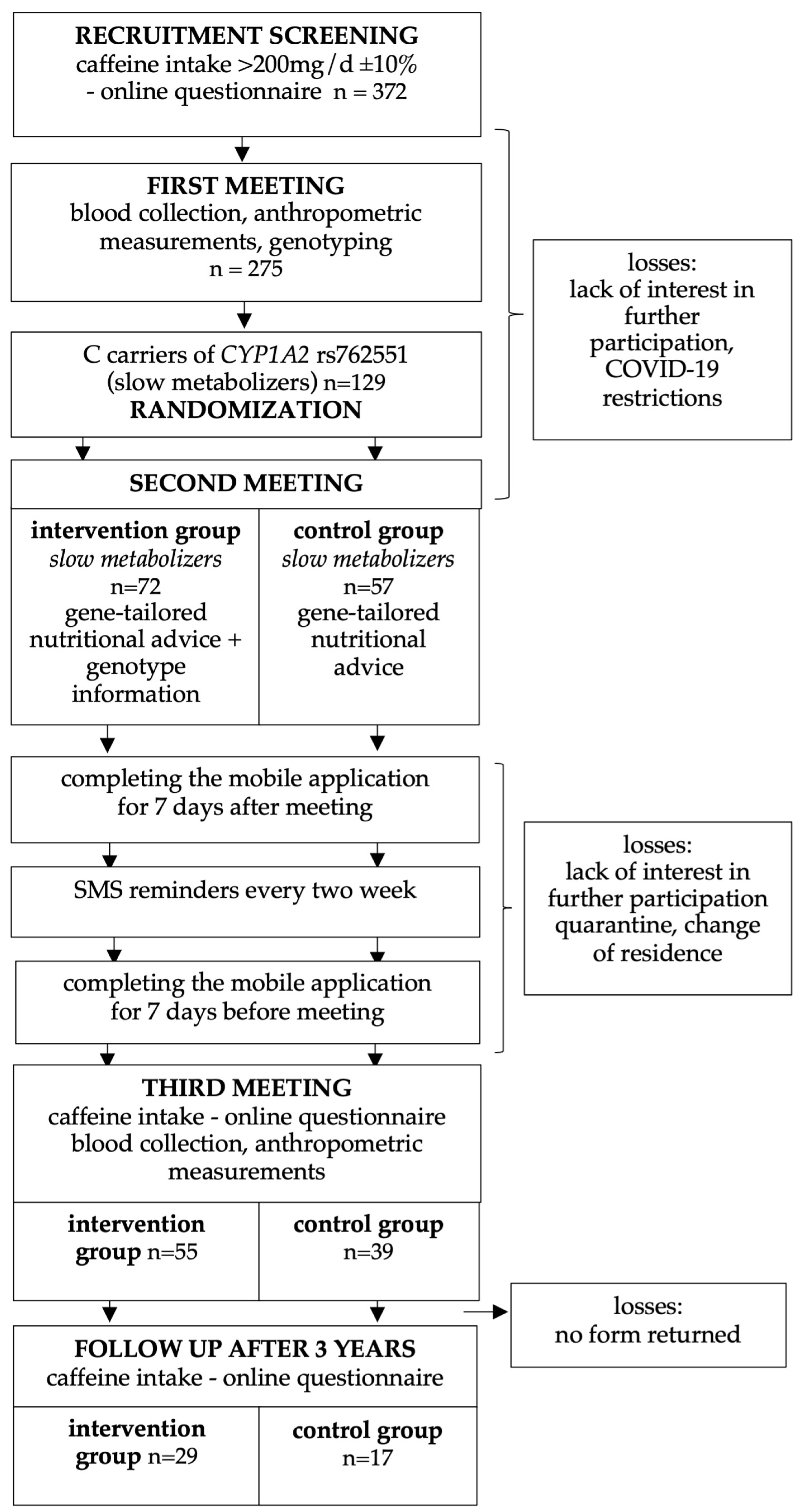
2.1. Study Design
2.2. Intervention
2.3. Caffeine Intake Assessment
2.4. Genotyping
2.5. Statistical Analysis
3. Results
3.1. Characteristics of the Study Group
3.2. Short-Term Changes in Caffeine Intake
3.2.1. Short-Term Changes in Caffeine Intake Assessed by the Caffeine Intake Questionnaire Following the PN Intervention
3.2.2. Short-Term Changes in Caffeine Intake Assessed by EMA Following the PN Intervention
3.2.3. Comparison of the Two Methods of Assessing Caffeine Consumption
3.3. Long-Term Changes in Caffeine Intake: Three-Year Follow-Up Assessment Using the Caffeine Intake Questionnaire
4. Discussion
5. Limitations
6. Conclusions
Supplementary Materials
Author Contributions
Funding
Institutional Review Board Statement
Informed Consent Statement
Data Availability Statement
Conflicts of Interest
Abbreviations
| BMI | body mass index |
| caf. mg/bm kg | caffeine intake in milligram per kilogram of body mass |
| DM2 | type 2 diabetes |
| EMA | ecological momentary assessment |
| ISNN | International Society of Nutrigenetics & Nutrigenomics |
| SD | standard deviation |
References
- Bush, C.L.; Blumberg, J.B.; El-Sohemy, A.; Minich, D.M.; Ordovás, J.M.; Reed, D.G.; Behm, V.A.Y. Toward the Definition of Personalized Nutrition: A Proposal by The American Nutrition Association. J. Am. Coll. Nutr. 2020, 39, 5–15. [Google Scholar] [CrossRef] [PubMed]
- Ewa, R.; Katarzyna, S.; Agnieszka, W.; Hanna, M. (Eds.) Normy Żywienia dla Populacji Polski; Narodowy Instytut Zdrowia Publicznego PZH—Państwowy Instytut Badawczy: Warszawa, Poland, 2024; ISBN 978-83-65870-78-0. [Google Scholar]
- Feskens, E.J.M.; Bailey, R.; Bhutta, Z.; Biesalski, H.-K.; Eicher-Miller, H.; Krämer, K.; Pan, W.-H.; Griffiths, J.C. Women’s Health: Optimal Nutrition throughout the Lifecycle. Eur. J. Nutr. 2022, 61, 1–23. [Google Scholar] [CrossRef]
- De Caterina, R.; El-Sohemy, A. Moving towards Specific Nutrigenetic Recommendation Algorithms: Caffeine, Genetic Variation and Cardiovascular Risk. J. Nutr. Nutr. 2016, 9, 106–115. [Google Scholar] [CrossRef] [PubMed]
- Cornelis, M.C.; El-Sohemy, A.; Kabagambe, E.K.; Campos, H. Coffee, CYP1A2 Genotype, and Risk of Myocardial Infarction. JAMA 2006, 295, 1135–1141. [Google Scholar] [CrossRef] [PubMed]
- EFSA Panel on Dietetic Products, Nutrition and Allergies (NDA). Scientific Opinion on the Safety of Caffeine. EFSA J. 2015, 13, 4102. [Google Scholar] [CrossRef]
- Jarosz, M.; Wierzejska, R.; Mojska, H.; Świderska, K.; Siuba, M.; Mirosław, J.; Wierzejska Regina, M.H.; Siuba Magdalena, Ś.K. Zawartość Kofeiny w Produktach Spożywczych. Brom. Chem. Toksykol. 2009, 42, 776–781. [Google Scholar]
- Bayer, S.; Winkler, V.; Hauner, H.; Holzapfel, C. Associations between Genotype–Diet Interactions and Weight Loss—A Systematic Review. Nutrients 2020, 12, 2891. [Google Scholar] [CrossRef]
- Jinnette, R.; Narita, A.; Manning, B.; Mcnaughton, S.A.; Mathers, J.C.; Livingstone, K.M. Does Personalized Nutrition Advice Improve Dietary Intake in Healthy Adults? A Systematic Review of Randomized Controlled Trials. Adv. Nutr. 2021, 12, 657–669. [Google Scholar] [CrossRef]
- Robinson, K.; Rozga, M.; Braakhuis, A.; Ellis, A.; Monnard, C.R.; Sinley, R.; Wanner, A.; Vargas, A.J. Effect of Incorporating Genetic Testing Results into Nutrition Counseling and Care on Dietary Intake: An Evidence Analysis Center Systematic Review—Part I. J. Acad. Nutr. Diet. 2021, 121, 553–581.e3. [Google Scholar] [CrossRef]
- Galekop, M.M.J.; Uyl-de Groot, C.A.; Ken Redekop, W. A Systematic Review of Cost-Effectiveness Studies of Interventions with a Personalized Nutrition Component in Adults. Value Health 2021, 24, 325–335. [Google Scholar] [CrossRef]
- Arkadianos, I.; Valdes, A.M.; Marinos, E.; Florou, A.; Gill, R.D.; Grimaldi, K.A. Improved Weight Management Using Genetic Information to Personalize a Calorie Controlled Diet. Nutr. J. 2007, 6, 29. [Google Scholar] [CrossRef]
- Chao, S.; Scott Roberts, J.; Marteau, T.M.; Silliman, R.; Adrienne Cupples, L.; Green, R.C.; Farrer, L.; Relkin, N.; Ravdin, L.; Whitehouse, P.; et al. Health Behavior Changes After Genetic Risk Assessment for Alzheimer Disease: The REVEAL Study. Alzheimer Dis. Assoc. Disord. 2008, 22, 94–97. [Google Scholar] [CrossRef]
- Horne, J.R.; Gilliland, J.A.; O’Connor, C.P.; Seabrook, J.A.; Madill, J. Change in Weight, BMI, and Body Composition in a Population-Based Intervention Versus Genetic-Based Intervention: The NOW Trial. Obesity 2020, 28, 1419–1427. [Google Scholar] [CrossRef]
- Horne, J.R.; Gilliland, J.A.; Vohl, M.C.; Madill, J. Exploring Attitudes, Subjective Norms and Perceived Behavioural Control in a Genetic-Based and a Population-Based Weight Management Intervention: A One-Year Randomized Controlled Trial. Nutrients 2020, 12, 3768. [Google Scholar] [CrossRef] [PubMed]
- Nielsen, D.E.; El-Sohemy, A. Disclosure of Genetic Information and Change in Dietary Intake: A Randomized Controlled Trial. PLoS ONE 2014, 9, e112665. [Google Scholar] [CrossRef] [PubMed]
- Hietaranta-Luoma, H.-L.; Tahvonen, R.; Iso-Touru, T.; Puolijoki, H.; Hopia, A. An Intervention Study of Individual, ApoE Genotype-Based Dietary and Physical-Activity Advice: Impact on Health Behavior. Lifestyle Genom. 2014, 7, 161–174. [Google Scholar] [CrossRef] [PubMed]
- Hietaranta-Luoma, H.-L.; Tringham, M.; Karjalainen, H.; Tanner, L.; Vähäkangas, K.; Pietilä, A.-M.; Åkerman, K.; Puolijoki, H.; Tahvonen, R.; Hopia, A. A Long-Term Follow-Up Study on Disclosing Genetic Risk Information (APOE) to Promote Healthy Lifestyles in Finland. Lifestyle Genom. 2018, 11, 147–154. [Google Scholar] [CrossRef]
- Komiya, Y.; Nakao, H.; Kuroda, Y.; Arizono, K.; Nakahara, A.; Katoh, T. Application of Aldehyde Dehydrogenase 2 (ALDH2) Genetic Diagnosis in Support of Decreasing Alcohol Intake. J. Occup. Health 2006, 48, 161–165. [Google Scholar] [CrossRef]
- Livingstone, K.M.; Celis-Morales, C.; Navas-Carretero, S.; San-Cristobal, R.; Macready, A.L.; Fallaize, R.; Forster, H.; Woolhead, C.; O’Donovan, C.B.; Marsaux, C.F.; et al. Effect of an Internet-Based, Personalized Nutrition Randomized Trial on Dietary Changes Associated with the Mediterranean Diet: The Food4Me Study. Am. J. Clin. Nutr. 2016, 104, 288–297. [Google Scholar] [CrossRef]
- Voils, C.I.; Coffman, C.J.; Grubber, J.M.; Edelman, D.; Sadeghpour, A.; Maciejewski, M.L.; Bolton, J.; Cho, A.; Ginsburg, G.S.; Yancy, W.S. Does Type 2 Diabetes Genetic Testing and Counseling Reduce Modifiable Risk Factors? A Randomized Controlled Trial of Veterans. J. Gen. Intern. Med. 2015, 30, 1591–1599. [Google Scholar] [CrossRef]
- Li, S.X.; Ye, Z.; Whelan, K.; Truby, H. The Effect of Communicating the Genetic Risk of Cardiometabolic Disorders on Motivation and Actual Engagement in Preventative Lifestyle Modification and Clinical Outcome: A Systematic Review and Meta-Analysis of Randomised Controlled Trials. Br. J. Nutr. 2016, 116, 924–934. [Google Scholar] [CrossRef]
- Schneider, K.I.; Schmidtke, J. Patient Compliance Based on Genetic Medicine: A Literature Review. J. Community Genet. 2014, 5, 31–48. [Google Scholar] [CrossRef] [PubMed]
- Shyam, S.; Lee, K.X.; Tan, A.S.W.; Khoo, T.A.; Harikrishnan, S.; Lalani, S.A.; Ramadas, A. Effect of Personalized Nutrition on Dietary, Physical Activity, and Health Outcomes: A Systematic Review of Randomized Trials. Nutrients 2022, 14, 4104. [Google Scholar] [CrossRef] [PubMed]
- Shiffman, S.; Stone, A.A.; Hufford, M.R. Ecological Momentary Assessment. Annu. Rev. Clin. Psychol. 2008, 4, 1–32. [Google Scholar] [CrossRef] [PubMed]
- Goldschmidt, A.B.; Wonderlich, S.A.; Crosby, R.D.; Engel, S.G.; Lavender, J.M.; Peterson, C.B.; Crow, S.J.; Cao, L.; Mitchell, J.E. Ecological Momentary Assessment of Stressful Events and Negative Affect in Bulimia Nervosa. J. Consult. Clin. Psychol. 2014, 82, 30–39. [Google Scholar] [CrossRef]
- Chmurzynska, A.; Mlodzik-Czyzewska, M.; Malinowska, A.; Czarnocinska, J.; Wiebe, D. Use of a Smartphone Application Can Improve Assessment of High-Fat Food Consumption in Overweight Individuals. Nutrients 2018, 10, 1692. [Google Scholar] [CrossRef]
- Przybysz, M.A.; Widła, G.; Dłużewska, E. Preferencje Konsumenckie Picia Kawy. Wpływ Temperatury I Czasu Prażenia Ziarna Kawy Na Ocenę Smaku I Zapachu Espresso. Zesz. Probl. Postępów Nauk. Rol. 2013, 572, 65–79. [Google Scholar]
- Bulczak, E.M.; Chmurzyńska, A.U. Caffeine Consumption in Polish Adults: Development and Validation of a Polish Questionnaire for Assessing Caffeine Intake. J. Am. Nutr. Assoc. 2023, 42, 769–775. [Google Scholar] [CrossRef]
- WHO Body Mass Index (BMI) Indicators. Available online: https://www.who.int/data/gho/data/themes/topics/topic-details/GHO/body-mass-index (accessed on 3 October 2025).
- Kwak, S.G.; Kim, J.H. Central Limit Theorem: The Cornerstone of Modern Statistics. Korean J. Anesthesiol. 2017, 70, 144. [Google Scholar] [CrossRef]
- Marteau, T.M.; Weinman, J. Self-Regulation and the Behavioural Response to DNA Risk Information: A Theoretical Analysis and Framework for Future Research. Soc. Sci. Med. 2006, 62, 1360–1368. [Google Scholar] [CrossRef]
- Kwasnicka, D.; Dombrowski, S.U.; White, M.; Sniehotta, F. Theoretical Explanations for Maintenance of Behaviour Change: A Systematic Review of Behaviour Theories. Health Psychol. Rev. 2016, 10, 277–296. [Google Scholar] [CrossRef]
- Celis-Morales, C.; Mathers, J.; Gibney, M.; Walsh, M.; EUFIC; Gibney, E.; Lovegrove, J.; Saris, W.; Brennan, L.; Görman, U.; et al. White Paper on Personalised Nutrition—Paving a Way to Better Population Health; EUFIC: Brussels, Belgium, 2015. [Google Scholar]
- Livingstone, K.M.; Celis-Morales, C.; Navas-Carretero, S.; San-Cristobal, R.; Forster, H.; Woolhead, C.; O’Donovan, C.B.; Moschonis, G.; Manios, Y.; Traczyk, I.; et al. Personalised Nutrition Advice Reduces Intake of Discretionary Foods and Beverages: Findings from the Food4Me Randomised Controlled Trial. Int. J. Behav. Nutr. Phys. Act. 2021, 18, 70. [Google Scholar] [CrossRef]
- O’Donovan, C.B.; Walsh, M.C.; Forster, H.; Woolhead, C.; Celis-Morales, C.; Fallaize, R.; Macready, A.L.; Marsaux, C.F.M.; Navas-Carretero, S.; San-Cristobal, R.; et al. The Impact of MTHFR 677C → T Risk Knowledge on Changes in Folate Intake: Findings from the Food4Me Study. Genes Nutr. 2016, 11, 25. [Google Scholar] [CrossRef]
- Celis-Morales, C.; Marsaux, C.F.; Livingstone, K.M.; Navas-Carretero, S.; San-Cristobal, R.; Fallaize, R.; Macready, A.L.; O’Donovan, C.; Woolhead, C.; Forster, H.; et al. Can Genetic-Based Advice Help You Lose Weight? Findings from the Food4Me European Randomized Controlled Trial 1–3. Am. J. Clin. Nutr. 2017, 105, 1204–1213. [Google Scholar] [CrossRef] [PubMed]
- Hoevenaars, F.P.M.; Berendsen, C.M.M.; Pasman, W.J.; van den Broek, T.J.; Barrat, E.; de Hoogh, I.M.; Wopereis, S. Evaluation of Food-Intake Behavior in a Healthy Population: Personalized vs. One-Size-Fits-All. Nutrients 2020, 12, 2819. [Google Scholar] [CrossRef] [PubMed]
- Bahrami, Z.; Heidari, A.; Cranney, J. Applying SMART Goal Intervention Leads to Greater Goal Attainment, Need Satisfaction and Positive Affect. Int. J. Ment. Health Promot. 2022, 24, 869–882. [Google Scholar] [CrossRef]
- Forster, H.; Walsh, M.C.; Gibney, M.J.; Brennan, L.; Gibney, E.R. Personalised Nutrition: The Role of New Dietary Assessment Methods. Proc. Nutr. Soc. 2016, 75, 96–105. [Google Scholar] [CrossRef]
- Lucas, M.; Asselin, G.; Mérette, C.; Poulin, M.-J.; Dodin, S. Validation of an FFQ for Evaluation of EPA and DHA Intake. Public Health Nutr. 2009, 12, 1783–1790. [Google Scholar] [CrossRef]
- Zhang, L.; Misir, A.; Boshuizen, H.; Ocké, M. A Systematic Review and Meta-Analysis of Validation Studies Performed on Dietary Record Apps. Adv. Nutr. 2021, 12, 2321–2332. [Google Scholar] [CrossRef]
- Eldridge, A.; Piernas, C.; Illner, A.-K.; Gibney, M.; Gurinović, M.; de Vries, J.; Cade, J. Evaluation of New Technology-Based Tools for Dietary Intake Assessment—An ILSI Europe Dietary Intake and Exposure Task Force Evaluation. Nutrients 2018, 11, 55. [Google Scholar] [CrossRef]
- Heron, K.E.; Smyth, J.M. Ecological Momentary Interventions: Incorporating Mobile Technology into Psychosocial and Health Behavior Treatments. Br. J. Health Psychol. 2010, 15, 1–39. [Google Scholar] [CrossRef]
- Zhang, M.J.; Luk, T.T.; Ho, S.Y.; Wang, M.P.; Lam, T.H.; Cheung, Y.T.D. Ecological Momentary Assessment of Alcohol Marketing Exposure, Alcohol Use, and Purchases Among University Students: Prospective Cohort Study. JMIR Mhealth Uhealth 2024, 12, e60052. [Google Scholar] [CrossRef]
- Yang, Y.S.; Ryu, G.W.; Choi, M. Factors Associated with Daily Completion Rates in a Smartphone-Based Ecological Momentary Assessment Study. Healthc. Inform. Res. 2019, 25, 332. [Google Scholar] [CrossRef]
- Ono, M.; Schneider, S.; Junghaenel, D.U.; Stone, A.A. What Affects the Completion of Ecological Momentary Assessments in Chronic Pain Research? An Individual Patient Data Meta-Analysis. J. Med. Internet Res. 2019, 21, e11398. [Google Scholar] [CrossRef]
- Maugeri, A.; Barchitta, M. A Systematic Review of Ecological Momentary Assessment of Diet: Implications and Perspectives for Nutritional Epidemiology. Nutrients 2019, 11, 2696. [Google Scholar] [CrossRef]
- Bulczak, E.; Chmurzynska, A. Response to Comments on the Article “Caffeine Consumption in Polish Adults: Development and Validation of a Polish Questionnaire for Assessing Caffeine Intake”. J. Am. Nutr. Assoc. 2023, 43, 113–114. [Google Scholar] [CrossRef]


| Variable | Intervention Group (with Genotype Information) n = 55 | Control Group (No Genotype Information) n = 39 | p 1 |
|---|---|---|---|
| age [year] | 33.7 ± 10.6 | 34.2 ± 10.7 | 0.84 |
| men/women [n/n] | 18/37 | 17/22 | 0.29 |
| smoking [%] | 11.11 | 15.38 | 0.55 |
| height [m] | 1.79 ± 0.08 | 1.72 ± 0.09 | 0.33 |
| body weight [kg] | 71.18 ± 15.36 | 69.85 ± 15.17 | 0.68 |
| BMI [kg/m2] | 24.56 ± 4.6 | 23.45 ± 3.94 | 0.23 |
| normal weight/overweight [n/n] | 31/24 | 25/14 | 0.46 |
| waist circumference [m] | 0.84 ± 0.15 | 0.81 ± 0.13 | 0.30 |
| hip circumference [m] | 0.99 ± 0.09 | 0.96 ± 0.09 | 0.06 |
| Food Product | Intake in the Intervention Group (with Genotype Information) n = 55 | Intake in the Control Group (without Genotype Information) n = 39 | p 2 | p 3 | ||||||||||
|---|---|---|---|---|---|---|---|---|---|---|---|---|---|---|
| Before Intervention [mg/day] | After Intervention [mg/day] | p 1 | ∆ | Before Intervention [mg/day] | After Intervention [mg/day] | p 1 | ∆ | |||||||
| Mean | SD | Mean | SD | [%] | Mean | SD | Mean | SD | [%] | |||||
| caffeine total | 380.69 | 217.58 | 153.73 | 98.19 | <0.01 | 59.62 | 394.44 | 256.29 | 169.87 | 85.70 | <0.01 | 56.93 | 0.78 | 0.41 |
| Coffee 4 | 242.75 | 151.42 | 96.49 | 80.81 | <0.01 | 60.25 | 257.70 | 208.92 | 118.66 | 68.50 | <0.01 | 53.95 | 0.69 | 0.17 |
| green and black tea | 95.33 | 83.59 | 33.58 | 41.14 | <0.01 | 64.77 | 84.01 | 74.88 | 40.92 | 40.18 | <0.01 | 51.29 | 0.50 | 0.39 |
| sweet beverages | 12.48 | 33.13 | 5.80 | 27.44 | 0.25 | 53.53 | 5.66 | 11.63 | 1.45 | 5.09 | 0.04 | 74.38 | 0.22 | 0.33 |
| energy drink | 7.27 | 27.85 | 1.46 | 10.79 | 0.10 | 79.92 | 6.15 | 28.34 | 2.05 | 12.81 | 0.41 | 66.67 | 0.85 | 0.81 |
| cocoa and chocolate | 19.16 | 32.03 | 10.03 | 24.42 | <0.01 | 47.65 | 12.96 | 13.89 | 6.48 | 8.86 | 0.02 | 50.00 | 0.26 | 0.39 |
| supplements | 3.11 | 17.46 | 0 | 0 | 0.29 | 100.00 | 24.90 | 78.28 | 0 | 0 | 0.05 | 100.00 | 0.05 | - |
| yerba mate | 0.61 | 3.19 | 6.38 | 40.26 | 0.68 | −945.90 | 3.06 | 14.41 | 0.31 | 1.91 | 0.24 | 89.87 | 0.23 | 0.35 |
| caf. mg/bm kg | 5.50 | 3.13 | 2.25 | 1.54 | <0.01 | 59.09 | 5.65 | 3.23 | 2.57 | 1.40 | <0.01 | 54.51 | 0.96 | 0.18 |
| Questionnaire | EMA | ||||||
|---|---|---|---|---|---|---|---|
| Recommended Caffeine Intake | Control % in Column n = 39 | Intervention % in Column n = 55 | p 1 (Y) | Recommended Caffeine Intake | Control % in Column n = 20 | Intervention % in Column n = 35 | p 1 (Y) |
| Failure (% in row) | 31 (46%) 79% | 37 (67%) 54% | 0.25 (−0.3) | Failure (% in row) | 8 (36%) 40% | 14 (64%) 40% | 1.0 (0) |
| Success (% in row) | 8 (31%) 21% | 18 (69%) 33% | Success (% in row) | 12 (35%) 60% | 21 (65%) 60% | ||
| Caffeine Intake [mg/day] | Intervention Group (with Genotype Information) n = 29 | Control Group (Without Genotype Information) n = 17 | p 1 | ||
|---|---|---|---|---|---|
| Mean | SD | Mean | SD | ||
| baseline | 381.63 | 237.55 | 416.10 | 290.88 | 0.66 |
| after the intervention | 127.20 | 89.39 | 150.22 | 68.28 | 0.36 |
| follow up | 227.94 | 146.32 | 263.82 | 136.92 | 0.42 |
| Comparison of caffeine intake in time (post hock) | Intervention group | Control group | |||
| p 2 | p 2 | ||||
| baseline vs. after the intervention | <0.01 | <0.01 | |||
| baseline vs. follow up | <0.01 | 0.06 | |||
| study group (1, 44) 3 | η2 = 0.02; F = 0.70; p = 0.41 | ||||
| time (2, 88) 3 | η2 = 0.40; F = 29.61; p < 0.01 | ||||
| time x study group (2, 88) 3 | η2 < 0.01; F = 0.02; p = 0.98 | ||||
Disclaimer/Publisher’s Note: The statements, opinions and data contained in all publications are solely those of the individual author(s) and contributor(s) and not of MDPI and/or the editor(s). MDPI and/or the editor(s) disclaim responsibility for any injury to people or property resulting from any ideas, methods, instructions or products referred to in the content. |
© 2025 by the authors. Licensee MDPI, Basel, Switzerland. This article is an open access article distributed under the terms and conditions of the Creative Commons Attribution (CC BY) license (https://creativecommons.org/licenses/by/4.0/).
Share and Cite
Bulczak, E.; Chmurzynska, A. Disclosure of Genotype Information to Reduce Caffeine Intake in Slow Metabolizers: Findings from a Randomized Controlled Trial on Personalized Dietary Interventions. Nutrients 2025, 17, 3236. https://doi.org/10.3390/nu17203236
Bulczak E, Chmurzynska A. Disclosure of Genotype Information to Reduce Caffeine Intake in Slow Metabolizers: Findings from a Randomized Controlled Trial on Personalized Dietary Interventions. Nutrients. 2025; 17(20):3236. https://doi.org/10.3390/nu17203236
Chicago/Turabian StyleBulczak, Ewa, and Agata Chmurzynska. 2025. "Disclosure of Genotype Information to Reduce Caffeine Intake in Slow Metabolizers: Findings from a Randomized Controlled Trial on Personalized Dietary Interventions" Nutrients 17, no. 20: 3236. https://doi.org/10.3390/nu17203236
APA StyleBulczak, E., & Chmurzynska, A. (2025). Disclosure of Genotype Information to Reduce Caffeine Intake in Slow Metabolizers: Findings from a Randomized Controlled Trial on Personalized Dietary Interventions. Nutrients, 17(20), 3236. https://doi.org/10.3390/nu17203236