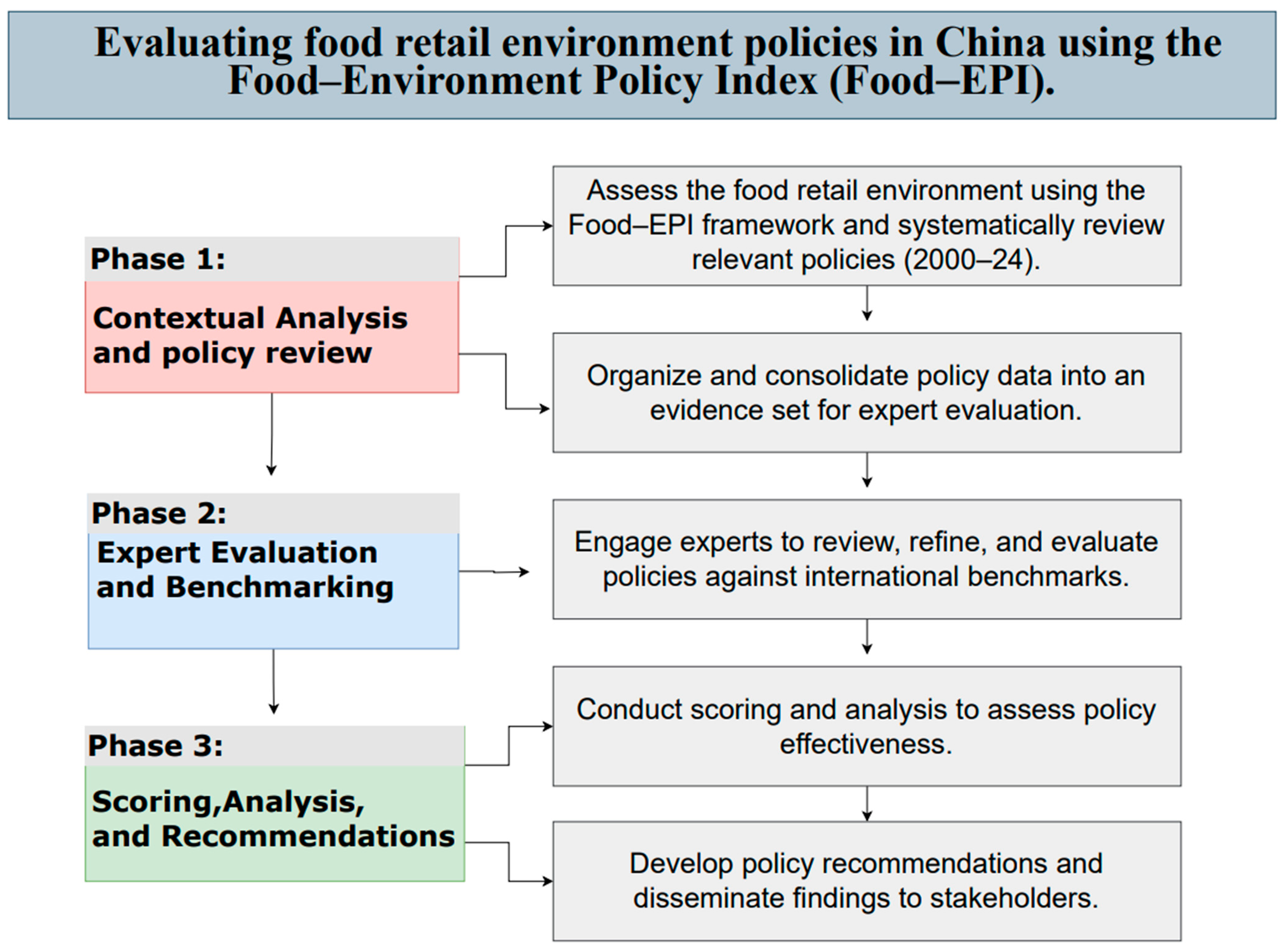
Evaluation of Food Retail Policies Implementation in China Using the Healthy Food Environment Policy Index

 , , , , ,
Highlights
- The study applied the Healthy Food Environment Policy Index (Food-EPI), a validated international tool, to assess and identify implementation gaps in China’s food retail policies.
- Results indicate low overall implementation of these policies, highlighting the urgent need for improvement.
- While provincial-level policies on healthy food access and promotion show moderate implementation, national-level coordination on fast-food zoning and government support remains limited.
- The research provides evidence-based recommendations for developing unified national frameworks and enhancing multi-sector collaboration to improve China’s food environment and better align with global health goals.
Abstract
1. Introduction
2. Materials and Methods
2.1. Contextual Analysis and Policy Review
2.2. Consolidation and Validation of Evidence
2.3. Expert-Led Validation and Refinement of the Evidence Set
2.4. Statistical Analysis
3. Results
3.1. Characteristics of Evidence on Government Policy on Food Retail in China
3.2. Expert Evaluation Workshop Conduction
3.3. Score, Implementation Percentage, and Implementation Level in Food Retail
3.4. Provincial Policies Enforce Fast-Food Zoning to Control Fast-Food Outlet Density
3.5. Multi-Tiered Policies Improve Healthy Food Access in Retail Outlets
3.6. National-Level Support Enhances Healthy Food Access in Schools
3.7. Voluntary Initiatives Promote Healthy Food in Service Environments
4. Discussion
5. Conclusions
- (1)
- Integrate socioeconomic metrics into zoning regulations, inspired by New Zealand’s deprivation-index-linked approach [38], and adopt Argentina’s income-stratified urban retail policies [39]. Establish a national legal framework to enforce uniform policies, particularly in rural regions with limited infrastructure.
- (2)
- Transition to binding standards, as seen in New Zealand’s junk-food-free checkout initiatives [44], and implement participatory monitoring systems like New Zealand’s FoodBack framework [45]. Provide financial incentives, such as subsidies and tax breaks, to businesses promoting healthy food, especially in less developed regions.
- (3)
- Adopt national metrics for healthy food availability, such as New Zealand’s shelf-length ratio standards [49], and expand school nutrition programs to regulate food outlets near schools. Engage communities, schools, and the media to foster a cultural shift towards healthier eating habits.
- (4)
- Launch pilot programs and stakeholder workshops to co-develop tailored interventions and enhance multi-sector collaboration, strengthen capacity building and resource allocation in underserved areas, and improve monitoring and adaptive governance mechanisms to ensure equitable and effective policy implementation.
Author Contributions
Funding
Institutional Review Board Statement
Informed Consent Statement
Data Availability Statement
Acknowledgments
Conflicts of Interest
Abbreviations
| BMI | Body mass index |
| Food-EPI | Healthy Food Environment Policy Index |
| INFORMAS | International Network for Food and Obesity/NCDs Research, Monitoring and Action Support |
| NCDs | Noncommunicable diseases |
| UNICEF | United Nations International Children’s Emergency Fund |
Appendix A
| Name | |
| Index Content | Indicator 1: Zoning laws and policies are robust to empower local governments to enforce restrictions on the density and location of fast-food restaurants and other retailers selling unhealthy foods. |
| International Best Practices | South Korea: Since 2019, South Korea has implemented the “Green Food Zones” initiative under the Special Act on Children’s Dietary Life Safety Management [50]. This policy prohibits the sale of high-calorie, low-nutrient foods, such as candies, ice cream, carbonated beverages, and burgers, within a 200 m radius of schools. By 2016, over 10,000 schools had been included in these zones. Detroit (USA): Detroit’s zoning ordinance, established in 1998, bans fast-food restaurants within 500 feet of primary, secondary, and high schools [51]. United Kingdom: In the UK, approximately fifteen local authorities have adopted supplemental planning documents to regulate the proximity of hot food takeaways to sensitive areas, particularly schools. For instance, in 2009, the London Borough of Waltham Forest introduced a policy prohibiting hot food takeaways within 400 m of schools, parks, and youth centers. Similarly, in 2010, the London Borough of Barking and Dagenham extended this restriction to areas within a 10 min walk from schools. Comparable policies were subsequently adopted by the councils of St. Helens in 2011 and Halton in 2012 [51]. |
| Local Evidence | |
| Regulations (Province) | The implementation of Heilongjiang Province’s Food Safety Rules established a 200 m radius around kindergartens and primary and secondary schools, where food stalls are prohibited, on October 1, 2019 [26]. Similarly, the Guangdong Province Food Production and Processing Workshops and Food Stall Regulations also ban food vendor activities in areas surrounding kindergartens and schools [23]. Other regions, such as Shaanxi Province and Anhui Province, have enacted similar regulations [22,25]. On March 16, 2019, the Gansu Provincial Market Supervision Administration issued a notice prohibiting the sale of “spicy strips”—a high-fat, high-salt, and additive-laden instant noodle product—within 200 m of all school campuses across the province [24]. The notice highlights the health risks associated with frequent consumption of these products and encourages citizens to report illegal production, sale, or food safety concerns related to “spicy strips.” Similar rules were adopted by Qinghai Province, Zhangzhou in Fujian Province, and other regions [52,53]. Additionally, the Beijing Night Market Food Service Food Safety Supervision and Management Regulations, effective 1 April 2013, require that night market catering activities be conducted in government-designated areas located at least 200 m away from the entrances of primary and secondary schools, as well as childcare institutions [21]. |
| Rating Score (Full points is 5) | Given the importance of food environments in shaping dietary behaviors and diet-related health outcomes, this study evaluated China’s food retail policies through international benchmarking to identify implementation gaps and propose evidence-based strategies for improving dietary environments and public health. |
| Suggestion | (To enhance the performance of this indicator, what specific recommendations do you propose for the future content and execution of related policies?) |
Appendix B
| Food Retail Indicator | Name | Type | Agency | Date of Issue | Mandatory Level |
| RETAIL 1 (Local fast-food zoning restrictions) | Heilongjiang Province’s Food Safety Rules [26] | Regulations (Provincial) | Heilongjiang Provincial Government | 1 October 2019 | High |
| Regulation on the Management of Guangdong Province Food Production and Processing Workshops and Food Stalls [23] | Regulations (Province) | Guangdong Provincial Government | 1 October 2015 | High | |
| Food Safety Rules (Anhui Province) [22] | Regulations (Province) | Anhui Provincial Government | 1 December 2017 | High | |
| Regulations on the Administration of Small Food Processing Factories, Small Restaurants, and Food Stalls (Shaanxi Province) [25] | Regulations (Province) | Shaanxi Provincial Government | 30 July 2015 | High | |
| Beijing Night Market Food Service Food Safety Supervision and Management Measures [21] | Regulations (Province) | Beijing Municipal Government | 1 April 2013 | High | |
| Gansu Provincial Market Supervision and Administration Bureau’s Announcement on Spicy Strips [24] (also, Qinghai Province, Zhangzhou in Fujian Province, and others) [52,53] | Guidance (Province) | Gansu Provincial Market Supervision and Administration Bureau | 16 March 2019 | High | |
| RETAIL 2 (Healthy food access in outlets) | Notice of the State Council on Further Promoting Vegetable Production and Guaranteeing the Basic Stability of Market Supply and Prices [27] | Guidance (National) | Chinese State Council | 27 August 2010 | High |
| Guidance on Strengthening the Management of Community Vegetable Drive-Through Vehicle [30] | Guidance (Province) | Beijing Municipal Bureau of Commerce | 16 January 2019 | Medium | |
| Xiamen Government on the Promotion of Fresh Supermarkets to Transform the Implementation of the Farmer Market [28] | Guidance (Province) | Xiamen Government | 2007 | Medium | |
| Guiyang Construction of the Convenience Stores (Community Fresh Produce Direct Sales Points) Program 2012 [31] | Guidance (Province) | Guiyang Government | 7 March 2012 | Medium | |
| Specifications for the Establishment and Management of Fresh Food Supermarkets [29] | Regulation (Province) | Beijing Government | 12 March 2025 | High | |
| RETAIL 3 (Government support for healthy food) | Regulations on School Food Safety and Nutrition Health Management [33] | Regulation (National) | Ministry of Education, State Administration of Market Supervision and Administration, National Health Commission | 1 April 2019 | High |
| Rural Compulsory Education Student Nutrition Improvement Plan Implementation Measures [32] | Guidance (National) | Ministry of Education, National Development and Reform Commission, Ministry of Finance, Ministry of Agriculture and Rural Affairs, National Health Commission, State Administration for Market Regulation, National Disease Control Bureau | 31 October 2022 | High | |
| RETAIL 4 (Promote healthy food in services) | Action On Salt China (ASC) [34] | Guidance (National) | George Institute for Global Health Queen Mary University of London China Center for Disease Control and Prevention China Center for Health Education National Center for Food Safety Risk Assessment | 2017 | Low |
| Three Reduction and Three Health (TRTH) [36] | Guidance (National) | Chinese Government (as part of the Medium- and Long-term Plan for Prevention and Treatment of Chronic Diseases) | 2017 | Medium | |
| Nutritional Health Restaurant Construction Guidelines [35] | Guidance (National) | Various Local Borough Councils | December 2020 | Low |
Appendix C
| Food Retail Indicator | Name | Type | Agency | Date of Issue | Mandatory Level |
| RETAIL 1 (Local fast-food zoning restrictions) | Green Food Zones (South Korea) [50] | Law (National) | South Korean Government | 2019 | High |
| Zoning Ordinance (Detroit, USA) [51] | Regulations (State) | Detroit Local Government | 1998 | High | |
| Local Borough Council Planning Policies (UK) [51] | Regulations (National) | Various Local Borough Councils | 2009, 2010, 2011, 2012 | High | |
| RETAIL 2 (Healthy food access in outlets) | Healthy Food Financing Initiative (USA) [51] | Regulations (Underprivileged areas) | US Congress | February 2014 | Medium |
| New Jersey Food Access Initiative (USA) [51] | Regulations (State) | New Jersey Local Government | 2016 | Medium | |
| New York City Green Cart Permit (USA) [51] | Regulations (National) | New York City Government | 2008 | Medium | |
| Food Retail Expansion to Support Health Program (FRESH) (New York City, USA) [54] | Regulations (National) | New York City Government | 2009 | Medium | |
| Healthy Living Neighborhood Shops (Scotland) [55] | Regulations (National) | Scottish Executive | 2004 | Medium | |
| RETAIL 3 (Government support for healthy food) | Special Supplemental Nutrition Program for Women, Infants, and Children (WIC) (USA) [56] | Regulations (National) | US Department of Agriculture | 2009 | High |
| RETAIL 4 (Promote healthy food in services) | Healthier Dining Program (Singapore) [57] | Regulations (National) | Health Promotion Board | 2014 | High |
| Health Food Incentives Ordinance (San Francisco, USA) [58] | Regulations (State) | San Francisco Local Government | 2012 | High | |
| Ordinance No. NS300-820 (Santa Clara County, USA) [51] | Law (State) | Santa Clara County Local Government | 2012 | High | |
| Sweetened Beverage Ban (France) [51] | Law (National) | French Government | 2017 | High |
References
- Downs, S.M.; Ahmed, S.; Fanzo, J.; Herforth, A. Food Environment Typology: Advancing an Expanded Definition, Framework, and Methodological Approach for Improved Characterization of Wild, Cultivated, and Built Food Environments toward Sustainable Diets. Foods 2020, 9, 532. [Google Scholar] [CrossRef]
- Williams, J.; Scarborough, P.; Matthews, A.; Cowburn, G.; Foster, C.; Roberts, N.; Rayner, M. A systematic review of the influence of the retail food environment around schools on obesity-related outcomes. Obes. Rev. 2014, 15, 359–374. [Google Scholar] [CrossRef]
- Smets, V.; Vandevijvere, S. Changes in retail food environments around schools over 12 years and associations with overweight and obesity among children and adolescents in Flanders, Belgium. BMC Public Health 2022, 22, 1570. [Google Scholar] [CrossRef] [PubMed]
- Armendariz, M.; Pérez-Ferrer, C.; Basto-Abreu, A.; Lovasi, G.S.; Bilal, U.; Barrientos-Gutiérrez, T. Changes in the Retail Food Environment in Mexican Cities and Their Association with Blood Pressure Outcomes. Int. J. Environ. Res. Public Health 2022, 19, 1353. [Google Scholar] [CrossRef] [PubMed]
- Pineda, E.; Brunner, E.J.; Llewellyn, C.H.; Mindell, J.S. The retail food environment and its association with body mass index in Mexico. Int. J. Obes. 2021, 45, 1215–1228. [Google Scholar] [CrossRef] [PubMed]
- Zhou, S.; Cheng, Y.; Cheng, L.; Wang, D.; Li, Q.; Liu, Z.; Wang, H.J. Association between convenience stores near schools and obesity among school-aged children in Beijing, China. BMC Public Health 2020, 20, 150. [Google Scholar] [CrossRef]
- Zhou, Y.; Du, S.; Su, C.; Zhang, B.; Wang, H.; Popkin, B.M. The food retail revolution in China and its association with diet and health. Food Policy 2015, 55, 92–100. [Google Scholar] [CrossRef]
- Mah, C.L.; Luongo, G.; Hasdell, R.; Taylor, N.G.A.; Lo, B.K. A Systematic Review of the Effect of Retail Food Environment Interventions on Diet and Health with a Focus on the Enabling Role of Public Policies. Curr. Nutr. Rep. 2019, 8, 411–428. [Google Scholar] [CrossRef]
- Wolgast, H.; Halverson, M.M.; Kennedy, N.; Gallard, I.; Karpyn, A. Encouraging Healthier Food and Beverage Purchasing and Consumption: A Review of Interventions within Grocery Retail Settings. Int. J. Environ. Res. Public Health 2022, 19, 16107. [Google Scholar] [CrossRef]
- Hyseni, L.; Atkinson, M.; Bromley, H.; Orton, L.; Lloyd-Williams, F.; McGill, R.; Capewell, S. The effects of policy actions to improve population dietary patterns and prevent diet-related non-communicable diseases: Scoping review. Eur. J. Clin. Nutr. 2017, 71, 694–711. [Google Scholar] [CrossRef]
- World Health Organization. Global Action Plan for the Prevention and Control of Noncommunicable Diseases 2013–2020; World Health Organization: Geneva, Switzerland, 2013. [Google Scholar]
- State Council of the People’s Republic of China. Outline of the “Healthy China 2030” Plan; State Council of the People’s Republic of China: Beijing, China, 2016.
- Sacks, G.; Kwon, J.; Vandevijvere, S.; Swinburn, B. Benchmarking as a Public Health Strategy for Creating Healthy Food Environments: An Evaluation of the INFORMAS Initiative (2012–2020). Annu. Rev. Public Health 2021, 42, 345–362. [Google Scholar] [CrossRef] [PubMed]
- Swinburn, B.; Vandevijvere, S.; Kraak, V.; Sacks, G.; Snowdon, W.; Hawkes, C.; Barquera, S.; Friel, S.; Kelly, B.; Kumanyika, S.; et al. Monitoring and benchmarking government policies and actions to improve the healthiness of food environments: A proposed Government Healthy Food Environment Policy Index. Obes. Rev. 2013, 14 (Suppl. 1), 24–37. [Google Scholar] [CrossRef]
- Nieto, C.; Rodríguez, E.; Sánchez-Bazán, K.; Tolentino-Mayo, L.; Carriedo-Lutzenkirchen, A.; Vandevijvere, S.; Barquera, S. The INFORMAS healthy food environment policy index (Food-EPI) in Mexico: An assessment of implementation gaps and priority recommendations. Obes. Rev. 2019, 20 (Suppl. 2), 67–77. [Google Scholar] [CrossRef]
- Vandevijvere, S.; Swinburn, B. Pilot test of the Healthy Food Environment Policy Index (Food-EPI) to increase government actions for creating healthy food environments. BMJ Open 2015, 5, e006194. [Google Scholar] [CrossRef]
- Ruffini, O.; Relf, C.; Mann, D.; Blake, M.R.; Carrad, A.; Reeve, B.; Barbour, L.; Vanderlee, L.; Vandevijvere, S.; Sacks, G. Development of the Local Food Systems Policy Index (Local Food-EPI+) tool and assessment process to benchmark the implementation of local government policies for creating healthy, equitable and environmentally sustainable food systems. Public Health Nutr. 2024, 27, e191. [Google Scholar] [CrossRef]
- Swinburn, B.; Sacks, G.; Vandevijvere, S.; Kumanyika, S.; Lobstein, T.; Neal, B.; Barquera, S.; Friel, S.; Hawkes, C.; Kelly, B.; et al. INFORMAS (International Network for Food and Obesity/non-communicable diseases Research, Monitoring and Action Support): Overview and key principles. Obes. Rev. 2013, 14 (Suppl. 1), 1–12. [Google Scholar] [CrossRef]
- Li, Z.; Fang, Y.; Zhang, N.; Zhu, W.; Chang, S.; Zhou, S.; Zhang, M.; Ma, G. Evaluating Childhood Overweight- and Obesity-Related Food Marketing Policies in China Using the Food–Environment Policy Index (Food–EPI). Nutrients 2024, 16, 482. [Google Scholar] [CrossRef]
- von Philipsborn, P.; Geffert, K.; Klinger, C.; Hebestreit, A.; Stratil, J.; Rehfuess, E.A. Nutrition policies in Germany: A systematic assessment with the Food Environment Policy Index. Public Health Nutr. 2022, 25, 1691–1700. [Google Scholar] [CrossRef] [PubMed]
- Beijing Municipal Health Bureau. Regulations on Food Safety Supervision and Management of Night Market Catering Services in Beijing; Beijing Municipal Health Bureau: Beijing, China, 2013.
- Anhui Market Regulation Administration. Regulations on Food Safety of Anhui Province; Anhui Market Regulation Administration: Hefei, China, 2021.
- Guangdong Medical Products Administration. Regulations of Guangdong Province on the Administration of Food Production—Processing Workshops and Food Vendors; Guangdong Medical Products Administration: Guangzhou, China, 2014.
- Gansu Administration for Market Regulation. Announcement of Gansu Market Regulation Administration on Prohibiting the Sale of “Spicy Strips” on and Around School Campuses; Gansu Administration for Market Regulation: Lanzhou, China, 2019.
- Xi’an Weiyang District Market Supervision Administration. Regulations of Shaanxi Province on the Administration of Small Food Workshops, Small Catering Establishments and Food Vendors; Xi’an Weiyang District Market Supervision Administration: Xi’an, China, 2022.
- Heilongjiang Provincial People’s Congress Standing Committee. Regulations of Heilongjiang Province on Food Safety; Heilongjiang Provincial People’s Congress Standing Committee: Harbin, China, 2019.
- State Council of the People’s Republic of China. Notice of the State Council on Further Promoting Vegetable Production to Ensure Market Supply and Basic Price Stability (Guo Fa [2010] No. 26); State Council of the People’s Republic of China: Beijing, China, 2020.
- Xiamen Municipal Government. Supplementary Notice of the General Office of Xiamen Municipal People’s Government on Promoting Fresh Food Supermarkets and Transforming Farmers’ Markets; Xiamen Municipal Government: Xiamen, China, 2007.
- Beijing Municipal Bureau of Commerce. Specifications for the Establishment and Management of Fresh Food Supermarkets; Beijing Municipal Bureau of Commerce: Beijing, China, 2013.
- Ministry of Commerce; Ministry of Agriculture and Rural Affairs; National Development and Reform Commission. Notice on the “Guiding Opinions on Strengthening the Management of Community Vegetable Direct Delivery Services”; Ministry of Commerce; Ministry of Agriculture and Rural Affairs; National Development and Reform Commission: Beijing, China, 2019.
- Guiyang Municipal People’s Government. Work Plan for the Construction of Convenience Markets (Community Fresh Food Direct Sales Points) in Guiyang in 2012; Guiyang Municipal People’s Government: Guiyang, China, 2012.
- Ministry of Education of the People’s Republic of China. Circular of the Ministry of Education and Six Other Departments on Issuing the Measures for the Implementation of the Nutrition Improvement Program for Rural Compulsory Education Students; Ministry of Education of the People’s Republic of China: Beijing, China, 2022.
- Ministry of Education of the People’s Republic of China; State Administration for Market Regulation of the People’s Republic of China; National Health Commission of the People’s Republic of China. Regulations on the Management of School Food Safety and Nutrition—Health; Ministry of Education of the People’s Republic of China: Beijing, China, 2019.
- He, F.J.; Zhang, P.; Li, Y.; MacGregor, G.A. Action on Salt China. Lancet 2018, 392, 7–9. [Google Scholar] [CrossRef]
- Ministry of Education; Ministry of Finance; National Health Commission; State Administration for Market Regulation; National Rural Revitalization Administration; China National Food Industry Association. Notice on Issuing the Guidelines for Nutrition Labelling of Catering Foods and Other 3 Guidelines; Ministry of Education: Beijing, China, 2020.
- Chinese Center For Disease Control And Prevention. Notice on Issuing the Action Plan for National Healthy Lifestyle (2017–2025); Chinese Center For Disease Control And Prevention: Beijing, China, 2017. [Google Scholar]
- Wang, C.; Zhen, Z.; Zhao, N.; Zhao, C. Associations between Fast-Food Restaurants Surrounding Kindergartens and Childhood Obesity: Evidence from China. Int. J. Environ. Res. Public Health 2021, 18, 9334. [Google Scholar] [CrossRef] [PubMed]
- Sushil, Z.; Vandevijvere, S.; Exeter, D.J.; Swinburn, B. Food swamps by area socioeconomic deprivation in New Zealand: A national study. Int. J. Public Health 2017, 62, 869–877. [Google Scholar] [CrossRef]
- Elorriaga, N.; Moyano, D.L.; López, M.V.; Cavallo, A.S.; Gutierrez, L.; Panaggio, C.B.; Irazola, V. Urban Retail Food Environments: Relative Availability and Prominence of Exhibition of Healthy vs. Unhealthy Foods at Supermarkets in Buenos Aires, Argentina. Int. J. Environ. Res. Public Health 2021, 18, 944. [Google Scholar] [CrossRef]
- Cauchi, D.; Pliakas, T.; Knai, C. Food environments in Malta: Associations with store size and area-level deprivation. Food Policy 2017, 71, 39–47. [Google Scholar] [CrossRef]
- Yamaguchi, M.; Nomura, M.; Arai, Y.; Vandevijvere, S.; Swinburn, B.; Nishi, N. An assessment of implementation gaps and priority recommendations on food environment policies: The Healthy Food Environment Policy Index in Japan. Public Health Nutr. 2022, 25, 1720–1732. [Google Scholar] [CrossRef]
- Tay, Z.A.-O.; Whitton, C.A.-O.; van Dam, R.M.; Chia, K.S.; Swinburn, B.; Vandevijvere, S.; Rebello, S.A. Identifying implementation gaps and priorities for the Singapore government to improve food environment policies: Perspectives from a local expert panel. Public Health Nutr. 2021, 24, 585–592. [Google Scholar] [CrossRef] [PubMed]
- Cameron, A.J.; Sayers, S.J.; Sacks, G.; Thornton, L.E. Do the foods advertised in Australian supermarket catalogues reflect national dietary guidelines? Health Promot. Int. 2017, 32, 113–121. [Google Scholar] [CrossRef] [PubMed]
- Vandevijvere, S.; Waterlander, W.; Molloy, J.; Nattrass, H.; Swinburn, B. Towards healthier supermarkets: A national study of in-store food availability, prominence and promotions in New Zealand. Eur. J. Clin. Nutr. 2018, 72, 971–978. [Google Scholar] [CrossRef]
- Vandevijvere, S.; Williams, R.; Tawfiq, E.; Swinburn, B. A food environments feedback system (FoodBack) for empowering citizens and change agents to create healthier community food places. Health Promot. Int. 2019, 34, 277–290. [Google Scholar] [CrossRef]
- Pineda, E.; Poelman, M.P.; Aaspõllu, A.; Bica, M.; Bouzas, C.; Carrano, E.; De Miguel-Etayo, P.; Djojosoeparto, S.; Blenkuš, M.G.; Graca, P.; et al. Policy implementation and priorities to create healthy food environments using the Healthy Food Environment Policy Index (Food-EPI): A pooled level analysis across eleven European countries. Lancet Reg. Health Eur. 2022, 23, 100522. [Google Scholar] [CrossRef]
- Vanderlee, L.; Goorang, S.; Karbasy, K.; Vandevijvere, S.; L’Abbé, M.R. Policies to Create Healthier Food Environments in Canada: Experts’ Evaluation and Prioritized Actions Using the Healthy Food Environment Policy Index (Food-EPI). Int. J. Environ. Res. Public Health 2019, 16, 4473. [Google Scholar] [CrossRef]
- Djojosoeparto, S.K.; Kamphuis, C.B.M.; Vandevijvere, S.; Murrin, C.; Stanley, I.; Romaniuk, P.; Harrington, J.M.; Poelman, M.P. Strength of EU-level food environment policies and priority recommendations to create healthy food environments. Eur. J. Public Health 2022, 32, 504–511. [Google Scholar] [CrossRef]
- Vandevijvere, S.; Mackenzie, T.; Mhurchu, C.N. Indicators of the relative availability of healthy versus unhealthy foods in supermarkets: A validation study. Int. J. Behav. Nutr. Phys. Act. 2017, 14, 53. [Google Scholar] [CrossRef] [PubMed]
- Lee, S.K.; Park, H.K.; Choi, Y.J. Nutritional standards for energy-dense low-nutrient density foods for children in Korea. Asia Pac. J. Clin. Nutr. 2014, 23, 27–33. [Google Scholar] [CrossRef] [PubMed]
- World Cancer Research Fund International. Set Incentives and Rules to Create a Healthy Retail and Food Service Environment; World Cancer Research Fund International: London, UK, 2016. [Google Scholar]
- Zhangzhou Market Supervision and Administration Bureau. Reply of Zhangzhou Municipal Market Supervision Bureau to Proposal No. 0097 at the Fourth Session of the 16th Municipal People’s Congress; Zhangzhou Market Supervision and Administration Bureau: Zhangzhou, China, 2020. [Google Scholar]
- Health Commission of Qinghai Province. Public Notice on Food Safety Standards for Seasoned Flour Products (Spicy Strips) Enterprises; Health Commission of Qinghai Province: Xining, China, 2021. [Google Scholar]
- Li, K.Y.; Cromley, E.K.; Fox, A.M.; Horowitz, C.R. Evaluation of the placement of mobile fruit and vegetable vendors to alleviate food deserts in New York City. Prev. Chronic Dis. 2014, 11, E158. [Google Scholar] [CrossRef] [PubMed][Green Version]
- Department of Health. Change4Life Convenience Stores Evaluation Report: Promoting the Purchase of Fresh Fruit and Vegetables in Deprived Areas; Department of Health: London, UK, 2010.
- Lu, W.; McKyer, E.L.J.; Dowdy, D.; Evans, A.; Ory, M.; Hoelscher, D.M.; Wang, S.; Miao, J. Evaluating the Influence of the Revised Special Supplemental Nutrition Program for Women, Infants, and Children (WIC) Food Allocation Package on Healthy Food Availability, Accessibility, and Affordability in Texas. J. Acad. Nutr. Diet. 2016, 116, 292–301. [Google Scholar] [CrossRef]
- Health Promotion Board. Healthier Dining Programme. Available online: https://www.hpb.gov.sg/healthy-living/food-beverage/healthier-dining-programme (accessed on 17 August 2025).
- Etow, A.M. No toy for you! The healthy food incentives ordinance: Paternalism or consumer protection? Am. Univ. Law Rev. 2012, 61, 1503–1542. [Google Scholar]


| Indicators | Description |
|---|---|
| RETAIL 1 (Local fast-food zoning restrictions) | Zoning laws and policies are robust to empower local governments to enforce restrictions on the density and location of fast-food restaurants and other retailers selling unhealthy foods. |
| RETAIL 2 (Healthy food access in outlets) | Zoning laws and policies are strong enough to ensure the provision of healthy options, such as fruits and vegetables, in food service establishments. |
| RETAIL 3 (Government support for healthy food) | The government ensures that existing support systems are implemented to enhance the availability of healthy foods and restrict the availability of unhealthy foods in retail settings. |
| RETAIL 4 (Promote healthy food in services) | The government ensures that the current support system is operational to promote the availability and supply of healthy foods and to limit the promotion and supply of unhealthy foods in food service outlets. |
| Description | Adherence to Best Practices (%) 1 | Score |
|---|---|---|
| Absence or nominal policy presence | <20% | 1 |
| Rudimentary policy structures | 20–40% | 2 |
| Intermediate policy implementation | 40–60% | 3 |
| Robust policy strategies | 60–80% | 4 |
| Comprehensive policy framework | >80% | 5 |
| Step | Description | Formula |
|---|---|---|
| 1. Indicator Score Determination (IS) | The average score for each food retail policy indicator, calculated from expert evaluations. Scores range from 0 to 5 points. | |
| 2. Indicator Implementation Percentage (Indicator Impl %) | The percentage representing the implementation level for each indicator’s policy, relative to the maximum possible score (5 points), reflecting adherence to international benchmarks. | |
| 3. Total Score (TS) | The overall average score across all four food retail policy indicators. | |
| 4. Total Implementation Percentage (Total Impl %) | The overall percentage of policy implementation across all four indicators, relative to the maximum possible total score (5 points). |
| Dimension of Policy | n | Proportion (%) | |
|---|---|---|---|
| Level | National | 6 | 37.5 |
| Provincial | 10 | 62.5 | |
| Type | Regulations | 10 | 62.5 |
| Guideline | 6 | 37.5 | |
| Mandatory | High | 10 | 62.5 |
| Medium | 4 | 25 | |
| Low | 2 | 12.5 |
| Domain | Average Score | The Level of Food Retail Policies Implementation | Low Level | Medium Level | High Level |
|---|---|---|---|---|---|
| Food retail overall | 2.3 ± 1.1 | 45.8% | Low | ||
| RETAIL 1 (Local fast-food zoning restrictions) | 1.7 ± 0.6 | 33.8% | Low | ||
| RETAIL 2 (Healthy food access in outlets) | 2.6 ± 1.3 | 52.4% | Medium | ||
| RETAIL 3 (Government support for healthy food) | 2.3 ± 1.1 | 46.2% | Low | ||
| RETAIL 4 (Promote healthy food in services) | 2.5 ± 1.0 | 50.8% | Medium |
| File Type | Document | Agency | Date of Issue | Target Population | Content |
|---|---|---|---|---|---|
| Regulations (National) | No documents identified | ||||
| Regulations (Province) | Heilongjiang Province’s Food Safety Rule | Heilongjiang Provincial Government | October 2019 | Food stalls near schools | Prohibits food stalls within a 200 m radius of kindergartens and primary and secondary schools [26] |
| Guangdong Province’s Regulation on the Management of Food Production and Processing Workshops and Food Stalls | Guangdong Provincial Government | 1 October 2015 | Food stalls near schools | Mandates restrictions on food vendor activities near kindergartens and schools [23] | |
| Anhui Province Food Safety Rules | Anhui Provincial Government | December 2017 | Food stalls near schools | Restricts food vendors near educational institutions [22] | |
| Regulations on the Administration of Small Food Processing Factories, Small Restaurants, and Food Stalls in Shaanxi Province | Shaanxi Provincial Government | 30 July 2015 | Food vendors near schools | Restricts food vendors near educational institutions [25] | |
| Beijing Night Market Food Service Food Safety Supervision and Management Regulation | Beijing Municipal Government (implemented by district or county governments) | 1 April 2013 | Night market catering activities | Requires night market catering activities to be in designated areas, at least 200 m away from primary/secondary schools and childcare institutions [21] | |
| Regulations (Notices) | Province-wide Notice Prohibiting “Spicy Strips” Sales near Schools | Gansu Provincial Market Supervision Bureau | 16 March 2019 | Food vendors near schools | Prohibits “spicy strips” sales within 200 m of schools [24] |
| File Type | Document | Agency | Date of Issue | Target Population | Content |
|---|---|---|---|---|---|
| Regulations (National) | Notice of the State Council on Further Promoting Vegetable Production and Guaranteeing the Basic Stability of Market Supply and Prices | State Council of China | 27 August 2010 | City mayors and urban vegetable markets | Emphasize the critical role of city mayors in managing urban vegetable markets and call for improvements in the construction, services, and management of wholesale and retail vegetable markets [27] |
| Regulations (Province) | Guidance on Strengthening the Management of Community Vegetable Drive-Through Vehicles | Beijing Municipal Bureau of Commerce | 16 January 2019 | Operators and managers of community vegetable drive-through vehicles | Standardize the operation and management of community vegetable drive-through vehicles, detailing the roles of relevant departments, the recruitment of businesses, and the supervision of operations [30] |
| Promotion of Fresh Supermarkets to Transform the Implementation of the Farmer Market Policy | Xiamen Municipal Government | 17 January 2007 | Fresh supermarkets | Require fresh supermarkets to maintain timely stock replenishment and adjust product variety to meet consumer needs [28] | |
| Convenience Stores (Community Fresh Produce Direct Sales Points) Program | Guiyang Municipal Government | 7 March 2012 | Fresh produce direct sales points and hypermarkets | Mandate that fresh produce direct sales points offer at least 40 types of fresh vegetables and agricultural products, with hypermarkets required to provide at least 60 different types [31] | |
| Specifications for the Establishment and Management of Fresh Food Supermarkets | Beijing Municipal Government | 12 March 2025 | General merchandise stores, community food retail settings, and fresh supermarkets | Specify that fresh food sales must constitute at least 60% of total sales and detail zoning requirements for various food types [29] |
| File Type | Document | Agency | Date of Issue | Target Population | Content |
|---|---|---|---|---|---|
| Regulations (National) | Regulations on School Food Safety and Nutrition Health Management | Ministry of Education, State Administration of Market Supervision and Administration, and National Health Commission | 1 April 2019 | Canteens, supermarkets, and other food stores operating within kindergartens, primary, and secondary schools | Prohibits the operation of canteens, supermarkets, and other food stores within kindergartens, primary, and secondary schools, except with legal permission. Even with permission, the sale of high-salt, high-sugar, and high-fat foods is strictly prohibited [33] |
| Rural Compulsory Education Student Nutrition Improvement Plan Implementation Measures | Ministry of Education (China) | 23 May 2012 | Schools participating in the rural compulsory education nutrition program | Specifies that food provided must meet food safety and nutrition health standards and respect the dietary habits of ethnic minorities. Encourages the use of fresh, high-nutrient foods and the avoidance of high-salt, high-oil, and high-sugar foods. Promotes local procurement of agricultural products to reduce costs and ensure freshness [32] |
| File Type | Document | Agency | Date of Issue | Target Population | Content |
|---|---|---|---|---|---|
| Action Plan (National) | Action on Salt China (ASC) Initiative | Action on Salt China (ASC) | 28 March 2017 | Restaurants | Engages customers, wait staff, and chefs through educational materials and training programs [34] |
| Guideline (National) | Three Reductions and Three Health (TRTH) Initiative | Chinese Government (State Council) | 22 January 2017 | General population | Promote the reduction in salt, oil, and sugar intake while enhancing oral health, healthy weight, and bone health through nationwide public health campaigns [35] |
| Guideline (National) | Nutritional Health Restaurant Construction Guidelines | National Health Commission | 25 December 2020 | Foodservice operators | Guide foodservice operators to create nutritious and health-focused dining environments through actionable recommendations [36] |
Disclaimer/Publisher’s Note: The statements, opinions and data contained in all publications are solely those of the individual author(s) and contributor(s) and not of MDPI and/or the editor(s). MDPI and/or the editor(s) disclaim responsibility for any injury to people or property resulting from any ideas, methods, instructions or products referred to in the content. |
© 2025 by the authors. Licensee MDPI, Basel, Switzerland. This article is an open access article distributed under the terms and conditions of the Creative Commons Attribution (CC BY) license (https://creativecommons.org/licenses/by/4.0/).
Share and Cite
Zhou, S.; Zhang, N.; Li, Z.; Zhu, W.; Chang, S.; Shirazi, A.; Gao, S.; Xi, Y.; Fang, Y.; Zhang, M.; et al. Evaluation of Food Retail Policies Implementation in China Using the Healthy Food Environment Policy Index. Nutrients 2025, 17, 2815. https://doi.org/10.3390/nu17172815
Zhou S, Zhang N, Li Z, Zhu W, Chang S, Shirazi A, Gao S, Xi Y, Fang Y, Zhang M, et al. Evaluation of Food Retail Policies Implementation in China Using the Healthy Food Environment Policy Index. Nutrients. 2025; 17(17):2815. https://doi.org/10.3390/nu17172815
Chicago/Turabian StyleZhou, Shuyi, Na Zhang, Zhenhui Li, Wenli Zhu, Suying Chang, Ali Shirazi, Shijie Gao, Yurong Xi, Yujie Fang, Man Zhang, and et al. 2025. "Evaluation of Food Retail Policies Implementation in China Using the Healthy Food Environment Policy Index" Nutrients 17, no. 17: 2815. https://doi.org/10.3390/nu17172815
APA StyleZhou, S., Zhang, N., Li, Z., Zhu, W., Chang, S., Shirazi, A., Gao, S., Xi, Y., Fang, Y., Zhang, M., & Ma, G. (2025). Evaluation of Food Retail Policies Implementation in China Using the Healthy Food Environment Policy Index. Nutrients, 17(17), 2815. https://doi.org/10.3390/nu17172815