Changes in Teenagers’ Dietary Choices in Smart School Canteens: A Pre-Post Single-Arm (Quasi-Experimental) Study of a Digital Nudge Intervention



Abstract
1. Introduction
2. Materials and Methods
2.1. Study Design and Participants
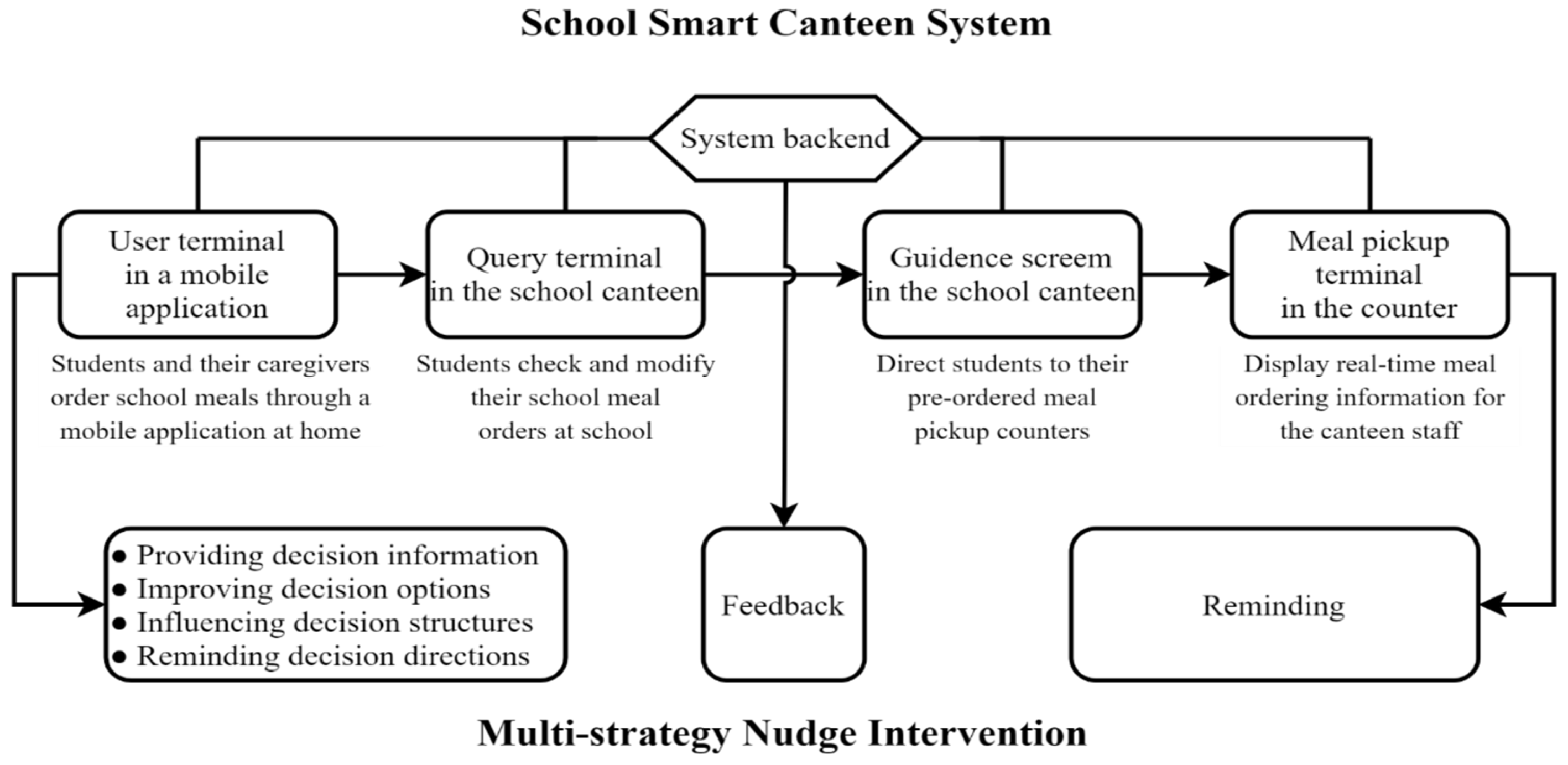
2.2. Digital Nudge Intervention Strategy of Online Ordering System in the Smart School Canteen
2.3. Investigation of Dietary Intake in School Meals
2.4. Investigation of Food Consumption Frequency
2.5. Statistical Analysis
3. Results
3.1. Demographic Characteristics of Participant Students
3.2. Comparison of Students’ Food Choice Before and After the Digital Nudge Intervention in Smart School Canteen
3.3. Comparison of Students’ Dietary Dairy, Vegetable, and Fruit Intakes Before and After the Digital Nudge Intervention According to Demographic Characteristics
3.4. Comparison of Students’ Dietary Nutrient Intakes Before and After the Digital Nudge Intervention in Smart School Canteen
4. Discussion
5. Conclusions
Author Contributions
Funding
Institutional Review Board Statement
Informed Consent Statement
Data Availability Statement
Acknowledgments
Conflicts of Interest
References
- Jones, M.; Lynch, K.T.; Kass, A.E.; Burrows, A.; Williams, J.; Wilfley, D.E.; Taylor, C.B. Healthy weight regulation and eating disorder prevention in high school students: A universal and targeted Web-based intervention. J. Med. Internet Res. 2014, 16, e57. [Google Scholar] [CrossRef]
- World Health Organization. Nudges to Promote Healthy Eating in Schools: Policy Brief; World Health Organization: Geneva, Switzerland, 2022. [Google Scholar]
- Jia, P.; Li, M.; Xue, H.; Lu, L.; Xu, F.; Wang, Y. School environment and policies, child eating behavior and overweight/obesity in urban China: The childhood obesity study in China megacities. Int. J. Obes. 2017, 41, 813–819. [Google Scholar] [CrossRef]
- Global Child Nutrition Foundation. School Meal Programs Around the World: Results from the 2021 Global Survey of School Meal Programs; Global Child Nutrition Foundation: Seattle, WA, USA, 2021. [Google Scholar]
- Metcalfe, J.J.; Ellison, B.; Hamdi, N.; Richardson, R.; Prescott, M.P. A systematic review of school meal nudge interventions to improve youth food behaviors. Int. J. Behav. Nutr. Phys. Act. 2020, 17, 77. [Google Scholar] [CrossRef] [PubMed]
- Downs, S.; Demmler, K.M. Food environment interventions targeting children and adolescents: A scoping review. Glob. Food Secur. 2020, 27, 100403. [Google Scholar] [CrossRef]
- Wyse, R.; Delaney, T.; Stacey, F.; Lecathelinais, C.; Ball, K.; Zoetemeyer, R.; Lamont, H.; Sutherland, R.; Nathan, N.; Wiggers, J.H.; et al. Long-term effectiveness of a multistrategy behavioral intervention to increase the nutritional quality of primary school students’ online lunch orders: 18-month follow-up of the Click & Crunch cluster randomized controlled trial. J. Med. Internet Res. 2021, 23, e31734. [Google Scholar] [CrossRef] [PubMed]
- Granheim, S.I.; Løvhaug, A.L.; Terragni, L.; Torheim, L.E.; Thurston, M. Mapping the digital food environment: A systematic scoping review. Obes. Rev. 2022, 23, e13356. [Google Scholar] [CrossRef]
- Özdemir, Ş. Digital nudges and dark patterns: The angels and the archfiends of digital communication. Digit. Sch. Humanit. 2019, 35, 417–428. [Google Scholar] [CrossRef]
- Leonard, A.; Delaney, T.; Seward, K.; Zoetemeyer, R.; Lamont, H.; Sutherland, R.; Reilly, K.; Lecathelinais, C.; Wyse, R. Investigating differences between traditional (paper bag) ordering and online ordering from primary school canteens: A cross-sectional study comparing menu, usage and lunch order characteristics. Public Health Nutr. 2021, 24, 2502–2511. [Google Scholar] [CrossRef]
- Delaney, T.; Wyse, R.; Yoong, S.L.; Sutherland, R.; Wiggers, J.; Ball, K.; Campbell, K.; Rissel, C.; Lecathelinais, C.; Wolfenden, L. Cluster randomized controlled trial of a consumer behavior intervention to improve healthy food purchases from online canteens. Am. J. Clin. Nutr. 2017, 106, 1311–1320. [Google Scholar] [CrossRef]
- Delaney, T.; Jackson, J.; Lecathelinais, C.; Yoong, S.L.; Wolfenden, L.; Sutherland, R.; Webb, E.; Wyse, R. Exploratory analysis of a cluster randomized controlled trial of a multi-strategy intervention delivered via online canteens on improving the nutritional quality of primary school students’ pre-ordered foods & drinks at recess. Appetite 2023, 185, 106528. [Google Scholar] [CrossRef]
- World Food Programme. State of School Feeding Worldwide 2020; World Food Programme: Rome, Italy, 2020. [Google Scholar]
- Vellinga, R.E.; Eykelenboom, M.; Olthof, M.R.; Steenhuis, I.H.M.; de Jonge, R.; Temme, E.H.M. Less meat in the shopping basket: The effect on meat purchases of higher prices, an information nudge and the combination: A randomized controlled trial. BMC Public Health 2022, 22, 1137. [Google Scholar] [CrossRef] [PubMed]
- Ministry of Education of the People’s Republic of China. Action Plan for the “Preventing Food Waste and Cultivating Saving Habits” in the Education System. 2020. Available online: http://www.moe.gov.cn/srcsite/A03/s7050/202009/t20200915_488025.html (accessed on 9 September 2020).
- Chinese Nutrition Society. Chinese Dietary Guidelines for School-Age Children. 19 May 2022. Available online: https://www.cnsoc.org/dGuideline/122510200.html (accessed on 19 May 2022).
- The National Health and Family Planning Commission of the People’s Republic of China. Student Meal Nutrition Guidelines. 1 August 2017. Available online: http://www.nhc.gov.cn/ewebeditor/uploadfile/2017/08/01/20170801100101818.pdf (accessed on 1 August 2017).
- Chinese Nutrition Society. Chinese Residents’ Dietary Nutrient Reference Intakes: 2023 Edition; People’s Medical Publishing House: Beijing, China, 2023; ISBN 9787117350693. [Google Scholar]
- Delaney, T.; Jackson, J.; Lecathelinais, C.; Clinton-McHarg, T.; Lamont, H.; Yoong, S.L.; Wolfenden, L.; Sutherland, R.; Wyse, R. Long-term effectiveness of a multi-strategy choice architecture intervention in increasing healthy food choices of high-school students from online canteens (Click & Crunch High Schools): Cluster randomized controlled trial. J. Med. Internet Res. 2024, 26, e51108. [Google Scholar] [CrossRef] [PubMed]
- Greene, K.N.; Gabrielyan, G.; Just, D.R.; Wansink, B. Fruit-promoting smarter lunchrooms interventions: Results from a cluster RCT. Am. J. Prev. Med. 2017, 52, 451–458. [Google Scholar] [CrossRef] [PubMed]
- Hubbard, K.L.; Bandini, L.G.; Folta, S.C.; Wansink, B.; Eliasziw, M.; Must, A. Impact of a Smarter Lunchroom intervention on food selection and consumption among adolescents and young adults with intellectual and developmental disabilities in a residential school setting. Public Health Nutr. 2015, 18, 361–371. [Google Scholar] [CrossRef]
- Cadario, R.; Chandon, P. Which healthy eating nudges work best? A meta-analysis of field experiments. Mark. Sci. 2020, 39, 465–486. [Google Scholar] [CrossRef]
- Delaney, T.; Yoong, S.L.; Lamont, H.; Lecathelinais, C.; Wolfenden, L.; Clinton-McHarg, T.; Sutherland, R.; Wyse, R. The efficacy of a multi-strategy choice architecture intervention on improving the nutritional quality of high school students’ lunch purchases from online canteens (Click & Crunch High Schools): A cluster randomized controlled trial. Int. J. Behav. Nutr. Phys. Act. 2022, 19, 120. [Google Scholar] [CrossRef]
- Thorndike, A.N.; Riis, J.; Sonnenberg, L.M.; Levy, D.E. Traffic-light labels and choice architecture: Promoting healthy food choices. Am. J. Prev. Med. 2014, 46, 143–149. [Google Scholar] [CrossRef]
- Wu, X.; Yu, Y.; He, H.; Yu, X.; Guo, D.; Zhu, W. Individual and family factors correlated with children’s fruit consumption. Front. Public Health 2024, 12, 1399704. [Google Scholar] [CrossRef]
- Beal, T.; Morris, S.S.; Tumilowicz, A. Global patterns of adolescent fruit, vegetable, carbonated soft drink, and fast-food consumption: A meta-analysis of global school-based student health surveys. Food Nutr. Bull. 2019, 40, 444–459. [Google Scholar] [CrossRef]
- Költő, A.; de Looze, M.; Jåstad, A.; Nealon Lennox, O.; Currie, D.; Gabhainn, S.N. A Focus on Adolescent Sexual Health in Europe, Central Asia and Canada: Health Behaviour in School-Aged Children International Report from the 2021/2022 Survey; World Health Organization, Regional Office for Europe: Copenhagen, Denmark, 2024; ISBN 9789289061155. [Google Scholar]
- Jia, S.; Hongyun, F.; Dongmei, Y.; Liyun, Z.; Lahaohong, J.; Qiyayi, G.; Li, H. Analysis of milk product intake by Chinese children and adolescents aged 6–17 years old. Chin. Food Nutr. 2022, 28, 26–30. [Google Scholar] [CrossRef]
- Zhang, J.; Wang, D.; Eldridge, A.L.; Huang, F.; Ouyang, Y.; Wang, H.; Zhang, B. Urban-rural disparities in energy intake and contribution of fat and animal source foods in Chinese children aged 4–17 years. Nutrients 2017, 9, 525. [Google Scholar] [CrossRef]
- Xu, P.P.; Yang, T.T.; Xu, J.; Li, L.; Cao, W.; Gan, Q.; Hu, X.Q.; Pan, H.; Zhao, W.H.; Zhang, Q. Dairy consumption and associations with nutritional status of Chinese children and adolescents. Biomed. Env. Sci. 2019, 32, 393–405. [Google Scholar] [CrossRef]
- World Health Organization. Slide to Order: A Food Systems Approach to Meals Delivery Apps: WHO European Office for the Prevention and Control of Non-Communicable Diseases; WHO: Moscow, Russia, 2021; Available online: https://www.who.int/europe/publications/i/item/WHO-EURO-2021-4360-44123-62247 (accessed on 6 December 2021).


| Demographic Characteristics | n | Percentage (%) |
|---|---|---|
| Gender | ||
| Male | 244 | 48.6 |
| Female | 258 | 51.4 |
| Grade | ||
| 10th | 278 | 55.4 |
| 11th | 224 | 44.6 |
| Household registration a | ||
| Rural | 114 | 27.1 |
| Urban | 306 | 72.9 |
| Proportion of household food expenditure a | ||
| <30% | 96 | 23.7 |
| 30–40% | 192 | 47.4 |
| 40–50% | 61 | 15.1 |
| >50% | 56 | 13.8 |
| Principal caregiver a | ||
| Mother | 371 | 81.4 |
| Father | 69 | 15.1 |
| Other | 16 | 3.5 |
| Principal caregiver’s education level a | ||
| High school education or below | 225 | 54.5 |
| Junior college or above | 188 | 45.5 |
| n = 502 | 100 |
| Food Consumption During the Past 7 Days | Baseline n (%) | Post-Intervention n (%) | p |
|---|---|---|---|
| Coarse grains (daily) | 88 (18.60) | 49 (23.90) | 0.017 a |
| Vegetables (daily) | 267 (71.84) | 168 (72.17) | 0.172 |
| Fruits (daily) | 209 (41.69) | 132 (54.87) | <0.001 a |
| Seafood (daily) | 294 (74.04) | 199 (82.95) | <0.001 a |
| Eggs (daily) | 177 (47.81) | 110 (46.02) | <0.001 a |
| Dairy products (daily) | 254 (68.50) | 138 (57.34) | <0.001 a |
| Soy products (daily) | 64 (17.36) | 51 (21.24) | <0.001 a |
| Breakfast (daily) | 299 (81.74) | 187 (77.91) | <0.001 a |
| Sweets (daily) | 62 (16.71) | 44 (18.32) | 0.033 a |
| Sugary drinks (daily) | 106 (28.78) | 57 (23.84) | 0.015 a |
| Fried foods (daily) | 79 (21.47) | 48 (19.97) | 0.247 |
| Eating out (daily) | 181 (49.19) | 94 (39.29) | <0.001 a |
| Fast food (daily) | 224 (60.26) | 124 (51.76) | <0.001 a |
| Foods | Baseline Intakes | Dietary Intakes After Intervention | ||||
|---|---|---|---|---|---|---|
| Mean (g/d) | P50 (P25–P75) (g/d) | Sufficient/Appropriate Intake Rate b (%) | Mean (g/d) | P50 (P25–P75) (g/d) | Sufficient/Appropriate Intake Rate b (%) | |
| Cereals and tubers | 281.67 | 243.00 (152.62–385.89) | 32.0 | 387.63 | 351.25 (290.77–475.62) a | 51.7 |
| Vegetables | 250.49 | 200.00 (100.00–383.38) | 15.0 | 266.65 | 213.22 (111.20–387.56) | 16.4 |
| Fruits | 89.27 | 0.00 (0.00–107.90) | 8.7 | 106.54 | 100.00 (0.00–195.00) a | 12.1 |
| Livestock and poultry meat | 136.67 | 100.00 (58.52–200) | 74.8 | 156.09 | 116.90 (74.86–202.06) | 77.6 |
| Aquatic products | 28.60 | 0.00 (0.00–42.48) | 22.4 | 31.65 | 0.00 (0.00–58.65) | 29.6 |
| Eggs | 63.39 | 50.32 (0.07–100.00) | 45.1 | 71.28 | 98.20 (9.58–100.00) | 52.6 |
| Dairy products | 87.56 | 100.00 (0.00–107.00) | 7.8 | 88.44 | 100.00 (0.00–111.55) | 7.8 |
| Soybeans and nuts | 21.93 | 0.00 (0.00–10.93) | 19.4 | 40.96 | 7.00 (0.00–77.15) | 32.8 |
| Demographic Characteristics | Dietary Vegetable Intake, P50 (P25–P75), g/d | Dietary Fruit Intake, P50 (P25–P75), g/d | ||||
|---|---|---|---|---|---|---|
| Baseline | Post-Intervention | p | Baseline | Post-Intervention | p | |
| Gender | ||||||
| Male | 190.10 (97.00–337.60) | 205.10 (117.80–369.83) | 0.186 | 0.00 (0.00–100.00) | 100.00 (0.00–212.50) | 0.006 a |
| Female | 213.60 (117.20–400.00) | 221.25 (100.00–400.00) | 0.834 | 50.00 (0.00–200.00) | 100.00 (0.00–150.00) | 0.846 |
| Proportion of household food expenditure | ||||||
| <30% | 181.50 (75.78–423.50) | 206.80 (105.30–349.30) | 0.967 | 0.00 (0.00–150.00) | 100.00 (0.00–150.00) | 0.315 |
| 30–40% | 207.30 (117.06–400.00) | 251.45 (158.65–400.00) | 0.390 | 0.10 (0.00–112.50) | 100.00 (0.00–200.00) | 0.028 a |
| 40–50% | 183.70 (107.65–302.35) | 203.70 (90.20–400.00) | 0.925 | 0.00 (0.00–100.00) | 50.00 (0.00–200.00) | 0.454 |
| >50% | 190.73 (100.00–346.88) | 196.10 (157.10–475.00) | 0.122 | 0.00 (0.00–125.00) | 100.00 (0.00–195.00) | 0.540 |
| Principal caregiver’s education level | ||||||
| High school education or below | 200.00 (100.00–349.30) | 200.00 (107.90–400.00) | 0.878 | 19.80 (0.00–150.00) | 100.00 (0.00–150.00) | 0.177 |
| Junior college or above | 200.00 (100.50–391.70) | 251.45 (100.00–397.90) | 0.522 | 0.00 (0.00–100.00) | 100.00 (0.00–200.00) | 0.093 b |
| Demographic Characteristics | Dietary Dairy Intake, P50(P25–P75), g/d | ||
|---|---|---|---|
| Baseline | Post-Intervention | p | |
| Gender | |||
| Male | 100.00 (0.00–100.00) | 100.00 (0.00–150.00) | 0.679 |
| Female | 50.00 (0.00–150.00) | 50.00 (0.00–100.00) | 0.441 |
| Proportion of household food expenditure | |||
| <30% | 50.00 (0.00–200.00) | 50.50 (0.00–125.00) | 0.892 |
| 30–40% | 100.00 (0.00–100.00) | 100.00 (0.00–141.88) | 0.485 |
| 40–50% | 50.00 (0.00–100.00) | 100.00 (0.00–100.00) | 0.740 |
| >50% | 100.00 (0.00–107.50) | 100.00 (0.00–100.00) | 0.535 |
| Principal caregiver’s education level | |||
| High school education or below | 50.00 (0.00–100.00) | 50.00 (0.00–115.40) | 0.779 |
| Junior college or above | 100.00 (0.00–128.75) | 100.00 (0.00–133.75) | 0.421 |
| Nutrients | Baseline Intakes | Dietary Intakes After Intervention | p | ||
|---|---|---|---|---|---|
| P50 (P25–P75) | Sufficient/Appropriate Intake Rate b (%) | P50 (P25–P75) | Sufficient/Appropriate Intake Rate b (%) | ||
| Protein (g/d) | 66.71 (52.41–86.17) | 62.5 | 69.55 (47.94–90.83) | 71.2 | 0.992 |
| Fat (%E) | 26.12 (20.75–32.63) | 79.1 | 27.73 (22.84–34.03) | 87.5 | 0.148 |
| Carbohydrate (%E) | 52.90 (45.91–59.50) | 60.2 | 52.19 (42.98–58.97) | 57.1 | 0.398 |
| Calcium (mg/d) | 683.00 (518.00–980.21) | 39.3 | 804.11 (468.89–1166.74) | 50.9 | 0.093 a |
| Iron (mg/d) | 25.44 (18.42–32.60) | 90.6 | 25.85 (20.16–35.61) | 91.1 | 0.377 |
| Zinc (mg/d) | 15.22 (10.52–20.02) | 86.9 | 15.02 (10.68–21.38) | 92.9 | 0.550 |
| Vitamin A (μg RAE/d) | 662.91 (375.52–1008.00) | 62.8 | 743.68 (353.28–1068.00) | 66.1 | 0.716 |
| Vitamin B1 (mg/d) | 1.14 (0.85–1.54) | 40.8 | 1.13 (0.88–1.66) | 42.0 | 0.746 |
| Vitamin B2 (mg/d) | 0.72 (0.53–0.96) | 16.8 | 0.77 (0.53–1.03) | 19.6 | 0.384 |
| Vitamin C (mg/d) | 140.00 (68.06–258.22) | 67.0 | 159.63 (73.77–280.17) | 74.1 | 0.192 |
| Demographic Characteristics | Dietary Calcium Intake, P50 (P25–P75), mg/d | Dietary Vitamin C Intake, P50 (P25–P75), mg/d | ||||
|---|---|---|---|---|---|---|
| Baseline | Post-Intervention | p | Baseline | Post-Intervention | p | |
| Gender | ||||||
| Male | 669.10 (540.00–908.83) | 836.24 (512.73–1210.84) | 0.015 a | 112.62 (59.71–229.21) | 166.80 (79.07–320.75) | 0.023 a |
| Female | 692.00 (481.58–1014.82) | 766.73 (467.88–1084.00) | 0.379 | 154.02 (73.52–285.07) | 155.10 (69.62–259.64) | 0.611 |
| Proportion of household food expenditure | ||||||
| <30% | 801.03 (579.06–1027.23) | 869.68 (472.93–1397.76) | 0.339 | 136.80 (54.73–238.48) | 151.52 (58.92–333.65) | 0.514 |
| 30–40% | 682.29 (514.00–952.00) | 774.98 (459.90–1069.36) | 0.312 | 135.46 (62.43–290.00) | 160.57 (86.05–294.29) | 0.259 |
| 40–50% | 648.00 (445.19–782.60) | 779.35 (381.18–1194.42) | 0.081 b | 133.57 (78.34–326.74) | 135.33 (71.48–275.91) | 0.948 |
| >50% | 711.13 (331.25–1068.01) | 753.03 (528.72–1019.72) | 0.708 | 136.79 (56.23–272.68) | 158.99 (39.99–184.28) | 0.364 |
| Principal caregiver’s education level | ||||||
| High school education or below | 648.00 (481.58–890.80) | 808.78 (552.14–1215.81) | 0.054 b | 154.02 (64.06–268.97) | 173.69 (97.47–346.66) | 0.155 |
| Junior college or above | 718.88 (522.76–980.21) | 746.59 (455.37–1089.41) | 0.307 | 126.94 (61.96–251.75) | 126.99 (53.78–276.08) | 0.556 |
Disclaimer/Publisher’s Note: The statements, opinions and data contained in all publications are solely those of the individual author(s) and contributor(s) and not of MDPI and/or the editor(s). MDPI and/or the editor(s) disclaim responsibility for any injury to people or property resulting from any ideas, methods, instructions or products referred to in the content. |
© 2025 by the authors. Licensee MDPI, Basel, Switzerland. This article is an open access article distributed under the terms and conditions of the Creative Commons Attribution (CC BY) license (https://creativecommons.org/licenses/by/4.0/).
Share and Cite
Liang, Z.; Hao, M.; Fan, R.; Wang, X.; Zhu, W.; Zhang, Z. Changes in Teenagers’ Dietary Choices in Smart School Canteens: A Pre-Post Single-Arm (Quasi-Experimental) Study of a Digital Nudge Intervention. Nutrients 2025, 17, 2782. https://doi.org/10.3390/nu17172782
Liang Z, Hao M, Fan R, Wang X, Zhu W, Zhang Z. Changes in Teenagers’ Dietary Choices in Smart School Canteens: A Pre-Post Single-Arm (Quasi-Experimental) Study of a Digital Nudge Intervention. Nutrients. 2025; 17(17):2782. https://doi.org/10.3390/nu17172782
Chicago/Turabian StyleLiang, Zuoyi, Mingshi Hao, Rui Fan, Xuerui Wang, Wenli Zhu, and Zhaofeng Zhang. 2025. "Changes in Teenagers’ Dietary Choices in Smart School Canteens: A Pre-Post Single-Arm (Quasi-Experimental) Study of a Digital Nudge Intervention" Nutrients 17, no. 17: 2782. https://doi.org/10.3390/nu17172782
APA StyleLiang, Z., Hao, M., Fan, R., Wang, X., Zhu, W., & Zhang, Z. (2025). Changes in Teenagers’ Dietary Choices in Smart School Canteens: A Pre-Post Single-Arm (Quasi-Experimental) Study of a Digital Nudge Intervention. Nutrients, 17(17), 2782. https://doi.org/10.3390/nu17172782