Review

Metabolic Effects of Selected Conventional and Alternative Sweeteners: A Narrative Review

by
Fabienne Teysseire
1,2,†,
Valentine Bordier
1,2,†,
Christoph Beglinger
2,
Bettina K. Wölnerhanssen
1,2,‡ and
Anne Christin Meyer-Gerspach
1,2,*,‡
1
St. Clara Research Ltd. at St. Claraspital, 4002 Basel, Switzerland
2
Faculty of Medicine, University of Basel, 4001 Basel, Switzerland
*
Author to whom correspondence should be addressed.
These authors contributed equally to this work.
These authors also contributed equally to this work.
Nutrients 2024, 16(5), 622; https://doi.org/10.3390/nu16050622
Submission received: 8 December 2023 / Revised: 2 February 2024 / Accepted: 17 February 2024 / Published: 23 February 2024
(This article belongs to the Special Issue Effects of Sugars and Sugar Alternatives on Human Health and Disease)

Abstract

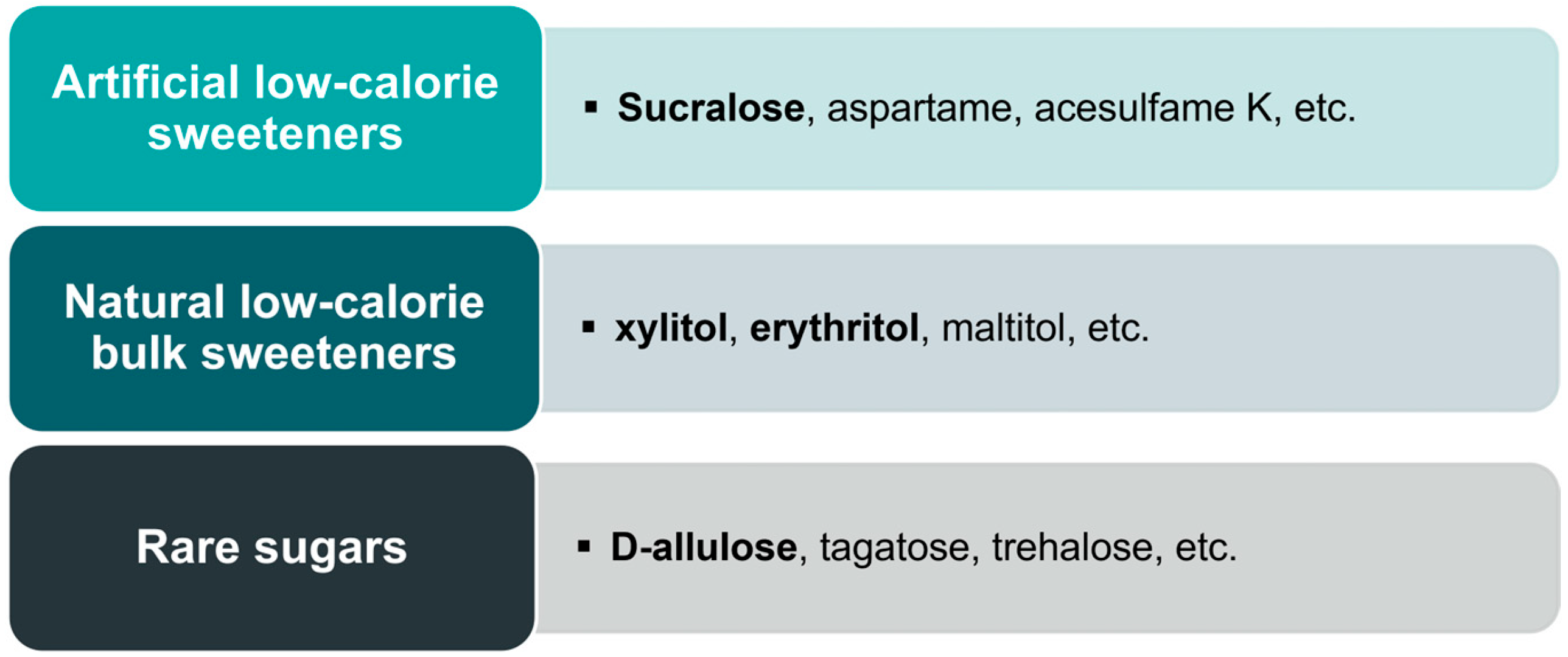
Sugar consumption is known to be associated with a whole range of adverse health effects, including overweight status and type II diabetes mellitus. In 2015, the World Health Organization issued a guideline recommending the reduction of sugar intake. In this context, alternative sweeteners have gained interest as sugar substitutes to achieve this goal without loss of the sweet taste. This review aims to provide an overview of the scientific literature and establish a reference tool for selected conventional sweeteners (sucrose, glucose, and fructose) and alternative sweeteners (sucralose, xylitol, erythritol, and D-allulose), specifically focusing on their important metabolic effects. The results show that alternative sweeteners constitute a diverse group, and each substance exhibits one or more metabolic effects. Therefore, no sweetener can be considered to be inert. Additionally, xylitol, erythritol, and D-allulose seem promising as alternative sweeteners due to favorable metabolic outcomes. These alternative sweeteners replicate the benefits of sugars (e.g., sweetness and gastrointestinal hormone release) while circumventing the detrimental effects of these substances on human health.
Keywords: glucose; fructose; sucrose; erythritol; xylitol; sucralose; D-allulose; sweeteners; satiation mechanisms; metabolic effects glucose; fructose; sucrose; erythritol; xylitol; sucralose; D-allulose; sweeteners; satiation mechanisms; metabolic effects