Article

Association of Low Protein-to-Carbohydrate Energy Ratio with Cognitive Impairment in Elderly Type 2 Diabetes Patients


1
Vascular and Metabolic Diseases Research Group, Endocrinology Department, Son Llàtzer University Hospital, Health Research Institute of the Balearic Islands (IdISBa), 07120 Palma de Mallorca, Spain
2
Laboratory of Renal Lithiasis Research, Department of Chemistry, University of Balearic Islands, Research Institute of Heath Science (IUNICS), Health Research Institute of Balearic Islands (IdISBa), 07120 Palma de Mallorca, Spain
3
CIBER Fisiopatología de la Obesidad y Nutrición (CIBERObn), Instituto de Salud Carlos III, 28029 Madrid, Spain
4
Neuropsychology and Cognition, Department of Psychology, Research Institute of Heath Science (IUNICS), University of Balearic Islands, Health Research Institute of Balearic Islands (IdISBa), 07120 Palma de Mallorca, Spain
5
Neurology Department, Son Llàtzer University Hospital, 07198 Palma de Mallorca, Spain
6
Neuroradiology Department, Son Llàtzer University Hospital, 07198 Palma de Mallorca, Spain
7
Balearic Research Group on Genetic Cardiopathies, Sudden Death, and TTR Amyloidosis, Health Research Institute of the Balearic Islands (IdISBa), 07120 Palma de Mallorca, Spain
8
Neuroopthalmology Department, Son Llàtzer University Hospital, 07198 Palma de Mallorca, Spain
9
Clinical Analysis Department, Son Llàtzer University Hospital, 07198 Palma de Mallorca, Spain
10
Clinical Toxicology Research Group, Health Research Institute of the Balearic Islands (IdISBa), 07120 Palma de Mallorca, Spain
11
Translational Research in Aging and Longevity (TRIAL) Group, Health Research Institute of the Balearic Islands (IdISBa), 07120 Palma de Mallorca, Spain
12
Faculty of Experimental Sciences, Universidad Francisco de Vitoria (UFV), 28223 Madrid, Spain
*
Author to whom correspondence should be addressed.
Nutrients 2024, 16(22), 3888; https://doi.org/10.3390/nu16223888
Submission received: 21 October 2024 / Revised: 7 November 2024 / Accepted: 12 November 2024 / Published: 14 November 2024
(This article belongs to the Section Geriatric Nutrition)

Abstract

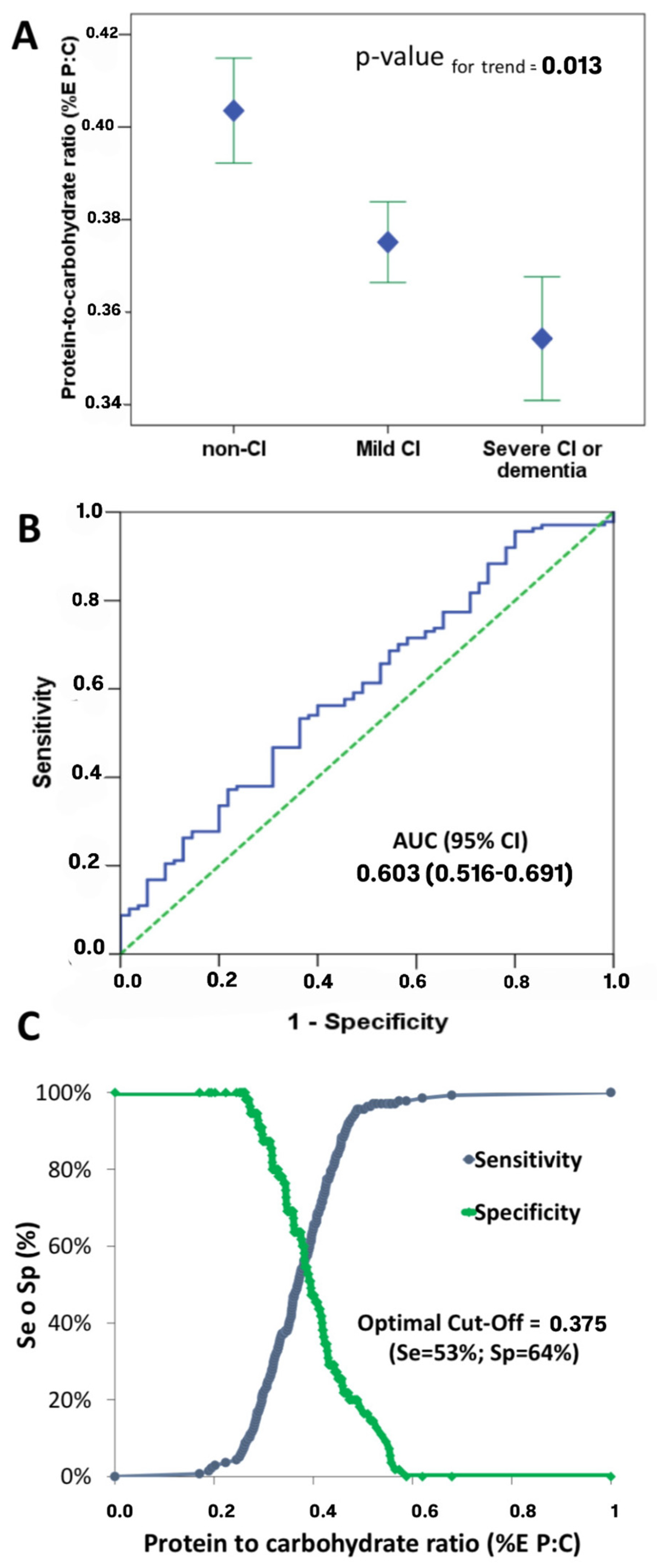
Background/Objectives: The relationship between macronutrient intake and cognitive decline in older adults with type 2 diabetes mellitus (T2DM) remains underexplored. Methods: This cross-sectional study aimed to evaluate the association between the protein-to-carbohydrate energy ratio (%E:P) and cognitive impairment among 192 elderly T2DM patients. Cognitive function was assessed using the Montreal Cognitive Assessment (MoCA) and the Self-Administered Gerocognitive Exam (SAGE), while dietary intake data, including (%E:P), was gathered using a validated semi-quantitative food frequency questionnaire. Results: Participants had a mean age of 71 ± 6 years, 46.4% were female, and the median BMI was 30 ± 4 kg/m2. After adjusting for confounding variables, patients in the highest (%E:P) tertile showed significantly higher MoCA and SAGE scores compared to those in the lowest tertile (p < 0.005). We identified an optimal (%E:P) threshold of 0.375 for predicting cognitive impairment, with a sensitivity of 53% and specificity of 64%. Conclusions: These findings suggest that a lower (%E:P) ratio may be a risk factor for cognitive impairment in elderly T2DM patients. Monitoring this ratio may serve as an early detection tool for cognitive deterioration. Moreover, current protein intake recommendations for older adults with T2DM may be insufficient to prevent cognitive impairment. Further research is needed to establish optimal dietary guidelines for this population.
Keywords: type 2 diabetes mellitus; cognitive impairment; diet; protein intake; protein-to-carbohydrate ratio; cognitive performance type 2 diabetes mellitus; cognitive impairment; diet; protein intake; protein-to-carbohydrate ratio; cognitive performance