Article

The Association between Dietary Iron Intake and Incidence of Dementia in Adults Aged 60 Years or over in the UK Biobank


1
Faculty of Medicine, Dentistry and Health Sciences, University of Melbourne, Melbourne, VIC 3010, Australia
2
Centre for Eye Research Australia, Royal Victorian Eye and Ear Hospital, Melbourne, VIC 3002, Australia
3
Faculty of Medicine, Nursing and Health Science, Monash University, Clayton, VIC 3800, Australia
4
Charles Perkins Centre, Faculty of Medicine and Health, University of Sydney, Sydney, NSW 2006, Australia
5
Melbourne School of Population and Global Health, University of Melbourne, Melbourne, VIC 3010, Australia
6
Austin Hospital, University of Melbourne, Melbourne, VIC 3084, Australia
7
Monash e-Research Center, Faculty of Engineering, Airdoc Research, Nvidia AI Technology Research Center, Monash University, Melbourne, VIC 3800, Australia
8
State Key Laboratory of Ophthalmology, Zhongshan Ophthalmic Center, Sun Yat-sen University, Guangzhou 510060, China
9
Guangdong Eye Institute, Department of Ophthalmology, Guangdong Provincial People’s Hospital, Guangdong Academy of Medical Sciences, Guangzhou 510080, China
*
Author to whom correspondence should be addressed.
Nutrients 2023, 15(2), 260; https://doi.org/10.3390/nu15020260
Submission received: 18 November 2022 / Revised: 22 December 2022 / Accepted: 26 December 2022 / Published: 4 January 2023
(This article belongs to the Section Nutritional Epidemiology)

Abstract

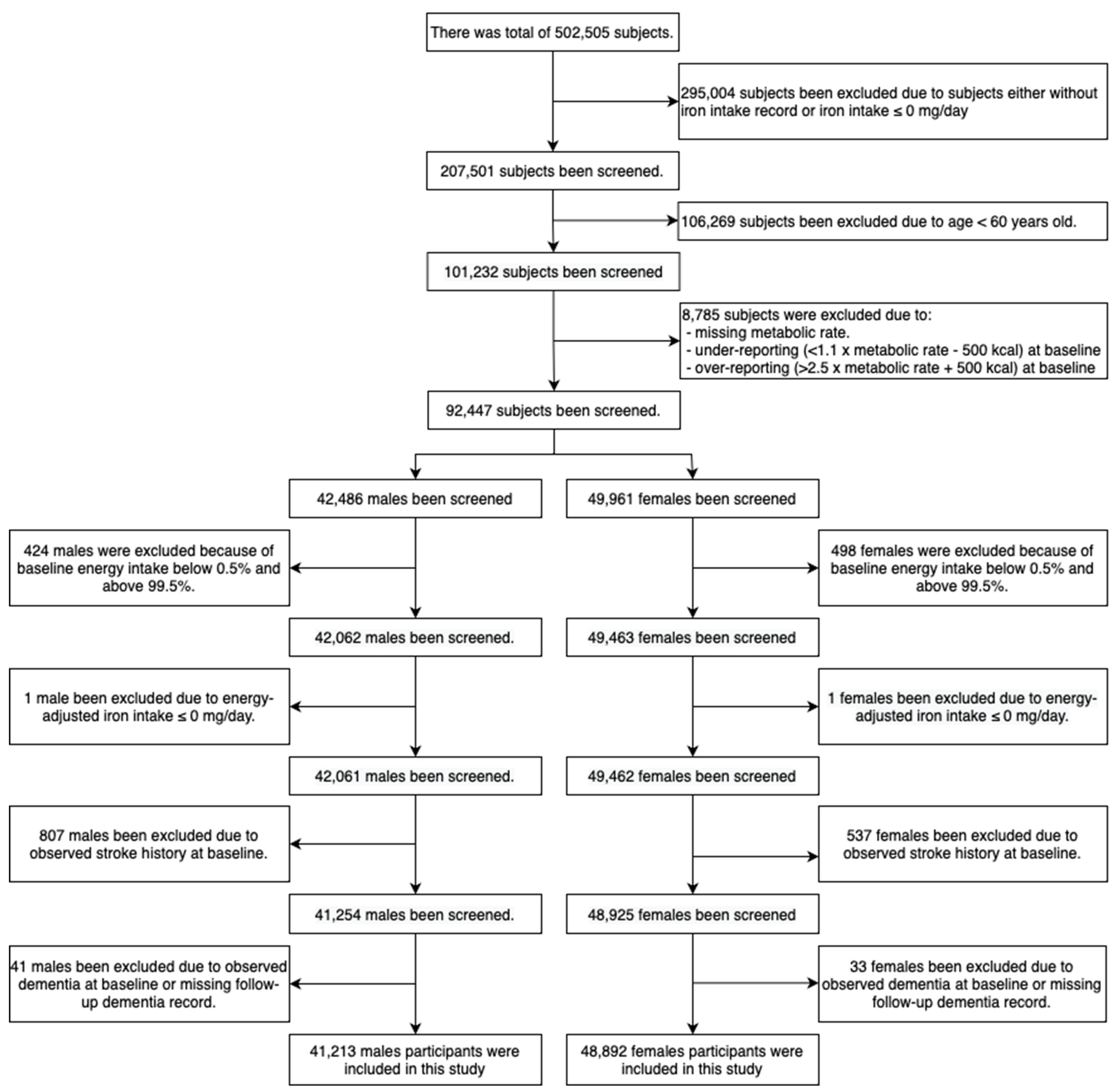
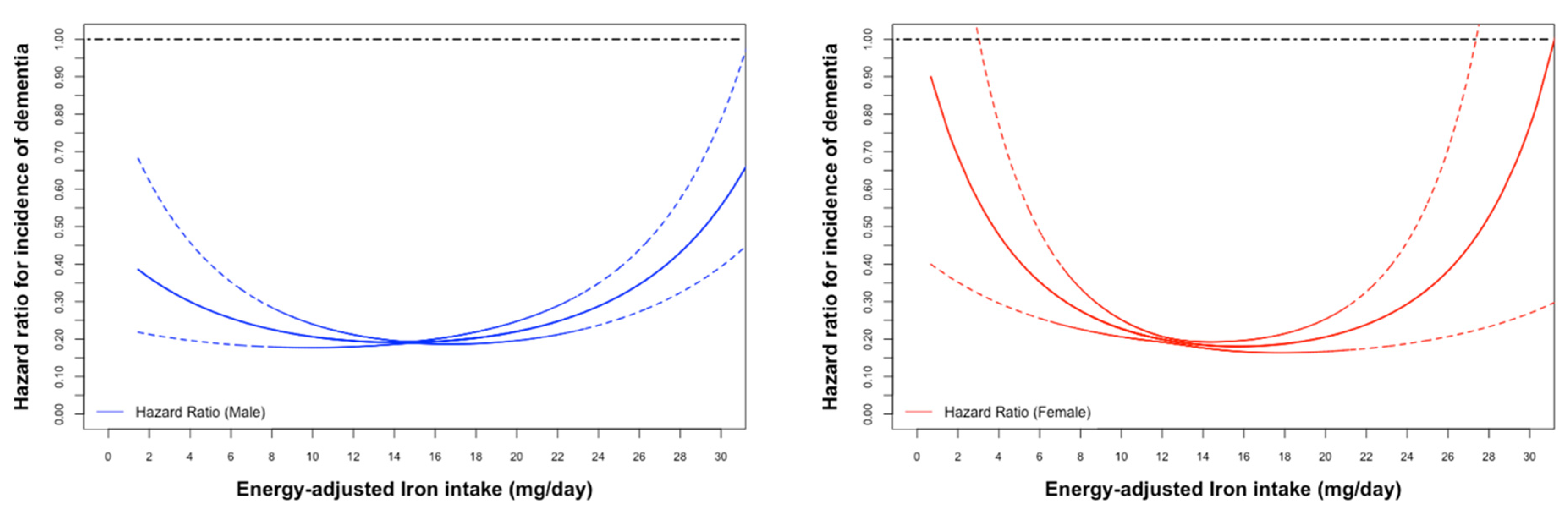
Background Several studies have investigated the association between dietary iron intake and cognitive impairment, but little is known about the relationship between iron intake and dementia incidence. Objectives This study explored the association between dietary iron intake and incident dementia in males and females. Whether this association was modified by factors such as age and medical diseases was also examined. Methods We included 41,213 males and 48,892 females aged 60 years or over, from the UK-Biobank cohort. Dietary iron intake was measured using a web-based 24-h dietary recall questionnaire from between 2009 and 2012. Incident dementia was ascertained using hospital inpatient records and death registers until April 2021. Cox proportional regression models examined the association between iron intake and incident dementia, and hazard ratio curves were constructed with knots from the analysis indicating insufficient or excessive iron intake. Results During a mean follow-up of 11.8 years, 560 males and 492 females developed dementia. A non-linear relationship between iron intake and incident dementia was observed in both males and females. The lowest incidence rates were observed in the higher iron intake quintile (Q4: ≥15.73, <17.57 mg/day) for males, and the intermediate iron intake quintile (Q3: ≥12.4, <13.71 mg/day) for females. Among those aged 60 and above, all-cause dementia in males was associated with deficient iron intake (Q1 versus Q4: Hazard ratio [HR]: 1.37, 95% Confidence interval [95%CI]: 1.01–1.86, p = 0.042) and excessive iron intake (Q5 versus Q4: HR: 1.49, 95%CI: 1.14–1.96, p = 0.003), whilst significant associations between all-cause dementia and deficient iron intake were only observed in females without hypertension. Smoking status was a significant moderator (p-value for trend = 0.017) for dementia in males only. Conclusions Excessive iron intake (≥17.57 mg/day) is associated with a higher incidence of all-cause dementia in males and smoking status modified this association amongst males. Deficient iron intake (<10.93 mg/day) was associated with a higher incidence of all-cause dementia in females without a history of hypertension.
Keywords: dietary iron; dementia; gender; modification analysis; sensitivity analysis dietary iron; dementia; gender; modification analysis; sensitivity analysis