Review

Dietary Natural Compounds and Vitamins as Potential Cofactors in Uterine Fibroids Growth and Development


by
Iwona Szydłowska
1,*,
Jolanta Nawrocka-Rutkowska
1,
Agnieszka Brodowska
1,
Aleksandra Marciniak
1,
Andrzej Starczewski
1 and
Małgorzata Szczuko
2
1
Department of Gynecology, Endocrinology and Gynecological Oncology, Pomeranian Medical University, 71-252 Szczecin, Poland
2
Department of Human Nutrition and Metabolomics, Pomeranian Medical University, 71-460 Szczecin, Poland
*
Author to whom correspondence should be addressed.
Nutrients 2022, 14(4), 734; https://doi.org/10.3390/nu14040734
Submission received: 13 January 2022 / Revised: 3 February 2022 / Accepted: 7 February 2022 / Published: 9 February 2022
(This article belongs to the Special Issue Nutrition and Specific Diseases by Women during the Life Course)

Abstract

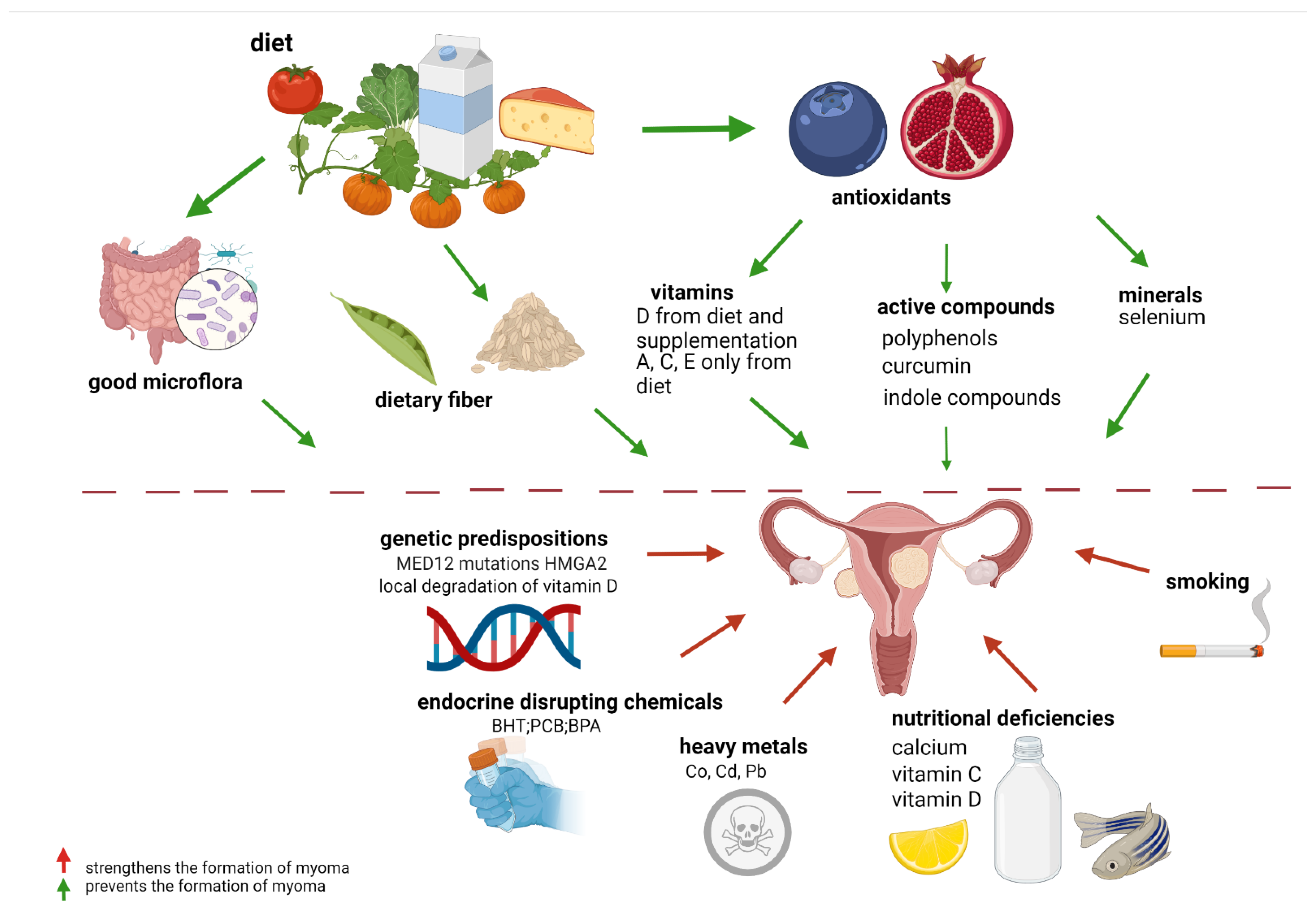
An analysis of the literature generated within the past 20 year-span concerning risks of uterine fibroids (UFs) occurrence and dietary factors was carried out. A link between Vitamin D deficiency and UFs formation is strongly indicated, making it a potent compound in leiomyoma therapy. Analogs of the 25-hydroxyvitamin D3, not susceptible to degradation by tissue 24-hydroxylase, appear to be especially promising and tend to show better therapeutic results. Although research on the role of Vitamin A in the formation of fibroids is contradictory, Vitamin A-enriched diet, as well as synthetic retinoid analogues, may be preventative or limit the growth of fibroids. Unambiguous conclusions cannot be drawn regarding Vitamin E and C supplementation, except for alpha-tocopherol. Alpha-tocopherol as a phytoestrogen taking part in the modulation of estrogen receptors (ERs) involved in UF etiology, should be particularly avoided in therapy. A diet enriched in fruits and vegetables, as sources of carotenoids, polyphenols, quercetin, and indole-3-carbinol, constitutes an easily modifiable lifestyle element with beneficial results in patients with UFs. Other natural substances, such as curcumin, can reduce the oxidative stress and protect against inflammation in leiomyoma. Although the exact effect of probiotics on uterine fibroids has not yet been thoroughly evaluated at this point, the protective role of dairy products, i.e., yogurt consumption, has been indicated. Trace elements such as selenium can also contribute to antioxidative and anti-inflammatory properties of a recommended diet. In contrast, heavy metals, endocrine disrupting chemicals, cigarette smoking, and a diet low in antioxidants and fiber were, alongside genetic predispositions, associated with UFs formation.
Keywords: uterine fibroids; diet; green tea; curcumin; vitamin A, C, D, E; selenium; trace elements uterine fibroids; diet; green tea; curcumin; vitamin A, C, D, E; selenium; trace elements