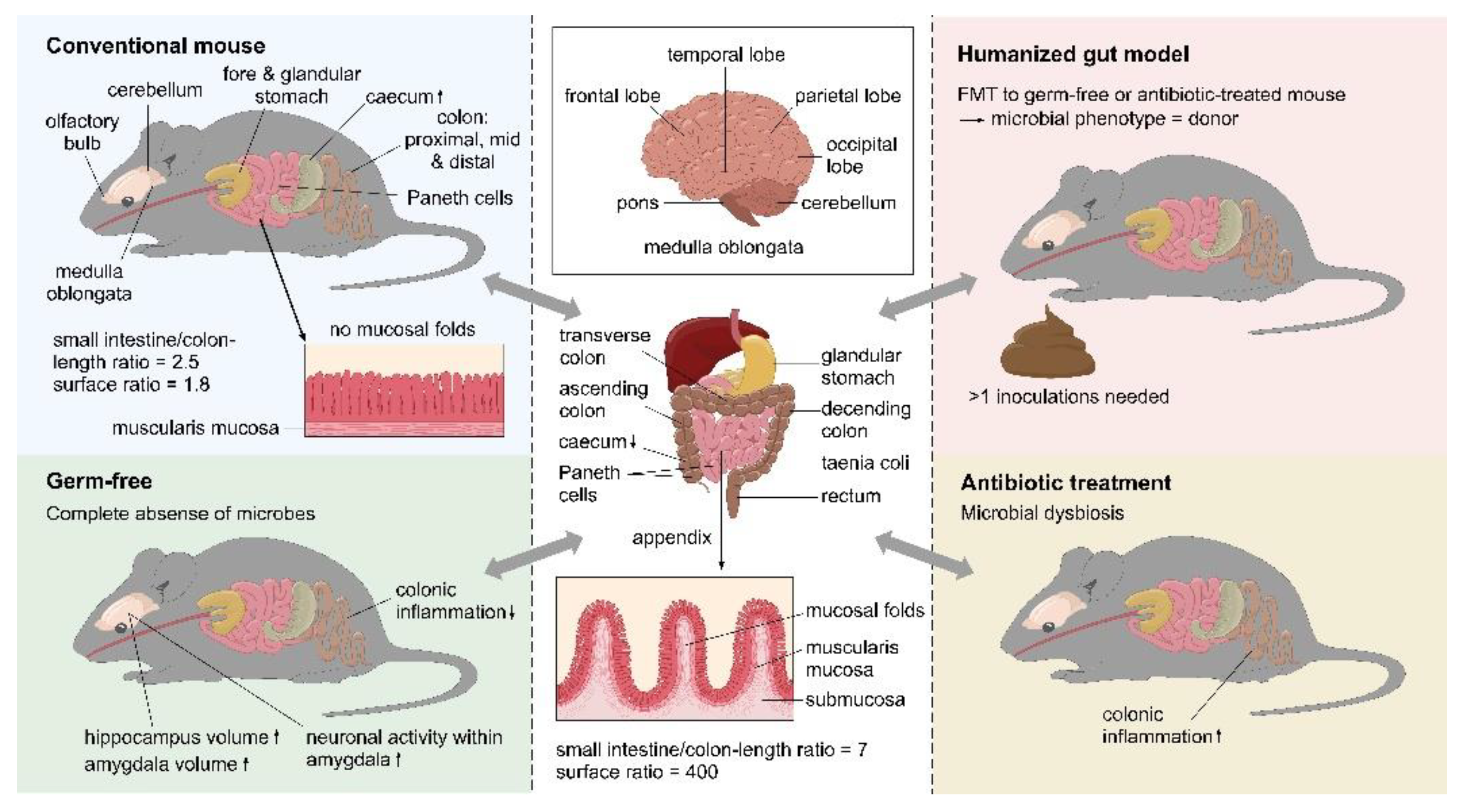
One Giant Leap from Mouse to Man: The Microbiota–Gut–Brain Axis in Mood Disorders and Translational Challenges Moving towards Human Clinical Trials

Abstract
Share and Cite
Forssten, S.D.; Ouwehand, A.C.; Griffin, S.M.; Patterson, E. One Giant Leap from Mouse to Man: The Microbiota–Gut–Brain Axis in Mood Disorders and Translational Challenges Moving towards Human Clinical Trials. Nutrients 2022, 14, 568. https://doi.org/10.3390/nu14030568
Forssten SD, Ouwehand AC, Griffin SM, Patterson E. One Giant Leap from Mouse to Man: The Microbiota–Gut–Brain Axis in Mood Disorders and Translational Challenges Moving towards Human Clinical Trials. Nutrients. 2022; 14(3):568. https://doi.org/10.3390/nu14030568
Chicago/Turabian StyleForssten, Sofia D., Arthur C. Ouwehand, Síle M. Griffin, and Elaine Patterson. 2022. "One Giant Leap from Mouse to Man: The Microbiota–Gut–Brain Axis in Mood Disorders and Translational Challenges Moving towards Human Clinical Trials" Nutrients 14, no. 3: 568. https://doi.org/10.3390/nu14030568
APA StyleForssten, S. D., Ouwehand, A. C., Griffin, S. M., & Patterson, E. (2022). One Giant Leap from Mouse to Man: The Microbiota–Gut–Brain Axis in Mood Disorders and Translational Challenges Moving towards Human Clinical Trials. Nutrients, 14(3), 568. https://doi.org/10.3390/nu14030568