Review

The Impact of Dietary Factors on the Sleep of Athletically Trained Populations: A Systematic Review

1
Centre for Sport Research, Deakin University, Geelong, VIC 3220, Australia
2
Appleton Institute for Behavioural Science, Central Queensland University, Wayville, SA 5034, Australia
3
Institute for Physical Activity and Nutrition (IPAN), School of Exercise and Nutrition Sciences, Deakin University, Geelong, VIC 3220, Australia
*
Author to whom correspondence should be addressed.
Nutrients 2022, 14(16), 3271; https://doi.org/10.3390/nu14163271
Submission received: 8 July 2022 / Revised: 8 August 2022 / Accepted: 8 August 2022 / Published: 10 August 2022
(This article belongs to the Section Nutrition and Public Health)

Abstract

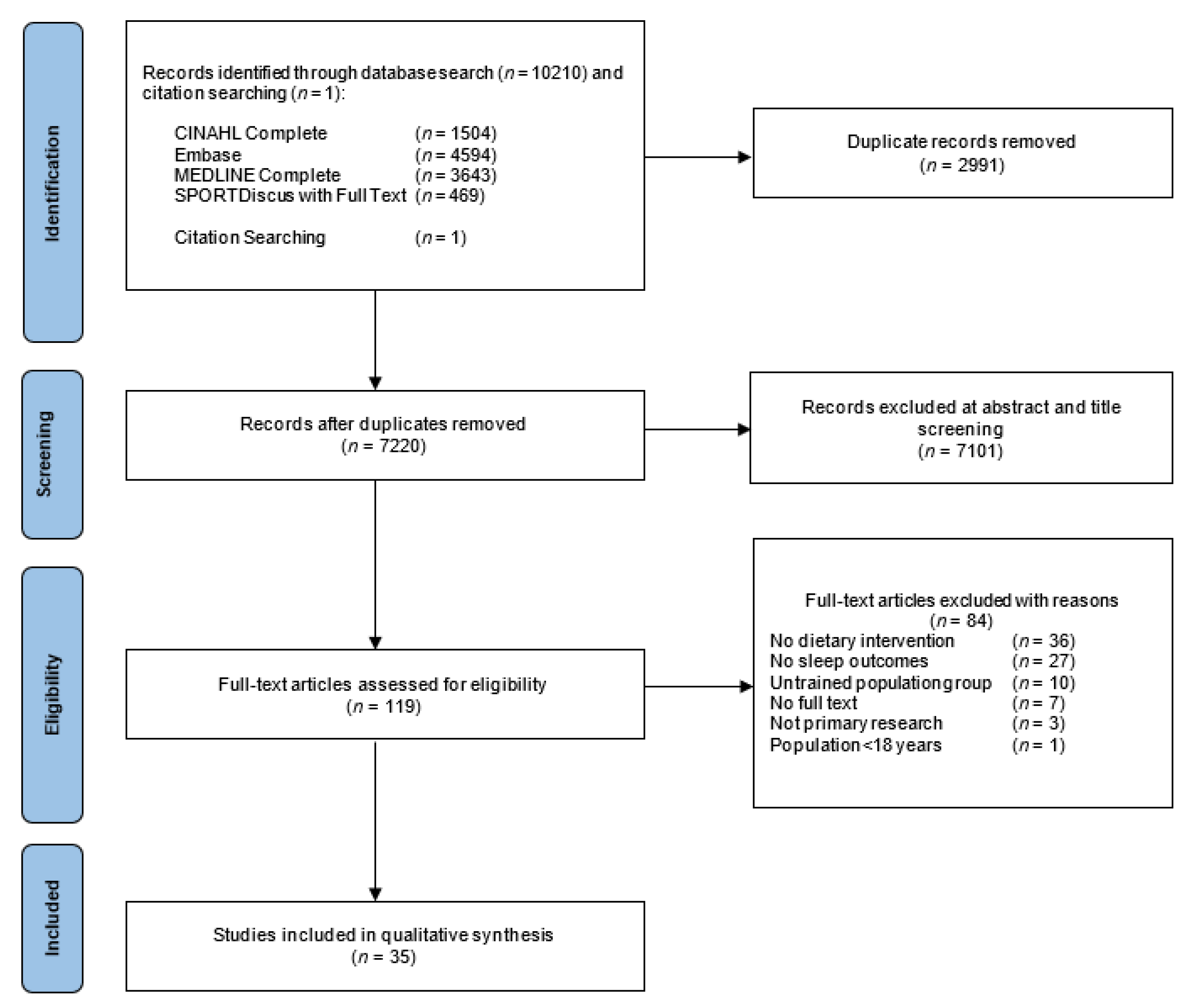
Many athletic populations report poor sleep, especially during intensive training and competition periods. Recently, diet has been shown to significantly affect sleep in general populations; however, little is known about the effect diet has on the sleep of athletically trained populations. With sleep critical for optimal recovery and sports performance, this systematic review aimed to evaluate the evidence demonstrating that dietary factors influence the sleep of athletically trained populations. Four electronic databases were searched from inception to May 2022, with primary research articles included if they contained a dietary factor(s), an outcome measure of sleep or sleepiness, and participants could be identified as ‘athletically trained’. Thirty-five studies were included, with 21 studies assessed as positive quality, 13 as neutral, and one as negative. Sleep or sleepiness was measured objectively in 46% of studies (n = 16). The review showed that evening (≥5 p.m.) caffeine intakes >2 mg·kg−1 body mass decreased sleep duration and sleep efficiency, and increased sleep latency and wake after sleep onset. Evening consumption of high glycaemic index carbohydrates and protein high in tryptophan may reduce sleep latency. Although promising, more research is required before the impact of probiotics, cherry juice, and beetroot juice on the sleep of athletes can be resolved. Athletic populations experiencing sleep difficulties should be screened for caffeine use and trial dietary strategies (e.g., evening consumption of high GI carbohydrates) to improve sleep.
Keywords: athlete; caffeine; carbohydrates; diet; health; nutrition; protein; sport athlete; caffeine; carbohydrates; diet; health; nutrition; protein; sport