Article

Risk of Low Energy Availability among Female and Male Elite Runners Competing at the 26th European Cross-Country Championships

1
Nutrition & Metabolism, NOVA Medical School, Faculdade de Ciências Médicas, Universidade NOVA de Lisboa, Campo dos Mártires da Pátria, 1169-056 Lisboa, Portugal
2
Exercise and Health Laboratory, CIPER, Faculdade de Motricidade Humana, Universidade de Lisboa, Estrada da Costa, 1499-002 Cruz-Quebrada, Portugal
3
CINTESIS, NOVA Medical School, NMS, Universidade Nova de Lisboa, 1169-056 Lisboa, Portugal
4
Medical & Anti-Doping Commission, European Athletics, CH-1003 Lausanne, Switzerland
*
Author to whom correspondence should be addressed.
Nutrients 2021, 13(3), 873; https://doi.org/10.3390/nu13030873
Submission received: 14 January 2021 / Revised: 18 February 2021 / Accepted: 3 March 2021 / Published: 7 March 2021
(This article belongs to the Special Issue Diet, Energy Intake and Body Composition for Health and Performance)

Abstract

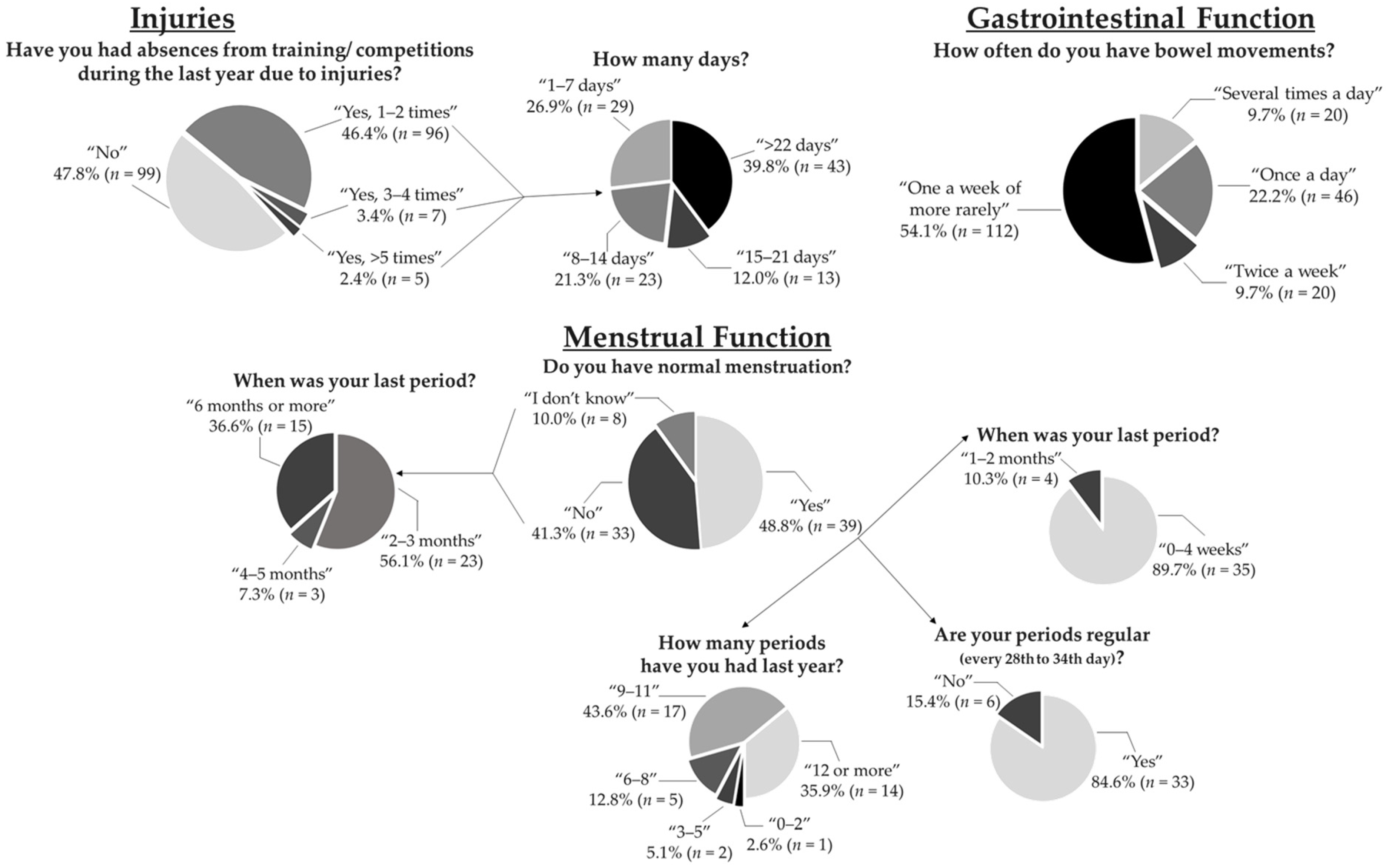
Low energy availability (LEA) causes impaired physiological functioning. Cross-country running is a weight-sensitive sport, making athletes more prone to LEA. We aimed to estimate the prevalence of elite European cross-country athletes at risk of LEA using the LEA in Females Questionnaire (LEAF-Q) and to analyze demographic and physical characteristics that are associated with LEA. Athletes ≥ 18 years competing at the 26th European Cross-Country Championships (n = 602) were invited to complete a questionnaire (sociodemographic, training, anthropometric characteristics, and LEAF-Q). A total of 207 valid surveys were collected (83 females, 22.1 (4.0) years, and 124 males, 22.3 (4.1) years), and 16 surveys were excluded. A high prevalence of athletes at risk of LEA (64.3%) was observed, being higher in females than in males (79.5 and 54.0% respectively, p < 0.001). More than half of athletes (54.1%, n = 112) reported bowel movements once a week or more rarely, while 33 female athletes (41.3%) did not report normal menstruation. Overall, cross-country athletes are at high risk of LEA. Moreover, a high prevalence of gastrointestinal and menstrual impairments was reported. Hence, athletes should be followed by multidisciplinary teams to inform, prevent, and treat LEA and its effects.
Keywords: nutrition; exercise; questionnaire; injuries; gastrointestinal function; menstrual function nutrition; exercise; questionnaire; injuries; gastrointestinal function; menstrual function