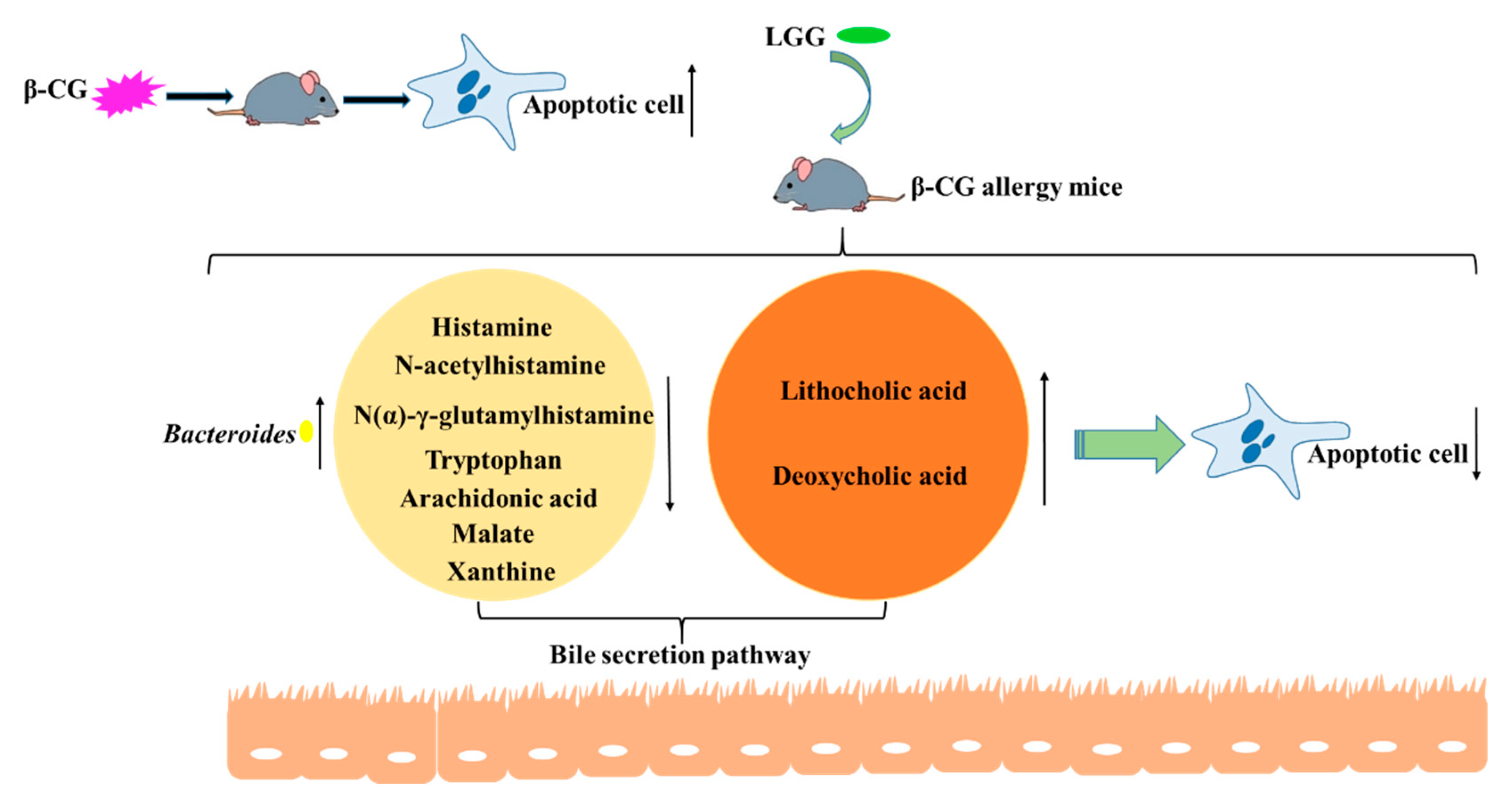
Lactobacillus rhamnosus GG Reduces β-conglycinin-Allergy-Induced Apoptotic Cells by Regulating Bacteroides and Bile Secretion Pathway in Intestinal Contents of BALB/c Mice

Abstract
Share and Cite
Chen, X.; Wu, Y.; Hu, Y.; Zhang, Y.; Wang, S. Lactobacillus rhamnosus GG Reduces β-conglycinin-Allergy-Induced Apoptotic Cells by Regulating Bacteroides and Bile Secretion Pathway in Intestinal Contents of BALB/c Mice. Nutrients 2021, 13, 55. https://doi.org/10.3390/nu13010055
Chen X, Wu Y, Hu Y, Zhang Y, Wang S. Lactobacillus rhamnosus GG Reduces β-conglycinin-Allergy-Induced Apoptotic Cells by Regulating Bacteroides and Bile Secretion Pathway in Intestinal Contents of BALB/c Mice. Nutrients. 2021; 13(1):55. https://doi.org/10.3390/nu13010055
Chicago/Turabian StyleChen, Xiaoxu, Yuekun Wu, Yaozhong Hu, Yan Zhang, and Shuo Wang. 2021. "Lactobacillus rhamnosus GG Reduces β-conglycinin-Allergy-Induced Apoptotic Cells by Regulating Bacteroides and Bile Secretion Pathway in Intestinal Contents of BALB/c Mice" Nutrients 13, no. 1: 55. https://doi.org/10.3390/nu13010055
APA StyleChen, X., Wu, Y., Hu, Y., Zhang, Y., & Wang, S. (2021). Lactobacillus rhamnosus GG Reduces β-conglycinin-Allergy-Induced Apoptotic Cells by Regulating Bacteroides and Bile Secretion Pathway in Intestinal Contents of BALB/c Mice. Nutrients, 13(1), 55. https://doi.org/10.3390/nu13010055