Article

Recurrent Climate-Driven Dieback of Subalpine Grasslands in Central Europe Detected from Multi-Decadal Landsat and Sentinel-2 Time Series


1
Department of Geography, Faculty of Science, Masaryk University, Kotlářská 267/2, 61137 Brno, Czech Republic
2
Department of Landscape Ecology, Landscape Research Institute, Lidická 25/27, 60200 Brno, Czech Republic
3
Global Change Research Institute of the Czech Academy of Sciences, Bělidla 986/4a, 60300 Brno, Czech Republic
4
Department of Agrosystems and Bioclimatology, Mendel University in Brno, Zemědělská 1, 61300 Brno, Czech Republic
5
Department of Vegetation Ecology, Institute of Botany, Czech Academy of Sciences, Lidická 25/27, 60200 Brno, Czech Republic
6
Department of Botany, Faculty of Science, Palacký University in Olomouc, Šlechtitelů 27, 77900 Olomouc, Czech Republic
*
Author to whom correspondence should be addressed.
Remote Sens. 2026, 18(9), 1328; https://doi.org/10.3390/rs18091328
Submission received: 12 February 2026 / Revised: 15 April 2026 / Accepted: 24 April 2026 / Published: 26 April 2026

Highlights

What are the main findings?
  • Repeated large-scale dieback of subalpine grasslands, which are the priority habitats for nature conservation, appears linked to drought extremes and winter frost events on shallow soils, with spatial patterns strongly controlled by local geomorphology.
  • Dieback episodes differ in duration and in the subsequent capacity of vegetation to recover.
What are the implications of the main findings?
  • Observed diebacks likely represent an early signal of broader climate-driven changes in subalpine ecosystems of Central Europe. Although currently spatially limited, they may expand under ongoing global change and therefore require targeted monitoring and adaptive conservation management.
  • Long-term satellite-based monitoring has proven effective for tracking dieback dynamics and identifying areas suitable for targeted restoration measures.

Abstract

Subalpine grasslands represent highly sensitive ecosystems that are increasingly exposed to climate extremes, yet their long-term disturbance dynamics remain poorly documented. This study investigates climate-driven dieback of subalpine grasslands in Central Europe using a harmonized, multi-decadal satellite time series. We analyzed Landsat (TM, ETM+, OLI, OLI-2) and Sentinel-2 imagery spanning 1984–2024 to detect changes in grassland condition, supported by field-based validation, climatic indices, and geomorphological analysis. Several spectral indices related to non-photosynthetic vegetation were evaluated, with the Normalized Burn Ratio (NBR) providing the best discrimination of dead grassland. In spatially grouped cross-validation, NBR achieved very high accuracy for dead versus non-dead grassland, with AUC = 0.9996, precision = 1.00, recall = 0.82, and F1-score = 0.90 for Sentinel-2, and AUC = 0.9982, precision = 1.00, recall = 0.62, and F1-score = 0.76 for Landsat 9. Retrospective mapping revealed four dieback events since 2000: two short-term episodes with rapid within-season recovery (2000, 2003) and two long-term events characterized by persistent degradation and slow regeneration (2012, late 2018–2019). The largest short-term event, in 2003, affected 42.19 ha of total dieback and 96.95 ha including partially damaged or regenerating grassland. Dieback extent was negatively associated with water balance deficit, strongest for SPEI-12 (ρ = −0.548, p = 0.002), while winter frost under shallow-soil conditions likely contributed to long-term damage in 2012. Geomorphological analysis indicated that elevation, terrain curvature, and, to a lesser extent, wind exposure are the primary controls on dieback susceptibility, highlighting the importance of fine-scale environmental controls. Our results demonstrate the value of long-term, multi-sensor satellite observations for detecting and interpreting climate-driven disturbances in subalpine grasslands and provide a transferable framework to support monitoring and conservation of mountain ecosystems under ongoing climate change.

1. Introduction

Alpine and subalpine ecosystems are among the most vulnerable to global change, primarily due to their limited and fragmented spatial distribution, confinement to higher elevations, and the overall adaptation of mountain species to cool and moist environmental conditions, especially in the temperate zone of Europe [1,2,3]. The ongoing progression of global warming is well documented [4] and is inducing significant alterations in subalpine ecosystems. Particularly dramatic transformations may be observed in subalpine habitats of mid-latitude mountain ranges, such as the Sudetes, where subalpine grasslands form the highest vegetation belt. One of the most notable changes is the upward shift in the treeline, which is primarily constrained by temperature [1,5]. This, in turn, is already contributing to a decline in the extent of treeless habitats [6,7], along with structural and functional modifications within them. These include the upward movement of species distributions [8], compositional shifts in subalpine communities [9,10,11,12], changes in plant physiology and reproduction [13,14], and variations in nutrient cycling and microbial activity [15,16].
In addition to rising temperatures, climate change is modifying precipitation patterns [17], increasing the frequency, magnitude, and duration of extreme events such as droughts [18], and reducing the accumulation of winter snowpack [19]. Historically, alpine and subalpine ecosystems have not been regularly exposed to drought conditions [20]. Within these environments, subalpine grasslands may exhibit comparatively lower drought resistance than forested ecosystems, which can be attributed to their shallower rooting systems. As a result, persistent soil moisture deficits may lead to severe water stress, declines in productivity, and potential dieback of grassland vegetation [21]. Additionally, diminished snow depth may lead to more severe soil freezing, increasing the risk of freezing damage to perennial vegetative structures [22,23].
Initially, the effects of reduced snow cover and early snowmelt [24,25,26], as well as extreme droughts [27,28,29], were extensively investigated in alpine and subalpine habitats, typically through manipulative experiments. These experiments have demonstrated that alpine grasslands may suffer severe declines in vitality, even leading to dieback [30].
Over the past two decades, reports of severe drought events in Central Europe have begun to emerge, underscoring their substantial impact on grassland vegetation. This recent dry period has been assessed as extraordinary in the context of the last two millennia [31]. In the Czech Republic, numerous episodes of early vegetation season (April–June) soil drought have been indicated using soil water balance model SoilClim [32,33], some of those fulfilling the conditions for being labeled as “flash droughts”, causing rapid decrease in soil water content in topsoil layer within only few weeks [34]. A notable reduction in primary productivity across Europe was documented already during the 2003 European heatwave [35]. Significant community composition changes were observed in mountain Nardus grasslands in the Rhön Mountains, Germany [36], following the severe summer droughts of 2015 [37] and 2018–2019 [38]. The impact of the same event on lowland grasslands was assessed via remote sensing in northeastern Germany [39], revealing a substantial increase in the non-photosynthetic fraction of grassland cover, particularly on less productive, sandy soils. The extreme drought of 2022 [40] caused notable dieback of dominant perennial grasses in open sandy grasslands in Hungary [41]. Prior to this, drought-induced dieback was reported in alpine Poa grasslands in Australia in 2007 [42].
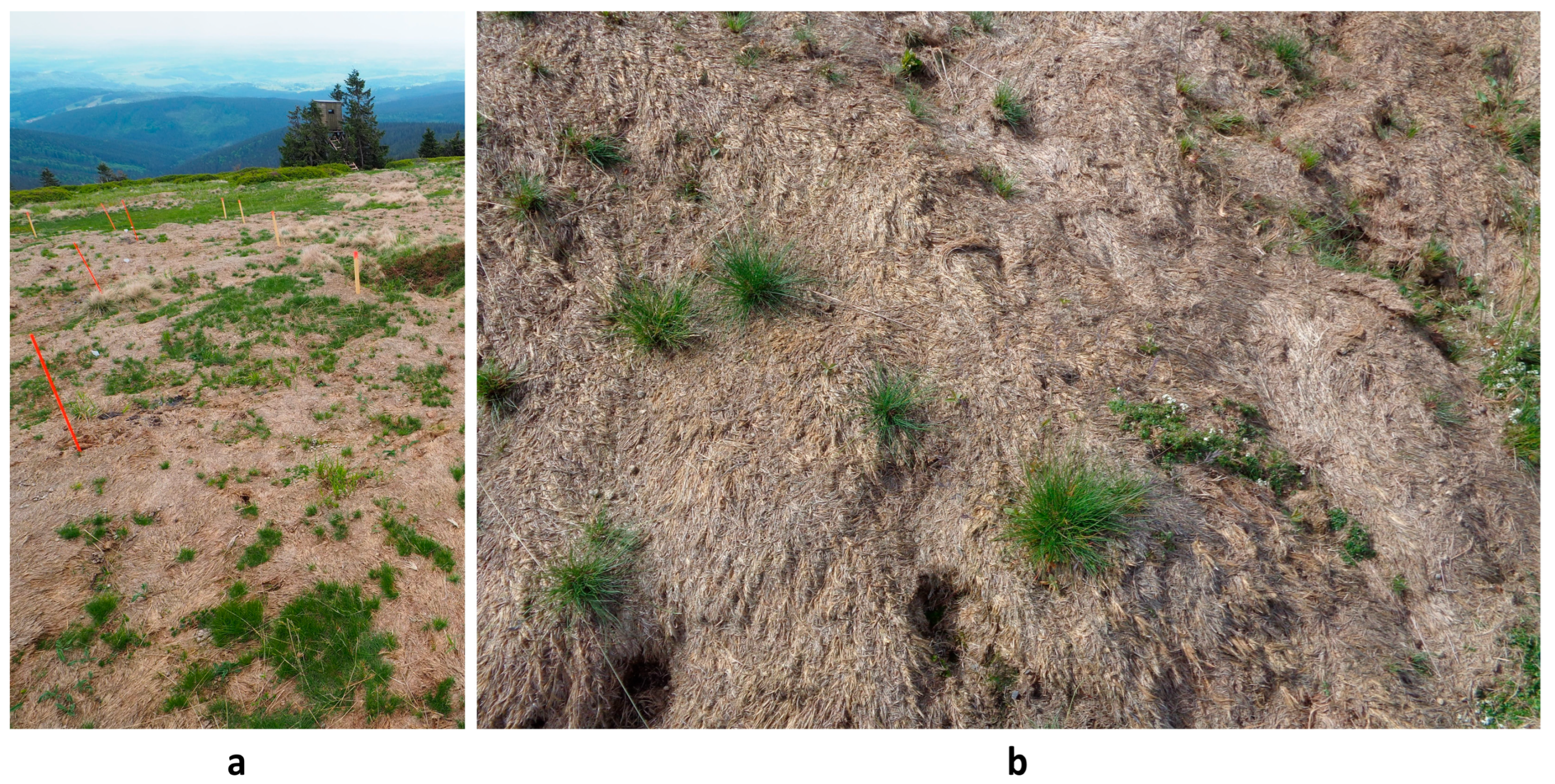
Repeated dieback of subalpine grasslands in the Hrubý Jeseník Mountains, Czech Republic, was first reported by local conservation authorities (Figure 1). In recent years, this phenomenon has attracted increasing scientific attention, with studies focusing on vegetation changes associated with dieback [43], evaluation of management approaches aimed at accelerating regeneration [44], and investigation of long-term land-use history as a potential contributing factor [45].
Remote sensing techniques offer extensive opportunities for monitoring vegetation cover dynamics in both near-real-time and retrospective analyses. This is particularly effective through indicators of non-photosynthetic biomass coupled with change detection methods. Specifically, the non-photosynthetic vegetation fraction (NPV) can be effectively indicated using a variety of spectral vegetation indices, collectively referred to as NPV indices. These have been addressed in numerous studies, many of which employ spectral unmixing methods (either regression-based or in combination with synthetic training data derived from spectral libraries) to differentiate NPV from bare soil and photosynthetic vegetation (PV) fractions [46,47,48,49,50]. Most NPV indices are designed to detect either the presence or absence of chlorophyll, primarily using red, red-edge, and near-infrared (NIR) bands [51,52]; or vegetation water-content deficits, using shortwave infrared (SWIR) bands [53,54]. Notably, a generalized framework for drought monitoring in Central European grasslands using Sentinel-2 time series was proposed by Kowalski et al. [55], building on the previously developed Normalized Difference Fraction Index (NDFI) [39]. Although the applicability of specific NPV indices may vary by site, the studies demonstrate that NPV index-based detection of dead phytomass in grasslands can serve as a robust indicator for examining extreme vegetation changes. Since the NPV/PV fraction ratio is also influenced by phenological cycles characterized by seasonal grassland growth and senescence, utilizing time series of multi- and hyperspectral imagery, rather than single-date images, can greatly enhance our ability to distinguish irreversible changes such as dieback from regular seasonal variability [48,56,57,58].
In this study, we pursued three main scientific objectives:
  • To identify the most suitable Non-Photosynthetic Vegetation (NPV) index for detecting dieback in subalpine grasslands of the Hrubý Jeseník Mountains.
  • To perform a retrospective analysis using archival satellite imagery to determine the onset and progression of dieback events, their spatial localization and extent, as well as the post-event recovery dynamics of subalpine grasslands.
  • To evaluate the influence of climate extremes and geomorphology on the spatiotemporal distribution of dieback events, including the relative contribution of factors to explaining the phenomenon.

2. Materials and Methods

2.1. Study Area

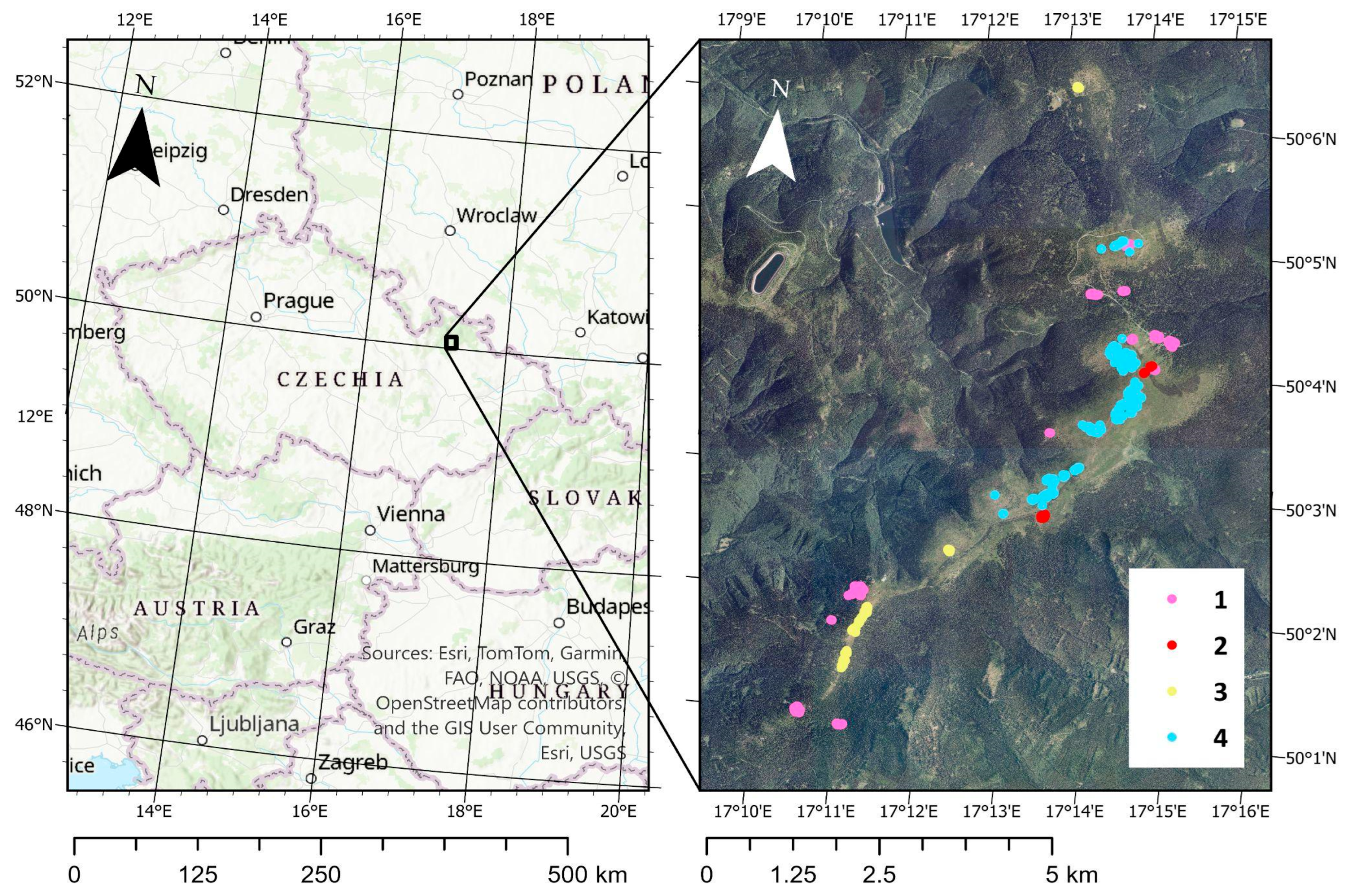
The study area is situated in the southern part of the Hrubý Jeseník Mountains in northeastern Czech Republic. This mountain range represents the second-highest massif in the country and forms part of the Sudetes. The investigated area is restricted to the treeless section of the main mountain ridge, which extends from southwest to northeast and encompasses the highest peaks of the range at an altitude of approximately 1330 to 1491 m above sea level. The location and spatial extent of the study area are shown in Figure 2.
The current treeline in the Hrubý Jeseník Mountains lies at approximately 1250–1300 m a.s.l. Above this elevation, the ridge is characterized by convex or plateau-like summits separated by concave saddles. The geological substrate is dominated by metamorphic rocks, primarily phyllites with minor occurrences of metadolerites, locally overlain or intermixed with deluvial sediments. Soils across the ridge are strongly acidic (pH in H2O varies from 3.5 to 4 in A horizons) and consist mainly of shallow, skeletal rankers and podzols. Peat bogs occur locally, most notably on the summit plateau of Velký Máj and in some saddle depressions. Soil depth is generally limited, rarely exceeding 40 cm even in saddle areas, and is particularly shallow in the southwestern part of the ridge near Břidličná, where depths of only 4–6 cm have been documented.
Climatic conditions in the study region reflect pronounced recent warming trends caused by the ongoing anthropogenic climate change. According to Dolák et al. [59], mean annual air temperature increased from 1.0 °C during the period 1961–1990 to 2.0 °C, or even 2.2 °C, according to Lipina and Šustková [60] in 1991–2020. Warming has been more pronounced during summer than in the winter. Long-term mean annual precipitation (1991–2020) ranges from 1180 mm at 1300–1400 m a.s.l. to 1254 mm above 1400 m a.s.l.
Vegetation above the upper treeline is dominated by three native habitat types. Siliceous short subalpine grasslands, habitat type 6150 in Natura 2000 classification, occur on flat mountain tops in climatically most extreme conditions. They are entirely dominated by three grass species: Avenella flexuosa, Festuca supina and Nardus stricta. The short subalpine grasslands are prone to sudden dieback and therefore subject of the present study. Subalpine tall grasslands, part of the habitat type 6430, are dominated by grasses Calamagrostis villosa and Luzula luzuloides, less frequently by Luzula sylvatica. Alpine dwarf-shrub vegetation, part of the habitat type 4060, is dominated by Calluna vulgaris, Vaccinium myrtillus and V. vitis-idaea. Parts of the ridge are additionally occupied by stands of the non-native dwarf pine Pinus mugo, which are currently being removed under conservation management. A fine-scale mosaic of other vegetation types is present, including raised bogs, rocky outcrops and screes, springs, tall-forb and fern communities in depressions, and occasional sparse tree cover [61]. The entire area has been protected as part of the Jeseníky Landscape Protected Area, Praděd National Nature Reserve and Site of Community Importance.

2.2. Climate Data

Climatological variables relevant to the study area, including mean daily air temperature and the Standardized Precipitation–Evapotranspiration Index (SPEI), were extracted for the Hrubý Jeseník region from 500 m gridded outputs of the SoilClim soil water balance model [33,62], which is driven by in situ measurements from the Czech Hydrometeorological Institute (CHMI).
Mean daily temperature was used to determine the onset of the growing season, defined as the first day of a five-day period with mean temperature exceeding 5 °C [63]. This definition enabled alignment and comparison of seasonal index trajectories among years and dieback episodes. Drought conditions were characterized using SPEI computed over 3-, 6-, and 12-month accumulation windows (SPEI-3, SPEI-6, and SPEI-12); in this study, declines below −1 were considered indicative of moderate or severe drought. These indices were used to assess the temporal correspondence between water balance deficits and observed dieback events.

2.3. Construction of a Harmonized Multi-Sensor Surface Reflectance Time Series (1984–2024)

To quantify the onset, extent, and temporal dynamics of subalpine grassland dieback, we constructed a harmonized multi-decadal time series of multispectral satellite imagery from Landsat (TM, ETM+, OLI, OLI-2) and Sentinel-2 (MSI A/B) surface reflectance products covering the period 1984–2024. These missions provide long-term temporal continuity combined with spatial resolutions suitable for retrospective monitoring of the spatially limited treeless zone of the Hrubý Jeseník Mountains.
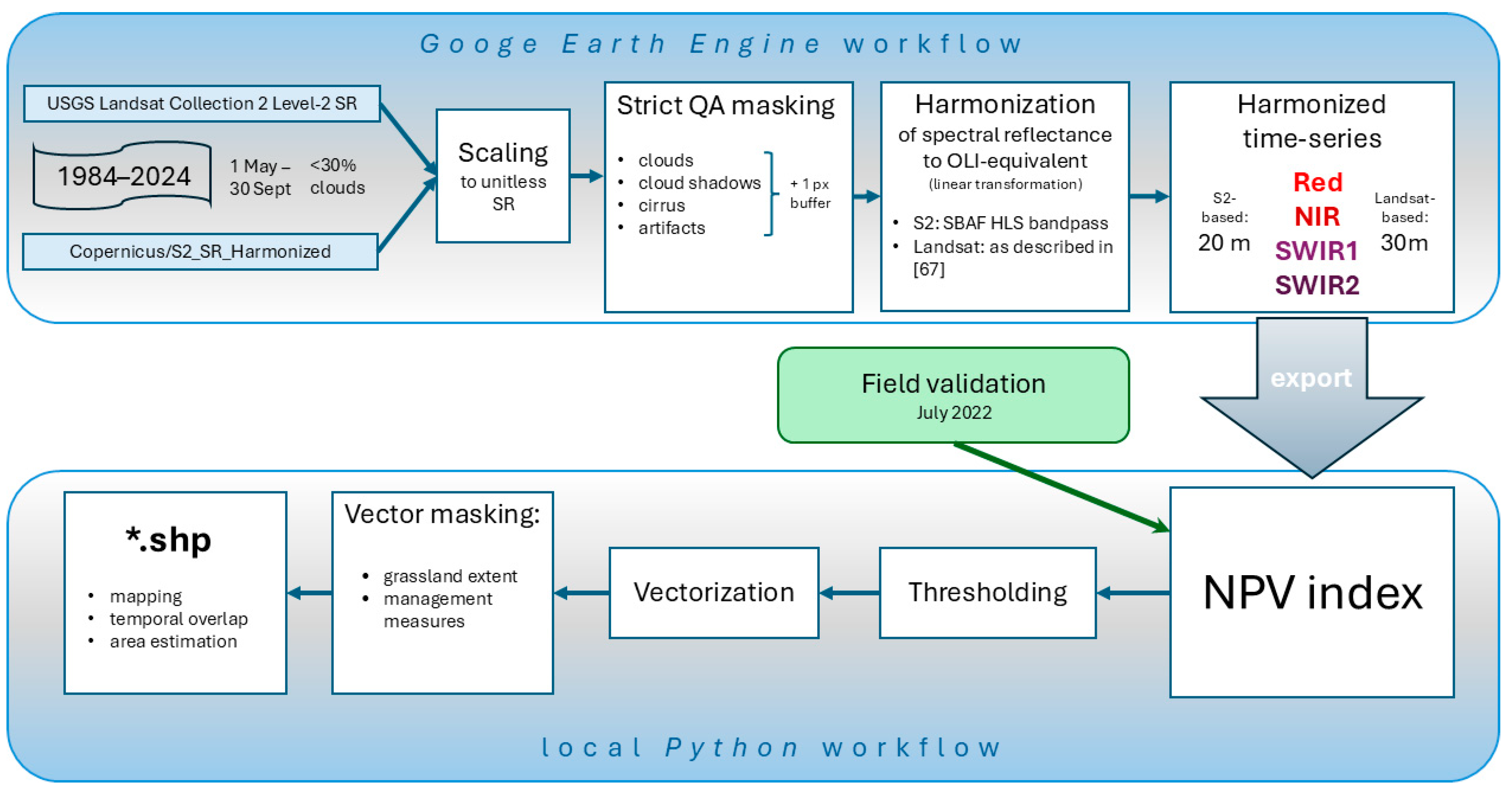
We generated a spectrally harmonized four-band dataset (Red, NIR, SWIR1, SWIR2) by combining (i) analysis-ready surface reflectance (SR) collections with per-pixel quality screening and (ii) cross-sensor spectral harmonization to a common reference sensor. Landsat SR data were obtained from the USGS Landsat Collection 2 Level-2 SR products (U.S. Geological Survey Earth Resources Observation and Science Center, Sioux Falls, SD, USA). Sentinel-2 SR data were obtained from the COPERNICUS/S2_SR_HARMONIZED collection (European Union/European Space Agency/Copernicus, Paris, France). Both collections were accessed and processed with Google Earth Engine (Google LLC, Mountain View, CA, USA). Spectral harmonization followed the “virtual constellation” concept of NASA’s Harmonized Landsat and Sentinel-2 (HLS) framework, which aims to make multi-sensor observations directly comparable by reducing systematic differences caused by sensor-specific bandpasses and processing chains [64,65]. Unlike standard HLS products, which are distributed on a common 30 m grid and limited to the Sentinel-2 era, our implementation adopted HLS-consistent spectral harmonization while preserving each sensor’s native spatial resolution (20 m analytical grid for Sentinel-2 imagery and 30 m for Landsat) and acquisition metadata for subsequent analyses and exports.
All image collections were filtered to the study area and restricted to the vegetation season (1 May–30 September). Scenes with excessive cloudiness were excluded using scene-level cloud metadata, applying a maximum cloud cover threshold of 30%.
Digital numbers were converted to unitless surface reflectance values prior to masking and harmonization. Landsat Collection 2 Level-2 SR was scaled using the USGS-provided factor and offset [66]:
ρ = (DN × 0.0000275) − 0.2
Sentinel-2 SR bands in the COPERNICUS/S2_SR_HARMONIZED collection are scaled by 10,000, and reflectance was obtained as:
ρ = DN/10,000
Clouds, cloud shadows, cirrus, and sensor artefacts were masked using the quality assurance layers provided with each product. For Landsat, masking relied on the QA_PIXEL and QA_RADSAT bands, while for Sentinel-2, QA60 and the Scene Classification Layer (SCL) were used.
All reflectance measurements were harmonized to an OLI-equivalent spectral reference, with Landsat 8/9 used as the reference sensor, consistent with HLS practice where OLI bandpasses serve as the baseline for MSI adjustments. All harmonization transformations were applied after conversion to physical surface reflectance units.
For Sentinel-2 MSI, we applied the official HLS bandpass adjustment (SBAF-style) linear transformation:
ρλOLI = aλρλMSI + bλ
where the coefficients aλ and bλ are band-specific, provided separately for Sentinel-2A and Sentinel-2B, and derived from synthetic OLI and MSI reflectances generated by convolving hyperspectral (Hyperion) spectra with sensor spectral response functions [65].
To reduce discontinuities between Landsat 7 ETM+ and Landsat 8/9 OLI within the long-term time series, we applied published ordinary least squares (OLS) cross-sensor transformation functions for surface reflectance [67]. Landsat 5 TM reflectance was transformed using the same correction coefficients as ETM+, as these sensors are spectrally similar in the VNIR–SWIR region.
Outputs were produced at each sensor’s native surface reflectance pixel size: Landsat reflective bands at 30 m; Sentinel-2 reflective bands at 20 m: upscaled Red, SWIR1, SWIR2, and NIR using band B8A, consistent with the HLS configuration. Each processed acquisition was clipped to the area of interest and exported as a per-date multiband GeoTIFF containing the harmonized four-band reflectance stack (Red, NIR, SWIR1, SWIR2).
All preprocessing was implemented in the Google Earth Engine Code Editor (https://code.earthengine.google.com, accessed on 23 April 2026). The GEE JavaScript code developed for this workflow is available via GitHub (https://github.com/olkachalova/subalpine_diebacks, accessed on 23 April 2026). The final dataset comprised 214 analysis-ready, harmonized four-band images spanning August 1984 to September 2024.

2.4. Selection, Validation, and Thresholding of the Optimal NPV Index

Among the large number of spectral indices proposed for detecting non-photosynthetic vegetation (NPV) [68,69], we restricted the candidate set to indices that are cross-sensor compatible, i.e., computable using bands available across Landsat 5–9 and Sentinel-2: red, near-infrared (NIR), shortwave infrared 1 (SWIR1), and shortwave infrared 2 (SWIR2). The final set of candidate indices is listed in Table 1.
To validate the performance of the candidate indices, field reference data were collected in July 2022. Homogeneous polygons representing four land-cover classes were delineated: (1) non-vegetated surfaces (screes, trails, rocks, built-up features, and areas affected by experimental management); (2) dead grassland; (3) semi-open, windswept grasslands dominated by Avenella flexuosa; and (4) dense grasslands dominated by Festuca supina and/or Nardus stricta.
Given the 20–30 m spatial resolution of the satellite data, mixed-pixel effects are unavoidable, particularly along patch margins and within fine-scale vegetation mosaics. To minimize their influence, validation polygons were selected to be as homogeneous as possible and located at sufficient distance from neighboring land-cover types. For the dead grassland class, which was relatively rare and spatially limited, polygons with a minimum size of 20 × 20 m (corresponding to the Sentinel-2 SWIR spatial resolution) were accepted. In contrast, for healthy grassland classes, larger homogeneous patches were preferentially selected wherever possible to further reduce mixed-pixel contamination. Despite these precautions, small dieback patches may remain underdetected, and mapped patch boundaries should therefore be interpreted as approximate.
Validation polygons were subsequently converted to point samples aligned with the native grids of Landsat (one point representing a 30 × 30 m pixel) and Sentinel-2 (one point representing a 20 × 20 m pixel). In total, 727 validation points were generated, and their spatial distribution is shown in Figure 2.
The spatial distribution of validation samples reflects the natural occurrence of the target habitat (short-stemmed subalpine grasslands), which is discontinuous and interspersed with other vegetation types (e.g., tall grasslands, dwarf-shrub heath, and peat bogs) that were not included in this study. Consequently, areas without validation points generally correspond to locations where the target habitat is absent.
To account for potential spatial autocorrelation among neighboring samples, the validation procedure was revised to operate on spatially independent units. The original grid-based samples were collapsed to native satellite pixel support (20 m for Sentinel-2 and 30 m for Landsat 9), and contiguous samples of the same class were aggregated into spatial patches. Classification performance was then evaluated using spatially grouped cross-validation, in which entire groups of adjacent samples were withheld during model evaluation.
A summary of the number of independent spatial units (patches) and corresponding validation samples is provided in Table S1 (Supplementary Materials). The final validation dataset comprised 124 independent spatial units, with particularly limited representation of dead grassland (7 patches), reflecting its restricted spatial extent at the time of field survey.
Accuracy assessment focused on the operational objective of this study, namely the discrimination of dead grassland from non-dead grassland within the grassland mask. Windswept and dense grassland classes were therefore merged into a single “non-dead” category, while unvegetated areas were excluded from the primary validation. The partially damaged or regenerating class was not included in the formal accuracy assessment, as it was not explicitly sampled during field data collection and represents an interpreted transitional state.
For validation, NPV index values were calculated from the harmonized Sentinel-2 image acquired on 19 July 2022 and the Landsat 9 image acquired on 21 July 2022, representing the closest available dates to the field survey, and extracted by validation points. Index distributions were compared among land cover classes using analysis of variance (ANOVA) and Cohen’s d effect sizes. Given the large sample size, effect sizes were used to assess practical separability among classes. The index that most strongly separated dead grassland from windswept healthy grassland was selected as the primary metric for retrospective dieback mapping, as both classes are characterized by relatively low index values.
Performance of the selected NPV index was evaluated separately for Sentinel-2 and Landsat 9 using confusion matrices and derived metrics, including precision, recall, F1-score, and balanced accuracy. In addition, receiver operating characteristic (ROC) curves and the corresponding area under the curve (AUC) were computed using continuous NBR values (with sign inversion to ensure monotonicity with the positive class). Given the limited number of dead grassland samples, a grouped three-fold cross-validation scheme was adopted to balance statistical robustness and sample availability.
Consequently, the selected NPV index was calculated for all images in the time series. Index images were then masked using the grassland extent layer and classified according to the defined thresholds for dead and partially damaged or regenerating grassland. The resulting classes were vectorized, and detected dieback patches were overlaid with spatial layers of management interventions to exclude areas affected by mowing or turf removal from being falsely classified as dieback. This stage of geospatial processing and map visualization was performed locally using Python scripts in ArcGIS Pro. Maps were produced using ArcGIS Pro 3.6 software. The complete workflow is summarized in Scheme 1.
A dieback event was defined as a distinct decline in NPV values into the range indicative of dead biomass, following a prior exceedance of this threshold, or as a failure to return above the threshold after the 50th day of the growing season. This temporal criterion was established based on inspection of long-term NPV trajectories, allowing delayed seasonal greening to be excluded while still capturing early-season dieback.

2.5. Geomorphological Feature Analysis

To identify geomorphological controls on the spatial distribution of grassland dieback, we combined binary logistic regression with Random Forest classification and feature-importance analysis. Terrain predictors were derived from the grid version of Digital Terrain Model of the Czech Republic, 5th Generation (DMR 5G), with a spatial resolution of 5 m and mean vertical errors of 0.18 m in open terrain and 0.30 m in forested areas. The dataset is provided by the Czech Office for Surveying, Mapping and Cadastre (ČÚZK), Prague, the Czech Republic via its Geoportal under an open data license. Elevation grid from DEM was resampled to a computational 10 m grid using bilinear interpolation to align with both 20 m Sentinel-2 and 30 m Landsat imagery. Although this inevitably smooths some micro-topographic variation, it reduces noise in fine-scale terrain derivatives and provides terrain predictors more consistent with the medium-resolution remote sensing data used to detect dieback. Topographic variables in 10 m resolution were computed using SAGA 8.2.2 [77]. To reduce multicollinearity, predictors showing strong pairwise correlations (|R| ≥ 0.8) were excluded prior to modelling; however, the initial list of geomorphological predictors and cross-corellation matrix is presented in Supplementary Materials (Table S2 and Figure S2). The retained predictor set included elevation, slope, eastness and northness (sine and cosine of aspect), total curvature, plan curvature, profile curvature, convexity, topographic position index (TPI), flow accumulation, wind exposition index, and the SAGA Wetness Index (TWI-SAGA), a modification of the standard Topographic Wetness Index using an alternative catchment area formulation. Eastness and northness were used to represent aspect as continuous variables while avoiding circularity.
The response variable was defined as a binary indicator of dieback, distinguishing areas exhibiting total dieback (1) from unaffected grasslands (0). Areas showing partial dieback or clear regeneration were excluded to reduce ambiguity in class assignment.
All statistical analysis was performed using Python 3.12.7. Binary logistic regression was used to evaluate the direction and strength of associations between geomorphological predictors and grassland dieback occurrence. Prior to modelling, predictors were standardized to zero mean and unit variance using StandardScaler from scikit-learn 1.8.0 Python library, so that regression coefficients were directly comparable across variables. The regression was fitted with the Logit class from the statsmodels 0.14.6 Python library, with an intercept included by adding a constant term to the predictor matrix. Because the dataset consisted of spatially adjacent pixels, coefficient uncertainty was estimated using cluster-robust standard errors, with spatial blocks used as clustering units. For each predictor, we report the standardized regression coefficient, robust standard error, p-value, and 95% confidence interval.
To assess predictive performance and variable importance under potentially nonlinear relationships among predictors, a Random Forest classifier was fitted using RandomForestClassifier from scikit-learn. Missing predictor values were imputed using the median (SimpleImputer), and the classifier was trained with 1000 trees (n_estimators = 1000), class balancing (class_weight = “balanced”), and a fixed random seed (random_state = 42). To reduce optimistic bias caused by spatial autocorrelation, model performance was evaluated using spatial block cross-validation rather than a random train-test split. Spatial blocks were created from pixel coordinates by dividing the study area into regular 200 × 200 m grid cells (block_size = 200 in map units). All observations within the same block were assigned to the same cross-validation fold, and the same block structure was used to define clusters for cluster-robust standard errors in logistic regression. We selected a 200 m block size as a compromise between reducing leakage from spatial autocorrelation among neighboring pixels and preserving enough spatial groups for stable model fitting and validation. Cross-validation was performed using GroupKFold with five folds, ensuring that training and test data were spatially separated. For each fold, we calculated the area under the ROC curve (AUC), balanced accuracy, and overall accuracy; reported values represent the mean ± standard deviation across folds.
Variable importance in the Random Forest model was quantified as the mean decrease in Gini impurity averaged across folds. Importance values were then normalized to relative importance, ranked, and visualized using horizontal bar plots. The results of the Random Forest model were interpreted together with the standardized logistic regression coefficients to compare predictor importance, effect direction, and statistical uncertainty.

3. Results

3.1. Defining the Thresholds of the Optimal NPV Index for Dead Grassland Detection

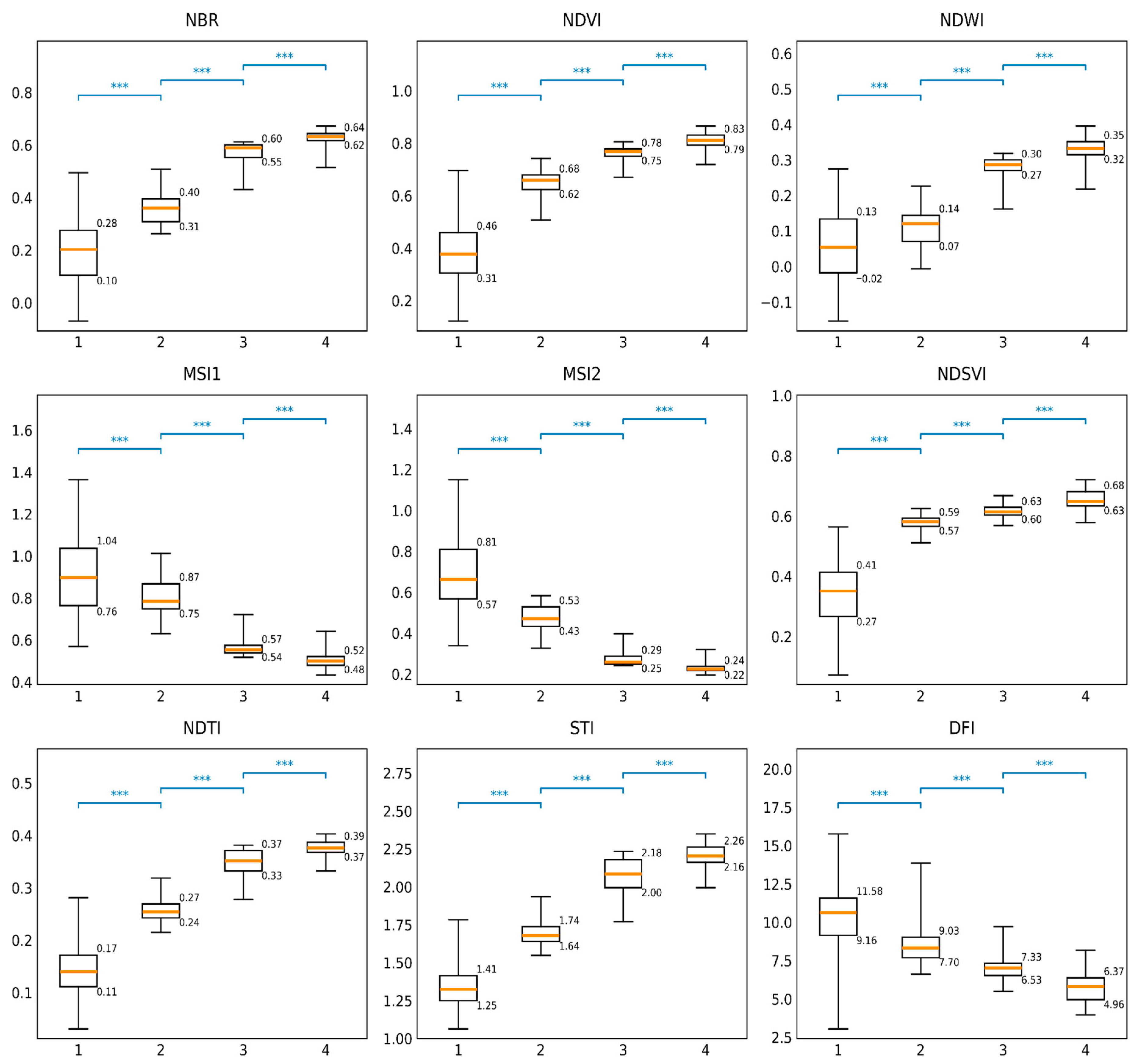
Boxplots illustrating the performance of individual NPV indices in distinguishing dead grasslands from other land cover types are shown in Figure 3. Overall, all nine tested indices demonstrated statistically significant separation among the land cover classes. However, the Normalized Burn Ratio (NBR) showed the highest Cohen’s d values for separating dead grassland from windswept grassland (Table 2) and was therefore selected for historical grassland dieback detection.
Considering that some areas affected by the late 2018–2019 dieback had already initiated regeneration by 2022, potentially influencing index values, NBR thresholds for detecting dead grassland were defined in the range [0.28–0.40], corresponding to the 95th percentile of the unvegetated class and the 95th percentile of the dead grassland class. As the 25th percentile of the windswept grassland class was approximately 0.55 and its distribution exhibited a slight lower-tail skew, an intermediate threshold range of [0.40–0.50] was defined to represent vegetation with partial damage or ongoing recovery. Because this transitional category was not explicitly sampled during field surveys, it should be regarded as an interpreted class rather than a fully validated land cover type.
To complement the class separability analysis, the performance of the selected NBR index was evaluated using a spatially independent validation framework based on native-resolution reference units and grouped cross-validation. Accuracy assessment focused on the binary discrimination of dead versus non-dead grassland within the grassland mask.
For Sentinel-2, the NBR-based classification achieved high performance across all metrics, with mean precision of 1.00, recall of 0.82, F1-score of 0.90, and balanced accuracy of 0.91. The corresponding ROC/AUC reached 0.9996, indicating near-perfect separability between dead and non-dead grassland. For Landsat 9, classification performance was slightly lower but remained robust, with precision of 1.00, recall of 0.62, F1-score of 0.76, and balanced accuracy of 0.81. The ROC/AUC value of 0.9982 similarly indicates excellent discriminative ability of the NBR index.
The consistently high precision across both sensors reflects the conservative thresholding approach, which effectively minimizes false positives (i.e., misclassification of healthy grassland as dead). Lower recall values, particularly for Landsat 9, indicate that some dead grassland pixels are not detected, likely due to coarser spatial resolution and mixed-pixel effects.
To account for potential spatial autocorrelation, classification performance was evaluated using grouped cross-validation with spatial blocking. Results remained stable across folds, confirming that the high separability of dead and non-dead grassland is not an artefact of spatially clustered samples. Detailed fold-wise metrics, confusion matrices, and sensitivity analyses are provided in the Supplementary Materials (Tables S3–S5).

3.2. Retrospective Detection and Mapping of Dieback Events

To evaluate the transferability of the 2022-derived thresholds across the full time series, we performed a sensitivity analysis. It showed that small shifts (±0.01) in NBR thresholds resulted in moderate and systematic changes in mapped total dieback extent (Table S6 in Supplementary Materials). Relative to the baseline threshold set (0.28–0.40), mapped area ranged from 77.5% to 123.1% across the tested variants and years, with the greatest sensitivity in 2003 and the lowest in 2012. This indicates that the selected thresholds are reasonably robust for identifying major dieback episodes, although the exact mapped extent remains moderately sensitive to threshold choice. An important outcome of the sensitivity analysis is that the response to threshold perturbation was highly consistent across all analysed dieback years. In every case, a parallel shift toward stricter thresholds reduced mapped dieback extent, whereas a shift toward more permissive thresholds increased it; similarly, contraction of the threshold interval decreased mapped extent and expansion increased it. This stable monotonic behavior indicates that the threshold-based classification is internally robust and does not respond erratically to small parameter changes. At the same time, the magnitude of area change differed among years, suggesting that threshold sensitivity is partly year-specific. Therefore, the analysis supports the transferability and practical robustness of the selected thresholds, but not strict universality of identical threshold behavior across all years and sensors.
A series of maps was generated based on NBR threshold values distinguishing total dieback and partial dieback or regeneration. This enabled retrospective identification of the timing and spatial extent of individual dieback events. The partial dieback or regeneration class was not explicitly sampled during field surveys and should therefore be interpreted as an inferred transitional category rather than a fully validated land-cover class.
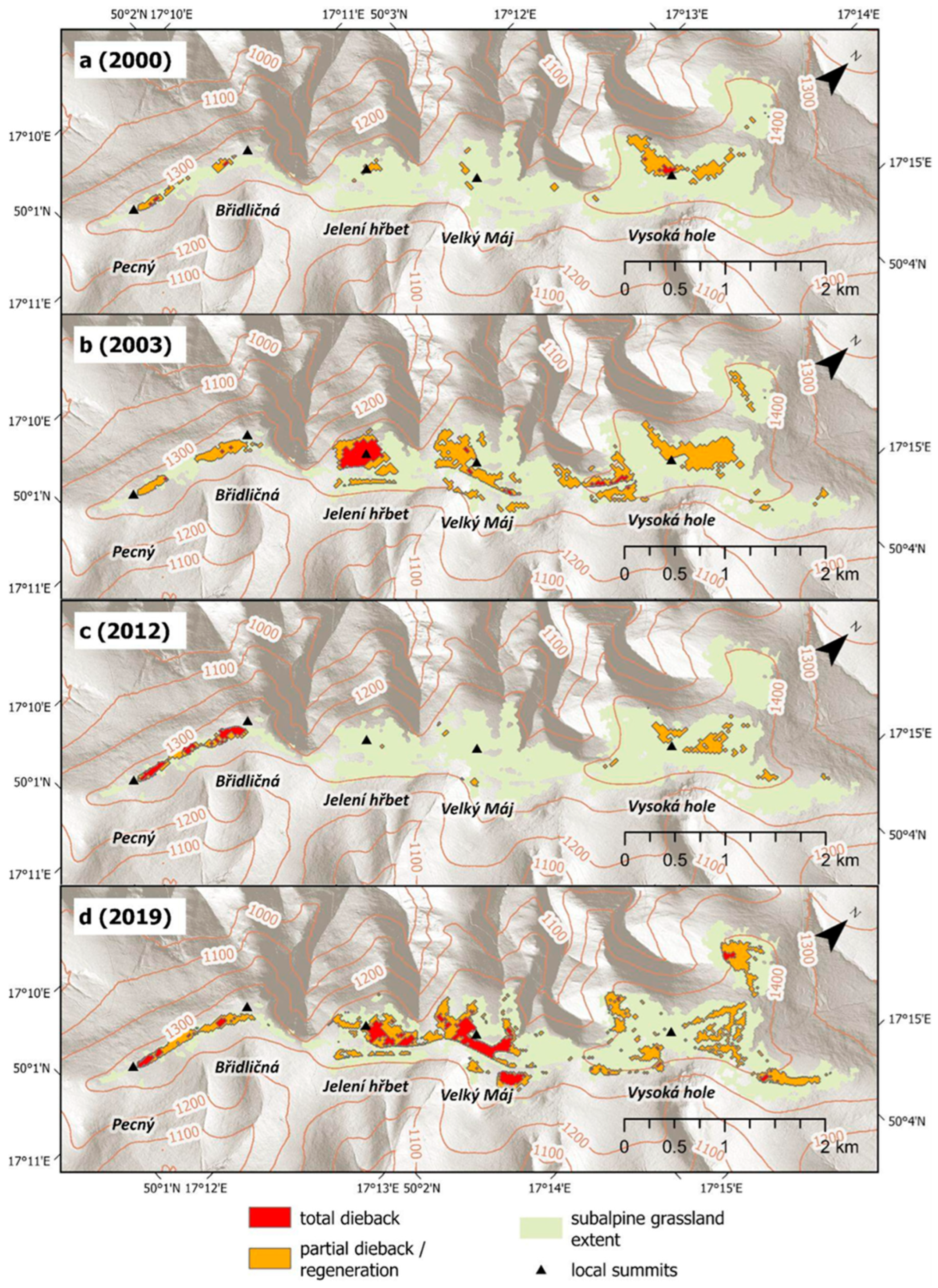
During the reference period 1984–1999, NBR values remained within the range of normal seasonal variability, and no dieback events were detected. The first dieback was observed in 2000. Since then, four distinct events have been identified:
  • Two short-term events (2000, 2003) characterized by rapid desiccation of grassland vegetation followed by regeneration mainly within the same growing season. These events likely affected primarily aboveground biomass, with root systems remaining mainly intact.
  • Two long-term events (2012, late 2018–2019) involving complete dieback of grass cover and accumulation of undecomposed biomass, resulting in multi-year persistence of degraded conditions and slow regeneration.
A summary of identified dieback events and subsequent regeneration dynamics is provided in Table 3. In years when no substantial within-season dieback dynamics were observed, the reference date corresponds to the best-quality satellite observation acquired during the middle of the vegetation season (July–early August). In years with pronounced intra-seasonal dieback/regeneration dynamics, multiple reference dates are presented to capture the temporal evolution of dieback and recovery. Given the limitations associated with the threshold-based approach, the estimated affected areas should be interpreted as approximate and indicative rather than exact. The spatial extent of dieback-affected areas since 2000 is shown in Figure 4. Annual maps illustrating degradation and regeneration dynamics are provided in the Supplementary Materials (Figure S1).
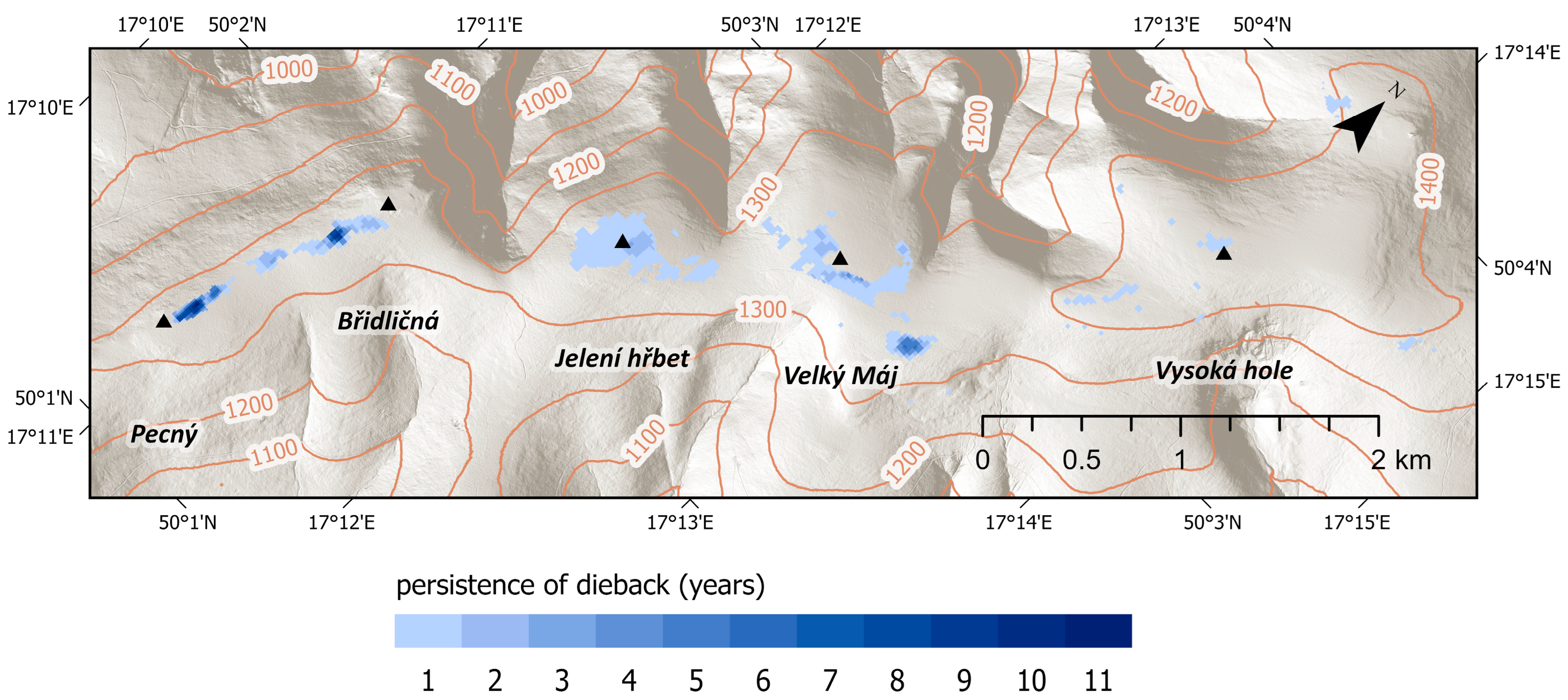
Figure 5 shows the recurrence of diebacks (repeated observations of dead grassland) at individual locations over the study period (2000–2024). The number of years with observed dieback ranges from 1 to 11. This measure is not ordinal and does not represent continuous duration, but rather the frequency (recurrence) of dieback events through time.
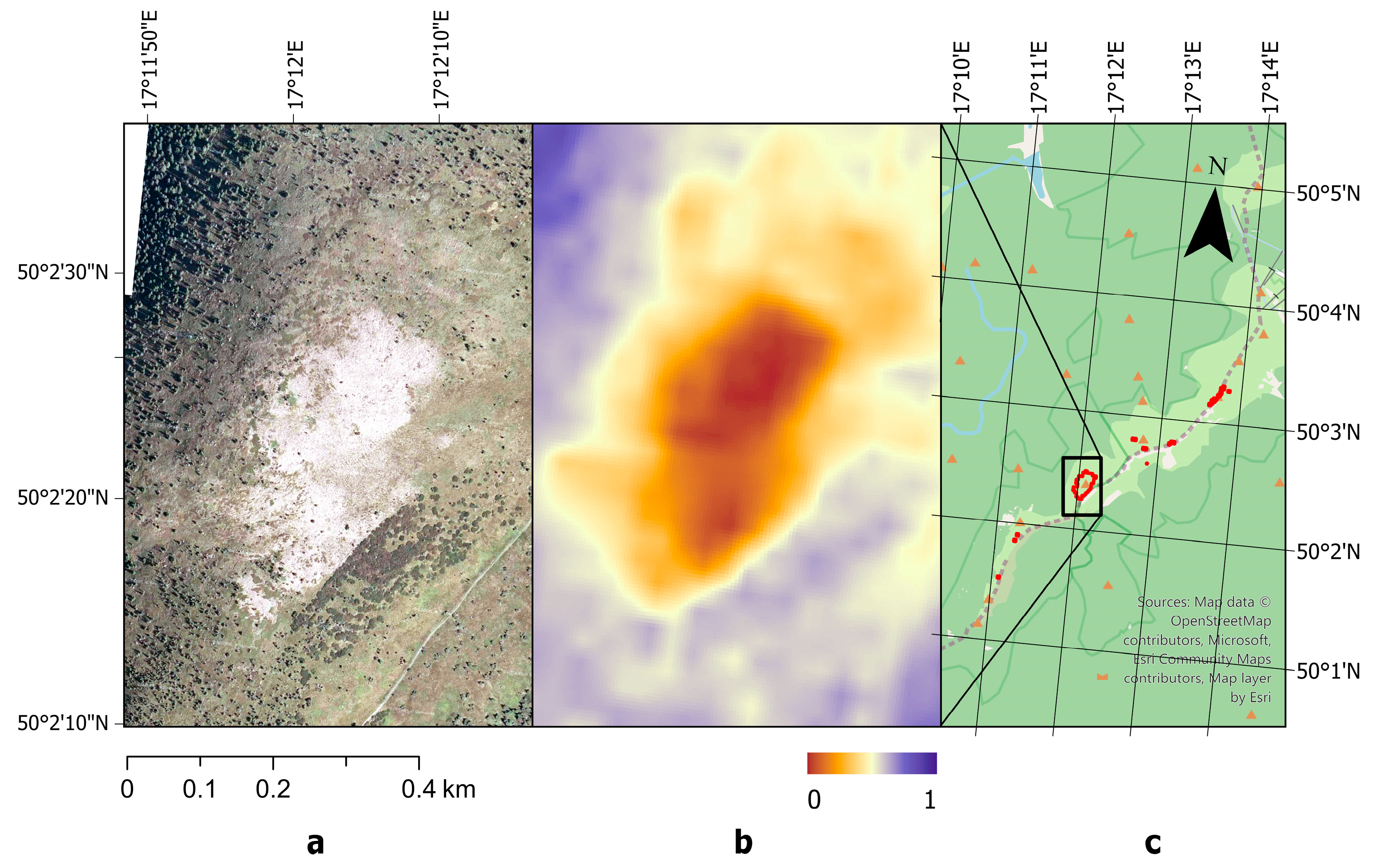
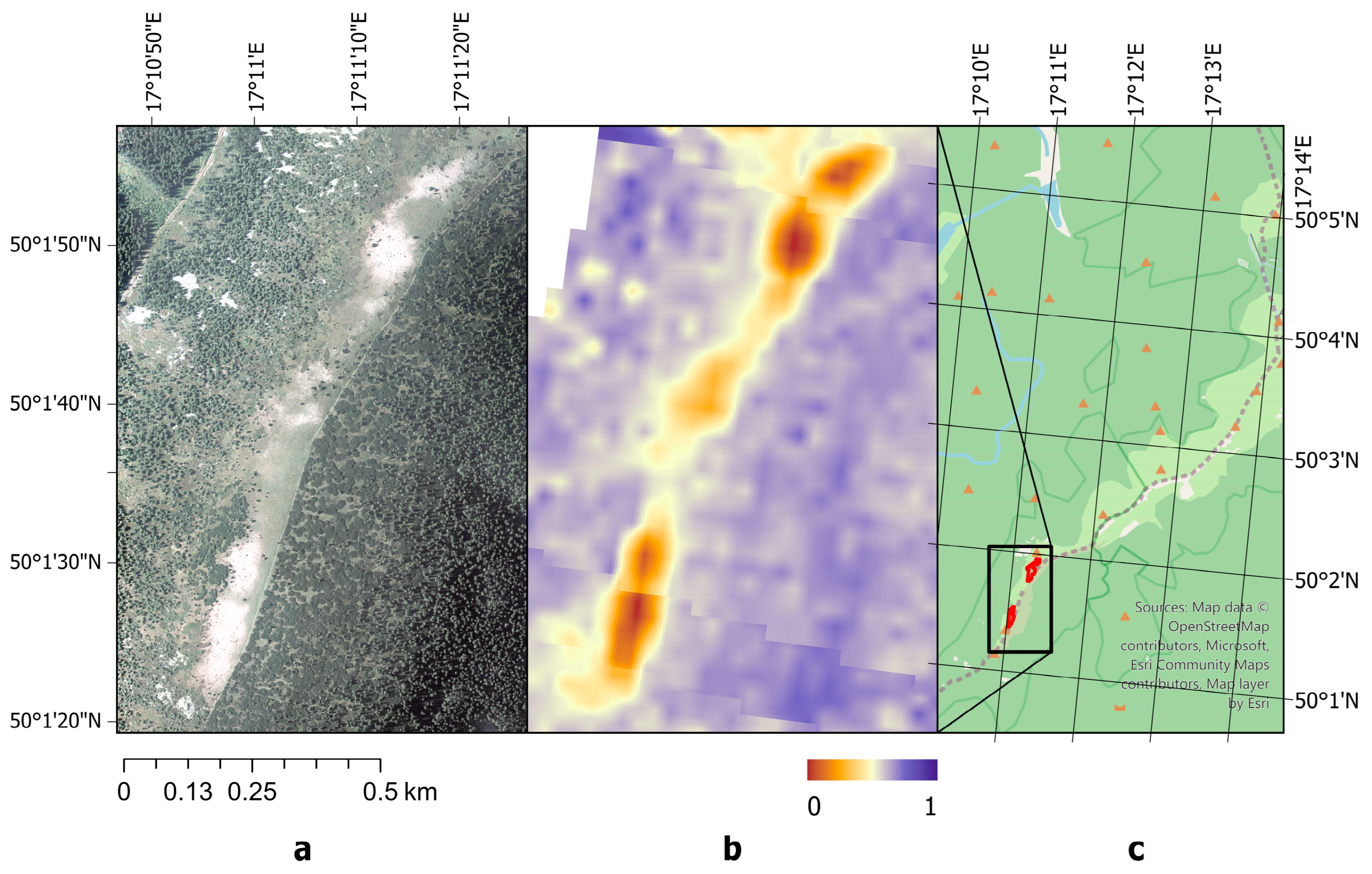
To additionally support the threshold-based retrospective mapping, detected dieback patches were, where possible, visually confirmed (Figure 6 and Figure 7) using archival orthophotos provided by the Czech Office for Surveying, Mapping and Cadastre (ČÚZK),via its Geoportal (https://geoportal.cuzk.cz/, accessed 23 April 2026), as well as orthophoto imagery available through the Mapy.com online mapping service (https://mapy.com/, accessed 23 April 2026).

3.3. Seasonal Changes in NBR Values

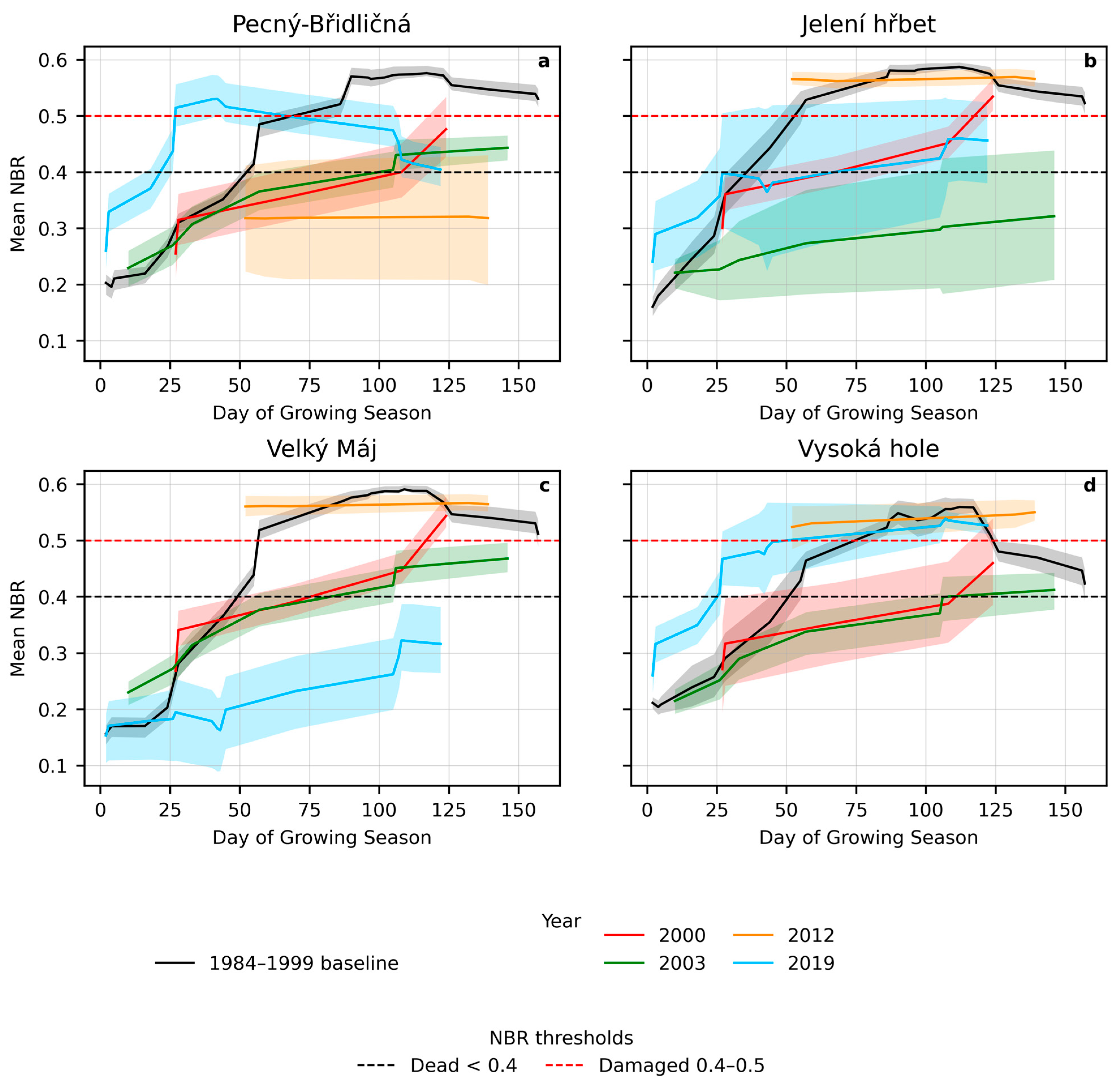
Seasonal trajectories of NBR values, aligned by day of the growing season, are shown in Figure 8 for dieback-affected grasslands at four localities: Pecný–Břidličná, Jelení hřbet, Velký Máj, and Vysoká hole. The onset of the growing season, derived from daily mean air temperature (SoilClim), is provided in Supplementary Materials (Table S7).
Curves represent mean NBR values for areas ever affected by total dieback at each locality, with shaded bands indicating the 25th–75th percentile range. The points on the curves indicate the dates of direct observations (expressed as the day of the growing season): 22–24 observations per year (depending on location) for 1984–1999, 5 observations in 2000, 7 in 2003, 5 in 2012, and 15 in 2019. Missing observations caused by cloud cover were linearly interpolated between adjacent dates, and a 5-day moving window was applied to smooth each curve. The black curve represents the reference seasonal trajectory derived from the period 1984–1999. Colored curves show deviations during years affected by dieback. Dashed horizontal lines indicate threshold values for dead grassland and damaged or regenerating vegetation.
It should be noted that the temporal resolution of the trajectories varies among years depending on the availability of cloud-free satellite observations and general sensor availability. In years with sparse data coverage, interpolation and smoothing may introduce apparent temporal detail that is not fully supported by direct observations. This is particularly relevant for 2012, where a substantial gap in observations limits the interpretation of within-season dynamics.
Across all localities, years affected by dieback show clear deviations from the reference seasonal NBR trajectory, particularly during the early and mid-growing season. In 2000 and 2003, NBR values frequently remained below the damaged or dead thresholds for extended periods; however, recovery of grassland vegetation is evident toward the end of the growing season in 2000. The 2012 dieback episode was largely confined to, and most intense at, the Pecný–Břidličná locality. In 2019, pronounced early-season declines were observed at Jelení hřbet and Velký Máj, whereas the other localities were less affected. Overall, the responses differed among localities, highlighting site-specific sensitivity to dieback processes.

3.4. Role of Geomorphological Factors

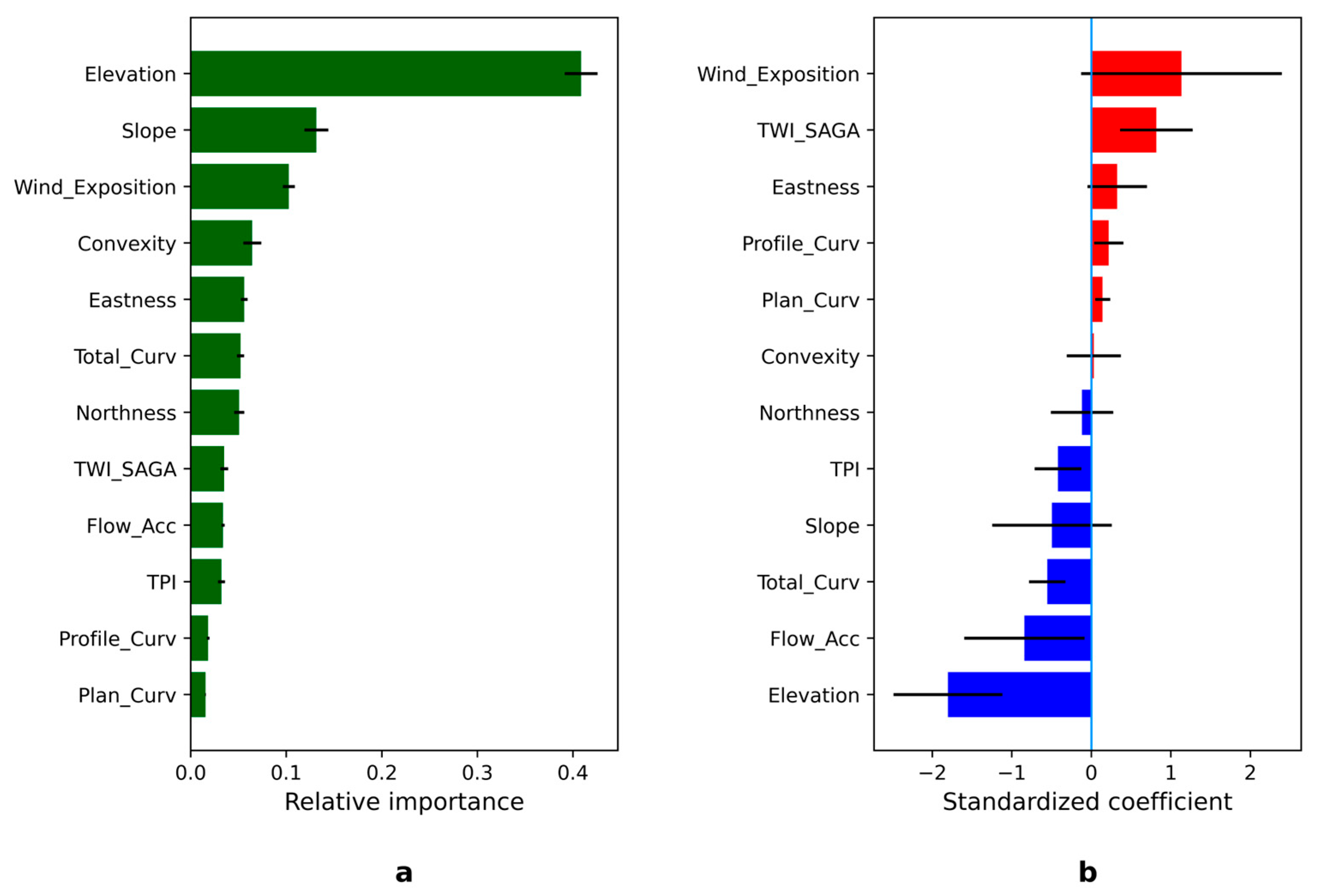
The relative importance of geomorphological variables was evaluated using Random Forest classification and binary logistic regression (Figure 9a,b). Full model outputs, including spatial cross-validated Random Forest performance metrics and predictor importance (Table S8), as well as standardized logistic regression coefficients with cluster-robust standard errors and confidence intervals (Table S9), are provided in the Supplementary Materials.
The spatially cross-validated Random Forest model showed strong discriminatory ability, with a mean AUC of 0.901 ± 0.045. In contrast, balanced accuracy was lower (0.653 ± 0.056), indicating only moderate class-balanced predictive performance. This suggests that geomorphological predictors capture the broad spatial pattern of dieback well, but classification remains less accurate when evaluated equally across affected and unaffected classes.
Elevation was by far the most influential predictor in the Random Forest model, accounting for approximately 41% of total variable importance. Logistic regression likewise showed a strong negative association between elevation and dieback probability (β = −1.80, 95% CI: −2.49 to −1.12, p < 0.001), indicating lower susceptibility at higher elevations. Slope and wind exposition were the second and third most important predictors in the Random Forest model, although only wind exposition showed a marginally positive effect in logistic regression (β = 1.13, p = 0.079), while slope was not statistically significant. Eastness showed a weak positive tendency (p = 0.088), whereas northness and convexity were not statistically significant.
Several curvature- and terrain-position-related variables also contributed to dieback occurrence. Total curvature showed a significant negative effect (β = −0.55, 95% CI: −0.78 to −0.33, p < 0.001), whereas plan curvature (β = 0.14, p = 0.004) and profile curvature (β = 0.22, p = 0.021) were positively associated with dieback probability. TPI also showed a significant negative relationship (β = −0.42, p = 0.005), supporting the importance of terrain form and topographic position.
The SAGA Wetness Index was positively associated with dieback probability (β = 0.82, 95% CI: 0.36 to 1.27, p < 0.001). However, as suggested in, for example [78], this relationship should be interpreted cautiously, as in this geomorphological context the wetness index likely reflects low slope angles and summit morphology rather than actual long-term soil moisture accumulation. Flow accumulation showed a significant negative effect (β = −0.84, p = 0.029), suggesting reduced dieback occurrence in areas with greater lateral water redistribution.

3.5. Role of Climate Extremes

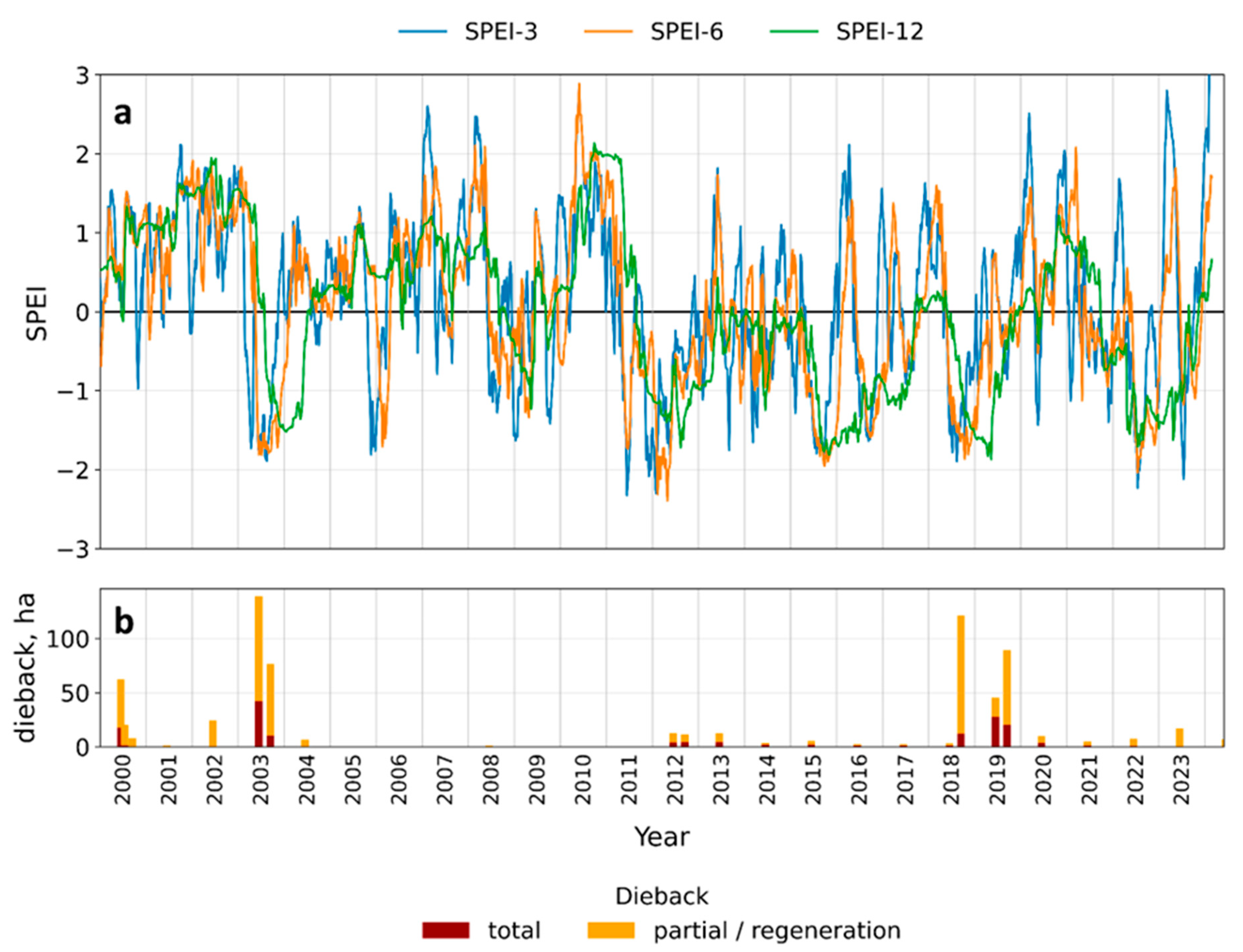
Our results show that the occurrence of subalpine grassland dieback is closely aligned with pronounced declines in the Standardized Precipitation–Evapotranspiration Index (SPEI) (Figure 10), supporting the interpretation that water balance deficits represent a primary driver of this phenomenon. To complement the qualitative comparison shown in Figure 10, we assessed the relationship between drought conditions and dieback extent using correlation analysis between monthly total dieback area (ha) and SPEI at different accumulation periods. Correlations were calculated using weekly SPEI values averaged for the corresponding calendar month to match the temporal resolution of the dieback area estimates. Spearman rank correlation indicated a moderate negative association between dieback extent and SPEI, which was statistically significant at the p < 0.05 level for SPEI-6 (ρ = −0.404, p = 0.030) and SPEI-12 (ρ = −0.548, p = 0.002), while the relationship for SPEI-3 was weaker and not statistically significant (ρ = −0.352, p = 0.061). These results support the interpretation that more severe drought conditions tend to be associated with greater dieback extent.
It should be noted, however, that this quantitative comparison is subject to several limitations. The SPEI data are interpolated/modelled at a coarse spatial resolution (500 m) and averaged from a limited number of pixels overlapping the study area, whereas dieback extent is derived from NBR at a much finer spatial resolution (20–30 m) and reflects localized vegetation responses, where severely affected areas may occur adjacent to healthy grassland patches during the same dieback event. This mismatch in spatial scale, together with temporal aggregation and the influence of local topographic and microclimatic factors, limits the strength of statistical inference between SPEI and direct NBR values.
During the 2000 event, NBR values remained suppressed within the range interpreted as substantial vegetation damage until approximately day 100 of the growing season, and patches classified as total dieback developed at Vysoká hole and Pecný–Břidličná. However, SPEI indices during this period did not show a marked decline, except for short-term SPEI-3 in the second half of the vegetation season. This combination suggests that the 2000 episode was not primarily driven by long-term soil drought caused by accumulated water balance deficits, but rather by a short-lived yet intense climatic stressor, potentially including a heatwave or a brief topsoil moisture deficit (i.e., flash drought) not captured by the aggregated SPEI accumulation windows.
In contrast, the 2003 event coincided with a clear and sustained decline in SPEI-3, SPEI-6, and SPEI-12, indicating prolonged drought conditions. In agreement with reports documenting widespread drought impacts across the Czech Republic [34], dieback in 2003 affected the entire ridge system, with particularly large areas on Jelení hřbet. Vegetation remained dry until late in the growing season, and regeneration became evident only after drought conditions weakened toward the end of the season.
The dieback in 2012 began at the very start of the growing season at Pecný–Břidličná, indicating that grassland vegetation failed to emerge from winter dormancy. During this period, SPEI indices also declined, and in addition, extremely low air temperatures (down to −25 °C over a two-week period) recorded in the preceding February may have played an important role. At dieback sites in the Pecný–Břidličná area, soils are extremely shallow (<10 cm); under severe frost and a probable deficit of insulating snow cover, this likely led to soil freezing and frost heave, detaching the surface soil layer together with vegetation and damaging root systems. Subsequent drought conditions probably intensified this effect, resulting in the persistence of dieback patches at this site for more than a decade.
Another long-term water balance deficit occurred in 2015, as indicated by a prolonged decline in SPEI-12; however, SPEI-3 and SPEI-6 exhibited short-term increases, suggesting that locally the drought was neither as prolonged nor as severe and was likely interrupted by precipitation events. During this period, no new dieback events were detected, but areas undergoing regeneration after the 2012 dieback experienced renewed stress and partial degradation.
The most severe drought occurred in 2018 and extended through almost the entire 2019 growing season. During this period, renewed degradation of previously regenerating grasslands in the Pecný–Břidličná area began already at the end of 2018, and a new episode of long-term dieback developed at Velký Máj. Extensive damage persisted throughout 2019. Regeneration began more intensively in 2020 on the summit of Velký Máj, whereas recovery in its southern part was considerably slower, with remnants of dry, undecomposed litter still observed there in 2024.
Drought conditions were also recorded in the middle of the 2022 growing season; however, their impact on vegetation at the local scale was relatively minor, leading mainly to partial senescence in areas that had been affected previously.

4. Discussion

Our results indicate that dieback of subalpine grasslands in the Hrubý Jeseník Mountains began around the year 2000 and has recurred intermittently since then. Across events, dieback manifested as rapid senescence of grassland vegetation during the growing season, affecting spatially extensive patches. In 2000 and 2003, dieback was short-lived and recovery occurred by the end of the same or the following growing season, suggesting that plant belowground organs largely remained viable and that stress primarily affected aboveground biomass. This interpretation is consistent with other studies indicating that some grassland dieback during climatic extremes reflects reversible dormancy rather than irreversible mortality. For example, during a severe hot drought in the Alps in 2013, alpine grasses lost approximately 80% of green cover, yet it remained unclear how much of this loss represented true mortality versus protective senescence to conserve water [79].
Most temperate grassland species are perennials with extensive belowground buds, rhizomes, or meristems, which often survive aboveground dieback. Following drought, dormant buds on grass tillers or roots can rapidly produce new shoots once moisture conditions improve [80]. Thus, observed aboveground dieback does not necessarily imply recolonization from seed; in many cases, vegetation can regenerate from existing belowground organs, leading to rapid recovery once stress subsides.
In contrast, the dieback events in 2012 and late 2018–2019 likely also affected plant regeneration organs, resulting in the persistence of a layer of dry, weakly decomposed litter and, consequently, a substantially slower recovery process extending over several years. In lowland temperate grasslands, Yu et al. [81] reported that most grassland types recovered within five months following drought during a four-year experimental drought in a C3-dominated grassland in northeastern China. Subalpine grasslands, however, operate under much stronger seasonal constraints: the effective growing season is limited to approximately 100 days, leaving little time for recovery after severe disturbance. Prolonged or repeated droughts may therefore progressively degrade the regenerative capacity of these systems. Supporting this view, a recent global experiment demonstrated that extreme multi-year drought caused substantially greater productivity losses and slower recovery than a single-year drought [82].
In addition to climatic anomalies, local geomorphological conditions play a significant role in determining the likelihood of grassland dieback, as demonstrated by our geomorphological analysis. The most important factors promoting dieback were elevation, terrain curvature, and wind exposure, together with variables describing terrain position and hydrological context. Similar patterns have been reported from other mountain regions, where vegetation on convex or elevated microsites is more prone to drought-induced damage than vegetation in concave, water-accumulating positions. For example, a drought-impact survey on Australia’s Bogong High Plains found that subalpine shrubs growing on the shallowest soils (rock outcrops and knolls) experienced the most severe dieback during a summer drought, whereas the same species on deeper valley soils largely survived [83].
Wind-exposed areas dry rapidly due to enhanced evapotranspiration, particularly where soil depth is very shallow. At the same time, such locations are strongly affected by snow redistribution during winter and may experience reduced snow accumulation, resulting in lower spring soil moisture availability. Moreover, wind-exposed slopes are especially prone to winter drought injury. On convex, wind-blown terrain with little or no snowpack, vegetation is directly exposed to frigid air and desiccating winds. Snowpack distribution plays a crucial role in alpine plant survival, creating sharp contrasts in freezing stress and season length between convex and concave microsites over distances of only a few meters [3]. Loss of insulating snow cover during cold, dry spells can therefore trigger widespread dieback. In coastal and boreal heathlands, an extreme “frost drought” event in 2014 led to massive dieback of Calluna vulgaris across exposed sites following an extended period of sub-zero temperatures with minimal snow or precipitation [84]. As noted above, we hypothesize that frost damage may have amplified the effects of the subsequent summer drought during the 2012 event.
Elevation above sea level was the dominant factor, showing a strong negative relationship with dieback probability. Higher elevations are generally characterized by lower mean temperatures and higher moisture availability, which may still provide conditions suitable for subalpine grassland persistence. This interpretation is consistent with the absence of observed dieback on the nearby summit of Praděd (1491 m a.s.l.) and in the Krkonoše Mountains, where subalpine grasslands occur at higher elevations, on broader plateau-like surfaces, and often on north-facing slopes that are less exposed to wind.
Terrain curvature and topographic position further contributed to the observed pattern. Variables describing curvature showed consistent effects, indicating that dieback tends to occur on relatively flat or weakly convex landforms, while strongly concave, water-accumulating positions are less affected. In addition, the Topographic Position Index indicated a preference for elevated or ridge-like locations, supporting the role of local topographic setting in controlling water redistribution and exposure.
The apparent positive importance of the Topographic Wetness Index should be interpreted cautiously and likely reflects a known limitation of TWI-based metrics, which tend to overestimate moisture accumulation in flat or gently sloping terrain. In this context, higher TWI values primarily indicate the tendency of dieback sites to occur near local summits with low slope angles rather than genuinely higher soil moisture availability. Due to shallow soil depth in these positions, drainage may still be rapid, with infiltrating water moving downslope and re-emerging as springs at lower elevations.
Climatic and geomorphological drivers therefore operate in a complex interplay and manifest differently at fine spatial scales, explaining why dieback events did not occur synchronously along the entire mountain ridge but instead emerged locally and repeatedly at different sites. A similar role of microtopography and habitat mosaics in buffering grasslands against extreme drought has been reported by Gyalus et al. [41]. These findings suggest that local microclimatic conditions are key determinants of subalpine grassland resilience yet remain difficult to assess due to the scarcity of fine-scale environmental data.
To address this limitation, we established a network of microclimatic sensors to monitor aboveground, surface, and belowground (root-zone) temperature and soil moisture. In addition, the local meteorological observation network was expanded by installing three additional meteorological mini stations along the main ridge of the Hrubý Jeseník Mountains. These high-resolution, long-term observations will provide a foundation for future analyses of microclimatic controls on soil moisture dynamics and grassland vitality.
Although the present study does not test management effects directly, land management practices may provide an important context for understanding subalpine grassland dieback in the Jeseníky Mountains. Historically, subalpine treeless areas and grasslands were maintained through grazing and mowing, as is still common in parts of the Carpathians. Following World War II, these practices largely ceased in the Jeseníky Mountains, leading to changes in vegetation structure and species composition [85], as well as to the accumulation of undecomposed aboveground biomass. Wild ungulates do not fully compensate for the effects of historical livestock management. Accumulated phytomass, particularly when heated and desiccated, may impede water infiltration and root growth, thereby exacerbating soil moisture deficits and increasing susceptibility to dieback [86]. For example, long-term field experiments in subalpine meadows have shown that regular defoliation (simulated grazing) limits litter accumulation and maintains higher soil water infiltration rates [87]. Similarly, a study conducted in Austrian mountain grasslands demonstrated that land-use intensity alters drought responses of plant–soil systems, with pasture-managed grasslands allocating carbon differently and recovering more rapidly after drought than grasslands under low-intensity management [88]. Experimental evaluation of alternative management strategies, including grazing, mowing, or turf removal, therefore represents an important direction for future research.
The dieback of subalpine grasslands documented in this study likely represents early evidence of broader ecosystem changes driven by ongoing climatic trends. Mean annual air temperature in the Jeseníky region has already increased by approximately 1.5 °C over the past 150 years and reached an average of 2.2 °C during the period 1991–2020 [60]. Climate projections suggest a further increase to approximately 5.7 °C by 2100 under the SSP2-4.5 scenario, or up to 8.3 °C under SSP5-8.5 [89]. Although projected changes in total annual precipitation remain uncertain, ranging from slight decreases to increases of approximately 200 mm yr−1 relative to 1991–2020, a shift in seasonal precipitation distribution and an increased frequency and duration of extreme droughts and heatwaves are expected, particularly after 2060 [89].
The satellite-based monitoring methodology developed in this study, together with ongoing and planned investigations of microclimatic processes and ecosystem responses, provides a transferable monitoring framework for detecting, interpreting, and anticipating subalpine grassland dieback. This approach can support evidence-based management and conservation of vulnerable mountain grassland ecosystems in Central Europe under future climate change.

5. Conclusions

This study demonstrates that multi-decadal satellite time series can be effectively used to detect, characterize, and interpret dieback dynamics of subalpine grasslands in mid-latitude mountain environments. By integrating long-term multisensor satellite observations with field-based validation, climatic indices, and high-resolution geomorphological data, we provide the first comprehensive reconstruction of grassland dieback events in the treeless zone of the Hrubý Jeseník Mountains.
Among the tested spectral indices, the Normalized Burn Ratio (NBR) showed the highest ability to discriminate dead grassland biomass from live vegetation and non-vegetated surfaces. Thresholds derived from field observations enabled consistent detection of total dieback and, more cautiously, partial damage or regeneration across a harmonized Landsat–Sentinel-2 time series spanning four decades. However, the partial damage or regeneration class was not explicitly field validated and should therefore be interpreted as an inferred transitional category rather than a fully validated land-cover class. This approach revealed four distinct dieback episodes since 2000, comprising two short-term events (2000, 2003) followed by rapid within-season recovery, and two long-term events (2012, late 2018–2019) associated with prolonged degradation and slow regeneration.
The temporal patterns of dieback correspond closely with climatic extremes, particularly droughts of varying duration and intensity, while the 2012 event additionally highlights the potential role of winter frost damage under conditions of shallow soils and reduced snow insulation. These findings indicate that subalpine grasslands may respond to different types of climatic stress through distinct dieback trajectories, ranging from transient aboveground damage to persistent ecosystem degradation.
Geomorphological analysis further showed that dieback susceptibility is strongly modulated by local terrain characteristics. Elevation and terrain curvature emerged as the strongest and most consistent predictors, while wind exposure also contributed to spatial variation, indicating that dieback preferentially occurs on exposed, ridge-like terrain and in topographic settings with shallow soils and limited water retention, while absolute susceptibility decreases toward the highest elevations. This underscores the importance of fine-scale topographic controls and microclimatic variability in shaping grassland resilience to climatic extremes.
Overall, the observed dieback events likely represent early signals of broader ecosystem changes driven by ongoing climate warming and increasing climate variability. The satellite-based framework developed in this study provides a robust and transferable tool for monitoring grassland dieback and recovery dynamics in mountain regions. When combined with in situ microclimatic observations and experimental management interventions, this approach can support adaptive conservation strategies aimed at maintaining the ecological integrity of vulnerable subalpine grassland ecosystems under future climate scenarios.

Supplementary Materials

The following supporting information can be downloaded at: https://www.mdpi.com/article/10.3390/rs18091328/s1, Table S1: Number of independent spatial units (patches) and validation samples; Table S2: List of geomorphological variables, derived from DEM; Table S3: Confusion matrices for Sentinel-2 and Landsat 9 NBR-based classification (dead vs. non-dead grassland) derived from grouped cross-validation; Table S4: Fold-wise classification metrics (precision, recall, F1-score, balanced accuracy, ROC/AUC) for Sentinel-2 and Landsat 9; Table S5: Overall classification metrics; Table S6: Sensitivity of mapped total dieback extent to shifts in NBR thresholds; Table S7: Onset of the growing season across the subalpine grassland extent in the Hrubý Jeseník Mountains, derived from mean daily air temperature (SoilClim); Table S8: Random Forest model performance and variable importance (spatial cross-validation); Table S9: Binary logistic regression of dieback occurrence on geomorphological predictors; Figure S1: Dynamics of subalpine grassland diebacks and regeneration; Figure S2: Cross-correlation matrix of geomorphological variables showing significant correlations (p < 0.05).

Author Contributions

Conceptualization, T.Ř., J.H., O.K. and R.H.; methodology, O.K.; software, O.K.; validation, O.K., J.Ř., M.T. and J.B.; formal analysis, O.K., J.Ř., M.T. and J.B.; investigation, O.K. and R.H.; resources, J.H., J.Ř., M.T. and J.B.; data curation, O.K.; writing—original draft preparation, O.K.; writing—review and editing, T.Ř., J.Ř. and R.H.; visualization, O.K.; supervision, T.Ř.; project administration, R.H.; funding acquisition, J.H. and R.H. All authors have read and agreed to the published version of the manuscript.

Funding

This research was funded by the Technology Agency of the Czech Republic under the research projects SS03010065 “Causes of decline and a system of effective restoration of priority habitat types of subalpine grasslands” and SQ01010248 “Analysis of spatial data as a practical tool to protect species and habitats of alpine and subalpine zone under the global change”. R.H. received funding from the long-term research development project RVO67985939 from the Czech Academy of Sciences.

Data Availability Statement

The original data presented in the study are openly available in Zenodo (https://doi.org/10.5281/zenodo.19773962, accessed on 23 April 2026). Geomorphological data were derived from the DEM 5G available in the public domain in the frame of INSPIRE infrastructure: https://geoportal.cuzk.cz/(S(03hutqumifcxmhdqaglyc3es))/Default.aspx?mode=TextMeta&metadataID=CZ-CUZK-EL&metadataXSL=Full&side=vyskopis, accessed on 23 April 2026 We used Google Earth Engine (https://earthengine.google.com/, accessed 23 April 2026) as the source of satellite data collections. Code, produced for data processing, is openly available at https://github.com/olkachalova/subalpine_diebacks/tree/main, accessed on 23 April 2026.

Acknowledgments

The authors would like to express their sincere gratitude to Radek Štencl and Jindřich Chlapek from the Nature Conservation Agency of the Czech Republic for initiating this study and data on experimental management. We also thank Marie Vymazalová (Landscape Research Institute) and Martina Fabšičová (Institute of Botany of the Czech Academy of Sciences) for their assistance in organizing and conducting the field research. The authors used GenAI tools (OpenAI ChatGPT 5.1 and 5.2) for language editing, refinement and troubleshooting of JavaScript and Python code, improvement of the visual quality and design of figures, and verification of compliance with the journal requirements. The authors take full responsibility for the content of the manuscript and confirm that artificial intelligence tools were not used to generate or change original data, interpret results, or draw scientific conclusions. All content was carefully reviewed and validated by the authors to ensure accuracy and integrity. Parts of this study were previously presented in preliminary form at international scientific conferences, including the IALE 2023 World Congress (Nairobi, Kenya) [90] and the ESA Living Planet Symposium 2025 (Vienna, Austria) [91]. These contributions were limited to conference abstracts and oral/poster presentations and did not constitute prior publication of the results presented in this manuscript.

Conflicts of Interest

The authors declare no conflicts of interest. The funders had no role in the design of the study; in the collection, analyses, or interpretation of data; in the writing of the manuscript; or in the decision to publish the results.

Abbreviations

The following abbreviations are used in this manuscript:
ANOVAAnalysis of variance
CHMICzech Hydrometeorological Institute
ČÚZKCzech Office for Surveying, Mapping and Cadastre
DEMDigital elevation model
DFIDead Fuel Index
ETM+Enhanced Thematic Mapper Plus
GEEGoogle Earth Engine
HLSHarmonized Landsat and Sentinel-2 framework
INSPIREInfrastructure for Spatial information in the European Community
L(5,7,8,9)Landsat (5,7,8,9)
MSIMoisture Stress Index
MSI A/BMultispectral Imager A/B
NASAThe National Aeronautics and Space Administration
NBRNormalized Burn Ratio
NDFINormalized Difference Fraction Index
NDSVINormalized Difference Senescent Vegetation Index
NDTINormalized Difference Tillage Index
NDVINormalized Difference Vegetation Index
NDWINormalized Difference Water Index
NIRNear-infrared
NPVNon-Photosynthetic Vegetation
OLIOperational Land Imager
PVPhotosynthetic Vegetation
RGBRed, Green, Blue
RMSERoot Mean Squared Error
S2Sentinel-2
SCLScene Classification Layer
SPEIStandardized Precipitation Evapotranspiration Index
STISoil Tillage Index
SWIRShort-wave infrared
TMThematic Mapper
TPITopographic Position Index
TWITopographic Wetness Index
USGSUnited States Geological Survey

References

  1. Grabherr, G.; Gottfried, M.; Pauli, H. Climate change impacts in alpine environments. Geogr. Compass 2010, 4, 1133–1153. [Google Scholar] [CrossRef]
  2. Gobiet, A.; Kotlarski, S.; Beniston, M.; Heinrich, G.; Rajczak, J.; Stoffel, M. 21st century climate change in the European Alps—A review. Sci. Total Environ. 2014, 493, 1138–1151. [Google Scholar] [CrossRef]
  3. Körner, C.; Hiltbrunner, E. Why is the alpine flora comparatively robust against climatic warming? Diversity 2021, 13, 383. [Google Scholar] [CrossRef]
  4. Calvin, K.; Dasgupta, D.; Krinner, G.; Mukherji, A.; Thorne, P.W.; Trisos, C.H.; Romero, J.; Aldunce, P.; Barrett, K.; Blanco, G.; et al. IPCC, 2023: Climate Change 2023: Synthesis Report. Contribution of Working Groups I, II and III to the Sixth Assessment Report of the Intergovernmental Panel on Climate Change; IPCC: Geneva, Switzerland, 2023. [Google Scholar] [CrossRef]
  5. Peringer, A.; Frank, V.; Snell, R.S. Climate change simulations in Alpine summer pastures suggest a disruption of current vegetation zonation. Glob. Ecol. Conserv. 2022, 37, e02140. [Google Scholar] [CrossRef]
  6. Leonelli, G.; Pelfini, M.; Morra Di Cella, U.; Garavaglia, V. Climate warming and the recent treeline shift in the European Alps: The role of geomorphological factors in high-altitude sites. AMBIO 2011, 40, 264–273. [Google Scholar] [CrossRef]
  7. Potůčková, M.; Kupková, L.; Červená, L.; Lysák, J.; Krause, D.; Hrázský, Z.; Březina, S.; Müllerová, J. Towards resolving conservation issues through historical aerial imagery: Vegetation cover changes in the Central European tundra. Biodivers. Conserv. 2021, 30, 3433–3455. [Google Scholar] [CrossRef]
  8. Vitasse, Y.; Ursenbacher, S.; Klein, G.; Bohnenstengel, T.; Chittaro, Y.; Delestrade, A.; Monnerat, C.; Rebetez, M.; Rixen, C.; Strebel, N.; et al. Phenological and elevational shifts of plants, animals and fungi under climate change in the European Alps. Biol. Rev. 2021, 96, 1816–1835. [Google Scholar] [CrossRef]
  9. Zeidler, M.; Husek, V.; Banaš, M.; Krahulec, F. Homogenization and species compositional shifts in subalpine vegetation during the 60-year period. Acta Soc. Bot. Pol. 2023, 92, 171689. [Google Scholar] [CrossRef]
  10. Engler, R.; Randin, C.F.; Thuiller, W.; Dullinger, S.; Zimmermann, N.E.; Araújo, M.B.; Pearman, P.B.; Le Lay, G.; Piedallu, C.; Albert, C.H.; et al. 21st century climate change threatens mountain flora unequally across Europe: Climate change impacts on mountain florae. Glob. Change Biol. 2011, 17, 2330–2341. [Google Scholar] [CrossRef]
  11. Jiménez-Alfaro, B.; Gavilán, R.G.; Escudero, A.; Iriondo, J.M.; Fernández-González, F. Decline of dry grassland specialists in Mediterranean high-mountain communities influenced by recent climate warming. J. Veg. Sci. 2014, 25, 1394–1404. [Google Scholar] [CrossRef]
  12. Boutin, M.; Corcket, E.; Alard, D.; Villar, L.; Jiménez, J.-J.; Blaix, C.; Lemaire, C.; Corriol, G.; Lamaze, T.; Pornon, A. Nitrogen deposition and climate change have increased vascular plant species richness and altered the composition of grazed subalpine grasslands. J. Ecol. 2017, 105, 1199–1209. [Google Scholar] [CrossRef]
  13. Hoyle, G.L.; Venn, S.E.; Steadman, K.J.; Good, R.B.; McAuliffe, E.J.; Williams, E.R.; Nicotra, A.B. Soil warming increases plant species richness but decreases germination from the alpine soil seed bank. Glob. Change Biol. 2013, 19, 1549–1561. [Google Scholar] [CrossRef] [PubMed]
  14. Doležal, J.; Altman, J.; Jandová, V.; Chytrý, M.; Conti, L.; Méndez-Castro, F.E.; Klimešová, J.; Zelený, D.; Ottaviani, G. Climate warming and extended droughts drive establishment and growth dynamics in temperate grassland plants. Agric. For. Meteorol. 2022, 313, 108762. [Google Scholar] [CrossRef]
  15. Breidenbach, A.; Schleuss, P.-M.; Liu, S.; Schneider, D.; Dippold, M.A.; de la Haye, T.; Miehe, G.; Heitkamp, F.; Seeber, E.; Mason-Jones, K.; et al. Microbial functional changes mark irreversible course of Tibetan grassland degradation. Nat. Commun. 2022, 13, 2681. [Google Scholar] [CrossRef]
  16. Hafeez, F.; Clément, J.; Bernard, L.; Poly, F.; Pommier, T. Early spring snowmelt and summer droughts strongly impair the resilience of bacterial community and N cycling functions in a subalpine grassland ecosystem. Oikos 2023, 2023, e09836. [Google Scholar] [CrossRef]
  17. Seneviratne, S.I.; Zhang, X.; Adnan, M.; Badi, W.; Dereczynski, C.; Di Luca, A.; Ghosh, S.; Iskandar, I.; Kossin, J.; Lewis, S.; et al. Weather and climate extreme events in a changing climate. In Climate Change 2021: The Physical Science Basis: Working Group I Contribution to the Sixth Assessment Report of the Intergovernmental Panel on Climate Change; Masson-Delmotte, V.P., Zhai, A., Pirani, S.L., Connors, C., Eds.; Cambridge University Press: Cambridge, UK, 2021; pp. 1513–1766. [Google Scholar] [CrossRef]
  18. Dai, A. Increasing drought under global warming in observations and models. Nat. Clim. Change 2013, 3, 52–58. [Google Scholar] [CrossRef]
  19. Rumpf, S.B.; Gravey, M.; Brönnimann, O.; Luoto, M.; Cianfrani, C.; Mariethoz, G.; Guisan, A. From white to green: Snow cover loss and increased vegetation productivity in the European Alps. Science 2022, 376, 1119–1122. [Google Scholar] [CrossRef] [PubMed]
  20. Van Der Schrier, G.; Efthymiadis, D.; Briffa, K.R.; Jones, P.D. European Alpine moisture variability for 1800–2003. Int. J. Climatol. 2007, 27, 415–427. [Google Scholar] [CrossRef]
  21. Bayat, B.; Van Der Tol, C.; Verhoef, W. Remote sensing of grass response to drought stress using spectroscopic techniques and canopy reflectance model inversion. Remote Sens. 2016, 8, 557. [Google Scholar] [CrossRef]
  22. Gu, L.; Hanson, P.J.; Post, W.M.; Kaiser, D.P.; Yang, B.; Nemani, R.; Pallardy, S.G.; Meyers, T. The 2007 Eastern US spring freeze: Increased cold damage in a warming world? BioScience 2008, 58, 253–262. [Google Scholar] [CrossRef]
  23. Lubbe, F.C.; Bitomský, M.; Hájek, T.; de Bello, F.; Doležal, J.; Jandová, V.; Janeček, Š.; Bartušková, A.; Lanta, V.; Klimešová, J. A tale of two grasslands: How belowground storage organs coordinate their traits with water-use traits. Plant Soil 2021, 465, 533–548. [Google Scholar] [CrossRef]
  24. Buttler, A.; Teuscher, R.; Deschamps, N.; Gavazov, K.; Bragazza, L.; Mariotte, P.; Schlaepfer, R.; Jassey, V.E.J.; Freund, L.; Cuartero, J.; et al. Impacts of snow-farming on alpine soil and vegetation: A case study from the Swiss Alps. Sci. Total Environ. 2023, 903, 166225. [Google Scholar] [CrossRef]
  25. Gavazov, K.; Ingrisch, J.; Hasibeder, R.; Mills, R.T.E.; Buttler, A.; Gleixner, G.; Pumpanen, J.; Bahn, M. Winter ecology of a subalpine grassland: Effects of snow removal on soil respiration, microbial structure and function. Sci. Total Environ. 2017, 590–591, 316–324. [Google Scholar] [CrossRef] [PubMed]
  26. Möhl, P.; Vorkauf, M.; Kahmen, A.; Hiltbrunner, E. Recurrent summer drought affects biomass production and community composition independently of snowmelt manipulation in alpine grassland. J. Ecol. 2023, 111, 2357–2375. [Google Scholar] [CrossRef]
  27. De Boeck, H.J.; Bassin, S.; Verlinden, M.; Zeiter, M.; Hiltbrunner, E. Simulated heat waves affected alpine grassland only in combination with drought. New Phytol. 2016, 209, 531–541. [Google Scholar] [CrossRef] [PubMed]
  28. Niu, Q.; Jin, G.; Yin, S.; Gan, L.; Yang, Z.; Dorji, T.; Shen, M. Transcriptional Changes Underlying the Degradation of Plant Community in Alpine Meadow Under Seasonal Warming Impact. Plant Cell Environ. 2025, 48, 526–536. [Google Scholar] [CrossRef] [PubMed]
  29. Niu, Y.; Schuchardt, M.A.; Von Heßberg, A.; Jentsch, A. Stable plant community biomass production despite species richness collapse under simulated extreme climate in the European Alps. Sci. Total Environ. 2023, 864, 161166. [Google Scholar] [CrossRef]
  30. Steinbauer, K.; Lamprecht, A.; Semenchuk, P.; Winkler, M.; Pauli, H. Dieback and expansions: Species-specific responses during 20 years of amplified warming in the high Alps. Alp. Bot. 2020, 130, 1–11. [Google Scholar] [CrossRef]
  31. Büntgen, U.; Urban, O.; Krusic, P.J.; Rybníček, M.; Kolář, T.; Kyncl, T.; Ač, A.; Koňasová, E.; Čáslavský, J.; Esper, J.; et al. Recent European drought extremes beyond common era background variability. Nat. Geosci. 2021, 14, 190–196. [Google Scholar] [CrossRef]
  32. Trnka, M.; Brázdil, R.; Možný, M.; Štěpánek, P.; Dobrovolný, P.; Zahradníček, P.; Balek, J.; Semerádová, D.; Dubrovský, M.; Hlavinka, P.; et al. Soil moisture trends in the Czech Republic between 1961 and 2012. Int. J. Climatol. 2015, 35, 3733–3747. [Google Scholar] [CrossRef]
  33. Řehoř, J.; Brázdil, R.; Trnka, M.; Fischer, M.; Balek, J.; Štěpánek, P.; Zahradníček, P.; Semerádová, D.; Bláhová, M. Effects of climatic and soil data on soil drought monitoring based on different modelling schemes. Atmosphere 2021, 12, 913. [Google Scholar] [CrossRef]
  34. Řehoř, J.; Brázdil, R.; Trnka, M.; Balek, J. Flash droughts in Central Europe and their circulation drivers. Clim. Dyn. 2024, 62, 1107–1121. [Google Scholar] [CrossRef]
  35. Ciais, P.; Reichstein, M.; Viovy, N.; Granier, A.; Ogée, J.; Allard, V.; Aubinet, M.; Buchmann, N.; Bernhofer, C.; Carrara, A.; et al. Europe-wide reduction in primary productivity caused by the heat and drought in 2003. Nature 2005, 437, 529–533. [Google Scholar] [CrossRef] [PubMed]
  36. Stanik, N.; Peppler-Lisbach, C.; Rosenthal, G. Extreme droughts in oligotrophic mountain grasslands cause substantial species abundance changes and amplify community filtering. Appl. Veg. Sci. 2021, 24, e12617. [Google Scholar] [CrossRef]
  37. Ionita, M.; Tallaksen, L.M.; Kingston, D.G.; Stagge, J.H.; Laaha, G.; Van Lanen, H.A.J.; Scholz, P.; Chelcea, S.M.; Haslinger, K. The European 2015 drought from a climatological perspective. Hydrol. Earth Syst. Sci. 2017, 21, 1397–1419. [Google Scholar] [CrossRef]
  38. Hari, V.; Rakovec, O.; Markonis, Y.; Hanel, M.; Kumar, R. Increased future occurrences of the exceptional 2018–2019 Central European drought under global warming. Sci. Rep. 2020, 10, 12207. [Google Scholar] [CrossRef]
  39. Kowalski, K.; Okujeni, A.; Brell, M.; Hostert, P. Quantifying drought effects in Central European grasslands through regression-based unmixing of intra-annual Sentinel-2 time series. Remote Sens. Environ. 2022, 268, 112781. [Google Scholar] [CrossRef]
  40. Bevacqua, E.; Rakovec, O.; Schumacher, D.L.; Kumar, R.; Thober, S.; Samaniego, L.; Seneviratne, S.I.; Zscheischler, J. Direct and lagged climate change effects intensified the 2022 European drought. Nat. Geosci. 2024, 17, 1100–1107. [Google Scholar] [CrossRef]
  41. Gyalus, A.; Bertalan, L.; Csonka, A.C.; Halassy, M.; Kertész, M.; Kröel-Dulay, G.; Nagy, A.F.; Ónodi, G.; Orbán, I.; Rédei, T.; et al. Nearby woody patches and microtopography reduce grass dieback during extreme drought. Glob. Ecol. Conserv. 2025, 60, e03596. [Google Scholar] [CrossRef]
  42. Griffin, P.C.; Hoffmann, A.A. Mortality of Australian alpine grasses (Poa spp.) after drought: Species differences and ecological patterns. J. Plant Ecol. 2012, 5, 121–133. [Google Scholar] [CrossRef]
  43. Vymazalová, M.; Fabšičová, M.; Mrázková, M.; Hédl, R.; Kachalova, O. Spontaneous regeneration of subalpine grasslands after large-scale dieback events. Ecosystems 2026. [Google Scholar]
  44. Mrázková-Štýbnarová, M.; Kolářová, M.; Štencl, R.; Šmirous, P.; Bjelková, M.; Holec, J.; Vašinka, M.; Tyšer, L.; Látal, O. Revitalising subalpine grasslands: Floristic shifts under renewed grazing. Plant Soil Environ. 2025, 71, 338–352. [Google Scholar] [CrossRef]
  45. Szabó, P.; Bobek, P.; Dudová, L.; Hédl, R. From oxen to tourists: The management history of subalpine grasslands in the Sudeten mountains and its significance for nature conservation. Anthr. Rev. 2025, 12, 18–34. [Google Scholar] [CrossRef]
  46. Dennison, P.E.; Qi, Y.; Meerdink, S.K.; Kokaly, R.F.; Thompson, D.R.; Daughtry, C.S.T.; Quemada, M.; Roberts, D.A.; Gader, P.D.; Wetherley, E.B.; et al. Comparison of methods for modeling fractional cover using simulated satellite hyperspectral imager spectra. Remote Sens. 2019, 11, 2072. [Google Scholar] [CrossRef]
  47. Bai, X.; Zhao, W.; Ji, S.; Qiao, R.; Dong, C.; Chang, X. Estimating fractional cover of non-photosynthetic vegetation for various grasslands based on CAI and DFI. Ecol. Indic. 2021, 131, 108252. [Google Scholar] [CrossRef]
  48. Guerschman, J.P.; Hill, M.J.; Renzullo, L.J.; Barrett, D.J.; Marks, A.S.; Botha, E.J. Estimating fractional cover of photosynthetic vegetation, non-photosynthetic vegetation and bare soil in the Australian tropical savanna region upscaling the EO-1 Hyperion and MODIS sensors. Remote Sens. Environ. 2009, 113, 928–945. [Google Scholar] [CrossRef]
  49. Wang, G.; Wang, J.; Zou, X.; Chai, G.; Wu, M.; Wang, Z. Estimating the fractional cover of photosynthetic vegetation, non-photosynthetic vegetation and bare soil from MODIS data: Assessing the applicability of the NDVI-DFI model in the typical Xilingol grasslands. Int. J. Appl. Earth Obs. Geoinf. 2019, 76, 154–166. [Google Scholar] [CrossRef]
  50. Zheng, B.; Campbell, J.B.; De Beurs, K.M. Remote sensing of crop residue cover using multi-temporal Landsat imagery. Remote Sens. Environ. 2012, 117, 177–183. [Google Scholar] [CrossRef]
  51. Tian, J.; Su, S.; Tian, Q.; Zhan, W.; Xi, Y.; Wang, N. A novel spectral index for estimating fractional cover of non-photosynthetic vegetation using near-infrared bands of Sentinel satellite. Int. J. Appl. Earth Obs. Geoinf. 2021, 101, 102361. [Google Scholar] [CrossRef]
  52. Tian, J.; Zhang, Z.; Philpot, W.D.; Tian, Q.; Zhan, W.; Xi, Y.; Wang, X.; Zhu, C. Simultaneous estimation of fractional cover of photosynthetic and non-photosynthetic vegetation using visible-near infrared satellite imagery. Remote Sens. Environ. 2023, 290, 113549. [Google Scholar] [CrossRef]
  53. Daughtry, C.S.T. Discriminating crop residues from soil by shortwave infrared reflectance. Agron. J. 2001, 93, 125–131. [Google Scholar] [CrossRef]
  54. Hively, W.D.; Lamb, B.T.; Daughtry, C.S.T.; Shermeyer, J.; McCarty, G.W.; Quemada, M. Mapping crop residue and tillage intensity using WorldView-3 satellite shortwave infrared residue indices. Remote Sens. 2018, 10, 1657. [Google Scholar] [CrossRef]
  55. Kowalski, K.; Okujeni, A.; Hostert, P. A generalized framework for drought monitoring across Central European grassland gradients with Sentinel-2 time series. Remote Sens. Environ. 2023, 286, 113449. [Google Scholar] [CrossRef]
  56. Moon, M.; Zhang, X.; Henebry, G.M.; Liu, L.; Gray, J.M.; Melaas, E.K.; Friedl, M.A. Long-term continuity in land surface phenology measurements: A comparative assessment of the MODIS land cover dynamics and VIIRS land surface phenology products. Remote Sens. Environ. 2019, 226, 74–92. [Google Scholar] [CrossRef]
  57. Luna, D.A.; Pottier, J.; Picon-Cochard, C. Variability and drivers of grassland sensitivity to drought at different timescales using satellite image time series. Agric. For. Meteorol. 2023, 331, 109325. [Google Scholar] [CrossRef]
  58. Reinermann, S.; Gessner, U.; Asam, S.; Kuenzer, C.; Dech, S. The effect of droughts on vegetation condition in Germany: An analysis based on two decades of satellite Earth observation time series and crop yield statistics. Remote Sens. 2019, 11, 1783. [Google Scholar] [CrossRef]
  59. Dolák, L.; Řehoř, J.; Láska, K.; Štěpánek, P.; Zahradníček, P. Air temperature variability of the northern mountains in the Czech Republic. Atmosphere 2023, 14, 1063. [Google Scholar] [CrossRef]
  60. Lipina, P.; Šustková, V. The climate of the Jeseníky Mountains and its development. Meteorol. Zprávy 2024, 77, 151–163. [Google Scholar] [CrossRef]
  61. Kachalova, O.; Červenka, J.; Hédl, R.; Houška, J. Map of Vegetation Types on the Main Ridge of the Hrubý Jeseník Mountains in 2022. Landscape Research Institute, 2024. Available online: https://agp.vukoz.cz/arcgis/apps/experiencebuilder/experience/?id=4308fc92df6e45f8bcca65b4c8906cc5 (accessed on 9 February 2026).
  62. Hlavinka, P.; Trnka, M.; Balek, J.; Semerádová, D.; Hayes, M.; Svoboda, M.; Eitzinger, J.; Možný, M.; Fischer, M.; Hunt, E.; et al. Development and evaluation of the SoilClim model for water balance and soil climate estimates. Agric. Water Manag. 2011, 98, 1249–1261. [Google Scholar] [CrossRef]
  63. Frich, P.; Alexander, L.V.; Della-Marta, P.; Gleason, B.; Haylock, M.; Klein Tank, A.M.G.; Peterson, T. Observed coherent changes in climatic extremes during the second half of the twentieth century. Clim. Res. 2002, 19, 193–212. [Google Scholar] [CrossRef]
  64. Claverie, M.; Ju, J.; Masek, J.G.; Dungan, J.L.; Vermote, E.F.; Roger, J.-C.; Skakun, S.V.; Justice, C.O. The Harmonized Landsat and Sentinel-2 surface reflectance data set. Remote Sens. Environ. 2018, 219, 145–161. [Google Scholar] [CrossRef]
  65. Claverie, M. Evaluation of surface reflectance bandpass adjustment techniques. ISPRS J. Photogramm. Remote Sens. 2023, 198, 210–222. [Google Scholar] [CrossRef]
  66. U.S. Geological Survey. Landsat Collection 2 (ver. 1.1, January 15, 2021). In U.S. Geological Survey Fact Sheet 2021–3002; U.S. Geological Survey: Reston, VA, USA, 2021; 4 p. [Google Scholar] [CrossRef]
  67. Roy, D.P.; Kovalskyy, V.; Zhang, H.K.; Vermote, E.F.; Yan, L.; Kumar, S.S.; Egorov, A. Characterization of Landsat-7 to Landsat-8 reflective wavelength and normalized difference vegetation index continuity. Remote Sens. Environ. 2016, 185, 57–70. [Google Scholar] [CrossRef] [PubMed]
  68. Yue, J.; Tian, Q. Estimating fractional cover of crop, crop residue, and soil in cropland using broadband remote sensing data and machine learning. Int. J. Appl. Earth Obs. Geoinf. 2020, 89, 102089. [Google Scholar] [CrossRef]
  69. Guo, Z.; Kurban, A.; Ablekim, A.; Wu, S.; Van de Voorde, T.; Azadi, H.; De Maeyer, P.; Dufatanye Umwali, E. Estimation of photosynthetic and non-photosynthetic vegetation coverage in the lower reaches of Tarim River based on Sentinel-2A data. Remote Sens. 2021, 13, 1458. [Google Scholar] [CrossRef]
  70. Cao, X.; Chen, J.; Matsushita, B.; Imura, H. Developing a MODIS-based index to discriminate dead fuel from photosynthetic vegetation and soil background in the Asian steppe area. Int. J. Remote Sens. 2010, 31, 1589–1604. [Google Scholar] [CrossRef]
  71. Gao, B.C. NDWI—A normalized difference water index for remote sensing of vegetation liquid water from space. Remote Sens. Environ. 1996, 58, 257–266. [Google Scholar] [CrossRef]
  72. Key, C.H.; Benson, N.C. Landscape Assessment (LA). In FIREMON: Fire Effects Monitoring and Inventory System; Lutes, D.C., Keane, R.E., Caratti, J.F., Key, C.H., Benson, N.C., Sutherland, S., Gangi, L.J., Eds.; U.S. Department of Agriculture, Forest Service, Rocky Mountain Research Station: Fort Collins, CO, USA, 2006; pp. LA-1–LA-55. [Google Scholar]
  73. Rouse, J.W.; Haas, R.H.; Scheel, J.A.; Deering, D.W. Monitoring vegetation systems in the Great Plains with ERTS. In Proceedings of the 3rd Earth Resource Technology Satellite (ERTS) Symposium; NASA: Washington, DC, USA, 1974; Volume 1, pp. 48–62. Available online: https://ntrs.nasa.gov/citations/19740022614 (accessed on 9 February 2026).
  74. Qi, J.; Marsett, R.; Heilman, P.; Biedenbender, S.; Moran, S.; Goodrich, D. RANGES improve satellite-based information and land cover assessments in southwest United States. Eos Trans. Am. Geophys. Union 2002, 83, 601–605. [Google Scholar] [CrossRef]
  75. Hunt, E.R., Jr.; Rock, B.N. Detection of changes in leaf water content using near- and middle-infrared reflectances. Remote Sens. Environ. 1989, 30, 43–54. [Google Scholar] [CrossRef]
  76. Van Deventer, A.P.; Ward, A.D.; Gowda, P.M.H.M.; Lyon, J.G. Using thematic mapper data to identify contrasting soil plains and tillage practices. Photogramm. Eng. Remote Sens. 1997, 63, 87–93. [Google Scholar] [CrossRef]
  77. Conrad, O.; Bechtel, B.; Bock, M.; Dietrich, H.; Fischer, E.; Gerlitz, L.; Wehberg, J.; Wichmann, V.; Böhner, J. System for Automated Geoscientific Analyses (SAGA) v. 2.1.4. Geosci. Model Dev. 2015, 8, 1991–2007. [Google Scholar] [CrossRef]
  78. Kopecký, M.; Macek, M.; Wild, J. Topographic Wetness Index calculation guidelines based on measured soil moisture and plant species composition. Sci. Total Environ. 2021, 757, 143785. [Google Scholar] [CrossRef] [PubMed]
  79. De Boeck, H.J.; Hiltbrunner, E.; Verlinden, M.; Bassin, S.; Zeiter, M. Legacy effects of climate extremes in alpine grassland. Front. Plant Sci. 2018, 9, 1586. [Google Scholar] [CrossRef] [PubMed]
  80. Luo, W.; Ma, W.; Song, L.; Te, N.; Chen, J.; Muraina, T.O.; Wilkins, K.; Griffin-Nolan, R.J.; Ma, T.; Qian, J.; et al. Compensatory dynamics drive grassland recovery from drought. J. Ecol. 2023, 111, 1281–1291. [Google Scholar] [CrossRef]
  81. Yu, H.; Zhu, L.; He, X.; Chen, Y.; Zhu, Y.; Liu, F. Resistance, resilience, and recovery time of grasslands in response to different drought patterns. Remote Sens. 2025, 17, 559. [Google Scholar] [CrossRef]
  82. Ohlert, T.; Smith, M.D.; Collins, S.L.; Knapp, A.K.; Dukes, J.S.; Sala, O.E.; Wilkins, K.D.; Munson, S.M.; Anderson, M.I.; Avolio, M.L.; et al. Drought intensity and duration interact to magnify losses in primary productivity. Science 2025, 390, 284–289. [Google Scholar] [CrossRef]
  83. Morgan, J. Drought-related dieback in four subalpine shrub species, Bogong High Plains, Victoria. Cunninghamia 2004, 8, 326–330. [Google Scholar]
  84. Gjedrem, A.M.; Log, T. Study of heathland succession, prescribed burning, and future perspectives at Kringsjå, Norway. Land 2020, 9, 485. [Google Scholar] [CrossRef]
  85. Zeidler, M.; Chmelinová, B.; Banaš, M.; Lešková, M. Dlouhodobé změny subalpínské vegetace svahu Petrových kamenů v Hrubém Jeseníku. Příroda 2014, 32, 5–17. [Google Scholar]
  86. Deutsch, E.S.; Bork, E.W.; Willms, W.D. Soil moisture and plant growth responses to litter and defoliation impacts in Parkland grasslands. Agric. Ecosyst. Environ. 2010, 135, 1–9. [Google Scholar] [CrossRef]
  87. Inauen, N.; Körner, C.; Hiltbrunner, E. Hydrological consequences of declining land use and elevated CO2 in alpine grassland. J. Ecol. 2013, 101, 86–96. [Google Scholar] [CrossRef]
  88. Karlowsky, S.; Augusti, A.; Ingrisch, J.; Hasibeder, R.; Lange, M.; Lavorel, S.; Bahn, M.; Gleixner, G. Land use in mountain grasslands alters drought response and recovery of carbon allocation and plant-microbial interactions. J. Ecol. 2018, 106, 1230–1243. [Google Scholar] [CrossRef] [PubMed]
  89. Šustková, V.; Valík, A.; Tolasz, R.; Dvoretska, I. Scenarios of future climate development in the Jeseníky Mountains according to the ALADIN-CLIMATE/CZ model. Meteorol. Zprávy 2024, 77, 173–178. [Google Scholar] [CrossRef]
  90. Kachalova, O. Retrospective Analysis of The Sudden Mortality and Recovery of Subalpine Grasslands in the Czech Republic Using Remote Sensed Satellite Data. In Proceedings of the IALE 2023 World Congress, Nairobi, Kenia, 9–15 July 2023. [Google Scholar]
  91. Kachalova, O.; Houška, J.; Hédl, R. Assessing subalpine grassland mortality in the Czech Republic using satellite multispectral imagery combined with machine learning techniques. In Proceedings of the ESA Living Planet Symposium 2025, Vienna, Austria, 23–27 June 2025. [Google Scholar]
Figure 1. Patches of dead subalpine grassland on the Velký Máj summit, Hrubý Jeseník Mountains, June 2021: (a) overview of affected area; (b) detail of dead vegetation. Photographs by Radim Hédl.
Remotesensing 18 01328 g001
Figure 2. Study area with location of field points used for the field validation of land cover categories (1—unvegetated, 2—dead grassland, 3—windswept grassland, 4—dense grassland).
Remotesensing 18 01328 g002
Scheme 1. Workflow for grassland diebacks detection and mapping.
Remotesensing 18 01328 sch001
Figure 3. Boxplots of NPV index values for four land cover classes: (1) unvegetated surfaces, (2) dead grassland, (3) windswept grassland, and (4) dense grassland. Boxes indicate the interquartile range (Q1–Q3), horizontal lines represent medians, and whiskers extend to 1.5× the interquartile range. Numeric labels denote Q1–Q3 values. Statistical significance of pairwise differences among classes was evaluated using Tukey’s HSD test (*** p < 0.001).
Remotesensing 18 01328 g003
Figure 4. Spatial extent of four subalpine grassland dieback events: 2000 (a), 2003 (b), 2012 (c), and 2019 (d). Areas mapped as partial dieback or regeneration represent an interpreted transitional class that was not explicitly field validated.
Remotesensing 18 01328 g004
Figure 5. Recurrence of dieback at specific locations during the study period (2000–2024), expressed as the number of years with observed dead grassland.
Remotesensing 18 01328 g005
Figure 6. Subalpine grassland dieback in 2003: (a) RGB orthophoto from August 2003 (source: Mapy.cz © Seznam.cz, a.s. and partners); (b) Normalized Burn Ratio (NBR) derived from Landsat 5 imagery acquired on 11 August 2003, resampled to a 5 m grid for visualization purposes; (c) location of panels (a,b) within the regional extent.
Remotesensing 18 01328 g006
Figure 7. Subalpine grassland dieback in 2012: (a) RGB orthophoto acquired on 19 August 2012 (source: Czech Office for Surveying, Mapping and Cadastre, ČÚZK); (b) Normalized Burn Ratio (NBR) derived from Landsat 7 imagery (composite of 16 June and 11 September 2012), resampled to a 5 m grid for visualization purposes; (c) location of panels (a,b) within the regional extent.
Remotesensing 18 01328 g007
Figure 8. Seasonal trajectories of mean NBR values for grasslands affected by dieback at four localities (ad). Shaded areas indicate the interquartile range. The black curve represents the reference period (1984–1999), while colored curves correspond to individual dieback years. Horizontal dashed lines indicate NBR thresholds used to classify dead and damaged vegetation.
Remotesensing 18 01328 g008
Figure 9. (a) Relative importance of geomorphological predictors derived from Random Forest classification; (b) Standardized coefficients from binary logistic regression indicating the direction and strength of relationships between predictors and dieback occurrence.
Remotesensing 18 01328 g009
Figure 10. Standardized Precipitation–Evapotranspiration Index (SPEI-3, SPEI-6, and SPEI-12) in a weekly step (a); and the extent of total and partial subalpine grassland dieback/regeneration (b).
Remotesensing 18 01328 g010
Table 1. Candidate NPV-related indices for detecting subalpine grassland dieback, compatible with Landsat 5, 7, 8, 9 and Sentinel-2 sensors.
AbbreviationIndex FormulationReference
DFIDFI = 100 × (1 − (SWIR2/SWIR1)) × (Red/NIR)[70]
NDWINDWI = (NIR − SWIR1)/(NIR + SWIR1)[71]
NBRNBR = (NIR − SWIR2)/(NIR + SWIR2)[72]
NDVINDVI = (NIR − Red)/(NIR + Red)[73]
NDSVINDSVI = (SWIR1 − Red)/(SWIR1 + Red)[74]
MSI(1)MSI(1) = SWIR1/NIR[75]
MSI(2)MSI(2) = SWIR2/NIR[75]
NDTINDTI = (SWIR1 − SWIR2)/(SWIR1 + SWIR2)[76]
STISTI = SWIR1/SWIR2[76]
Table 2. Absolute Cohen’s d effect sizes for pairwise comparisons between land cover classes.
NPV IndexCohen’s d (Absolute Values)
Unvegetated vs. DeadDead vs. WindsweptWindswept vs. Dense
NBR1.519813.798862.08758
MSI21.417733.778232.07653
NDWI0.693993.433191.79646
MSI10.717613.337571.80475
NDTI2.368043.264041.83914
STI2.546133.131741.79815
NDVI2.206742.933881.73470
NDSVI2.356021.891671.32456
DFI0.595341.765641.33966
Table 3. Estimated area (ha) of total dieback (T) and partial dieback/regeneration (P) of subalpine grasslands by locality, for individual dieback events and post-event years between 2000 and 2024. Letters a, b, c next to year indicate the different time periods of the same year. (P) represents an interpreted transitional class that was not explicitly field validated.
Dieback EventYearLocalityPecný-
Břidličná
Jelení HřbetVelký MájVysoká HoleIn Total
Reference DateTPTPTPTPTP
I (short-term)2000 a22 June3.723.700.456.573.9713.819.4320.5617.5744.64
2000 b2 August0.613.560.001.340.001.350.9912.501.6018.75
2000 c18 August0.000.450.000.170.000.000.186.940.187.56
200128 July0.000.000.000.000.021.630.000.000.021.63
200224 August0.003.300.001.390.004.720.0914.760.0924.17
II (short-term)2003 a23 June6.174.5819.3414.534.4316.4612.2561.3842.1996.95
2003 b11 August0.277.488.278.750.6320.291.2429.3110.4165.83
200429 August0.000.120.182.870.000.050.003.250.186.29
200530 July0.000.000.000.360.000.010.000.180.000.55
200617 July0.000.000.000.000.000.050.000.000.000.05
20075 August0.000.000.000.000.000.050.000.000.000.05
200831 August0.000.000.000.000.000.230.001.080.001.31
2009 a17 July0.000.000.000.000.000.000.000.090.000.09
2009 b2 August0.000.000.000.000.000.040.000.000.000.04
201021 August0.000.470.000.000.000.000.000.090.000.56
201129 June0.000.000.000.000.000.140.000.090.000.23
III (long-term)2012 a23 June3.882.420.000.000.000.040.006.383.888.84
2012 b4 September3.981.750.000.090.000.660.004.953.987.45
201329 July2.723.430.000.181.334.360.000.454.058.42
20149 August1.831.510.000.000.000.000.000.001.831.51
201520 August1.733.650.000.000.000.000.000.001.733.65
201621 July1.521.060.000.000.000.090.000.001.521.15
20171 August1.361.280.000.000.000.000.000.031.361.31
2018 a5 July1.241.260.000.000.000.410.000.001.241.67
2018 b9 August8.643.260.1620.412.6832.010.5153.8811.99109.56
IV (long-term) 2019 a25 July0.281.649.834.2417.4611.540.000.2527.5717.67
2019 b31 August2.147.224.8211.2111.6115.541.7435.1820.3169.15
202031 July2.083.200.000.201.432.880.000.013.516.29
202115 August0.280.680.000.120.902.860.000.131.183.79
20225 August0.161.270.000.500.802.700.001.820.966.29
202325 August0.003.760.002.550.544.500.005.550.5416.36
202412 August0.001.310.000.730.162.060.002.570.166.67
Disclaimer/Publisher’s Note: The statements, opinions and data contained in all publications are solely those of the individual author(s) and contributor(s) and not of MDPI and/or the editor(s). MDPI and/or the editor(s) disclaim responsibility for any injury to people or property resulting from any ideas, methods, instructions or products referred to in the content.